English Language Tenses
The Continuous Form Of Tense
Learning Objectives:
• Make sentences to indicate actions going on
at certain times in the past
• Make sentences to indicate actions currently
ongoing
• Make sentences to show actions that will be
ongoing at a specific time in future
• Contrast the simple form of tense with the
continuous form
Present Perfect Tense
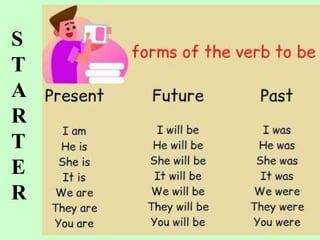
S
T
A
R
T
E
R
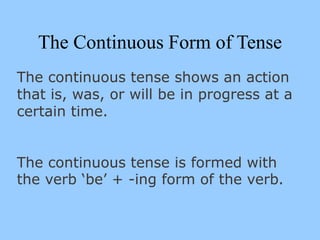
The Continuous Form of Tense
The continuous tense shows an action
that is, was, or will be in progress at a
certain time.
The continuous tense is formed with
the verb ‘be’ + -ing form of the verb.
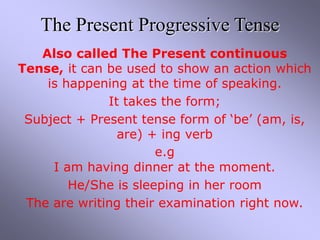
The Present Progressive Tense
Also called The Present continuous
Tense, it can be used to show an action which
is happening at the time of speaking.
It takes the form;
Subject + Present tense form of ‘be’ (am, is,
are) + ing verb
e.g
I am having dinner at the moment.
He/She is sleeping in her room
The are writing their examination right now.
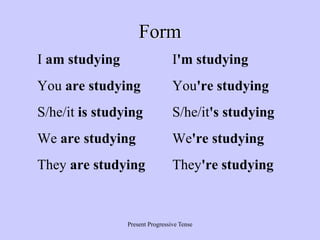
Present Progressive Tense
Form
I am studying I'm studying
You are studying You're studying
S/he/it is studying S/he/it's studying
We are studying We're studying
They are studying They're studying
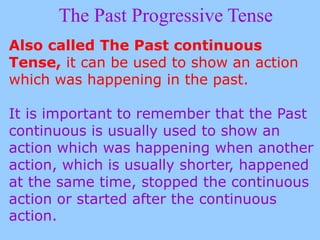
The Past Progressive Tense
Also called The Past continuous
Tense, it can be used to show an action
which was happening in the past.
It is important to remember that the Past
continuous is usually used to show an
action which was happening when another
action, which is usually shorter, happened
at the same time, stopped the continuous
action or started after the continuous
action.
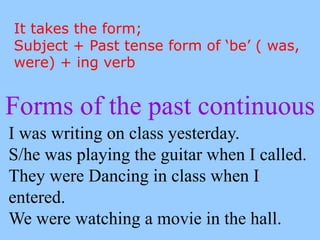
Forms of the past continuous
I was writing on class yesterday.
S/he was playing the guitar when I called.
They were Dancing in class when I
entered.
We were watching a movie in the hall.
It takes the form;
Subject + Past tense form of ‘be’ ( was,
were) + ing verb
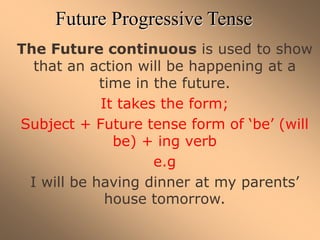
Future Progressive Tense
The Future continuous is used to show
that an action will be happening at a
time in the future.
It takes the form;
Subject + Future tense form of ‘be’ (will
be) + ing verb
e.g
I will be having dinner at my parents’
house tomorrow.
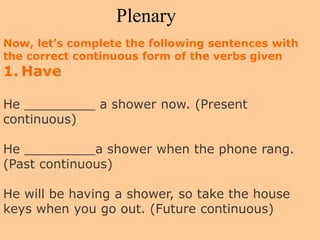
Plenary
Now, let’s complete the following sentences with
the correct continuous form of the verbs given
1. Have
He _________ a shower now. (Present
continuous)
He _________a shower when the phone rang.
(Past continuous)
He will be having a shower, so take the house
keys when you go out. (Future continuous)
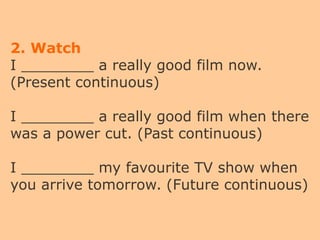
2. Watch
I ________ a really good film now.
(Present continuous)
I ________ a really good film when there
was a power cut. (Past continuous)
I ________ my favourite TV show when
you arrive tomorrow. (Future continuous)
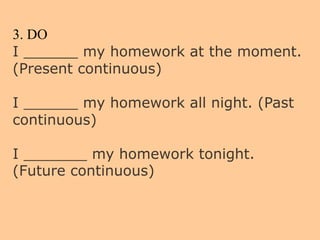
3. DO
I ______ my homework at the moment.
(Present continuous)
I ______ my homework all night. (Past
continuous)
I _______ my homework tonight.
(Future continuous)
The Simple and Continuous
Tense
AT A GLANCE
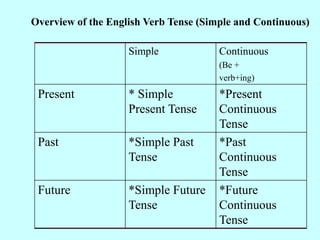
Overview of the English Verb Tense (Simple and Continuous)
Simple Continuous
(Be +
verb+ing)
Present * Simple
Present Tense
*Present
Continuous
Tense
Past *Simple Past
Tense
*Past
Continuous
Tense
Future *Simple Future
Tense
*Future
Continuous
Tense
October 2023
The End

Use of Tenses - Types, forms and examples.pptx

  • 1.
    English Language Tenses TheContinuous Form Of Tense
  • 2.
    Learning Objectives: • Makesentences to indicate actions going on at certain times in the past • Make sentences to indicate actions currently ongoing • Make sentences to show actions that will be ongoing at a specific time in future • Contrast the simple form of tense with the continuous form
  • 3.
  • 4.
    The Continuous Formof Tense The continuous tense shows an action that is, was, or will be in progress at a certain time. The continuous tense is formed with the verb ‘be’ + -ing form of the verb.
  • 5.
    The Present ProgressiveTense Also called The Present continuous Tense, it can be used to show an action which is happening at the time of speaking. It takes the form; Subject + Present tense form of ‘be’ (am, is, are) + ing verb e.g I am having dinner at the moment. He/She is sleeping in her room The are writing their examination right now.
  • 6.
    Present Progressive Tense Form Iam studying I'm studying You are studying You're studying S/he/it is studying S/he/it's studying We are studying We're studying They are studying They're studying
  • 7.
    The Past ProgressiveTense Also called The Past continuous Tense, it can be used to show an action which was happening in the past. It is important to remember that the Past continuous is usually used to show an action which was happening when another action, which is usually shorter, happened at the same time, stopped the continuous action or started after the continuous action.
  • 8.
    Forms of thepast continuous I was writing on class yesterday. S/he was playing the guitar when I called. They were Dancing in class when I entered. We were watching a movie in the hall. It takes the form; Subject + Past tense form of ‘be’ ( was, were) + ing verb
  • 9.
    Future Progressive Tense TheFuture continuous is used to show that an action will be happening at a time in the future. It takes the form; Subject + Future tense form of ‘be’ (will be) + ing verb e.g I will be having dinner at my parents’ house tomorrow.
  • 10.
    Plenary Now, let’s completethe following sentences with the correct continuous form of the verbs given 1. Have He _________ a shower now. (Present continuous) He _________a shower when the phone rang. (Past continuous) He will be having a shower, so take the house keys when you go out. (Future continuous)
  • 11.
    2. Watch I ________a really good film now. (Present continuous) I ________ a really good film when there was a power cut. (Past continuous) I ________ my favourite TV show when you arrive tomorrow. (Future continuous)
  • 12.
    3. DO I ______my homework at the moment. (Present continuous) I ______ my homework all night. (Past continuous) I _______ my homework tonight. (Future continuous)
  • 13.
    The Simple andContinuous Tense AT A GLANCE
  • 14.
    Overview of theEnglish Verb Tense (Simple and Continuous) Simple Continuous (Be + verb+ing) Present * Simple Present Tense *Present Continuous Tense Past *Simple Past Tense *Past Continuous Tense Future *Simple Future Tense *Future Continuous Tense
  • 15.