Data Communication
Instructor: Sazid Zaman Khan
Assistant Professor, CSE, IIUC
Performance: Performance can be measured in many ways,
including transit time and response time.
Transit time is the amount of time required for a message
to travel from one device to another.
Response time is the elapsed time between an inquiry and a
response. The performance of a network depends on a
number of factors, including the number of users, the type
of transmission medium, the capabilities of the connected
hardware, and the efficiency of the software.
Performance is often evaluated by two networking metrics:
throughput and delay.
Network criteria
We often need more throughput and less delay.
However, these two criteria are often contradictory.
If we try to send more data to the network, we may
increase throughput but we increase the delay because
of traffic congestion in the network.
Network criteria
The throughput is a measure of how fast we can
actually send data through a network. Although, at first
glance, bandwidth in bits per second and throughput
seem the same,
They are different. A link may have a bandwidth of B
bps, but we can only send T bps through this link with
T always less than B. In other words, the bandwidth is a
potential measurement of a link; the throughput is an
actual measurement of how fast we can send data.
Network criteria
Example 3.44(Forouzan-85p)
A network with bandwidth of 10 Mbps can pass only
an average of 12,000 frames per minute with each
frame carrying an average of 10,000 bits. What is the
throughput of this network?
Network criteria
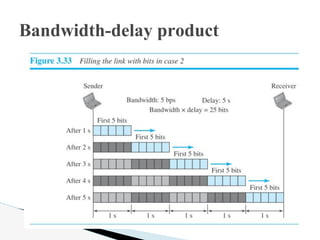
The latency or delay defines how long it takes for an
entire message to completely arrive at the destination
from the time the first bit is sent out from the source.
We can say that latency is made of four components:
propagation time, transmission time, queuing time and
processing delay.
Latency = propagation time + transmission time +
queuing time + processing delay.
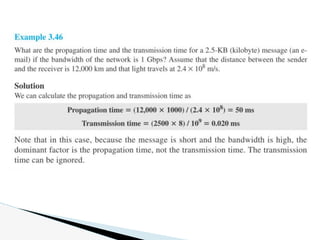
Propagation time = Distance / (Propagation Speed).
Latency or Delay
Transmission Time: In data communications we don’t
send just 1 bit, we send a message. The transmission
time of a message depends on the size of the message
and the bandwidth of the channel.
Transmission time = (Message size) / Bandwidth
Latency or Delay
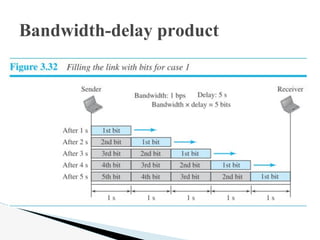
Bandwidth-delay product
Reliability: In addition to accuracy of delivery,
network reliability is measured by the frequency of
failure, the time it takes a link to recover from a failure,
and the network’s robustness in a catastrophe.
Security: Network security issues include protecting
data from unauthorized access, protecting data from
damage, and implementing policies and procedures for
recovery from breaches and data losses.
Network criteria
A point-to-point connection provides a dedicated link
between two devices. The entire capacity of the link is
reserved for transmission between those two devices.
A multipoint (also called multi-drop) connection is one
in which more than two specific devices share a single
link
Connection types
The term physical topology refers to the way in which a
network is laid out physically.
Two or more devices connect to a link; two or more
links form a topology. The topology of a network is the
geometric representation of the relationship of all the
links and linking devices (usually called nodes) to one
another.
Physical Topology
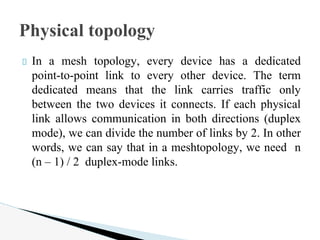
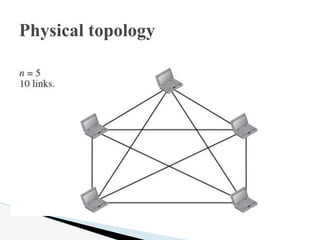
In a mesh topology, every device has a dedicated
point-to-point link to every other device. The term
dedicated means that the link carries traffic only
between the two devices it connects. If each physical
link allows communication in both directions (duplex
mode), we can divide the number of links by 2. In other
words, we can say that in a meshtopology, we need n
(n – 1) / 2 duplex-mode links.
Physical topology
Physical topology
The main disadvantages of a mesh are related to the
amount of cabling and the number of I/O ports
required.
For these reasons a mesh topology is usually
implemented in a limited fashion, for example, as a
backbone connecting the main computers of a
hybridnetwork that can include several other
topologies.
Physical topology
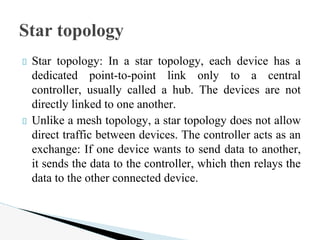
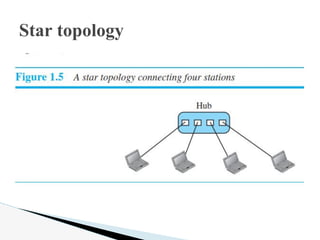
Star topology: In a star topology, each device has a
dedicated point-to-point link only to a central
controller, usually called a hub. The devices are not
directly linked to one another.
Unlike a mesh topology, a star topology does not allow
direct traffic between devices. The controller acts as an
exchange: If one device wants to send data to another,
it sends the data to the controller, which then relays the
data to the other connected device.
Star topology
Star topology
A star topology is less expensive than a mesh topology.
In a star, each device needs only one link and one I/O
port to connect it to any number of others.
This factor also makes it Far less cabling needs to be
housed easy to install and reconfigure.
One big disadvantage of a star topology is the
dependency of the whole topology on one single point,
the hub. If the hub goes down, the whole system is
dead.
Star topology
The preceding examples all describe point-to-point
connections.
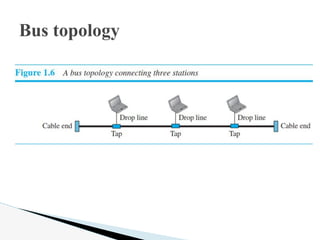
A bus topology, on the other hand, is multipoint. One
long cable acts as a backbone to link all the devices in a
network (see Figure 1.6).
Bus topology
Bus topology
Advantages of a bus topology include ease of installation.
Backbone cable can be laid along the most efficient path,
then connected to the nodes by drop lines of various lengths.
In this way, a bus uses less cabling than mesh or star
topologies
Disadvantages include difficult reconnection and fault
isolation. A bus is usually designed to be optimally efficient
at installation. It can therefore be difficult to add new
devices. Signal reflection at the taps can cause degradation
in quality.
Bus topology
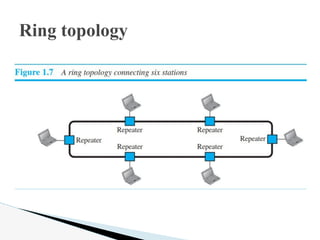
In a ring topology, each device has a dedicated
point-to-point connection with only the two devices on
either side of it. A signal is passed along the ring in one
direction, from device to device, until it reaches its
destination. Each device in the ring incorporates a
repeater. When a device receives a signal intended for
another device, its repeater regenerates the bits and
passes them along.
Ring topology
Ring topology
A ring is relatively easy to install and reconfigure. Each
device is linked to only its immediate neighbors (either
physically or logically). To add or delete a device
requires changing only two connections.
However, unidirectional traffic can be a disadvantage.
In a simple ring, a break in the ring (such as a disabled
station) can disable the entire network.
Ring topology
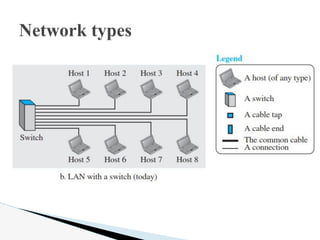
Local Area Network: A local area network (LAN) is
usually privately owned and connects some hosts in a
single office, building, or campus. Depending on the
needs of an organization, a LAN can be as simple as
two PCs and a printer in someone’s home office, or it
can extend throughout a company and include audio
and video devices.
Network types
Each host in a LAN has an identifier, an address, that
uniquely defines the host in the LAN. A packet sent by
a host to another host carries both the source host’s and
the destination host’s addresses.
Network types
Network types
A wide area network (WAN) is also an interconnection
of devices capable of communication. However, there
are some differences between a LAN and a WAN. A
LAN is normally limited in size, spanning an office, a
building, or a campus; a WAN has a wider
geographical span, spanning a town, a state, a country,
or even the world.
Network types
A LAN is normally privately owned by the
organization that uses it; a WAN is normally created
and run by communication companies and leased by an
organization that uses it. We see two distinct examples
of WANs today: point-to-point WANs and switched
WANs.
Network types
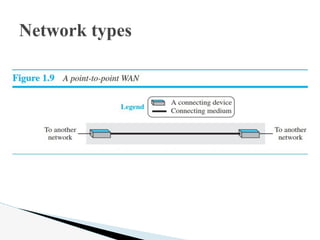
Point to point WAN: A point-to-point WAN is a
network that connects two communicating devices
through a transmission media (cable or air). We will
see examples of these WANs when we discuss how to
connect the networks to one another. Figure 1.9 shows
an example of a point-to-point WAN.
Network types
Network types
Switched A switched WAN is a network with more
than two ends. A switched WAN, as we will see
shortly, is used in the backbone of global
communication today.
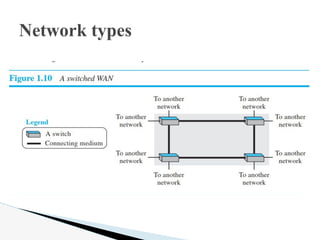
We can say that a switched WAN is a combination of
several point-to-point WANs that are connected by
switches. Figure 1.10 shows an example of a switched
WAN.
Network types
Network types
Today, it is very rare to see a LAN or a WAN in isolation; they are
connected to one another.
When two or more networks are connected, they make an internetwork,
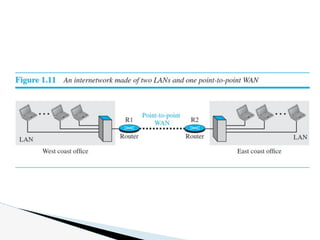
or internet. As an example, assume that an organization has two offices,
one on the east coast and the other on the west coast. Each office has a
LAN that allows all employees in the office to communicate with each
other. To make the communication between employees at different
offices possible, the management leases a point-to-point dedicated
WAN from a service provider, such as a telephone company, and
connects the two LANs.
Now the company has an internetwork, or a private internet (with
lowercase i). Communication between offices is now possible. Figure
1.11 shows this internet.
Internetwork
An Internet standard is a thoroughly tested specification
that is useful to and adhered to by those who work with
the Internet. It is a formalized regulation that must be
followed.
There is a strict procedure by which a specification
attains Internet standard status. A specification begins
as an Internet draft.
The Standard
A protocol defines certain rules and procedures for
communicating data.
In data communication and networking, a protocol defines
the rules that both the sender and receiver and all
intermediate devices need to follow to be able to
communicate effectively.
When communication is simple, we may need only one
simple protocol; when the communication is complex, we
may need to divide the task between different layers, in
which case we need a protocol at each layer, or protocol
layering.
Protocol


lec2_datacomm.pdfaaaaaaaqaaaaaaaaaaaaaaa

  • 1.
    Data Communication Instructor: SazidZaman Khan Assistant Professor, CSE, IIUC
  • 2.
    Performance: Performance canbe measured in many ways, including transit time and response time. Transit time is the amount of time required for a message to travel from one device to another. Response time is the elapsed time between an inquiry and a response. The performance of a network depends on a number of factors, including the number of users, the type of transmission medium, the capabilities of the connected hardware, and the efficiency of the software. Performance is often evaluated by two networking metrics: throughput and delay. Network criteria
  • 3.
    We often needmore throughput and less delay. However, these two criteria are often contradictory. If we try to send more data to the network, we may increase throughput but we increase the delay because of traffic congestion in the network. Network criteria
  • 4.
    The throughput isa measure of how fast we can actually send data through a network. Although, at first glance, bandwidth in bits per second and throughput seem the same, They are different. A link may have a bandwidth of B bps, but we can only send T bps through this link with T always less than B. In other words, the bandwidth is a potential measurement of a link; the throughput is an actual measurement of how fast we can send data. Network criteria
  • 5.
    Example 3.44(Forouzan-85p) A networkwith bandwidth of 10 Mbps can pass only an average of 12,000 frames per minute with each frame carrying an average of 10,000 bits. What is the throughput of this network? Network criteria
  • 6.
    The latency ordelay defines how long it takes for an entire message to completely arrive at the destination from the time the first bit is sent out from the source. We can say that latency is made of four components: propagation time, transmission time, queuing time and processing delay. Latency = propagation time + transmission time + queuing time + processing delay. Propagation time = Distance / (Propagation Speed). Latency or Delay
  • 7.
    Transmission Time: Indata communications we don’t send just 1 bit, we send a message. The transmission time of a message depends on the size of the message and the bandwidth of the channel. Transmission time = (Message size) / Bandwidth Latency or Delay
  • 9.
  • 10.
  • 11.
    Reliability: In additionto accuracy of delivery, network reliability is measured by the frequency of failure, the time it takes a link to recover from a failure, and the network’s robustness in a catastrophe. Security: Network security issues include protecting data from unauthorized access, protecting data from damage, and implementing policies and procedures for recovery from breaches and data losses. Network criteria
  • 12.
    A point-to-point connectionprovides a dedicated link between two devices. The entire capacity of the link is reserved for transmission between those two devices. A multipoint (also called multi-drop) connection is one in which more than two specific devices share a single link Connection types
  • 13.
    The term physicaltopology refers to the way in which a network is laid out physically. Two or more devices connect to a link; two or more links form a topology. The topology of a network is the geometric representation of the relationship of all the links and linking devices (usually called nodes) to one another. Physical Topology
  • 14.
    In a meshtopology, every device has a dedicated point-to-point link to every other device. The term dedicated means that the link carries traffic only between the two devices it connects. If each physical link allows communication in both directions (duplex mode), we can divide the number of links by 2. In other words, we can say that in a meshtopology, we need n (n – 1) / 2 duplex-mode links. Physical topology
  • 15.
  • 16.
    The main disadvantagesof a mesh are related to the amount of cabling and the number of I/O ports required. For these reasons a mesh topology is usually implemented in a limited fashion, for example, as a backbone connecting the main computers of a hybridnetwork that can include several other topologies. Physical topology
  • 17.
    Star topology: Ina star topology, each device has a dedicated point-to-point link only to a central controller, usually called a hub. The devices are not directly linked to one another. Unlike a mesh topology, a star topology does not allow direct traffic between devices. The controller acts as an exchange: If one device wants to send data to another, it sends the data to the controller, which then relays the data to the other connected device. Star topology
  • 18.
  • 19.
    A star topologyis less expensive than a mesh topology. In a star, each device needs only one link and one I/O port to connect it to any number of others. This factor also makes it Far less cabling needs to be housed easy to install and reconfigure. One big disadvantage of a star topology is the dependency of the whole topology on one single point, the hub. If the hub goes down, the whole system is dead. Star topology
  • 20.
    The preceding examplesall describe point-to-point connections. A bus topology, on the other hand, is multipoint. One long cable acts as a backbone to link all the devices in a network (see Figure 1.6). Bus topology
  • 21.
  • 22.
    Advantages of abus topology include ease of installation. Backbone cable can be laid along the most efficient path, then connected to the nodes by drop lines of various lengths. In this way, a bus uses less cabling than mesh or star topologies Disadvantages include difficult reconnection and fault isolation. A bus is usually designed to be optimally efficient at installation. It can therefore be difficult to add new devices. Signal reflection at the taps can cause degradation in quality. Bus topology
  • 23.
    In a ringtopology, each device has a dedicated point-to-point connection with only the two devices on either side of it. A signal is passed along the ring in one direction, from device to device, until it reaches its destination. Each device in the ring incorporates a repeater. When a device receives a signal intended for another device, its repeater regenerates the bits and passes them along. Ring topology
  • 24.
  • 25.
    A ring isrelatively easy to install and reconfigure. Each device is linked to only its immediate neighbors (either physically or logically). To add or delete a device requires changing only two connections. However, unidirectional traffic can be a disadvantage. In a simple ring, a break in the ring (such as a disabled station) can disable the entire network. Ring topology
  • 26.
    Local Area Network:A local area network (LAN) is usually privately owned and connects some hosts in a single office, building, or campus. Depending on the needs of an organization, a LAN can be as simple as two PCs and a printer in someone’s home office, or it can extend throughout a company and include audio and video devices. Network types
  • 27.
    Each host ina LAN has an identifier, an address, that uniquely defines the host in the LAN. A packet sent by a host to another host carries both the source host’s and the destination host’s addresses. Network types
  • 28.
  • 29.
    A wide areanetwork (WAN) is also an interconnection of devices capable of communication. However, there are some differences between a LAN and a WAN. A LAN is normally limited in size, spanning an office, a building, or a campus; a WAN has a wider geographical span, spanning a town, a state, a country, or even the world. Network types
  • 30.
    A LAN isnormally privately owned by the organization that uses it; a WAN is normally created and run by communication companies and leased by an organization that uses it. We see two distinct examples of WANs today: point-to-point WANs and switched WANs. Network types
  • 31.
    Point to pointWAN: A point-to-point WAN is a network that connects two communicating devices through a transmission media (cable or air). We will see examples of these WANs when we discuss how to connect the networks to one another. Figure 1.9 shows an example of a point-to-point WAN. Network types
  • 32.
  • 33.
    Switched A switchedWAN is a network with more than two ends. A switched WAN, as we will see shortly, is used in the backbone of global communication today. We can say that a switched WAN is a combination of several point-to-point WANs that are connected by switches. Figure 1.10 shows an example of a switched WAN. Network types
  • 34.
  • 35.
    Today, it isvery rare to see a LAN or a WAN in isolation; they are connected to one another. When two or more networks are connected, they make an internetwork, or internet. As an example, assume that an organization has two offices, one on the east coast and the other on the west coast. Each office has a LAN that allows all employees in the office to communicate with each other. To make the communication between employees at different offices possible, the management leases a point-to-point dedicated WAN from a service provider, such as a telephone company, and connects the two LANs. Now the company has an internetwork, or a private internet (with lowercase i). Communication between offices is now possible. Figure 1.11 shows this internet. Internetwork
  • 37.
    An Internet standardis a thoroughly tested specification that is useful to and adhered to by those who work with the Internet. It is a formalized regulation that must be followed. There is a strict procedure by which a specification attains Internet standard status. A specification begins as an Internet draft. The Standard
  • 38.
    A protocol definescertain rules and procedures for communicating data. In data communication and networking, a protocol defines the rules that both the sender and receiver and all intermediate devices need to follow to be able to communicate effectively. When communication is simple, we may need only one simple protocol; when the communication is complex, we may need to divide the task between different layers, in which case we need a protocol at each layer, or protocol layering. Protocol