1
Dr. VK
UN
Video Links:
https://www.youtube.com/c/unitednations/videos
https://www.youtube.com/playlist?list=PLwoDFQJEq_0YqXfi2s0x3sW0jaNPoEpvs
UN & India: https://www.youtube.com/watch?v=yFkbQiAHFJI
What are United Nations sanctions? https://www.youtube.com/watch?v=wgS-aNJVEK4
International Court order to Myanmar on Rohingya :
https://www.youtube.com/watch?v=mvIwRieqRw4
https://www.youtube.com/watch?v=XvKpnRPosek
http://webtv.un.org/
https://www.youtube.com/cha
nnel/UC5O114-PQNYkurlTg6hekZw
UN History
• League of Nations
– After 1st World War
– Weaknesses
• No clear division of responsibility between League Council & League Assembly
• Recommendations not binding
• No mechanisms to coordinate military or economic sanctions against
miscreant states
• Key states such as US not member
• Economic & Social questions to League Assembly
24 October 1945, 51 countries established UN
Sources
• UN Timeline :
• https://www.bbc.co.uk/radio4/news/un/timeline.shtml#fifty
• http://www.unis.unvienna.org/pdf/2015/UN70_Timeline_ENG.pdf
• https://www.aljazeera.com/focus/humanrightsun/2008/12/200812482540920317.html#:~:text=Oct
ober%2024%2C%201945%3A%20The%20UN,of%20Israel%20despite%20Arab%20anger.
• research.un.org/en/UN75
1942: The name "United Nations" is coined by US President Franklin D Roosevelt
1945: Representatives of 50 countries met in San Francisco at the United Nations Conference on International
Organization to draw up the United Nations Charter.
24 October 1945: The United Nations officially comes into existence-United Nations Day
1946: The now famous United Nations Security Council meets for the first time
1946: The UN General Assembly adopts its first resolution. Its main focus is on peaceful uses of atomic energy and
the elimination of atomic and other weapons of mass destruction
1948: The first UN observer mission is established in Palestine - UN Truce Supervision Organisation or UNTSO
1948: The Universal Declaration of Human Rights is proclaimed.
1949: India and Pakistan sign the UN-sponsored Karachi Agreement establishing a cease-fire line which the the
United Nations Military Observer Group in India and Pakistan (UNMOGIP) is to monitor.
1950: The UN Security Council passed a resolution which called on all members to help repel the invasion of South
Korea by the North. The motion was only passed because the Soviet delegate, who would have certainly vetoed it,
was absent
1951: After a humiliating retreat, caused by the intervention of Chinese forces, the UN forces are forced to retreat
from the sections of North Korea
1956: The First Emergency Special Session of the General Assembly meets on the Suez Canal crisis and establishes
the first UN Emergency Force or UNEF.
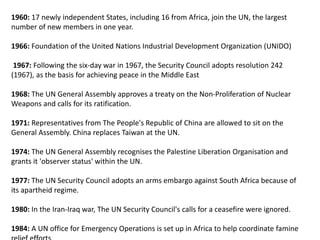
1960: 17 newly independent States, including 16 from Africa, join the UN, the largest
number of new members in one year.
1966: Foundation of the United Nations Industrial Development Organization (UNIDO)
1967: Following the six-day war in 1967, the Security Council adopts resolution 242
(1967), as the basis for achieving peace in the Middle East
1968: The UN General Assembly approves a treaty on the Non-Proliferation of Nuclear
Weapons and calls for its ratification.
1971: Representatives from The People's Republic of China are allowed to sit on the
General Assembly. China replaces Taiwan at the UN.
1974: The UN General Assembly recognises the Palestine Liberation Organisation and
grants it 'observer status' within the UN.
1977: The UN Security Council adopts an arms embargo against South Africa because of
its apartheid regime.
1980: In the Iran-Iraq war, The UN Security Council's calls for a ceasefire were ignored.
1984: A UN office for Emergency Operations is set up in Africa to help coordinate famine
1987: In the Iran-Iraq war, the Security Council passed Resolution 958, again urging an
end to the fighting. The Resolution was formally accepted in 1988 but it was not until
1990 that the two countries finally agreed to settle their differences
1987: Lobbying by the UN leads to the signing of the Treaty on the Protection of the
Ozone Layer - known as the Montreal Protocol.
August 2 1990: Iraq invades Kuwait, starting the Gulf War. In November, the UN Security
Council authorises the use of "all means necessary" to eject Iraq from Kuwait. After the
UN deadline for Iraqi withdrawal on 15 February 1991 is not met, the allied attack begins
on 17 February with operation Desert Storm.
1992: The UN Conference on Environment and Development, the "Earth Summit", is held
in Rio de Janeiro and attended by leaders from over 100 countries, the largest such
gathering in history. A treaty on climate change is adopted.
1992: A UN peacekeeping force is sent to restore order and safeguard relief supplies in
the war-torn state of Somalia. However, three years later, the UN peacekeepers leave the
country having failed in their mission. The UN declared it too dangerous to keep the
operations up and closed their office in the capital Mogadishu in 1995.
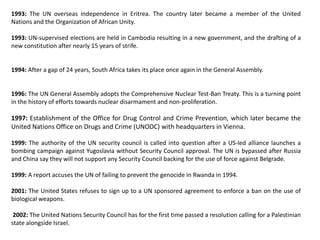
1993: The UN overseas independence in Eritrea. The country later became a member of the United
Nations and the Organization of African Unity.
1993: UN-supervised elections are held in Cambodia resulting in a new government, and the drafting of a
new constitution after nearly 15 years of strife.
1994: After a gap of 24 years, South Africa takes its place once again in the General Assembly.
1996: The UN General Assembly adopts the Comprehensive Nuclear Test-Ban Treaty. This is a turning point
in the history of efforts towards nuclear disarmament and non-proliferation.
1997: Establishment of the Office for Drug Control and Crime Prevention, which later became the
United Nations Office on Drugs and Crime (UNODC) with headquarters in Vienna.
1999: The authority of the UN security council is called into question after a US-led alliance launches a
bombing campaign against Yugoslavia without Security Council approval. The UN is bypassed after Russia
and China say they will not support any Security Council backing for the use of force against Belgrade.
1999: A report accuses the UN of failing to prevent the genocide in Rwanda in 1994.
2001: The United States refuses to sign up to a UN sponsored agreement to enforce a ban on the use of
biological weapons.
2002: The United Nations Security Council has for the first time passed a resolution calling for a Palestinian
state alongside Israel.
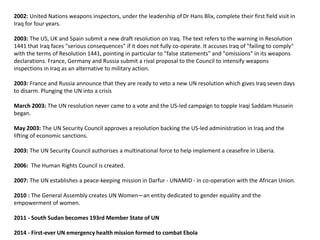
2002: United Nations weapons inspectors, under the leadership of Dr Hans Blix, complete their first field visit in
Iraq for four years.
2003: The US, UK and Spain submit a new draft resolution on Iraq. The text refers to the warning in Resolution
1441 that Iraq faces "serious consequences" if it does not fully co-operate. It accuses Iraq of "failing to comply"
with the terms of Resolution 1441, pointing in particular to "false statements" and "omissions" in its weapons
declarations. France, Germany and Russia submit a rival proposal to the Council to intensify weapons
inspections in Iraq as an alternative to military action.
2003: France and Russia announce that they are ready to veto a new UN resolution which gives Iraq seven days
to disarm. Plunging the UN into a crisis
March 2003: The UN resolution never came to a vote and the US-led campaign to topple Iraqi Saddam Hussein
began.
May 2003: The UN Security Council approves a resolution backing the US-led administration in Iraq and the
lifting of economic sanctions.
2003: The UN Security Council authorises a multinational force to help implement a ceasefire in Liberia.
2006: The Human Rights Council is created.
2007: The UN establishes a peace-keeping mission in Darfur - UNAMID - in co-operation with the African Union.
2010 : The General Assembly creates UN Women—an entity dedicated to gender equality and the
empowerment of women.
2011 - South Sudan becomes 193rd Member State of UN
2014 - First-ever UN emergency health mission formed to combat Ebola
2015: Member States set to agree on a series of Sustainable Development Goals
in September and, in December, a deal to tackle climate change.
2016 - António Guterres appointed Secretary-General- This was the first time
that the selection process was made public.
2018 - The Global Compact for Safe, Orderly and Regular Migration is the first
intergovernmental agreement prepared under the auspices of the United
Nations
2 April 2020, the General Assembly adopted the first resolution related to the
coronavirus disease 2019 (COVID-19) in which it recognized the unprecedented
effects of this pandemic
23 February 2023
The UN General Assembly on Thursday called for ending the war in Ukraine and
demanded Russia’s immediate withdrawal from the country, in line with the
UN Charter. The results were 141 Member States in favour and seven against -
Belarus, the Democratic People's Republic of Korea, Eritrea, Mali, Nicaragua,
Russia and Syria. Among the 32 abstentions were China, India and Pakistan.
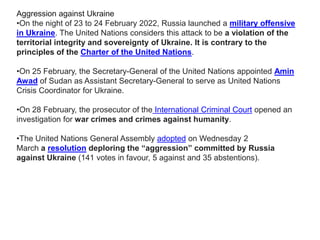
Aggression against Ukraine
•On the night of 23 to 24 February 2022, Russia launched a military offensive
in Ukraine. The United Nations considers this attack to be a violation of the
territorial integrity and sovereignty of Ukraine. It is contrary to the
principles of the Charter of the United Nations.
•On 25 February, the Secretary-General of the United Nations appointed Amin
Awad of Sudan as Assistant Secretary-General to serve as United Nations
Crisis Coordinator for Ukraine.
•On 28 February, the prosecutor of the International Criminal Court opened an
investigation for war crimes and crimes against humanity.
•The United Nations General Assembly adopted on Wednesday 2
March a resolution deploring the “aggression” committed by Russia
against Ukraine (141 votes in favour, 5 against and 35 abstentions).
The UN and the war in Ukraine: key
information
The UN Human Rights Council adopted a resolution on 4 March calling for the
“swift and verifiable” withdrawal of Russian troops and Russian-backed armed
groups from the entire territory of Ukraine.
•The UN Human Rights Council decided on 5 March to urgently establish
an independent international commission of inquiry following Russia’s
aggression against Ukraine.
•On 16 March the International Court of Justice ordered Russia to immediately
suspend its military operations in Ukraine.
•On Thursday 24 March, the UN General Assembly overwhelmingly
demanded civilian protection and humanitarian access in Ukraine, while also
criticizing Russia for creating a “dire” humanitarian situation (140 votes in
favour, 5 against and 38 abstentions).
•On 7 April, the UN General Assembly adopted a resolution calling for Russia to be
suspended from the Human Rights Council. The resolution received a two-thirds majority
of those voting, minus abstentions, in the 193-member Assembly, with 93 nations voting
in favour and 24 against.
https://unric.org/en/the-un-and-the-war-in-ukraine-key-
information/#:~:text=Aggression%20against%20Ukraine,Ch
arter%20of%20the%20United%20Nations.
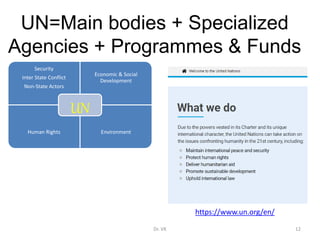
UN=Main bodies + Specialized
Agencies + Programmes & Funds
Security
Inter State Conflict
Non-State Actors
Economic & Social
Development
Human Rights Environment
UN
12
Dr. VK
https://www.un.org/en/
13
Dr. VK
Dr. VK 14
https://www.un.org/en/
15
Dr. VK
UN – Principal Organ-Security Council
– Recognition of great power prerogatives
(Calls UN Reform)
– To maintain international peace & security
• Chapter VI – Mediation etc
• Sending Peacekeeping
• Chapter VII – Economic sanctions, Arms
Embargo, Collective military action
– Unlike the League (LoN), Decisions are
binding
– Majority =9: P5+ Any 4/10 non-permanent
– Recommend to General Assembly
appointment of Sec. General & New Members
Dr. VK 16
UN – Principal Organ-General Assembly
• Universalist principles-One vote for all member
states
• Decisions/resolutions have status of
recommendations…represents world
opinion…so moral force
• Simple majority for many matters
• Two –thirds majority required in issues like
– International Peace & Security
– New Members Admission
– Budget (Decision binding )
17
Dr. VK
ADMINISTRATIVE WORK DIRECTED BY UNGA,
UNSC AND OTHER ORGANS
LED BY SEC. GENERAL
LACKS POLITICAL POWER EXCEPT
ART 99 OF UN CHARTER RELATED TO
BREAKDOWN OF INTERNATIONAL PEACE &
SECURITY… SEC. GENERAL INVITE ATTENTION
OF UNSC…EMPOWERS SEC. GENERAL TO
INVOLVE IN THREATS TO PEACE, ECO&SCO
PROBLEMS & HUMANITARIAN CRISES
UN – PRINCIPAL ORGAN- The
Secretariat
18
Dr. VK
UN – Principal Organ- The
Economic and Social Council
(ECOSOC)
• ECOSOC under the overall authority of
UNGA
• ECOSOC subsidiary bodies – functional
commissions
• Maintaining link between Civil Society &
UN
• Along with UNGA & Secretariat oversee
UN specialised agencies (more
autonomy), UN programmes and funds
(less autonomy) 19
Dr. VK
UN – Principal Organs
Trusteeship Council
By 1994, all Trust Territories had attained self-
government or independence and the
Trusteeship Council suspended operation
International Court of Justice
• 15 judges jointly elected by UNGA & UNSC
• Decides disputes between countries
• States participation voluntary…but if
participates…obligated to comply with
decisions
• Provides also advisory opinions to UN organs
20
Dr. VK
The International Criminal Court
(ICC)
• ​Investigates and, where
warranted, tries individuals
charged with the gravest
crimes of concern to the
international community:
genocide, war crimes, crimes
against humanity and the
crime of aggression.
• 123 countries are States
Parties to the Rome Statute of
the International Criminal
Court.
PERMANENT COURT OF ARBITRATION
• Established in 1899 to
facilitate arbitration and other
forms of dispute resolution
between states.
• The PCA provides
administrative support in
international arbitrations
involving various combinations
of states, state entities,
international organizations
and private parties.

UN.pptx

  • 1.
    1 Dr. VK UN Video Links: https://www.youtube.com/c/unitednations/videos https://www.youtube.com/playlist?list=PLwoDFQJEq_0YqXfi2s0x3sW0jaNPoEpvs UN& India: https://www.youtube.com/watch?v=yFkbQiAHFJI What are United Nations sanctions? https://www.youtube.com/watch?v=wgS-aNJVEK4 International Court order to Myanmar on Rohingya : https://www.youtube.com/watch?v=mvIwRieqRw4 https://www.youtube.com/watch?v=XvKpnRPosek http://webtv.un.org/ https://www.youtube.com/cha nnel/UC5O114-PQNYkurlTg6hekZw
  • 2.
    UN History • Leagueof Nations – After 1st World War – Weaknesses • No clear division of responsibility between League Council & League Assembly • Recommendations not binding • No mechanisms to coordinate military or economic sanctions against miscreant states • Key states such as US not member • Economic & Social questions to League Assembly 24 October 1945, 51 countries established UN
  • 3.
    Sources • UN Timeline: • https://www.bbc.co.uk/radio4/news/un/timeline.shtml#fifty • http://www.unis.unvienna.org/pdf/2015/UN70_Timeline_ENG.pdf • https://www.aljazeera.com/focus/humanrightsun/2008/12/200812482540920317.html#:~:text=Oct ober%2024%2C%201945%3A%20The%20UN,of%20Israel%20despite%20Arab%20anger. • research.un.org/en/UN75
  • 4.
    1942: The name"United Nations" is coined by US President Franklin D Roosevelt 1945: Representatives of 50 countries met in San Francisco at the United Nations Conference on International Organization to draw up the United Nations Charter. 24 October 1945: The United Nations officially comes into existence-United Nations Day 1946: The now famous United Nations Security Council meets for the first time 1946: The UN General Assembly adopts its first resolution. Its main focus is on peaceful uses of atomic energy and the elimination of atomic and other weapons of mass destruction 1948: The first UN observer mission is established in Palestine - UN Truce Supervision Organisation or UNTSO 1948: The Universal Declaration of Human Rights is proclaimed. 1949: India and Pakistan sign the UN-sponsored Karachi Agreement establishing a cease-fire line which the the United Nations Military Observer Group in India and Pakistan (UNMOGIP) is to monitor. 1950: The UN Security Council passed a resolution which called on all members to help repel the invasion of South Korea by the North. The motion was only passed because the Soviet delegate, who would have certainly vetoed it, was absent 1951: After a humiliating retreat, caused by the intervention of Chinese forces, the UN forces are forced to retreat from the sections of North Korea 1956: The First Emergency Special Session of the General Assembly meets on the Suez Canal crisis and establishes the first UN Emergency Force or UNEF.
  • 5.
    1960: 17 newlyindependent States, including 16 from Africa, join the UN, the largest number of new members in one year. 1966: Foundation of the United Nations Industrial Development Organization (UNIDO) 1967: Following the six-day war in 1967, the Security Council adopts resolution 242 (1967), as the basis for achieving peace in the Middle East 1968: The UN General Assembly approves a treaty on the Non-Proliferation of Nuclear Weapons and calls for its ratification. 1971: Representatives from The People's Republic of China are allowed to sit on the General Assembly. China replaces Taiwan at the UN. 1974: The UN General Assembly recognises the Palestine Liberation Organisation and grants it 'observer status' within the UN. 1977: The UN Security Council adopts an arms embargo against South Africa because of its apartheid regime. 1980: In the Iran-Iraq war, The UN Security Council's calls for a ceasefire were ignored. 1984: A UN office for Emergency Operations is set up in Africa to help coordinate famine
  • 6.
    1987: In theIran-Iraq war, the Security Council passed Resolution 958, again urging an end to the fighting. The Resolution was formally accepted in 1988 but it was not until 1990 that the two countries finally agreed to settle their differences 1987: Lobbying by the UN leads to the signing of the Treaty on the Protection of the Ozone Layer - known as the Montreal Protocol. August 2 1990: Iraq invades Kuwait, starting the Gulf War. In November, the UN Security Council authorises the use of "all means necessary" to eject Iraq from Kuwait. After the UN deadline for Iraqi withdrawal on 15 February 1991 is not met, the allied attack begins on 17 February with operation Desert Storm. 1992: The UN Conference on Environment and Development, the "Earth Summit", is held in Rio de Janeiro and attended by leaders from over 100 countries, the largest such gathering in history. A treaty on climate change is adopted. 1992: A UN peacekeeping force is sent to restore order and safeguard relief supplies in the war-torn state of Somalia. However, three years later, the UN peacekeepers leave the country having failed in their mission. The UN declared it too dangerous to keep the operations up and closed their office in the capital Mogadishu in 1995.
  • 7.
    1993: The UNoverseas independence in Eritrea. The country later became a member of the United Nations and the Organization of African Unity. 1993: UN-supervised elections are held in Cambodia resulting in a new government, and the drafting of a new constitution after nearly 15 years of strife. 1994: After a gap of 24 years, South Africa takes its place once again in the General Assembly. 1996: The UN General Assembly adopts the Comprehensive Nuclear Test-Ban Treaty. This is a turning point in the history of efforts towards nuclear disarmament and non-proliferation. 1997: Establishment of the Office for Drug Control and Crime Prevention, which later became the United Nations Office on Drugs and Crime (UNODC) with headquarters in Vienna. 1999: The authority of the UN security council is called into question after a US-led alliance launches a bombing campaign against Yugoslavia without Security Council approval. The UN is bypassed after Russia and China say they will not support any Security Council backing for the use of force against Belgrade. 1999: A report accuses the UN of failing to prevent the genocide in Rwanda in 1994. 2001: The United States refuses to sign up to a UN sponsored agreement to enforce a ban on the use of biological weapons. 2002: The United Nations Security Council has for the first time passed a resolution calling for a Palestinian state alongside Israel.
  • 8.
    2002: United Nationsweapons inspectors, under the leadership of Dr Hans Blix, complete their first field visit in Iraq for four years. 2003: The US, UK and Spain submit a new draft resolution on Iraq. The text refers to the warning in Resolution 1441 that Iraq faces "serious consequences" if it does not fully co-operate. It accuses Iraq of "failing to comply" with the terms of Resolution 1441, pointing in particular to "false statements" and "omissions" in its weapons declarations. France, Germany and Russia submit a rival proposal to the Council to intensify weapons inspections in Iraq as an alternative to military action. 2003: France and Russia announce that they are ready to veto a new UN resolution which gives Iraq seven days to disarm. Plunging the UN into a crisis March 2003: The UN resolution never came to a vote and the US-led campaign to topple Iraqi Saddam Hussein began. May 2003: The UN Security Council approves a resolution backing the US-led administration in Iraq and the lifting of economic sanctions. 2003: The UN Security Council authorises a multinational force to help implement a ceasefire in Liberia. 2006: The Human Rights Council is created. 2007: The UN establishes a peace-keeping mission in Darfur - UNAMID - in co-operation with the African Union. 2010 : The General Assembly creates UN Women—an entity dedicated to gender equality and the empowerment of women. 2011 - South Sudan becomes 193rd Member State of UN 2014 - First-ever UN emergency health mission formed to combat Ebola
  • 9.
    2015: Member Statesset to agree on a series of Sustainable Development Goals in September and, in December, a deal to tackle climate change. 2016 - António Guterres appointed Secretary-General- This was the first time that the selection process was made public. 2018 - The Global Compact for Safe, Orderly and Regular Migration is the first intergovernmental agreement prepared under the auspices of the United Nations 2 April 2020, the General Assembly adopted the first resolution related to the coronavirus disease 2019 (COVID-19) in which it recognized the unprecedented effects of this pandemic 23 February 2023 The UN General Assembly on Thursday called for ending the war in Ukraine and demanded Russia’s immediate withdrawal from the country, in line with the UN Charter. The results were 141 Member States in favour and seven against - Belarus, the Democratic People's Republic of Korea, Eritrea, Mali, Nicaragua, Russia and Syria. Among the 32 abstentions were China, India and Pakistan.
  • 10.
    Aggression against Ukraine •Onthe night of 23 to 24 February 2022, Russia launched a military offensive in Ukraine. The United Nations considers this attack to be a violation of the territorial integrity and sovereignty of Ukraine. It is contrary to the principles of the Charter of the United Nations. •On 25 February, the Secretary-General of the United Nations appointed Amin Awad of Sudan as Assistant Secretary-General to serve as United Nations Crisis Coordinator for Ukraine. •On 28 February, the prosecutor of the International Criminal Court opened an investigation for war crimes and crimes against humanity. •The United Nations General Assembly adopted on Wednesday 2 March a resolution deploring the “aggression” committed by Russia against Ukraine (141 votes in favour, 5 against and 35 abstentions).
  • 11.
    The UN andthe war in Ukraine: key information The UN Human Rights Council adopted a resolution on 4 March calling for the “swift and verifiable” withdrawal of Russian troops and Russian-backed armed groups from the entire territory of Ukraine. •The UN Human Rights Council decided on 5 March to urgently establish an independent international commission of inquiry following Russia’s aggression against Ukraine. •On 16 March the International Court of Justice ordered Russia to immediately suspend its military operations in Ukraine. •On Thursday 24 March, the UN General Assembly overwhelmingly demanded civilian protection and humanitarian access in Ukraine, while also criticizing Russia for creating a “dire” humanitarian situation (140 votes in favour, 5 against and 38 abstentions). •On 7 April, the UN General Assembly adopted a resolution calling for Russia to be suspended from the Human Rights Council. The resolution received a two-thirds majority of those voting, minus abstentions, in the 193-member Assembly, with 93 nations voting in favour and 24 against. https://unric.org/en/the-un-and-the-war-in-ukraine-key- information/#:~:text=Aggression%20against%20Ukraine,Ch arter%20of%20the%20United%20Nations.
  • 12.
    UN=Main bodies +Specialized Agencies + Programmes & Funds Security Inter State Conflict Non-State Actors Economic & Social Development Human Rights Environment UN 12 Dr. VK https://www.un.org/en/
  • 13.
  • 14.
  • 15.
  • 16.
    UN – PrincipalOrgan-Security Council – Recognition of great power prerogatives (Calls UN Reform) – To maintain international peace & security • Chapter VI – Mediation etc • Sending Peacekeeping • Chapter VII – Economic sanctions, Arms Embargo, Collective military action – Unlike the League (LoN), Decisions are binding – Majority =9: P5+ Any 4/10 non-permanent – Recommend to General Assembly appointment of Sec. General & New Members Dr. VK 16
  • 17.
    UN – PrincipalOrgan-General Assembly • Universalist principles-One vote for all member states • Decisions/resolutions have status of recommendations…represents world opinion…so moral force • Simple majority for many matters • Two –thirds majority required in issues like – International Peace & Security – New Members Admission – Budget (Decision binding ) 17 Dr. VK
  • 18.
    ADMINISTRATIVE WORK DIRECTEDBY UNGA, UNSC AND OTHER ORGANS LED BY SEC. GENERAL LACKS POLITICAL POWER EXCEPT ART 99 OF UN CHARTER RELATED TO BREAKDOWN OF INTERNATIONAL PEACE & SECURITY… SEC. GENERAL INVITE ATTENTION OF UNSC…EMPOWERS SEC. GENERAL TO INVOLVE IN THREATS TO PEACE, ECO&SCO PROBLEMS & HUMANITARIAN CRISES UN – PRINCIPAL ORGAN- The Secretariat 18 Dr. VK
  • 19.
    UN – PrincipalOrgan- The Economic and Social Council (ECOSOC) • ECOSOC under the overall authority of UNGA • ECOSOC subsidiary bodies – functional commissions • Maintaining link between Civil Society & UN • Along with UNGA & Secretariat oversee UN specialised agencies (more autonomy), UN programmes and funds (less autonomy) 19 Dr. VK
  • 20.
    UN – PrincipalOrgans Trusteeship Council By 1994, all Trust Territories had attained self- government or independence and the Trusteeship Council suspended operation International Court of Justice • 15 judges jointly elected by UNGA & UNSC • Decides disputes between countries • States participation voluntary…but if participates…obligated to comply with decisions • Provides also advisory opinions to UN organs 20 Dr. VK
  • 21.
    The International CriminalCourt (ICC) • ​Investigates and, where warranted, tries individuals charged with the gravest crimes of concern to the international community: genocide, war crimes, crimes against humanity and the crime of aggression. • 123 countries are States Parties to the Rome Statute of the International Criminal Court. PERMANENT COURT OF ARBITRATION • Established in 1899 to facilitate arbitration and other forms of dispute resolution between states. • The PCA provides administrative support in international arbitrations involving various combinations of states, state entities, international organizations and private parties.