OOAD
Class
Diagram
What is a Class Diagram?
• A Class Diagram is a diagram describing
the structure of a system
• shows the system's
• classes
• Attributes
• Operations (or methods),
• Relationships among the classes.
What is a Class Diagram?
• A class diagram depicts classes and their
interrelationships
• Used for describing structure and behavior in the
use cases
• Provide a conceptual model of the system in
terms of entities and their relationships
• Used for requirement capture, end-user
interaction
• Detailed class diagrams are used for developers
Essential Elements of a UML Class Diagram
• Class
• Attributes
• Operations
• Relationships
– Associations
– Generalization
– Realization
– Dependency
• Constraint Rules and Notes
Class
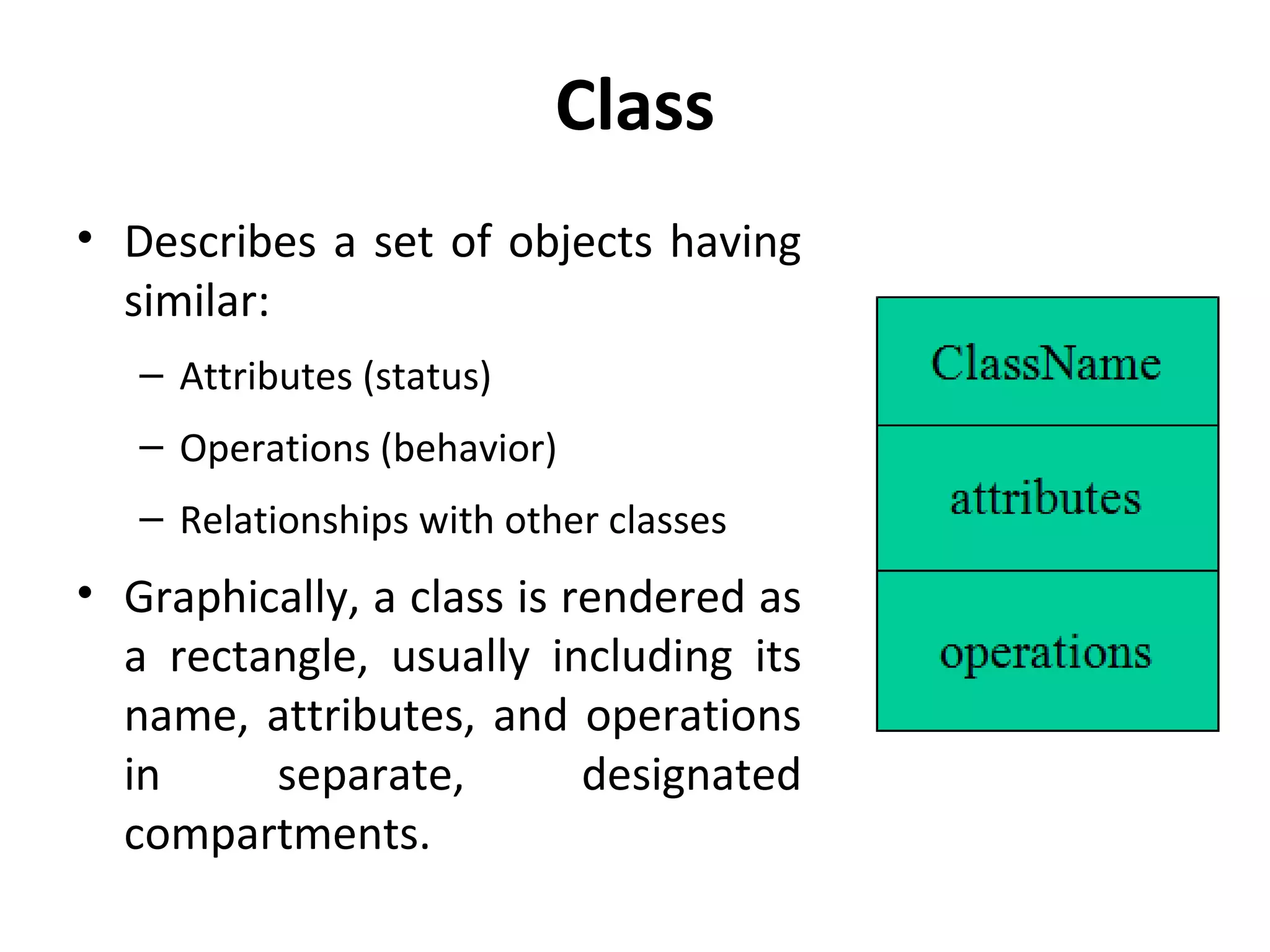
• Describes a set of objects having
similar:
– Attributes (status)
– Operations (behavior)
– Relationships with other classes
• Graphically, a class is rendered as
a rectangle, usually including its
name, attributes, and operations
in separate, designated
compartments.
Class Names
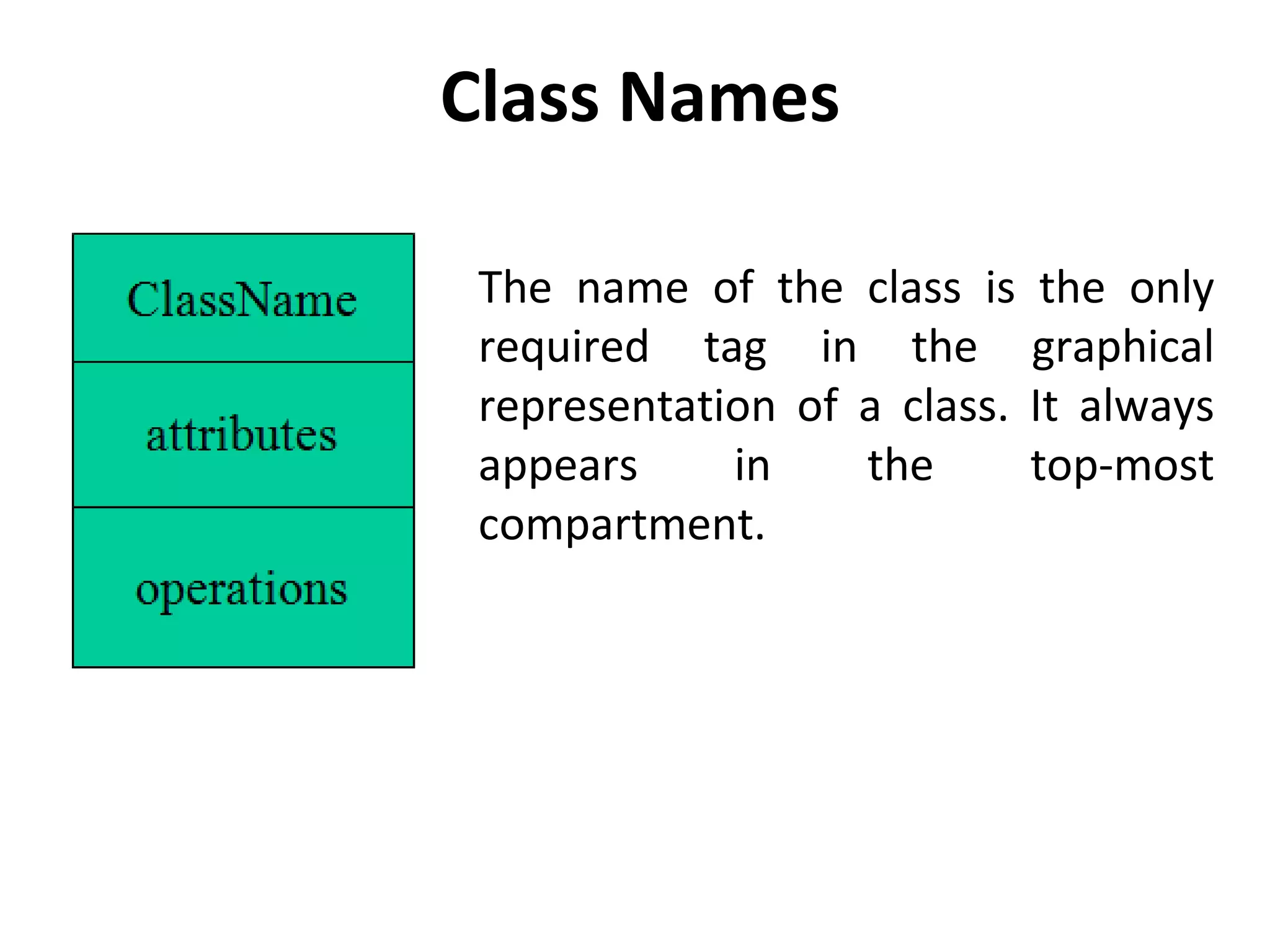
The name of the class is the only
required tag in the graphical
representation of a class. It always
appears in the top-most
compartment.
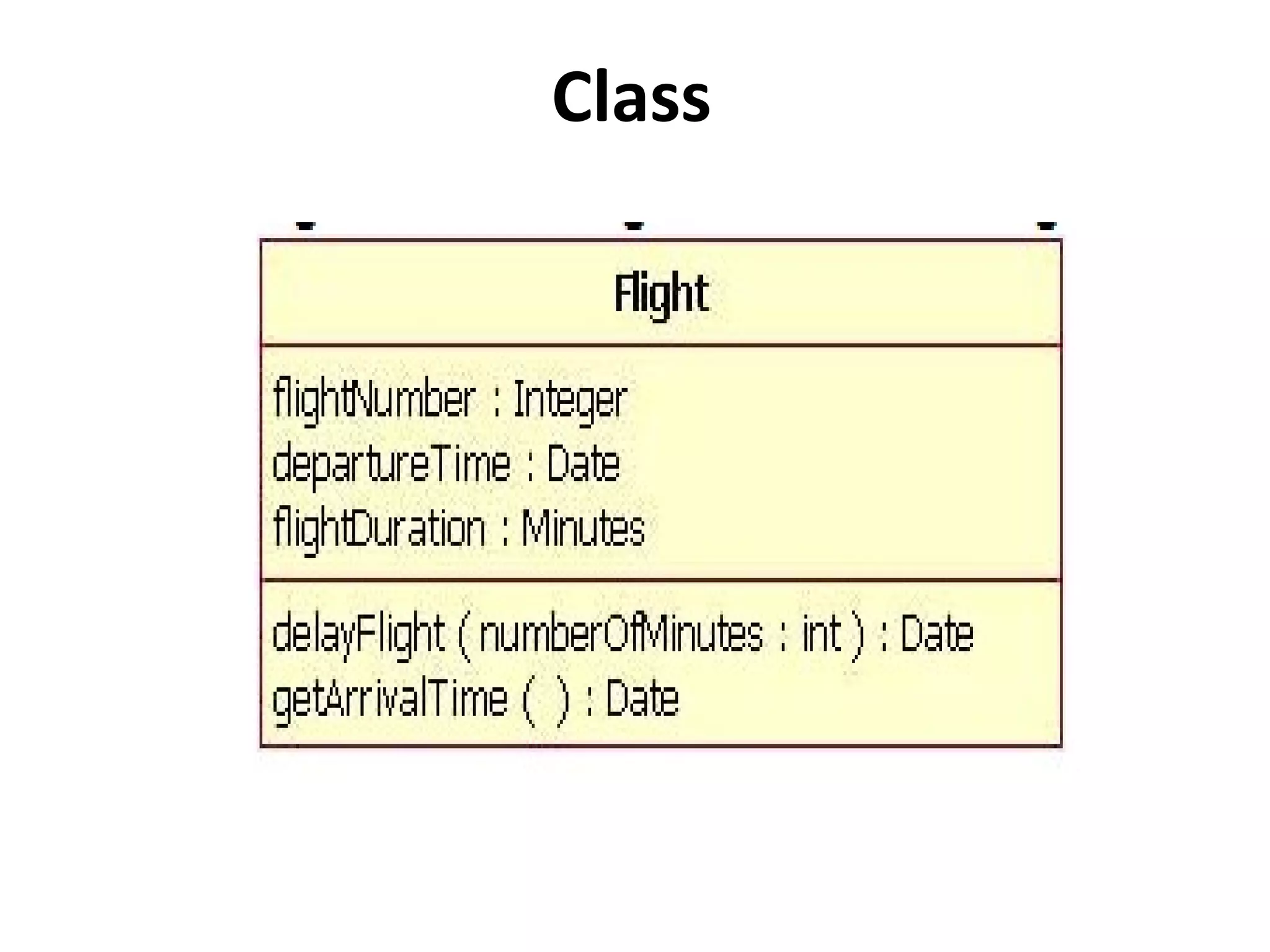
Class
Class Attributes and Operations
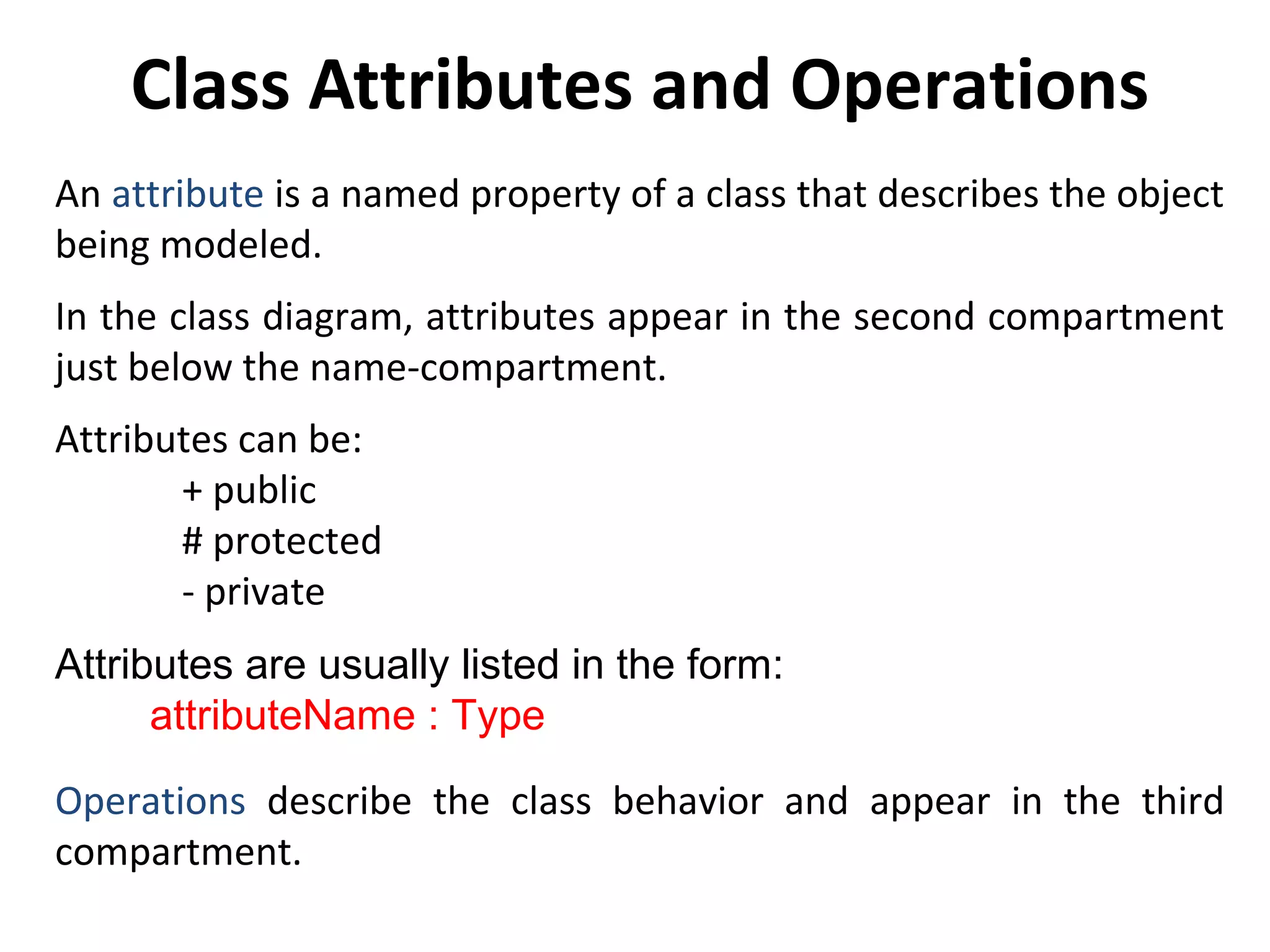
An attribute is a named property of a class that describes the object
being modeled.
In the class diagram, attributes appear in the second compartment
just below the name-compartment.
Attributes can be:
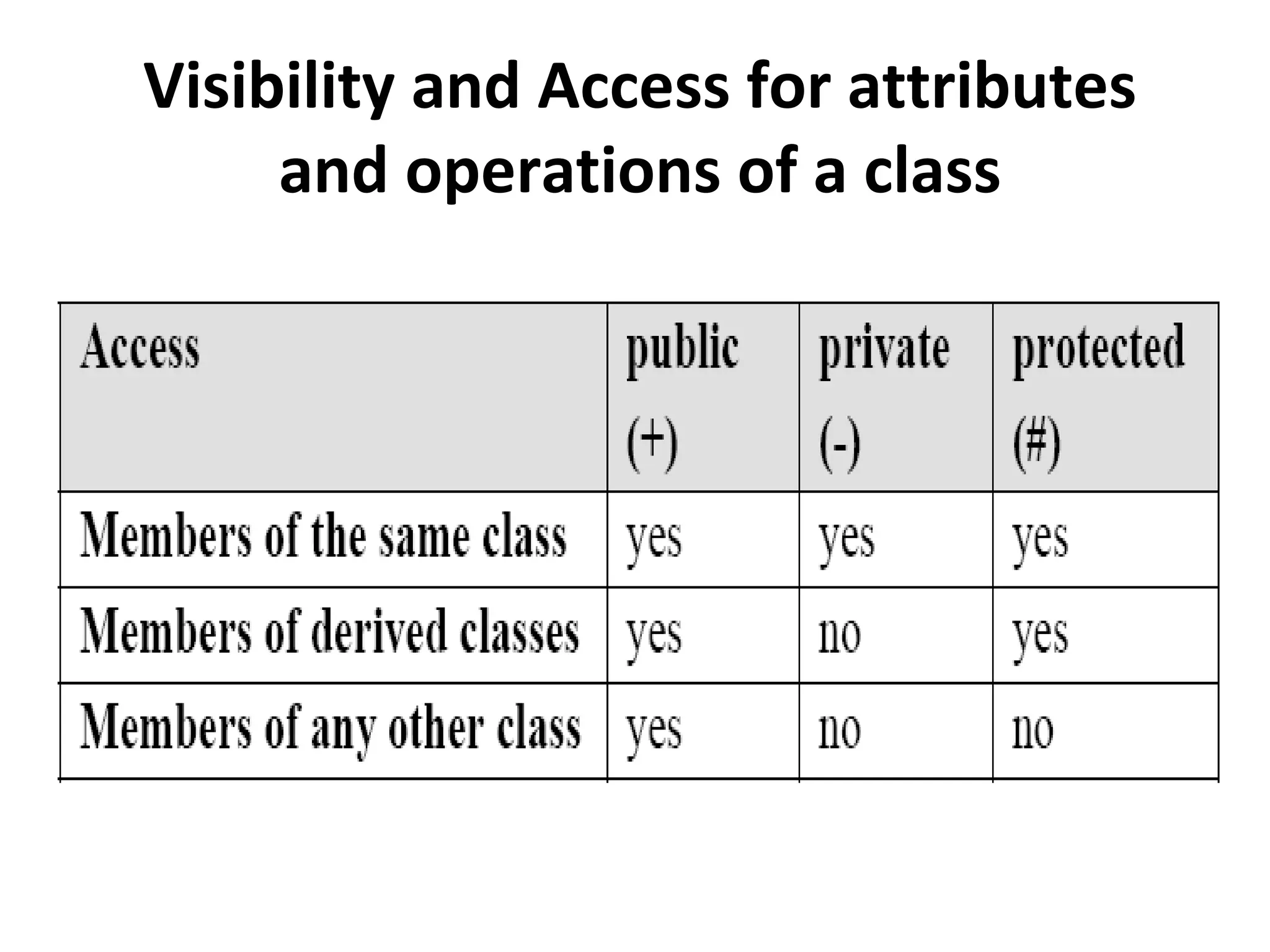
+ public
# protected
- private
Attributes are usually listed in the form:
attributeName : Type
Operations describe the class behavior and appear in the third
compartment.
Visibility and Access for attributes
and operations of a class
Class
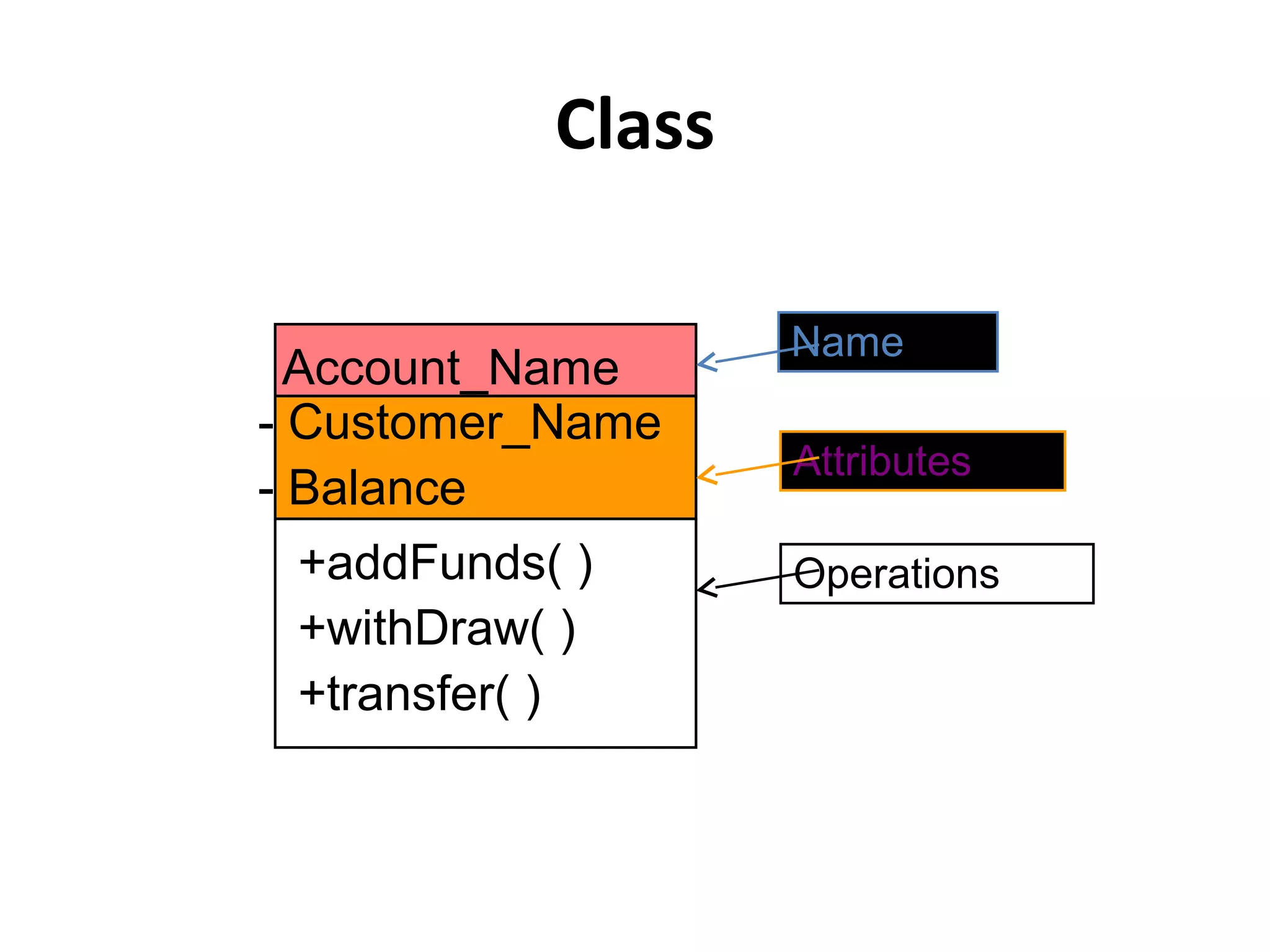
Account_Name
- Customer_Name
- Balance
+addFunds( )
+withDraw( )
+transfer( )
Name
Attributes
Operations
Class Attributes and Operations
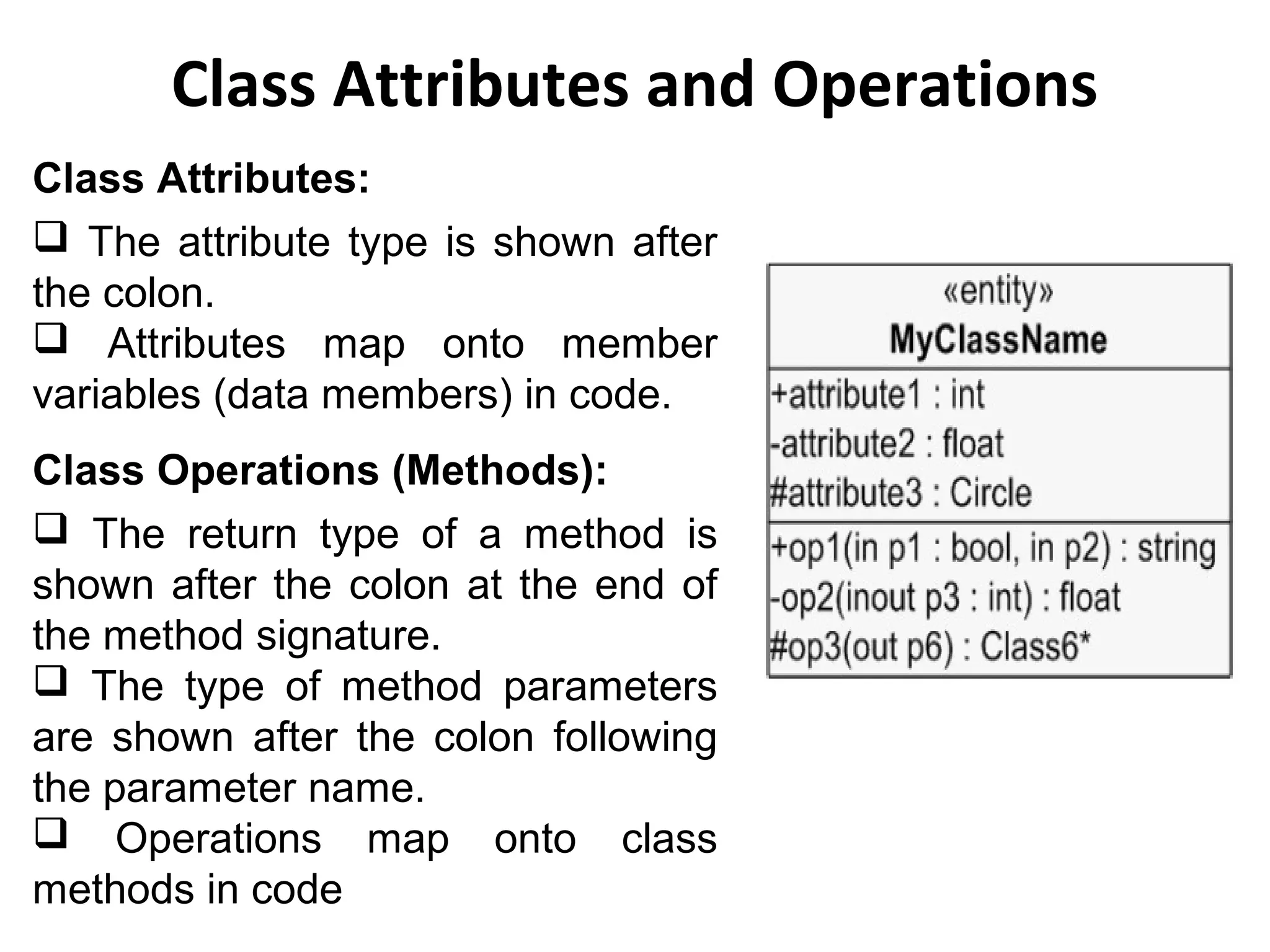
Class Attributes:
 The attribute type is shown after
the colon.
 Attributes map onto member
variables (data members) in code.
Class Operations (Methods):
 The return type of a method is
shown after the colon at the end of
the method signature.
 The type of method parameters
are shown after the colon following
the parameter name.
 Operations map onto class
methods in code
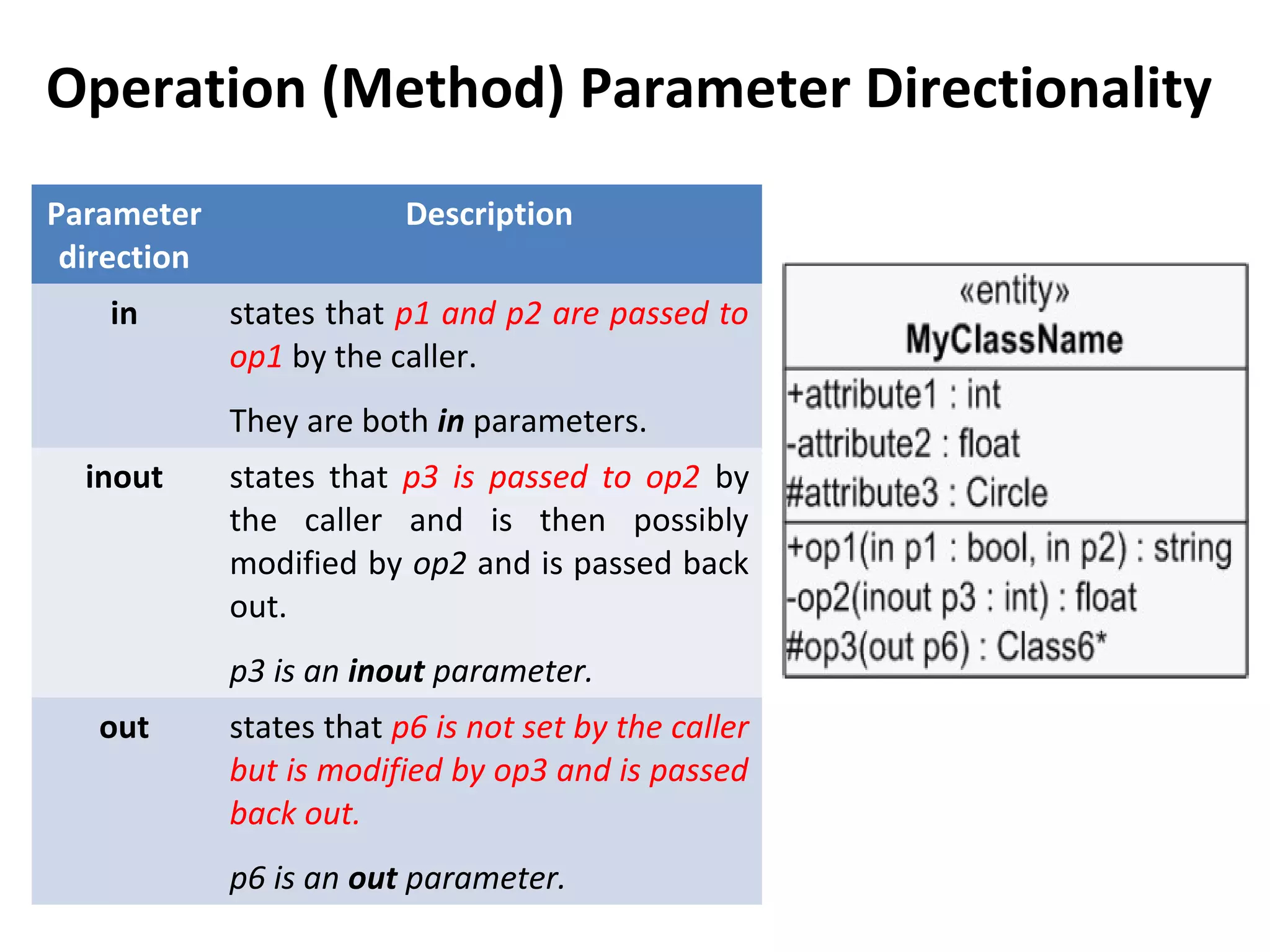
Operation (Method) Parameter Directionality
Parameter
direction
Description
in states that p1 and p2 are passed to
op1 by the caller.
They are both in parameters.
inout states that p3 is passed to op2 by
the caller and is then possibly
modified by op2 and is passed back
out.
p3 is an inout parameter.
out states that p6 is not set by the caller
but is modified by op3 and is passed
back out.
p6 is an out parameter.
Association
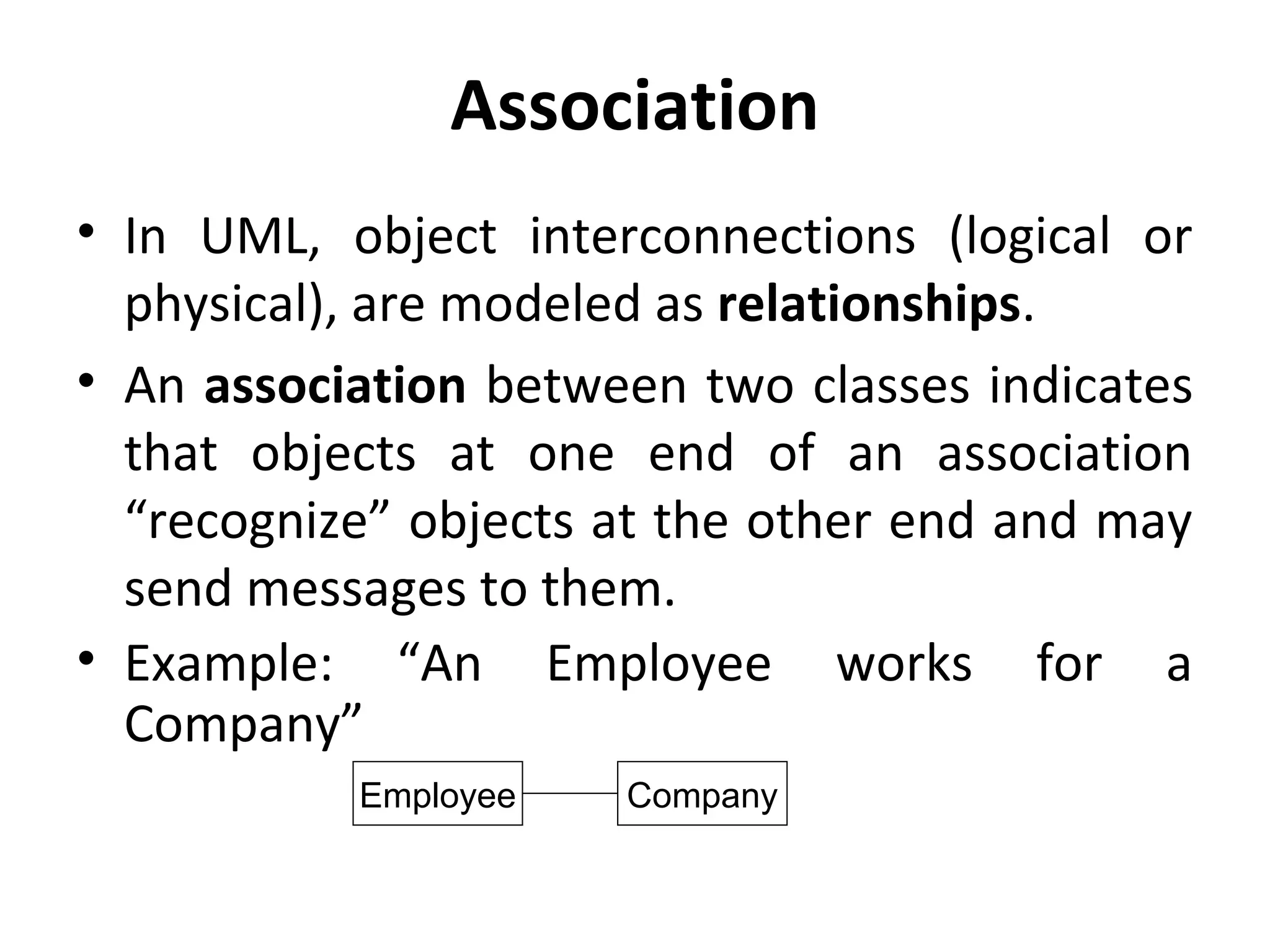
• In UML, object interconnections (logical or
physical), are modeled as relationships.
• An association between two classes indicates
that objects at one end of an association
“recognize” objects at the other end and may
send messages to them.
• Example: “An Employee works for a
Company”
Employee Company
Association Relationships
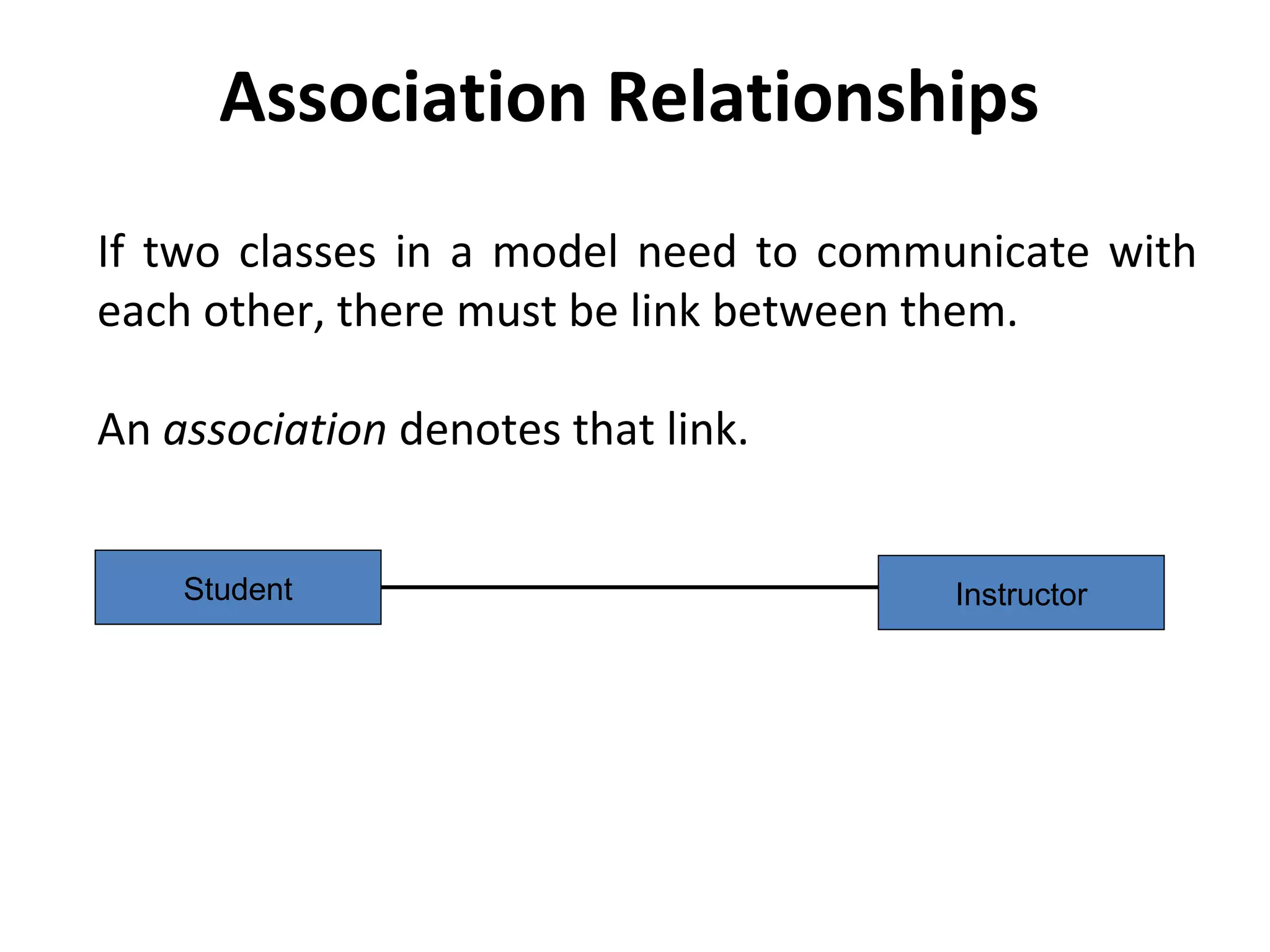
If two classes in a model need to communicate with
each other, there must be link between them.
An association denotes that link.
InstructorStudent
Association Relationships
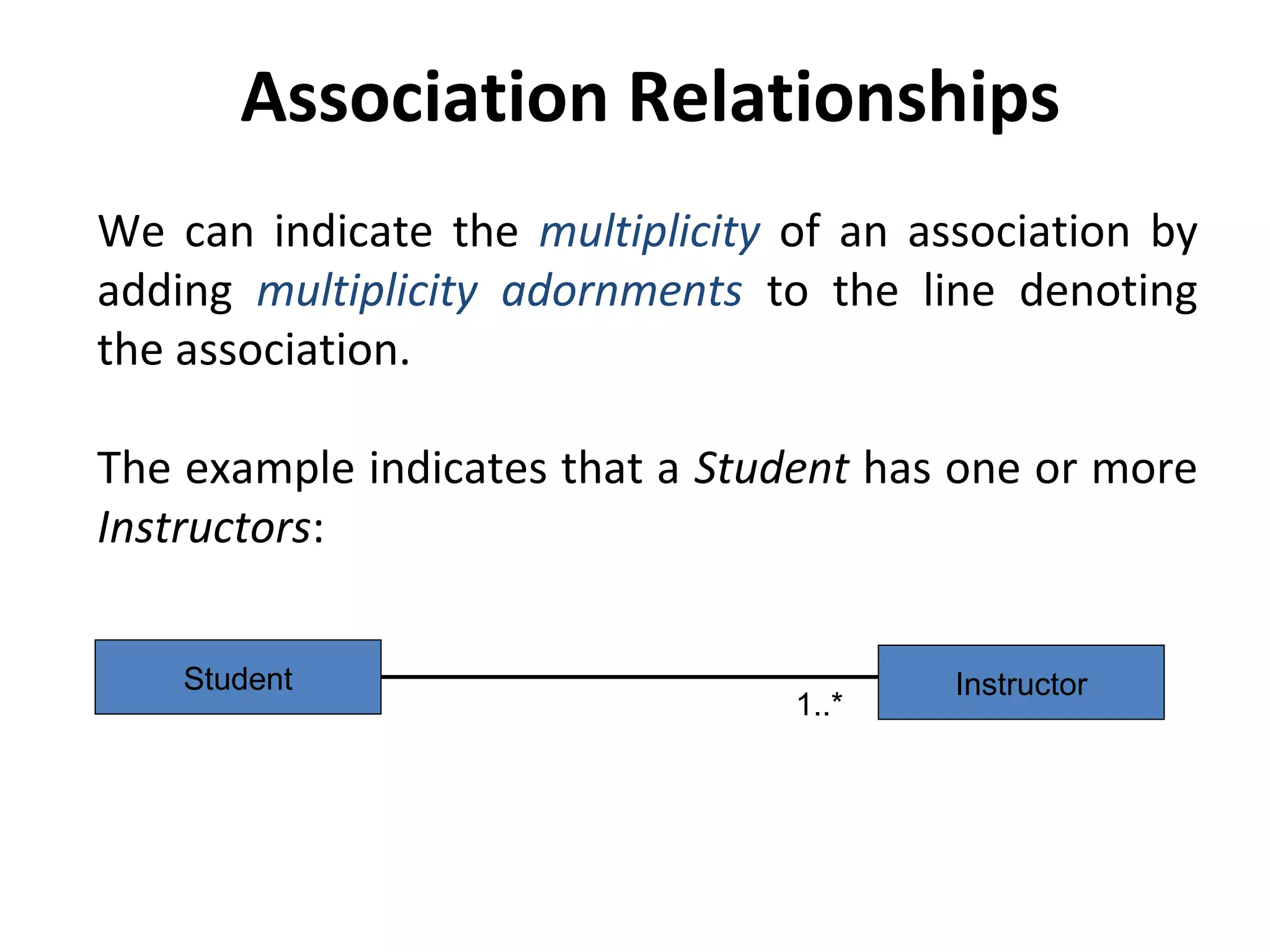
We can indicate the multiplicity of an association by
adding multiplicity adornments to the line denoting
the association.
The example indicates that a Student has one or more
Instructors:
InstructorStudent
1..*
Association Relationships
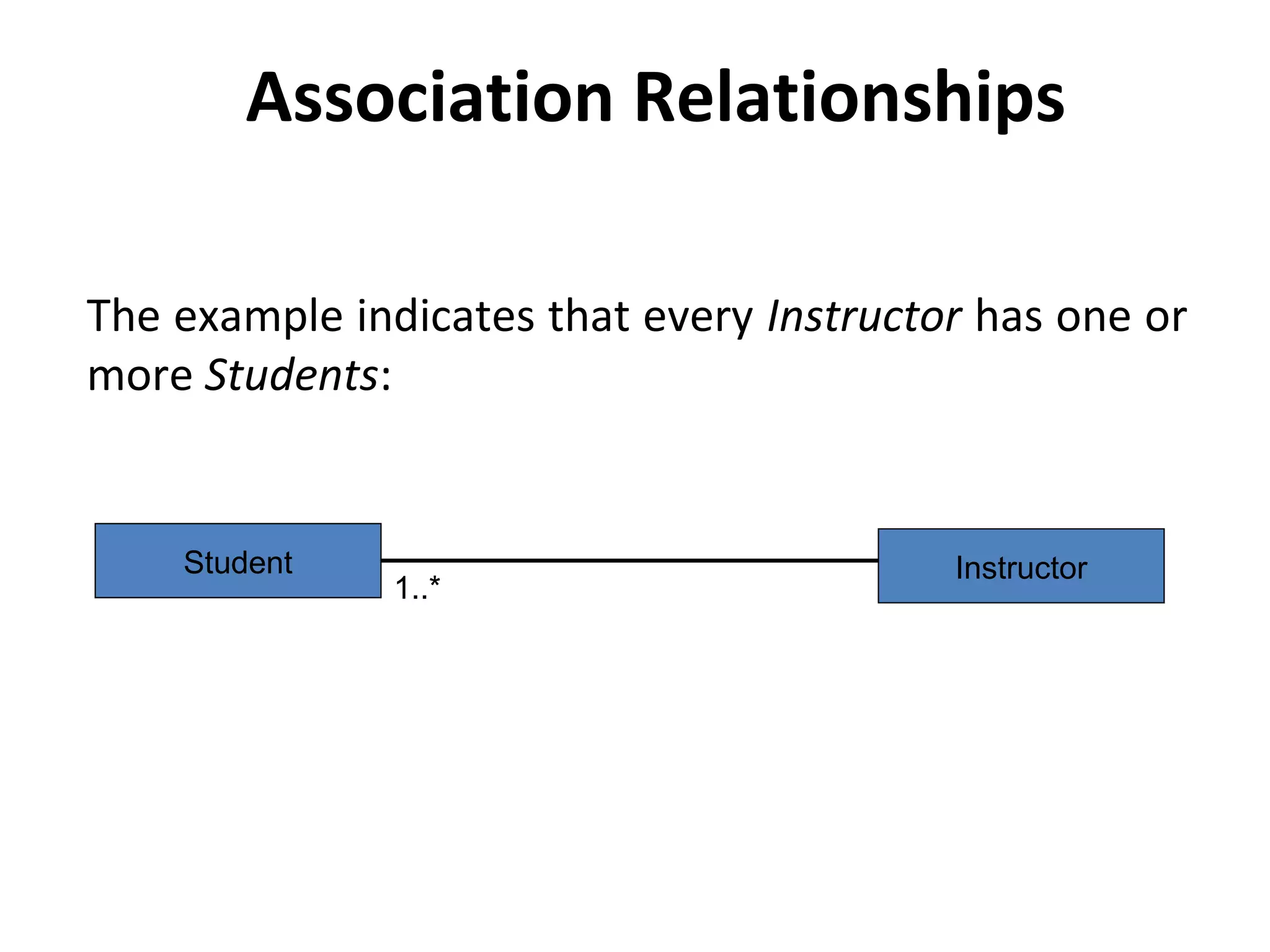
The example indicates that every Instructor has one or
more Students:
InstructorStudent
1..*
Association Relationships
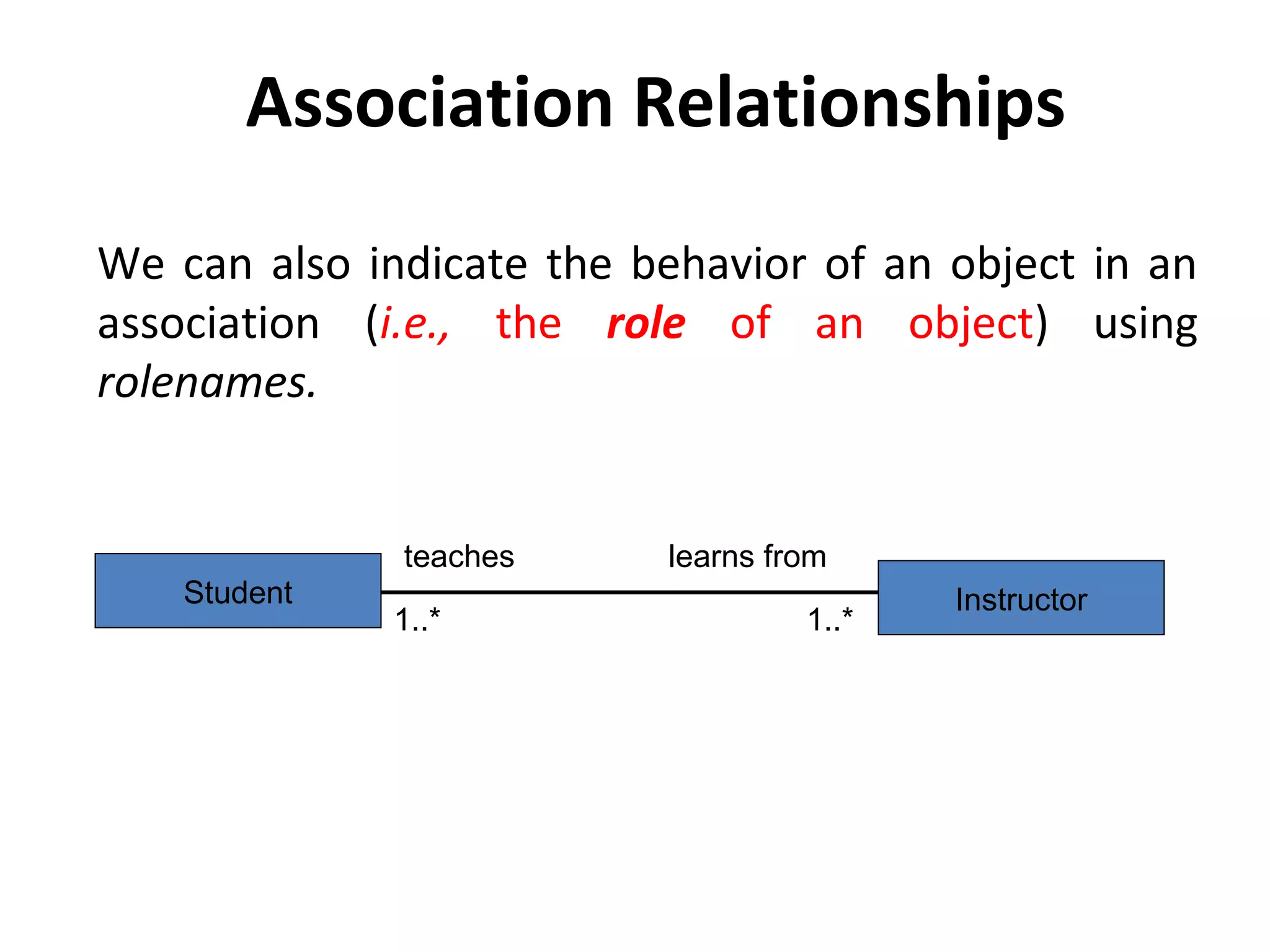
We can also indicate the behavior of an object in an
association (i.e., the role of an object) using
rolenames.
InstructorStudent
1..*1..*
learns fromteaches
Association Relationships
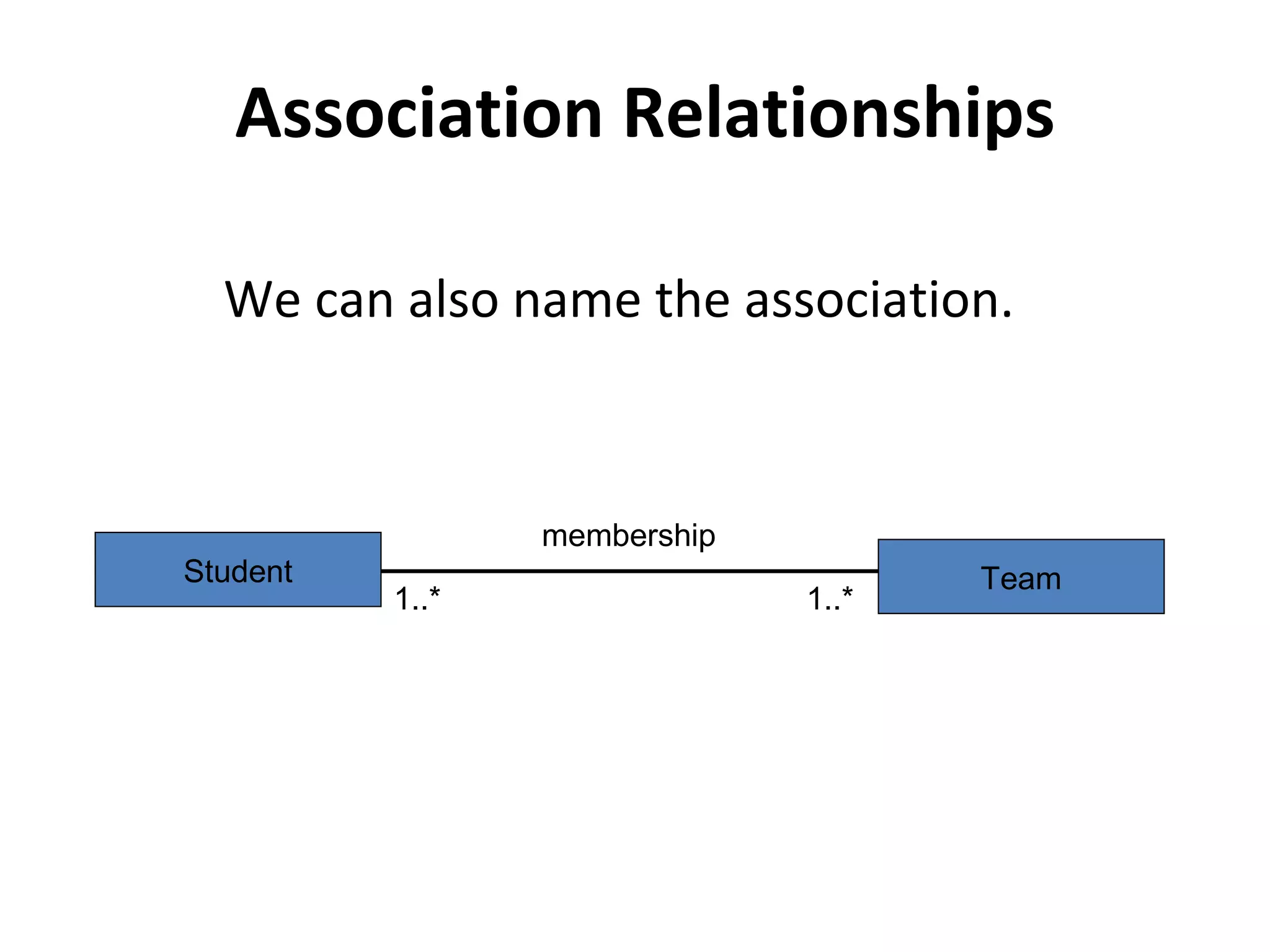
We can also name the association.
TeamStudent
membership
1..* 1..*
Association Relationships
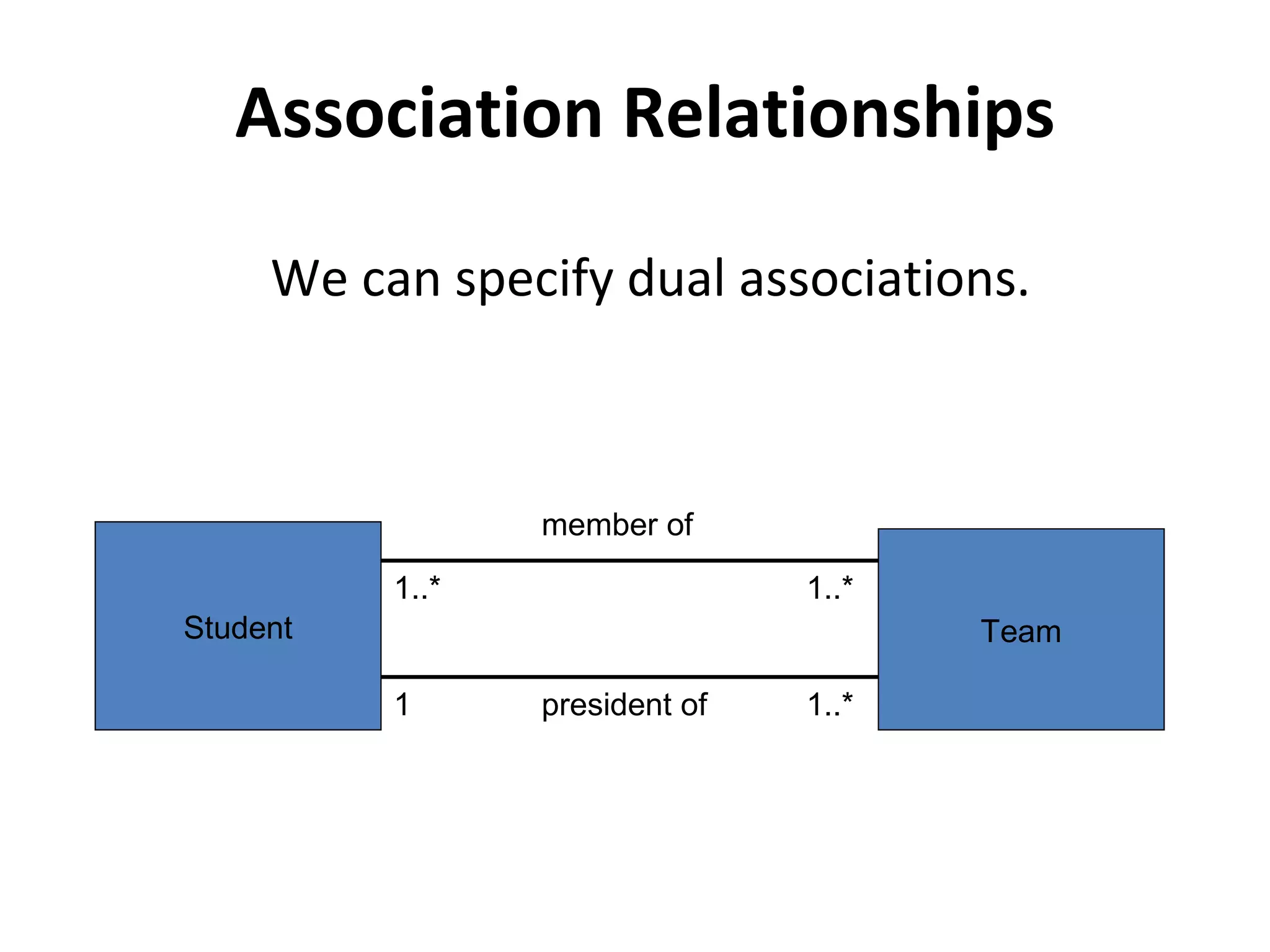
We can specify dual associations.
TeamStudent
member of
1..*
president of1 1..*
1..*
Associations
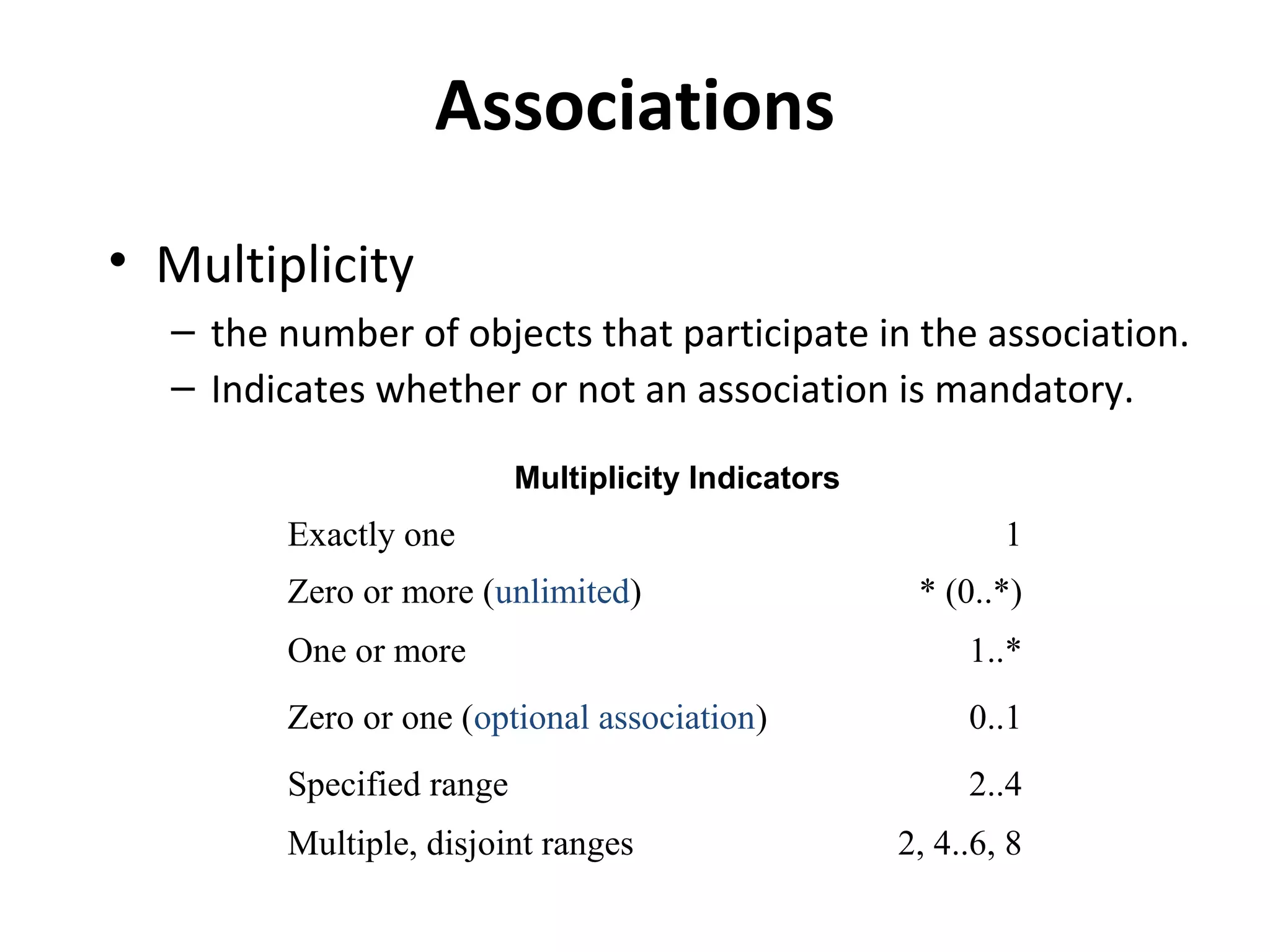
• Multiplicity
– the number of objects that participate in the association.
– Indicates whether or not an association is mandatory.
Exactly one 1
Zero or more (unlimited) * (0..*)
One or more 1..*
Zero or one (optional association) 0..1
Specified range 2..4
Multiple, disjoint ranges 2, 4..6, 8
Multiplicity Indicators
Association Relationships
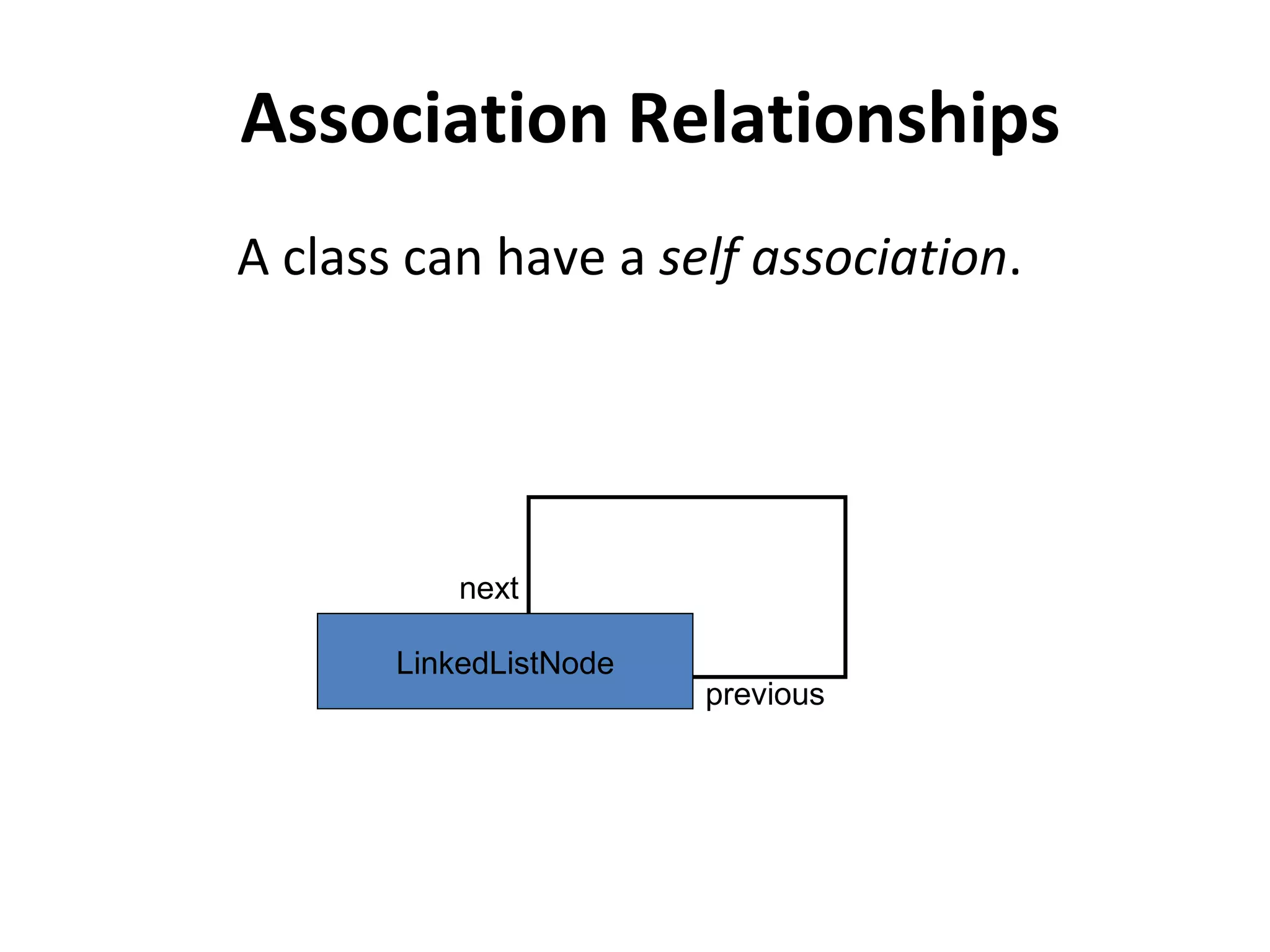
A class can have a self association.
LinkedListNode
next
previous
Aggregation
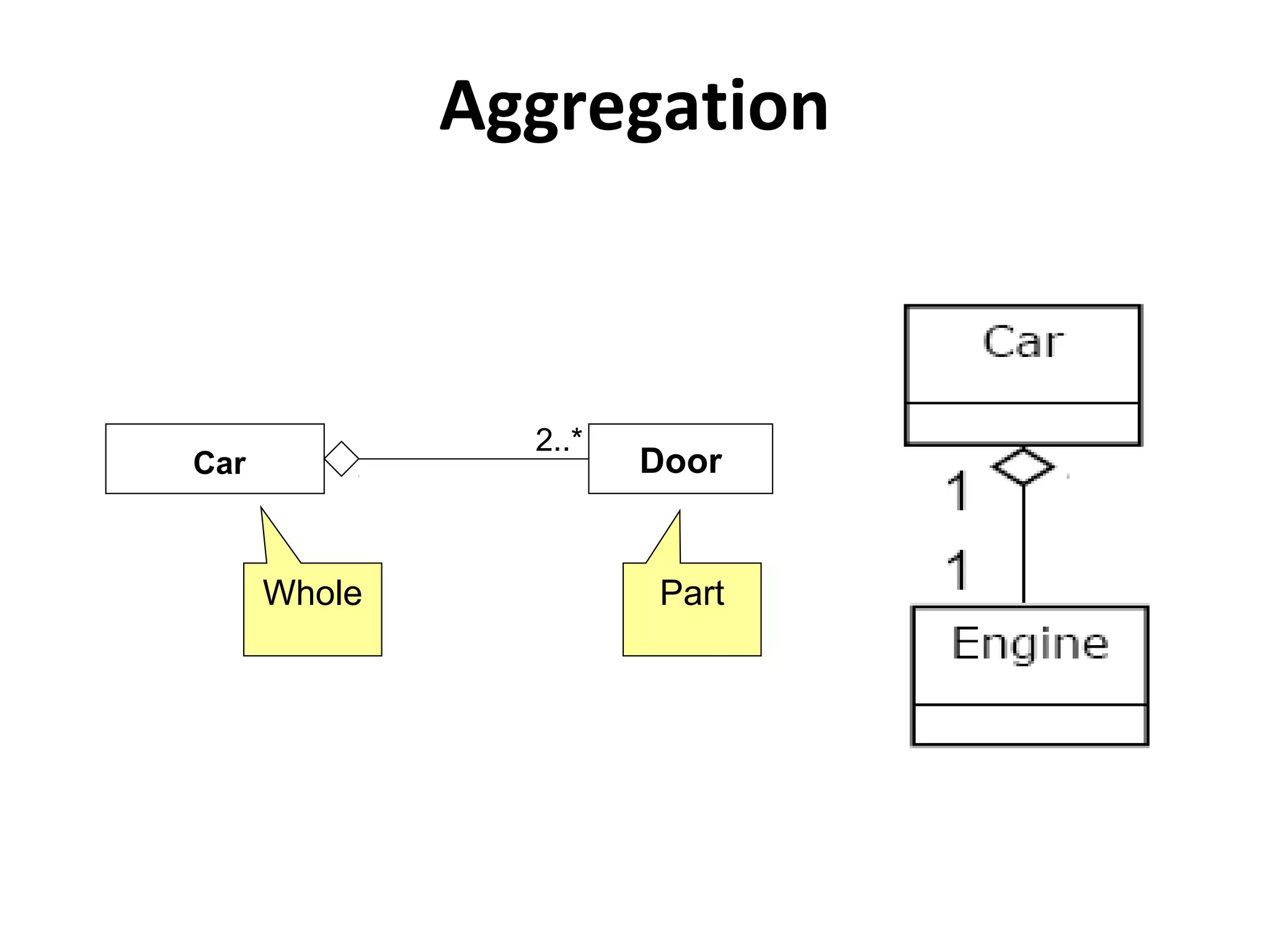
• A special form of association that models a
whole-part relationship between an aggregate
(the whole) and its parts.
• A directional association between objects.
• When an object ‘has-a’ another object, then
you have got an aggregation between them.
• Direction between them specified which
object contains the other object.
• It is also called ‘Has-a’ relationship.
Aggregation
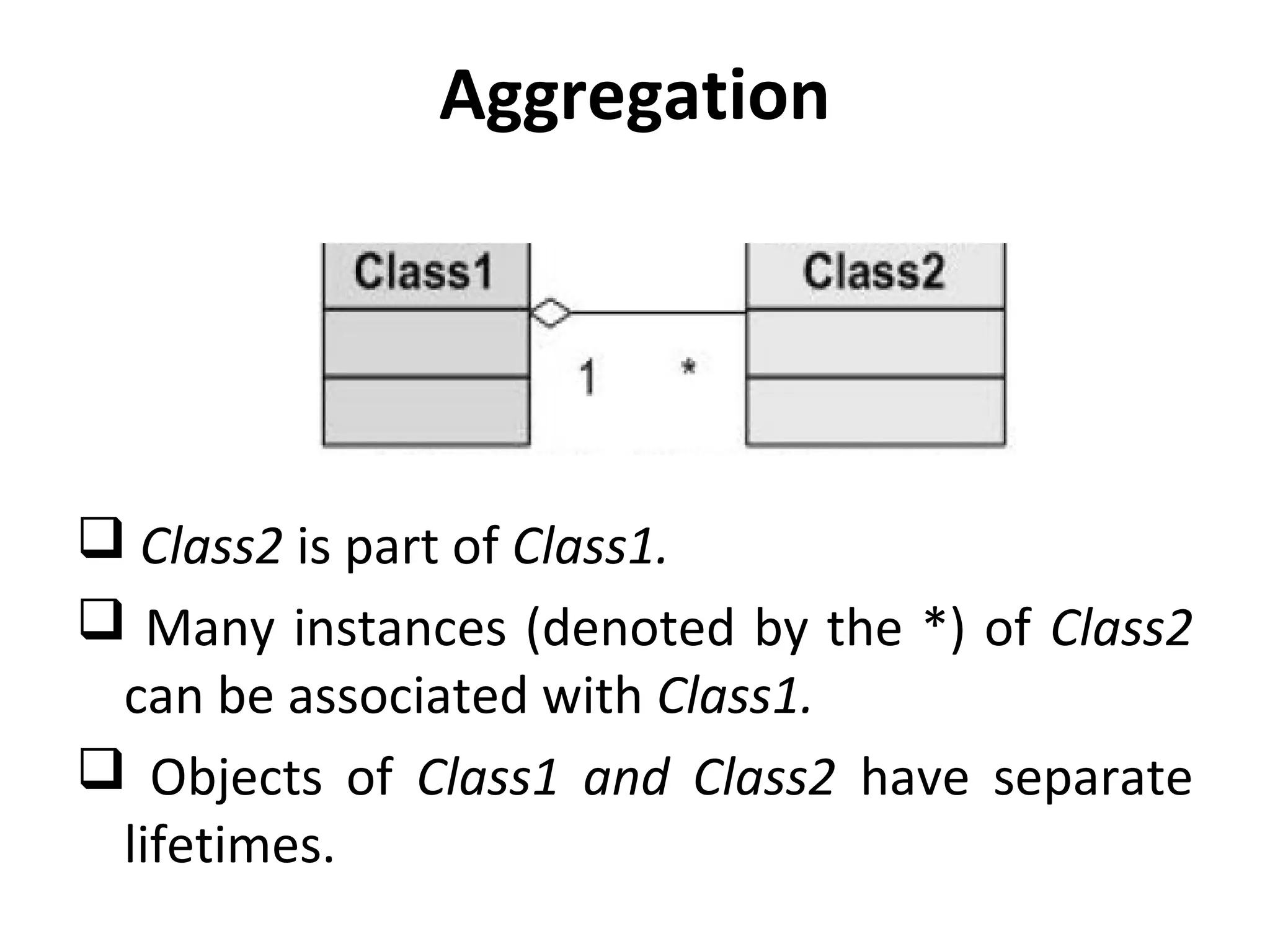
 Class2 is part of Class1.
 Many instances (denoted by the *) of Class2
can be associated with Class1.
 Objects of Class1 and Class2 have separate
lifetimes.
Aggregation
• Note: If you delete the parent object, even
then the child object may exist. One object
can contain the other, but there is no
restriction that the composed object has to
exist in order to have existence of child object.
Aggregation
Whole Part
Car Door
2..*
Composition
• A strong form of aggregation
• In a more specific manner, a restricted
aggregation is called composition.
– The whole is the sole owner of its part.
• The part object may belong to only one whole
– The life time of the part is dependent upon the
whole.
• The composite must manage the creation and
destruction of its parts.
Composition
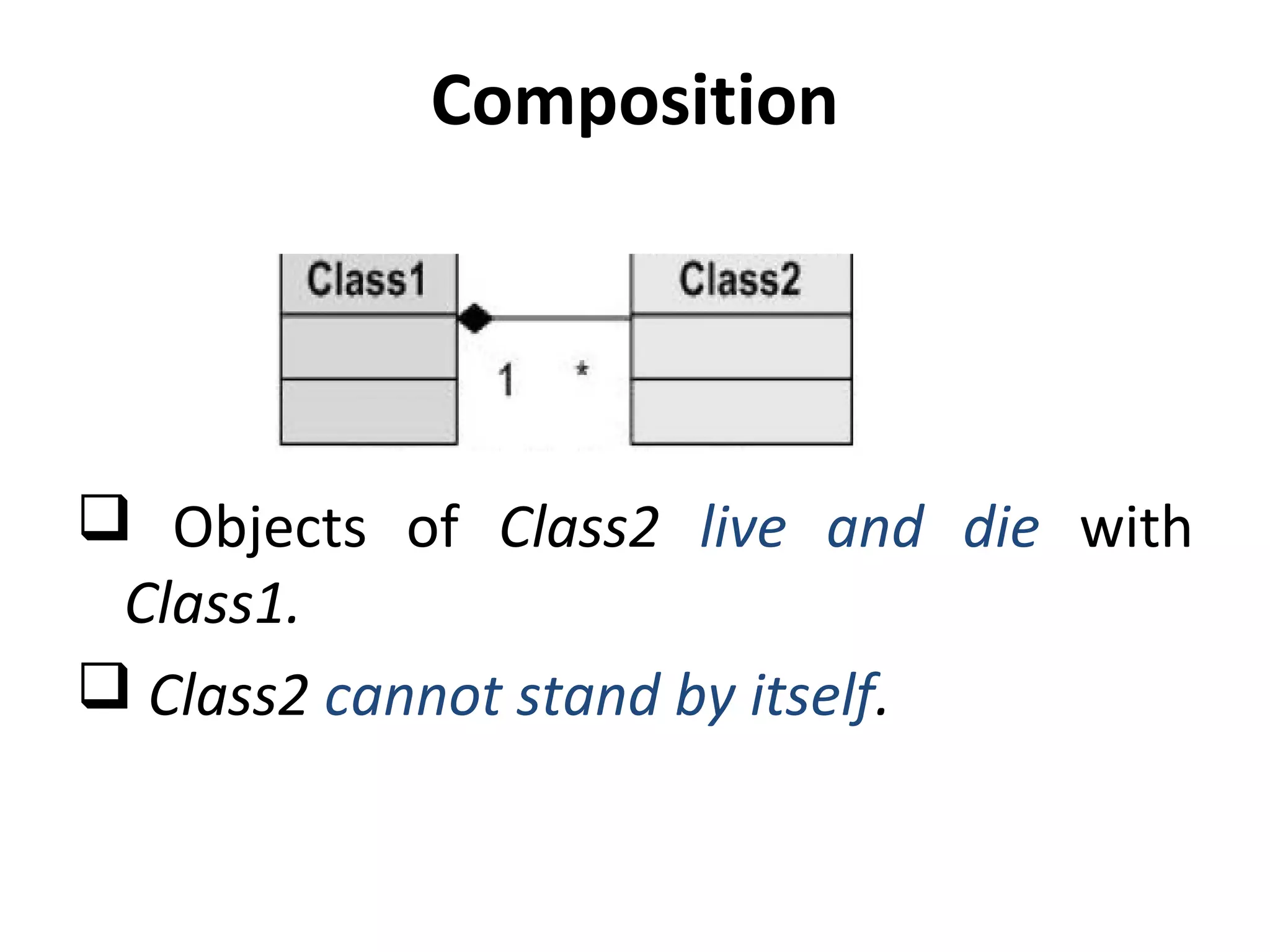
 Objects of Class2 live and die with
Class1.
 Class2 cannot stand by itself.
Composition
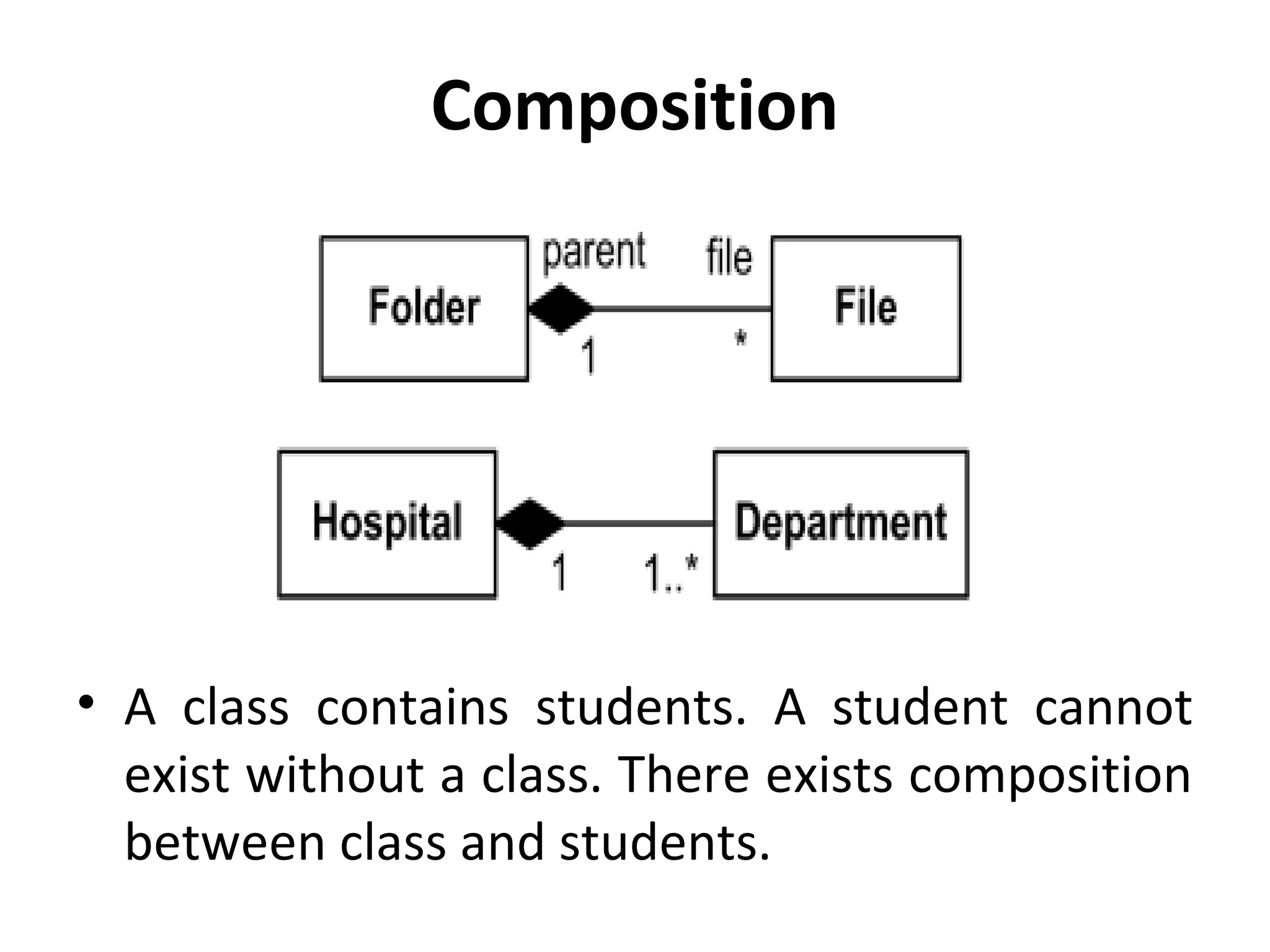
• A class contains students. A student cannot
exist without a class. There exists composition
between class and students.
Difference between aggregation
and composition
• Composition is more restrictive.
• When there is a composition between two objects,
the composed object cannot exist without the other
object.
• This restriction is not there in aggregation. Though
one object can contain the other object, there is no
condition that the composed object must exist.
• The existence of the composed object in aggregation
is entirely optional.
Difference between aggregation
and composition
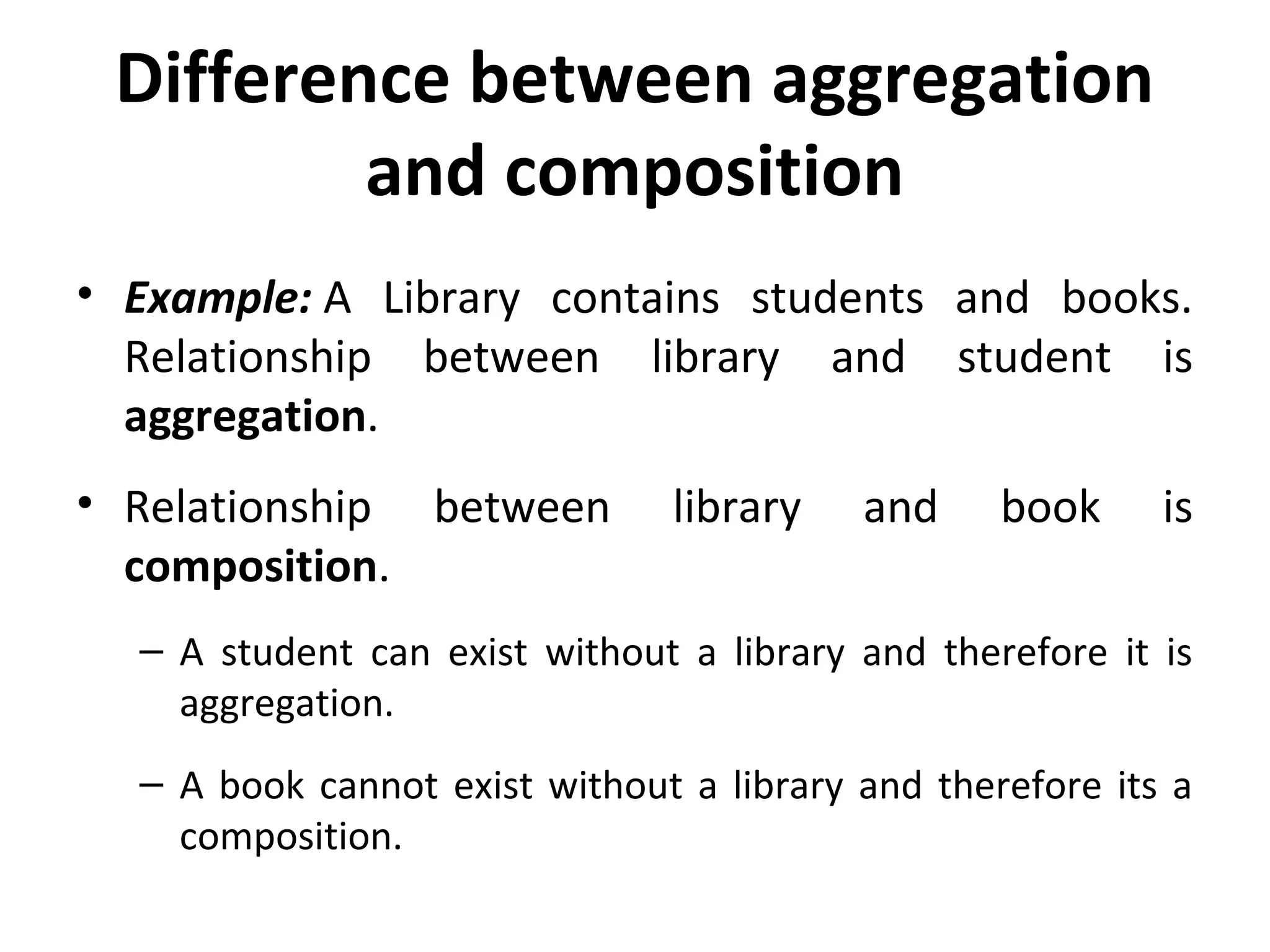
• Example: A Library contains students and books.
Relationship between library and student is
aggregation.
• Relationship between library and book is
composition.
– A student can exist without a library and therefore it is
aggregation.
– A book cannot exist without a library and therefore its a
composition.
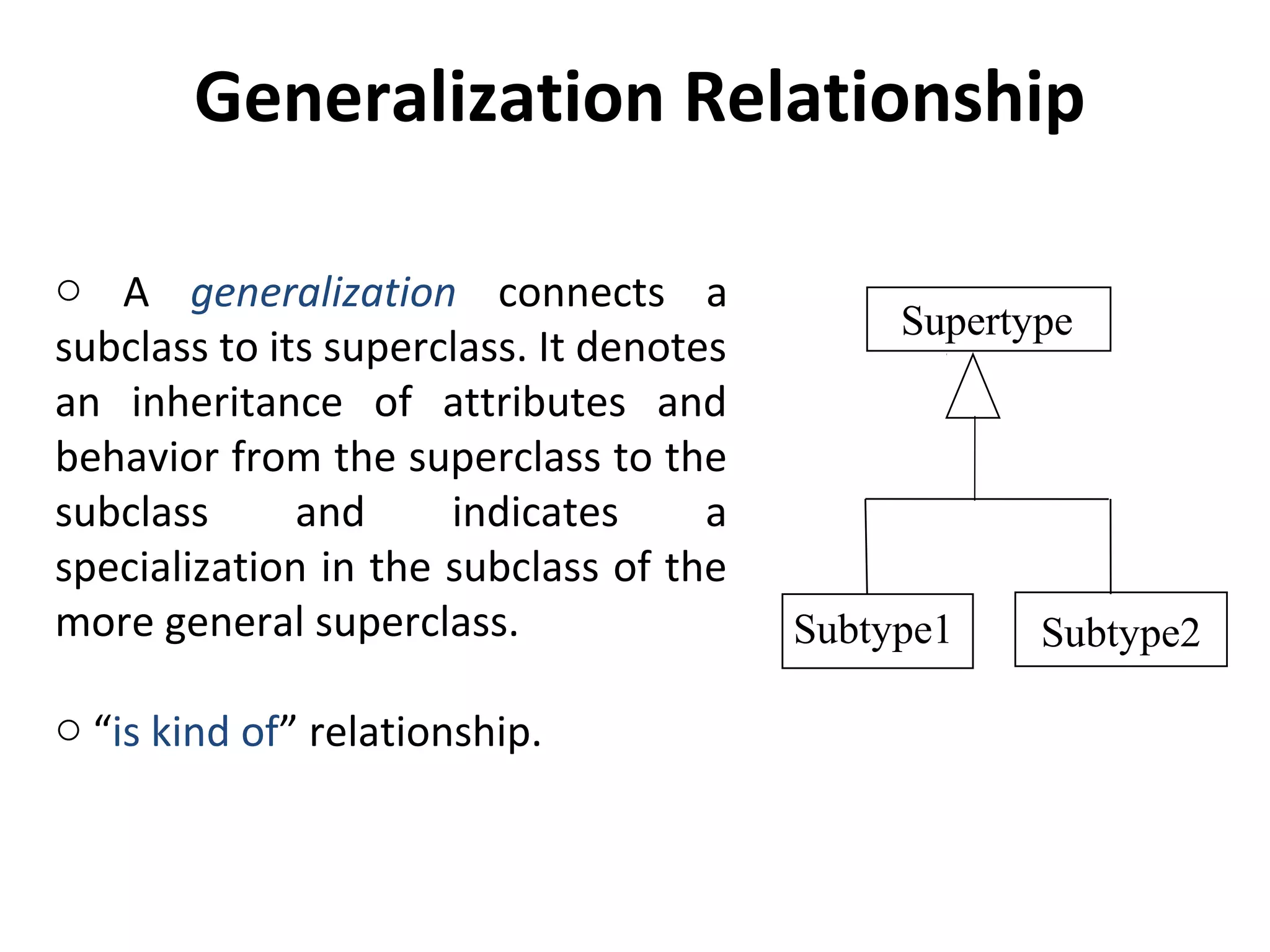
Generalization Relationship
o A generalization connects a
subclass to its superclass. It denotes
an inheritance of attributes and
behavior from the superclass to the
subclass and indicates a
specialization in the subclass of the
more general superclass.
o “is kind of” relationship.
Subtype2Subtype1
Supertype
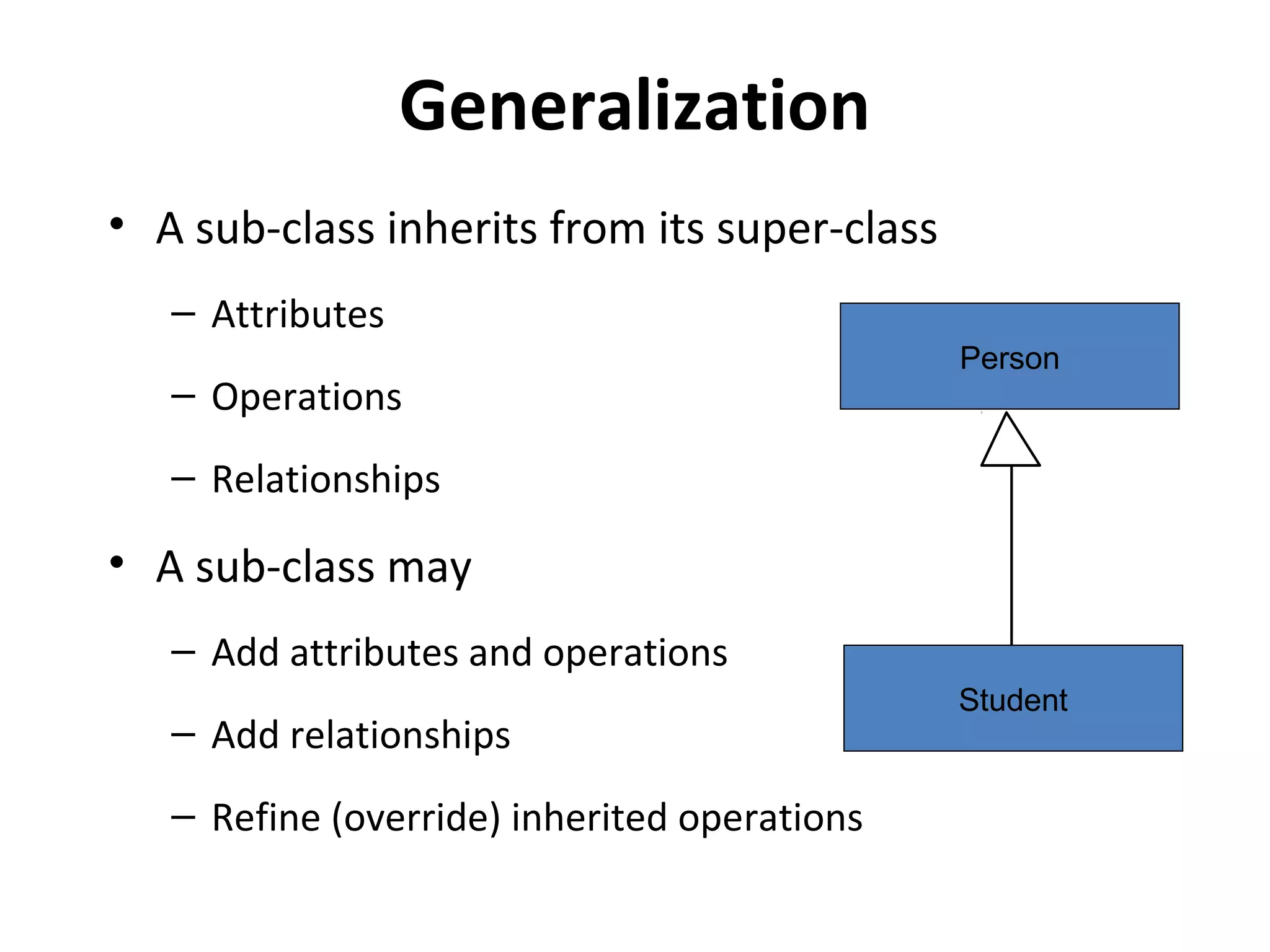
Generalization
• A sub-class inherits from its super-class
– Attributes
– Operations
– Relationships
• A sub-class may
– Add attributes and operations
– Add relationships
– Refine (override) inherited operations
Person
Student
Generalization Relationships
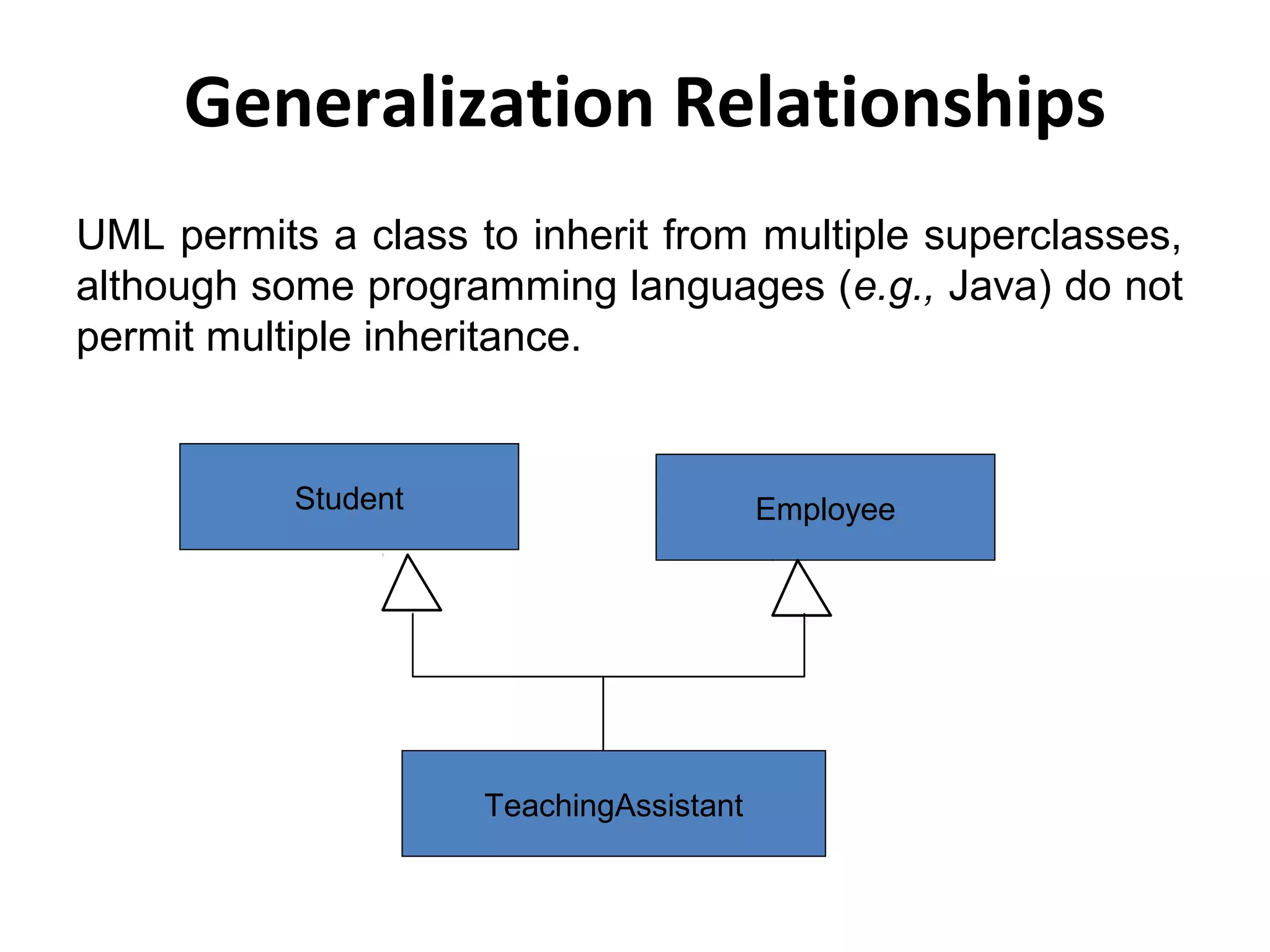
UML permits a class to inherit from multiple superclasses,
although some programming languages (e.g., Java) do not
permit multiple inheritance.
Student
TeachingAssistant
Employee
Generalization Relationships
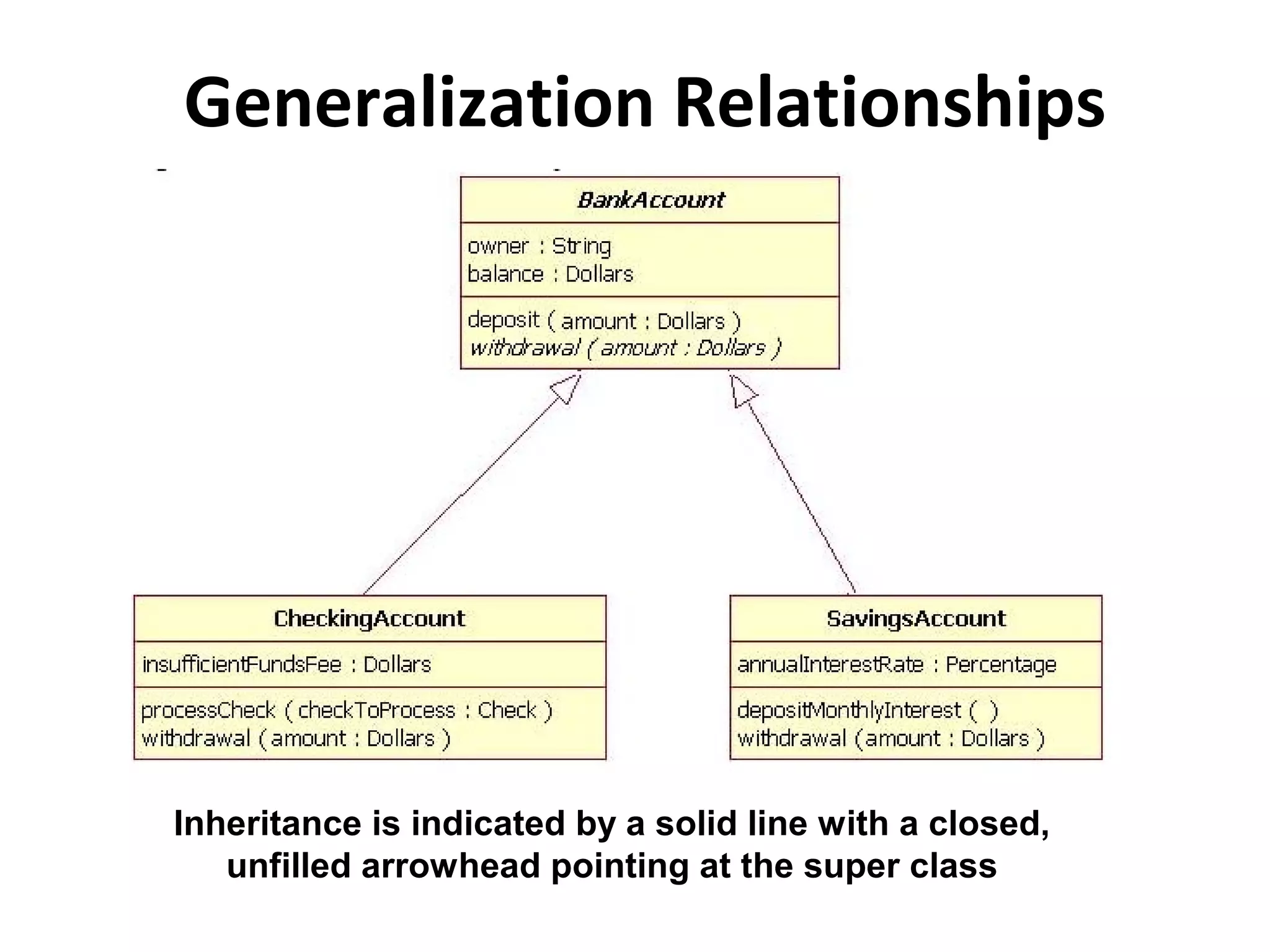
 Inheritance is indicated by a solid line with a closed, 
unfilled arrowhead pointing at the super class
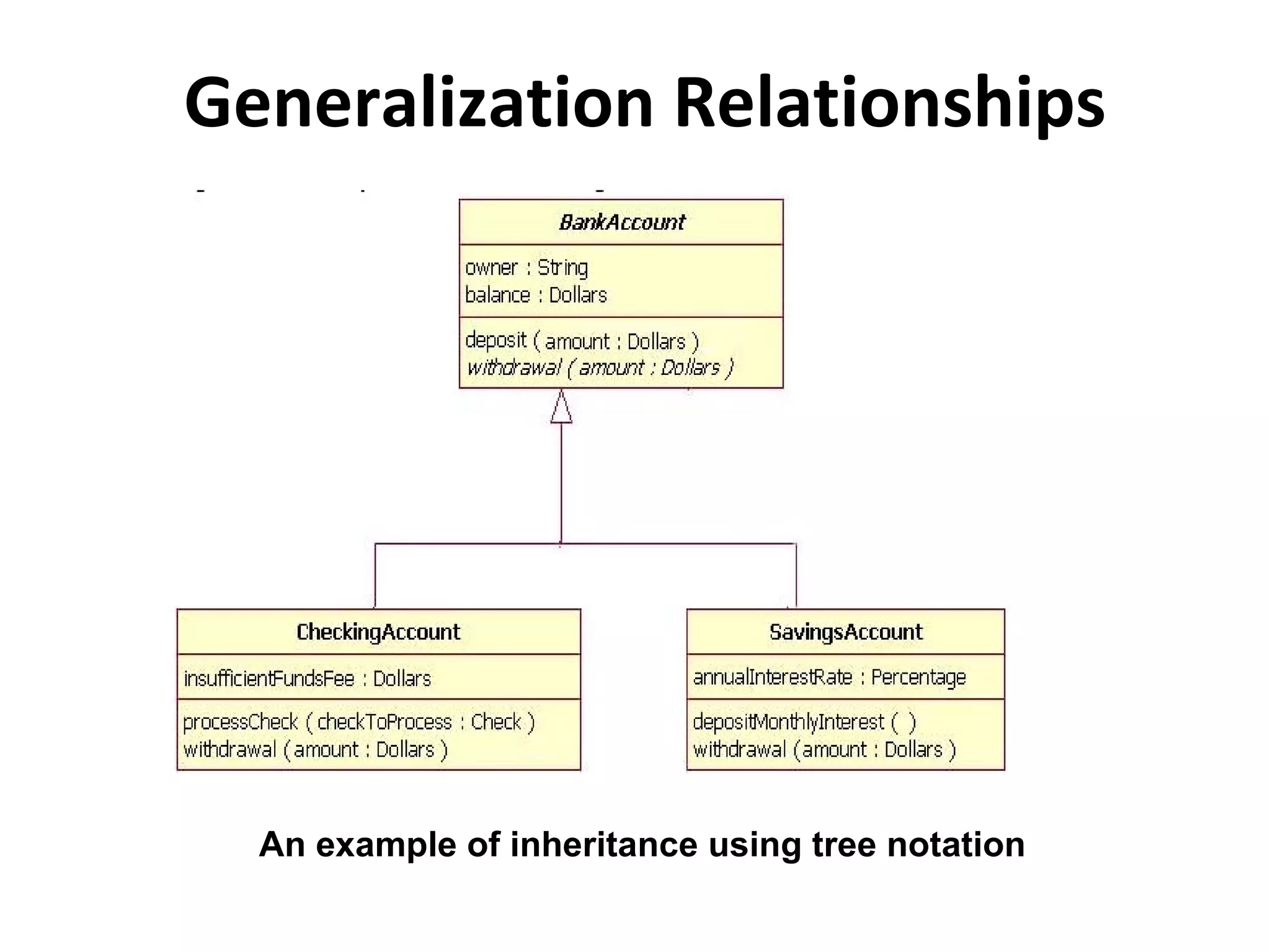
Generalization Relationships
An example of inheritance using tree notation
Packages
 UML provides an organizing element called
a package.
 Packages enable modelers to organize the
model's classifiers into namespaces, which is sort
of like folders in a filing system.
 Dividing a system into multiple packages
makes the system easier to understand,
especially if each package represents a specific
part of the system.
Drawing Packages
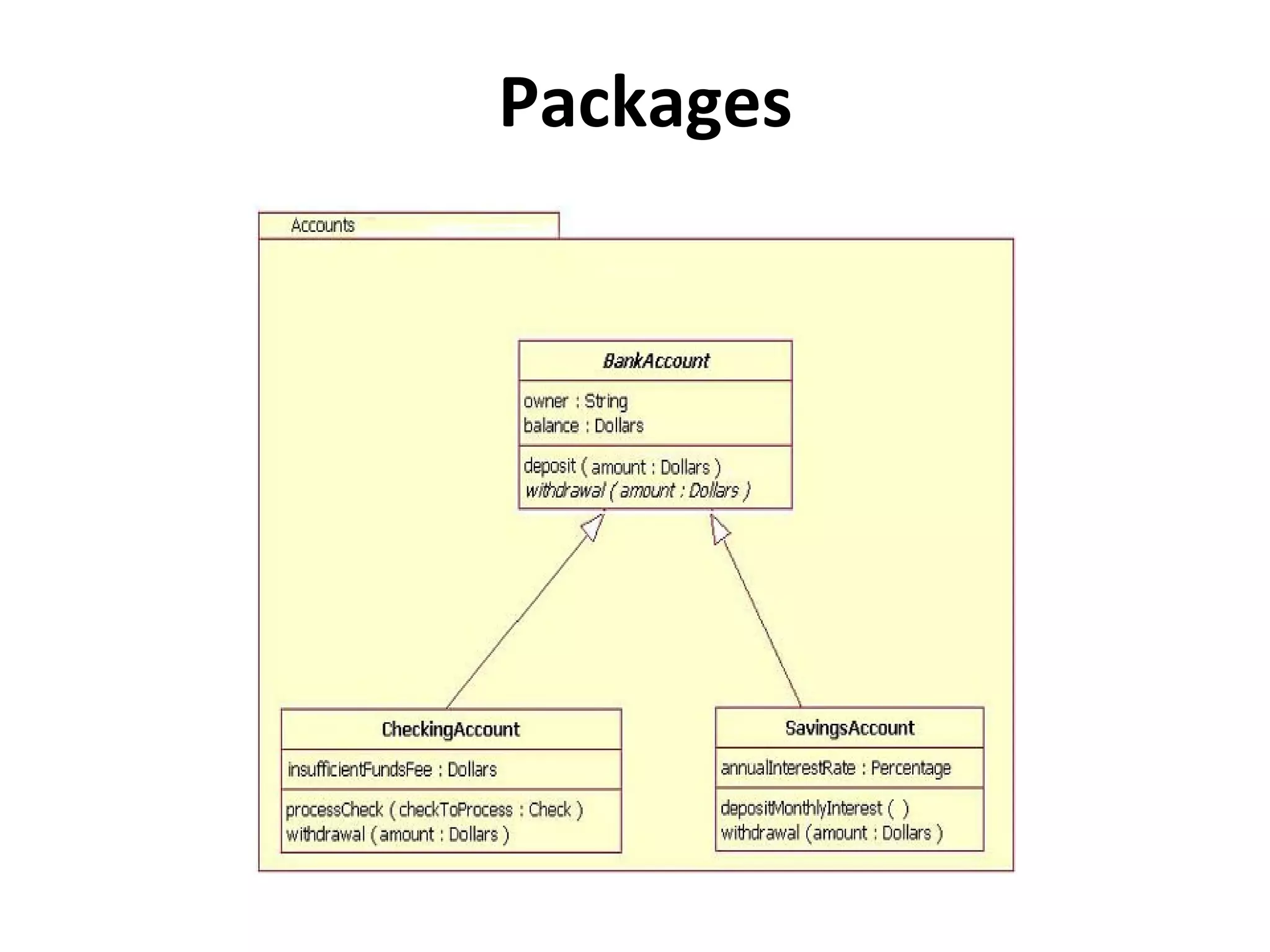
• There are two ways of drawing packages on
diagrams.
1. If the modeler decides to show the package's
members within the large rectangle, then all
those members need to be placed within the
rectangle.
Packages
Drawing Packages
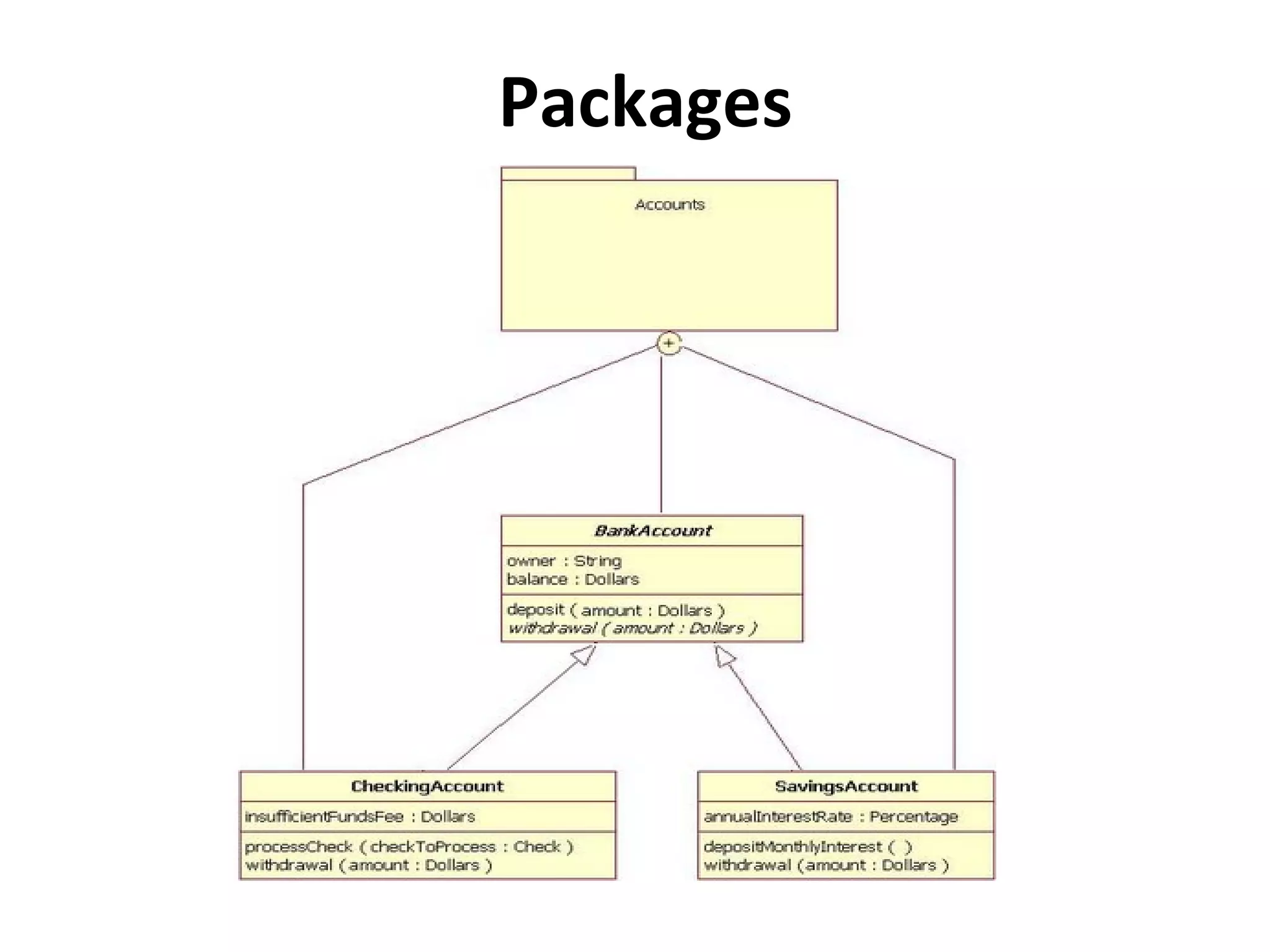
2. If the modeler decides to show the package's
members outside the large rectangle then all
the members that will be shown on the
diagram need to be placed outside the
rectangle. To show what classifiers belong to
the package, a line is drawn from each
classifier to a circle that has a plus sign inside
the circle attached to the package
Packages
Realization
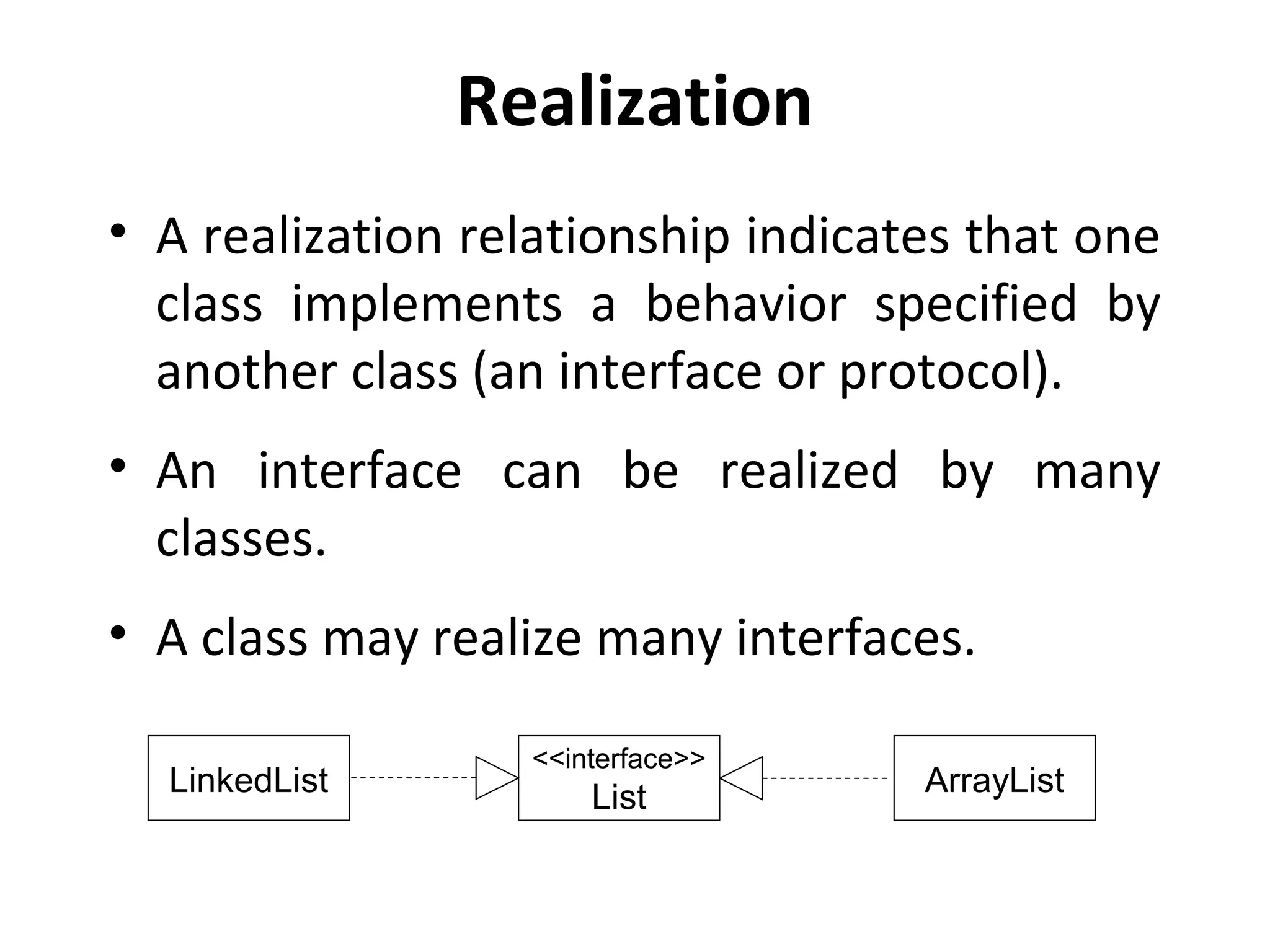
• A realization relationship indicates that one
class implements a behavior specified by
another class (an interface or protocol).
• An interface can be realized by many
classes.
• A class may realize many interfaces.
LinkedList
<<interface>>
List ArrayList
Constraint Rules and Notes
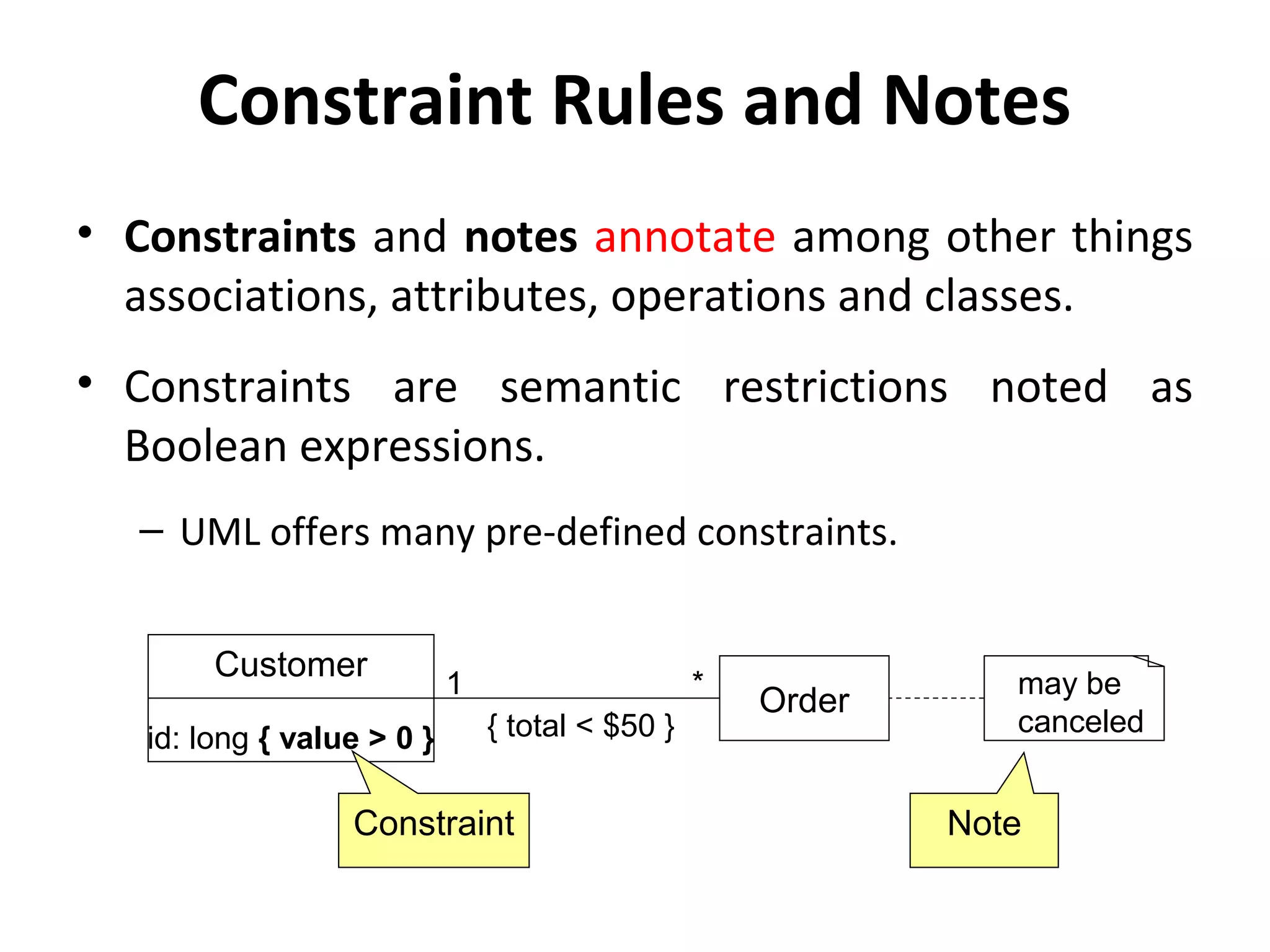
• Constraints and notes annotate among other things
associations, attributes, operations and classes.
• Constraints are semantic restrictions noted as
Boolean expressions.
– UML offers many pre-defined constraints.
id: long { value > 0 }
Customer
Order
*1
{ total < $50 }
may be
canceled
Constraint Note
What is a Object Diagram?
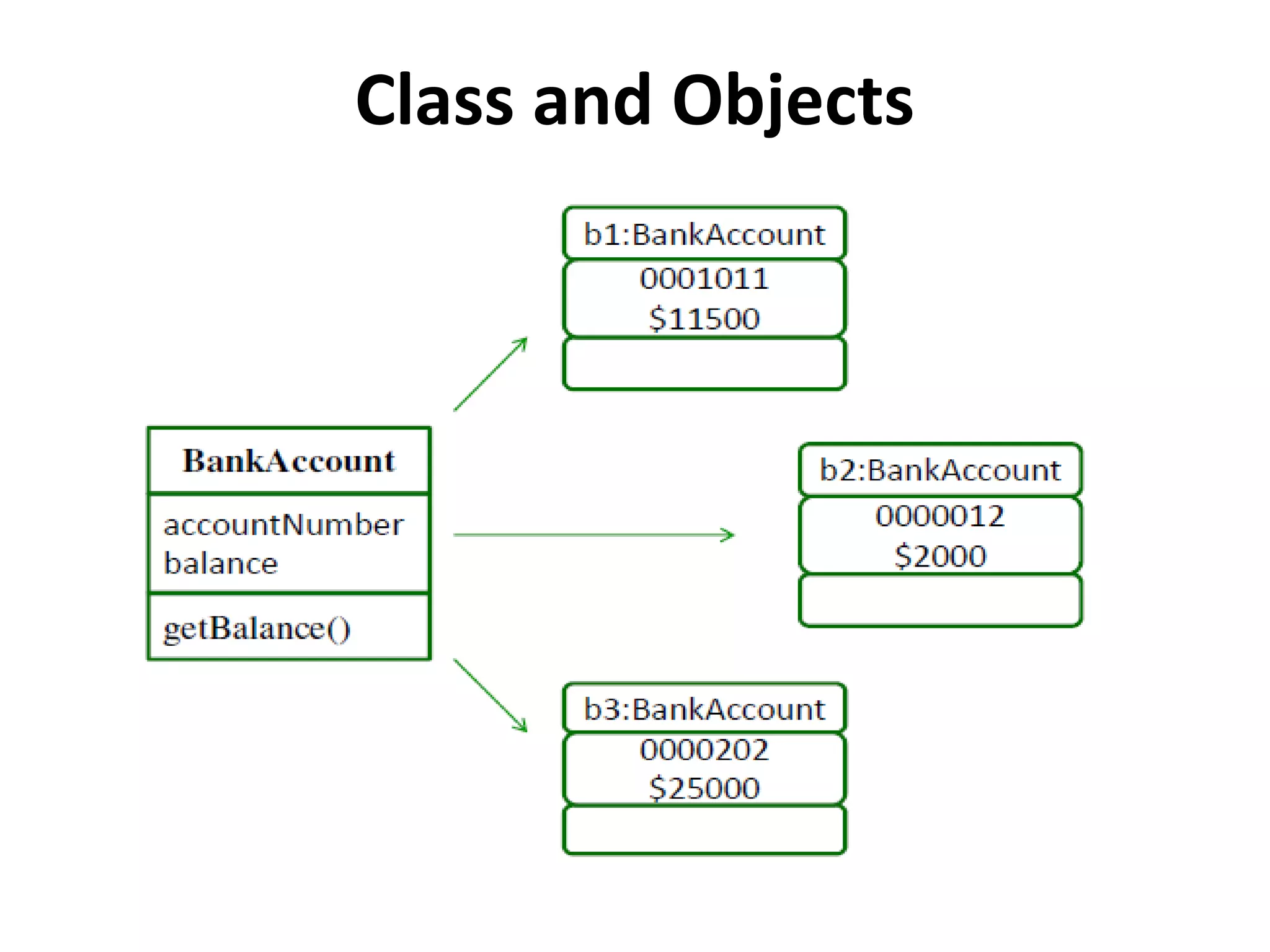
• Object diagrams represent an instance of a
class diagram.
• The purposes of object diagrams are similar to
class diagrams.
• The difference is that a class diagram
represents an abstract model consisting of
classes and their relationships. But an object
diagram represents an instance at a particular
moment which is concrete in nature.
Class and Objects

Slide 5 Class Diagram

  • 1.
  • 2.
    What is aClass Diagram? • A Class Diagram is a diagram describing the structure of a system • shows the system's • classes • Attributes • Operations (or methods), • Relationships among the classes.
  • 3.
    What is aClass Diagram? • A class diagram depicts classes and their interrelationships • Used for describing structure and behavior in the use cases • Provide a conceptual model of the system in terms of entities and their relationships • Used for requirement capture, end-user interaction • Detailed class diagrams are used for developers
  • 4.
    Essential Elements ofa UML Class Diagram • Class • Attributes • Operations • Relationships – Associations – Generalization – Realization – Dependency • Constraint Rules and Notes
  • 5.
    Class • Describes aset of objects having similar: – Attributes (status) – Operations (behavior) – Relationships with other classes • Graphically, a class is rendered as a rectangle, usually including its name, attributes, and operations in separate, designated compartments.
  • 6.
    Class Names The nameof the class is the only required tag in the graphical representation of a class. It always appears in the top-most compartment.
  • 7.
  • 8.
    Class Attributes andOperations An attribute is a named property of a class that describes the object being modeled. In the class diagram, attributes appear in the second compartment just below the name-compartment. Attributes can be: + public # protected - private Attributes are usually listed in the form: attributeName : Type Operations describe the class behavior and appear in the third compartment.
  • 9.
    Visibility and Accessfor attributes and operations of a class
  • 10.
    Class Account_Name - Customer_Name - Balance +addFunds() +withDraw( ) +transfer( ) Name Attributes Operations
  • 11.
    Class Attributes andOperations Class Attributes:  The attribute type is shown after the colon.  Attributes map onto member variables (data members) in code. Class Operations (Methods):  The return type of a method is shown after the colon at the end of the method signature.  The type of method parameters are shown after the colon following the parameter name.  Operations map onto class methods in code
  • 12.
    Operation (Method) ParameterDirectionality Parameter direction Description in states that p1 and p2 are passed to op1 by the caller. They are both in parameters. inout states that p3 is passed to op2 by the caller and is then possibly modified by op2 and is passed back out. p3 is an inout parameter. out states that p6 is not set by the caller but is modified by op3 and is passed back out. p6 is an out parameter.
  • 13.
    Association • In UML,object interconnections (logical or physical), are modeled as relationships. • An association between two classes indicates that objects at one end of an association “recognize” objects at the other end and may send messages to them. • Example: “An Employee works for a Company” Employee Company
  • 14.
    Association Relationships If twoclasses in a model need to communicate with each other, there must be link between them. An association denotes that link. InstructorStudent
  • 15.
    Association Relationships We canindicate the multiplicity of an association by adding multiplicity adornments to the line denoting the association. The example indicates that a Student has one or more Instructors: InstructorStudent 1..*
  • 16.
    Association Relationships The exampleindicates that every Instructor has one or more Students: InstructorStudent 1..*
  • 17.
    Association Relationships We canalso indicate the behavior of an object in an association (i.e., the role of an object) using rolenames. InstructorStudent 1..*1..* learns fromteaches
  • 18.
    Association Relationships We canalso name the association. TeamStudent membership 1..* 1..*
  • 19.
    Association Relationships We canspecify dual associations. TeamStudent member of 1..* president of1 1..* 1..*
  • 20.
    Associations • Multiplicity – thenumber of objects that participate in the association. – Indicates whether or not an association is mandatory. Exactly one 1 Zero or more (unlimited) * (0..*) One or more 1..* Zero or one (optional association) 0..1 Specified range 2..4 Multiple, disjoint ranges 2, 4..6, 8 Multiplicity Indicators
  • 21.
    Association Relationships A classcan have a self association. LinkedListNode next previous
  • 22.
    Aggregation • A specialform of association that models a whole-part relationship between an aggregate (the whole) and its parts. • A directional association between objects. • When an object ‘has-a’ another object, then you have got an aggregation between them. • Direction between them specified which object contains the other object. • It is also called ‘Has-a’ relationship.
  • 23.
    Aggregation  Class2 ispart of Class1.  Many instances (denoted by the *) of Class2 can be associated with Class1.  Objects of Class1 and Class2 have separate lifetimes.
  • 24.
    Aggregation • Note: Ifyou delete the parent object, even then the child object may exist. One object can contain the other, but there is no restriction that the composed object has to exist in order to have existence of child object.
  • 25.
  • 26.
    Composition • A strongform of aggregation • In a more specific manner, a restricted aggregation is called composition. – The whole is the sole owner of its part. • The part object may belong to only one whole – The life time of the part is dependent upon the whole. • The composite must manage the creation and destruction of its parts.
  • 27.
    Composition  Objects ofClass2 live and die with Class1.  Class2 cannot stand by itself.
  • 28.
    Composition • A classcontains students. A student cannot exist without a class. There exists composition between class and students.
  • 29.
    Difference between aggregation andcomposition • Composition is more restrictive. • When there is a composition between two objects, the composed object cannot exist without the other object. • This restriction is not there in aggregation. Though one object can contain the other object, there is no condition that the composed object must exist. • The existence of the composed object in aggregation is entirely optional.
  • 30.
    Difference between aggregation andcomposition • Example: A Library contains students and books. Relationship between library and student is aggregation. • Relationship between library and book is composition. – A student can exist without a library and therefore it is aggregation. – A book cannot exist without a library and therefore its a composition.
  • 31.
    Generalization Relationship o Ageneralization connects a subclass to its superclass. It denotes an inheritance of attributes and behavior from the superclass to the subclass and indicates a specialization in the subclass of the more general superclass. o “is kind of” relationship. Subtype2Subtype1 Supertype
  • 32.
    Generalization • A sub-classinherits from its super-class – Attributes – Operations – Relationships • A sub-class may – Add attributes and operations – Add relationships – Refine (override) inherited operations Person Student
  • 33.
    Generalization Relationships UML permitsa class to inherit from multiple superclasses, although some programming languages (e.g., Java) do not permit multiple inheritance. Student TeachingAssistant Employee
  • 34.
  • 35.
  • 36.
    Packages  UML providesan organizing element called a package.  Packages enable modelers to organize the model's classifiers into namespaces, which is sort of like folders in a filing system.  Dividing a system into multiple packages makes the system easier to understand, especially if each package represents a specific part of the system.
  • 37.
    Drawing Packages • Thereare two ways of drawing packages on diagrams. 1. If the modeler decides to show the package's members within the large rectangle, then all those members need to be placed within the rectangle.
  • 38.
  • 39.
    Drawing Packages 2. Ifthe modeler decides to show the package's members outside the large rectangle then all the members that will be shown on the diagram need to be placed outside the rectangle. To show what classifiers belong to the package, a line is drawn from each classifier to a circle that has a plus sign inside the circle attached to the package
  • 40.
  • 41.
    Realization • A realizationrelationship indicates that one class implements a behavior specified by another class (an interface or protocol). • An interface can be realized by many classes. • A class may realize many interfaces. LinkedList <<interface>> List ArrayList
  • 42.
    Constraint Rules andNotes • Constraints and notes annotate among other things associations, attributes, operations and classes. • Constraints are semantic restrictions noted as Boolean expressions. – UML offers many pre-defined constraints. id: long { value > 0 } Customer Order *1 { total < $50 } may be canceled Constraint Note
  • 43.
    What is aObject Diagram? • Object diagrams represent an instance of a class diagram. • The purposes of object diagrams are similar to class diagrams. • The difference is that a class diagram represents an abstract model consisting of classes and their relationships. But an object diagram represents an instance at a particular moment which is concrete in nature.
  • 44.

Editor's Notes

  • #13 Syntax: visibility name (dir parameterName : type = default value, ... ) : returnType Parameter directions: in, out, inout or return Only name is mandatory in Analysis