OVERVIEW
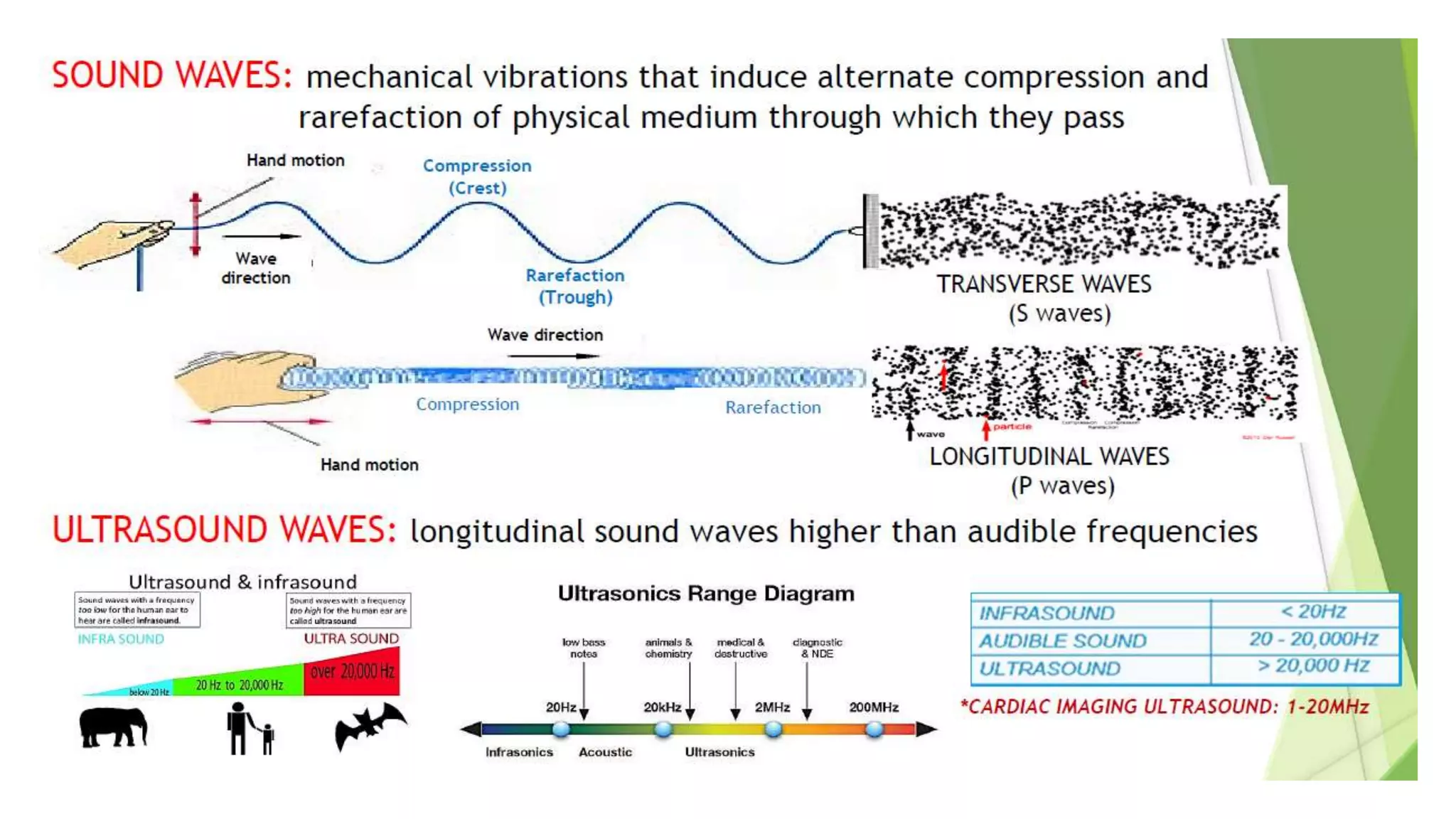
What are waves-sound vs ultrasound waves
How image is created by USG
Factors affecting image resolution
Artefacts
Doppler effect
Pulse/continuous and color doppler
USG waves
Characteristics
of a wave
• Velocity=frequency x wavelength
• Wavelength=1/frequency if velocity assumed 1540 m/s
USG PULSES
USG WAVES IN BODY
ATTENUATION
IMAGE
GENERATION
• Amplitude =brightness value on grayscale
• Time taken to reflect=distance of the
object
• Multiple one-dimensional beams fan out
• Multiple beams and averaging process
=2D or B mode
• Number of images in a second =Frame
rate
M mode
AXIAL RESOLUTION
• discern two objects longitudinally adjacent to each other
• depends on wavelength /Frequency
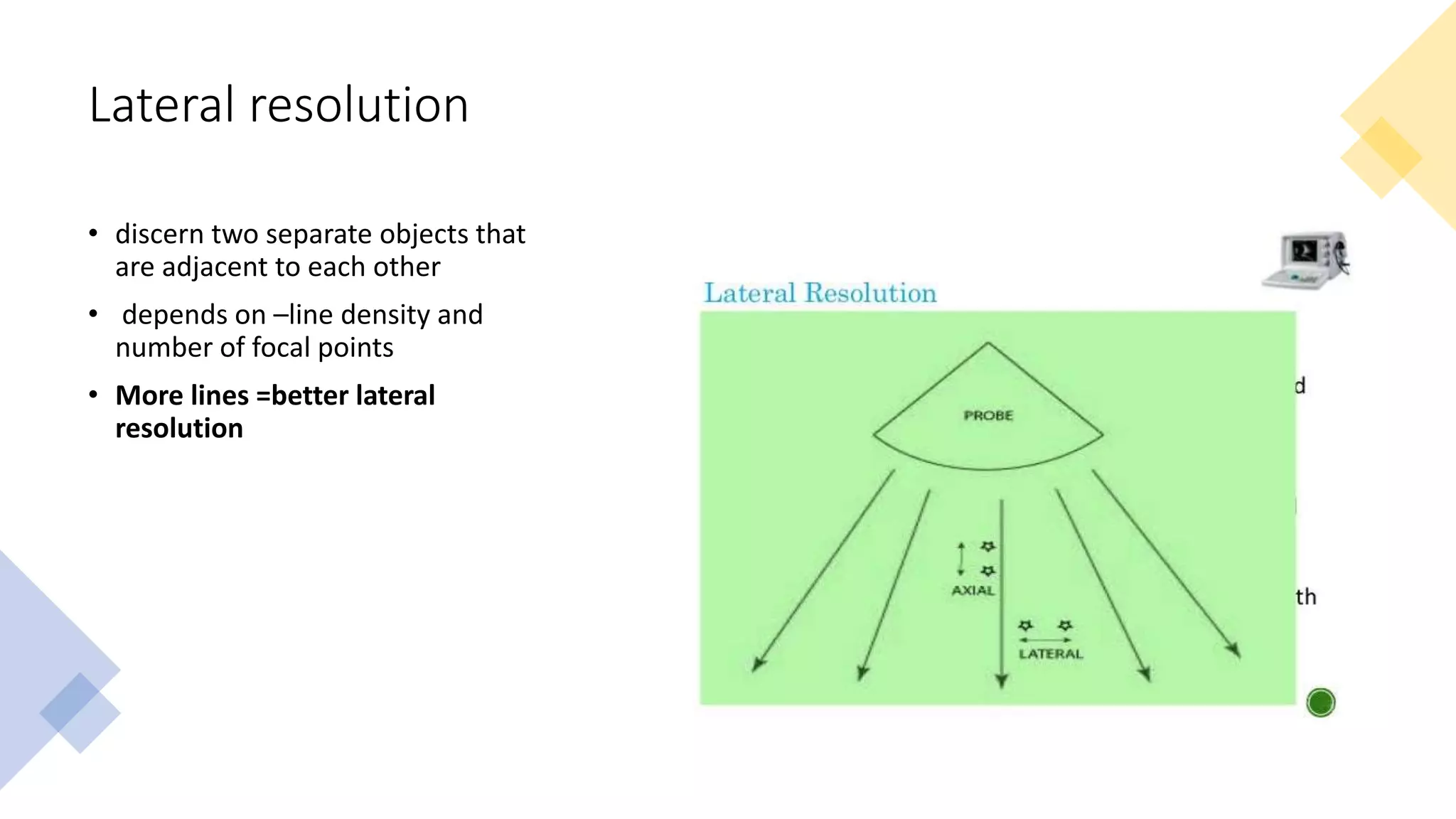
Lateral resolution
• discern two separate objects that
are adjacent to each other
• depends on –line density and
number of focal points
• More lines =better lateral
resolution
TEMPORAL RESOLUTION
• distinguish changes between successive image frames over time
• Higher frame rate =higher temporal resolution
Temporal
vs Lateral
Frame
rate
sector
size
line
density
Settings to
optimize
view
• Sector size
• frame rate vs lateral resolution
• Focus-beams converge with acoustic lens–
maximal overlap in area chosen
• Gain –degree of amplification of returning signal
• Time gain compensation-software adjusts
degree of amplification
Artefacts
Doppler Principal
Doppler
Principal
PULSE WAVE
• sample volume
• Aliasing above 2 m/sec
• Nyquist limit=PRF/2
• LVOT ,DIASTOLOGY,CO
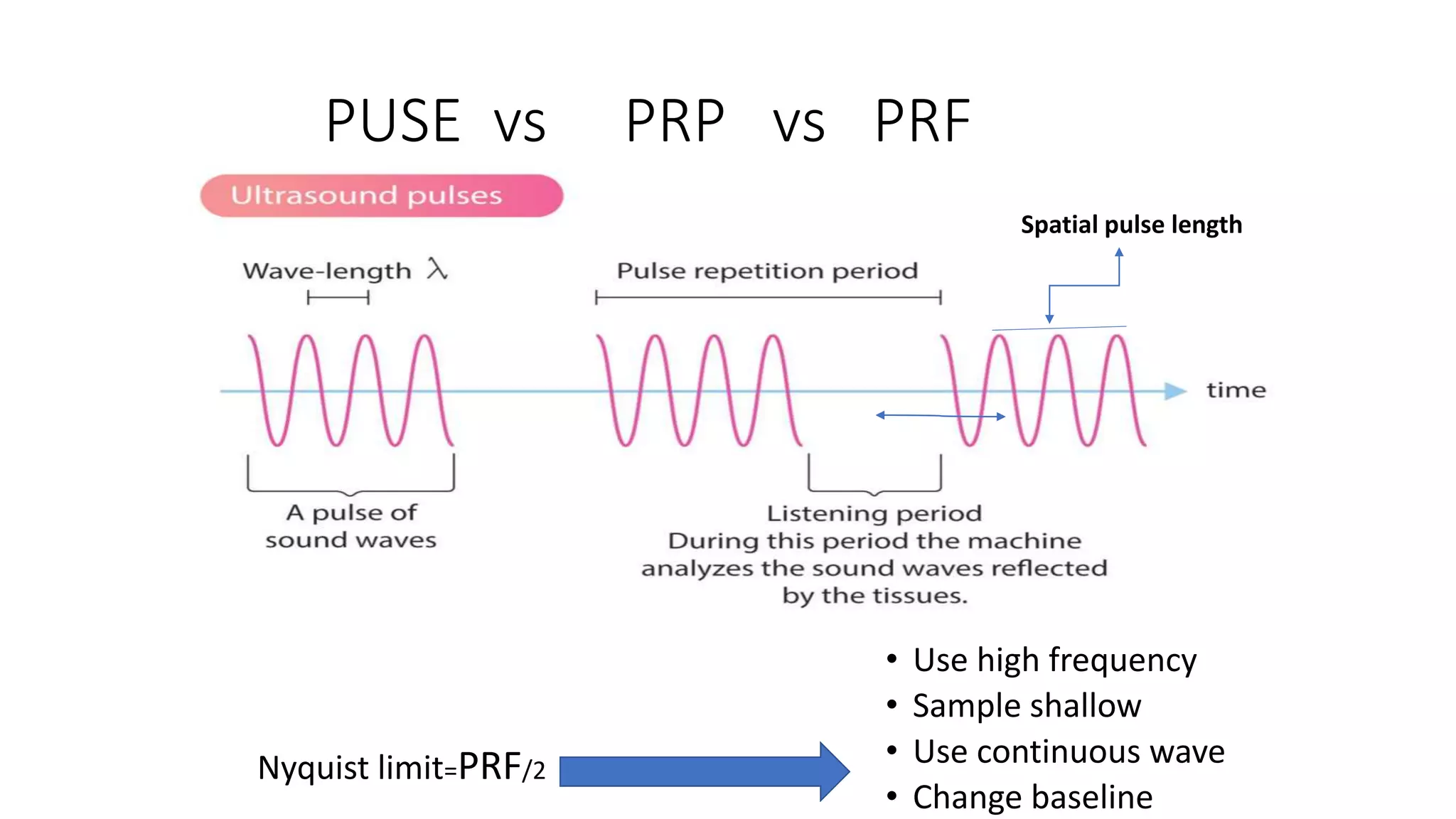
PUSE vs PRP vs PRF
Nyquist limit=PRF/2
• Use high frequency
• Sample shallow
• Use continuous wave
• Change baseline
Spatial pulse length
Continuous wave
• Range ambiguity -not site
specific
• Useful for high velocities -AS
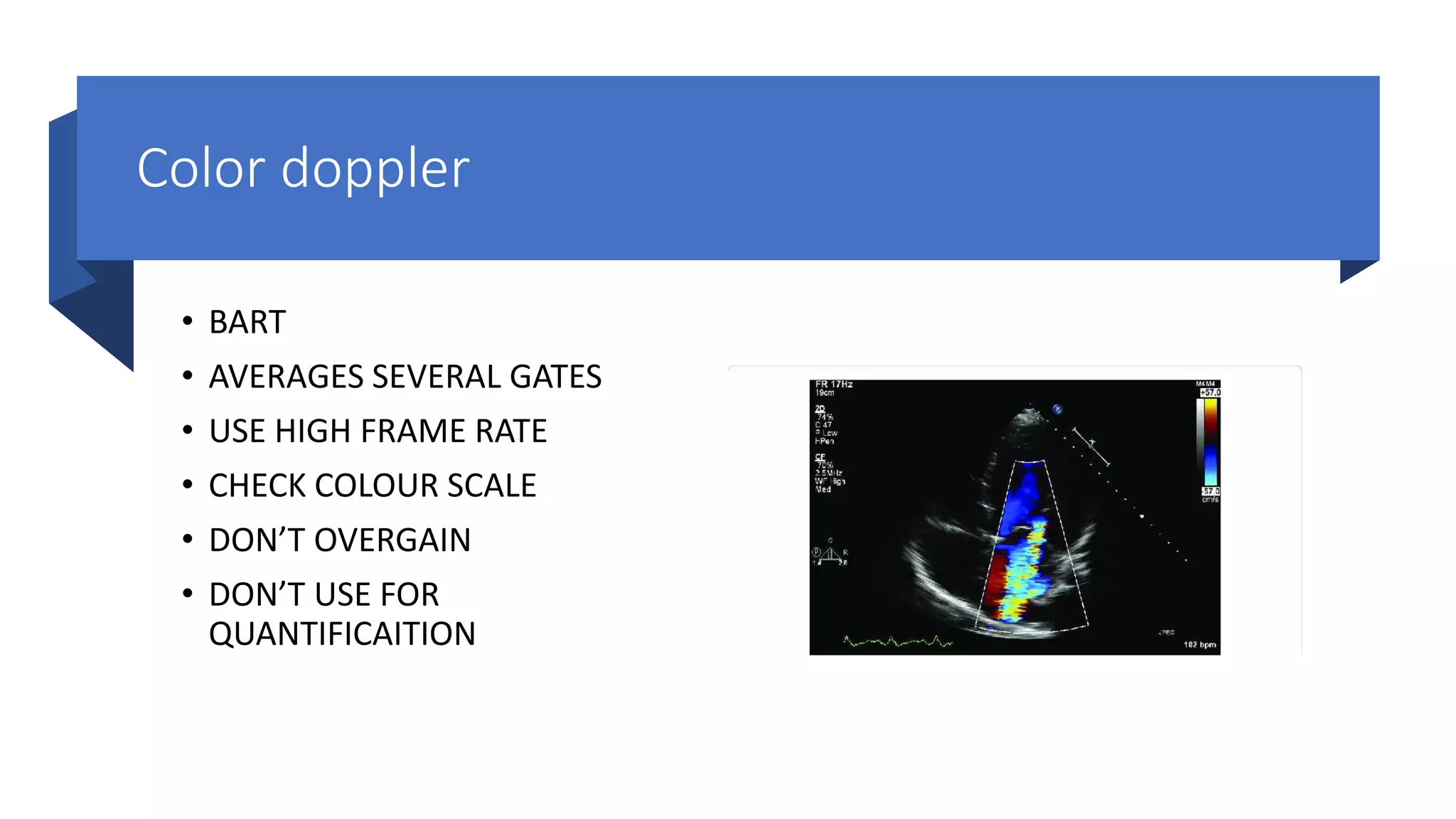
Color doppler
• BART
• AVERAGES SEVERAL GATES
• USE HIGH FRAME RATE
• CHECK COLOUR SCALE
• DON’T OVERGAIN
• DON’T USE FOR
QUANTIFICAITION
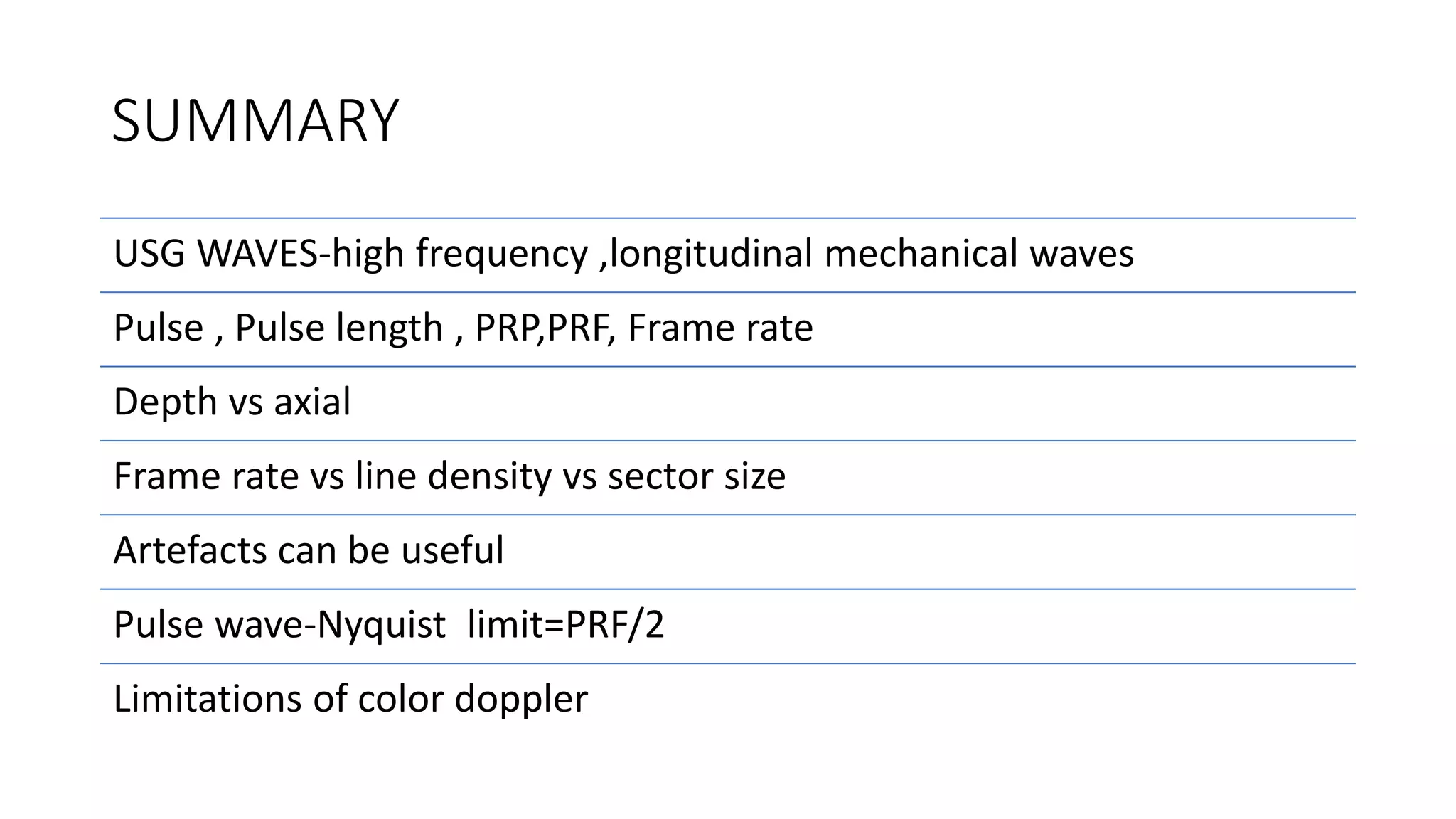
SUMMARY
USG WAVES-high frequency ,longitudinal mechanical waves
Pulse , Pulse length , PRP,PRF, Frame rate
Depth vs axial
Frame rate vs line density vs sector size
Artefacts can be useful
Pulse wave-Nyquist limit=PRF/2
Limitations of color doppler

Ultrasound physics

  • 2.
    OVERVIEW What are waves-soundvs ultrasound waves How image is created by USG Factors affecting image resolution Artefacts Doppler effect Pulse/continuous and color doppler
  • 5.
  • 6.
    Characteristics of a wave •Velocity=frequency x wavelength • Wavelength=1/frequency if velocity assumed 1540 m/s
  • 7.
  • 8.
    USG WAVES INBODY ATTENUATION
  • 9.
    IMAGE GENERATION • Amplitude =brightnessvalue on grayscale • Time taken to reflect=distance of the object • Multiple one-dimensional beams fan out • Multiple beams and averaging process =2D or B mode • Number of images in a second =Frame rate
  • 10.
  • 11.
    AXIAL RESOLUTION • discerntwo objects longitudinally adjacent to each other • depends on wavelength /Frequency
  • 12.
    Lateral resolution • discerntwo separate objects that are adjacent to each other • depends on –line density and number of focal points • More lines =better lateral resolution
  • 13.
    TEMPORAL RESOLUTION • distinguishchanges between successive image frames over time • Higher frame rate =higher temporal resolution Temporal vs Lateral Frame rate sector size line density
  • 14.
    Settings to optimize view • Sectorsize • frame rate vs lateral resolution • Focus-beams converge with acoustic lens– maximal overlap in area chosen • Gain –degree of amplification of returning signal • Time gain compensation-software adjusts degree of amplification
  • 16.
  • 17.
  • 18.
  • 20.
    PULSE WAVE • samplevolume • Aliasing above 2 m/sec • Nyquist limit=PRF/2 • LVOT ,DIASTOLOGY,CO
  • 21.
    PUSE vs PRPvs PRF Nyquist limit=PRF/2 • Use high frequency • Sample shallow • Use continuous wave • Change baseline Spatial pulse length
  • 22.
    Continuous wave • Rangeambiguity -not site specific • Useful for high velocities -AS
  • 23.
    Color doppler • BART •AVERAGES SEVERAL GATES • USE HIGH FRAME RATE • CHECK COLOUR SCALE • DON’T OVERGAIN • DON’T USE FOR QUANTIFICAITION
  • 24.
    SUMMARY USG WAVES-high frequency,longitudinal mechanical waves Pulse , Pulse length , PRP,PRF, Frame rate Depth vs axial Frame rate vs line density vs sector size Artefacts can be useful Pulse wave-Nyquist limit=PRF/2 Limitations of color doppler