References: CT and MR imaging of whole abdomen
            John R. Haaga, MD, FACR
   Anatomy

   Role of imaging in Localization of pathology

   Neoplasms
   Posterior peritoneum
   Renal (Gerota’s) fasciae
   Lateroconal fascia
   Musculoaponeurotic plane, embracing the
    quadratus lumborum and psoas muscles, the
    diaphragmatic crura and associated
    ligamentous fascia.
Retroperitoneal spaces
   Iliopsoas compartment
    - located within and immediate adjacent to
    psoas muscle
    - posteromedial to the posterior pararenal
    space
   The retromesenteric, retrorenal, and lateroconal
    planes are potential routes of interfascial
    communication between the retroperitoneal
    spaces. Retroperitoneal hemorrhage or rapidly
    expanding fluid collections can spread via
    these interfascial connections.
   Largest
   Pancreas, Duodenum, Colon
   Continuous across the midline
   Smallest
   Continues anterolaterally into the
    properitoneal fat, the extraperitoneal fat of the
    anterior abdominal wall.
   Plain radiograph
   USG
   CT
   MRI
Pancreatic calcification
 Common                      Rare
  - Chronic alcoholic          - Idiopathic
  pancreatitis                 - Hereditary pancreatitis
                               - Cystic fibrosis
                               - Hyperparathyroidism
                               - Protein malnutrition
                               - Cystic tumours
                               - Cavernous lymphangioma
                               - Islet cell tumours
                               - Haemangioma
                               - Pseudo cysts
                               - Haematoma
   Multidetector CT in retroperitoneal
    haemorrhages, fluid collections, AAA and
    masses.

   Magnetic resonance (MR) imaging has an
    increasing role in evaluating soft-tissue masses
    of the extraperitoneal spaces.
   Below the kidneys, the retroperitoneal spaces -a single
    space with direct contiguity between the anterior and
    posterior portions.
   Retroperitoneal hemorrhage or fluid spread from the
    abdominal retroperitoneum into the extraperitoneal
    pelvis along the anterior and posterior perirenal
    fasciae, which combine to form the fascial plane in the
    iliac fossa .
   Superiorly, the perirenal fasciae are attached to the
    diaphragm.
   On the right side, the bare area of the liver is directly
    connected to the anterior pararenal space.
    Therefore, hepatic lacerations involving the bare area
    of the liver can be a source (albeit uncommon) of
    retroperitoneal hemorrhage.
   CT findings of duodenal injury
-   duodenal wall thickening
-    periduodenal fluid
-   Fluid in the right anterior pararenal space
-   Diminished bowel wall enhancement of the
    injured segment
-   extraluminal air (More specific sign of duodenal
    perforation)
-   extraluminal oral contrast material air (More
    specific sign of duodenal perforation)
-   the “sentinel clot” sign
   Two-thirds of blunt pancreatic injuries occur in
    the pancreatic body, with the remainder
    occurring with equal frequency in the
    head, neck, and tail.
   Goals of imaging
-   to identify the retroperitoneal hemorrhage, its
    location and its possible source
-   to assess its relative stability on the basis of the
    size and presence (or absence) of active
    extravasation of intravascular contrast material
Surgical standpoint, the retroperitoneum can be
divided into zones because hematoma location
has therapeutic implications
   Pelvic retroperitoneum is the most common
    location of retroperitoneal
    hemorrhage, frequently in association with
    pelvic fractures.
   In the setting of trauma should raise suspicion
    for
-   Pancreatic injury
-   Duodenal injury
-   Renal collecting system injury (with urine
    leakage)
-   Retroperitoneal hemorrhage
   Primary
-   Lymphoid malignancy : NHL, HL, HIV related
    NHL
-   Enlarged LNs in HIV
-   Soft tissue masses

   Secondary
-   Lymphnodes            Testicular, Prostate
-   Metastases            UB, Cervix etc..
    Lymphnodes
1)   Paracaval and paraortic : > 10 mm
2)   Retrocural : > 7 mm
    MRI has better distinction than CT between
     LNs and vessels and bowels
 NHL/HD
 Paraortic LN very frequent in NHL as compared to
  HD
Ann Arbor staging
   Characterization of the Retroperitoneal Space

   Displacement of retroperitoneal organs
    strongly suggests that the tumor arises in the
    retroperitoneum

   Displacement of Major vessels and some of
    their branches
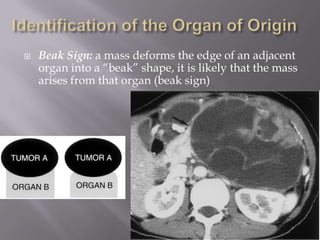
   Beak Sign: a mass deforms the edge of an adjacent
    organ into a “beak” shape, it is likely that the mass
    arises from that organ (beak sign)
Embedded Organ Sign.—When a tumor compresses an
adjacent plastic organ (eg, gastrointestinal tract, inferior
vena cava) that is not the organ of origin.
   Phantom (Invisible) Organ Sign.—When a
    large mass arises from a small organ, the organ
    sometimes becomes undetectable.
   Prominent Feeding Artery Sign.—
    Hypervascular masses are often supplied by
    feeding arteries that are prominent enough to
    be visualized at CT or MR imaging, a finding
    that provides an important key to
    understanding the origin of the mass.
   Although the MR imaging appearance of most
    soft-tissue masses is nonspecific
    The presence of certain histologic components
    (eg, myxoid stroma, collagen
    fibers, calcification, and fat) can be suggested
    by evaluating intralesion signal intensity and
    enhancement patterns.
    Determination of the dominant histologic
    component can help narrow the differential
    diagnosis of the lesion.
   However, management changes a bit
Poorly differentiated liposarcoma
   Target Sign: a central area of low to
    intermediate signal intensity surrounded by a
    ring of high signal intensity on T2-weighted
    images
   Corresponds to fibrous tissue centrally and
    myxoid tissue peripherally and is commonly
    seen in neurofibroma and schwannoma
Neurofibroma
   Bowl of Fruit Sign: A mosaic of mixed
    low, intermediate, and high signal intensity on
    T2- weighted images as a result of admixture of
    solid components, cystic
    degeneration, hemorrhage, myxoid
    stroma, and fibrous tissue.
   This finding is commonly seen in malignant
    fibrous histiocytoma, synovial sarcoma, and
    Ewing sarcoma.
Malignant fibrous histiocytoma
   Proliferation of fibroblasts, infiltration of acute
    inflammatory cells, and proliferation of
    capillaries, surrounded by collagen fibers.
   Eitiology
-   Idiopathic (70 %)             -   Focal inflammatory or
-   Around AAAs                       infectious conditions
-   Medications e.g.              -   (e.g., diverticulosis, app
    methysergide, beta                endicitis, extravasation
    blockers, methyldopa, h           from the urinary tract).
    ydralazine, antibiotics, a    -    Previous surgery or
    nd some analgesics                radiation treatment.
-   systemic infections           -    Trauma.
    (e.g., tuberculosis, syphi    -   Retroperitoneal
    lis, actinomycosis, bruce         hemorrhage.
    llosis, fungal infections).   -   Marfan's disease.
                                  -   Inflammatow bowel
                                      disease
   Defined as focal area of dilatation of aortic
    diameter >3 cm
   Majority are infrarenal
   2-20 %- juxtrarenal and pararenal
   Atherosclerotic/ degenerative- most common
   Other causes
   Inflammatory aneurysm (5-15 %)

   Results from fibrotic autoimmune reaction to
    atherosclerotic plaque

   Difficult surgical management
   Infected aneurysms
   More prone to rupture
   Increased periaortic fat earliest sign
   Irregularly shaped
Retroperitonium
Retroperitonium
Retroperitonium
Retroperitonium
Retroperitonium
Retroperitonium

Retroperitonium

  • 1.
    References: CT andMR imaging of whole abdomen John R. Haaga, MD, FACR
  • 2.
    Anatomy  Role of imaging in Localization of pathology  Neoplasms
  • 3.
    Posterior peritoneum  Renal (Gerota’s) fasciae  Lateroconal fascia  Musculoaponeurotic plane, embracing the quadratus lumborum and psoas muscles, the diaphragmatic crura and associated ligamentous fascia.
  • 6.
  • 8.
    Iliopsoas compartment - located within and immediate adjacent to psoas muscle - posteromedial to the posterior pararenal space
  • 11.
    The retromesenteric, retrorenal, and lateroconal planes are potential routes of interfascial communication between the retroperitoneal spaces. Retroperitoneal hemorrhage or rapidly expanding fluid collections can spread via these interfascial connections.
  • 12.
    Largest  Pancreas, Duodenum, Colon  Continuous across the midline
  • 14.
    Smallest  Continues anterolaterally into the properitoneal fat, the extraperitoneal fat of the anterior abdominal wall.
  • 21.
    Plain radiograph  USG  CT  MRI
  • 22.
    Pancreatic calcification  Common  Rare - Chronic alcoholic - Idiopathic pancreatitis - Hereditary pancreatitis - Cystic fibrosis - Hyperparathyroidism - Protein malnutrition - Cystic tumours - Cavernous lymphangioma - Islet cell tumours - Haemangioma - Pseudo cysts - Haematoma
  • 30.
    Multidetector CT in retroperitoneal haemorrhages, fluid collections, AAA and masses.  Magnetic resonance (MR) imaging has an increasing role in evaluating soft-tissue masses of the extraperitoneal spaces.
  • 31.
    Below the kidneys, the retroperitoneal spaces -a single space with direct contiguity between the anterior and posterior portions.  Retroperitoneal hemorrhage or fluid spread from the abdominal retroperitoneum into the extraperitoneal pelvis along the anterior and posterior perirenal fasciae, which combine to form the fascial plane in the iliac fossa .  Superiorly, the perirenal fasciae are attached to the diaphragm.  On the right side, the bare area of the liver is directly connected to the anterior pararenal space. Therefore, hepatic lacerations involving the bare area of the liver can be a source (albeit uncommon) of retroperitoneal hemorrhage.
  • 32.
    CT findings of duodenal injury - duodenal wall thickening - periduodenal fluid - Fluid in the right anterior pararenal space - Diminished bowel wall enhancement of the injured segment - extraluminal air (More specific sign of duodenal perforation) - extraluminal oral contrast material air (More specific sign of duodenal perforation) - the “sentinel clot” sign
  • 36.
    Two-thirds of blunt pancreatic injuries occur in the pancreatic body, with the remainder occurring with equal frequency in the head, neck, and tail.
  • 41.
    Goals of imaging - to identify the retroperitoneal hemorrhage, its location and its possible source - to assess its relative stability on the basis of the size and presence (or absence) of active extravasation of intravascular contrast material
  • 42.
    Surgical standpoint, theretroperitoneum can be divided into zones because hematoma location has therapeutic implications
  • 46.
    Pelvic retroperitoneum is the most common location of retroperitoneal hemorrhage, frequently in association with pelvic fractures.
  • 47.
    In the setting of trauma should raise suspicion for - Pancreatic injury - Duodenal injury - Renal collecting system injury (with urine leakage) - Retroperitoneal hemorrhage
  • 48.
    Primary - Lymphoid malignancy : NHL, HL, HIV related NHL - Enlarged LNs in HIV - Soft tissue masses  Secondary - Lymphnodes Testicular, Prostate - Metastases UB, Cervix etc..
  • 49.
    Lymphnodes 1) Paracaval and paraortic : > 10 mm 2) Retrocural : > 7 mm  MRI has better distinction than CT between LNs and vessels and bowels
  • 50.
     NHL/HD  ParaorticLN very frequent in NHL as compared to HD Ann Arbor staging
  • 53.
    Characterization of the Retroperitoneal Space  Displacement of retroperitoneal organs strongly suggests that the tumor arises in the retroperitoneum  Displacement of Major vessels and some of their branches
  • 54.
    Beak Sign: a mass deforms the edge of an adjacent organ into a “beak” shape, it is likely that the mass arises from that organ (beak sign)
  • 55.
    Embedded Organ Sign.—Whena tumor compresses an adjacent plastic organ (eg, gastrointestinal tract, inferior vena cava) that is not the organ of origin.
  • 56.
    Phantom (Invisible) Organ Sign.—When a large mass arises from a small organ, the organ sometimes becomes undetectable.  Prominent Feeding Artery Sign.— Hypervascular masses are often supplied by feeding arteries that are prominent enough to be visualized at CT or MR imaging, a finding that provides an important key to understanding the origin of the mass.
  • 57.
    Although the MR imaging appearance of most soft-tissue masses is nonspecific  The presence of certain histologic components (eg, myxoid stroma, collagen fibers, calcification, and fat) can be suggested by evaluating intralesion signal intensity and enhancement patterns.  Determination of the dominant histologic component can help narrow the differential diagnosis of the lesion.  However, management changes a bit
  • 58.
  • 59.
    Target Sign: a central area of low to intermediate signal intensity surrounded by a ring of high signal intensity on T2-weighted images  Corresponds to fibrous tissue centrally and myxoid tissue peripherally and is commonly seen in neurofibroma and schwannoma
  • 60.
  • 61.
    Bowl of Fruit Sign: A mosaic of mixed low, intermediate, and high signal intensity on T2- weighted images as a result of admixture of solid components, cystic degeneration, hemorrhage, myxoid stroma, and fibrous tissue.  This finding is commonly seen in malignant fibrous histiocytoma, synovial sarcoma, and Ewing sarcoma.
  • 62.
  • 63.
    Proliferation of fibroblasts, infiltration of acute inflammatory cells, and proliferation of capillaries, surrounded by collagen fibers.
  • 64.
    Eitiology - Idiopathic (70 %) - Focal inflammatory or - Around AAAs infectious conditions - Medications e.g. - (e.g., diverticulosis, app methysergide, beta endicitis, extravasation blockers, methyldopa, h from the urinary tract). ydralazine, antibiotics, a - Previous surgery or nd some analgesics radiation treatment. - systemic infections - Trauma. (e.g., tuberculosis, syphi - Retroperitoneal lis, actinomycosis, bruce hemorrhage. llosis, fungal infections). - Marfan's disease. - Inflammatow bowel disease
  • 67.
    Defined as focal area of dilatation of aortic diameter >3 cm  Majority are infrarenal  2-20 %- juxtrarenal and pararenal  Atherosclerotic/ degenerative- most common  Other causes
  • 69.
    Inflammatory aneurysm (5-15 %)  Results from fibrotic autoimmune reaction to atherosclerotic plaque  Difficult surgical management
  • 71.
    Infected aneurysms  More prone to rupture  Increased periaortic fat earliest sign  Irregularly shaped