
IS Presentation
Topic : Ultrasonic level Measurment
Principle : Ultrasonic level instruments operate on the
basic principle of using sound waves to determine liquid/
solid/slurries level.
• In addition to standard level or volume measurement,
they can monitor open channel flow, determine the
actual volumetric throughput in lift stations, measure
differential level and control the pumps.
• Ultrasonic Level Transmitters consist of two
elements:
1) a high efficiency transducer and,
2) an associated electronic transceiver.
 Together, they operate to determine the time for a
transmitted ultrasonic pulse and its reflected echo to make
a complete return trip between the non-contacting
transducer and the sensed material level.
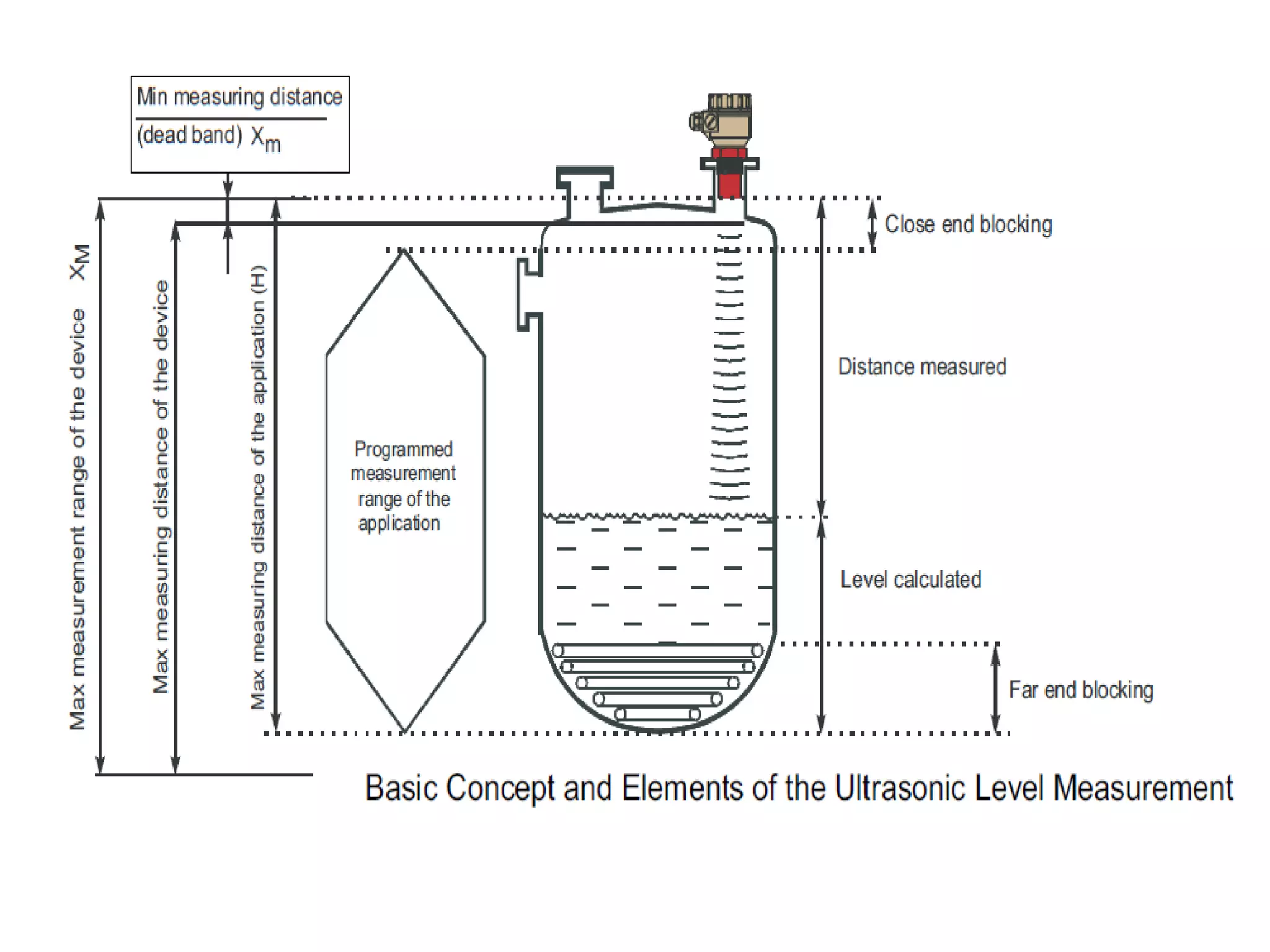
 As shown in Figure, a top-of-tank mounted transducer
directs waves downward in bursts onto the surface of the
material whose level is to be measured.
 A piezoelectric crystal inside the transducer converts
electrical pulses into sound energy that travels in the form
of a wave at the established frequency and at a constant
speed in a given medium.
 Echoes of these waves return to the transducer, which
performs calculations to convert the distance of wave
travel into a measure of level in the tank.
• Minimum measuring distance (X ): (also known as the
“Dead Band”) is a feature common to all m ultrasonic level
meters. This is a short range in front of the sensor within
which the ultrasonic device can not measure.
• Maximum measuring distance (X ): The longest range
under ideal condition within which the device can M measure.
No measurement is possible beyond this distance.
frequency range for ultrasonic methods is in the range of
15...200 kHz. The lower frequency instruments are used for
more difficult applications; such as longer distances and solid
level measurements and those with higher frequency are
used for shorter liquid level measurements.
Factors effecting this method
1. The speed of sound through the medium (usually air)
varies with the medium’s temperature.
2. The presence of heavy foam/dust on the surface of the
material can act as a sound absorbent.
3. Extreme turbulence of the liquid can cause fluctuating
readings.
Indumart Inc. model
Indumart Ultrasonic Level Transmitter is capable of monitoring virtually
any short to medium range noncontact ultrasonic level measurements of
most free flowing solids (granules and powders) and liquids.
A definite advantage of some models
of Indumart Ultrasonic Level
Transmitter is their narrow total
beam angle of 5° or 6° at -3 dB . As a
result of narrow beam angle, the
emitted ultrasonic signal ensures
outstanding focusing and good
penetration trough dust, and
furthermore, provides reliable
measurements in narrow silos with
uneven side walls and protruding
Ultrasonic level instrument

Ultrasonic level instrument

  • 1.
    IS Presentation Topic :Ultrasonic level Measurment
  • 2.
    Principle : Ultrasoniclevel instruments operate on the basic principle of using sound waves to determine liquid/ solid/slurries level. • In addition to standard level or volume measurement, they can monitor open channel flow, determine the actual volumetric throughput in lift stations, measure differential level and control the pumps. • Ultrasonic Level Transmitters consist of two elements: 1) a high efficiency transducer and, 2) an associated electronic transceiver.
  • 3.
     Together, theyoperate to determine the time for a transmitted ultrasonic pulse and its reflected echo to make a complete return trip between the non-contacting transducer and the sensed material level.  As shown in Figure, a top-of-tank mounted transducer directs waves downward in bursts onto the surface of the material whose level is to be measured.  A piezoelectric crystal inside the transducer converts electrical pulses into sound energy that travels in the form of a wave at the established frequency and at a constant speed in a given medium.  Echoes of these waves return to the transducer, which performs calculations to convert the distance of wave travel into a measure of level in the tank.
  • 5.
    • Minimum measuringdistance (X ): (also known as the “Dead Band”) is a feature common to all m ultrasonic level meters. This is a short range in front of the sensor within which the ultrasonic device can not measure. • Maximum measuring distance (X ): The longest range under ideal condition within which the device can M measure. No measurement is possible beyond this distance. frequency range for ultrasonic methods is in the range of 15...200 kHz. The lower frequency instruments are used for more difficult applications; such as longer distances and solid level measurements and those with higher frequency are used for shorter liquid level measurements.
  • 6.
    Factors effecting thismethod 1. The speed of sound through the medium (usually air) varies with the medium’s temperature. 2. The presence of heavy foam/dust on the surface of the material can act as a sound absorbent. 3. Extreme turbulence of the liquid can cause fluctuating readings.
  • 7.
    Indumart Inc. model IndumartUltrasonic Level Transmitter is capable of monitoring virtually any short to medium range noncontact ultrasonic level measurements of most free flowing solids (granules and powders) and liquids. A definite advantage of some models of Indumart Ultrasonic Level Transmitter is their narrow total beam angle of 5° or 6° at -3 dB . As a result of narrow beam angle, the emitted ultrasonic signal ensures outstanding focusing and good penetration trough dust, and furthermore, provides reliable measurements in narrow silos with uneven side walls and protruding