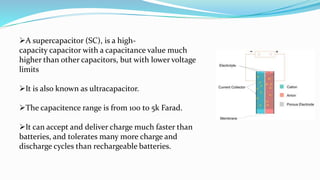
A supercapacitor (SC), is a high-
capacity capacitor with a capacitance value much
higher than other capacitors, but with lower voltage
limits
It is also known as ultracapacitor.
The capacitence range is from 100 to 5k Farad.
It can accept and deliver charge much faster than
batteries, and tolerates many more charge and
discharge cycles than rechargeable batteries.
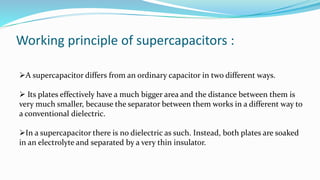
A supercapacitor differs from an ordinary capacitor in two different ways.
 Its plates effectively have a much bigger area and the distance between them is
very much smaller, because the separator between them works in a different way to
a conventional dielectric.
In a supercapacitor there is no dielectric as such. Instead, both plates are soaked
in an electrolyte and separated by a very thin insulator.
Working principle of supercapacitors :
When the plates are charged up, an opposite charge forms on
either side of the separator, creating what’s called a electric double
layer, maybe just one molecule thick.
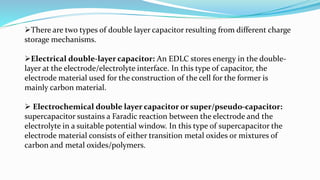
There are two types of double layer capacitor resulting from different charge
storage mechanisms.
Electrical double-layer capacitor: An EDLC stores energy in the double-
layer at the electrode/electrolyte interface. In this type of capacitor, the
electrode material used for the construction of the cell for the former is
mainly carbon material.
 Electrochemical double layer capacitor or super/pseudo-capacitor:
supercapacitor sustains a Faradic reaction between the electrode and the
electrolyte in a suitable potential window. In this type of supercapacitor the
electrode material consists of either transition metal oxides or mixtures of
carbon and metal oxides/polymers.
Advantages of supercapacitor:
 Provide peak power and backup power.
 Extend battery run time and battery life.
 Reduce battery size, weight and cost.
 Enable low/high (-40⁰C to +65⁰C) temperature operation.
 Improve load balancing when used in parallel with a battery.
 Provide energy storage and source balancing when used with energy harvesters
 Eco-friendly.
Limitations:
 It can’t be used in AC & high frequency circuits.
 High self discharge.
 Low energy density.
 Supercapacitors are generally restricted to operating voltages in the region of
2.5 - 2.7V
 In order to achieve higher operating voltages for supercapacitors, they can be
placed in series. This reduces the total capacitance.
Applications:
 They can primarily be found in applications that require rapid charge and
discharge cycles, such as in automobiles where they are used for regenerative
braking.
 Another common application for supercapacitors is in wind turbines. Here,
very large supercapacitors help to smooth out the intermittent power supplied
by the wind.
 Due to unique storage capability of supercapacitors, it has been widely used in
various applications like electric drives, UPS, electric vehicles, SSD’s, LED
flashlights etc.

Supercapacitors.pptx

  • 2.
    A supercapacitor (SC),is a high- capacity capacitor with a capacitance value much higher than other capacitors, but with lower voltage limits It is also known as ultracapacitor. The capacitence range is from 100 to 5k Farad. It can accept and deliver charge much faster than batteries, and tolerates many more charge and discharge cycles than rechargeable batteries.
  • 3.
    A supercapacitor differsfrom an ordinary capacitor in two different ways.  Its plates effectively have a much bigger area and the distance between them is very much smaller, because the separator between them works in a different way to a conventional dielectric. In a supercapacitor there is no dielectric as such. Instead, both plates are soaked in an electrolyte and separated by a very thin insulator. Working principle of supercapacitors :
  • 4.
    When the platesare charged up, an opposite charge forms on either side of the separator, creating what’s called a electric double layer, maybe just one molecule thick.
  • 5.
    There are twotypes of double layer capacitor resulting from different charge storage mechanisms. Electrical double-layer capacitor: An EDLC stores energy in the double- layer at the electrode/electrolyte interface. In this type of capacitor, the electrode material used for the construction of the cell for the former is mainly carbon material.  Electrochemical double layer capacitor or super/pseudo-capacitor: supercapacitor sustains a Faradic reaction between the electrode and the electrolyte in a suitable potential window. In this type of supercapacitor the electrode material consists of either transition metal oxides or mixtures of carbon and metal oxides/polymers.
  • 6.
    Advantages of supercapacitor: Provide peak power and backup power.  Extend battery run time and battery life.  Reduce battery size, weight and cost.  Enable low/high (-40⁰C to +65⁰C) temperature operation.  Improve load balancing when used in parallel with a battery.  Provide energy storage and source balancing when used with energy harvesters  Eco-friendly.
  • 7.
    Limitations:  It can’tbe used in AC & high frequency circuits.  High self discharge.  Low energy density.  Supercapacitors are generally restricted to operating voltages in the region of 2.5 - 2.7V  In order to achieve higher operating voltages for supercapacitors, they can be placed in series. This reduces the total capacitance.
  • 8.
    Applications:  They canprimarily be found in applications that require rapid charge and discharge cycles, such as in automobiles where they are used for regenerative braking.  Another common application for supercapacitors is in wind turbines. Here, very large supercapacitors help to smooth out the intermittent power supplied by the wind.  Due to unique storage capability of supercapacitors, it has been widely used in various applications like electric drives, UPS, electric vehicles, SSD’s, LED flashlights etc.