Kinran
HAStark
1
‹#›
2015 © All rights reserved to
From Data Science to Data Impact:
On many ways to segment your players
Volodymyr (Vlad) Kazantsev
Head of Data Science at Product Madness
jobs@productmadness.com
volodymyrk
‹#›
What we do?
jobs@productmadness.com volodymyr.kazantsev@productmadness.com volodymyrk
‹#›
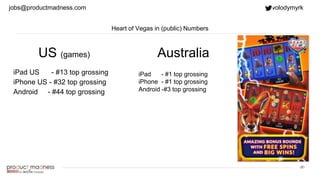
Heart of Vegas in (public) Numbers
iPad US - #13 top grossing
iPhone US - #32 top grossing
Android - #44 top grossing
US (games) Australia
iPad - #1 top grossing
iPhone - #1 top grossing
Android -#3 top grossing
jobs@productmadness.com volodymyrk
‹#›
Data Impact Team
Ad-hoc analytics;
dashboards
Deep dive analysis;
Predictive analytics
ETL, R&D
jobs@productmadness.com volodymyrk
‹#›
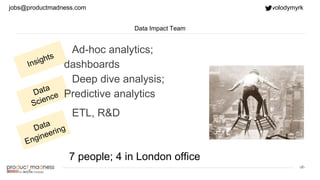
Data Impact Team
7 people; 4 in London office
jobs@productmadness.com volodymyrk
Ad-hoc analytics;
dashboards
Deep dive analysis;
Predictive analytics
ETL, R&D
‹#›
Ad-hoc analytics;
dashboards
Deep dive analysis;
Predictive analytics
ETL, R&D
Data Impact Team
7 people; 4 in London office
jobs@productmadness.com volodymyrk
‹#›
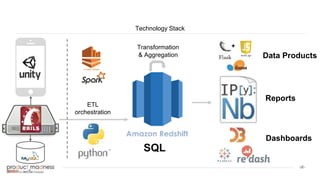
Technology Stack
ETL
orchestration
Transformation
& Aggregation
SQL
Data Products
Reports
Dashboards
+
‹#›
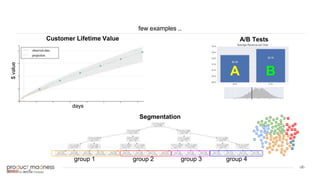
few examples ..
A B
A/B TestsCustomer Lifetime Value
days
$value
Segmentation
group 1 group 2 group 3 group 4
‹#
›
Segmentation Basics
1
‹#›
Successful segmentation is the product of a detailed
understanding of your market and will therefore take time
- Market Segmentation: How to Do it and Profit from it, 4th edition: Malcolm McDonald
‹#›
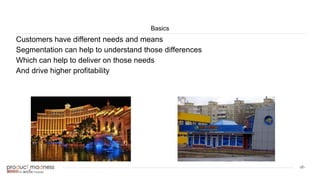
Basics
Customers have different needs and means
Segmentation can help to understand those differences
Which can help to deliver on those needs
And drive higher profitability
‹#›
What is a Player Segment?
A segment is a group of customers who display similarities to
each other...
Customers move in and out of segments over time
‹#›
How many segments are there?
There is no one right way to segment (not should there be):
Many different approaches and techniques
Mix of art, science, common sense, experience and practical knowledge
Depends on business needs and availability of data
Don’t aim to build one holistic model to meet all needs
‹#›
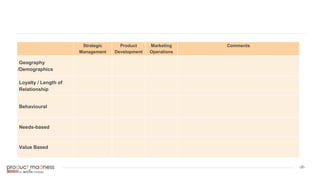
Strategic
Management
Product
Development
Marketing
Operations
Comments
Geography
/Demographics
Loyalty / Length of
Relationship
Behavioural
Needs-based
Value Based
‹#›
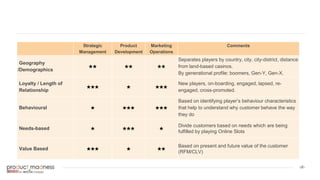
Strategic
Management
Product
Development
Marketing
Operations
Comments
Geography
/Demographics
✭✭ ✭✭ ✭✭
Separates players by country, city, city-district, distance
from land-based casinos.
By generational profile: boomers, Gen-Y, Gen-X.
Loyalty / Length of
Relationship
✭✭✭ ✭ ✭✭✭
New players, on-boarding, engaged, lapsed, re-
engaged, cross-promoted.
Behavioural ✭ ✭✭✭ ✭✭✭
Based on identifying player’s behaviour characteristics
that help to understand why customer behave the way
they do
Needs-based ✭ ✭✭✭ ✭
Divide customers based on needs which are being
fulfilled by playing Online Slots
Value Based ✭✭✭ ✭ ✭✭
Based on present and future value of the customer
(RFM/CLV)
‹#›
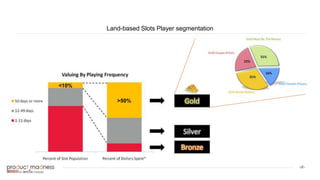
Land-based Slots Player segmentation
<10%
>50%
‹#›
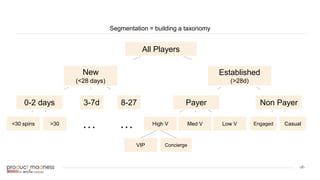
Segmentation = building a taxonomy
All Players
New
(<28 days)
Established
(>28d)
Payer Non Payer0-2 days 3-7d 8-27
<30 spins >30 … High V Med V Low V Engaged Casual…
VIP Concierge
‹#›
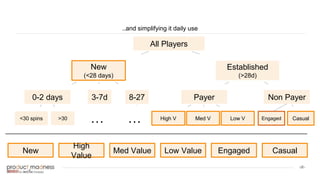
..and simplifying it daily use
All Players
New
(<28 days)
Established
(>28d)
Payer Non Payer0-2 days 3-7d 8-27
<30 spins >30 … High V Med V Low V Casual…
New
High
Value
Med Value Low Value Engaged Casual
Engaged
‹#
›
How to profit from Segmentation?
2
‹#›
Clients of Segmentation
○ Strategy and Finance
○ Product development
○ Marketing operations
‹#›
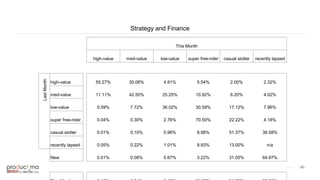
Strategy and Finance
This Month
high-value med-value low-value super free-rider casual slotter recently lapsed
high-value 55.27% 30.06% 4.81% 5.54% 2.00% 2.32%
med-value 11.11% 42.50% 25.25% 10.92% 6.20% 4.02%
low-value 0.59% 7.72% 36.02% 30.59% 17.12% 7.96%
super free-rider 0.04% 0.30% 2.76% 70.50% 22.22% 4.18%
casual slotter 0.01% 0.10% 0.96% 8.98% 51.37% 38.58%
recently lapsed 0.05% 0.22% 1.01% 8.93% 13.00% n/a
New 0.01% 0.08% 0.67% 3.22% 31.05% 64.97%
LastMonth
‹#›
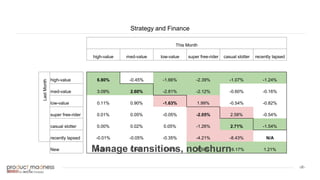
Strategy and Finance
This Month
high-value med-value low-value super free-rider casual slotter recently lapsed
high-value 6.80% -0.45% -1.66% -2.39% -1.07% -1.24%
med-value 3.09% 2.60% -2.81% -2.12% -0.60% -0.16%
low-value 0.11% 0.90% -1.63% 1.99% -0.54% -0.82%
super free-rider 0.01% 0.05% -0.05% -2.05% 2.58% -0.54%
casual slotter 0.00% 0.02% 0.05% -1.26% 2.71% -1.54%
recently lapsed -0.01% -0.05% -0.35% -4.21% -8.43% N/A
New 0.01% 0.04% 0.36% 1.59% 16.17% 1.21%Manage transitions, not churn
LastMonth
‹#›
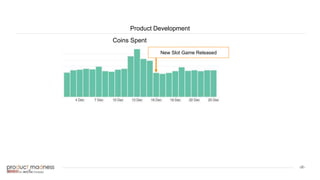
Product Development
New Slot Game Released
Coins Spent
‹#›
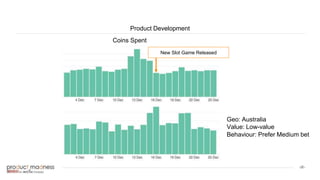
Product Development
Geo: Australia
Value: Low-value
Behaviour: Prefer Medium bet
New Slot Game Released
Coins Spent
‹#›
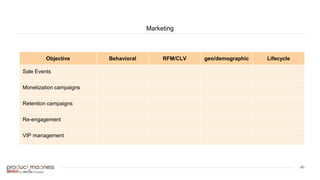
Marketing
Objective Behavioral RFM/CLV geo/demographic Lifecycle
Sale Events
Monetization campaigns
Retention campaigns
Re-engagement
VIP management
‹#
›
How to actually do segmentation?
3
‹#›
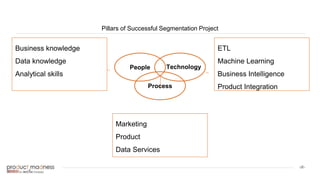
Pillars of Successful Segmentation Project
Business knowledge
Data knowledge
Analytical skills
People
Process
Technology
ETL
Machine Learning
Business Intelligence
Product Integration
Marketing
Product
Data Services
‹#›
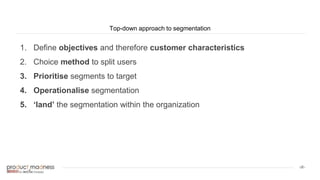
Top-down approach to segmentation
1. Define objectives and therefore customer characteristics
a.dd
2. Choice method to split users
a.d
3. Prioritise segments to target
a.d
4. Operationalise segmentation
a.s
5. ‘land’ the segmentation within the organization
‹#›
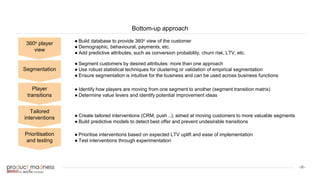
Bottom-up approach
360o player
view
Segmentation
Player
transitions
Tailored
interventions
Prioritisation
and testing
● Build database to provide 360o view of the customer
● Demographic, behavioural, payments, etc.
● Add predictive attributes, such as conversion probability, churn risk, LTV, etc.
● Segment customers by desired attributes: more than one approach
● Use robust statistical techniques for clustering or validation of empirical segmentation
● Ensure segmentation is intuitive for the business and can be used across business functions
● Identify how players are moving from one segment to another (segment transition matrix)
● Determine value levers and identify potential improvement ideas
● Create tailored interventions (CRM, push ..), aimed at moving customers to more valuable segments
● Build predictive models to detect best offer and prevent undesirable transitions
● Prioritise interventions based on expected LTV uplift and ease of implementation
● Test interventions through experimentation
‹#›
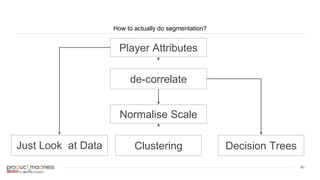
How to actually do segmentation?
Just Look at Data Clustering Decision Trees
Player Attributes
de-correlate
Normalise Scale
‹#›
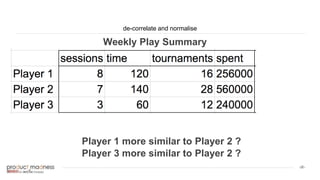
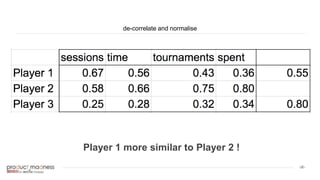
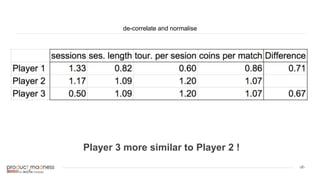
de-correlate and normalise
Player 1 more similar to Player 2 ?
Player 3 more similar to Player 2 ?
Weekly Play Summary
‹#›
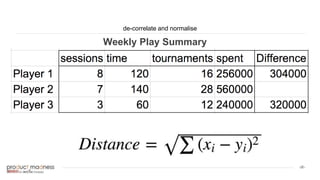
de-correlate and normalise
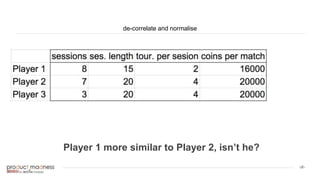
Weekly Play Summary
‹#›
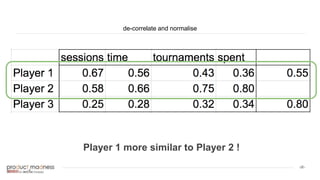
de-correlate and normalise
Player 1 more similar to Player 2 !
‹#›
de-correlate and normalise
Player 1 more similar to Player 2 !
‹#›
de-correlate and normalise
Player 1 more similar to Player 2, isn’t he?
‹#›
de-correlate and normalise
Player 3 more similar to Player 2 !
‹#›
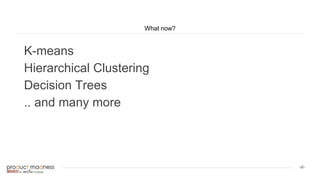
What now?
K-means
Hierarchical Clustering
Decision Trees
.. and many more
‹#›
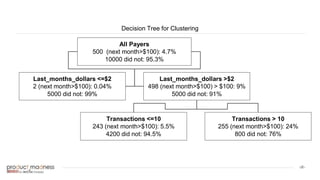
Decision Tree for Clustering
All Payers
500 (next month>$100): 4.7%
10000 did not: 95.3%
Last_months_dollars <=$2
2 (next month>$100): 0.04%
5000 did not: 99%
Last_months_dollars >$2
498 (next month>$100) > $100: 9%
5000 did not: 91%
Transactions <=10
243 (next month>$100): 5.5%
4200 did not: 94.5%
Transactions > 10
255 (next month>$100): 24%
800 did not: 76%
‹#›
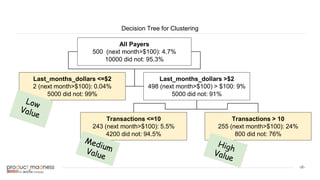
Decision Tree for Clustering
All Payers
500 (next month>$100): 4.7%
10000 did not: 95.3%
Last_months_dollars <=$2
2 (next month>$100): 0.04%
5000 did not: 99%
Last_months_dollars >$2
498 (next month>$100) > $100: 9%
5000 did not: 91%
Transactions <=10
243 (next month>$100): 5.5%
4200 did not: 94.5%
Transactions > 10
255 (next month>$100): 24%
800 did not: 76%
‹#
›
Segmentation at Product Madness
4
‹#›
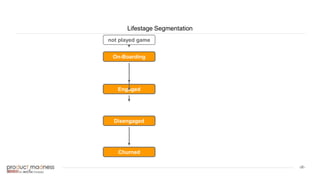
Lifestage Segmentation
On-Boarding
Disengaged
Engaged
not played game
Churned
‹#›
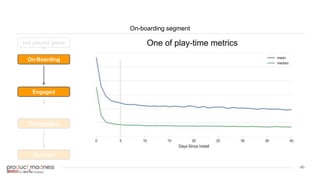
On-boarding segment
On-Boarding
Disengaged
Engaged
not played game
Churned
‹#›
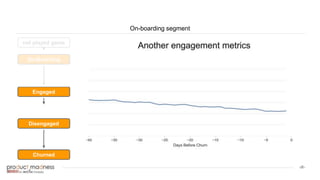
On-boarding segment
On-Boarding
Disengaged
Engaged
not played game
Churned
‹#›
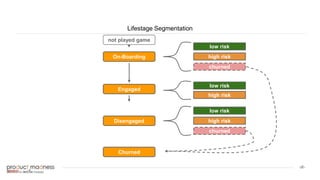
Lifestage Segmentation
On-Boarding
Disengaged
Engaged
low risk
high risk
low risk
high risk
low risk
high risk
not played game
churned
churned
Churned
‹#›
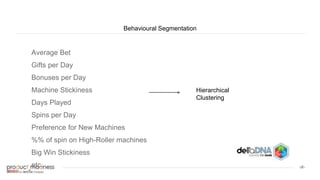
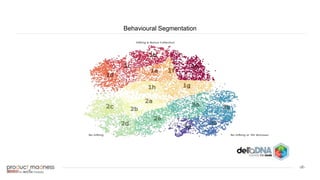
Behavioural Segmentation
Average Bet
Gifts per Day
Bonuses per Day
Machine Stickiness
Days Played
Spins per Day
Preference for New Machines
%% of spin on High-Roller machines
Big Win Stickiness
etc.
Hierarchical
Clustering
‹#›
Behavioural Segmentation
‹#›
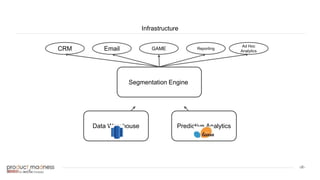
Infrastructure
Data Warehouse
Segmentation Engine
CRM Email GAME Reporting
Ad Hoc
Analytics
Predictive Analytics
‹#›
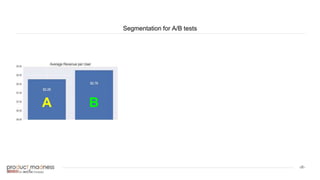
Segmentation for A/B tests
A B
‹#›
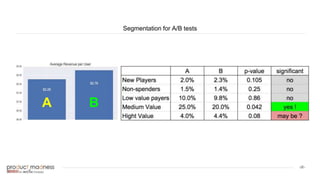
Segmentation for A/B tests
A B
‹#›
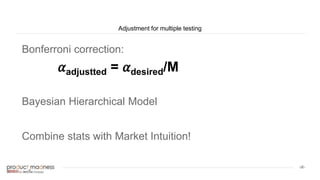
Bonferroni correction:
Bayesian Hierarchical Model
Combine stats with Market Intuition!
Adjustment for multiple testing
𝛼adjustted = 𝛼desired/M
‹#›
2015 © All rights reserved to
Thank You!
jobs@productmadness.com
volodymyr.kazantsev@productmadness.com
volodymyrk
JOIN IN THE CONVERSATION PARTICIPATE IN THE NEXT GIAF
Analytics for Games
www.deltadna.com/giaf
events@deltadna.com
#UKGIAF

UK GIAF Summer 2015 - From data science to data impact

Editor's Notes

  • #6 \/ \/ \/ \/ \/ \/ \/ US (games) iPad US - #13 top grossing iPhone US - #32 top grossing Android - #44 top grossing Australia Who cares about Australia. We do iPad - #1 top grossing iPhone - #1 top grossing Android -#3 top grossing Overall, not only games
  • #7 Ad-hoc analytics, daily fires, dashboards, Insights Deep dive analysis - reports that take few weeks to complete; Predictive analytics, Machine learning, statistical modelling Data Pipeline, platform for machine learning and modelling
  • #8 Insights Data Science Data Engineering 7 people; 4 in London office
  • #9 We Are Hiring ! jobs@productmadness.com
  • #10 Events are generated on server-side. This way we control data quality. We are processing 350 Million events per day They got ingested into Amazon Cloud to S3, with the help of Python and Spark. And then got copied to Amazon Redshift - Columnar parallel database. Currently we have 12 nodes, with total capacity of 24TB Once the data is in there - we do all heavy aggregations and transformations. We have moved from Hadoop more than a year ago and haven’t looked back since. We perform most of interactive analysis in Python Notebooks. For trivial things we are using re.dash, which is similar to Mode and Periscope. It is Web-based SQL client with integrated plotting and collaboration functionality. You can even create dashboards with re.dash, but for production dashboards we prefer to use Tableau or our own D3.js-based application. All our web applications are using Python backend, Flask framework. We use scikit-learn for machine learning and predictive analytics. As you have probably guessed, we like Python.
  • #11 What we do: AB tests bread and butter of data science teams yet controversial and often misunderstood Customer Lifetime Value modelling knowing how much your customer worth, shortly after you acquite them is a holy-grail of User Acqusition can easily spend next 40 minutes talking about customer lifetime value modelling, but .. So - segmentation
  • #12 In this presentation I will not be taking in details about classification algorithm, dimensionality reduction or machine learning. Instead, we will be looking at segmentation from Product Marketing perspective.
  • #13 Successful segmentation is the product of a detailed understanding of your market and will therefore take time Segmentation is not a two-weeks task you assign to your analytics department
  • #14 Customers have different needs and means. Some players play for fun, others got a kick from competition. We all know that players have very different willingness to pay. Most of you know how rare it is to find a Normal Distribution among our players - our games are played by outliers. If you remove outliers from any analysis - you will probably miss the point of it. Segmentation can help to understand those differences Which can help to deliver on those needs And drive higher profitability
  • #15 A segment is a group of customers who display similarities to each other... They may react similarly in a product/service offering They may provide comparable values (profitability) to the company They may bear the same needs or behave in alike ways Customers move in and out of segments over time
  • #16 There is no one right way to segment (not should there be): Many different approaches and techniques. I will cover few techniques in the following slides. Mix of art, science, common sense, experience and practical knowledge You need to take business needs into account, but also what data is available and can be used, operationally. Don’t aim to build one holistic taxonomy to meet all needs, So what are different types of segmentation? How do you approach a problem like this?
  • #17 Multiple way to segment users And there are different use cases for segmentation. You can segment on: geography and basic demographics. In our case - Australian players are very important, and usually behave quite differently from the rest of the world. You can segment based on stage in a player’s Lifecycle - new players behave differently to someone who have been playing your game for the last two years. Also, knowing users who are showing signs of disengagement is very important. You can also segment on Behaviour, Needs (if you can identify them, possibly based on observed behaviour) and, of course, based on Player Value. But different parts of the business are interested in different segmentations.
  • #18 Product Managers and Marketing teams might be very interested in Behavioural Segments. But CEO may be more interested to track retention metric for your most valuable players (whales).
  • #19 The actual segmentation might be hybrid. This is the segmentation of the Land-based Slot players. First layer - by frequency of play, e.g. engagement Second layers - bahavioural
  • #22 But of course, it is important to understand why segmentation is useful for a business. What decisions can it help to make? And how it can affect daily operations and possibly product?
  • #23 Clients of Segmentation Strategy and Finance Product development Marketing operations
  • #24 Strategy and Finance
  • #26 When we looked at data after launch, amount of coints spent has actually dropped on the day of the launch! But was it even a real drop?
  • #27 But for a specific segment, that day was very positive.
  • #30 Business knowledge: - high-level segments goals - product/marketing strategy Data knowledge: - how to access 360 view? - what are segments definitions? Stats/Analytical skills - how to profile various segments? ETL - recalculated daily or real-time - regular reviews Integration with back-office and game - segmentation engine + ETL Dashboards Reporting Marketing: - day-2-day campaigns for segments - reporting (monthly and daily) Product - review feature success for segment Analytics and data engineering - ongoing support and refinement
  • #31 What are business objectives and therefore customer characteristics we should use to profile the market? What approach should we take to ensure segments accurately represent the market and actionable? What criteria should we use to prioritise segments and select targets? How can we ensure segmentation is operational and can be deployed? How to do ‘land’ the segmentation within the organization and ensure it gains traction?
  • #40 K-means Hierarchical Clustering Decision Trees .. and many more