UK Film
Consumption
Abi Bacon
What is the overall trend in film consumption?
Growth/decline?
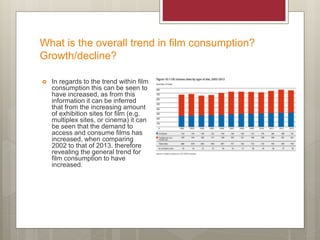
 In regards to the trend within film
consumption this can be seen to
have increased, as from this
information it can be inferred
that from the increasing amount
of exhibition sites for film (e.g.
multiplex sites, or cinema) it can
be seen that the demand to
access and consume films has
increased, when comparing
2002 to that of 2013. therefore
revealing the general trend for
film consumption to have
increased.
Who watches films in the UK (age, gender, other
characteristics)
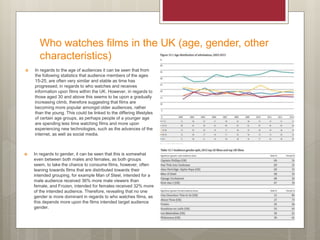
 In regards to the age of audiences it can be seen that from
the following statistics that audience members of the ages
15-25, are often very similar and stable as time has
progressed, in regards to who watches and receives
information upon films within the UK. However, in regards to
those aged 30 and above this seems to be upon a gradually
increasing climb, therefore suggesting that films are
becoming more popular amongst older audiences, rather
than the young. This could be linked to the differing lifestyles
of certain age groups, as perhaps people of a younger age
are spending less time watching films and more upon
experiencing new technologies, such as the advances of the
internet, as well as social media.
 In regards to gender, it can be seen that this is somewhat
even between both males and females, as both groups
seem, to take the chance to consume films, however, often
leaning towards films that are distributed towards their
intended grouping, for example Man of Steel, intended for a
male audience received 36% more male viewers than
female, and Frozen, intended for females received 32% more
of the intended audience. Therefore, revealing that no one
gender is more dominant in regards to who watches films, as
this depends more upon the films intended target audience
gender.
Who watches films in the UK (age, gender, other
characteristics)
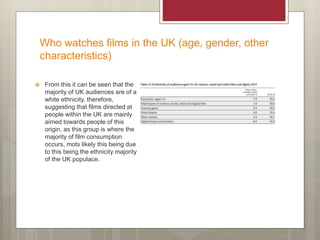
 From this it can be seen that the
majority of UK audiences are of a
white ethnicity, therefore,
suggesting that films directed at
people within the UK are mainly
aimed towards people of this
origin, as this group is where the
majority of film consumption
occurs, mots likely this being due
to this being the ethnicity majority
of the UK populace.
Which audience groups are under-represented in
the figures?
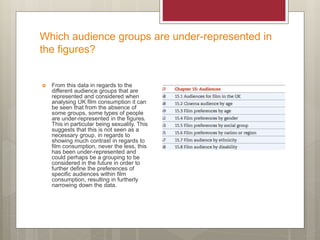
 From this data in regards to the
different audience groups that are
represented and considered when
analysing UK film consumption it can
be seen that from the absence of
some groups, some types of people
are under-represented in the figures.
This in particular being sexuality. This
suggests that this is not seen as a
necessary group, in regards to
showing much contrast in regards to
film consumption, never the less, this
has been under-represented and
could perhaps be a grouping to be
considered in the future in order to
further define the preferences of
specific audiences within film
consumption, resulting in furtherly
narrowing down the data.
Where/how do people watch
films?
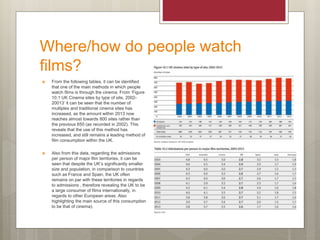
 From the following tables, it can be identified
that one of the main methods in which people
watch films is through the cinema. From ‘Figure
10.1 UK Cinema sites by type of site, 2002-
20013’ it can be seen that the number of
multiplex and traditional cinema sites has
increased, as the amount within 2013 now
reaches almost towards 800 sites rather than
the previous 650 (as recorded in 2002). This
reveals that the use of this method has
increased, and still remains a leading method of
film consumption within the UK.
 Also from this data, regarding the admissions
per person of major film territories, it can be
seen that despite the UK’s significantly smaller
size and population, in comparison to countries
such as France and Spain, the UK often
remains on par with these territories in regards
to admissions , therefore revealing the UK to be
a large consumer of films internationally, in
regards to other European areas. Also
highlighting the main source of this consumption
to be that of cinema).
Where/how do people watch
films?
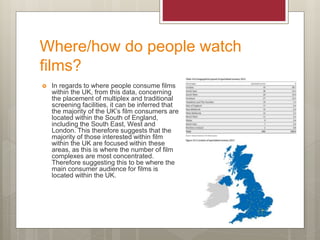
 In regards to where people consume films
within the UK, from this data, concerning
the placement of multiplex and traditional
screening facilities, it can be inferred that
the majority of the UK’s film consumers are
located within the South of England,
including the South East, West and
London. This therefore suggests that the
majority of those interested within film
within the UK are focused within these
areas, as this is where the number of film
complexes are most concentrated.
Therefore suggesting this to be where the
main consumer audience for films is
located within the UK.
Where/how do people watch
films?
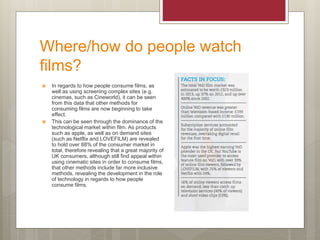
 In regards to how people consume films, as
well as using screening complex sites (e.g.
cinemas, such as Cineworld), it can be seen
from this data that other methods for
consuming films are now beginning to take
effect.
 This can be seen through the dominance of the
technological market within film. As products
such as apple, as well as on demand sites
(such as Netflix and LOVEFILM) are revealed
to hold over 88% of the consumer market in
total, therefore revealing that a great majority of
UK consumers, although still find appeal within
using cinematic sites in order to consume films,
that other methods include far more inclusive
methods, revealing the development in the role
of technology in regards to how people
consume films.
What type of films are the most popular?
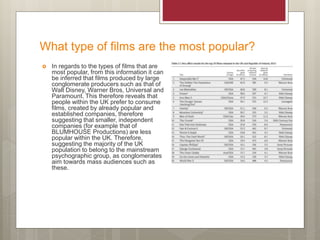
 In regards to the types of films that are
most popular, from this information it can
be inferred that films produced by large
conglomerate producers such as that of
Walt Disney, Warner Bros, Universal and
Paramount. This therefore reveals that
people within the UK prefer to consume
films, created by already popular and
established companies, therefore
suggesting that smaller, independent
companies (for example that of
BLUMHOUSE Productions) are less
popular within the UK. Therefore,
suggesting the majority of the UK
population to belong to the mainstream
psychographic group, as conglomerates
aim towards mass audiences such as
these.
What type of films are the most popular?
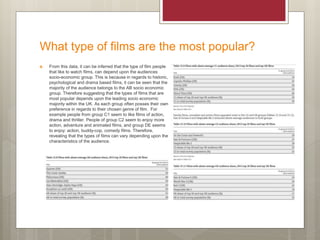
 From this data, it can be inferred that the type of film people
that like to watch films, can depend upon the audiences
socio-economic group. This is because in regards to historic,
psychological and drama based films, it can be seen that the
majority of the audience belongs to the AB socio economic
group. Therefore suggesting that the types of films that are
most popular depends upon the leading socio economic
majority within the UK. As each group often posses their own
preference in regards to their chosen genre of film. For
example people from group C1 seem to like films of action,
drama and thriller. People of group C2 seem to enjoy more
action, adventure and animated films, and group DE seems
to enjoy: action, buddy-cop, comedy films. Therefore,
revealing that the types of films can vary depending upon the
characteristics of the audience.
What role does technology play in the
consumption of film today?
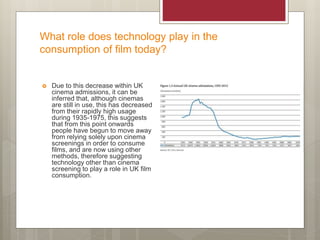
 Due to this decrease within UK
cinema admissions, it can be
inferred that, although cinemas
are still in use, this has decreased
from their rapidly high usage
during 1935-1975, this suggests
that from this point onwards
people have begun to move away
from relying solely upon cinema
screenings in order to consume
films, and are now using other
methods, therefore suggesting
technology other than cinema
screening to play a role in UK film
consumption.
What role does technology play in the
consumption of film today?
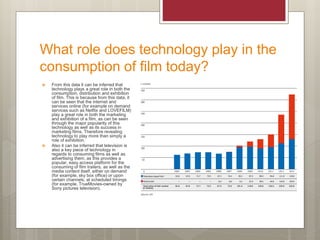
 From this data it can be inferred that
technology plays a great role in both the
consumption, distribution and exhibition
of film. This is because from this data, it
can be seen that the internet and
services online (for example on demand
services such as Netflix and LOVEFILM)
play a great role in both the marketing
and exhibition of a film, as can be seen
through the major popularity of this
technology as well as its success in
marketing films. Therefore revealing
technology to play more than simply a
role of exhibition.
 Also it can be inferred that television is
also a key piece of technology in
regards to consuming films as well as
advertising them, as this provides a
popular, easy access platform for the
consuming of film trailers, as well as the
media content itself, either on demand
(for example, sky box office) or upon
certain channels, at scheduled timings
(for example, TrueMovies-owned by
Sony pictures television).
What role does technology play in the
consumption of film today?
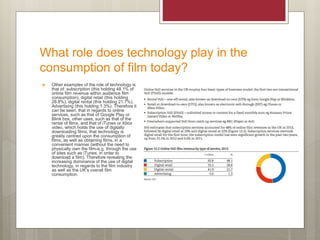
 Other examples of the role of technology is
that of: subscription (this holding 48.1% of
online film revenue within audience film
consumption), digital retail (this holding
28.8%), digital rental (this holding 21.7%),
Advertising (this holding 1.3%). Therefore it
can be seen, that in regards to online
services, such as that of Google Play or
Blink box, other uses, such as that of the
rental of films, and that of iTunes or Xbox
video, which holds the use of digitally
downloading films, that technology is
greatly centred upon the consumption of
films, as well as obtaining films, in a
convenient manner (without the need to
physically own the film-e.g. through the use
of sites such as iTunes, in order to
download a film). Therefore revealing the
increasing dominance of the use of digital
technology, in regards to the film industry
as well as the UK’s overall film
consumption.

UK Film Consumption

  • 1.
  • 2.
    What is theoverall trend in film consumption? Growth/decline?  In regards to the trend within film consumption this can be seen to have increased, as from this information it can be inferred that from the increasing amount of exhibition sites for film (e.g. multiplex sites, or cinema) it can be seen that the demand to access and consume films has increased, when comparing 2002 to that of 2013. therefore revealing the general trend for film consumption to have increased.
  • 3.
    Who watches filmsin the UK (age, gender, other characteristics)  In regards to the age of audiences it can be seen that from the following statistics that audience members of the ages 15-25, are often very similar and stable as time has progressed, in regards to who watches and receives information upon films within the UK. However, in regards to those aged 30 and above this seems to be upon a gradually increasing climb, therefore suggesting that films are becoming more popular amongst older audiences, rather than the young. This could be linked to the differing lifestyles of certain age groups, as perhaps people of a younger age are spending less time watching films and more upon experiencing new technologies, such as the advances of the internet, as well as social media.  In regards to gender, it can be seen that this is somewhat even between both males and females, as both groups seem, to take the chance to consume films, however, often leaning towards films that are distributed towards their intended grouping, for example Man of Steel, intended for a male audience received 36% more male viewers than female, and Frozen, intended for females received 32% more of the intended audience. Therefore, revealing that no one gender is more dominant in regards to who watches films, as this depends more upon the films intended target audience gender.
  • 4.
    Who watches filmsin the UK (age, gender, other characteristics)  From this it can be seen that the majority of UK audiences are of a white ethnicity, therefore, suggesting that films directed at people within the UK are mainly aimed towards people of this origin, as this group is where the majority of film consumption occurs, mots likely this being due to this being the ethnicity majority of the UK populace.
  • 5.
    Which audience groupsare under-represented in the figures?  From this data in regards to the different audience groups that are represented and considered when analysing UK film consumption it can be seen that from the absence of some groups, some types of people are under-represented in the figures. This in particular being sexuality. This suggests that this is not seen as a necessary group, in regards to showing much contrast in regards to film consumption, never the less, this has been under-represented and could perhaps be a grouping to be considered in the future in order to further define the preferences of specific audiences within film consumption, resulting in furtherly narrowing down the data.
  • 6.
    Where/how do peoplewatch films?  From the following tables, it can be identified that one of the main methods in which people watch films is through the cinema. From ‘Figure 10.1 UK Cinema sites by type of site, 2002- 20013’ it can be seen that the number of multiplex and traditional cinema sites has increased, as the amount within 2013 now reaches almost towards 800 sites rather than the previous 650 (as recorded in 2002). This reveals that the use of this method has increased, and still remains a leading method of film consumption within the UK.  Also from this data, regarding the admissions per person of major film territories, it can be seen that despite the UK’s significantly smaller size and population, in comparison to countries such as France and Spain, the UK often remains on par with these territories in regards to admissions , therefore revealing the UK to be a large consumer of films internationally, in regards to other European areas. Also highlighting the main source of this consumption to be that of cinema).
  • 7.
    Where/how do peoplewatch films?  In regards to where people consume films within the UK, from this data, concerning the placement of multiplex and traditional screening facilities, it can be inferred that the majority of the UK’s film consumers are located within the South of England, including the South East, West and London. This therefore suggests that the majority of those interested within film within the UK are focused within these areas, as this is where the number of film complexes are most concentrated. Therefore suggesting this to be where the main consumer audience for films is located within the UK.
  • 8.
    Where/how do peoplewatch films?  In regards to how people consume films, as well as using screening complex sites (e.g. cinemas, such as Cineworld), it can be seen from this data that other methods for consuming films are now beginning to take effect.  This can be seen through the dominance of the technological market within film. As products such as apple, as well as on demand sites (such as Netflix and LOVEFILM) are revealed to hold over 88% of the consumer market in total, therefore revealing that a great majority of UK consumers, although still find appeal within using cinematic sites in order to consume films, that other methods include far more inclusive methods, revealing the development in the role of technology in regards to how people consume films.
  • 9.
    What type offilms are the most popular?  In regards to the types of films that are most popular, from this information it can be inferred that films produced by large conglomerate producers such as that of Walt Disney, Warner Bros, Universal and Paramount. This therefore reveals that people within the UK prefer to consume films, created by already popular and established companies, therefore suggesting that smaller, independent companies (for example that of BLUMHOUSE Productions) are less popular within the UK. Therefore, suggesting the majority of the UK population to belong to the mainstream psychographic group, as conglomerates aim towards mass audiences such as these.
  • 10.
    What type offilms are the most popular?  From this data, it can be inferred that the type of film people that like to watch films, can depend upon the audiences socio-economic group. This is because in regards to historic, psychological and drama based films, it can be seen that the majority of the audience belongs to the AB socio economic group. Therefore suggesting that the types of films that are most popular depends upon the leading socio economic majority within the UK. As each group often posses their own preference in regards to their chosen genre of film. For example people from group C1 seem to like films of action, drama and thriller. People of group C2 seem to enjoy more action, adventure and animated films, and group DE seems to enjoy: action, buddy-cop, comedy films. Therefore, revealing that the types of films can vary depending upon the characteristics of the audience.
  • 11.
    What role doestechnology play in the consumption of film today?  Due to this decrease within UK cinema admissions, it can be inferred that, although cinemas are still in use, this has decreased from their rapidly high usage during 1935-1975, this suggests that from this point onwards people have begun to move away from relying solely upon cinema screenings in order to consume films, and are now using other methods, therefore suggesting technology other than cinema screening to play a role in UK film consumption.
  • 12.
    What role doestechnology play in the consumption of film today?  From this data it can be inferred that technology plays a great role in both the consumption, distribution and exhibition of film. This is because from this data, it can be seen that the internet and services online (for example on demand services such as Netflix and LOVEFILM) play a great role in both the marketing and exhibition of a film, as can be seen through the major popularity of this technology as well as its success in marketing films. Therefore revealing technology to play more than simply a role of exhibition.  Also it can be inferred that television is also a key piece of technology in regards to consuming films as well as advertising them, as this provides a popular, easy access platform for the consuming of film trailers, as well as the media content itself, either on demand (for example, sky box office) or upon certain channels, at scheduled timings (for example, TrueMovies-owned by Sony pictures television).
  • 13.
    What role doestechnology play in the consumption of film today?  Other examples of the role of technology is that of: subscription (this holding 48.1% of online film revenue within audience film consumption), digital retail (this holding 28.8%), digital rental (this holding 21.7%), Advertising (this holding 1.3%). Therefore it can be seen, that in regards to online services, such as that of Google Play or Blink box, other uses, such as that of the rental of films, and that of iTunes or Xbox video, which holds the use of digitally downloading films, that technology is greatly centred upon the consumption of films, as well as obtaining films, in a convenient manner (without the need to physically own the film-e.g. through the use of sites such as iTunes, in order to download a film). Therefore revealing the increasing dominance of the use of digital technology, in regards to the film industry as well as the UK’s overall film consumption.