LOGICAL REASONING
SERIES AND RANKING
BY SHOBHIT MOHTA
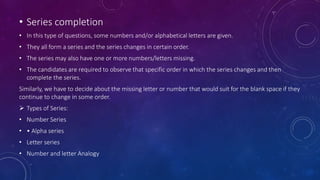
• Series completion
• In this type of questions, some numbers and/or alphabetical letters are given.
• They all form a series and the series changes in certain order.
• The series may also have one or more numbers/letters missing.
• The candidates are required to observe that specific order in which the series changes and then
complete the series.
Similarly, we have to decide about the missing letter or number that would suit for the blank space if they
continue to change in some order.
 Types of Series:
• Number Series
• • Alpha series
• Letter series
• Number and letter Analogy
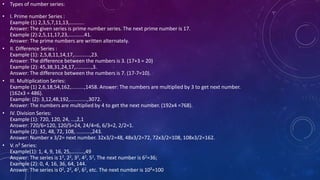
• Types of number series:
• I. Prime number Series :
Example (1) 2,3,5,7,11,13,………..
Answer: The given series is prime number series. The next prime number is 17.
Example (2):2,5,11,17,23,...........41.
Answer: The prime numbers are written alternately.
• II. Difference Series :
Example (1): 2,5,8,11,14,17,...........,23.
Answer: The difference between the numbers is 3. (17+3 = 20)
Example (2): 45,38,31,24,17,...........,3.
Answer: The difference between the numbers is 7. (17-7=10).
• III. Multiplication Series:
Example (1) 2,6,18,54,162,.........,1458. Answer: The numbers are multiplied by 3 to get next number.
(162x3 = 486).
Example: (2): 3,12,48,192,............,3072.
Answer: The numbers are multiplied by 4 to get the next number. (192x4 =768).
• IV. Division Series:
Example (1): 720, 120, 24, ...,2,1
Answer: 720/6=120, 120/5=24, 24/4=6, 6/3=2, 2/2=1.
Example (2): 32, 48, 72, 108, ..........,243.
Answer: Number x 3/2= next number. 32x3/2=48, 48x3/2=72, 72x3/2=108, 108x3/2=162.
• V. n² Series:
Example(1): 1, 4, 9, 16, 25,……….,49
Answer: The series is 12, 22, 32, 42, 52, The next number is 62=36;
Example (2): 0, 4, 16, 36, 64, 144.
Answer: The series is 02, 22, 42, 62, etc. The next number is 10²=100
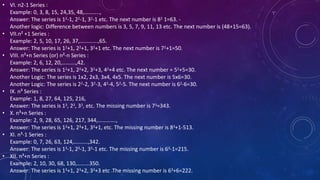
• VI. n2-1 Series :
Example: 0, 3, 8, 15, 24,35, 48,………..,
Answer: The series is 12-1, 22-1, 32-1 etc. The next number is 82 1=63. -
Another logic: Difference between numbers is 3, 5, 7, 9, 11, 13 etc. The next number is (48+15=63).
• VII.n² +1 Series :
Example: 2, 5, 10, 17, 26, 37,………….,65.
Answer: The series is 12+1, 22+1, 32+1 etc. The next number is 72+1=50.
• VIII. n²+n Series (or) n²-n Series :
Example: 2, 6, 12, 20,……….,42.
Answer: The series is 12+1, 22+2, 32+3, 42+4 etc. The next number = 52+5=30.
Another Logic: The series is 1x2, 2x3, 3x4, 4x5. The next number is 5x6=30.
Another Logic: The series is 22-2, 32-3, 42-4, 52-5. The next number is 62-6=30.
• IX. n³ Series :
Example: 1, 8, 27, 64, 125, 216,
Answer: The series is 13, 23, 33, etc. The missing number is 73=343.
• X. n³+n Series :
Example: 2, 9, 28, 65, 126, 217, 344,………….,
Answer: The series is 13+1, 23+1, 33+1, etc. The missing number is 83+1-513.
• XI. n³-1 Series :
Example: 0, 7, 26, 63, 124,……….,342.
Answer: The series is 13-1, 23-1, 33-1 etc. The missing number is 63-1=215.
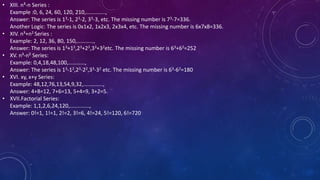
• XII. n³+n Series :
Example: 2, 10, 30, 68, 130,………350.
Answer: The series is 13+1, 23+2, 33+3 etc .The missing number is 63+6=222.
• XIII. n³-n Series :
Example :0, 6, 24, 60, 120, 210,…………..,
Answer: The series is 13-1, 23-2, 33-3, etc. The missing number is 73-7=336.
Another Logic: The series is 0x1x2, 1x2x3, 2x3x4, etc. The missing number is 6x7x8=336.
• XIV. n³+n2 Series :
Example: 2, 12, 36, 80, 150,…………,
Answer: The series is 13+12,23+22,33+32etc. The missing number is 63+62=252
• XV. n³-n² Series:
Example: 0,4,18,48,100,…………,
Answer: The series is 13-12,23-22,33-32 etc. The missing number is 63-62=180
• XVI. xy, x+y Series:
Example: 48,12,76,13,54,9,32,…………..,
Answer: 4+8=12, 7+6=13, 5+4=9, 3+2=5.
• XVII.Factorial Series:
Example: 1,1,2,6,24,120,.............,
Answer: 0!=1, 1!=1, 2!=2, 3!=6, 4!=24, 5!=120, 6!=720
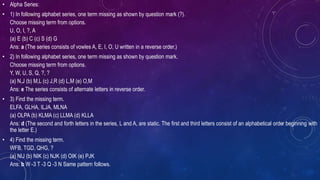
• Alpha Series:
• 1) In following alphabet series, one term missing as shown by question mark (?).
Choose missing term from options.
U, O, I, ?, A
(a) E (b) C (c) S (d) G
Ans: a (The series consists of vowles A, E, I, O, U written in a reverse order.)
• 2) In following alphabet series, one term missing as shown by question mark.
Choose missing term from options.
Y, W, U, S, Q, ?, ?
(a) N,J (b) M,L (c) J,R (d) L,M (e) O,M
Ans: e The series consists of alternate letters in reverse order.
• 3) Find the missing term.
ELFA, GLHA, ILJA, MLNA
(a) OLPA (b) KLMA (c) LLMA (d) KLLA
Ans: d (The second and forth letters in the series, L and A, are static. The first and third letters consist of an alphabetical order beginning with
the letter E.)
• 4) Find the missing term.
WFB, TGD, QHG, ?
(a) NIJ (b) NIK (c) NJK (d) OIK (e) PJK
Ans: b W -3 T -3 Q -3 N Same pattern follows.
• Letter series:
• Q1. Complete the series. ba_ba_bac_acb_cbac
• a) aacb b) bbca c) ccba d) cbac e) None of these
• Ans: c
• Q2. n_mnp_ _ P_ npmn_ mnp
• a) pmnpm b) pmnpp c) pmnmp d) pnpmn e) Pppmn
• Ans: c
• The block of letters npm has been repeated.
• Q3. Find the last 5 missing letters of the series. pq_st_p_rss_pq
• a) rstqp b) tsrqp c) rstpq d) rtspq e) Prstq
• Ans: c
• The last letter of each block of 5 letters is brought in the beginning of the next block.
RANKING AND ORDER
CASE 1
• The ranks of a person from both sides, left or right
• Or from top to bottom, are mentioned
• And total number of persons are asked.
• Questions are also based on their interchanged positions.
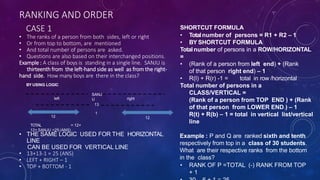
Example : A class of boys is standing in a single line. SANJU is
thirteenth from the left-hand side as well as from the right-
hand side. How many boys are there in the class?
• THE SAME LOGIC USED FOR THE HORIZONTAL
LINE
CAN BE USED FOR VERTICAL LINE
• 13+13-1 = 25 (ANS)
• LEFT + RIGHT – 1
• TOP + BOTTOM - 1
BY USING LOGIC
SANJ
U
left
13
right
12
TOTAL = 12+
12+ SANJU =25 (ANS)
1
12
SHORTCUT FORMULA
• Totalnumber of persons = R1 + R2 – 1
• BY SHORTCUT FORMULA
Total number of persons in a ROW/HORIZONTAL
=
• (Rank of a person from left end) + (Rank
of that person right end) – 1
• R(l) + R(r) -1 = total in row /horizontal
Total number of persons in a
CLASS/VERTICAL =
(Rank of a person from TOP END ) + (Rank
of that person from LOWER END ) – 1
R(t) + R(b) – 1 = total in vertical list/vertical
line
Example : P and Q are ranked sixth and tenth
respectively from top in a class of 30 students.
What are their respective ranks from the bottom
in the class?
• RANK OF P =TOTAL (-) RANK FROM TOP
+ 1
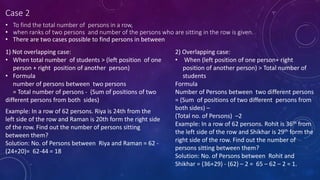
1) Not overlapping case:
• When total number of students > (left position of one
person + right position of another person)
• Formula
number of persons between two persons
= Total number of persons - (Sum of positions of two
different persons from both sides)
Example: In a row of 62 persons. Riya is 24th from the
left side of the row and Raman is 20th form the right side
of the row. Find out the number of persons sitting
between them?
Solution: No. of Persons between Riya and Raman = 62 -
(24+20)= 62-44 = 18
2) Overlapping case:
• When (left position of one person+ right
position of another person) > Total number of
students
Formula
Number of Persons between two different persons
= (Sum of positions of two different persons from
both sides) –
(Total no. of Persons) –2
Example: In a row of 62 persons. Rohit is 36th from
the left side of the row and Shikhar is 29th form the
right side of the row. Find out the number of
persons sitting between them?
Solution: No. of Persons between Rohit and
Shikhar = (36+29) - (62) – 2 = 65 – 62 – 2 = 1.
Case 2
• To find the total number of persons in a row,
• when ranks of two persons and number of the persons who are sitting in the row is given.
• There are two cases possible to find persons in between
WHEN POSITIONS ARE
INTERCHANGED
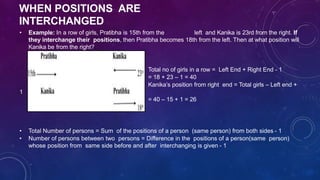
• Example: In a row of girls, Pratibha is 15th from the left and Kanika is 23rd from the right. If
they interchange their positions, then Pratibha becomes 18th from the left. Then at what position will
Kanika be from the right?
Total no of girls in a row = Left End + Right End - 1
= 18 + 23 – 1 = 40
Kanika’s position from right end = Total girls – Left end +
1
= 40 – 15 + 1 = 26
• Total Number of persons = Sum of the positions of a person (same person) from both sides - 1
• Number of persons between two persons = Difference in the positions of a person(same person)
whose position from same side before and after interchanging is given - 1
THANK YOU

Logical Reasoning.pptx

  • 1.
    LOGICAL REASONING SERIES ANDRANKING BY SHOBHIT MOHTA
  • 2.
    • Series completion •In this type of questions, some numbers and/or alphabetical letters are given. • They all form a series and the series changes in certain order. • The series may also have one or more numbers/letters missing. • The candidates are required to observe that specific order in which the series changes and then complete the series. Similarly, we have to decide about the missing letter or number that would suit for the blank space if they continue to change in some order.  Types of Series: • Number Series • • Alpha series • Letter series • Number and letter Analogy
  • 3.
    • Types ofnumber series: • I. Prime number Series : Example (1) 2,3,5,7,11,13,……….. Answer: The given series is prime number series. The next prime number is 17. Example (2):2,5,11,17,23,...........41. Answer: The prime numbers are written alternately. • II. Difference Series : Example (1): 2,5,8,11,14,17,...........,23. Answer: The difference between the numbers is 3. (17+3 = 20) Example (2): 45,38,31,24,17,...........,3. Answer: The difference between the numbers is 7. (17-7=10). • III. Multiplication Series: Example (1) 2,6,18,54,162,.........,1458. Answer: The numbers are multiplied by 3 to get next number. (162x3 = 486). Example: (2): 3,12,48,192,............,3072. Answer: The numbers are multiplied by 4 to get the next number. (192x4 =768). • IV. Division Series: Example (1): 720, 120, 24, ...,2,1 Answer: 720/6=120, 120/5=24, 24/4=6, 6/3=2, 2/2=1. Example (2): 32, 48, 72, 108, ..........,243. Answer: Number x 3/2= next number. 32x3/2=48, 48x3/2=72, 72x3/2=108, 108x3/2=162. • V. n² Series: Example(1): 1, 4, 9, 16, 25,……….,49 Answer: The series is 12, 22, 32, 42, 52, The next number is 62=36; Example (2): 0, 4, 16, 36, 64, 144. Answer: The series is 02, 22, 42, 62, etc. The next number is 10²=100
  • 4.
    • VI. n2-1Series : Example: 0, 3, 8, 15, 24,35, 48,……….., Answer: The series is 12-1, 22-1, 32-1 etc. The next number is 82 1=63. - Another logic: Difference between numbers is 3, 5, 7, 9, 11, 13 etc. The next number is (48+15=63). • VII.n² +1 Series : Example: 2, 5, 10, 17, 26, 37,………….,65. Answer: The series is 12+1, 22+1, 32+1 etc. The next number is 72+1=50. • VIII. n²+n Series (or) n²-n Series : Example: 2, 6, 12, 20,……….,42. Answer: The series is 12+1, 22+2, 32+3, 42+4 etc. The next number = 52+5=30. Another Logic: The series is 1x2, 2x3, 3x4, 4x5. The next number is 5x6=30. Another Logic: The series is 22-2, 32-3, 42-4, 52-5. The next number is 62-6=30. • IX. n³ Series : Example: 1, 8, 27, 64, 125, 216, Answer: The series is 13, 23, 33, etc. The missing number is 73=343. • X. n³+n Series : Example: 2, 9, 28, 65, 126, 217, 344,…………., Answer: The series is 13+1, 23+1, 33+1, etc. The missing number is 83+1-513. • XI. n³-1 Series : Example: 0, 7, 26, 63, 124,……….,342. Answer: The series is 13-1, 23-1, 33-1 etc. The missing number is 63-1=215. • XII. n³+n Series : Example: 2, 10, 30, 68, 130,………350. Answer: The series is 13+1, 23+2, 33+3 etc .The missing number is 63+6=222.
  • 5.
    • XIII. n³-nSeries : Example :0, 6, 24, 60, 120, 210,………….., Answer: The series is 13-1, 23-2, 33-3, etc. The missing number is 73-7=336. Another Logic: The series is 0x1x2, 1x2x3, 2x3x4, etc. The missing number is 6x7x8=336. • XIV. n³+n2 Series : Example: 2, 12, 36, 80, 150,…………, Answer: The series is 13+12,23+22,33+32etc. The missing number is 63+62=252 • XV. n³-n² Series: Example: 0,4,18,48,100,…………, Answer: The series is 13-12,23-22,33-32 etc. The missing number is 63-62=180 • XVI. xy, x+y Series: Example: 48,12,76,13,54,9,32,………….., Answer: 4+8=12, 7+6=13, 5+4=9, 3+2=5. • XVII.Factorial Series: Example: 1,1,2,6,24,120,............., Answer: 0!=1, 1!=1, 2!=2, 3!=6, 4!=24, 5!=120, 6!=720
  • 6.
    • Alpha Series: •1) In following alphabet series, one term missing as shown by question mark (?). Choose missing term from options. U, O, I, ?, A (a) E (b) C (c) S (d) G Ans: a (The series consists of vowles A, E, I, O, U written in a reverse order.) • 2) In following alphabet series, one term missing as shown by question mark. Choose missing term from options. Y, W, U, S, Q, ?, ? (a) N,J (b) M,L (c) J,R (d) L,M (e) O,M Ans: e The series consists of alternate letters in reverse order. • 3) Find the missing term. ELFA, GLHA, ILJA, MLNA (a) OLPA (b) KLMA (c) LLMA (d) KLLA Ans: d (The second and forth letters in the series, L and A, are static. The first and third letters consist of an alphabetical order beginning with the letter E.) • 4) Find the missing term. WFB, TGD, QHG, ? (a) NIJ (b) NIK (c) NJK (d) OIK (e) PJK Ans: b W -3 T -3 Q -3 N Same pattern follows.
  • 7.
    • Letter series: •Q1. Complete the series. ba_ba_bac_acb_cbac • a) aacb b) bbca c) ccba d) cbac e) None of these • Ans: c • Q2. n_mnp_ _ P_ npmn_ mnp • a) pmnpm b) pmnpp c) pmnmp d) pnpmn e) Pppmn • Ans: c • The block of letters npm has been repeated. • Q3. Find the last 5 missing letters of the series. pq_st_p_rss_pq • a) rstqp b) tsrqp c) rstpq d) rtspq e) Prstq • Ans: c • The last letter of each block of 5 letters is brought in the beginning of the next block.
  • 8.
    RANKING AND ORDER CASE1 • The ranks of a person from both sides, left or right • Or from top to bottom, are mentioned • And total number of persons are asked. • Questions are also based on their interchanged positions. Example : A class of boys is standing in a single line. SANJU is thirteenth from the left-hand side as well as from the right- hand side. How many boys are there in the class? • THE SAME LOGIC USED FOR THE HORIZONTAL LINE CAN BE USED FOR VERTICAL LINE • 13+13-1 = 25 (ANS) • LEFT + RIGHT – 1 • TOP + BOTTOM - 1 BY USING LOGIC SANJ U left 13 right 12 TOTAL = 12+ 12+ SANJU =25 (ANS) 1 12 SHORTCUT FORMULA • Totalnumber of persons = R1 + R2 – 1 • BY SHORTCUT FORMULA Total number of persons in a ROW/HORIZONTAL = • (Rank of a person from left end) + (Rank of that person right end) – 1 • R(l) + R(r) -1 = total in row /horizontal Total number of persons in a CLASS/VERTICAL = (Rank of a person from TOP END ) + (Rank of that person from LOWER END ) – 1 R(t) + R(b) – 1 = total in vertical list/vertical line Example : P and Q are ranked sixth and tenth respectively from top in a class of 30 students. What are their respective ranks from the bottom in the class? • RANK OF P =TOTAL (-) RANK FROM TOP + 1
  • 9.
    1) Not overlappingcase: • When total number of students > (left position of one person + right position of another person) • Formula number of persons between two persons = Total number of persons - (Sum of positions of two different persons from both sides) Example: In a row of 62 persons. Riya is 24th from the left side of the row and Raman is 20th form the right side of the row. Find out the number of persons sitting between them? Solution: No. of Persons between Riya and Raman = 62 - (24+20)= 62-44 = 18 2) Overlapping case: • When (left position of one person+ right position of another person) > Total number of students Formula Number of Persons between two different persons = (Sum of positions of two different persons from both sides) – (Total no. of Persons) –2 Example: In a row of 62 persons. Rohit is 36th from the left side of the row and Shikhar is 29th form the right side of the row. Find out the number of persons sitting between them? Solution: No. of Persons between Rohit and Shikhar = (36+29) - (62) – 2 = 65 – 62 – 2 = 1. Case 2 • To find the total number of persons in a row, • when ranks of two persons and number of the persons who are sitting in the row is given. • There are two cases possible to find persons in between
  • 10.
    WHEN POSITIONS ARE INTERCHANGED •Example: In a row of girls, Pratibha is 15th from the left and Kanika is 23rd from the right. If they interchange their positions, then Pratibha becomes 18th from the left. Then at what position will Kanika be from the right? Total no of girls in a row = Left End + Right End - 1 = 18 + 23 – 1 = 40 Kanika’s position from right end = Total girls – Left end + 1 = 40 – 15 + 1 = 26 • Total Number of persons = Sum of the positions of a person (same person) from both sides - 1 • Number of persons between two persons = Difference in the positions of a person(same person) whose position from same side before and after interchanging is given - 1
  • 11.