Understanding Computers: Today and Tomorrow, 13th Edition
Chapter 11:
E-Commerce
Understanding Computers: Today and Tomorrow, 13th Edition
2
Learning Objectives
1. Explain what e-commerce is and describe some of the
advantages and disadvantages involved with
implementing e-commerce.
2. Identify a variety of e-commerce business models and
discuss their differences.
3. Discuss the types of Web sites that can be used to
implement e-commerce.
4. List several strategies for implementing e-commerce
using the Web, including some of the decisions that
need to be made, the options available for accepting
payments, and the process of designing and developing
an effective Web site.
Understanding Computers: Today and Tomorrow, 13th Edition
3
Learning Objectives
5. Outline some sales and marketing strategies that can
be used in conjunction with an e-commerce Web site.
6. Discuss some security issues related to e-commerce
sites.
Understanding Computers: Today and Tomorrow, 13th Edition
4
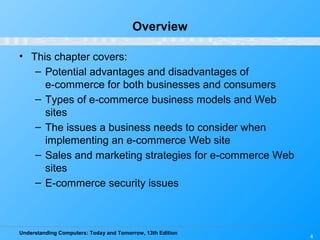
Overview
• This chapter covers:
– Potential advantages and disadvantages of
e-commerce for both businesses and consumers
– Types of e-commerce business models and Web
sites
– The issues a business needs to consider when
implementing an e-commerce Web site
– Sales and marketing strategies for e-commerce Web
sites
– E-commerce security issues
Understanding Computers: Today and Tomorrow, 13th Edition
5
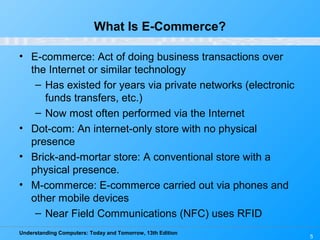
What Is E-Commerce?
• E-commerce: Act of doing business transactions over
the Internet or similar technology
– Has existed for years via private networks (electronic
funds transfers, etc.)
– Now most often performed via the Internet
• Dot-com: An internet-only store with no physical
presence
• Brick-and-mortar store: A conventional store with a
physical presence.
• M-commerce: E-commerce carried out via phones and
other mobile devices
– Near Field Communications (NFC) uses RFID
Understanding Computers: Today and Tomorrow, 13th Edition
6
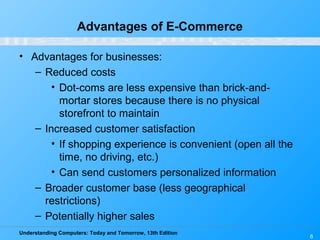
Advantages of E-Commerce
• Advantages for businesses:
– Reduced costs
• Dot-coms are less expensive than brick-and-
mortar stores because there is no physical
storefront to maintain
– Increased customer satisfaction
• If shopping experience is convenient (open all the
time, no driving, etc.)
• Can send customers personalized information
– Broader customer base (less geographical
restrictions)
– Potentially higher sales
Understanding Computers: Today and Tomorrow, 13th Edition
7
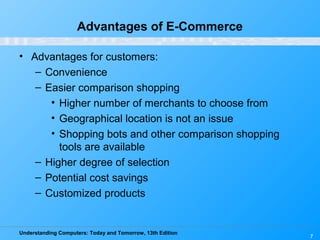
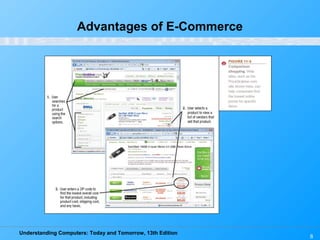
Advantages of E-Commerce
• Advantages for customers:
– Convenience
– Easier comparison shopping
• Higher number of merchants to choose from
• Geographical location is not an issue
• Shopping bots and other comparison shopping
tools are available
– Higher degree of selection
– Potential cost savings
– Customized products
Understanding Computers: Today and Tomorrow, 13th Edition
8
Advantages of E-Commerce
Understanding Computers: Today and Tomorrow, 13th Edition
9
Disadvantages of E-Commerce
• Disadvantages for businesses:
– Pressure to be always open, site always working
• Solid, well designed sites and hosting
– Lost business due to some customer hesitation to
shop online
– Risk of fraudulent credit card transactions
– Ease of entry for competitors
Understanding Computers: Today and Tomorrow, 13th Edition
10
Disadvantages of E-Commerce
• Disadvantages for customers:
– Potential for fraud and other potential security
problems
• Buyer protection programs and using
credit card protection can help
– Not being able to see or touch the goods
• 3D online stores may help
– Possible expense of returning merchandise
• Some brick and mortar stores allow returns to local
stores
Understanding Computers: Today and Tomorrow, 13th Edition
11
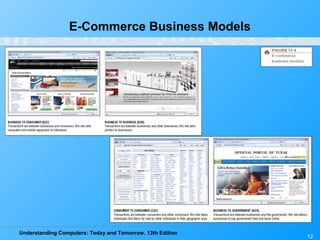
E-Commerce Business Models
• E-commerce business models
– Business-to-consumer (B2C): An e-commerce model
in which a business provides goods or services to
consumers
– Business-to-business (B2B): An e-commerce model
in which a business provides goods or services to
other businesses
– Consumer-to-consumer (C2C): An e-commerce
model in which a consumer provides goods or
services to other consumers
– Business-to-government (B2G): An e-commerce
mode n which a business provides goods and
services to government organizations
Understanding Computers: Today and Tomorrow, 13th Edition
12
E-Commerce Business Models
Understanding Computers: Today and Tomorrow, 13th Edition
13
Quick Quiz
1. Which of the following is NOT an advantage of e-
commerce for a business?
a. Reduced cost
b. Increased customer satisfaction
c. Reduced competition
2. True or False: An online auction is a type of brokerage
site.
3. A business following the ______________________
model sells products directly to consumers.
Answers:
1) c; 2) True; 3) Business-to-consumer (B2C)
Understanding Computers: Today and Tomorrow, 13th Edition
14
Types of E-Commerce Web Sites
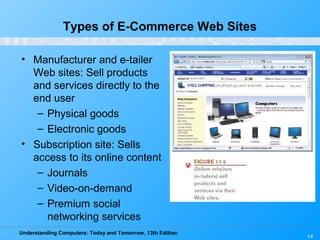
• Manufacturer and e-tailer
Web sites: Sell products
and services directly to the
end user
– Physical goods
– Electronic goods
• Subscription site: Sells
access to its online content
– Journals
– Video-on-demand
– Premium social
networking services
Understanding Computers: Today and Tomorrow, 13th Edition
15
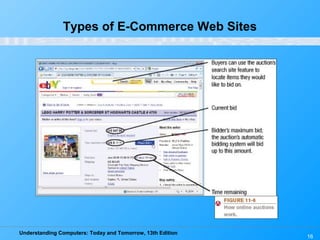
Types of E-Commerce Web Sites
• Brokerage sites: Bring buyers and sellers together and
earn revenue by charging commissions on sales made
via the site
– Online auctions: Allow consumers or businesses to
auction products to consumers
• Buyers bid and highest bidder at the time the
auction closes buys the item
• Seller pays a listing fee and a selling fee based on
the final price
• Some online auction sites have automatic bidding
systems
Understanding Computers: Today and Tomorrow, 13th Edition
16
Types of E-Commerce Web Sites
Understanding Computers: Today and Tomorrow, 13th Edition
17
Types of E-Commerce Web Sites
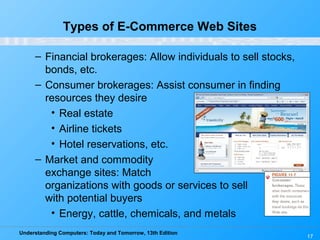
– Financial brokerages: Allow individuals to sell stocks,
bonds, etc.
– Consumer brokerages: Assist consumer in finding
resources they desire
• Real estate
• Airline tickets
• Hotel reservations, etc.
– Market and commodity
exchange sites: Match
organizations with goods or services to sell
with potential buyers
• Energy, cattle, chemicals, and metals
Understanding Computers: Today and Tomorrow, 13th Edition
18
Quick Quiz
1. Which of the following is not a type of brokerage site?
a. E-tailer site
b. Online auction site
c. Market exchange
2. True or False: Both manufacturers and online retailers
can sell directly to customers via their Web sites.
3. A(n) ______________________ site sells online content
(music, articles, social networking access, etc.) to
individuals.
Answers:
1) a; 2) True; 3) subscription
Understanding Computers: Today and Tomorrow, 13th Edition
19
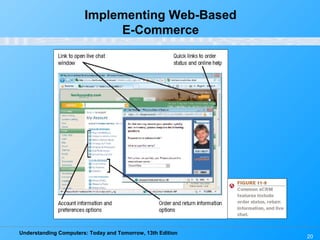
Implementing Web-Based
E-Commerce
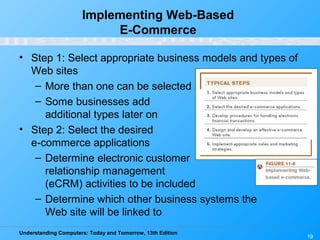
• Step 1: Select appropriate business models and types of
Web sites
– More than one can be selected
– Some businesses add
additional types later on
• Step 2: Select the desired
e-commerce applications
– Determine electronic customer
relationship management
(eCRM) activities to be included
– Determine which other business systems the
Web site will be linked to
Understanding Computers: Today and Tomorrow, 13th Edition
20
Implementing Web-Based
E-Commerce
Understanding Computers: Today and Tomorrow, 13th Edition
21
Implementing Web-Based
E-Commerce
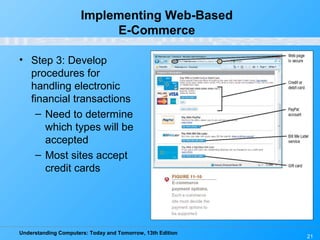
• Step 3: Develop
procedures for
handling electronic
financial transactions
– Need to determine
which types will be
accepted
– Most sites accept
credit cards
Understanding Computers: Today and Tomorrow, 13th Edition
22
Implementing Web-Based
E-Commerce
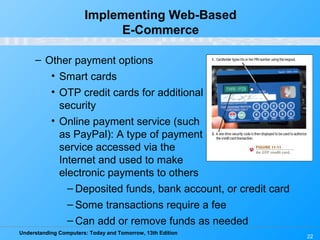
– Other payment options
• Smart cards
• OTP credit cards for additional
security
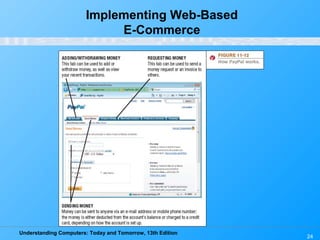
• Online payment service (such
as PayPal): A type of payment
service accessed via the
Internet and used to make
electronic payments to others
– Deposited funds, bank account, or credit card
– Some transactions require a fee
– Can add or remove funds as needed
Understanding Computers: Today and Tomorrow, 13th Edition
23
Online Video
“Secure Shopping with Emue OTP Credit Cards”
(click below to start video)
Reminder: The complete set of online videos and video podcasts are available at:
www.cengage.com/computerconcepts/np/uc13
Courtesy Emue
Technologies
Understanding Computers: Today and Tomorrow, 13th Edition
24
Implementing Web-Based
E-Commerce
Understanding Computers: Today and Tomorrow, 13th Edition
25
Implementing Web-Based
E-Commerce
• Digital gift certificates, gift cards, and coupons:
Appropriate codes are entered into the Web site at
time of purchase
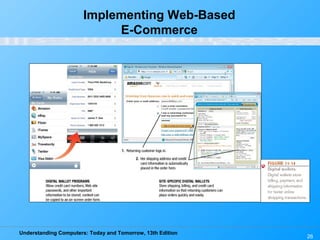
• Digital wallet: Holds a buyer’s information that can
be used to speed up online purchase transactions
– Digital wallet programs (used with computers
and mobile phones)
– Online digital wallets (Google Checkout)
– Site-specific digital wallets (store this
information for each customer on a business’
Web server for use with purchases on that site
only e.g. Amazon.com
Understanding Computers: Today and Tomorrow, 13th Edition
26
Implementing Web-Based
E-Commerce
Understanding Computers: Today and Tomorrow, 13th Edition
27
Implementing Web-Based
E-Commerce
• Special B2B considerations because of the volume of
B2B transactions
– B2B transaction processing: Allows merchants to
customize their payment processing plans to fit their
needs
• Can process payments, do credit checks, track
expenses, do billing, etc.
– Order-fulfillment companies: Take care of physically
filling orders for a business
• Can provide order management, CRM services,
marketing tools, etc.
Understanding Computers: Today and Tomorrow, 13th Edition
28
Implementing Web-Based
E-Commerce
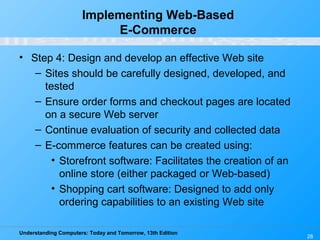
• Step 4: Design and develop an effective Web site
– Sites should be carefully designed, developed, and
tested
– Ensure order forms and checkout pages are located
on a secure Web server
– Continue evaluation of security and collected data
– E-commerce features can be created using:
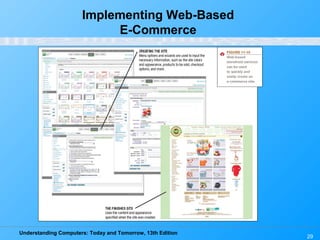
• Storefront software: Facilitates the creation of an
online store (either packaged or Web-based)
• Shopping cart software: Designed to add only
ordering capabilities to an existing Web site
Understanding Computers: Today and Tomorrow, 13th Edition
29
Implementing Web-Based
E-Commerce
Understanding Computers: Today and Tomorrow, 13th Edition
30
Implementing Web-Based
E-Commerce
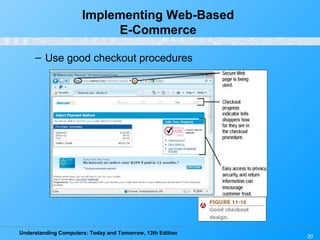
– Use good checkout procedures
Understanding Computers: Today and Tomorrow, 13th Edition
31
Implementing Web-Based
E-Commerce
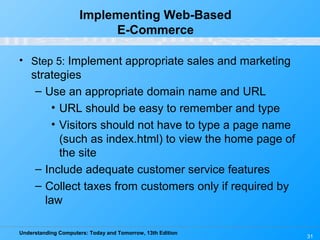
• Step 5: Implement appropriate sales and marketing
strategies
– Use an appropriate domain name and URL
• URL should be easy to remember and type
• Visitors should not have to type a page name
(such as index.html) to view the home page of
the site
– Include adequate customer service features
– Collect taxes from customers only if required by
law
Understanding Computers: Today and Tomorrow, 13th Edition
32
Implementing Web-Based
E-Commerce
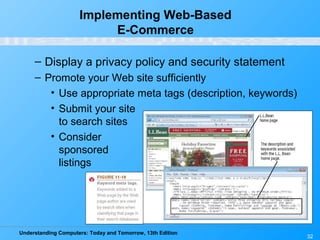
– Display a privacy policy and security statement
– Promote your Web site sufficiently
• Use appropriate meta tags (description, keywords)
• Submit your site
to search sites
• Consider
sponsored
listings
Understanding Computers: Today and Tomorrow, 13th Edition
33
Implementing Web-Based
E-Commerce
• Optimize your site (SSO)
• Advertise your site on business cards, ads, etc.
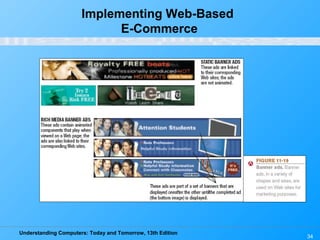
• Consider using banner ads
– Use of rich media ads is growing
– Can display sponsor banner ads on site
– Banner ad exchanges
– Use of behavioral (targeted) ads is growing
• Update your site regularly and consider adding
incentives for return visits (contests, coupons, etc.)
• Use e-mail marketing techniques (free shipping
offers, new product notifications, etc.)
Understanding Computers: Today and Tomorrow, 13th Edition
34
Implementing Web-Based
E-Commerce
Understanding Computers: Today and Tomorrow, 13th Edition
35
Security Issues
• Security is essential for e-commerce Web sites
• Some guidelines for e-commerce sites:
– Secure transactions (use a secure Web server)
– Secure sensitive documents and files (use encryption)
– Authenticate online business partners (use digital
certificates and digital signatures)
Understanding Computers: Today and Tomorrow, 13th Edition
36
Quick Quiz
1. PayPal is an example of a(n)
______________________.
a. digital wallet
b. online payment service
c. order fulfillment service
2. True or False: A credit and a debit card work the same
way on the consumers’ side.
3. All online financial transactions should take place via a(n)
______________________ Web server.
Answers:
1) b; 2) False; 3) secure
Understanding Computers: Today and Tomorrow, 13th Edition
37
Summary
• What Is E-Commerce?
• E-Commerce Business Models
• Types of E-Commerce Web Sites
• Implementing Web-Based E-Commerce
• Security Issues

Uc13.chapter.11

  • 1.
    Understanding Computers: Todayand Tomorrow, 13th Edition Chapter 11: E-Commerce
  • 2.
    Understanding Computers: Todayand Tomorrow, 13th Edition 2 Learning Objectives 1. Explain what e-commerce is and describe some of the advantages and disadvantages involved with implementing e-commerce. 2. Identify a variety of e-commerce business models and discuss their differences. 3. Discuss the types of Web sites that can be used to implement e-commerce. 4. List several strategies for implementing e-commerce using the Web, including some of the decisions that need to be made, the options available for accepting payments, and the process of designing and developing an effective Web site.
  • 3.
    Understanding Computers: Todayand Tomorrow, 13th Edition 3 Learning Objectives 5. Outline some sales and marketing strategies that can be used in conjunction with an e-commerce Web site. 6. Discuss some security issues related to e-commerce sites.
  • 4.
    Understanding Computers: Todayand Tomorrow, 13th Edition 4 Overview • This chapter covers: – Potential advantages and disadvantages of e-commerce for both businesses and consumers – Types of e-commerce business models and Web sites – The issues a business needs to consider when implementing an e-commerce Web site – Sales and marketing strategies for e-commerce Web sites – E-commerce security issues
  • 5.
    Understanding Computers: Todayand Tomorrow, 13th Edition 5 What Is E-Commerce? • E-commerce: Act of doing business transactions over the Internet or similar technology – Has existed for years via private networks (electronic funds transfers, etc.) – Now most often performed via the Internet • Dot-com: An internet-only store with no physical presence • Brick-and-mortar store: A conventional store with a physical presence. • M-commerce: E-commerce carried out via phones and other mobile devices – Near Field Communications (NFC) uses RFID
  • 6.
    Understanding Computers: Todayand Tomorrow, 13th Edition 6 Advantages of E-Commerce • Advantages for businesses: – Reduced costs • Dot-coms are less expensive than brick-and- mortar stores because there is no physical storefront to maintain – Increased customer satisfaction • If shopping experience is convenient (open all the time, no driving, etc.) • Can send customers personalized information – Broader customer base (less geographical restrictions) – Potentially higher sales
  • 7.
    Understanding Computers: Todayand Tomorrow, 13th Edition 7 Advantages of E-Commerce • Advantages for customers: – Convenience – Easier comparison shopping • Higher number of merchants to choose from • Geographical location is not an issue • Shopping bots and other comparison shopping tools are available – Higher degree of selection – Potential cost savings – Customized products
  • 8.
    Understanding Computers: Todayand Tomorrow, 13th Edition 8 Advantages of E-Commerce
  • 9.
    Understanding Computers: Todayand Tomorrow, 13th Edition 9 Disadvantages of E-Commerce • Disadvantages for businesses: – Pressure to be always open, site always working • Solid, well designed sites and hosting – Lost business due to some customer hesitation to shop online – Risk of fraudulent credit card transactions – Ease of entry for competitors
  • 10.
    Understanding Computers: Todayand Tomorrow, 13th Edition 10 Disadvantages of E-Commerce • Disadvantages for customers: – Potential for fraud and other potential security problems • Buyer protection programs and using credit card protection can help – Not being able to see or touch the goods • 3D online stores may help – Possible expense of returning merchandise • Some brick and mortar stores allow returns to local stores
  • 11.
    Understanding Computers: Todayand Tomorrow, 13th Edition 11 E-Commerce Business Models • E-commerce business models – Business-to-consumer (B2C): An e-commerce model in which a business provides goods or services to consumers – Business-to-business (B2B): An e-commerce model in which a business provides goods or services to other businesses – Consumer-to-consumer (C2C): An e-commerce model in which a consumer provides goods or services to other consumers – Business-to-government (B2G): An e-commerce mode n which a business provides goods and services to government organizations
  • 12.
    Understanding Computers: Todayand Tomorrow, 13th Edition 12 E-Commerce Business Models
  • 13.
    Understanding Computers: Todayand Tomorrow, 13th Edition 13 Quick Quiz 1. Which of the following is NOT an advantage of e- commerce for a business? a. Reduced cost b. Increased customer satisfaction c. Reduced competition 2. True or False: An online auction is a type of brokerage site. 3. A business following the ______________________ model sells products directly to consumers. Answers: 1) c; 2) True; 3) Business-to-consumer (B2C)
  • 14.
    Understanding Computers: Todayand Tomorrow, 13th Edition 14 Types of E-Commerce Web Sites • Manufacturer and e-tailer Web sites: Sell products and services directly to the end user – Physical goods – Electronic goods • Subscription site: Sells access to its online content – Journals – Video-on-demand – Premium social networking services
  • 15.
    Understanding Computers: Todayand Tomorrow, 13th Edition 15 Types of E-Commerce Web Sites • Brokerage sites: Bring buyers and sellers together and earn revenue by charging commissions on sales made via the site – Online auctions: Allow consumers or businesses to auction products to consumers • Buyers bid and highest bidder at the time the auction closes buys the item • Seller pays a listing fee and a selling fee based on the final price • Some online auction sites have automatic bidding systems
  • 16.
    Understanding Computers: Todayand Tomorrow, 13th Edition 16 Types of E-Commerce Web Sites
  • 17.
    Understanding Computers: Todayand Tomorrow, 13th Edition 17 Types of E-Commerce Web Sites – Financial brokerages: Allow individuals to sell stocks, bonds, etc. – Consumer brokerages: Assist consumer in finding resources they desire • Real estate • Airline tickets • Hotel reservations, etc. – Market and commodity exchange sites: Match organizations with goods or services to sell with potential buyers • Energy, cattle, chemicals, and metals
  • 18.
    Understanding Computers: Todayand Tomorrow, 13th Edition 18 Quick Quiz 1. Which of the following is not a type of brokerage site? a. E-tailer site b. Online auction site c. Market exchange 2. True or False: Both manufacturers and online retailers can sell directly to customers via their Web sites. 3. A(n) ______________________ site sells online content (music, articles, social networking access, etc.) to individuals. Answers: 1) a; 2) True; 3) subscription
  • 19.
    Understanding Computers: Todayand Tomorrow, 13th Edition 19 Implementing Web-Based E-Commerce • Step 1: Select appropriate business models and types of Web sites – More than one can be selected – Some businesses add additional types later on • Step 2: Select the desired e-commerce applications – Determine electronic customer relationship management (eCRM) activities to be included – Determine which other business systems the Web site will be linked to
  • 20.
    Understanding Computers: Todayand Tomorrow, 13th Edition 20 Implementing Web-Based E-Commerce
  • 21.
    Understanding Computers: Todayand Tomorrow, 13th Edition 21 Implementing Web-Based E-Commerce • Step 3: Develop procedures for handling electronic financial transactions – Need to determine which types will be accepted – Most sites accept credit cards
  • 22.
    Understanding Computers: Todayand Tomorrow, 13th Edition 22 Implementing Web-Based E-Commerce – Other payment options • Smart cards • OTP credit cards for additional security • Online payment service (such as PayPal): A type of payment service accessed via the Internet and used to make electronic payments to others – Deposited funds, bank account, or credit card – Some transactions require a fee – Can add or remove funds as needed
  • 23.
    Understanding Computers: Todayand Tomorrow, 13th Edition 23 Online Video “Secure Shopping with Emue OTP Credit Cards” (click below to start video) Reminder: The complete set of online videos and video podcasts are available at: www.cengage.com/computerconcepts/np/uc13 Courtesy Emue Technologies
  • 24.
    Understanding Computers: Todayand Tomorrow, 13th Edition 24 Implementing Web-Based E-Commerce
  • 25.
    Understanding Computers: Todayand Tomorrow, 13th Edition 25 Implementing Web-Based E-Commerce • Digital gift certificates, gift cards, and coupons: Appropriate codes are entered into the Web site at time of purchase • Digital wallet: Holds a buyer’s information that can be used to speed up online purchase transactions – Digital wallet programs (used with computers and mobile phones) – Online digital wallets (Google Checkout) – Site-specific digital wallets (store this information for each customer on a business’ Web server for use with purchases on that site only e.g. Amazon.com
  • 26.
    Understanding Computers: Todayand Tomorrow, 13th Edition 26 Implementing Web-Based E-Commerce
  • 27.
    Understanding Computers: Todayand Tomorrow, 13th Edition 27 Implementing Web-Based E-Commerce • Special B2B considerations because of the volume of B2B transactions – B2B transaction processing: Allows merchants to customize their payment processing plans to fit their needs • Can process payments, do credit checks, track expenses, do billing, etc. – Order-fulfillment companies: Take care of physically filling orders for a business • Can provide order management, CRM services, marketing tools, etc.
  • 28.
    Understanding Computers: Todayand Tomorrow, 13th Edition 28 Implementing Web-Based E-Commerce • Step 4: Design and develop an effective Web site – Sites should be carefully designed, developed, and tested – Ensure order forms and checkout pages are located on a secure Web server – Continue evaluation of security and collected data – E-commerce features can be created using: • Storefront software: Facilitates the creation of an online store (either packaged or Web-based) • Shopping cart software: Designed to add only ordering capabilities to an existing Web site
  • 29.
    Understanding Computers: Todayand Tomorrow, 13th Edition 29 Implementing Web-Based E-Commerce
  • 30.
    Understanding Computers: Todayand Tomorrow, 13th Edition 30 Implementing Web-Based E-Commerce – Use good checkout procedures
  • 31.
    Understanding Computers: Todayand Tomorrow, 13th Edition 31 Implementing Web-Based E-Commerce • Step 5: Implement appropriate sales and marketing strategies – Use an appropriate domain name and URL • URL should be easy to remember and type • Visitors should not have to type a page name (such as index.html) to view the home page of the site – Include adequate customer service features – Collect taxes from customers only if required by law
  • 32.
    Understanding Computers: Todayand Tomorrow, 13th Edition 32 Implementing Web-Based E-Commerce – Display a privacy policy and security statement – Promote your Web site sufficiently • Use appropriate meta tags (description, keywords) • Submit your site to search sites • Consider sponsored listings
  • 33.
    Understanding Computers: Todayand Tomorrow, 13th Edition 33 Implementing Web-Based E-Commerce • Optimize your site (SSO) • Advertise your site on business cards, ads, etc. • Consider using banner ads – Use of rich media ads is growing – Can display sponsor banner ads on site – Banner ad exchanges – Use of behavioral (targeted) ads is growing • Update your site regularly and consider adding incentives for return visits (contests, coupons, etc.) • Use e-mail marketing techniques (free shipping offers, new product notifications, etc.)
  • 34.
    Understanding Computers: Todayand Tomorrow, 13th Edition 34 Implementing Web-Based E-Commerce
  • 35.
    Understanding Computers: Todayand Tomorrow, 13th Edition 35 Security Issues • Security is essential for e-commerce Web sites • Some guidelines for e-commerce sites: – Secure transactions (use a secure Web server) – Secure sensitive documents and files (use encryption) – Authenticate online business partners (use digital certificates and digital signatures)
  • 36.
    Understanding Computers: Todayand Tomorrow, 13th Edition 36 Quick Quiz 1. PayPal is an example of a(n) ______________________. a. digital wallet b. online payment service c. order fulfillment service 2. True or False: A credit and a debit card work the same way on the consumers’ side. 3. All online financial transactions should take place via a(n) ______________________ Web server. Answers: 1) b; 2) False; 3) secure
  • 37.
    Understanding Computers: Todayand Tomorrow, 13th Edition 37 Summary • What Is E-Commerce? • E-Commerce Business Models • Types of E-Commerce Web Sites • Implementing Web-Based E-Commerce • Security Issues