MOBILE
COMMUNICATION
• Introduction
• 1G technology
• 2G technology
• 3G technology
• 4G technology
• 5G technology
CONTENT
WHAT IS A MOBILE ?
• A mobile is a portable telephone that does not use a
wired connection. It connects to a wireless carrier
network using waves.
INTRODUCTION
WHAT IS MOBILE COMMUNICATION ?
• A wireless form of communication in which voice
and data information is emitted, transmitted and
received via microwaves.
• This type of communication allows individuals to
converse with one another or transmit data while
moving from one place to another.
INTRODUCTION
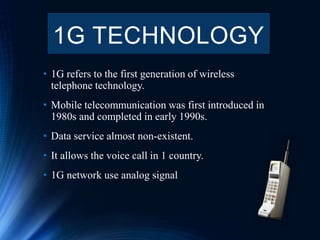
• 1G refers to the first generation of wireless
telephone technology.
• Mobile telecommunication was first introduced in
1980s and completed in early 1990s.
• Data service almost non-existent.
• It allows the voice call in 1 country.
• 1G network use analog signal
1G TECHNOLOGY
DRAWBACKS:
• Poor voice quality
• Poor battery life
• Large phone size
• No security
• Limited capacity
1G TECHNOLOGY
• 2G technology refers to the 2nd generation which is
based on GSM.
• It was launched in Finland in the year 1991.
• 2G network use digital signals.
• It’s data speed was up to 64kbps
• It enables services such as text messages, picture
messages or multi media message
• It provides better quality and capacity.
2G TECHNOLOGY
DRAWBACKS:
• These systems are unable to handle complex data
such as videos.
• 2G requires strong digital signals to help mobile
phones work. If there is no network coverage in any
specific area, digital signals would weak.
2G TECHNOLOGY
• 2.5G is a technology between the 2G and 3G
• 2.5G is sometimes described as 2G cellular
technology combined with GPRS
Features includes:
 Phone calls
 Send/receive E-mail messages
 Camera phone
 Speed: 64-144 Kbps.
2.5G TECHNOLOGY
• 3G technology refer to third generation which was
introduced in year 2006.
• Data transmission speed increased from
144kbps – 2 Mbps.
• Typically called smart phones
• Accommodate web based applications and audio
and video files.
3G TECHNOLOGY
FEATURES:
• Provides faster communication
• Send/receive large Email messages
• TV streaming/ mobile TV
• 11 sec – 1.5 min time to download a 3min MP3
song.
3G TECHNOLOGY
• 4G technology refer to fourth generation which was
started from 2011.
• Capable of providing 100Mbps – 1Gbps speed.
• One of the basic term used to describe 4G is MAGIC:
Mobile multimedia
Any time anywhere
Global mobility support
Integrated wireless solution
Customized personal services
4G TECHNOLOGY
DRAWBACKES:
• Battery usage is more
• Hard to implement
• Need complicated hardware
• Expensive equipment required to implement next
generation network.
4G TECHNOLOGY
• 5G technology refer to fifth generation.
• Complete wireless communication with almost no
limitation.
BENEFITS:
• High speed, high capacity
• Faster data transmission that of the previous
generations.
• Support interactive multimedia, voice, streaming
video , internet
5G TECHNOLOGY
CONCLUSION
e
CONCLUSION
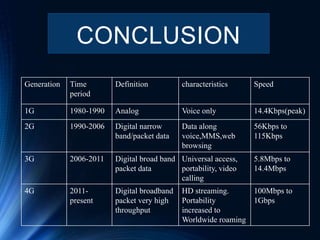
Generation Time
period
Definition characteristics Speed
1G 1980-1990 Analog Voice only 14.4Kbps(peak)
2G 1990-2006 Digital narrow
band/packet data
Data along
voice,MMS,web
browsing
56Kbps to
115Kbps
3G 2006-2011 Digital broad band
packet data
Universal access,
portability, video
calling
5.8Mbps to
14.4Mbps
4G 2011-
present
Digital broadband
packet very high
throughput
HD streaming.
Portability
increased to
Worldwide roaming
100Mbps to
1Gbps
By-
KONIKA VERMA
FARHAN KHAN
THANKYOU

Mobile Communication

  • 1.
  • 2.
    • Introduction • 1Gtechnology • 2G technology • 3G technology • 4G technology • 5G technology CONTENT
  • 3.
    WHAT IS AMOBILE ? • A mobile is a portable telephone that does not use a wired connection. It connects to a wireless carrier network using waves. INTRODUCTION
  • 4.
    WHAT IS MOBILECOMMUNICATION ? • A wireless form of communication in which voice and data information is emitted, transmitted and received via microwaves. • This type of communication allows individuals to converse with one another or transmit data while moving from one place to another. INTRODUCTION
  • 5.
    • 1G refersto the first generation of wireless telephone technology. • Mobile telecommunication was first introduced in 1980s and completed in early 1990s. • Data service almost non-existent. • It allows the voice call in 1 country. • 1G network use analog signal 1G TECHNOLOGY
  • 6.
    DRAWBACKS: • Poor voicequality • Poor battery life • Large phone size • No security • Limited capacity 1G TECHNOLOGY
  • 7.
    • 2G technologyrefers to the 2nd generation which is based on GSM. • It was launched in Finland in the year 1991. • 2G network use digital signals. • It’s data speed was up to 64kbps • It enables services such as text messages, picture messages or multi media message • It provides better quality and capacity. 2G TECHNOLOGY
  • 8.
    DRAWBACKS: • These systemsare unable to handle complex data such as videos. • 2G requires strong digital signals to help mobile phones work. If there is no network coverage in any specific area, digital signals would weak. 2G TECHNOLOGY
  • 9.
    • 2.5G isa technology between the 2G and 3G • 2.5G is sometimes described as 2G cellular technology combined with GPRS Features includes:  Phone calls  Send/receive E-mail messages  Camera phone  Speed: 64-144 Kbps. 2.5G TECHNOLOGY
  • 10.
    • 3G technologyrefer to third generation which was introduced in year 2006. • Data transmission speed increased from 144kbps – 2 Mbps. • Typically called smart phones • Accommodate web based applications and audio and video files. 3G TECHNOLOGY
  • 11.
    FEATURES: • Provides fastercommunication • Send/receive large Email messages • TV streaming/ mobile TV • 11 sec – 1.5 min time to download a 3min MP3 song. 3G TECHNOLOGY
  • 12.
    • 4G technologyrefer to fourth generation which was started from 2011. • Capable of providing 100Mbps – 1Gbps speed. • One of the basic term used to describe 4G is MAGIC: Mobile multimedia Any time anywhere Global mobility support Integrated wireless solution Customized personal services 4G TECHNOLOGY
  • 13.
    DRAWBACKES: • Battery usageis more • Hard to implement • Need complicated hardware • Expensive equipment required to implement next generation network. 4G TECHNOLOGY
  • 14.
    • 5G technologyrefer to fifth generation. • Complete wireless communication with almost no limitation. BENEFITS: • High speed, high capacity • Faster data transmission that of the previous generations. • Support interactive multimedia, voice, streaming video , internet 5G TECHNOLOGY
  • 15.
  • 16.
    CONCLUSION Generation Time period Definition characteristicsSpeed 1G 1980-1990 Analog Voice only 14.4Kbps(peak) 2G 1990-2006 Digital narrow band/packet data Data along voice,MMS,web browsing 56Kbps to 115Kbps 3G 2006-2011 Digital broad band packet data Universal access, portability, video calling 5.8Mbps to 14.4Mbps 4G 2011- present Digital broadband packet very high throughput HD streaming. Portability increased to Worldwide roaming 100Mbps to 1Gbps
  • 17.