Unit 4 Lesson 1 The Water Cycle
Copyright © Houghton Mifflin Harcourt Publishing Company
Unit 4 Lesson 1 The Water Cycle
Indiana Standards
Copyright © Houghton Mifflin Harcourt Publishing Company
• 8.2.1 Recognize and demonstrate how the sun’s
energy drives convection in the atmosphere and in
bodies of water, which results in ocean currents
and weather patterns.
• 8.2.2 Describe and model how water moves
through the earth’s crust, atmosphere, and oceans
in a cyclic way, as liquid, vapor, and solid.
What Goes Up …
Copyright © Houghton Mifflin Harcourt Publishing Company
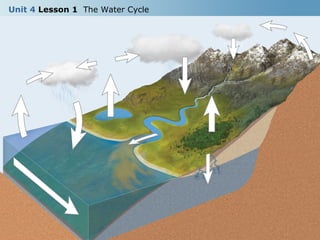
What is the water cycle?
• Movement of water between the atmosphere,
land, ocean, and living things make up the water
cycle.
• Water and snow moves downward due to gravity.
Water vapor moves upward.
Unit 4 Lesson 1 The Water Cycle
How does water change state?
• Water on Earth is found as a liquid, solid, or gas.
• Water absorbs energy as it melts from solid to
liquid.
• Water absorbs energy as it evaporates from liquid
to gas.
Copyright © Houghton Mifflin Harcourt Publishing Company
Unit 4 Lesson 1 The Water Cycle
How does water change state?
• Water releases energy when it condenses from
gas to liquid or when it sublimates from solid to
gas.
• Water releases energy as it freezes from liquid to
solid or deposits from gas to solid.
Copyright © Houghton Mifflin Harcourt Publishing Company
Unit 4 Lesson 1 The Water Cycle
How does water reach the atmosphere?
• Water reaches the atmosphere through
evaporation, transpiration, and sublimation.
• Evaporation occurs when liquid water changes to
water vapor.
• Most evaporation comes from Earth’s oceans.
Copyright © Houghton Mifflin Harcourt Publishing Company
Unit 4 Lesson 1 The Water Cycle
How does water reach the atmosphere?
• Transpiration is the release of water vapor into
the atmosphere by plants.
• Sublimation is when solid water changes directly
to water vapor without first becoming a liquid.
• Sublimation can occur when dry air blows over ice
or snow.
Copyright © Houghton Mifflin Harcourt Publishing Company
Unit 4 Lesson 1 The Water Cycle
How does water reach the atmosphere?
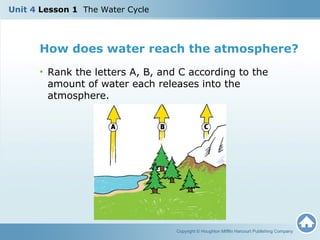
• Rank the letters A, B, and C according to the
amount of water each releases into the
atmosphere.
Copyright © Houghton Mifflin Harcourt Publishing Company
Unit 4 Lesson 1 The Water Cycle
What happens to water in the
atmosphere?
• Condensation is the change of state from gas to
liquid.
• Condensation can occur as clouds, fog, or mist, or
on the ground as dew.
• Precipitation is any form of water that falls to
Earth from clouds.
• Rain, snow, and hail are forms of precipitation.
Copyright © Houghton Mifflin Harcourt Publishing Company
Unit 4 Lesson 1 The Water Cycle
How does water move on land and in
the oceans?
• Water that flows over land and into streams and
rivers is called runoff.
• Water seeps into the ground through infiltration.
• Water underground is called groundwater.
Copyright © Houghton Mifflin Harcourt Publishing Company
Unit 4 Lesson 1 The Water Cycle
How does water move on land and in
the oceans?
• Glaciers flow downhill and sometimes flow into the
ocean.
• Winds move ocean water on the surface long
distances.
• Cold or salty water will sink in the ocean, forming
deep ocean currents that move large amounts of
water.
Copyright © Houghton Mifflin Harcourt Publishing Company
Unit 4 Lesson 1 The Water Cycle
Water Works
Copyright © Houghton Mifflin Harcourt Publishing Company
What does the water cycle transport?
• The water cycle moves energy and matter.
• Energy is transported by changes in state and by
the movement of water from place to place.
• Matter is transported by the vast amounts of
water that move all around the world.
Unit 4 Lesson 1 The Water Cycle
What does the water cycle transport?
• Identify the steps in the water cycle.
Copyright © Houghton Mifflin Harcourt Publishing Company
Unit 4 Lesson 1 The Water Cycle

U4L1 - The Water Cycle

  • 1.
    Unit 4 Lesson1 The Water Cycle Copyright © Houghton Mifflin Harcourt Publishing Company
  • 2.
    Unit 4 Lesson1 The Water Cycle Indiana Standards Copyright © Houghton Mifflin Harcourt Publishing Company • 8.2.1 Recognize and demonstrate how the sun’s energy drives convection in the atmosphere and in bodies of water, which results in ocean currents and weather patterns. • 8.2.2 Describe and model how water moves through the earth’s crust, atmosphere, and oceans in a cyclic way, as liquid, vapor, and solid.
  • 3.
    What Goes Up… Copyright © Houghton Mifflin Harcourt Publishing Company What is the water cycle? • Movement of water between the atmosphere, land, ocean, and living things make up the water cycle. • Water and snow moves downward due to gravity. Water vapor moves upward. Unit 4 Lesson 1 The Water Cycle
  • 4.
    How does waterchange state? • Water on Earth is found as a liquid, solid, or gas. • Water absorbs energy as it melts from solid to liquid. • Water absorbs energy as it evaporates from liquid to gas. Copyright © Houghton Mifflin Harcourt Publishing Company Unit 4 Lesson 1 The Water Cycle
  • 5.
    How does waterchange state? • Water releases energy when it condenses from gas to liquid or when it sublimates from solid to gas. • Water releases energy as it freezes from liquid to solid or deposits from gas to solid. Copyright © Houghton Mifflin Harcourt Publishing Company Unit 4 Lesson 1 The Water Cycle
  • 6.
    How does waterreach the atmosphere? • Water reaches the atmosphere through evaporation, transpiration, and sublimation. • Evaporation occurs when liquid water changes to water vapor. • Most evaporation comes from Earth’s oceans. Copyright © Houghton Mifflin Harcourt Publishing Company Unit 4 Lesson 1 The Water Cycle
  • 7.
    How does waterreach the atmosphere? • Transpiration is the release of water vapor into the atmosphere by plants. • Sublimation is when solid water changes directly to water vapor without first becoming a liquid. • Sublimation can occur when dry air blows over ice or snow. Copyright © Houghton Mifflin Harcourt Publishing Company Unit 4 Lesson 1 The Water Cycle
  • 8.
    How does waterreach the atmosphere? • Rank the letters A, B, and C according to the amount of water each releases into the atmosphere. Copyright © Houghton Mifflin Harcourt Publishing Company Unit 4 Lesson 1 The Water Cycle
  • 9.
    What happens towater in the atmosphere? • Condensation is the change of state from gas to liquid. • Condensation can occur as clouds, fog, or mist, or on the ground as dew. • Precipitation is any form of water that falls to Earth from clouds. • Rain, snow, and hail are forms of precipitation. Copyright © Houghton Mifflin Harcourt Publishing Company Unit 4 Lesson 1 The Water Cycle
  • 10.
    How does watermove on land and in the oceans? • Water that flows over land and into streams and rivers is called runoff. • Water seeps into the ground through infiltration. • Water underground is called groundwater. Copyright © Houghton Mifflin Harcourt Publishing Company Unit 4 Lesson 1 The Water Cycle
  • 11.
    How does watermove on land and in the oceans? • Glaciers flow downhill and sometimes flow into the ocean. • Winds move ocean water on the surface long distances. • Cold or salty water will sink in the ocean, forming deep ocean currents that move large amounts of water. Copyright © Houghton Mifflin Harcourt Publishing Company Unit 4 Lesson 1 The Water Cycle
  • 12.
    Water Works Copyright ©Houghton Mifflin Harcourt Publishing Company What does the water cycle transport? • The water cycle moves energy and matter. • Energy is transported by changes in state and by the movement of water from place to place. • Matter is transported by the vast amounts of water that move all around the world. Unit 4 Lesson 1 The Water Cycle
  • 13.
    What does thewater cycle transport? • Identify the steps in the water cycle. Copyright © Houghton Mifflin Harcourt Publishing Company Unit 4 Lesson 1 The Water Cycle