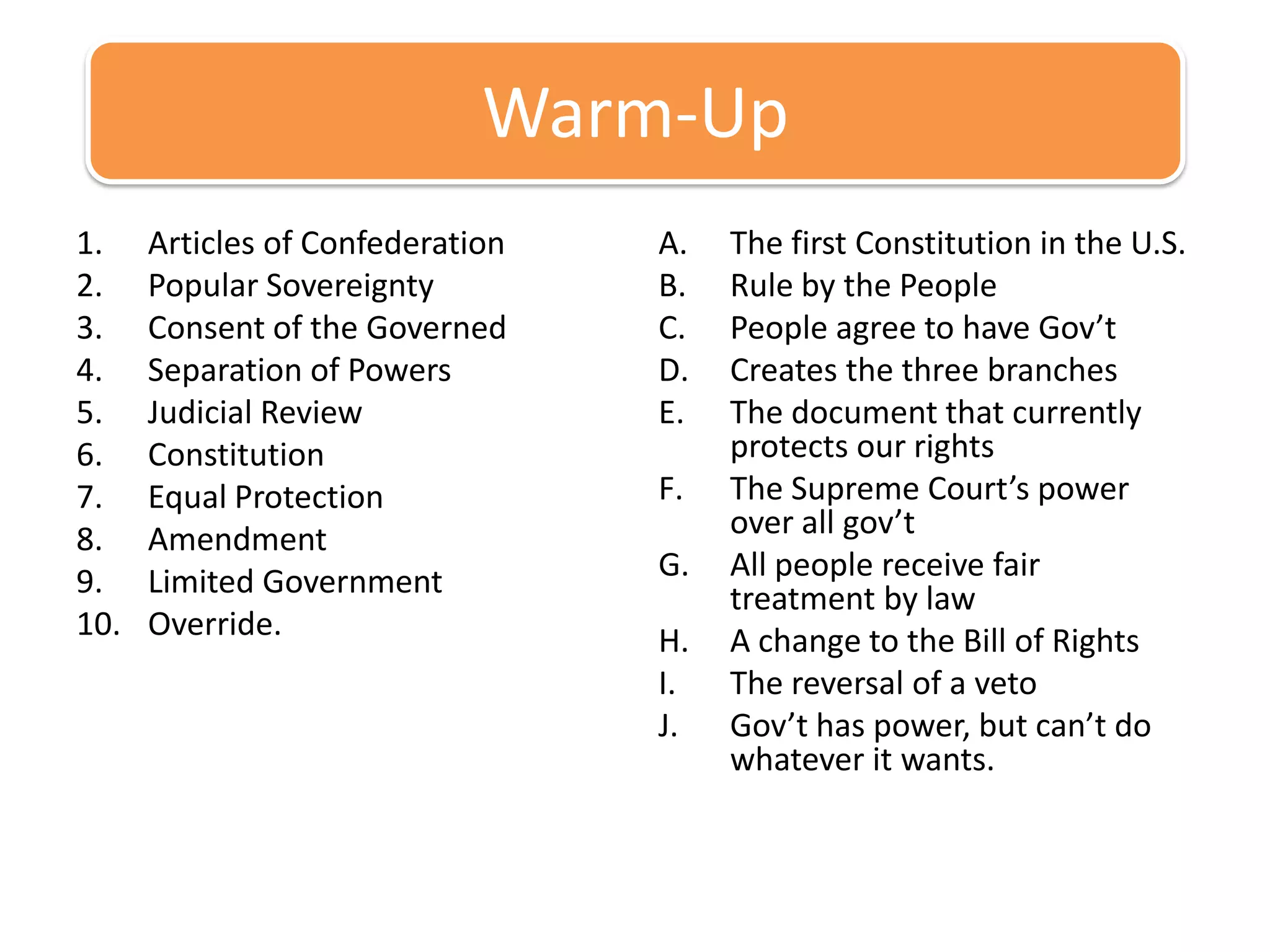
Articles of ConfederationPopular SovereigntyConsent of the GovernedSeparation of PowersJudicial ReviewConstitutionEqual ProtectionAmendmentLimited GovernmentOverride.The first Constitution in the U.S.Rule by the PeoplePeople agree to have Gov’tCreates the three branchesThe document that currently protects our rightsThe Supreme Court’s power over all gov’tAll people receive fair treatment by lawA change to the Bill of RightsThe reversal of a vetoGov’t has power, but can’t do whatever it wants.Warm-Up
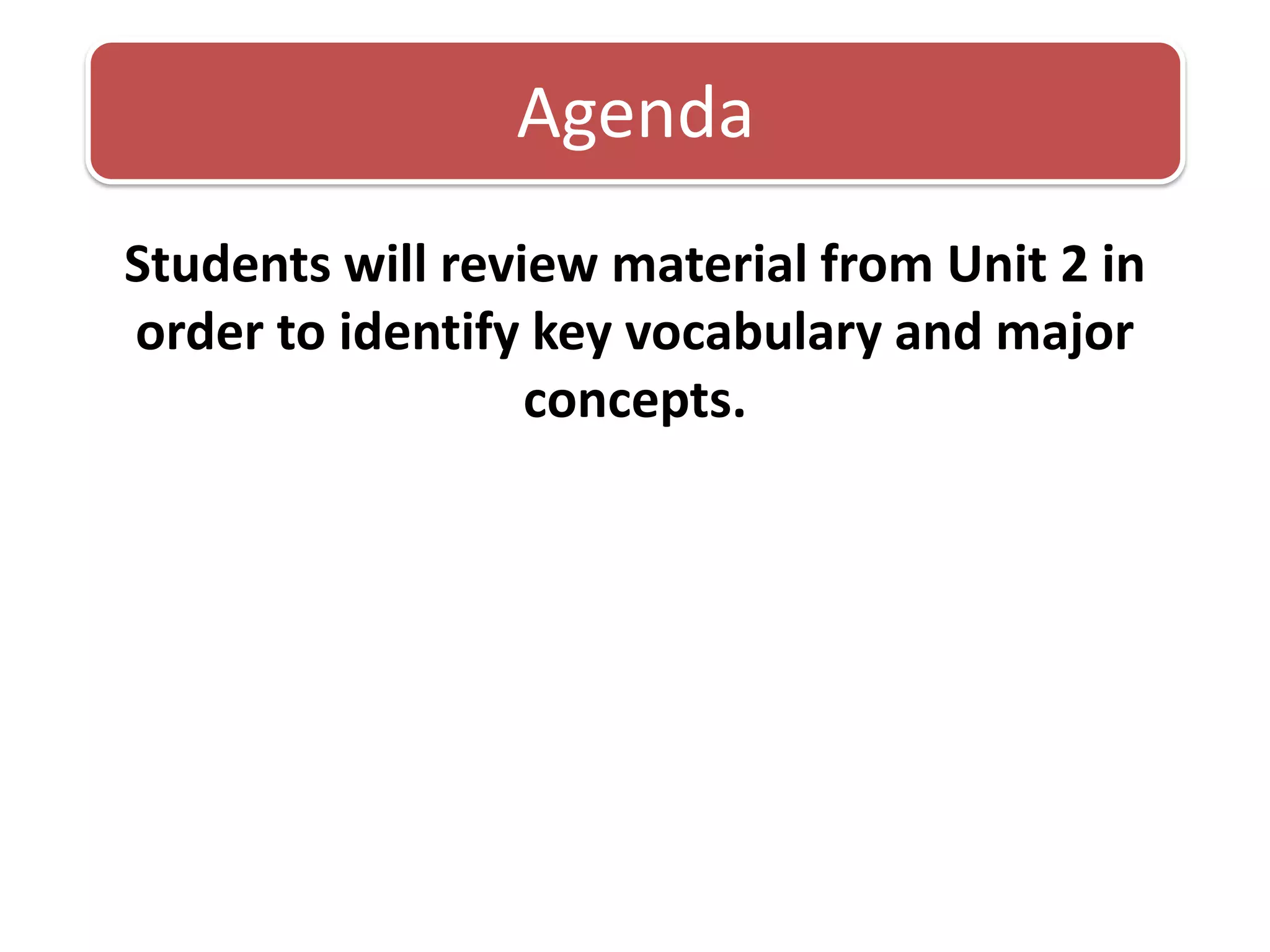
Students will review material from Unit 2 in order to identify key vocabulary and major concepts. Agenda
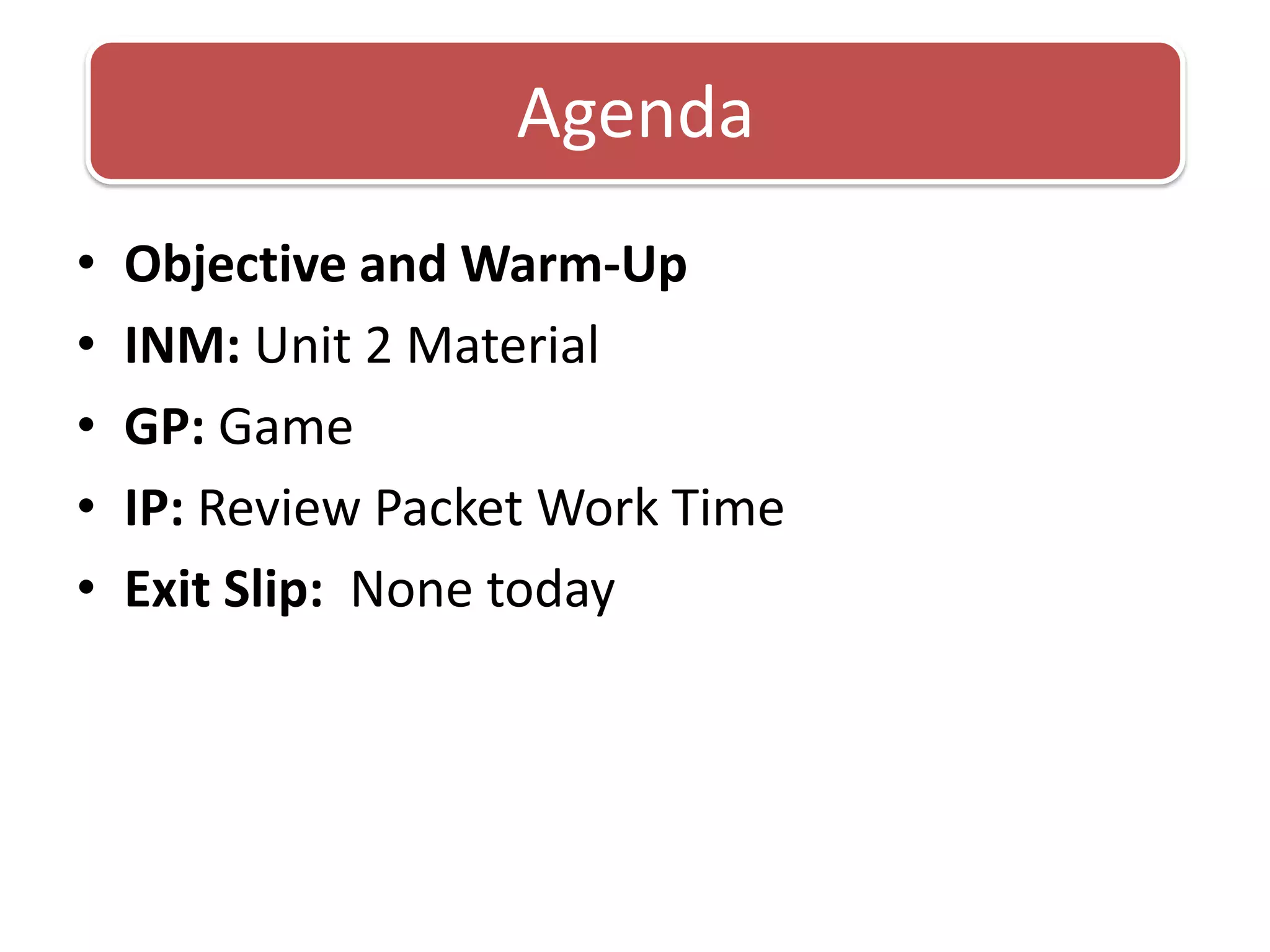
Objective and Warm-UpINM: Unit 2 MaterialGP: GameIP: Review Packet Work TimeExit Slip: None todayAgenda
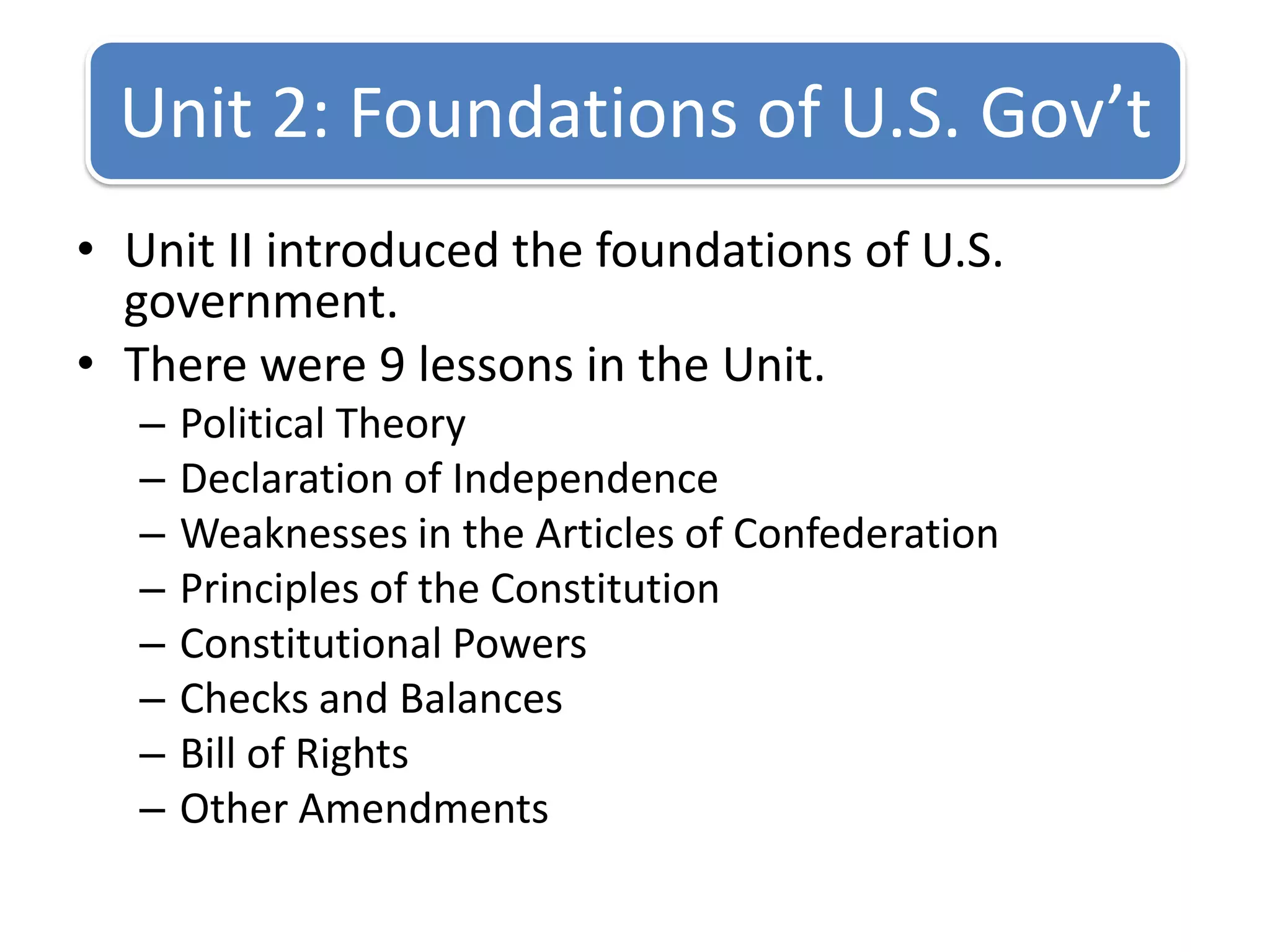
Unit II introduced the foundations of U.S. government.There were 9 lessons in the Unit. Political TheoryDeclaration of IndependenceWeaknesses in the Articles of ConfederationPrinciples of the ConstitutionConstitutional PowersChecks and BalancesBill of RightsOther AmendmentsUnit 2: Foundations of U.S. Gov’t
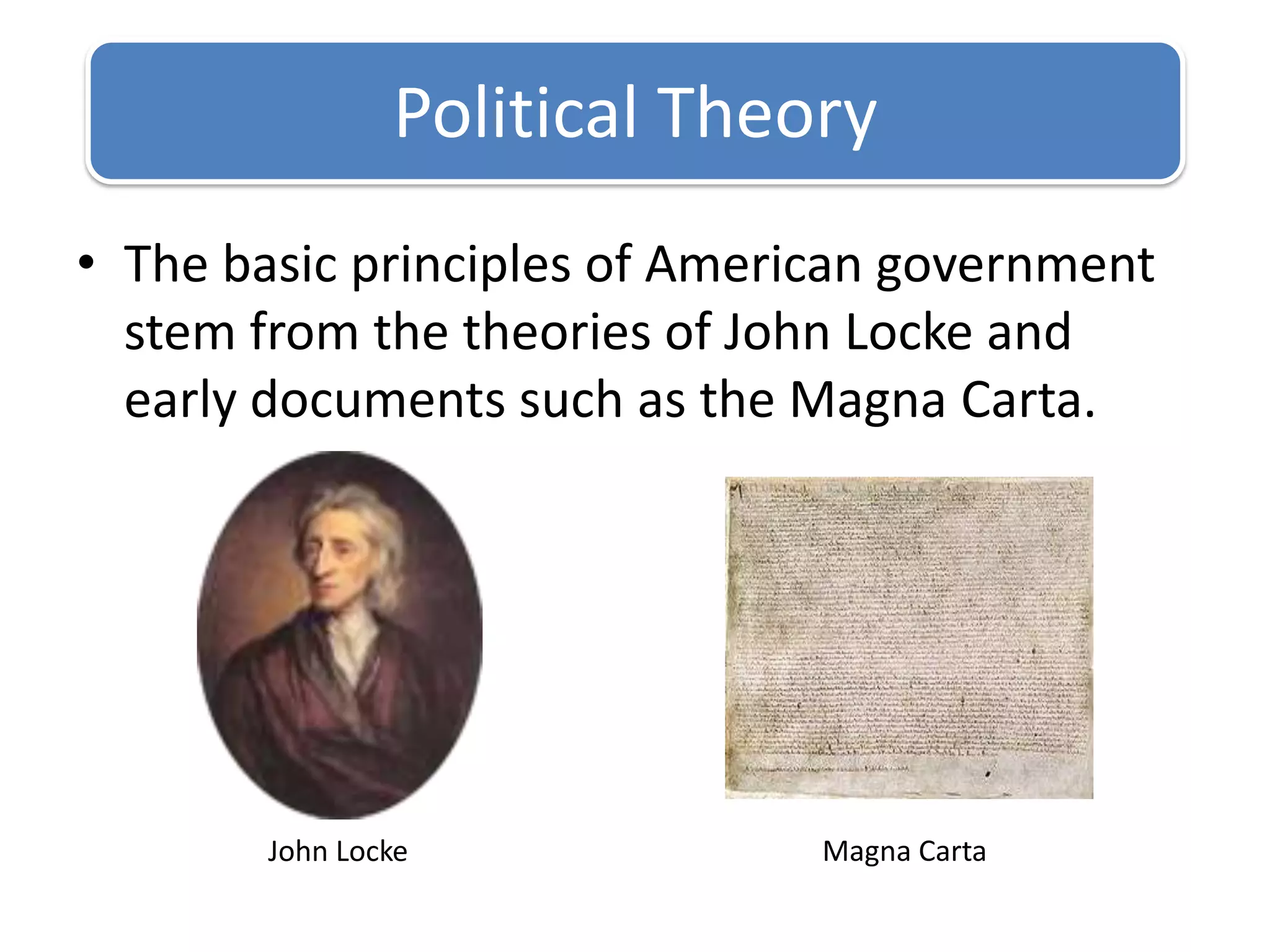
The basic principles of American government stem from the theories of John Locke and early documents such as the Magna Carta.Political TheoryMagna CartaJohn Locke
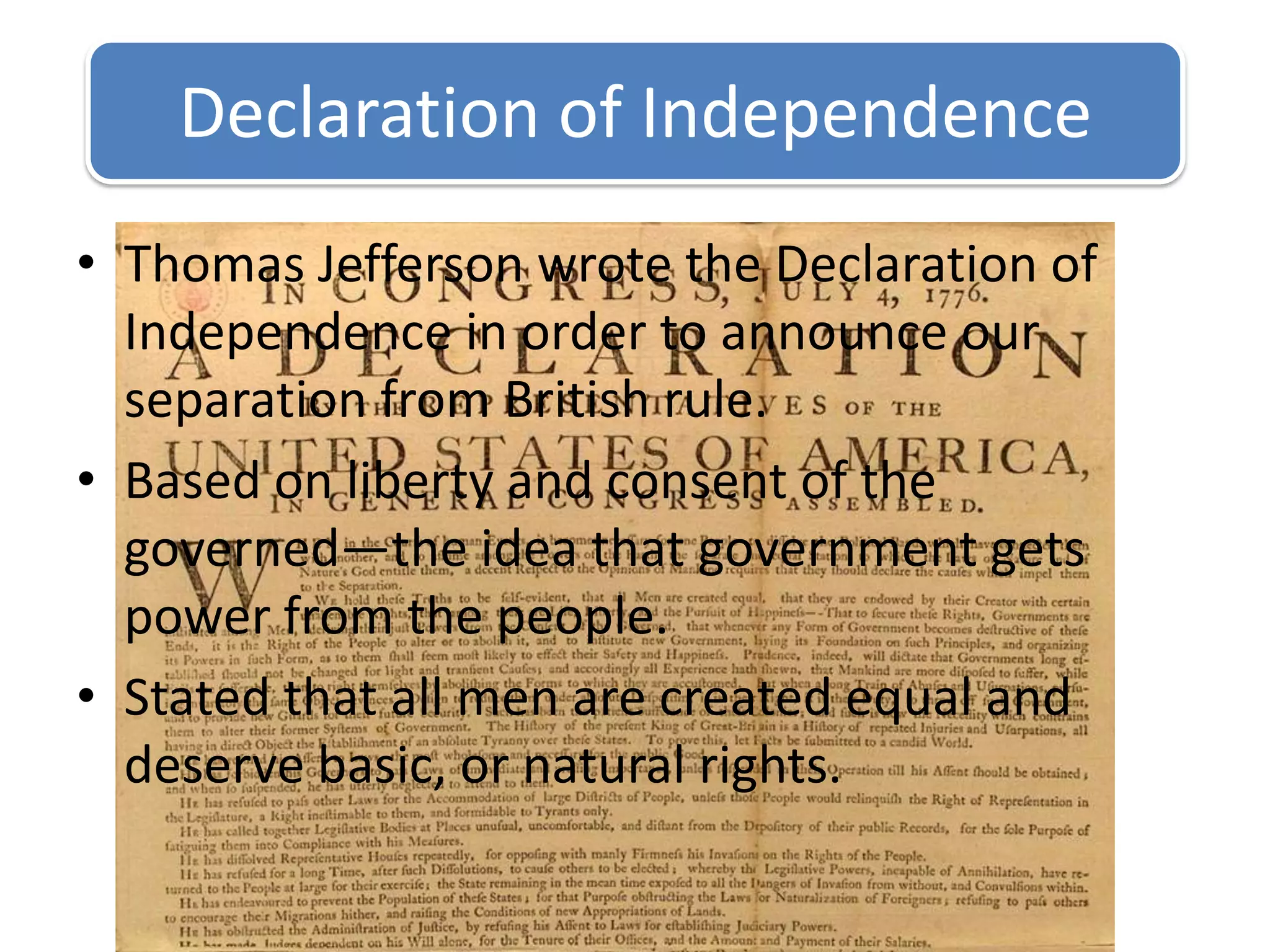
Declaration of IndependenceThomas Jefferson wrote the Declaration of Independence in order to announce our separation from British rule.Based on liberty and consent of the governed—the idea that government gets power from the people.Stated that all men are created equal and deserve basic, or natural rights.
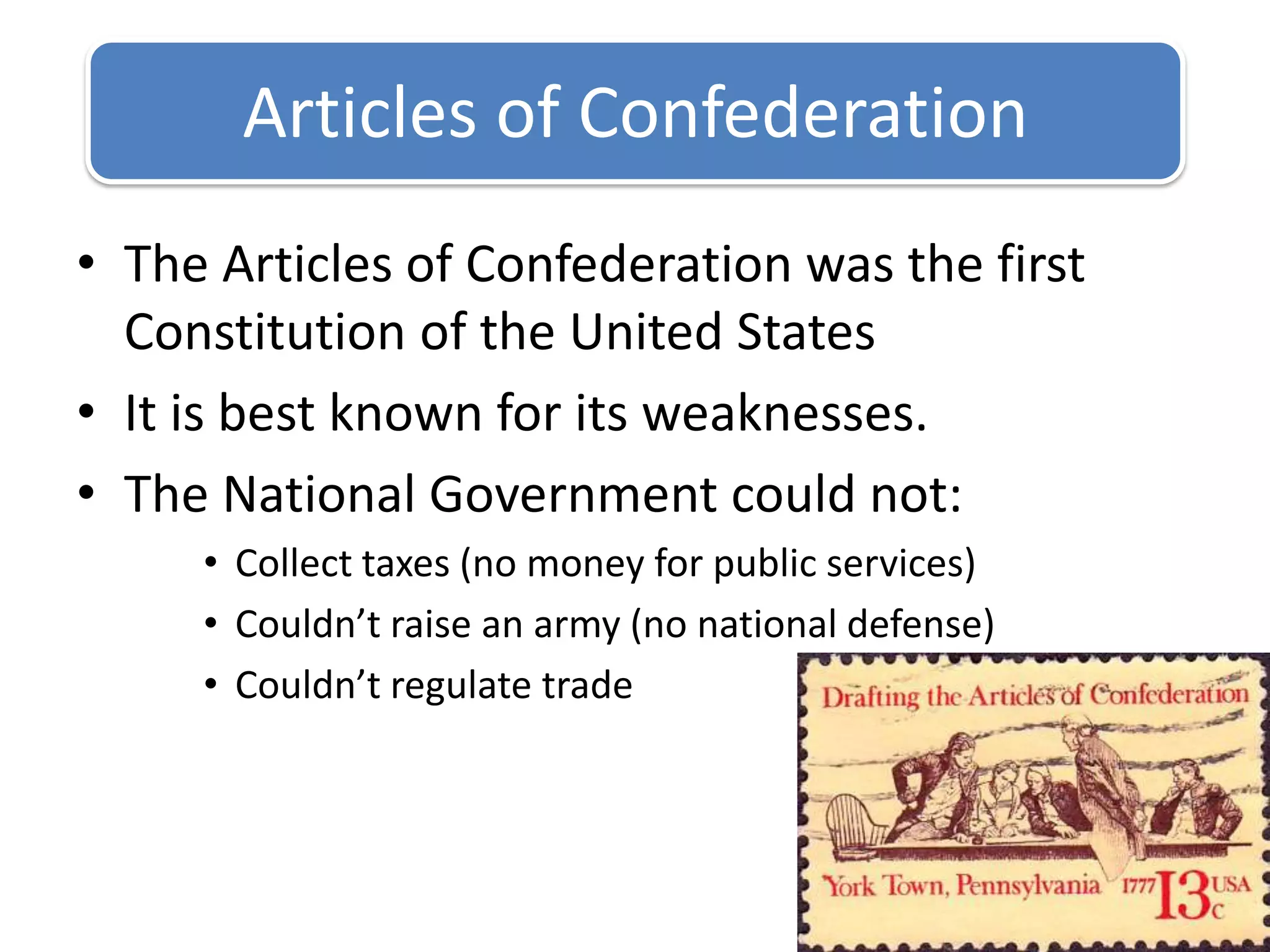
The Articles of Confederation was the first Constitution of the United StatesIt is best known for its weaknesses.The National Government could not:Collect taxes (no money for public services)Couldn’t raise an army (no national defense)Couldn’t regulate tradeArticles of Confederation
Principles of the ConstitutionThe Constitution was created to solve the problems of the Articles of Confederation, while continuing to protect individual rights.It limited the power of government, while also giving more to the national level.It introduced several major principles:FederalismSeparation of powersChecks and balancesJudicial ReviewRule of Law
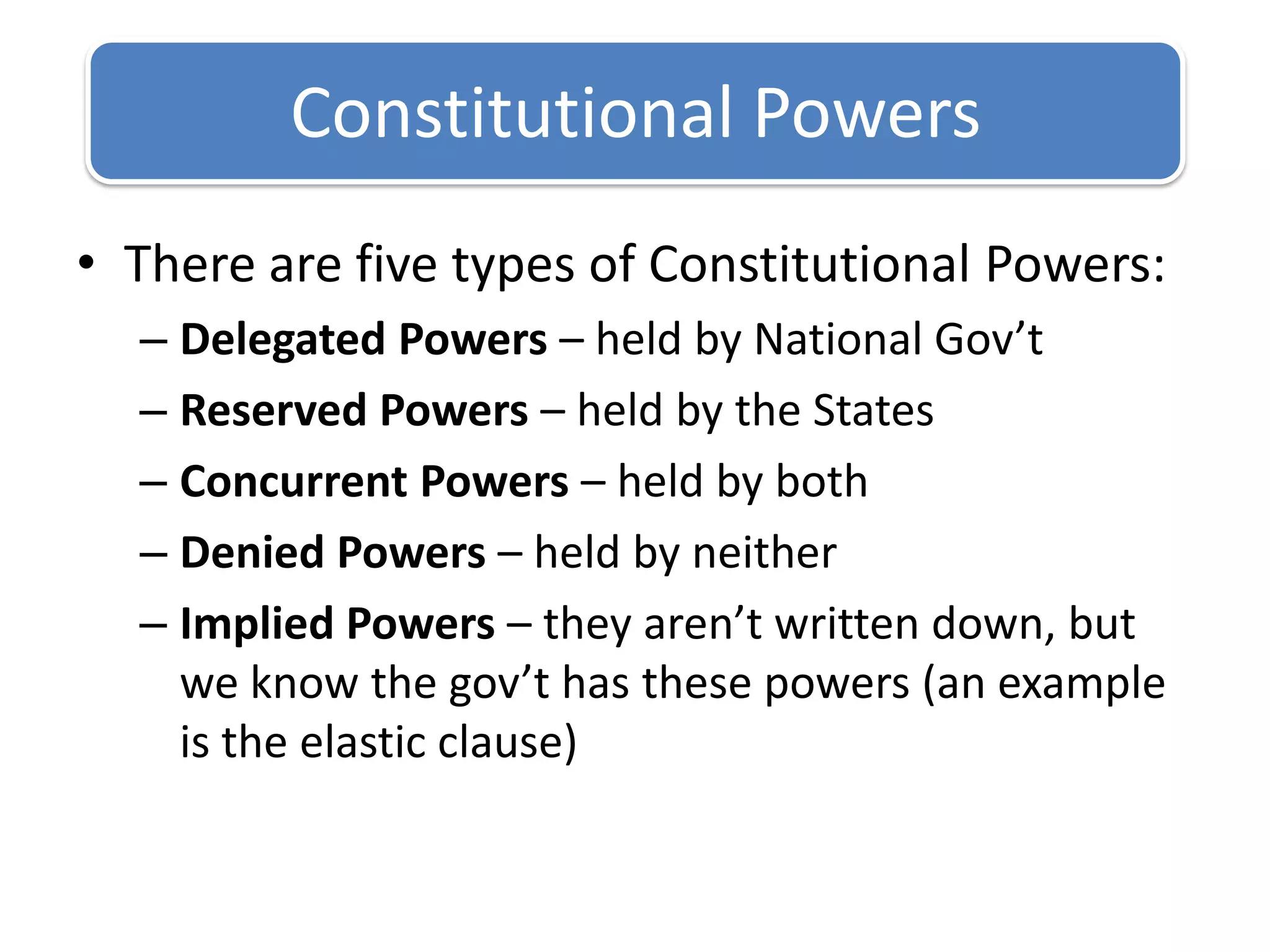
There are five types of Constitutional Powers:Delegated Powers – held by National Gov’tReserved Powers – held by the StatesConcurrent Powers – held by bothDenied Powers – held by neitherImplied Powers – they aren’t written down, but we know the gov’t has these powers (an example is the elastic clause)Constitutional Powers
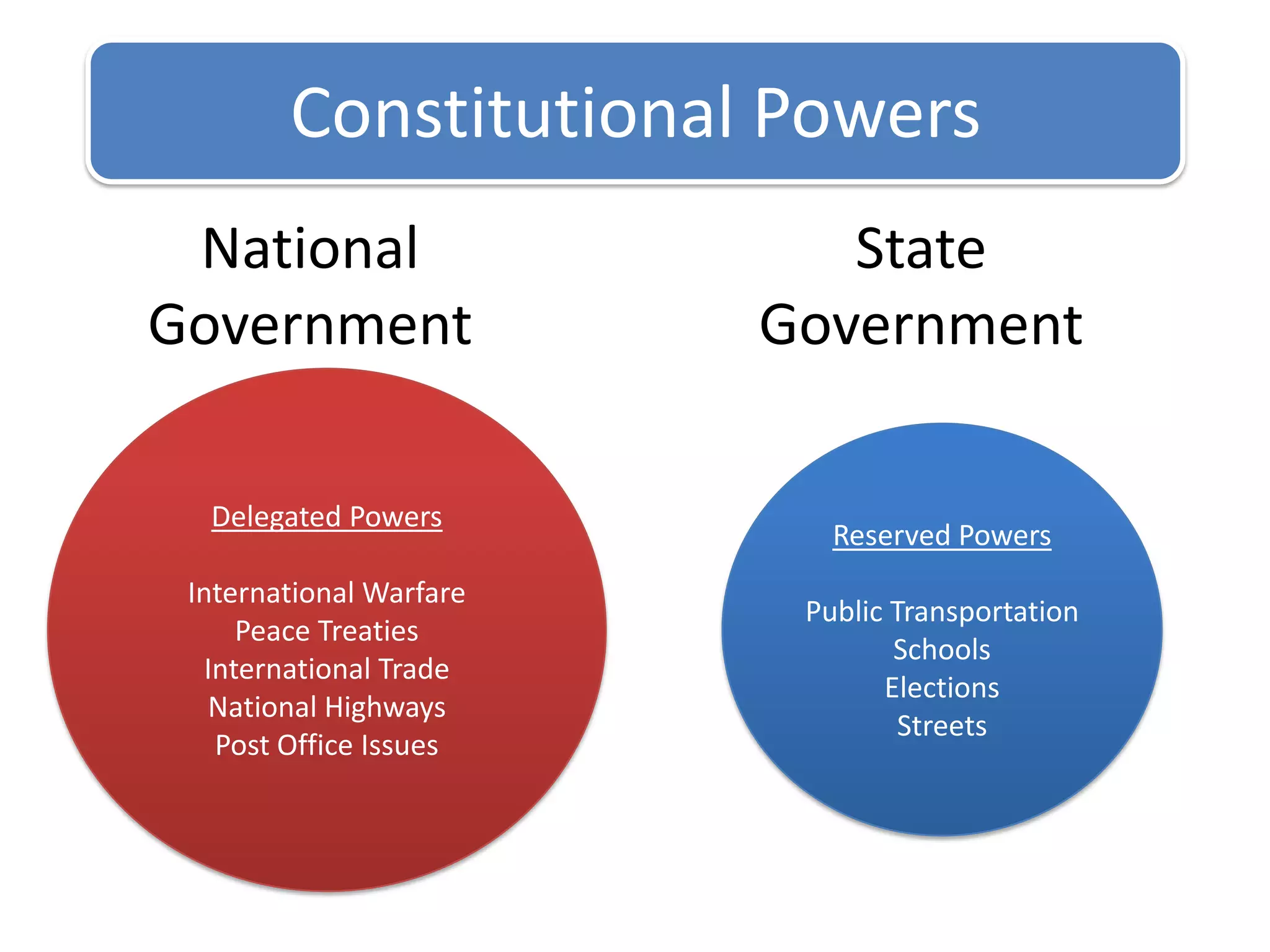
Constitutional PowersNationalGovernmentStateGovernmentDelegated PowersInternational WarfarePeace TreatiesInternational TradeNational HighwaysPost Office IssuesReserved PowersPublic TransportationSchoolsElectionsStreets
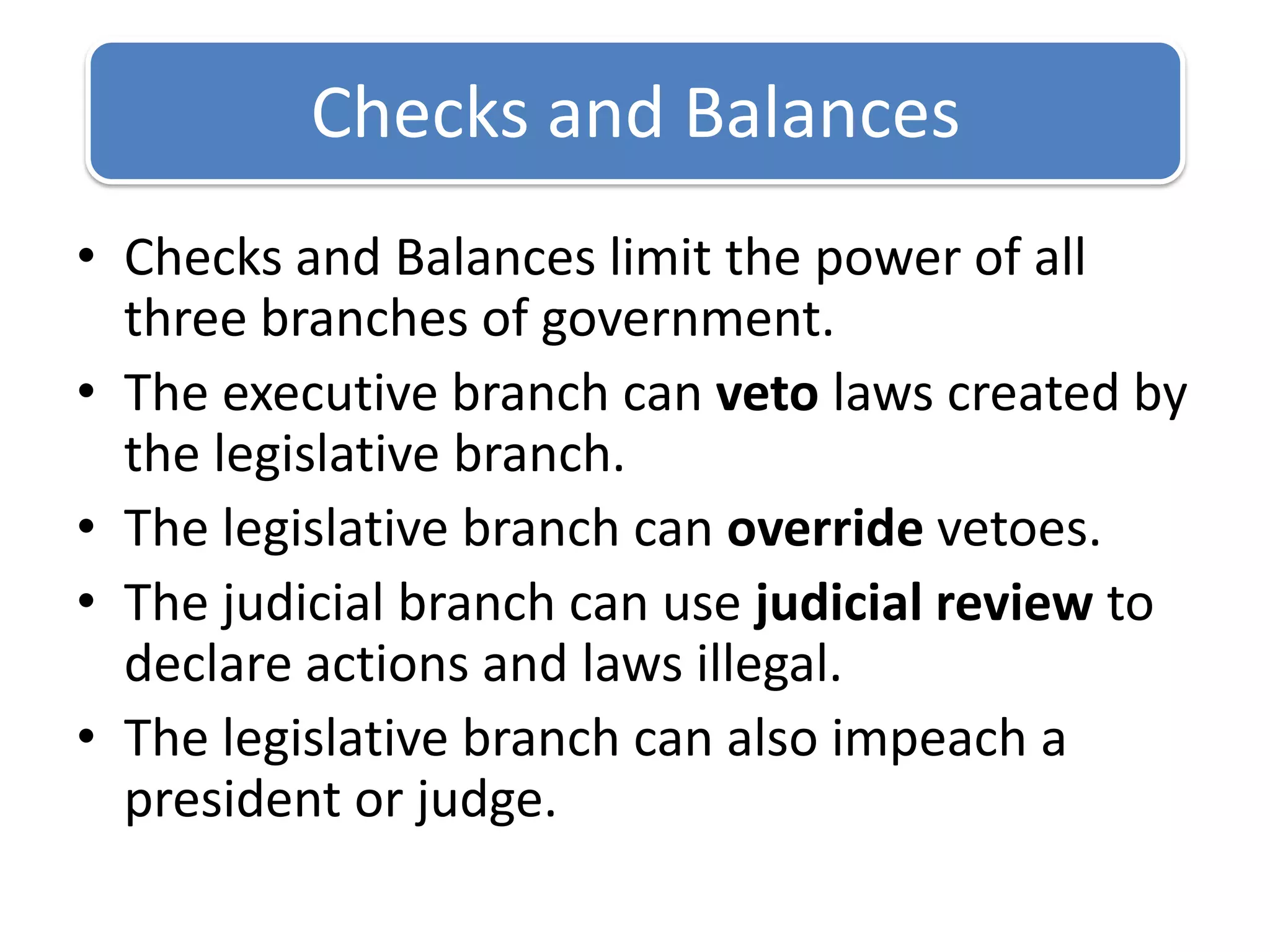
Checks and Balances limit the power of all three branches of government.The executive branch can veto laws created by the legislative branch.The legislative branch can override vetoes.The judicial branch can use judicial review to declare actions and laws illegal.The legislative branch can also impeach a president or judge.Checks and Balances
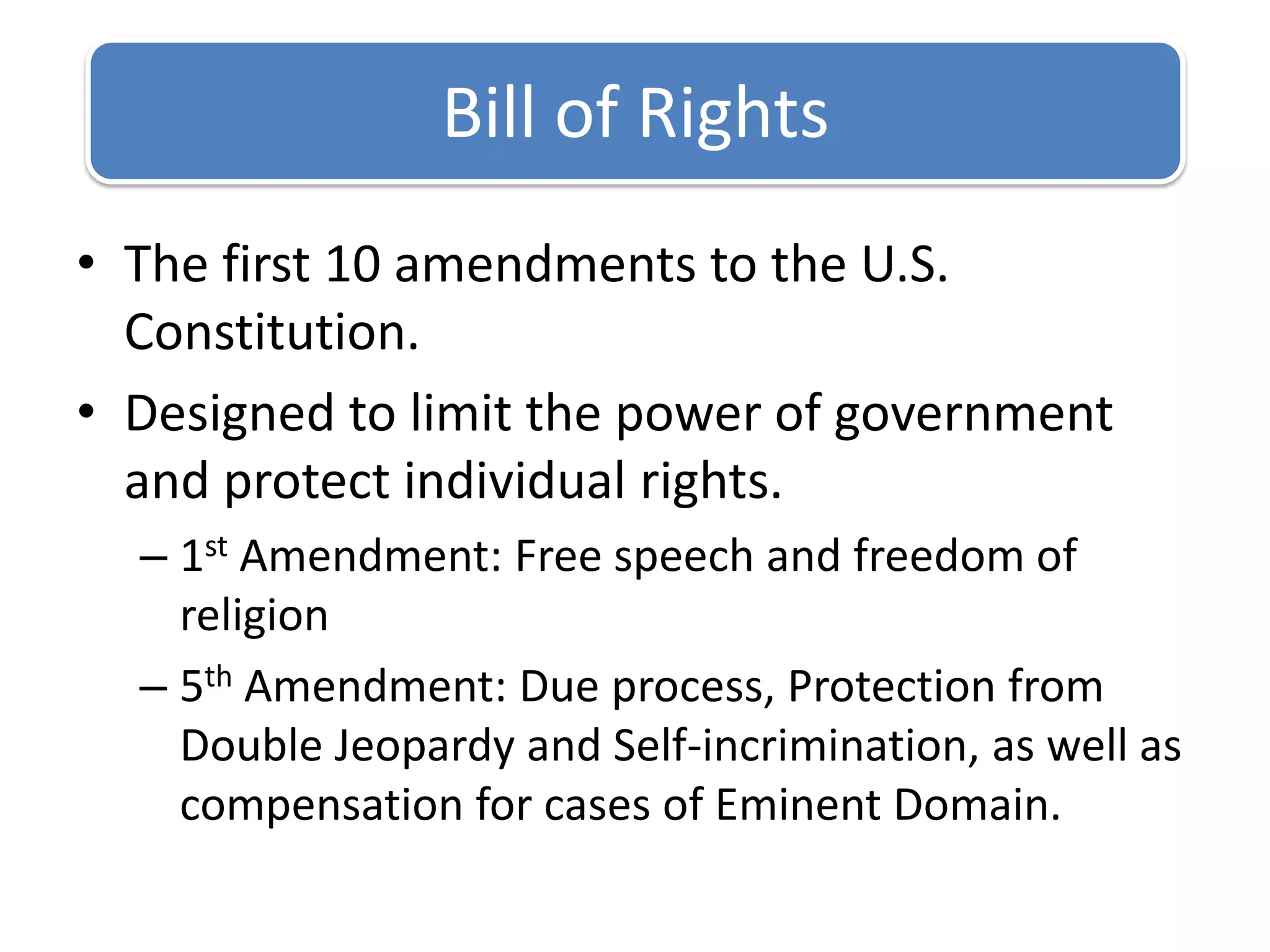
The first 10 amendments to the U.S. Constitution.Designed to limit the power of government and protect individual rights.1st Amendment: Free speech and freedom of religion5th Amendment: Due process, Protection from Double Jeopardy and Self-incrimination, as well as compensation for cases of Eminent Domain.Bill of Rights
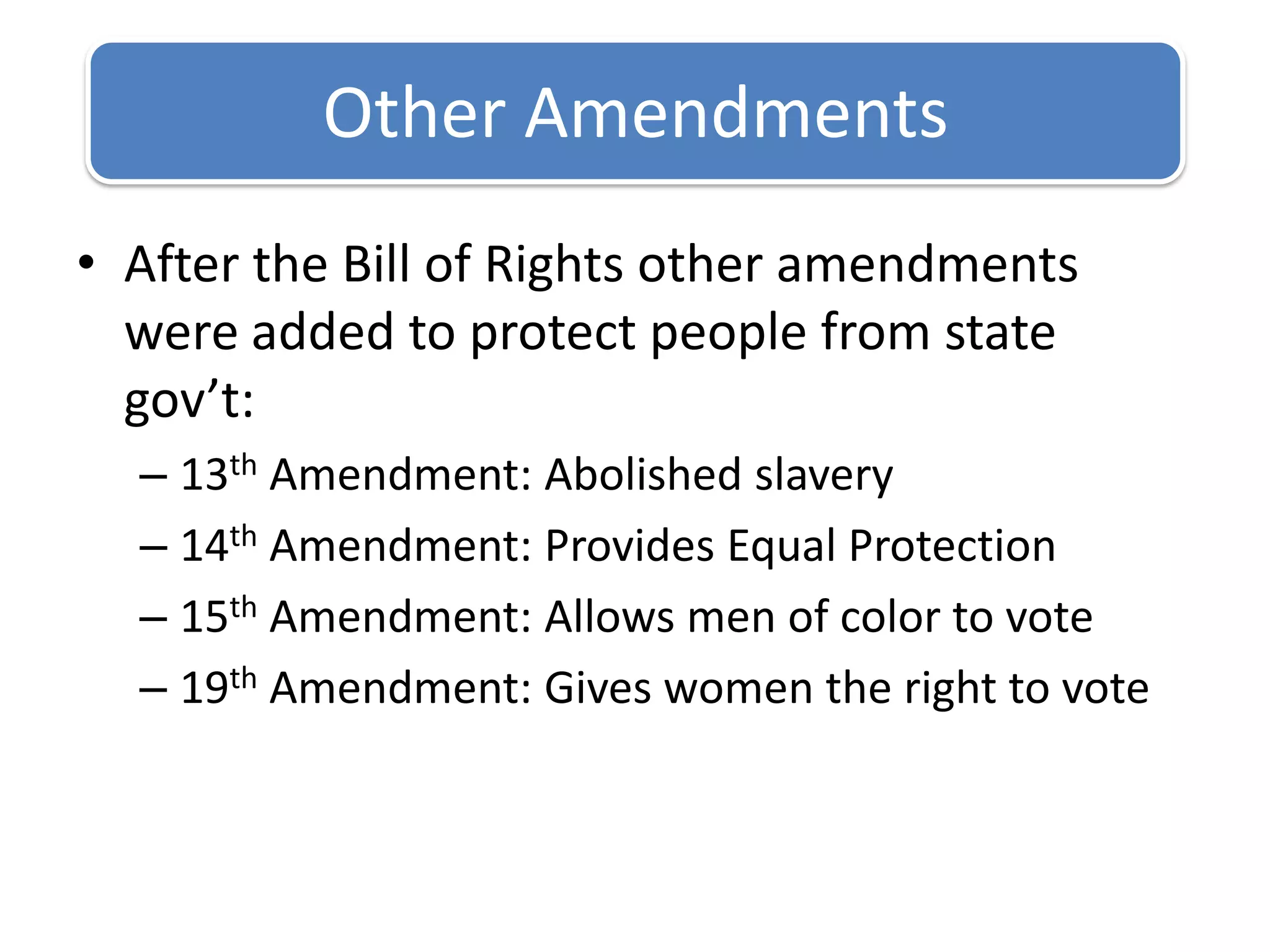
After the Bill of Rights other amendments were added to protect people from state gov’t:13th Amendment: Abolished slavery14th Amendment: Provides Equal Protection15th Amendment: Allows men of color to vote19th Amendment: Gives women the right to voteOther Amendments
Bust out the clickers.It’s time to see what you know.
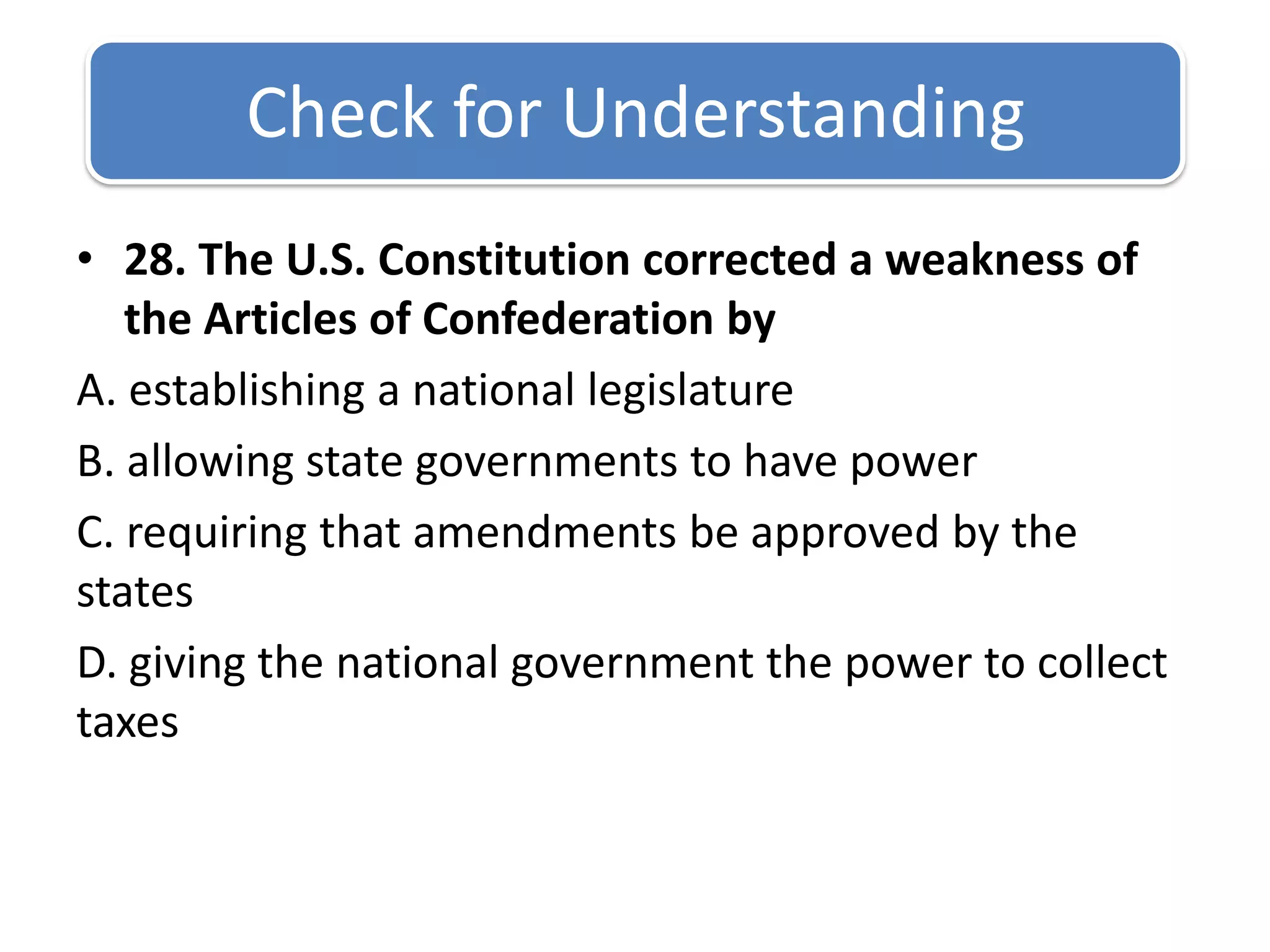
Check for Understanding 28. The U.S. Constitution corrected a weakness of the Articles of Confederation byA. establishing a national legislature B. allowing state governments to have power C. requiring that amendments be approved by the statesD. giving the national government the power to collect taxes
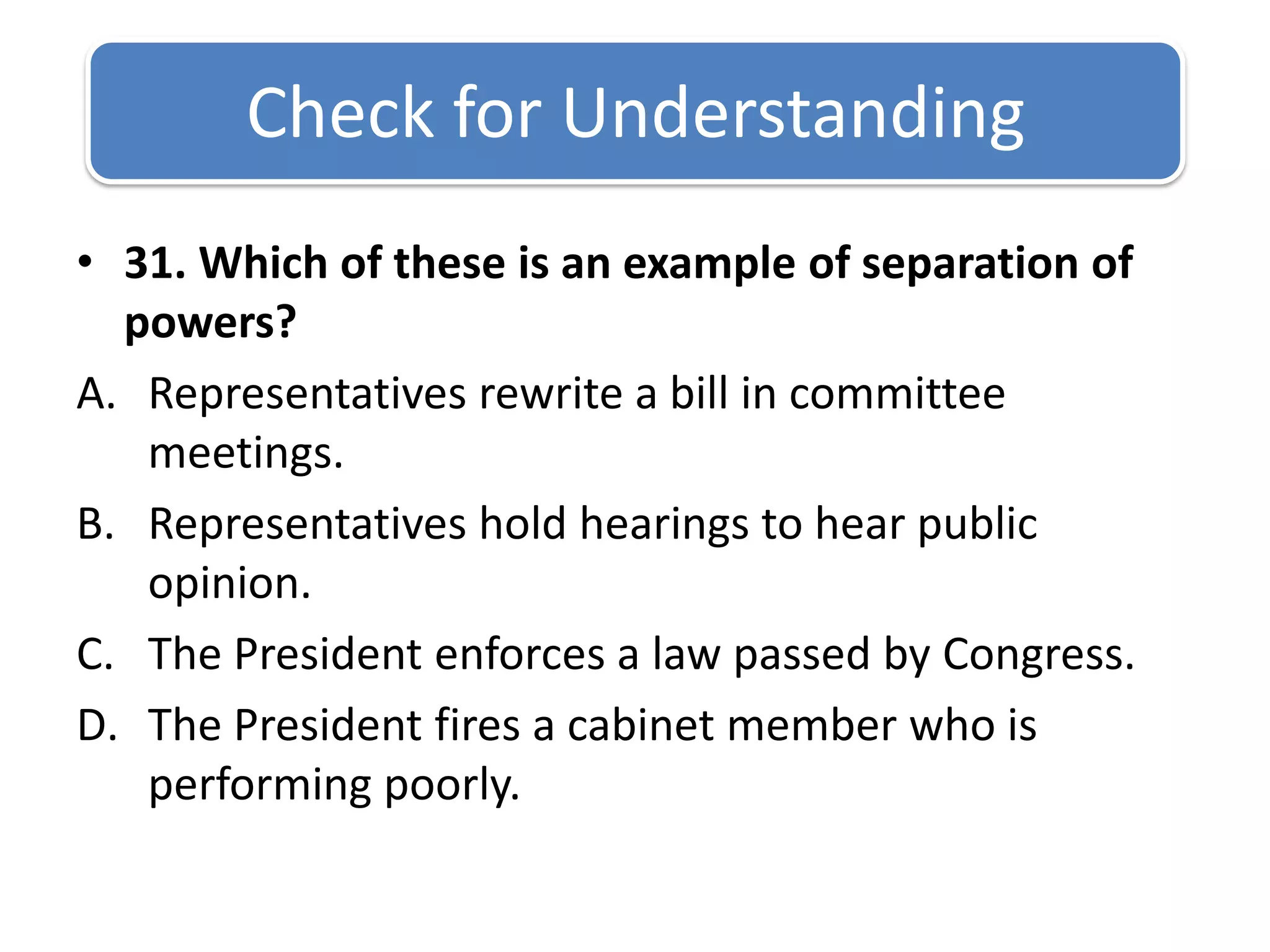
Check for Understanding 31. Which of these is an example of separation of powers?Representatives rewrite a bill in committee meetings. Representatives hold hearings to hear public opinion.The President enforces a law passed by Congress.The President fires a cabinet member who is performing poorly.
Check for Understanding 34. Read the excerpt below.“In [creating] a government which is to be administered by men over men, the great difficulty lies in this: You must first enable the government to control the governed; and in the next place, [make it ]control itself.”  --- The Federalist No. 51Which of these principles is best reflected in the excerpt?A. majority rule B. popular sovereignty C. limited government D. representative democracy
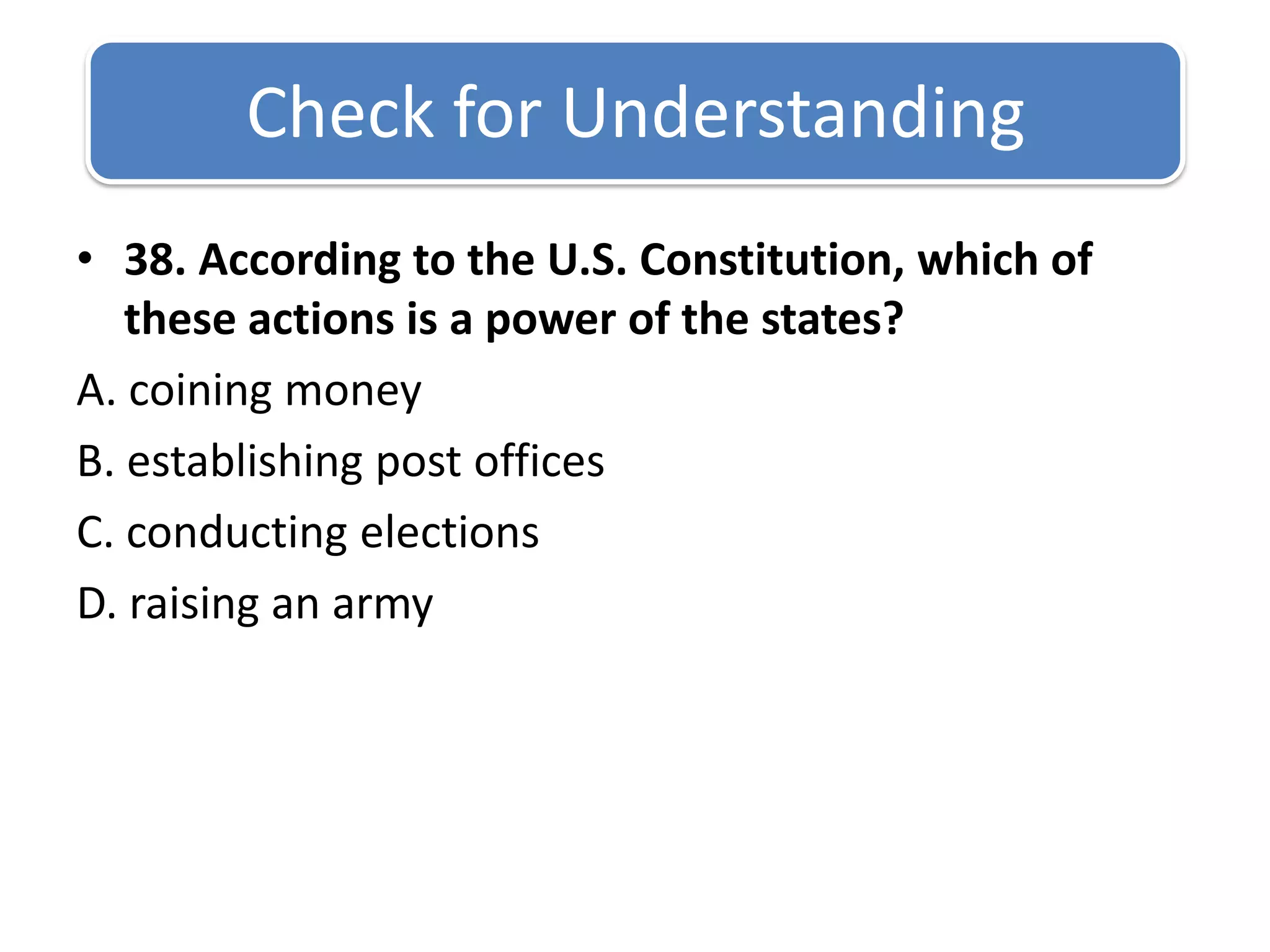
Check for Understanding 38. According to the U.S. Constitution, which of these actions is a power of the states?A. coining money B. establishing post offices C. conducting elections D. raising an army
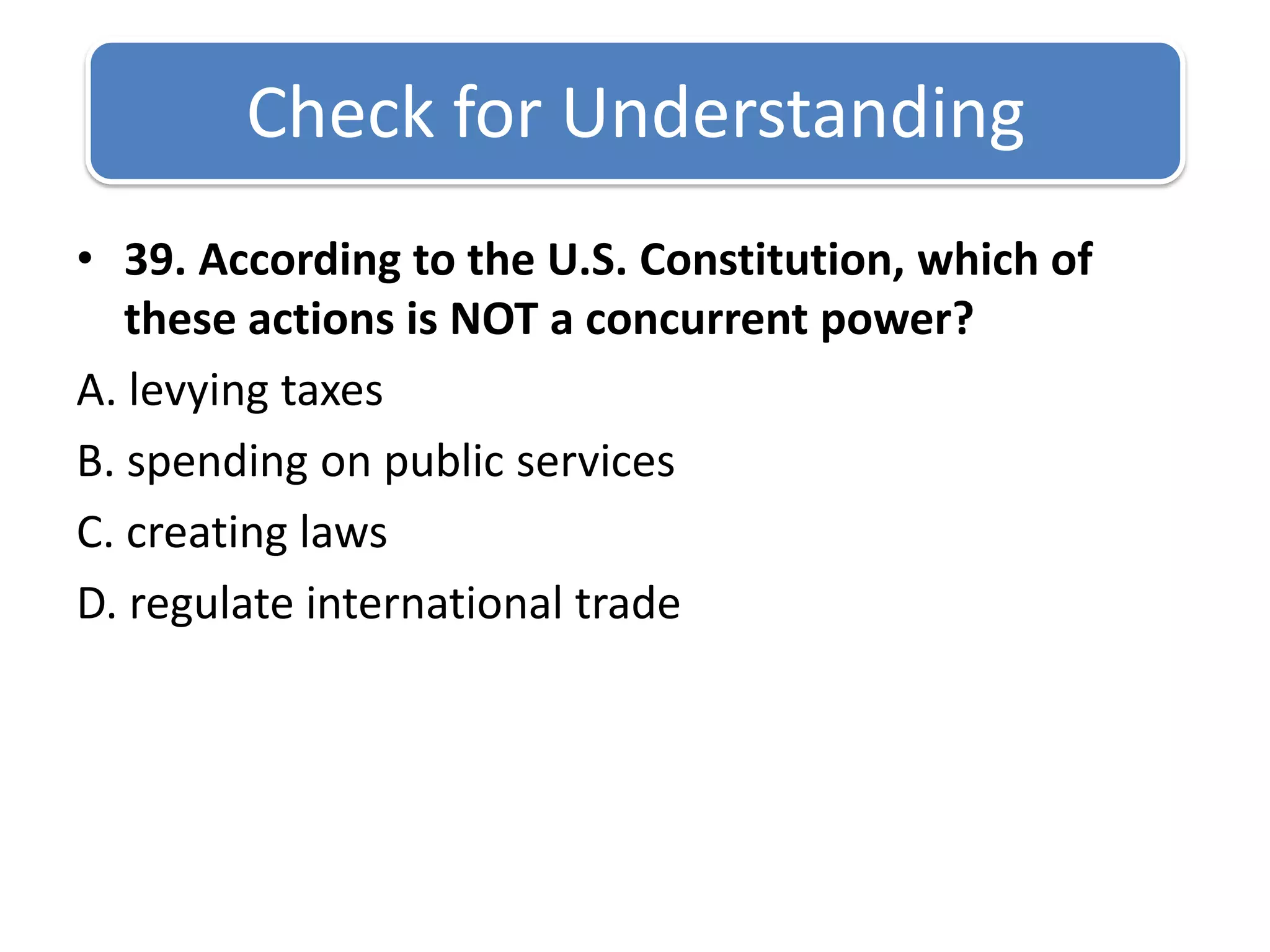
Check for Understanding 39. According to the U.S. Constitution, which of these actions is NOT a concurrent power?A. levying taxes B. spending on public services C. creating laws D. regulate international trade
Have your notes ready, as we get ready to play a game of…Guided PracticeJEOPARDY!!!
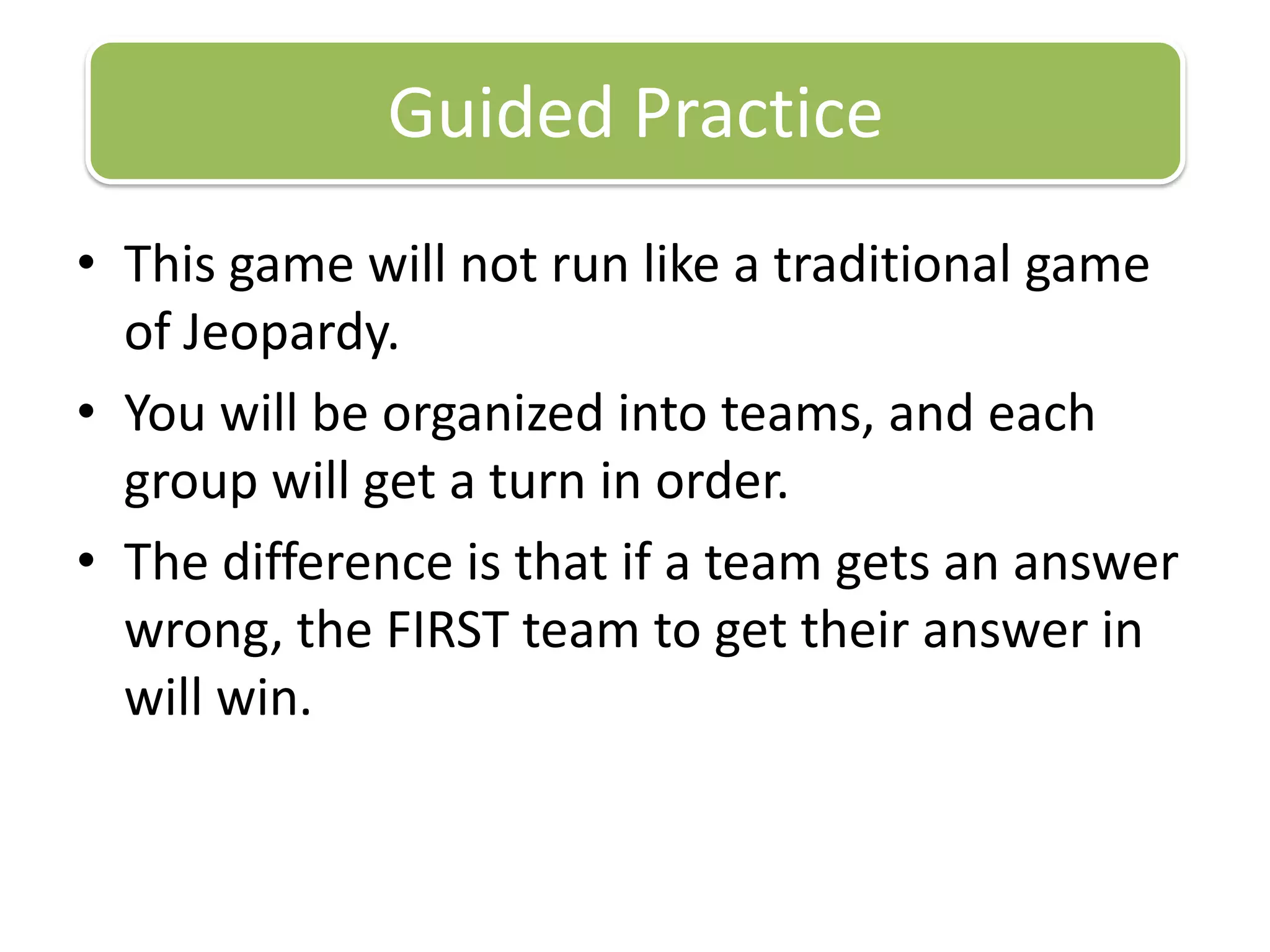
This game will not run like a traditional game of Jeopardy.You will be organized into teams, and each group will get a turn in order.The difference is that if a team gets an answer wrong, the FIRST team to get their answer in will win.Guided Practice
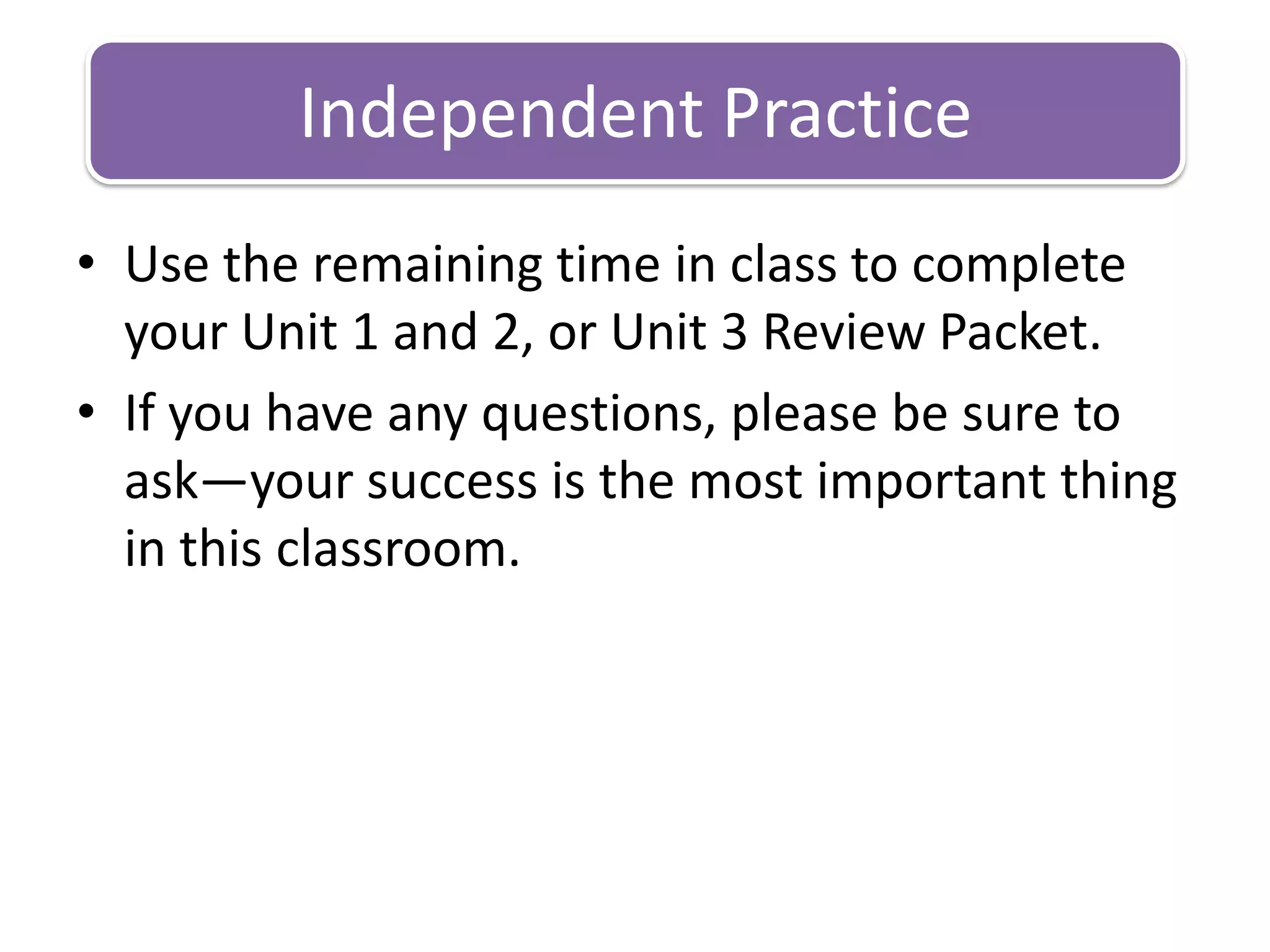
Use the remaining time in class to complete your Unit 1 and 2, or Unit 3 Review Packet.If you have any questions, please be sure to ask—your success is the most important thing in this classroom.Independent Practice
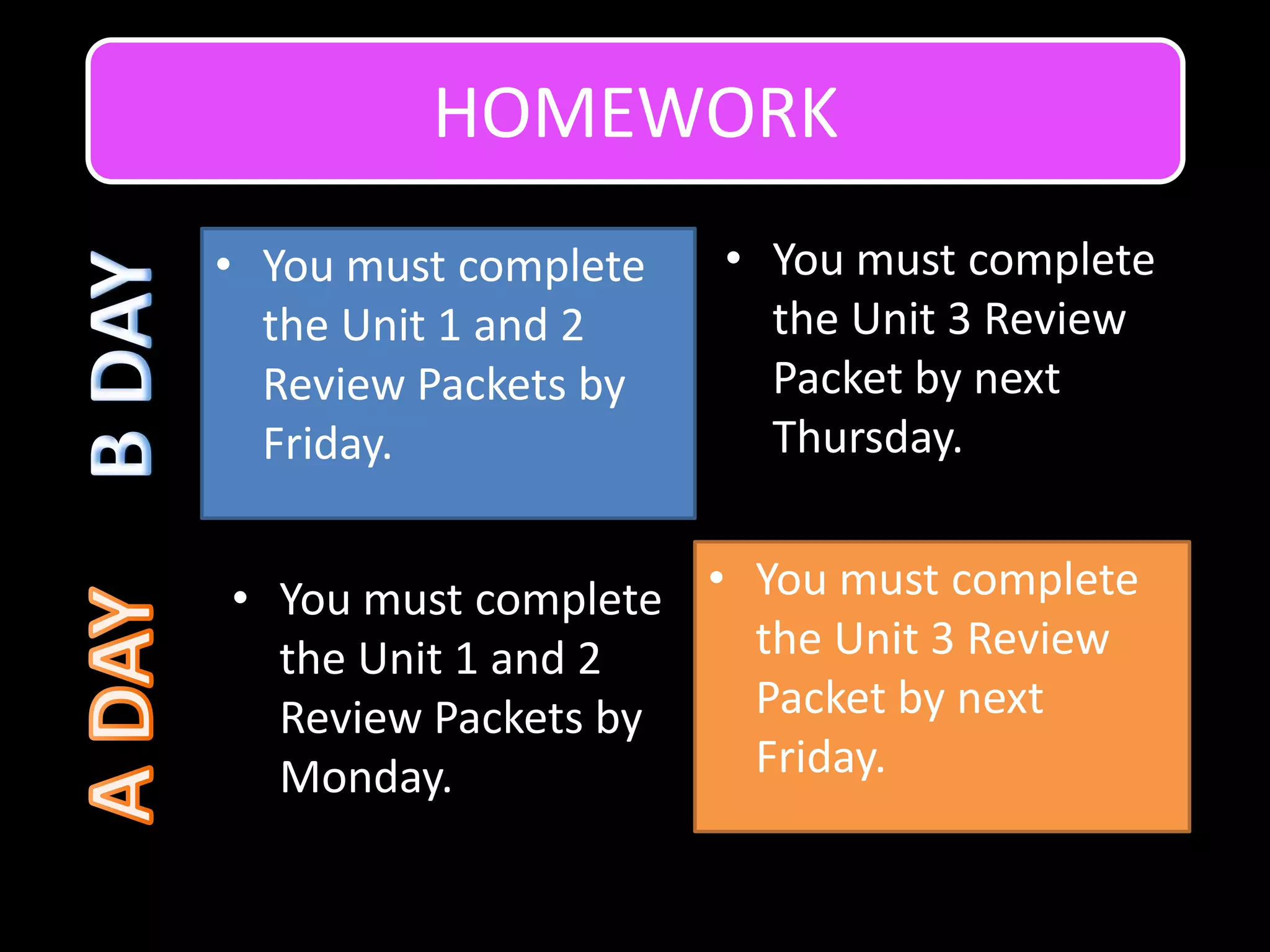
HOMEWORKYou must complete the Unit 3 Review Packet by next Thursday.You must complete the Unit 1 and 2 Review Packets by Friday.B DAYYou must complete the Unit 3 Review Packet by next Friday.You must complete the Unit 1 and 2 Review Packets by Monday.A DAY
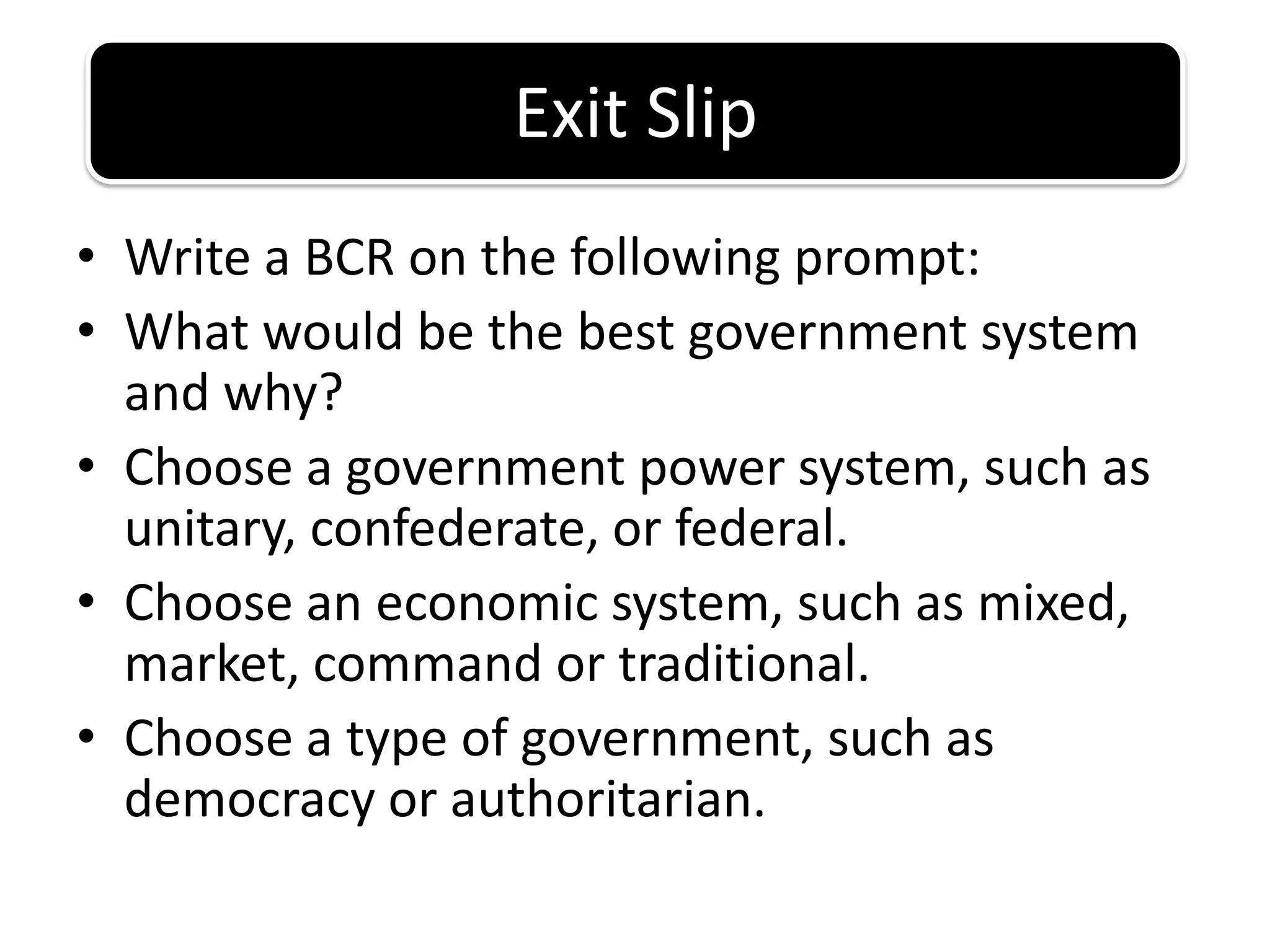
Write a BCR on the following prompt:What would be the best government system and why?Choose a government power system, such as unitary, confederate, or federal.Choose an economic system, such as mixed, market, command or traditional.Choose a type of government, such as democracy or authoritarian.Exit Slip

FAST II: Unit 2 Review

  • 1.
    Articles of ConfederationPopularSovereigntyConsent of the GovernedSeparation of PowersJudicial ReviewConstitutionEqual ProtectionAmendmentLimited GovernmentOverride.The first Constitution in the U.S.Rule by the PeoplePeople agree to have Gov’tCreates the three branchesThe document that currently protects our rightsThe Supreme Court’s power over all gov’tAll people receive fair treatment by lawA change to the Bill of RightsThe reversal of a vetoGov’t has power, but can’t do whatever it wants.Warm-Up
  • 2.
    Students will reviewmaterial from Unit 2 in order to identify key vocabulary and major concepts. Agenda
  • 3.
    Objective and Warm-UpINM:Unit 2 MaterialGP: GameIP: Review Packet Work TimeExit Slip: None todayAgenda
  • 4.
    Unit II introducedthe foundations of U.S. government.There were 9 lessons in the Unit. Political TheoryDeclaration of IndependenceWeaknesses in the Articles of ConfederationPrinciples of the ConstitutionConstitutional PowersChecks and BalancesBill of RightsOther AmendmentsUnit 2: Foundations of U.S. Gov’t
  • 5.
    The basic principlesof American government stem from the theories of John Locke and early documents such as the Magna Carta.Political TheoryMagna CartaJohn Locke
  • 6.
    Declaration of IndependenceThomasJefferson wrote the Declaration of Independence in order to announce our separation from British rule.Based on liberty and consent of the governed—the idea that government gets power from the people.Stated that all men are created equal and deserve basic, or natural rights.
  • 7.
    The Articles ofConfederation was the first Constitution of the United StatesIt is best known for its weaknesses.The National Government could not:Collect taxes (no money for public services)Couldn’t raise an army (no national defense)Couldn’t regulate tradeArticles of Confederation
  • 8.
    Principles of theConstitutionThe Constitution was created to solve the problems of the Articles of Confederation, while continuing to protect individual rights.It limited the power of government, while also giving more to the national level.It introduced several major principles:FederalismSeparation of powersChecks and balancesJudicial ReviewRule of Law
  • 9.
    There are fivetypes of Constitutional Powers:Delegated Powers – held by National Gov’tReserved Powers – held by the StatesConcurrent Powers – held by bothDenied Powers – held by neitherImplied Powers – they aren’t written down, but we know the gov’t has these powers (an example is the elastic clause)Constitutional Powers
  • 10.
    Constitutional PowersNationalGovernmentStateGovernmentDelegated PowersInternationalWarfarePeace TreatiesInternational TradeNational HighwaysPost Office IssuesReserved PowersPublic TransportationSchoolsElectionsStreets
  • 11.
    Checks and Balanceslimit the power of all three branches of government.The executive branch can veto laws created by the legislative branch.The legislative branch can override vetoes.The judicial branch can use judicial review to declare actions and laws illegal.The legislative branch can also impeach a president or judge.Checks and Balances
  • 12.
    The first 10amendments to the U.S. Constitution.Designed to limit the power of government and protect individual rights.1st Amendment: Free speech and freedom of religion5th Amendment: Due process, Protection from Double Jeopardy and Self-incrimination, as well as compensation for cases of Eminent Domain.Bill of Rights
  • 13.
    After the Billof Rights other amendments were added to protect people from state gov’t:13th Amendment: Abolished slavery14th Amendment: Provides Equal Protection15th Amendment: Allows men of color to vote19th Amendment: Gives women the right to voteOther Amendments
  • 14.
    Bust out theclickers.It’s time to see what you know.
  • 15.
    Check for Understanding28. The U.S. Constitution corrected a weakness of the Articles of Confederation byA. establishing a national legislature B. allowing state governments to have power C. requiring that amendments be approved by the statesD. giving the national government the power to collect taxes
  • 16.
    Check for Understanding31. Which of these is an example of separation of powers?Representatives rewrite a bill in committee meetings. Representatives hold hearings to hear public opinion.The President enforces a law passed by Congress.The President fires a cabinet member who is performing poorly.
  • 17.
    Check for Understanding34. Read the excerpt below.“In [creating] a government which is to be administered by men over men, the great difficulty lies in this: You must first enable the government to control the governed; and in the next place, [make it ]control itself.” --- The Federalist No. 51Which of these principles is best reflected in the excerpt?A. majority rule B. popular sovereignty C. limited government D. representative democracy
  • 18.
    Check for Understanding38. According to the U.S. Constitution, which of these actions is a power of the states?A. coining money B. establishing post offices C. conducting elections D. raising an army
  • 19.
    Check for Understanding39. According to the U.S. Constitution, which of these actions is NOT a concurrent power?A. levying taxes B. spending on public services C. creating laws D. regulate international trade
  • 20.
    Have your notesready, as we get ready to play a game of…Guided PracticeJEOPARDY!!!
  • 21.
    This game willnot run like a traditional game of Jeopardy.You will be organized into teams, and each group will get a turn in order.The difference is that if a team gets an answer wrong, the FIRST team to get their answer in will win.Guided Practice
  • 22.
    Use the remainingtime in class to complete your Unit 1 and 2, or Unit 3 Review Packet.If you have any questions, please be sure to ask—your success is the most important thing in this classroom.Independent Practice
  • 23.
    HOMEWORKYou must completethe Unit 3 Review Packet by next Thursday.You must complete the Unit 1 and 2 Review Packets by Friday.B DAYYou must complete the Unit 3 Review Packet by next Friday.You must complete the Unit 1 and 2 Review Packets by Monday.A DAY
  • 24.
    Write a BCRon the following prompt:What would be the best government system and why?Choose a government power system, such as unitary, confederate, or federal.Choose an economic system, such as mixed, market, command or traditional.Choose a type of government, such as democracy or authoritarian.Exit Slip