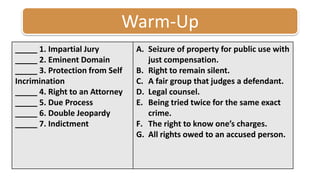
Warm-Up
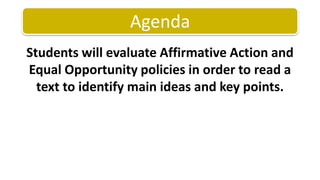
Students will evaluate Affirmative Action and Equal Opportunity policies in order to read a text to identify main ideas and key points. Agenda
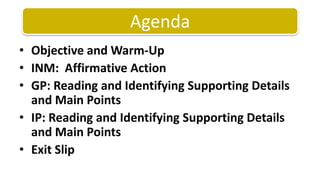
Objective and Warm-UpINM:  Affirmative Action GP: Reading and Identifying Supporting Details and Main PointsIP: Reading and Identifying Supporting Details and Main PointsExit Slip Agenda
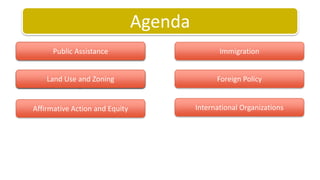
AgendaVocabulary Review Immigration Public AssistanceStructure and Organization of CongressForeign PolicyStructure and Judicial Review Land Use and Zoning International OrganizationsAffirmative Action and Equity
What is Affirmative Action?Affirmative action are laws or policies that give preference to women and minorities in jobs and education who have been denied them in the past due to their gender and race.
 What are the Goals of Affirmative Action? The goals of Affirmative action are to Promotes educational opportunities for women and minorities.Increase the number of minorities and women hiredPromote equal economic opportunities of minorities and women.Recognize there were violations against these groups so they deserve some extra help now Promotes equity and fights discrimination
What are Equal Opportunity laws?Equal Opportunity Laws require that people be treated fairly by government, businesses, universities and colleges. It makes discrimination based on race, color, religion, sex or national origin illegal.
How does government carry out AA and EO laws?Some examples of the way the government carries out these Providing equal wages for equal work. That is, women can sue if they make less than men who do the same job as they do. Increase opportunities for women, minorities, the disabledAllow minority groups like Native Americans to have control over their own cultural artifacts.Pay something to those that suffered from past mistreatment like imprisonment, discrimination, loss of life, etc.
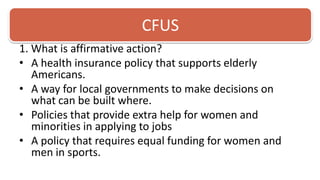
CFUS1. What is affirmative action? A health insurance policy that supports elderly Americans. A way for local governments to make decisions on what can be built where. Policies that provide extra help for women and minorities in applying to jobsA policy that requires equal funding for women and men in sports.
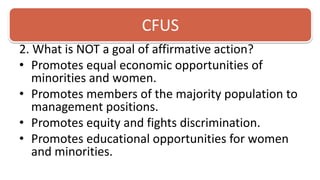
CFUS2. What is NOT a goal of affirmative action? Promotes equal economic opportunities of minorities and women.Promotes members of the majority population to management positions. Promotes equity and fights discrimination. Promotes educational opportunities for women and minorities.
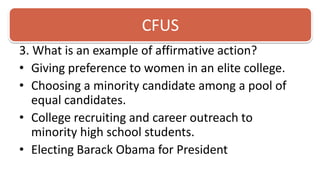
CFUS3. What is an example of affirmative action?Giving preference to women in an elite college.Choosing a minority candidate among a pool of equal candidates.College recruiting and career outreach to minority high school students. Electing Barack Obama for President
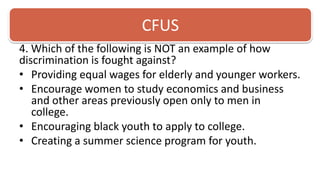
CFUS4. Which of the following is NOT an example of how discrimination is fought against? Providing equal wages for elderly and younger workers.Encourage women to study economics and business and other areas previously open only to men in college.Encouraging black youth to apply to college.Creating a summer science program for youth.
CFUS5. Which of the following Executive Orders seems to promote equal opportunity? All workers should be at least 15 years of age in order to be employedAll people seeking an apartment should be treated fairly and giving the chance to rent. Gay and lesbian service members will be dishonorably discharged from the military if their sexual orientation is discovered by a superior. School is compulsory for all minors, parents of truant parents are punishable by law.
Guided and Independent PracticeStudents will evaluate Affirmative Action and Equal Opportunity policies in order to read a text to identify main ideas and key points.
Guided and Independent PracticeWe will read a text about Affirmative Action.For the first section we will: 1. determine the supporting details2. determine the Main Idea from the supporting details. Using the model,  you will do the rest. I will look at your answers and we will go over one other section of the reading together.
HOMEWORKFinish the classwork.

U6.LP3: Affirmative Action

  • 1.
  • 2.
    Students will evaluateAffirmative Action and Equal Opportunity policies in order to read a text to identify main ideas and key points. Agenda
  • 3.
    Objective and Warm-UpINM: Affirmative Action GP: Reading and Identifying Supporting Details and Main PointsIP: Reading and Identifying Supporting Details and Main PointsExit Slip Agenda
  • 4.
    AgendaVocabulary Review ImmigrationPublic AssistanceStructure and Organization of CongressForeign PolicyStructure and Judicial Review Land Use and Zoning International OrganizationsAffirmative Action and Equity
  • 5.
    What is AffirmativeAction?Affirmative action are laws or policies that give preference to women and minorities in jobs and education who have been denied them in the past due to their gender and race.
  • 6.
     What are theGoals of Affirmative Action? The goals of Affirmative action are to Promotes educational opportunities for women and minorities.Increase the number of minorities and women hiredPromote equal economic opportunities of minorities and women.Recognize there were violations against these groups so they deserve some extra help now Promotes equity and fights discrimination
  • 7.
    What are EqualOpportunity laws?Equal Opportunity Laws require that people be treated fairly by government, businesses, universities and colleges. It makes discrimination based on race, color, religion, sex or national origin illegal.
  • 8.
    How does governmentcarry out AA and EO laws?Some examples of the way the government carries out these Providing equal wages for equal work. That is, women can sue if they make less than men who do the same job as they do. Increase opportunities for women, minorities, the disabledAllow minority groups like Native Americans to have control over their own cultural artifacts.Pay something to those that suffered from past mistreatment like imprisonment, discrimination, loss of life, etc.
  • 9.
    CFUS1. What isaffirmative action? A health insurance policy that supports elderly Americans. A way for local governments to make decisions on what can be built where. Policies that provide extra help for women and minorities in applying to jobsA policy that requires equal funding for women and men in sports.
  • 10.
    CFUS2. What isNOT a goal of affirmative action? Promotes equal economic opportunities of minorities and women.Promotes members of the majority population to management positions. Promotes equity and fights discrimination. Promotes educational opportunities for women and minorities.
  • 11.
    CFUS3. What isan example of affirmative action?Giving preference to women in an elite college.Choosing a minority candidate among a pool of equal candidates.College recruiting and career outreach to minority high school students. Electing Barack Obama for President
  • 12.
    CFUS4. Which ofthe following is NOT an example of how discrimination is fought against? Providing equal wages for elderly and younger workers.Encourage women to study economics and business and other areas previously open only to men in college.Encouraging black youth to apply to college.Creating a summer science program for youth.
  • 13.
    CFUS5. Which ofthe following Executive Orders seems to promote equal opportunity? All workers should be at least 15 years of age in order to be employedAll people seeking an apartment should be treated fairly and giving the chance to rent. Gay and lesbian service members will be dishonorably discharged from the military if their sexual orientation is discovered by a superior. School is compulsory for all minors, parents of truant parents are punishable by law.
  • 14.
    Guided and IndependentPracticeStudents will evaluate Affirmative Action and Equal Opportunity policies in order to read a text to identify main ideas and key points.
  • 15.
    Guided and IndependentPracticeWe will read a text about Affirmative Action.For the first section we will: 1. determine the supporting details2. determine the Main Idea from the supporting details. Using the model, you will do the rest. I will look at your answers and we will go over one other section of the reading together.
  • 16.