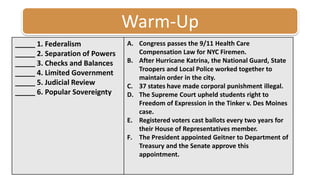
Warm-Up
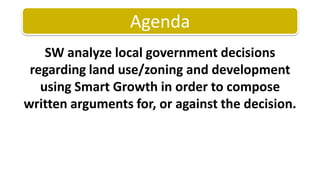
SW analyzelocalgovernmentdecisionsregarding land use/zoning and development using Smart Growth in order to composewrittenarguments for, oragainst the decision.  Agenda
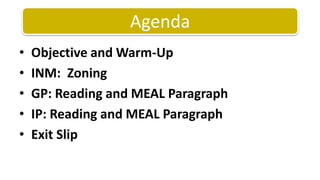
Objective and Warm-UpINM:  Zoning GP: Reading and MEAL ParagraphIP: Reading and MEAL ParagraphExit Slip Agenda
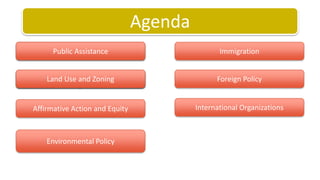
AgendaVocabulary Review Immigration Public AssistanceStructure and Organization of CongressForeign PolicyStructure and Judicial Review Land Use and Zoning International OrganizationsAffirmative Action and EquityEnvironmental Policy
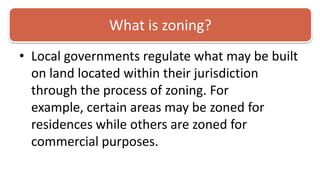
What is zoning?Local governments regulate what may be built on land located within their jurisdiction through the process of zoning. For example, certain areas may be zoned for residences while others are zoned for commercial purposes.
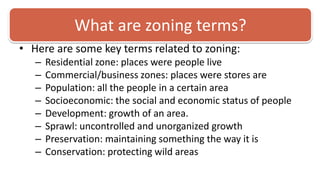
What are zoning terms?Here are some key terms related to zoning: Residential zone: places were people liveCommercial/business zones: places were stores arePopulation: all the people in a certain areaSocioeconomic: the social and economic status of peopleDevelopment: growth of an area. Sprawl: uncontrolled and unorganized growthPreservation: maintaining something the way it is Conservation: protecting wild areas
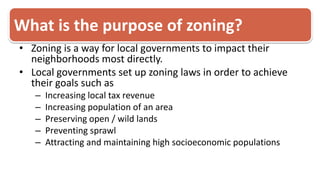
What is the purpose of zoning? Zoning is a way for local governments to impact their neighborhoods most directly. Local governments set up zoning laws in order to achieve their goals such as Increasing local tax revenue Increasing population of an areaPreserving open / wild lands Preventing sprawl Attracting and maintaining high socioeconomic populations
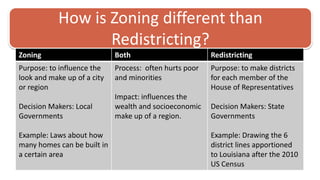
How is Zoning different than Redistricting?
What is Smart Growth?Smart Growth is a Maryland zoning plan. It requires that local governments consider the Smart Growth goals before creating zoning laws. The goals of Smart Growth are Limit the growth of development Avoid sprawl Preserve historic and existing neighborhoodsPreserve natural resources, open land and farmlandsTo save taxpayers money
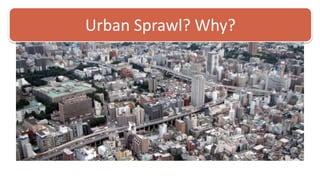
What is Urban Sprawl? Urban sprawl is the spreading outwards of a city in an uncontrollable, unorganized way. Some of its impacts are: Dependence on driving and trafficInadequate facilities like hospitals, food stores, schools, roads, etc. Racial and socioeconomic segregation Inefficient / waste of taxpayer money Loss of open spaces and natural lands
Urban Sprawl? Why?
CFUSWhat is zoning? Chaotic growth of citiesLaw related to what can be built in an areaA group of people that chose one House of Representative memberMindlessly staring into space
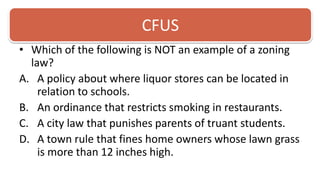
CFUSWhich of the following is NOT an example of a zoning law? A policy about where liquor stores can be located in relation to schools. An ordinance that restricts smoking in restaurants. A city law that punishes parents of truant students.  A town rule that fines home owners whose lawn grass is more than 12 inches high.
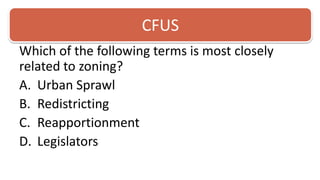
CFUSWhich of the following terms is most closely related to zoning? Urban SprawlRedistrictingReapportionmentLegislators
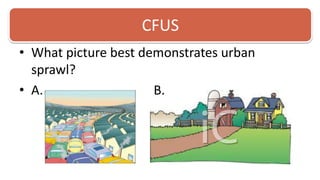
CFUSWhat picture best demonstrates urban sprawl? A. 							  B.
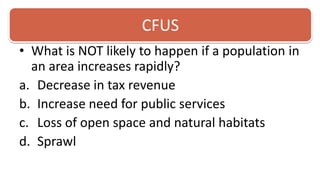
CFUSWhat is NOT likely to happen if a population in an area increases rapidly?Decrease in tax revenueIncrease need for public servicesLoss of open space and natural habitatsSprawl
Guided and Independent PracticeSW analyzelocalgovernmentdecisionsregarding land use/zoning and development using Smart Growth in order to composewrittenarguments for, oragainst the decision.
Guided and Independent PracticeWe will read and write one meal paragraph together. Using the model you will do the rest. I will look at your answers and we will go over one other reading/MEAL paragraph together.
HOMEWORKFinish the classwork.

U6.LP2: Zoning and Land Use

  • 1.
  • 2.
    SW analyzelocalgovernmentdecisionsregarding landuse/zoning and development using Smart Growth in order to composewrittenarguments for, oragainst the decision. Agenda
  • 3.
    Objective and Warm-UpINM: Zoning GP: Reading and MEAL ParagraphIP: Reading and MEAL ParagraphExit Slip Agenda
  • 4.
    AgendaVocabulary Review ImmigrationPublic AssistanceStructure and Organization of CongressForeign PolicyStructure and Judicial Review Land Use and Zoning International OrganizationsAffirmative Action and EquityEnvironmental Policy
  • 5.
    What is zoning?Localgovernments regulate what may be built on land located within their jurisdiction through the process of zoning. For example, certain areas may be zoned for residences while others are zoned for commercial purposes.
  • 6.
    What are zoningterms?Here are some key terms related to zoning: Residential zone: places were people liveCommercial/business zones: places were stores arePopulation: all the people in a certain areaSocioeconomic: the social and economic status of peopleDevelopment: growth of an area. Sprawl: uncontrolled and unorganized growthPreservation: maintaining something the way it is Conservation: protecting wild areas
  • 7.
    What is thepurpose of zoning? Zoning is a way for local governments to impact their neighborhoods most directly. Local governments set up zoning laws in order to achieve their goals such as Increasing local tax revenue Increasing population of an areaPreserving open / wild lands Preventing sprawl Attracting and maintaining high socioeconomic populations
  • 8.
    How is Zoningdifferent than Redistricting?
  • 9.
    What is SmartGrowth?Smart Growth is a Maryland zoning plan. It requires that local governments consider the Smart Growth goals before creating zoning laws. The goals of Smart Growth are Limit the growth of development Avoid sprawl Preserve historic and existing neighborhoodsPreserve natural resources, open land and farmlandsTo save taxpayers money
  • 10.
    What is UrbanSprawl? Urban sprawl is the spreading outwards of a city in an uncontrollable, unorganized way. Some of its impacts are: Dependence on driving and trafficInadequate facilities like hospitals, food stores, schools, roads, etc. Racial and socioeconomic segregation Inefficient / waste of taxpayer money Loss of open spaces and natural lands
  • 11.
  • 12.
    CFUSWhat is zoning?Chaotic growth of citiesLaw related to what can be built in an areaA group of people that chose one House of Representative memberMindlessly staring into space
  • 13.
    CFUSWhich of thefollowing is NOT an example of a zoning law? A policy about where liquor stores can be located in relation to schools. An ordinance that restricts smoking in restaurants. A city law that punishes parents of truant students. A town rule that fines home owners whose lawn grass is more than 12 inches high.
  • 14.
    CFUSWhich of thefollowing terms is most closely related to zoning? Urban SprawlRedistrictingReapportionmentLegislators
  • 15.
    CFUSWhat picture bestdemonstrates urban sprawl? A. B.
  • 16.
    CFUSWhat is NOTlikely to happen if a population in an area increases rapidly?Decrease in tax revenueIncrease need for public servicesLoss of open space and natural habitatsSprawl
  • 17.
    Guided and IndependentPracticeSW analyzelocalgovernmentdecisionsregarding land use/zoning and development using Smart Growth in order to composewrittenarguments for, oragainst the decision.
  • 18.
    Guided and IndependentPracticeWe will read and write one meal paragraph together. Using the model you will do the rest. I will look at your answers and we will go over one other reading/MEAL paragraph together.
  • 19.