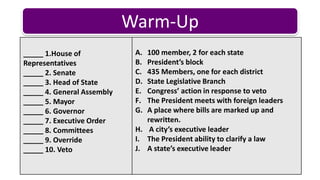
Warm-Up
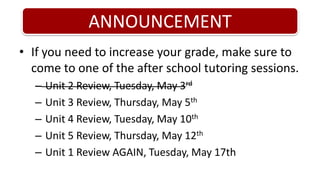
ANNOUNCEMENTIf you need to increase your grade, make sure to come to one of the after school tutoring sessions. Unit 2 Review, Tuesday, May 3rdUnit 3 Review, Thursday, May 5thUnit 4 Review, Tuesday, May 10thUnit 5 Review, Thursday, May 12thUnit 1 Review AGAIN, Tuesday, May 17th
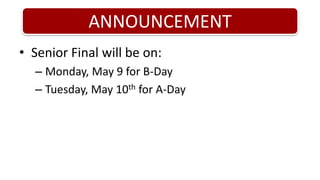
ANNOUNCEMENTSenior Final will be on:Monday, May 9 for B-DayTuesday, May 10th for A-Day
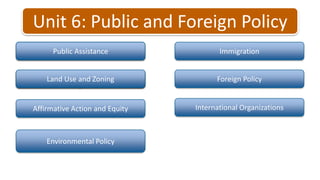
Unit 6: Public and Foreign PolicyVocabulary Review Immigration Public AssistanceStructure and Organization of CongressForeign PolicyStructure and Judicial Review Land Use and Zoning International OrganizationsAffirmative Action and EquityEnvironmental Policy
Students will analyze foreign policy concepts in order to create policy solutions to current world events and that address national interests. Objective
Objective and Warm-UpFrayer ModelCornell NotesGuided Practice: Foreign Policy EventIndependent Practice: Foreign Policy EventsExit SlipAgenda
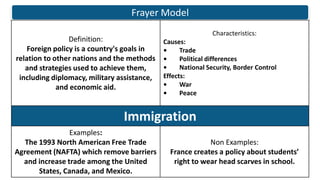
Frayer Model
Objective and Warm-UpFrayer ModelCornell NotesGuided Practice: Foreign Policy EventIndependent Practice: Foreign Policy EventsExit SlipAgenda
Countries set up economic trade policies with other countries in order to get essential goods from other countries and protect their countries’ businesses. Economic Foreign Policy
Key vocabulary: Trade: to buy and sell goods Exports: goods that are sent to other countriesImports: goods that are brought into a countryFree Trade: An agreement to eliminate restrictions, such as tariffs and quotas to trade between countries. Tariff: a tax on imports and exportsQuota: a restriction on the number of specific items imported. Embargo or Economic Sanction: To stop all trade with a country. Embargoes are imposed primarily to coerce other nations into eliminating policies by weakening their economy. Economic Foreign Policy
Countries must protect its borders, citizens and freedoms in order to stay a sovereign (independent) nation. Political / Military Foreign Policy
Political / Military Foreign Policy Key Vocabulary Treaties: Agreements among nations that each nation followsMilitary alliances: an agreement among countries to help one another when attacked. NATO: North Atlantic Treaty Organization is a military alliance that protects member nations.United Nations: an international organization with more that 190 country members to promote peace Diplomacy: handling foreign policy
Social / Humanitarian Foreign PolicyCountries assist struggling countries for the sake of helping innocent people and maintaining peace and democracy in unstable countries
Social / Humanitarian Foreign PolicyKey Vocabulary Human rights: basic rights of all peopleFamine: lack of food, mass starvationCivil War: war within a nation
Why do we have foreign policy?Foreign Policy protects our national interests for: national security: protecting borders economic stability: maintaining a healthy economy promoting democracy: helping other country’s establish democratic governmentsprotecting human rights: protecting innocent people from human rights abuses the reputation of the United States as a world leader: asserting our position as a military and economic superpower.
Objective and Warm-UpFrayer ModelCornell NotesGuided Practice: Foreign Policy EventIndependent Practice: Foreign Policy EventsExit SlipAgenda
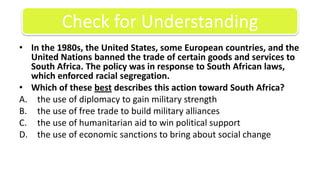
In the 1980s, the United States, some European countries, and the United Nations banned the trade of certain goods and services to South Africa. The policy was in response to South African laws, which enforced racial segregation.Which of these best describes this action toward South Africa?the use of diplomacy to gain military strengththe use of free trade to build military alliancesthe use of humanitarian aid to win political supportthe use of economic sanctions to bring about social changeCheck for Understanding
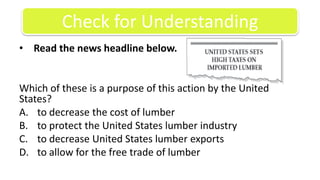
 Read the news headline below.Which of these is a purpose of this action by the United States?to decrease the cost of lumberto protect the United States lumber industryto decrease United States lumber exportsto allow for the free trade of lumberCheck for Understanding
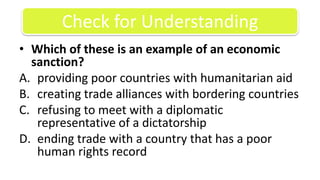
Which of these is an example of an economic sanction? providing poor countries with humanitarian aidcreating trade alliances with bordering countriesrefusing to meet with a diplomatic representative of a dictatorshipending trade with a country that has a poor human rights recordCheck for Understanding
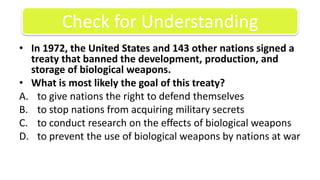
In 1972, the United States and 143 other nations signed a treaty that banned the development, production, and storage of biological weapons.What is most likely the goal of this treaty?to give nations the right to defend themselvesto stop nations from acquiring military secretsto conduct research on the effects of biological weaponsto prevent the use of biological weapons by nations at warCheck for Understanding
“… let us resolve to wage an unrelenting [continuous] battle against poverty and for shared prosperity so that no part of humanity is left behind in the global economy.….” —President Bill Clinton, at the United Nations, September 21, 1999Which of these topics is most related to the excerpt?arms reductionclimatic changesmilitary deploymentdevelopment assistance Check for Understanding
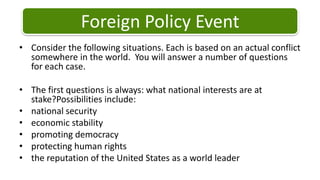
Foreign Policy Event Consider the following situations. Each is based on an actual conflict somewhere in the world.  You will answer a number of questions for each case. The first questions is always: what national interests are at stake?Possibilitiesinclude: national securityeconomic stabilitypromoting democracyprotecting human rightsthe reputation of the United States as a world leader
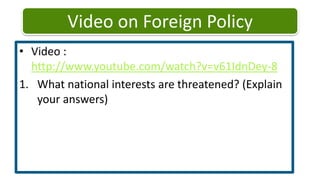
Video on Foreign PolicyVideo : http://www.youtube.com/watch?v=v61IdnDey-8What national interests are threatened? (Explain your answers)
Video on Foreign Policy2. What questions do you have for Pakistan?
Video on Foreign Policy3. Do you think the United States should pull troops out of Afghanistan now? Why or why not?
Foreign Policy EventsComplete the three foreign policy events and the questions. You have 20 minutes to finish. We will go over the second event in 15 minutes.
Finish your letter to the President of the United States.Hand it in so that we can mail the letter to him!!!If you get a response from the President, we will bump your grade by one whole letter.HOMEWORK
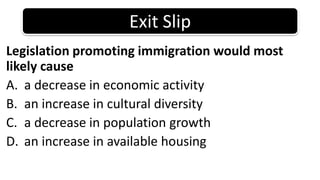
Exit SlipLegislation promoting immigration would most likely causea decrease in economic activityan increase in cultural diversitya decrease in population growthan increase in available housing
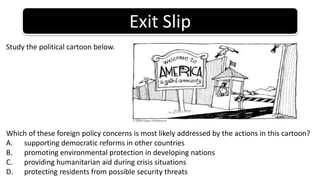
Exit SlipStudy the political cartoon below.Which of these foreign policy concerns is most likely addressed by the actions in this cartoon?supporting democratic reforms in other countriespromoting environmental protection in developing nationsproviding humanitarian aid during crisis situationsprotecting residents from possible security threats

U6.LP5: U.S. Foreign Policy

  • 1.
  • 2.
    ANNOUNCEMENTIf you needto increase your grade, make sure to come to one of the after school tutoring sessions. Unit 2 Review, Tuesday, May 3rdUnit 3 Review, Thursday, May 5thUnit 4 Review, Tuesday, May 10thUnit 5 Review, Thursday, May 12thUnit 1 Review AGAIN, Tuesday, May 17th
  • 3.
    ANNOUNCEMENTSenior Final willbe on:Monday, May 9 for B-DayTuesday, May 10th for A-Day
  • 4.
    Unit 6: Publicand Foreign PolicyVocabulary Review Immigration Public AssistanceStructure and Organization of CongressForeign PolicyStructure and Judicial Review Land Use and Zoning International OrganizationsAffirmative Action and EquityEnvironmental Policy
  • 5.
    Students will analyzeforeign policy concepts in order to create policy solutions to current world events and that address national interests. Objective
  • 6.
    Objective and Warm-UpFrayerModelCornell NotesGuided Practice: Foreign Policy EventIndependent Practice: Foreign Policy EventsExit SlipAgenda
  • 7.
  • 8.
    Objective and Warm-UpFrayerModelCornell NotesGuided Practice: Foreign Policy EventIndependent Practice: Foreign Policy EventsExit SlipAgenda
  • 9.
    Countries set upeconomic trade policies with other countries in order to get essential goods from other countries and protect their countries’ businesses. Economic Foreign Policy
  • 10.
    Key vocabulary: Trade:to buy and sell goods Exports: goods that are sent to other countriesImports: goods that are brought into a countryFree Trade: An agreement to eliminate restrictions, such as tariffs and quotas to trade between countries. Tariff: a tax on imports and exportsQuota: a restriction on the number of specific items imported. Embargo or Economic Sanction: To stop all trade with a country. Embargoes are imposed primarily to coerce other nations into eliminating policies by weakening their economy. Economic Foreign Policy
  • 11.
    Countries must protectits borders, citizens and freedoms in order to stay a sovereign (independent) nation. Political / Military Foreign Policy
  • 12.
    Political / MilitaryForeign Policy Key Vocabulary Treaties: Agreements among nations that each nation followsMilitary alliances: an agreement among countries to help one another when attacked. NATO: North Atlantic Treaty Organization is a military alliance that protects member nations.United Nations: an international organization with more that 190 country members to promote peace Diplomacy: handling foreign policy
  • 13.
    Social / HumanitarianForeign PolicyCountries assist struggling countries for the sake of helping innocent people and maintaining peace and democracy in unstable countries
  • 14.
    Social / HumanitarianForeign PolicyKey Vocabulary Human rights: basic rights of all peopleFamine: lack of food, mass starvationCivil War: war within a nation
  • 15.
    Why do wehave foreign policy?Foreign Policy protects our national interests for: national security: protecting borders economic stability: maintaining a healthy economy promoting democracy: helping other country’s establish democratic governmentsprotecting human rights: protecting innocent people from human rights abuses the reputation of the United States as a world leader: asserting our position as a military and economic superpower.
  • 16.
    Objective and Warm-UpFrayerModelCornell NotesGuided Practice: Foreign Policy EventIndependent Practice: Foreign Policy EventsExit SlipAgenda
  • 17.
    In the 1980s,the United States, some European countries, and the United Nations banned the trade of certain goods and services to South Africa. The policy was in response to South African laws, which enforced racial segregation.Which of these best describes this action toward South Africa?the use of diplomacy to gain military strengththe use of free trade to build military alliancesthe use of humanitarian aid to win political supportthe use of economic sanctions to bring about social changeCheck for Understanding
  • 18.
     Read the newsheadline below.Which of these is a purpose of this action by the United States?to decrease the cost of lumberto protect the United States lumber industryto decrease United States lumber exportsto allow for the free trade of lumberCheck for Understanding
  • 19.
    Which of theseis an example of an economic sanction? providing poor countries with humanitarian aidcreating trade alliances with bordering countriesrefusing to meet with a diplomatic representative of a dictatorshipending trade with a country that has a poor human rights recordCheck for Understanding
  • 20.
    In 1972, theUnited States and 143 other nations signed a treaty that banned the development, production, and storage of biological weapons.What is most likely the goal of this treaty?to give nations the right to defend themselvesto stop nations from acquiring military secretsto conduct research on the effects of biological weaponsto prevent the use of biological weapons by nations at warCheck for Understanding
  • 21.
    “… let usresolve to wage an unrelenting [continuous] battle against poverty and for shared prosperity so that no part of humanity is left behind in the global economy.….” —President Bill Clinton, at the United Nations, September 21, 1999Which of these topics is most related to the excerpt?arms reductionclimatic changesmilitary deploymentdevelopment assistance Check for Understanding
  • 22.
    Foreign Policy EventConsider the following situations. Each is based on an actual conflict somewhere in the world. You will answer a number of questions for each case. The first questions is always: what national interests are at stake?Possibilitiesinclude: national securityeconomic stabilitypromoting democracyprotecting human rightsthe reputation of the United States as a world leader
  • 23.
    Video on ForeignPolicyVideo : http://www.youtube.com/watch?v=v61IdnDey-8What national interests are threatened? (Explain your answers)
  • 24.
    Video on ForeignPolicy2. What questions do you have for Pakistan?
  • 25.
    Video on ForeignPolicy3. Do you think the United States should pull troops out of Afghanistan now? Why or why not?
  • 26.
    Foreign Policy EventsCompletethe three foreign policy events and the questions. You have 20 minutes to finish. We will go over the second event in 15 minutes.
  • 27.
    Finish your letterto the President of the United States.Hand it in so that we can mail the letter to him!!!If you get a response from the President, we will bump your grade by one whole letter.HOMEWORK
  • 28.
    Exit SlipLegislation promotingimmigration would most likely causea decrease in economic activityan increase in cultural diversitya decrease in population growthan increase in available housing
  • 29.
    Exit SlipStudy thepolitical cartoon below.Which of these foreign policy concerns is most likely addressed by the actions in this cartoon?supporting democratic reforms in other countriespromoting environmental protection in developing nationsproviding humanitarian aid during crisis situationsprotecting residents from possible security threats