Unit 4
ECONOMIC ACTIVITIES
& GEOGRAPHICAL
SPACES
IESCamilo José Cela
Teacher: Rocío Bautista
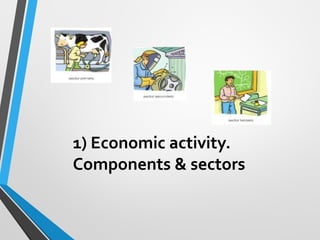
1) Economic activity.
Components & sectors
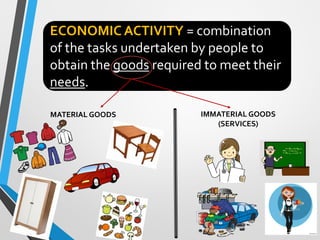
ECONOMIC ACTIVITY = combination
of the tasks undertaken by people to
obtain the goods required to meet their
needs.
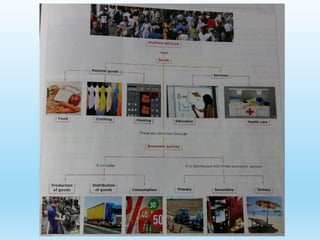
MATERIAL GOODS IMMATERIAL GOODS
(SERVICES)
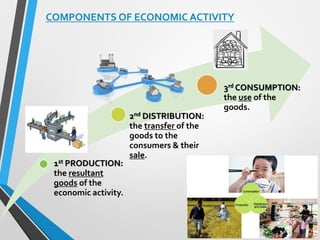
1st PRODUCTION:
the resultant
goods of the
economic activity.
2nd DISTRIBUTION:
the transfer of the
goods to the
consumers & their
sale.
3rd CONSUMPTION:
the use of the
goods.
COMPONENTS OF ECONOMIC ACTIVITY
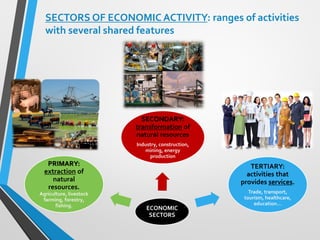
SECTORS OF ECONOMIC ACTIVITY: ranges of activities
with several shared features
ECONOMIC
SECTORS
SECONDARY:
transformation of
natural resources
Industry, construction,
mining, energy
production
TERTIARY:
activities that
provides services.
Trade, transport,
tourism, healthcare,
education…
PRIMARY:
extraction of
natural
resources.
Agriculture, livestock
farming, forestry,
fishing.
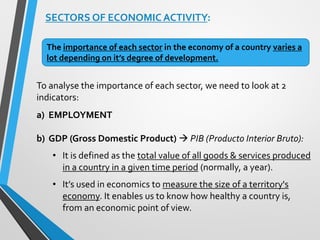
SECTORS OF ECONOMIC ACTIVITY:
To analyse the importance of each sector, we need to look at 2
indicators:
a) EMPLOYMENT
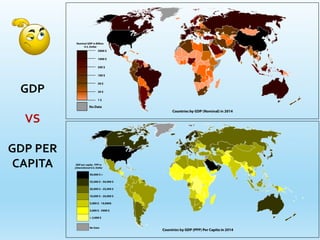
b) GDP (Gross Domestic Product)  PIB (Producto Interior Bruto):
• It is defined as the total value of all goods & services produced
in a country in a given time period (normally, a year).
• It’s used in economics to measure the size of a territory's
economy. It enables us to know how healthy a country is,
from an economic point of view.
The importance of each sector in the economy of a country varies a
lot depending on it’s degree of development.
GDP
VS
GDP PER
CAPITA
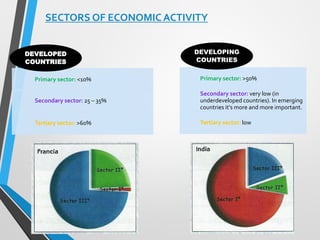
SECTORS OF ECONOMIC ACTIVITY
Primary sector: <10%
Secondary sector: 25 – 35%
Tertiary sector: >60%
DEVELOPED
COUNTRIES
Primary sector: >50%
Secondary sector: very low (in
underdeveloped countries). In emerging
countries it’s more and more important.
Tertiary sector: low
DEVELOPING
COUNTRIES
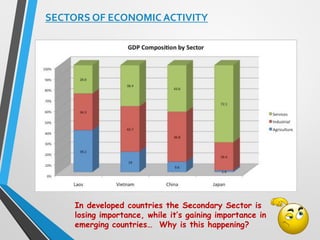
SECTORS OF ECONOMIC ACTIVITY
In developed countries the Secondary Sector is
losing importance, while it’s gaining importance in
emerging countries… Why is this happening?
ACTIVITY 1
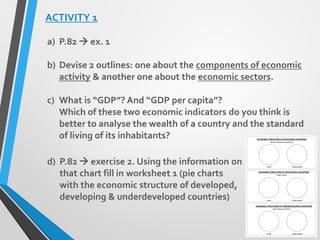
a) P.82  ex. 1
b) Devise 2 outlines: one about the components of economic
activity & another one about the economic sectors.
c) What is “GDP”? And “GDP per capita”?
Which of these two economic indicators do you think is
better to analyse the wealth of a country and the standard
of living of its inhabitants?
d) P.82  exercise 2. Using the information on
that chart fill in worksheet 1 (pie charts
with the economic structure of developed,
developing & underdeveloped countries)
ACTIVITY 2
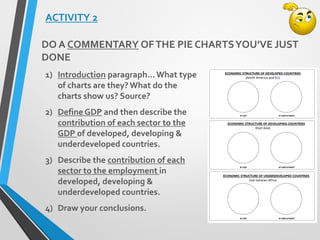
DO A COMMENTARY OFTHE PIE CHARTSYOU’VE JUST
DONE
1) Introduction paragraph…What type
of charts are they? What do the
charts show us? Source?
2) Define GDP and then describe the
contribution of each sector to the
GDP of developed, developing &
underdeveloped countries.
3) Describe the contribution of each
sector to the employment in
developed, developing &
underdeveloped countries.
4) Draw your conclusions.
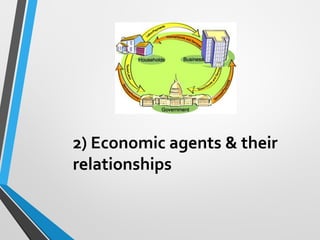
2) Economic agents & their
relationships
Which “agents” (who?) are
involved in economic
activities?
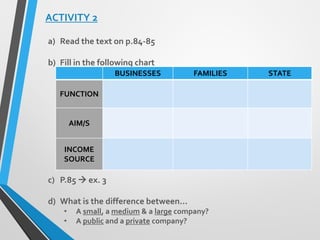
ACTIVITY 2
a) Read the text on p.84-85
b) Fill in the following chart
c) P.85  ex. 3
d) What is the difference between…
• A small, a medium & a large company?
• A public and a private company?
BUSINESSES FAMILIES STATE
FUNCTION
AIM/S
INCOME
SOURCE
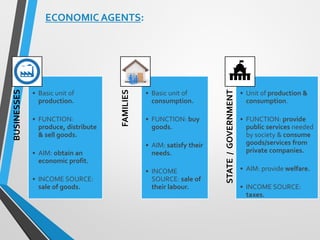
ECONOMIC AGENTS:BUSINESSES
• Basic unit of
production.
• FUNCTION:
produce, distribute
& sell goods.
• AIM: obtain an
economic profit.
• INCOME SOURCE:
sale of goods.
FAMILIES
• Basic unit of
consumption.
• FUNCTION: buy
goods.
• AIM: satisfy their
needs.
• INCOME
SOURCE: sale of
their labour.
STATE/GOVERNMENT
• Unit of production &
consumption.
• FUNCTION: provide
public services needed
by society & consume
goods/services from
private companies.
• AIM: provide welfare.
• INCOME SOURCE:
taxes.
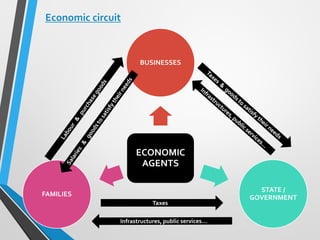
Economic circuit
ECONOMIC
AGENTS
BUSINESSES
STATE /
GOVERNMENTFAMILIES
Taxes
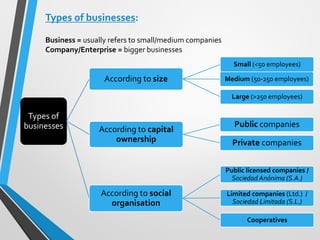
Types of businesses:
Types of
businesses
According to size
Small (<50 employees)
Medium (50-250 employees)
Large (>250 employees)
According to capital
ownership
Public companies
Private companies
According to social
organisation
Public licensed companies /
Sociedad Anónima (S.A.)
Limited companies (Ltd.) /
Sociedad Limitada (S.L.)
Cooperatives
Business = usually refers to small/medium companies
Company/Enterprise = bigger businesses
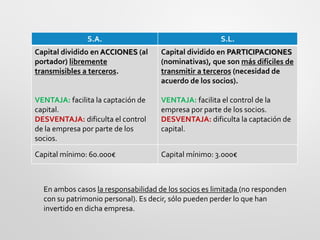
S.A. S.L.
Capital dividido en ACCIONES (al
portador) libremente
transmisibles a terceros.
VENTAJA: facilita la captación de
capital.
DESVENTAJA: dificulta el control
de la empresa por parte de los
socios.
Capital dividido en PARTICIPACIONES
(nominativas), que son más difíciles de
transmitir a terceros (necesidad de
acuerdo de los socios).
VENTAJA: facilita el control de la
empresa por parte de los socios.
DESVENTAJA: dificulta la captación de
capital.
Capital mínimo: 60.000€ Capital mínimo: 3.000€
En ambos casos la responsabilidad de los socios es limitada (no responden
con su patrimonio personal). Es decir, sólo pueden perder lo que han
invertido en dicha empresa.
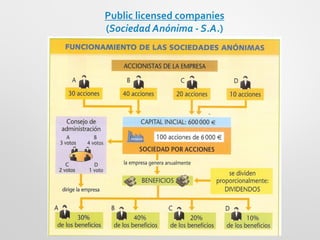
Public licensed companies
(Sociedad Anónima - S.A.)
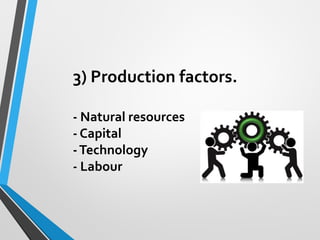
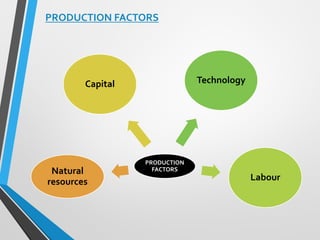
3) Production factors.
- Natural resources
- Capital
-Technology
- Labour
What things
does a business need
to develop its economic activity???
PRODUCTION FACTORS
PRODUCTION
FACTORS
Technology
Labour
Capital
Natural
resources
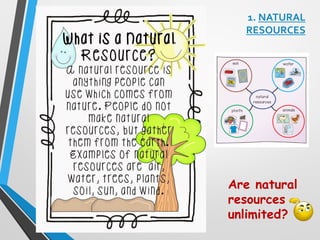
1. NATURAL
RESOURCES
Are natural
resources
unlimited?
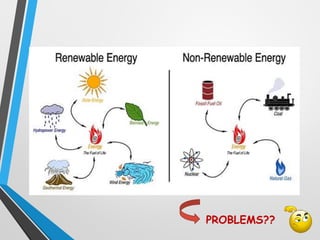
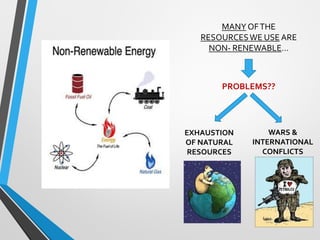
PROBLEMS??
MANY OFTHE
RESOURCESWE USEARE
NON- RENEWABLE…
PROBLEMS??
EXHAUSTION
OF NATURAL
RESOURCES
WARS &
INTERNATIONAL
CONFLICTS
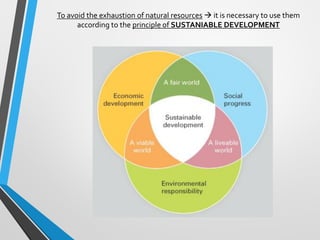
To avoid the exhaustion of natural resources  it is necessary to use them
according to the principle of SUSTANIABLE DEVELOPMENT
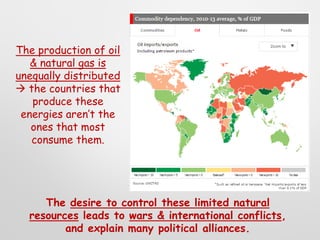
The production of oil
& natural gas is
unequally distributed
 the countries that
produce these
energies aren’t the
ones that most
consume them.
The desire to control these limited natural
resources leads to wars & international conflicts,
and explain many political alliances.
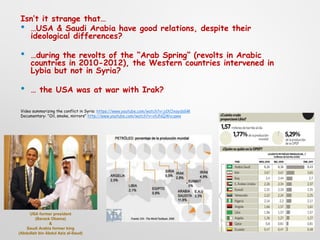
Isn’t it strange that…
• …USA & Saudi Arabia have good relations, despite their
ideological differences?
• …during the revolts of the “Arab Spring” (revolts in Arabic
countries in 2010-2012), the Western countries intervened in
Lybia but not in Syria?
• … the USA was at war with Irak?
Video summarizing the conflict in Syria: https://www.youtube.com/watch?v=jdXOxaydsGM
Documentary: “Oil, smoke, mirrors” http://www.youtube.com/watch?v=xlUNQWvcqww
USA former president
(Barack Obama)
&
Saudi Arabia former king
(Abdullah bin Abdul Aziz al-Saud)
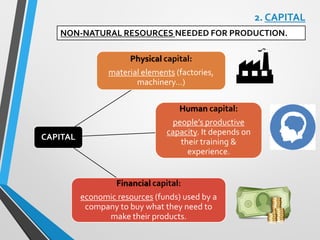
2. CAPITAL
NON-NATURAL RESOURCES NEEDED FOR PRODUCTION.
CAPITAL
Physical capital:
material elements (factories,
machinery…)
Human capital:
people’s productive
capacity. It depends on
their training &
experience.
Financial capital:
economic resources (funds) used by a
company to buy what they need to
make their products.
3.TECHNOLOGY
KNOWLEDGE, METHODS & PROCEDURES
USED IN PRODUCTION PROCESS.
Types of technology
Manual Mechanised Robotised
4. LABOUR
PHYSICAL OR INTELECTUAL EFFORT MADE BY PEOPLE IN
ORDERTO PRODUCE GOODS & PROVIDE SERVICES.
ACTIVITY 3
a) Define:
• Production factors
• Sustainable development
b) What problems does the excessive use of non-
renewable resources give rise to?
c) Devise a diagram of the production factors.
d) P. 86 – 87  exercises 1 & 2
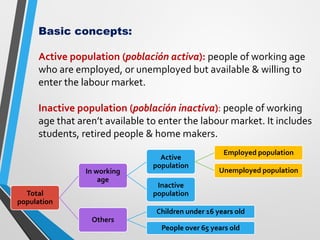
Basic concepts:
Active population (población activa): people of working age
who are employed, or unemployed but available & willing to
enter the labour market.
Inactive population (población inactiva): people of working
age that aren’t available to enter the labour market. It includes
students, retired people & home makers.
Total
population
In working
age
Active
population
Employed population
Unemployed population
Inactive
population
Others
Children under 16 years old
People over 65 years old
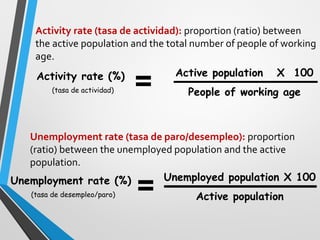
Activity rate (tasa de actividad): proportion (ratio) of active
population in a country.(it is calculated among the working-age population!)
Active population X 100
People of working age
Activity rate (%)
(tasa de actividad)
Unemployed population X 100
Active population
Unemployment rate (%)
(tasa de desempleo/paro)
Unemployment rate (tasa de paro/desempleo): proportion
(ratio) between the unemployed population and the active
population.
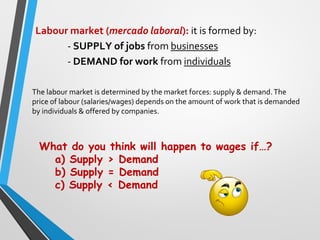
Labour market (mercado laboral): it is formed by:
What do you think will happen to wages if…?
a) Supply > Demand
b) Supply = Demand
c) Supply < Demand
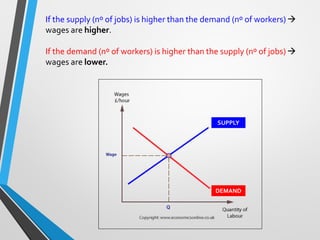
The labour market is determined by the market forces: supply & demand.The
price of labour (salaries/wages) depends on the amount of work that is
demanded by individuals & offered by companies.
- DEMAND for work
from individuals
- SUPPLY of jobs from
businesses
If the supply (available jobs) is higher than the
demand (nº of workers) (there are more jobs than
people willing to work)  wages are higher.
If the demand (available people to work) is
higher than the supply (available jobs)  wages
are lower.
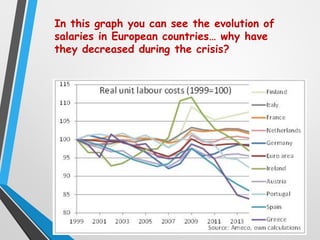
In this graph you can see the evolution of
salaries in European countries… why have they
decreased during the crisis?
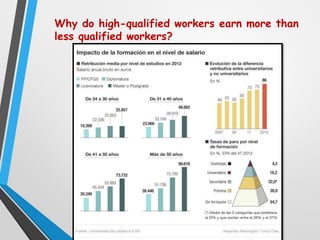
Why do high-qualified workers earn more than
less qualified workers?
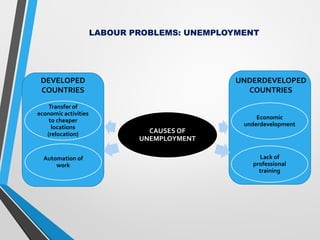
CAUSES OF
UNEMPLOYMENT
Automation of
work
Economic
underdevelopment
Lack of
professional
training
Transfer of
economic activities
to cheaper
locations
(relocation)
UNDERDEVELOPED
COUNTRIES
DEVELOPED
COUNTRIES
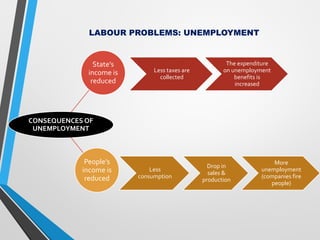
LABOUR PROBLEMS: UNEMPLOYMENT
CONSEQUENCES OF
UNEMPLOYMENT
People’s
income is
reduced
State’s
income is
reduced
Less
consumption
Drop in
sales &
production
More
unemployment
(companies fire
people)
Less taxes are
collected
The expenditure
on unemployment
benefits is
increased
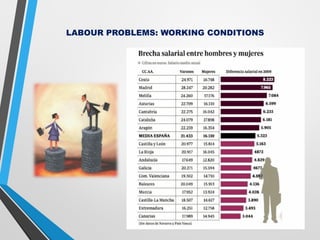
LABOUR PROBLEMS: WORKING CONDITIONS
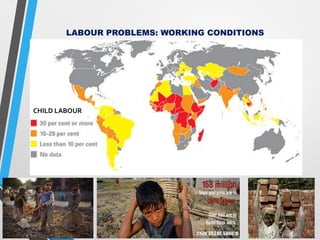
CHILD LABOUR
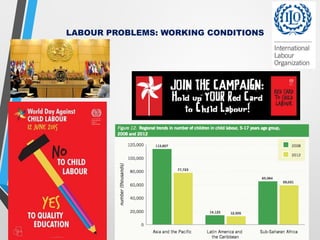
LABOUR PROBLEMS: WORKING CONDITIONS
4) Economic systems
5) Current economic trends:
- Ideologies & problems
- Globalisation
6) Worldwide geoeconomic
areas

U4. Economic activities and geographical spaces

  • 1.
    Unit 4 ECONOMIC ACTIVITIES &GEOGRAPHICAL SPACES IESCamilo José Cela Teacher: Rocío Bautista
  • 2.
  • 3.
    ECONOMIC ACTIVITY =combination of the tasks undertaken by people to obtain the goods required to meet their needs. MATERIAL GOODS IMMATERIAL GOODS (SERVICES)
  • 5.
    1st PRODUCTION: the resultant goodsof the economic activity. 2nd DISTRIBUTION: the transfer of the goods to the consumers & their sale. 3rd CONSUMPTION: the use of the goods. COMPONENTS OF ECONOMIC ACTIVITY
  • 6.
    SECTORS OF ECONOMICACTIVITY: ranges of activities with several shared features ECONOMIC SECTORS SECONDARY: transformation of natural resources Industry, construction, mining, energy production TERTIARY: activities that provides services. Trade, transport, tourism, healthcare, education… PRIMARY: extraction of natural resources. Agriculture, livestock farming, forestry, fishing.
  • 8.
    SECTORS OF ECONOMICACTIVITY: To analyse the importance of each sector, we need to look at 2 indicators: a) EMPLOYMENT b) GDP (Gross Domestic Product)  PIB (Producto Interior Bruto): • It is defined as the total value of all goods & services produced in a country in a given time period (normally, a year). • It’s used in economics to measure the size of a territory's economy. It enables us to know how healthy a country is, from an economic point of view. The importance of each sector in the economy of a country varies a lot depending on it’s degree of development.
  • 9.
  • 10.
    SECTORS OF ECONOMICACTIVITY Primary sector: <10% Secondary sector: 25 – 35% Tertiary sector: >60% DEVELOPED COUNTRIES Primary sector: >50% Secondary sector: very low (in underdeveloped countries). In emerging countries it’s more and more important. Tertiary sector: low DEVELOPING COUNTRIES
  • 11.
    SECTORS OF ECONOMICACTIVITY In developed countries the Secondary Sector is losing importance, while it’s gaining importance in emerging countries… Why is this happening?
  • 12.
    ACTIVITY 1 a) P.82 ex. 1 b) Devise 2 outlines: one about the components of economic activity & another one about the economic sectors. c) What is “GDP”? And “GDP per capita”? Which of these two economic indicators do you think is better to analyse the wealth of a country and the standard of living of its inhabitants? d) P.82  exercise 2. Using the information on that chart fill in worksheet 1 (pie charts with the economic structure of developed, developing & underdeveloped countries)
  • 14.
    ACTIVITY 2 DO ACOMMENTARY OFTHE PIE CHARTSYOU’VE JUST DONE 1) Introduction paragraph…What type of charts are they? What do the charts show us? Source? 2) Define GDP and then describe the contribution of each sector to the GDP of developed, developing & underdeveloped countries. 3) Describe the contribution of each sector to the employment in developed, developing & underdeveloped countries. 4) Draw your conclusions.
  • 15.
    2) Economic agents& their relationships
  • 16.
    Which “agents” (who?)are involved in economic activities?
  • 17.
    ACTIVITY 2 a) Readthe text on p.84-85 b) Fill in the following chart c) P.85  ex. 3 d) What is the difference between… • A small, a medium & a large company? • A public and a private company? BUSINESSES FAMILIES STATE FUNCTION AIM/S INCOME SOURCE
  • 18.
    ECONOMIC AGENTS:BUSINESSES • Basicunit of production. • FUNCTION: produce, distribute & sell goods. • AIM: obtain an economic profit. • INCOME SOURCE: sale of goods. FAMILIES • Basic unit of consumption. • FUNCTION: buy goods. • AIM: satisfy their needs. • INCOME SOURCE: sale of their labour. STATE/GOVERNMENT • Unit of production & consumption. • FUNCTION: provide public services needed by society & consume goods/services from private companies. • AIM: provide welfare. • INCOME SOURCE: taxes.
  • 19.
  • 20.
    Types of businesses: Typesof businesses According to size Small (<50 employees) Medium (50-250 employees) Large (>250 employees) According to capital ownership Public companies Private companies According to social organisation Public licensed companies / Sociedad Anónima (S.A.) Limited companies (Ltd.) / Sociedad Limitada (S.L.) Cooperatives Business = usually refers to small/medium companies Company/Enterprise = bigger businesses
  • 21.
    S.A. S.L. Capital divididoen ACCIONES (al portador) libremente transmisibles a terceros. VENTAJA: facilita la captación de capital. DESVENTAJA: dificulta el control de la empresa por parte de los socios. Capital dividido en PARTICIPACIONES (nominativas), que son más difíciles de transmitir a terceros (necesidad de acuerdo de los socios). VENTAJA: facilita el control de la empresa por parte de los socios. DESVENTAJA: dificulta la captación de capital. Capital mínimo: 60.000€ Capital mínimo: 3.000€ En ambos casos la responsabilidad de los socios es limitada (no responden con su patrimonio personal). Es decir, sólo pueden perder lo que han invertido en dicha empresa.
  • 22.
  • 23.
    3) Production factors. -Natural resources - Capital -Technology - Labour
  • 24.
    What things does abusiness need to develop its economic activity???
  • 25.
  • 26.
  • 27.
  • 28.
    MANY OFTHE RESOURCESWE USEARE NON-RENEWABLE… PROBLEMS?? EXHAUSTION OF NATURAL RESOURCES WARS & INTERNATIONAL CONFLICTS
  • 29.
    To avoid theexhaustion of natural resources  it is necessary to use them according to the principle of SUSTANIABLE DEVELOPMENT
  • 30.
    The production ofoil & natural gas is unequally distributed  the countries that produce these energies aren’t the ones that most consume them. The desire to control these limited natural resources leads to wars & international conflicts, and explain many political alliances.
  • 31.
    Isn’t it strangethat… • …USA & Saudi Arabia have good relations, despite their ideological differences? • …during the revolts of the “Arab Spring” (revolts in Arabic countries in 2010-2012), the Western countries intervened in Lybia but not in Syria? • … the USA was at war with Irak? Video summarizing the conflict in Syria: https://www.youtube.com/watch?v=jdXOxaydsGM Documentary: “Oil, smoke, mirrors” http://www.youtube.com/watch?v=xlUNQWvcqww USA former president (Barack Obama) & Saudi Arabia former king (Abdullah bin Abdul Aziz al-Saud)
  • 32.
    2. CAPITAL NON-NATURAL RESOURCESNEEDED FOR PRODUCTION. CAPITAL Physical capital: material elements (factories, machinery…) Human capital: people’s productive capacity. It depends on their training & experience. Financial capital: economic resources (funds) used by a company to buy what they need to make their products.
  • 33.
    3.TECHNOLOGY KNOWLEDGE, METHODS &PROCEDURES USED IN PRODUCTION PROCESS. Types of technology Manual Mechanised Robotised
  • 34.
    4. LABOUR PHYSICAL ORINTELECTUAL EFFORT MADE BY PEOPLE IN ORDERTO PRODUCE GOODS & PROVIDE SERVICES.
  • 35.
    ACTIVITY 3 a) Define: •Production factors • Sustainable development b) What problems does the excessive use of non- renewable resources give rise to? c) Devise a diagram of the production factors. d) P. 86 – 87  exercises 1 & 2
  • 36.
    Basic concepts: Active population(población activa): people of working age who are employed, or unemployed but available & willing to enter the labour market. Inactive population (población inactiva): people of working age that aren’t available to enter the labour market. It includes students, retired people & home makers. Total population In working age Active population Employed population Unemployed population Inactive population Others Children under 16 years old People over 65 years old
  • 37.
    Activity rate (tasade actividad): proportion (ratio) of active population in a country.(it is calculated among the working-age population!) Active population X 100 People of working age Activity rate (%) (tasa de actividad) Unemployed population X 100 Active population Unemployment rate (%) (tasa de desempleo/paro) Unemployment rate (tasa de paro/desempleo): proportion (ratio) between the unemployed population and the active population.
  • 38.
    Labour market (mercadolaboral): it is formed by: What do you think will happen to wages if…? a) Supply > Demand b) Supply = Demand c) Supply < Demand The labour market is determined by the market forces: supply & demand.The price of labour (salaries/wages) depends on the amount of work that is demanded by individuals & offered by companies. - DEMAND for work from individuals - SUPPLY of jobs from businesses
  • 39.
    If the supply(available jobs) is higher than the demand (nº of workers) (there are more jobs than people willing to work)  wages are higher. If the demand (available people to work) is higher than the supply (available jobs)  wages are lower.
  • 40.
    In this graphyou can see the evolution of salaries in European countries… why have they decreased during the crisis?
  • 41.
    Why do high-qualifiedworkers earn more than less qualified workers?
  • 42.
    CAUSES OF UNEMPLOYMENT Automation of work Economic underdevelopment Lackof professional training Transfer of economic activities to cheaper locations (relocation) UNDERDEVELOPED COUNTRIES DEVELOPED COUNTRIES LABOUR PROBLEMS: UNEMPLOYMENT
  • 43.
    CONSEQUENCES OF UNEMPLOYMENT People’s income is reduced State’s incomeis reduced Less consumption Drop in sales & production More unemployment (companies fire people) Less taxes are collected The expenditure on unemployment benefits is increased
  • 44.
  • 45.
    LABOUR PROBLEMS: WORKINGCONDITIONS CHILD LABOUR
  • 46.
  • 47.
  • 48.
    5) Current economictrends: - Ideologies & problems - Globalisation
  • 49.