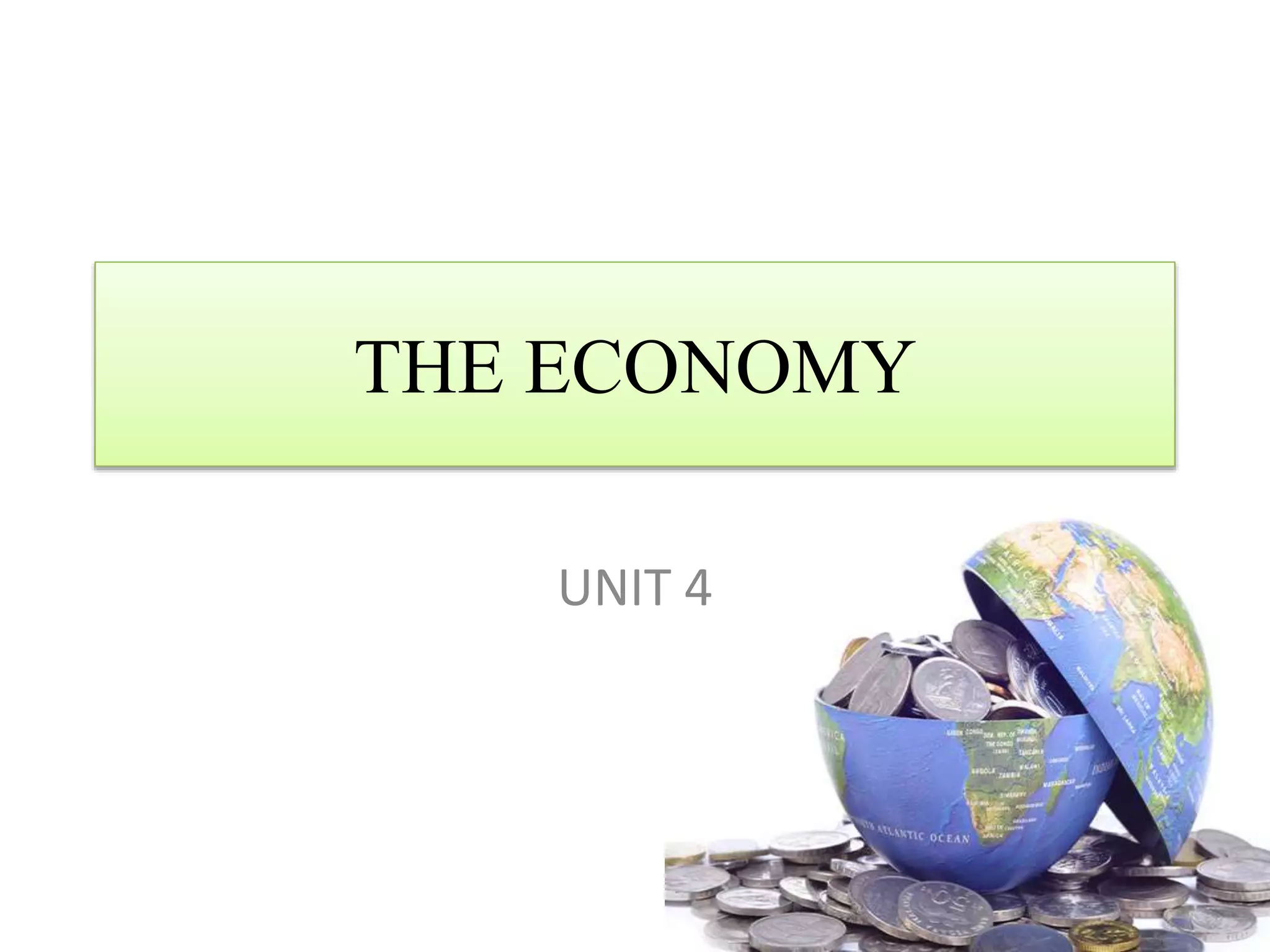
THE ECONOMY
UNIT 4
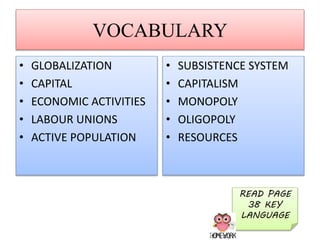
VOCABULARY
• GLOBALIZATION
• CAPITAL
• ECONOMIC ACTIVITIES
• LABOUR UNIONS
• ACTIVE POPULATION
• SUBSISTENCE SYSTEM
• CAPITALISM
• MONOPOLY
• OLIGOPOLY
• RESOURCES
READ PAGE
38 KEY
LANGUAGE
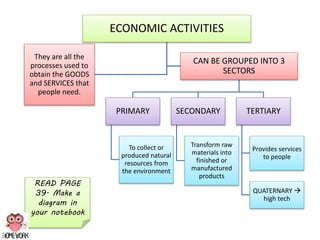
ECONOMIC ACTIVITIES
They are all the
processes used to
obtain the GOODS
and SERVICES that
people need.
CAN BE GROUPED INTO 3
SECTORS
PRIMARY
To collect or
produced natural
resources from
the environment
SECONDARY
Transform raw
materials into
finished or
manufactured
products
TERTIARY
Provides services
to people
QUATERNARY 
high tech
READ PAGE
39. Make a
diagram in
your notebook
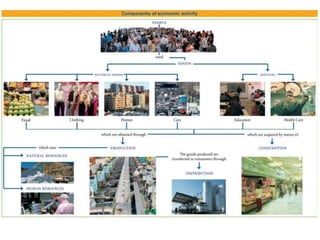
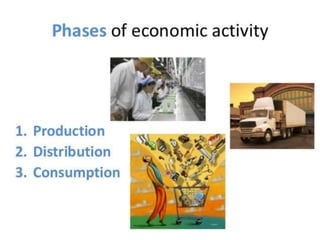
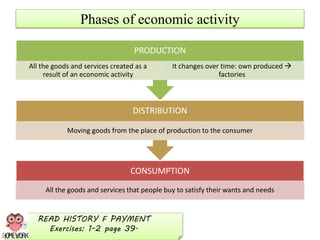
Phases of economic activity
CONSUMPTION
All the goods and services that people buy to satisfy their wants and needs
DISTRIBUTION
Moving goods from the place of production to the consumer
PRODUCTION
All the goods and services created as a
result of an economic activity
It changes over time: own produced 
factories
READ HISTORY F PAYMENT
Exercises: 1-2 page 39.
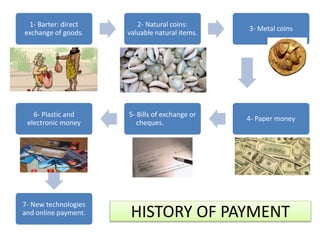
HISTORY OF PAYMENT
1- Barter: direct
exchange of goods.
2- Natural coins:
valuable natural items.
3- Metal coins
4- Paper money
5- Bills of exchange or
cheques.
6- Plastic and
electronic money
7- New technologies
and online payment.
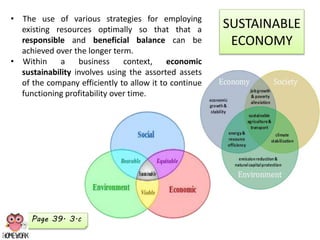
SUSTAINABLE
ECONOMY
• The use of various strategies for employing
existing resources optimally so that that a
responsible and beneficial balance can be
achieved over the longer term.
• Within a business context, economic
sustainability involves using the assorted assets
of the company efficiently to allow it to continue
functioning profitability over time.
Page 39. 3.c
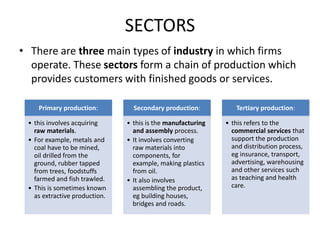
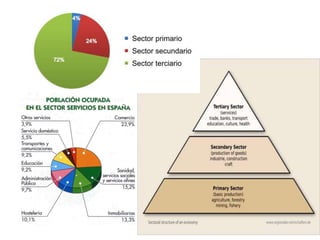
SECTORS
• There are three main types of industry in which firms
operate. These sectors form a chain of production which
provides customers with finished goods or services.
Primary production:
• this involves acquiring
raw materials.
• For example, metals and
coal have to be mined,
oil drilled from the
ground, rubber tapped
from trees, foodstuffs
farmed and fish trawled.
• This is sometimes known
as extractive production.
Secondary production:
• this is the manufacturing
and assembly process.
• It involves converting
raw materials into
components, for
example, making plastics
from oil.
• It also involves
assembling the product,
eg building houses,
bridges and roads.
Tertiary production:
• this refers to the
commercial services that
support the production
and distribution process,
eg insurance, transport,
advertising, warehousing
and other services such
as teaching and health
care.
What are economic sectors?
• Economic activities are classified into three main
sectors: primary, secondary and tertiary.
– The primary sector:
• It includes the activities based on the extraction of goods and
resources from the environment: agriculture, stock breeding,
hunting, forestry, fishing and mining.
• Primary activities are carried out in rural, marine and forest areas,
which are usually far from the cities.
– The secondary sector:
• It includes the economic activities which transform the goods and
resources extracted from the environment (raw materials) into
processed products.
• Construction and industry are the main activities in this sector.
Industries are usually located in cities and nearby areas.
What are economic sectors?
– The tertiary sector:
• It includes activities which provide services of all kind:
trade, transport, tourism, health, communication,
education, finance or culture.
– The quaternary sector is due to the rapid
expansion of the tertiary sector.
• It includes several service activities characterized by a
high level of specialisation, such as management,
decision-making, high research or the new
technologies.
Page 40. Ex1
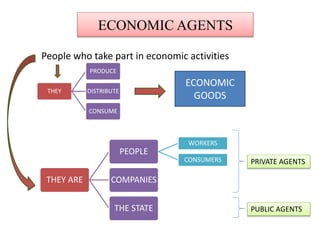
ECONOMIC AGENTS
People who take part in economic activities
ECONOMIC
GOODS
THEY
PRODUCE
DISTRIBUTE
CONSUME
THEY ARE
PEOPLE
WORKERS
CONSUMERS
COMPANIES
THE STATE
PRIVATE AGENTS
PUBLIC AGENTS
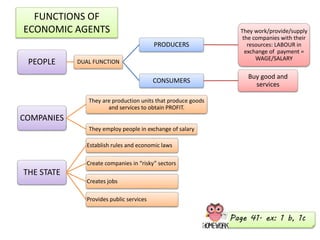
FUNCTIONS OF
ECONOMIC AGENTS
PEOPLE DUAL FUNCTION
PRODUCERS
They work/provide/supply
the companies with their
resources: LABOUR in
exchange of payment =
WAGE/SALARY
CONSUMERS
Buy good and
services
COMPANIES
They are production units that produce goods
and services to obtain PROFIT.
They employ people in exchange of salary
THE STATE
Establish rules and economic laws
Create companies in “risky” sectors
Creates jobs
Provides public services
Page 41. ex: 1 b, 1c
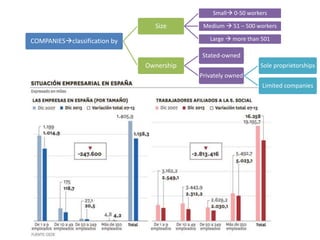
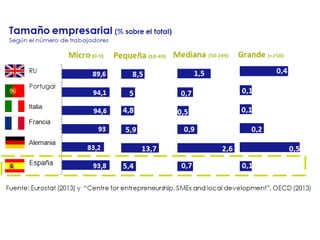
COMPANIESclassification by
Size
Small 0-50 workers
Medium  51 – 500 workers
Large  more than 501
Ownership
Stated-owned
Privately owned
Sole proprietorships
Limited companies
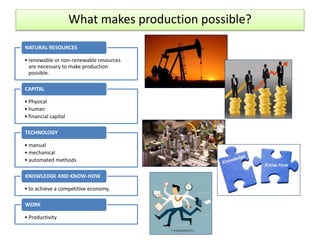
What makes production possible?
• renewable or non-renewable resources
are necessary to make production
possible.
NATURAL RESOURCES
• Physical
• human
• financial capital
CAPITAL
• manual
• mechanical
• automated methods
TECHNOLOGY
• to achieve a competitive economy.
KNOWLEDGE AND KNOW-HOW
• Productivity
WORK
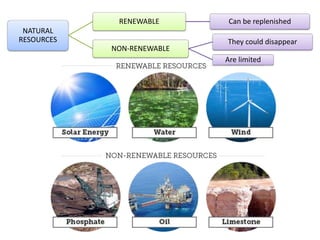
NATURAL
RESOURCES
RENEWABLE Can be replenished
NON-RENEWABLE
They could disappear
Are limited
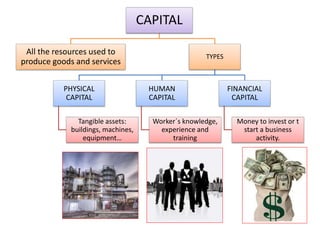
CAPITAL
All the resources used to
produce goods and services
TYPES
PHYSICAL
CAPITAL
Tangible assets:
buildings, machines,
equipment…
HUMAN
CAPITAL
Worker´s knowledge,
experience and
training
FINANCIAL
CAPITAL
Money to invest or t
start a business
activity.
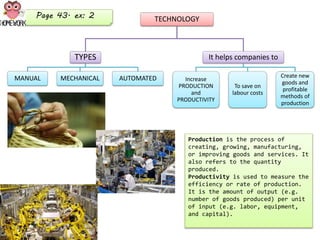
TECHNOLOGY
TYPES
MANUAL MECHANICAL AUTOMATED
It helps companies to
Increase
PRODUCTION
and
PRODUCTIVITY
To save on
labour costs
Create new
goods and
profitable
methods of
production
Production is the process of
creating, growing, manufacturing,
or improving goods and services. It
also refers to the quantity
produced.
Productivity is used to measure the
efficiency or rate of production.
It is the amount of output (e.g.
number of goods produced) per unit
of input (e.g. labor, equipment,
and capital).
Page 43. ex: 2
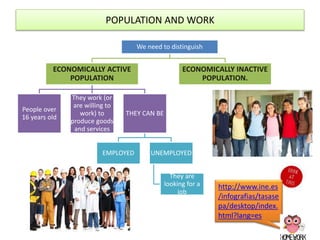
We need to distinguish
ECONOMICALLY ACTIVE
POPULATION
People over
16 years old
They work (or
are willing to
work) to
produce goods
and services
THEY CAN BE
EMPLOYED UNEMPLOYED
They are
looking for a
job
ECONOMICALLY INACTIVE
POPULATION.
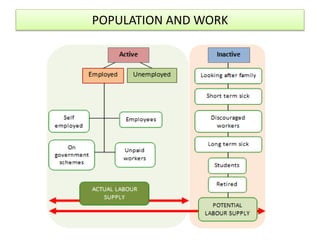
POPULATION AND WORK
http://www.ine.es
/infografias/tasase
pa/desktop/index.
html?lang=es
POPULATION AND WORK
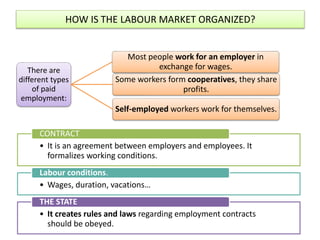
HOW IS THE LABOUR MARKET ORGANIZED?
• It is an agreement between employers and employees. It
formalizes working conditions.
CONTRACT
• Wages, duration, vacations…
Labour conditions.
• It creates rules and laws regarding employment contracts
should be obeyed.
THE STATE
There are
different types
of paid
employment:
Most people work for an employer in
exchange for wages.
Some workers form cooperatives, they share
profits.
Self-employed workers work for themselves.
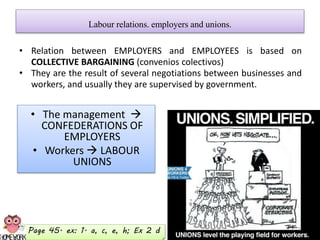
Labour relations. employers and unions.
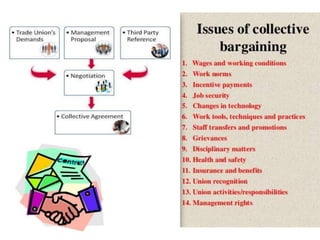
• Relation between EMPLOYERS and EMPLOYEES is based on
COLLECTIVE BARGAINING (convenios colectivos)
• They are the result of several negotiations between businesses and
workers, and usually they are supervised by government.
• The management 
CONFEDERATIONS OF
EMPLOYERS
• Workers  LABOUR
UNIONS
Page 45. ex: 1. a, c, e, h; Ex 2 d
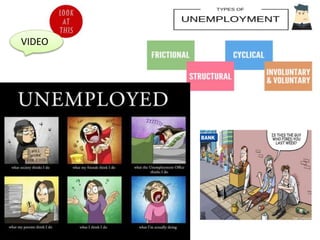
VIDEO
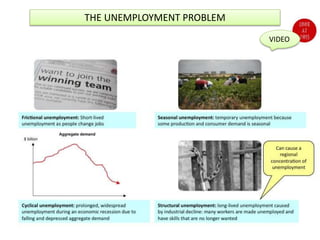
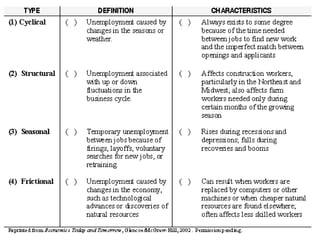
THE UNEMPLOYMENT PROBLEM
VIDEO
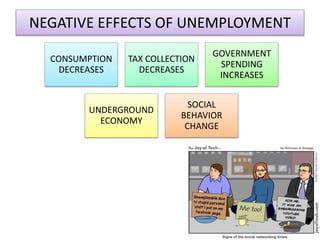
NEGATIVE EFFECTS OF UNEMPLOYMENT
CONSUMPTION
DECREASES
TAX COLLECTION
DECREASES
GOVERNMENT
SPENDING
INCREASES
UNDERGROUND
ECONOMY
SOCIAL
BEHAVIOR
CHANGE
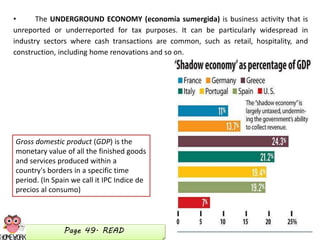
• The UNDERGROUND ECONOMY (economía sumergida) is business activity that is
unreported or underreported for tax purposes. It can be particularly widespread in
industry sectors where cash transactions are common, such as retail, hospitality, and
construction, including home renovations and so on.
Gross domestic product (GDP) is the
monetary value of all the finished goods
and services produced within a
country's borders in a specific time
period. (In Spain we call it IPC Indice de
precios al consumo)
Page 49. READ
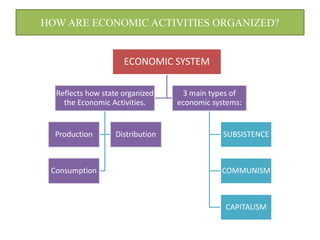
HOW ARE ECONOMIC ACTIVITIES ORGANIZED?
ECONOMIC SYSTEM
Reflects how state organized
the Economic Activities.
Production Distribution
Consumption
3 main types of
economic systems:
SUBSISTENCE
COMMUNISM
CAPITALISM
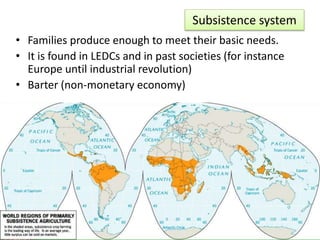
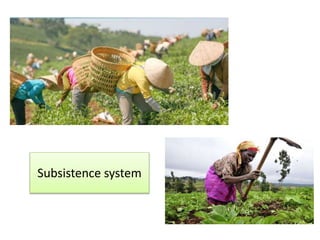
Subsistence system
• Families produce enough to meet their basic needs.
• It is found in LEDCs and in past societies (for instance
Europe until industrial revolution)
• Barter (non-monetary economy)
Subsistence system
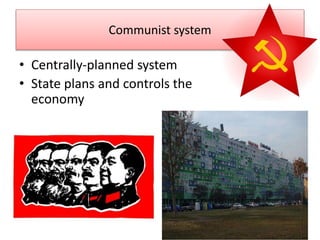
Communist system
• Centrally-planned system
• State plans and controls the
economy
Capitalist system
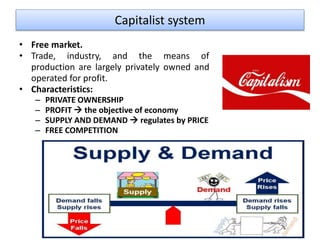
• Free market.
• Trade, industry, and the means of
production are largely privately owned and
operated for profit.
• Characteristics:
– PRIVATE OWNERSHIP
– PROFIT  the objective of economy
– SUPPLY AND DEMAND  regulates by PRICE
– FREE COMPETITION
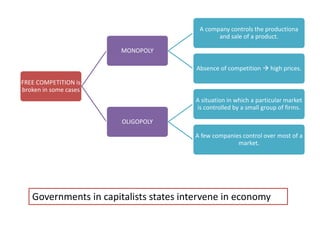
FREE COMPETITION is
broken in some cases
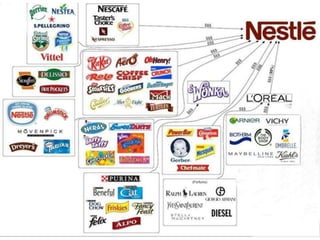
MONOPOLY
A company controls the productiona
and sale of a product.
Absence of competition  high prices.
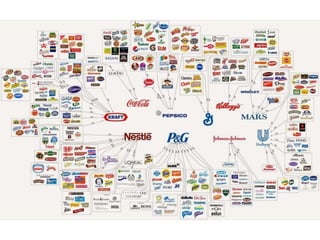
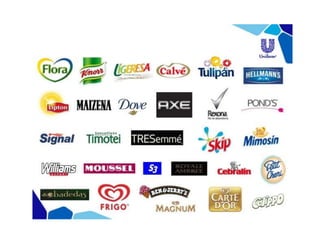
OLIGOPOLY
A situation in which a particular market
is controlled by a small group of firms.
A few companies control over most of a
market.
Governments in capitalists states intervene in economy
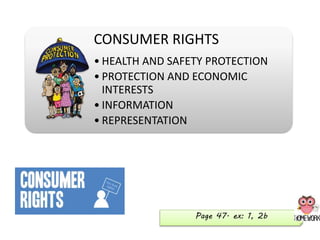
CONSUMER RIGHTS
• HEALTH AND SAFETY PROTECTION
• PROTECTION AND ECONOMIC
INTERESTS
• INFORMATION
• REPRESENTATION
Page 47. ex: 1, 2b

UNIT 4. GEOGRAPHY. The economy

  • 1.
  • 2.
    VOCABULARY • GLOBALIZATION • CAPITAL •ECONOMIC ACTIVITIES • LABOUR UNIONS • ACTIVE POPULATION • SUBSISTENCE SYSTEM • CAPITALISM • MONOPOLY • OLIGOPOLY • RESOURCES READ PAGE 38 KEY LANGUAGE
  • 3.
    ECONOMIC ACTIVITIES They areall the processes used to obtain the GOODS and SERVICES that people need. CAN BE GROUPED INTO 3 SECTORS PRIMARY To collect or produced natural resources from the environment SECONDARY Transform raw materials into finished or manufactured products TERTIARY Provides services to people QUATERNARY  high tech READ PAGE 39. Make a diagram in your notebook
  • 6.
    Phases of economicactivity CONSUMPTION All the goods and services that people buy to satisfy their wants and needs DISTRIBUTION Moving goods from the place of production to the consumer PRODUCTION All the goods and services created as a result of an economic activity It changes over time: own produced  factories READ HISTORY F PAYMENT Exercises: 1-2 page 39.
  • 7.
    HISTORY OF PAYMENT 1-Barter: direct exchange of goods. 2- Natural coins: valuable natural items. 3- Metal coins 4- Paper money 5- Bills of exchange or cheques. 6- Plastic and electronic money 7- New technologies and online payment.
  • 8.
    SUSTAINABLE ECONOMY • The useof various strategies for employing existing resources optimally so that that a responsible and beneficial balance can be achieved over the longer term. • Within a business context, economic sustainability involves using the assorted assets of the company efficiently to allow it to continue functioning profitability over time. Page 39. 3.c
  • 9.
    SECTORS • There arethree main types of industry in which firms operate. These sectors form a chain of production which provides customers with finished goods or services. Primary production: • this involves acquiring raw materials. • For example, metals and coal have to be mined, oil drilled from the ground, rubber tapped from trees, foodstuffs farmed and fish trawled. • This is sometimes known as extractive production. Secondary production: • this is the manufacturing and assembly process. • It involves converting raw materials into components, for example, making plastics from oil. • It also involves assembling the product, eg building houses, bridges and roads. Tertiary production: • this refers to the commercial services that support the production and distribution process, eg insurance, transport, advertising, warehousing and other services such as teaching and health care.
  • 10.
    What are economicsectors? • Economic activities are classified into three main sectors: primary, secondary and tertiary. – The primary sector: • It includes the activities based on the extraction of goods and resources from the environment: agriculture, stock breeding, hunting, forestry, fishing and mining. • Primary activities are carried out in rural, marine and forest areas, which are usually far from the cities. – The secondary sector: • It includes the economic activities which transform the goods and resources extracted from the environment (raw materials) into processed products. • Construction and industry are the main activities in this sector. Industries are usually located in cities and nearby areas.
  • 11.
    What are economicsectors? – The tertiary sector: • It includes activities which provide services of all kind: trade, transport, tourism, health, communication, education, finance or culture. – The quaternary sector is due to the rapid expansion of the tertiary sector. • It includes several service activities characterized by a high level of specialisation, such as management, decision-making, high research or the new technologies. Page 40. Ex1
  • 13.
    ECONOMIC AGENTS People whotake part in economic activities ECONOMIC GOODS THEY PRODUCE DISTRIBUTE CONSUME THEY ARE PEOPLE WORKERS CONSUMERS COMPANIES THE STATE PRIVATE AGENTS PUBLIC AGENTS
  • 14.
    FUNCTIONS OF ECONOMIC AGENTS PEOPLEDUAL FUNCTION PRODUCERS They work/provide/supply the companies with their resources: LABOUR in exchange of payment = WAGE/SALARY CONSUMERS Buy good and services COMPANIES They are production units that produce goods and services to obtain PROFIT. They employ people in exchange of salary THE STATE Establish rules and economic laws Create companies in “risky” sectors Creates jobs Provides public services Page 41. ex: 1 b, 1c
  • 15.
    COMPANIESclassification by Size Small 0-50workers Medium  51 – 500 workers Large  more than 501 Ownership Stated-owned Privately owned Sole proprietorships Limited companies
  • 18.
    What makes productionpossible? • renewable or non-renewable resources are necessary to make production possible. NATURAL RESOURCES • Physical • human • financial capital CAPITAL • manual • mechanical • automated methods TECHNOLOGY • to achieve a competitive economy. KNOWLEDGE AND KNOW-HOW • Productivity WORK
  • 19.
    NATURAL RESOURCES RENEWABLE Can bereplenished NON-RENEWABLE They could disappear Are limited
  • 20.
    CAPITAL All the resourcesused to produce goods and services TYPES PHYSICAL CAPITAL Tangible assets: buildings, machines, equipment… HUMAN CAPITAL Worker´s knowledge, experience and training FINANCIAL CAPITAL Money to invest or t start a business activity.
  • 21.
    TECHNOLOGY TYPES MANUAL MECHANICAL AUTOMATED Ithelps companies to Increase PRODUCTION and PRODUCTIVITY To save on labour costs Create new goods and profitable methods of production Production is the process of creating, growing, manufacturing, or improving goods and services. It also refers to the quantity produced. Productivity is used to measure the efficiency or rate of production. It is the amount of output (e.g. number of goods produced) per unit of input (e.g. labor, equipment, and capital). Page 43. ex: 2
  • 22.
    We need todistinguish ECONOMICALLY ACTIVE POPULATION People over 16 years old They work (or are willing to work) to produce goods and services THEY CAN BE EMPLOYED UNEMPLOYED They are looking for a job ECONOMICALLY INACTIVE POPULATION. POPULATION AND WORK http://www.ine.es /infografias/tasase pa/desktop/index. html?lang=es
  • 23.
  • 24.
    HOW IS THELABOUR MARKET ORGANIZED? • It is an agreement between employers and employees. It formalizes working conditions. CONTRACT • Wages, duration, vacations… Labour conditions. • It creates rules and laws regarding employment contracts should be obeyed. THE STATE There are different types of paid employment: Most people work for an employer in exchange for wages. Some workers form cooperatives, they share profits. Self-employed workers work for themselves.
  • 25.
    Labour relations. employersand unions. • Relation between EMPLOYERS and EMPLOYEES is based on COLLECTIVE BARGAINING (convenios colectivos) • They are the result of several negotiations between businesses and workers, and usually they are supervised by government. • The management  CONFEDERATIONS OF EMPLOYERS • Workers  LABOUR UNIONS Page 45. ex: 1. a, c, e, h; Ex 2 d
  • 27.
  • 28.
  • 30.
    NEGATIVE EFFECTS OFUNEMPLOYMENT CONSUMPTION DECREASES TAX COLLECTION DECREASES GOVERNMENT SPENDING INCREASES UNDERGROUND ECONOMY SOCIAL BEHAVIOR CHANGE
  • 31.
    • The UNDERGROUNDECONOMY (economía sumergida) is business activity that is unreported or underreported for tax purposes. It can be particularly widespread in industry sectors where cash transactions are common, such as retail, hospitality, and construction, including home renovations and so on. Gross domestic product (GDP) is the monetary value of all the finished goods and services produced within a country's borders in a specific time period. (In Spain we call it IPC Indice de precios al consumo) Page 49. READ
  • 32.
    HOW ARE ECONOMICACTIVITIES ORGANIZED? ECONOMIC SYSTEM Reflects how state organized the Economic Activities. Production Distribution Consumption 3 main types of economic systems: SUBSISTENCE COMMUNISM CAPITALISM
  • 33.
    Subsistence system • Familiesproduce enough to meet their basic needs. • It is found in LEDCs and in past societies (for instance Europe until industrial revolution) • Barter (non-monetary economy)
  • 34.
  • 35.
    Communist system • Centrally-plannedsystem • State plans and controls the economy
  • 36.
    Capitalist system • Freemarket. • Trade, industry, and the means of production are largely privately owned and operated for profit. • Characteristics: – PRIVATE OWNERSHIP – PROFIT  the objective of economy – SUPPLY AND DEMAND  regulates by PRICE – FREE COMPETITION
  • 37.
    FREE COMPETITION is brokenin some cases MONOPOLY A company controls the productiona and sale of a product. Absence of competition  high prices. OLIGOPOLY A situation in which a particular market is controlled by a small group of firms. A few companies control over most of a market. Governments in capitalists states intervene in economy
  • 41.
    CONSUMER RIGHTS • HEALTHAND SAFETY PROTECTION • PROTECTION AND ECONOMIC INTERESTS • INFORMATION • REPRESENTATION Page 47. ex: 1, 2b