ECONOMICS
A SOCIAL SCIENCE
What is economics?
• It’s a social science.
• It concerns the production of wealth and the
distribution of wealth between different countries
and different agents.
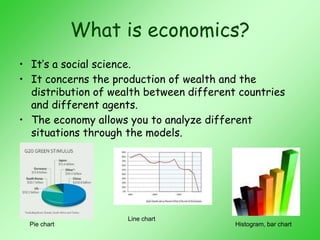
• The economy allows you to analyze different
situations through the models.
Line chart
Pie chart Histogram, bar chart
It is made up of:
• Microeconomics: it
deals with the
behaviour of single
economic agents
• Macroeconomics: it
deals with the
behaviour of the
economy as a whole
What is economics about?
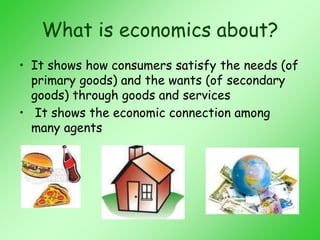
• It shows how consumers satisfy the needs (of
primary goods) and the wants (of secondary
goods) through goods and services
• It shows the economic connection among
many agents
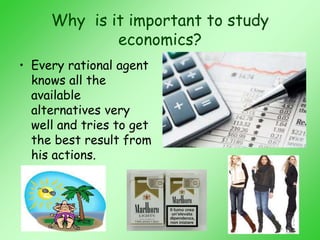
Why is it important to study
economics?
• Every rational agent
knows all the
available
alternatives very
well and tries to get
the best result from
his actions.
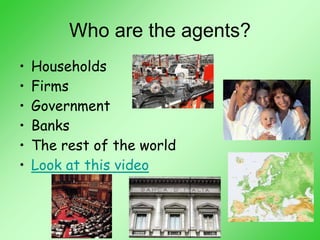
Who are the agents?
• Households
• Firms
• Government
• Banks
• The rest of the world
• Look at this video
Who are the agents?
• ……so economic activity takes place
within societies to satisfy the needs and
the wants of the consumers!!
if there were no needs, there would be no
economy!
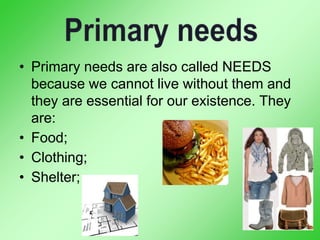
• Primary needs are also called NEEDS
because we cannot live without them and
they are essential for our existence. They
are:
• Food;
• Clothing;
• Shelter;
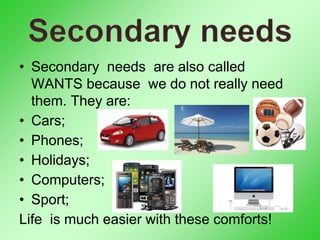
• Secondary needs are also called
WANTS because we do not really need
them. They are:
• Cars;
• Phones;
• Holidays;
• Computers;
• Sport;
Life is much easier with these comforts!
Needs and wants
• Our idea of needs and wants is always
changing.
• As a result of consumers’ increased
demands (request) the market now offers
(supply) an enormous number of different
products.
• There are two main types of products:
goods and services
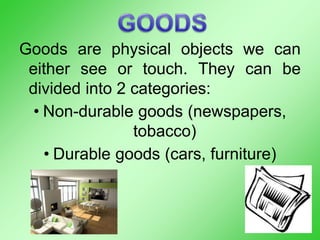
Goods are physical objects we can
either see or touch. They can be
divided into 2 categories:
• Non-durable goods (newspapers,
tobacco)
• Durable goods (cars, furniture)
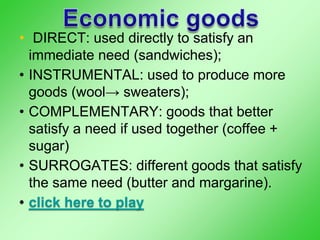
• DIRECT: used directly to satisfy an
immediate need (sandwiches);
• INSTRUMENTAL: used to produce more
goods (wool→ sweaters);
• COMPLEMENTARY: goods that better
satisfy a need if used together (coffee +
sugar)
• SURROGATES: different goods that satisfy
the same need (butter and margarine).
• click here to play
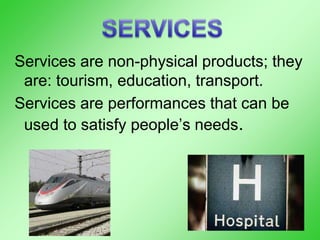
Services are non-physical products; they
are: tourism, education, transport.
Services are performances that can be
used to satisfy people’s needs.
PRODUCTION
• ….to satisfy needs and wants it is
necessary to produce some goods and
services
The meaning of “production”:
• Production is the activity that makes
use of natural goods to satisfy
people’s needs.
• A lot of goods can’t be used when
they are in their natural state, so
they have to be transformed
through work and machineries in
order to be useful or more useful.
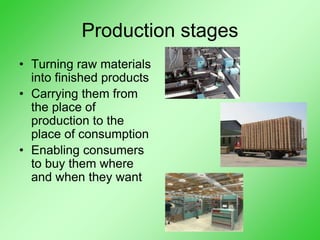
Production stages
• Turning raw materials
into finished products
• Carrying them from
the place of
production to the
place of consumption
• Enabling consumers
to buy them where
and when they want
IMPORTANT!!!!!
• The production factors are in short
supply. As a result, it is important to use
resources efficiently, in order to maximise
the output that can be produced from them
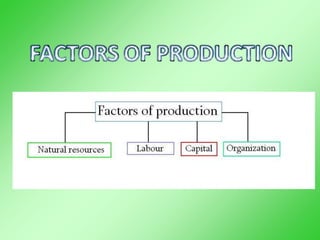
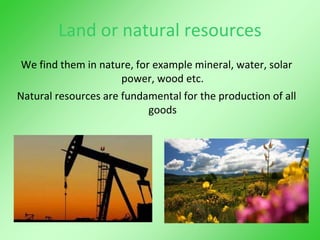
Land or natural resources
We find them in nature, for example mineral, water, solar
power, wood etc.
Natural resources are fundamental for the production of all
goods
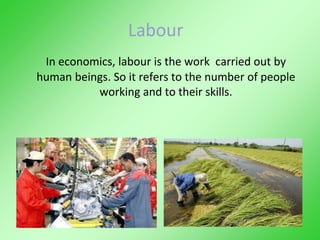
Labour
In economics, labour is the work carried out by
human beings. So it refers to the number of people
working and to their skills.
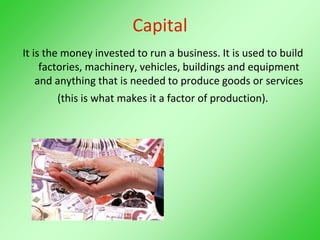
Capital
It is the money invested to run a business. It is used to build
factories, machinery, vehicles, buildings and equipment
and anything that is needed to produce goods or services
(this is what makes it a factor of production).
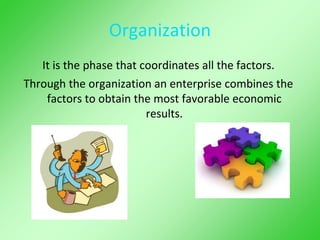
Organization
It is the phase that coordinates all the factors.
Through the organization an enterprise combines the
factors to obtain the most favorable economic
results.
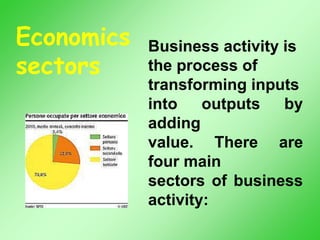
Economics
sectors
Business activity is
the process of
transforming inputs
into outputs by
adding
value. There are
four main
sectors of business
activity:
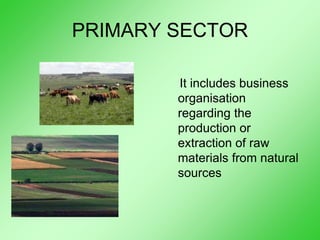
PRIMARY SECTOR
It includes business
organisation
regarding the
production or
extraction of raw
materials from natural
sources
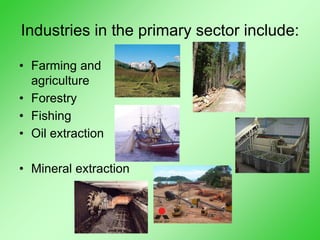
Industries in the primary sector include:
• Farming and
agriculture
• Forestry
• Fishing
• Oil extraction
• Mineral extraction
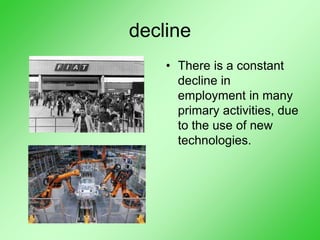
decline
• There is a constant
decline in
employment in many
primary activities, due
to the use of new
technologies.
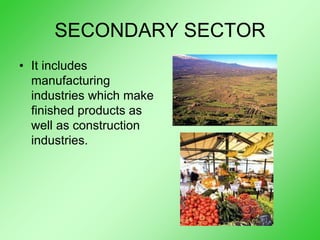
SECONDARY SECTOR
• It includes
manufacturing
industries which make
finished products as
well as construction
industries.
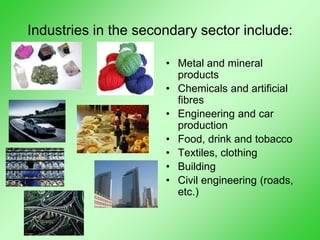
Industries in the secondary sector include:
• Metal and mineral
products
• Chemicals and artificial
fibres
• Engineering and car
production
• Food, drink and tobacco
• Textiles, clothing
• Building
• Civil engineering (roads,
etc.)
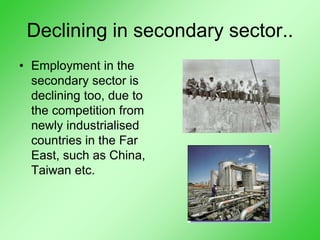
Declining in secondary sector..
• Employment in the
secondary sector is
declining too, due to
the competition from
newly industrialised
countries in the Far
East, such as China,
Taiwan etc.
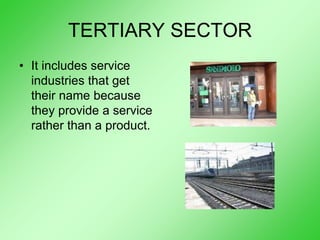
TERTIARY SECTOR
• It includes service
industries that get
their name because
they provide a service
rather than a product.
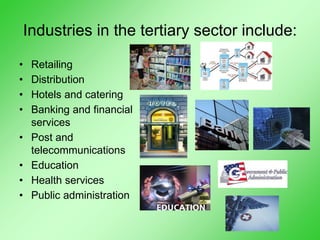
Industries in the tertiary sector include:
• Retailing
• Distribution
• Hotels and catering
• Banking and financial
services
• Post and
telecommunications
• Education
• Health services
• Public administration
Tertiary advanced sector
The advanced tertiary sector is
represented by new information
technologies. Companies dealing
with telecommunications,
information technologies, media
consulting services, and information
processing are all part of the
advanced tertiary sector. The term
“advanced tertiary” was coined in
the last decades to distinguish
between the companies offering
service at low value-added from
those working at high technological
level.

New economics

  • 1.
  • 2.
    What is economics? •It’s a social science. • It concerns the production of wealth and the distribution of wealth between different countries and different agents. • The economy allows you to analyze different situations through the models. Line chart Pie chart Histogram, bar chart
  • 3.
    It is madeup of: • Microeconomics: it deals with the behaviour of single economic agents • Macroeconomics: it deals with the behaviour of the economy as a whole
  • 4.
    What is economicsabout? • It shows how consumers satisfy the needs (of primary goods) and the wants (of secondary goods) through goods and services • It shows the economic connection among many agents
  • 5.
    Why is itimportant to study economics? • Every rational agent knows all the available alternatives very well and tries to get the best result from his actions.
  • 7.
    Who are theagents? • Households • Firms • Government • Banks • The rest of the world • Look at this video
  • 8.
    Who are theagents? • ……so economic activity takes place within societies to satisfy the needs and the wants of the consumers!! if there were no needs, there would be no economy!
  • 9.
    • Primary needsare also called NEEDS because we cannot live without them and they are essential for our existence. They are: • Food; • Clothing; • Shelter;
  • 10.
    • Secondary needsare also called WANTS because we do not really need them. They are: • Cars; • Phones; • Holidays; • Computers; • Sport; Life is much easier with these comforts!
  • 11.
    Needs and wants •Our idea of needs and wants is always changing. • As a result of consumers’ increased demands (request) the market now offers (supply) an enormous number of different products. • There are two main types of products: goods and services
  • 12.
    Goods are physicalobjects we can either see or touch. They can be divided into 2 categories: • Non-durable goods (newspapers, tobacco) • Durable goods (cars, furniture)
  • 13.
    • DIRECT: useddirectly to satisfy an immediate need (sandwiches); • INSTRUMENTAL: used to produce more goods (wool→ sweaters); • COMPLEMENTARY: goods that better satisfy a need if used together (coffee + sugar) • SURROGATES: different goods that satisfy the same need (butter and margarine). • click here to play
  • 14.
    Services are non-physicalproducts; they are: tourism, education, transport. Services are performances that can be used to satisfy people’s needs.
  • 15.
    PRODUCTION • ….to satisfyneeds and wants it is necessary to produce some goods and services
  • 16.
    The meaning of“production”: • Production is the activity that makes use of natural goods to satisfy people’s needs. • A lot of goods can’t be used when they are in their natural state, so they have to be transformed through work and machineries in order to be useful or more useful.
  • 17.
    Production stages • Turningraw materials into finished products • Carrying them from the place of production to the place of consumption • Enabling consumers to buy them where and when they want
  • 19.
    IMPORTANT!!!!! • The productionfactors are in short supply. As a result, it is important to use resources efficiently, in order to maximise the output that can be produced from them
  • 20.
    Land or naturalresources We find them in nature, for example mineral, water, solar power, wood etc. Natural resources are fundamental for the production of all goods
  • 21.
    Labour In economics, labouris the work carried out by human beings. So it refers to the number of people working and to their skills.
  • 22.
    Capital It is themoney invested to run a business. It is used to build factories, machinery, vehicles, buildings and equipment and anything that is needed to produce goods or services (this is what makes it a factor of production).
  • 23.
    Organization It is thephase that coordinates all the factors. Through the organization an enterprise combines the factors to obtain the most favorable economic results.
  • 25.
    Economics sectors Business activity is theprocess of transforming inputs into outputs by adding value. There are four main sectors of business activity:
  • 26.
    PRIMARY SECTOR It includesbusiness organisation regarding the production or extraction of raw materials from natural sources
  • 27.
    Industries in theprimary sector include: • Farming and agriculture • Forestry • Fishing • Oil extraction • Mineral extraction
  • 28.
    decline • There isa constant decline in employment in many primary activities, due to the use of new technologies.
  • 29.
    SECONDARY SECTOR • Itincludes manufacturing industries which make finished products as well as construction industries.
  • 30.
    Industries in thesecondary sector include: • Metal and mineral products • Chemicals and artificial fibres • Engineering and car production • Food, drink and tobacco • Textiles, clothing • Building • Civil engineering (roads, etc.)
  • 31.
    Declining in secondarysector.. • Employment in the secondary sector is declining too, due to the competition from newly industrialised countries in the Far East, such as China, Taiwan etc.
  • 32.
    TERTIARY SECTOR • Itincludes service industries that get their name because they provide a service rather than a product.
  • 33.
    Industries in thetertiary sector include: • Retailing • Distribution • Hotels and catering • Banking and financial services • Post and telecommunications • Education • Health services • Public administration
  • 34.
    Tertiary advanced sector Theadvanced tertiary sector is represented by new information technologies. Companies dealing with telecommunications, information technologies, media consulting services, and information processing are all part of the advanced tertiary sector. The term “advanced tertiary” was coined in the last decades to distinguish between the companies offering service at low value-added from those working at high technological level.