Tyre Retreading by Hot Retreading Process
S. Ajeeth Kumar*
UG scholar, Mechanical department, Sethu institute of technology, Madurai, India
*Corresponding author: ajeeth1112@gmail.com
Abstract
Tyre is made up of natural rubber or synthetic rubber .natural rubber is present as milky liquid or latex in
the bark of rubber tree, HEVEA BRASILIENSIS. Natural rubber combines with carbon, oil, sulphur and
the chemicals at a temperature of 100-140oC and under goes a number of stages of processes. Synthetic
rubber is any vulcanisable man made rubber like polymer. By retreading tyre we are doing a good job
which is in favour of Natural resources. Tyre Retreading is a new technology, where the old tyres are made
serviceable by removing worn out and damaged treads and replacing it with new treads. New treads are
available in the market in form of rolls and in brief, in can be put on old tyre and cured with the help of
steam. Similar to the new tyres, the treaded tyres can be very well used on all vehicles, irrespective of
light or heavy vehicles. With a safe and new technology, which is being adopted now-a-days, it will be
more easy and economical to produce tyres. As day by day, more and more vehicles are running on roads,
hence more tyres are required for replacement. With further growth of economy, there will be an increase
in transport as well as passenger vehicles and hence more tyres will be required. Hence, there is a very
wide scope for retread tyres as an original replacement.
Keywords: Retreading, synthetic rubber, curing, buffing, vulcanization, new technology, economy.
It is very essential to know the meaning of ‘tread’. The grooves which are cut on the tyre surface are
called tread. These treads ensure the gripping action between the road surface and tyre. After the use of
tyre the depth of treads becomes less and a slippery action takes place between road surface and tyre. The
co-efficient of friction becomes less. A tyre is in no more condition to be used again. Now, here becomes
the choice either to replace the tyre with a new one which is very expensive or to retread the tyre which
is less expensive as compared to the cost of new tyre. Retreading process can also rectify minor cuts or
defects on the side walls of tyre, beads and punctures in a single stage. A tyre can be retreaded or not
this is entirely dependable on the type of use of tyre and condition of tyre.
International Journal of Applied Science and Engineering 4(2): December, 2016: pp. 61-65
DOI: 10.5958/2322-0465.2016.00007.1
©2016 New Delhi Publishers. All rights reserved
62
Kumar
Manufacturing Process
The manufacturing of retreading rubber is done in the following stages:
	 (I)	 Compounding: Removing unwanted materials such as nails, rivets etc.
	 (II)	 Mixing: Reclaimed rubber and oils
	 (III)	 Extruding: The mixture of rubber so obtained is put into extruder to form rubber sheets.
	 (IV)	 Retreading: Before retreading tyre is buffed and it is allowed to stick properly.
Tyres are buffed properly to remove all undesired rubber and to clean surface. The retreading rubber
is now put on its outer surface with an adhesive solution.
Retreading process is of two types:
	 1.	 Hot retreading
	 2.	 Cold retreading
Hot Retreading Process
Before the tyre undergoes certain process, it should be
verified for the initial inspection throughout inside and
outside of the tyre. Identify the casing injuries and determine
if repairable and then reject or approve the casing for further
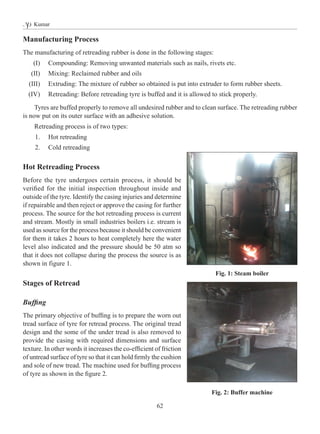
process. The source for the hot retreading process is current
and stream. Mostly in small industries boilers i.e. stream is
used as source for the process because it should be convenient
for them it takes 2 hours to heat completely here the water
level also indicated and the pressure should be 50 atm so
that it does not collapse during the process the source is as
shown in figure 1.
Stages of Retread
Buffing
The primary objective of buffing is to prepare the worn out
tread surface of tyre for retread process. The original tread
design and the some of the under tread is also removed to
provide the casing with required dimensions and surface
texture. In other words it increases the co-efficient of friction
of untread surface of tyre so that it can hold firmly the cushion
and sole of new tread. The machine used for buffing process
of tyre as shown in the figure 2.
Fig. 1: Steam boiler
Fig. 2: Buffer machine
63
Tyre retreading by hot retreading process
Tread Preparation and Building
Building is the process of applying a premoulded retread or new tread rubber to the buffed and prepared
casing. It done by rotating a tyre continuously and vulcanized rubber solvent is placed over the surface
of tyre .the solvent is prepared by mixing black vulcanizing cement and petrol ,here petrol is used for
reducing the viscosity of the solvent so that they can be applied on the tyre smoothly In this way it spreads
uniformly. Take another dip of solvent if required.After the application of sufficient solvent a cushioning
strip is fixed and tyre is slowly rotated so that complete circumference of ta painting brush depth in tyre
is covered and uncured tread compound is extruded or applied as a strip of sufficient length directly to
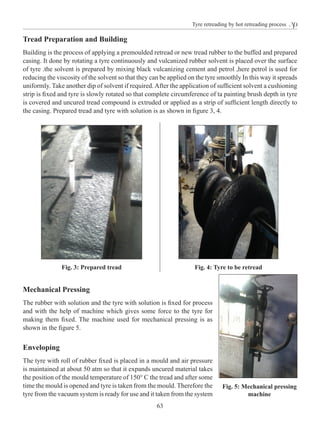
the casing. Prepared tread and tyre with solution is as shown in figure 3, 4.
Fig. 3: Prepared tread Fig. 4: Tyre to be retread
Mechanical Pressing
The rubber with solution and the tyre with solution is fixed for process
and with the help of machine which gives some force to the tyre for
making them fixed. The machine used for mechanical pressing is as
shown in the figure 5.
Enveloping
The tyre with roll of rubber fixed is placed in a mould and air pressure
is maintained at about 50 atm so that it expands uncured material takes
the position of the mould temperature of 150° C the tread and after some
time the mould is opened and tyre is taken from the mould. Therefore the
tyre from the vacuum system is ready for use and it taken from the system
Fig. 5: Mechanical pressing
machine
64
Kumar
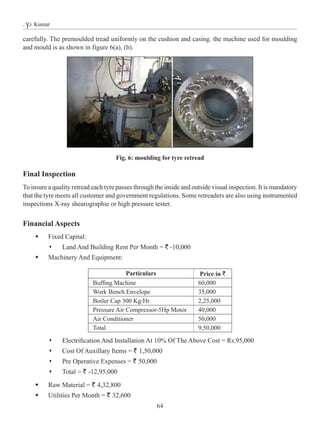
carefully. The premoulded tread uniformly on the cushion and casing. the machine used for moulding
and mould is as shown in figure 6(a), (b).
Fig. 6: moulding for tyre retread
Final Inspection
To insure a quality retread each tyre passes through the inside and outside visual inspection. It is mandatory
that the tyre meets all customer and government regulations. Some retreaders are also using instrumented
inspections X-ray shearographie or high pressure tester.
Financial Aspects
ŠŠ Fixed Capital:
ŒŒ Land And Building Rent Per Month = ` -10,000
ŠŠ Machinery And Equipment:
Particulars Price in `
Buffing Machine 60,000
Work Bench Envelope 35,000
Boiler Cap 300 Kg/Hr 2,25,000
Pressure Air Compressor-5Hp Motor 40,000
Air Conditioner 50,000
Total 9,50,000
ŒŒ Electrification And Installation At 10% Of The Above Cost = Rs.95,000
ŒŒ Cost Of Auxillary Items = ` 1,50,000
ŒŒ Pre Operative Expenses = ` 50,000
ŒŒ Total = ` -12,95,000
ŠŠ Raw Material = ` 4,32,800
ŠŠ Utilities Per Month = ` 32,600
65
Tyre retreading by hot retreading process
ŒŒ (Power @ ` 3.50 For 3600 Units and Fuel For Boiler)
ŒŒ Other Contigent Expenses = ` 33,000
ŒŒ Total Recurring Expenses = ` 5,63,000
ŒŒ Total Capital Investment
ƒƒ Fixed Capital ` 12,95,000
ƒƒ Working Capital ` 16,89,000
ƒƒ Total = ` 29,84,000(Including All Taxes)
Conclusion
Retreading of tyres is an important ecological and economical issue which is not easy to solve. Since
the retreading saves the rubber which is raw material for the tyre.. A tyre is made up of 100% rubber
approximate. as main ingredient 20% is only used in worn out tyres rest 80% is tyre carcass. For retreading
only 5 litres of crude oil is needed but for making a new tyre about 28 litres is needed. Another thing is
that exploitation parameters of tire, where the accent is put on distribution of probability of number of
retreading and travelled distance after certain (number) of retreading. To make final decision to retread
or not, it is necessary that for each such problem proper data bases for each tire are provided and statistic
analysis are made.
References
Chary.S.N.,Production and operation management (III edition) chapter-4, pages-4.3, 4.4, Tata McGrawill.
N.S.I.C Okhla Phase-III, New Delhi, consultation.
Central Workshop-II, Okhla (DTC) apperentice ship Training
Revision of rates of preparation Small industries service Institute (Sikkim) December-2002.
www.aryanmachinery.com
Gavrić, P., Danon, G., Momčilović, V. i Bunčić, S.,2009. Eksploatacija i održavanje pneumatika komercijalnih
vozila, Istraživanja i projektovanja zaprivredu, Beograd, (25), pp. 1-10.
Beukering, P.J.H. and Janssen, M., 2001. Trade and recycling of used tyres in Western and Eastern Europe. Resource
Conservation and Recycling (33), 235–265.
Tyre Retreading by Hot Retreading Process

Tyre Retreading by Hot Retreading Process

  • 1.
    Tyre Retreading byHot Retreading Process S. Ajeeth Kumar* UG scholar, Mechanical department, Sethu institute of technology, Madurai, India *Corresponding author: ajeeth1112@gmail.com Abstract Tyre is made up of natural rubber or synthetic rubber .natural rubber is present as milky liquid or latex in the bark of rubber tree, HEVEA BRASILIENSIS. Natural rubber combines with carbon, oil, sulphur and the chemicals at a temperature of 100-140oC and under goes a number of stages of processes. Synthetic rubber is any vulcanisable man made rubber like polymer. By retreading tyre we are doing a good job which is in favour of Natural resources. Tyre Retreading is a new technology, where the old tyres are made serviceable by removing worn out and damaged treads and replacing it with new treads. New treads are available in the market in form of rolls and in brief, in can be put on old tyre and cured with the help of steam. Similar to the new tyres, the treaded tyres can be very well used on all vehicles, irrespective of light or heavy vehicles. With a safe and new technology, which is being adopted now-a-days, it will be more easy and economical to produce tyres. As day by day, more and more vehicles are running on roads, hence more tyres are required for replacement. With further growth of economy, there will be an increase in transport as well as passenger vehicles and hence more tyres will be required. Hence, there is a very wide scope for retread tyres as an original replacement. Keywords: Retreading, synthetic rubber, curing, buffing, vulcanization, new technology, economy. It is very essential to know the meaning of ‘tread’. The grooves which are cut on the tyre surface are called tread. These treads ensure the gripping action between the road surface and tyre. After the use of tyre the depth of treads becomes less and a slippery action takes place between road surface and tyre. The co-efficient of friction becomes less. A tyre is in no more condition to be used again. Now, here becomes the choice either to replace the tyre with a new one which is very expensive or to retread the tyre which is less expensive as compared to the cost of new tyre. Retreading process can also rectify minor cuts or defects on the side walls of tyre, beads and punctures in a single stage. A tyre can be retreaded or not this is entirely dependable on the type of use of tyre and condition of tyre. International Journal of Applied Science and Engineering 4(2): December, 2016: pp. 61-65 DOI: 10.5958/2322-0465.2016.00007.1 ©2016 New Delhi Publishers. All rights reserved
  • 2.
    62 Kumar Manufacturing Process The manufacturingof retreading rubber is done in the following stages: (I) Compounding: Removing unwanted materials such as nails, rivets etc. (II) Mixing: Reclaimed rubber and oils (III) Extruding: The mixture of rubber so obtained is put into extruder to form rubber sheets. (IV) Retreading: Before retreading tyre is buffed and it is allowed to stick properly. Tyres are buffed properly to remove all undesired rubber and to clean surface. The retreading rubber is now put on its outer surface with an adhesive solution. Retreading process is of two types: 1. Hot retreading 2. Cold retreading Hot Retreading Process Before the tyre undergoes certain process, it should be verified for the initial inspection throughout inside and outside of the tyre. Identify the casing injuries and determine if repairable and then reject or approve the casing for further process. The source for the hot retreading process is current and stream. Mostly in small industries boilers i.e. stream is used as source for the process because it should be convenient for them it takes 2 hours to heat completely here the water level also indicated and the pressure should be 50 atm so that it does not collapse during the process the source is as shown in figure 1. Stages of Retread Buffing The primary objective of buffing is to prepare the worn out tread surface of tyre for retread process. The original tread design and the some of the under tread is also removed to provide the casing with required dimensions and surface texture. In other words it increases the co-efficient of friction of untread surface of tyre so that it can hold firmly the cushion and sole of new tread. The machine used for buffing process of tyre as shown in the figure 2. Fig. 1: Steam boiler Fig. 2: Buffer machine
  • 3.
    63 Tyre retreading byhot retreading process Tread Preparation and Building Building is the process of applying a premoulded retread or new tread rubber to the buffed and prepared casing. It done by rotating a tyre continuously and vulcanized rubber solvent is placed over the surface of tyre .the solvent is prepared by mixing black vulcanizing cement and petrol ,here petrol is used for reducing the viscosity of the solvent so that they can be applied on the tyre smoothly In this way it spreads uniformly. Take another dip of solvent if required.After the application of sufficient solvent a cushioning strip is fixed and tyre is slowly rotated so that complete circumference of ta painting brush depth in tyre is covered and uncured tread compound is extruded or applied as a strip of sufficient length directly to the casing. Prepared tread and tyre with solution is as shown in figure 3, 4. Fig. 3: Prepared tread Fig. 4: Tyre to be retread Mechanical Pressing The rubber with solution and the tyre with solution is fixed for process and with the help of machine which gives some force to the tyre for making them fixed. The machine used for mechanical pressing is as shown in the figure 5. Enveloping The tyre with roll of rubber fixed is placed in a mould and air pressure is maintained at about 50 atm so that it expands uncured material takes the position of the mould temperature of 150° C the tread and after some time the mould is opened and tyre is taken from the mould. Therefore the tyre from the vacuum system is ready for use and it taken from the system Fig. 5: Mechanical pressing machine
  • 4.
    64 Kumar carefully. The premouldedtread uniformly on the cushion and casing. the machine used for moulding and mould is as shown in figure 6(a), (b). Fig. 6: moulding for tyre retread Final Inspection To insure a quality retread each tyre passes through the inside and outside visual inspection. It is mandatory that the tyre meets all customer and government regulations. Some retreaders are also using instrumented inspections X-ray shearographie or high pressure tester. Financial Aspects ŠŠ Fixed Capital: ŒŒ Land And Building Rent Per Month = ` -10,000 ŠŠ Machinery And Equipment: Particulars Price in ` Buffing Machine 60,000 Work Bench Envelope 35,000 Boiler Cap 300 Kg/Hr 2,25,000 Pressure Air Compressor-5Hp Motor 40,000 Air Conditioner 50,000 Total 9,50,000 ŒŒ Electrification And Installation At 10% Of The Above Cost = Rs.95,000 ŒŒ Cost Of Auxillary Items = ` 1,50,000 ŒŒ Pre Operative Expenses = ` 50,000 ŒŒ Total = ` -12,95,000 ŠŠ Raw Material = ` 4,32,800 ŠŠ Utilities Per Month = ` 32,600
  • 5.
    65 Tyre retreading byhot retreading process ŒŒ (Power @ ` 3.50 For 3600 Units and Fuel For Boiler) ŒŒ Other Contigent Expenses = ` 33,000 ŒŒ Total Recurring Expenses = ` 5,63,000 ŒŒ Total Capital Investment ƒƒ Fixed Capital ` 12,95,000 ƒƒ Working Capital ` 16,89,000 ƒƒ Total = ` 29,84,000(Including All Taxes) Conclusion Retreading of tyres is an important ecological and economical issue which is not easy to solve. Since the retreading saves the rubber which is raw material for the tyre.. A tyre is made up of 100% rubber approximate. as main ingredient 20% is only used in worn out tyres rest 80% is tyre carcass. For retreading only 5 litres of crude oil is needed but for making a new tyre about 28 litres is needed. Another thing is that exploitation parameters of tire, where the accent is put on distribution of probability of number of retreading and travelled distance after certain (number) of retreading. To make final decision to retread or not, it is necessary that for each such problem proper data bases for each tire are provided and statistic analysis are made. References Chary.S.N.,Production and operation management (III edition) chapter-4, pages-4.3, 4.4, Tata McGrawill. N.S.I.C Okhla Phase-III, New Delhi, consultation. Central Workshop-II, Okhla (DTC) apperentice ship Training Revision of rates of preparation Small industries service Institute (Sikkim) December-2002. www.aryanmachinery.com Gavrić, P., Danon, G., Momčilović, V. i Bunčić, S.,2009. Eksploatacija i održavanje pneumatika komercijalnih vozila, Istraživanja i projektovanja zaprivredu, Beograd, (25), pp. 1-10. Beukering, P.J.H. and Janssen, M., 2001. Trade and recycling of used tyres in Western and Eastern Europe. Resource Conservation and Recycling (33), 235–265.