Syllabus Design
Process VS product syllabi
Synthetic VS analytic syllabi
TypeA VS Type B syllabi ⚫
Set By :
Rasoul Al Manhi & Thikra Al
Ghizi
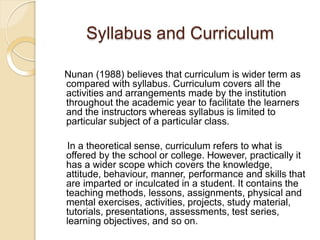
Syllabus and Curriculum
Nunan (1988) believes that curriculum is wider term as
compared with syllabus. Curriculum covers all the
activities and arrangements made by the institution
throughout the academic year to facilitate the learners
and the instructors whereas syllabus is limited to
particular subject of a particular class.
In a theoretical sense, curriculum refers to what is
offered by the school or college. However, practically it
has a wider scope which covers the knowledge,
attitude, behaviour, manner, performance and skills that
are imparted or inculcated in a student. It contains the
teaching methods, lessons, assignments, physical and
mental exercises, activities, projects, study material,
tutorials, presentations, assessments, test series,
learning objectives, and so on.
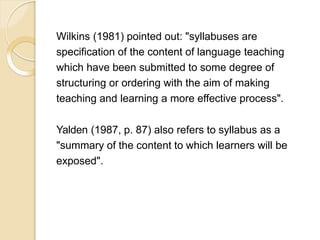
Wilkins (1981) pointed out: "syllabuses are
specification of the content of language teaching
which have been submitted to some degree of
structuring or ordering with the aim of making
teaching and learning a more effective process".
Yalden (1987, p. 87) also refers to syllabus as a
"summary of the content to which learners will be
exposed".
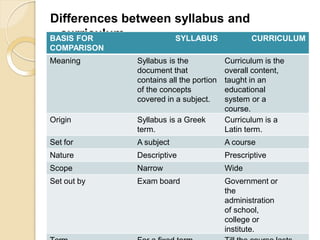
Differences between syllabus and
curriculum
⚫
BASIS FOR
COMPARISON
SYLLABUS CURRICULUM
Meaning Syllabus is the
document that
contains all the portion
of the concepts
covered in a subject.
Curriculum is the
overall content,
taught in an
educational
system or a
course.
Origin Syllabus is a Greek
term.
Curriculum is a
Latin term.
Set for A subject A course
Nature Descriptive Prescriptive
Scope Narrow Wide
Set out by Exam board Government or
the
administration
of school,
college or
institute.
Characteristics of a syllabus
1.Consists of a comprehensive list of
- content items ( words , structures , topics )
- Process items ( tasks , methods )
2. Is ordered ( easier , more essential items first )
3.Has explicit objectives ( usually expressed in the
introduction )
4.Is a public documents .
5.May indicate a time schedule .
6.May indicate preferred methodology or approach.
7.May recommend materials .
Syllabus types
Different approaches to syllabus design are
categorized into two main types:
* Product-oriented versus process-
oriented syllabuses
* synthetic versusAnalytic syllabuses
*TypeAversus Type B syllabuses
Product-oriented versus process-
oriented syllabuses
David Nunan in his book “ Syllabus
Design P. 27 “ drew a distinction
between product-oriented and process
– oriented syllabus ; he points out that
product syllabuses are those in
which the focus is on the knowledge
and skills which learners should gain
as a result of instruction , while
process syllabuses are those which
focus on the learning experiences
themselves.
1. Product – oriented
syllabus
Also known as the synthetic approach, these
kinds of syllabuses emphasize the product of
language learning and are prone to
intervention from an authority.
●emphasize the product of language learning
●different parts of language are taught
separately
●acquisition is a process of gradual
accumulation of parts
●learner is being exposed to a deliberately
limited sample of language (Wilkins, 1976).
According to Rabbini (2002), Product-oriented
syllabuses ), focus on what the learners will
know as
a result at the end of instruction session.
Nunan (1988) explains that product-oriented
syllabuses are those in which the focus is on
the
knowledge and skills which learners should
gain as
a result of instruction (the product or the end).
The grammatical, lexical, situational and
notional-functional are the examples of
2. Process- oriented syllabuses
Process-Oriented Syllabuses, or the
analytical approach, according to
Rabbini (2002), developed as a result of
a sense of failure in product-oriented
courses to enhance communicative
language skills. It is a process rather
than a product. That is, focus is not on
what the student will have accomplished
on completion of the program, but on the
specification of learning tasks and
activities that s/he will undertake during
process-oriented syllabi operate in terms of the
purposes for which people are learning language and
the kinds of language performance that are necessary
to meet those purposes (Wilkins, 1976, p. 13).
Procedural, process and task syllabuses are examples
of analytic, process-oriented syllabuses.
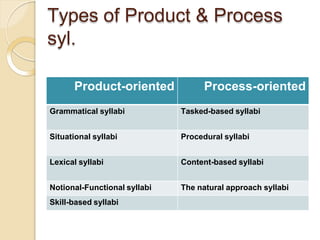
Types of Product & Process
syl.
Product-oriented Process-oriented
Grammatical syllabi Tasked-based syllabi
Situational syllabi Procedural syllabi
Lexical syllabi Content-based syllabi
Notional-Functional syllabi The natural approach syllabi
Skill-based syllabi
The distinction between product-based
syllabi and process-based syllabi can
be summarized by saying that in
process syllabi the focus shifts from
the outcome of instruction, i.e., the
knowledge and skills to be gained by
the learners, to learning experiences
and the process through which
knowledge and skills are gained.
Synthetic VS Analytic syllabi
1. Synthetic Syllabi
Wilkins (1976) separates language syllabi into
synthetic and analytical types of syllabi.
Synthetic syllabuses:
●segment the target language into discrete
linguistic items
● Different parts of language are taught separately
● The learners’ job is to synthesize the language
●Structural, lexical, notional and functional, and
most
situational and topical syllabuses are all synthetic
(Long and Crookes, 1992, 1993; Long and
Robinson, 1998).
Wilkins (1976) argues that “synthetic language
teaching strategy is one in which the different parts
of language are taught separately and step-by-step
so that acquisition is a process of gradual
accumulation of the parts until the whole structure
of the language has been built up (p. 2)”. In this
kind of syllabus learning occurs linearly; unless the
learner masters one unit they do not go to the next
unit. The salient example of synthetic syllabus is
grammatical or structural syllabus.
Long & Robinson’ criticism
( Focus on Forms )
(a) Absence of needs analysis;
(b) Linguistic grading;
(c)Lack of support from language learning
theory;
(d)Ignorance of learners' role in language
development;
(e)Tendency to produce boring lessons,
despite the best efforts of highly skilled
teachers and textbook writers; and
(f)Production of many more false beginners
than finishers
(see Long and Robinson 1998 for more detail).
2. Analytic syllabi
The second fundamental type of
syllabus distinguished by Wilkins is
the analytic. The analytical syllabus is
a semantic, meaning-based syllabus,
which aims at developing the learners’
communicative competence.
Analytic syllabuses focus on the learner
and his needs and on the kinds of
linguistic performance necessary to
achieve
those goals (Wilkins, 1976:13-14).
Analytic syllabuses treat language as a whole and
emphasize its communicative aspect rather than its
structural qualities. Analytic syllabuses are organized
in terms of the purposes for which people are learning
language and the kinds of language performance that
are necessary to meet those purposes.
Learners are presented with chunks of language which
may include structures of varying degrees of difficulty.
Analytic syllabuses are more likely to result from the
use of experiential rather than linguistic content as the
starting point for syllabus design.
The language and content are drawn
from the input and are selected and
graded primarily according to what the
learner’s need to do in performing the
real world communicative task. In the
task, linguistic knowledge that is built
through the unit is applied to the
solving of a communicative problem.
Procedural, process, and task
syllabuses are examples of the
analytic syllabus type.
Long & Robinson’ criticism
( Focus on Meaning )
Some types of analytic syllabuses, also called "focus
on meaning" in Long and Robinson (1998), have
been criticized for, for example,
- Lack of needs analysis,
- Lack of accuracy attained,
-unlearn ability of some grammatical
features from positive evidence only,
-And deprivation of the opportunity to
speed up the rate of learning.
The distinction between the synthetic and
analytic syllabus is that the former is of the
view that nature of learning is additive while
later holds that the nature of learning is
holistic.
It is worth noting that one should not take
synthetic and analytic approaches as
being dichotomous. These approaches
should be taken as being conceptually
different and any course syllabus could
be placed somewhere on the continuum
between the wholly synthetic and the
wholly analytic.
Type A Versus Type B
From another perspective, White (1988) explains that all
current syllabuses fall under two categories: Type A and
Type
B syllabuses.
1.Type A syllabuses
This type deals with what should be learned in a second
language classroom. Most syllabuses that fall under
'Type A' syllabus are best represented by controlled
practice, sequentially presenting language items one
at a time, whereby learners are expected to build a
gradual understanding of language. Here, the teacher
is the authority in the classroom.
He decides about what items the students must learn and
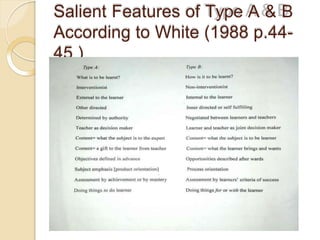
how they will be evaluated. So, things are done to the
learner. As it is clear from the definition of this type of
syllabus, it is product-oriented synthetic syllabus.
2.Type B syllabuses
Consider the question of how a second
language should be learned. Here, the
emphasis is on the
learning process. Objectives of the course are
based on the needs of the learners. The
teacher and students work together. So,
things are done with the learners. This type of
syllabus is useful for the author in developing
learners‘ communicative skills. Type B
syllabuses stand for Process-oriented
analytic syllabuses. White categorizes
content or
skills-based syllabuses as typeA and process
and the procedural syllabuses as type B
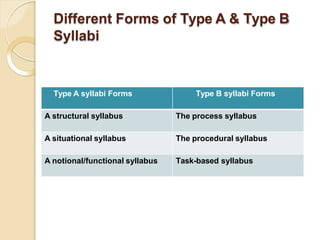
Different Forms of Type A & Type B
Syllabi
Type A syllabi Forms Type B syllabi Forms
A structural syllabus The process syllabus
A situational syllabus The procedural syllabus
A notional/functional syllabus Task-based syllabus
Salient Features of Type A & B
According to White (1988 p.44-
45 )
Conclusion
A good and valid syllabus covers more or less
all
aspects of both these types, therefore, proper
and
appropriate implementation of syllabus in
language
teaching is expected.
Without proper implementation of syllabus, on
the one hand, desired objectives will be hard
to obtain and on the other hand students will
suffer from a lack of appropriate syllabus
which could fulfill their immediate
pedagogical requirements.
Thank you for your patience and
attention
Rasoul Al Manhi
&

typesofsyllabusdesign-190728190707.pptx

  • 1.
    Syllabus Design Process VSproduct syllabi Synthetic VS analytic syllabi TypeA VS Type B syllabi ⚫ Set By : Rasoul Al Manhi & Thikra Al Ghizi
  • 2.
    Syllabus and Curriculum Nunan(1988) believes that curriculum is wider term as compared with syllabus. Curriculum covers all the activities and arrangements made by the institution throughout the academic year to facilitate the learners and the instructors whereas syllabus is limited to particular subject of a particular class. In a theoretical sense, curriculum refers to what is offered by the school or college. However, practically it has a wider scope which covers the knowledge, attitude, behaviour, manner, performance and skills that are imparted or inculcated in a student. It contains the teaching methods, lessons, assignments, physical and mental exercises, activities, projects, study material, tutorials, presentations, assessments, test series, learning objectives, and so on.
  • 3.
    Wilkins (1981) pointedout: "syllabuses are specification of the content of language teaching which have been submitted to some degree of structuring or ordering with the aim of making teaching and learning a more effective process". Yalden (1987, p. 87) also refers to syllabus as a "summary of the content to which learners will be exposed".
  • 4.
    Differences between syllabusand curriculum ⚫ BASIS FOR COMPARISON SYLLABUS CURRICULUM Meaning Syllabus is the document that contains all the portion of the concepts covered in a subject. Curriculum is the overall content, taught in an educational system or a course. Origin Syllabus is a Greek term. Curriculum is a Latin term. Set for A subject A course Nature Descriptive Prescriptive Scope Narrow Wide Set out by Exam board Government or the administration of school, college or institute.
  • 5.
    Characteristics of asyllabus 1.Consists of a comprehensive list of - content items ( words , structures , topics ) - Process items ( tasks , methods ) 2. Is ordered ( easier , more essential items first ) 3.Has explicit objectives ( usually expressed in the introduction ) 4.Is a public documents . 5.May indicate a time schedule . 6.May indicate preferred methodology or approach. 7.May recommend materials .
  • 6.
    Syllabus types Different approachesto syllabus design are categorized into two main types: * Product-oriented versus process- oriented syllabuses * synthetic versusAnalytic syllabuses *TypeAversus Type B syllabuses
  • 7.
    Product-oriented versus process- orientedsyllabuses David Nunan in his book “ Syllabus Design P. 27 “ drew a distinction between product-oriented and process – oriented syllabus ; he points out that product syllabuses are those in which the focus is on the knowledge and skills which learners should gain as a result of instruction , while process syllabuses are those which focus on the learning experiences themselves.
  • 8.
    1. Product –oriented syllabus Also known as the synthetic approach, these kinds of syllabuses emphasize the product of language learning and are prone to intervention from an authority. ●emphasize the product of language learning ●different parts of language are taught separately ●acquisition is a process of gradual accumulation of parts ●learner is being exposed to a deliberately limited sample of language (Wilkins, 1976).
  • 9.
    According to Rabbini(2002), Product-oriented syllabuses ), focus on what the learners will know as a result at the end of instruction session. Nunan (1988) explains that product-oriented syllabuses are those in which the focus is on the knowledge and skills which learners should gain as a result of instruction (the product or the end). The grammatical, lexical, situational and notional-functional are the examples of
  • 10.
    2. Process- orientedsyllabuses Process-Oriented Syllabuses, or the analytical approach, according to Rabbini (2002), developed as a result of a sense of failure in product-oriented courses to enhance communicative language skills. It is a process rather than a product. That is, focus is not on what the student will have accomplished on completion of the program, but on the specification of learning tasks and activities that s/he will undertake during
  • 11.
    process-oriented syllabi operatein terms of the purposes for which people are learning language and the kinds of language performance that are necessary to meet those purposes (Wilkins, 1976, p. 13). Procedural, process and task syllabuses are examples of analytic, process-oriented syllabuses.
  • 12.
    Types of Product& Process syl. Product-oriented Process-oriented Grammatical syllabi Tasked-based syllabi Situational syllabi Procedural syllabi Lexical syllabi Content-based syllabi Notional-Functional syllabi The natural approach syllabi Skill-based syllabi
  • 13.
    The distinction betweenproduct-based syllabi and process-based syllabi can be summarized by saying that in process syllabi the focus shifts from the outcome of instruction, i.e., the knowledge and skills to be gained by the learners, to learning experiences and the process through which knowledge and skills are gained.
  • 14.
    Synthetic VS Analyticsyllabi 1. Synthetic Syllabi Wilkins (1976) separates language syllabi into synthetic and analytical types of syllabi. Synthetic syllabuses: ●segment the target language into discrete linguistic items ● Different parts of language are taught separately ● The learners’ job is to synthesize the language ●Structural, lexical, notional and functional, and most situational and topical syllabuses are all synthetic (Long and Crookes, 1992, 1993; Long and Robinson, 1998).
  • 15.
    Wilkins (1976) arguesthat “synthetic language teaching strategy is one in which the different parts of language are taught separately and step-by-step so that acquisition is a process of gradual accumulation of the parts until the whole structure of the language has been built up (p. 2)”. In this kind of syllabus learning occurs linearly; unless the learner masters one unit they do not go to the next unit. The salient example of synthetic syllabus is grammatical or structural syllabus.
  • 16.
    Long & Robinson’criticism ( Focus on Forms ) (a) Absence of needs analysis; (b) Linguistic grading; (c)Lack of support from language learning theory; (d)Ignorance of learners' role in language development; (e)Tendency to produce boring lessons, despite the best efforts of highly skilled teachers and textbook writers; and (f)Production of many more false beginners than finishers (see Long and Robinson 1998 for more detail).
  • 17.
    2. Analytic syllabi Thesecond fundamental type of syllabus distinguished by Wilkins is the analytic. The analytical syllabus is a semantic, meaning-based syllabus, which aims at developing the learners’ communicative competence. Analytic syllabuses focus on the learner and his needs and on the kinds of linguistic performance necessary to achieve those goals (Wilkins, 1976:13-14).
  • 18.
    Analytic syllabuses treatlanguage as a whole and emphasize its communicative aspect rather than its structural qualities. Analytic syllabuses are organized in terms of the purposes for which people are learning language and the kinds of language performance that are necessary to meet those purposes. Learners are presented with chunks of language which may include structures of varying degrees of difficulty. Analytic syllabuses are more likely to result from the use of experiential rather than linguistic content as the starting point for syllabus design.
  • 19.
    The language andcontent are drawn from the input and are selected and graded primarily according to what the learner’s need to do in performing the real world communicative task. In the task, linguistic knowledge that is built through the unit is applied to the solving of a communicative problem. Procedural, process, and task syllabuses are examples of the analytic syllabus type.
  • 20.
    Long & Robinson’criticism ( Focus on Meaning ) Some types of analytic syllabuses, also called "focus on meaning" in Long and Robinson (1998), have been criticized for, for example, - Lack of needs analysis, - Lack of accuracy attained, -unlearn ability of some grammatical features from positive evidence only, -And deprivation of the opportunity to speed up the rate of learning.
  • 21.
    The distinction betweenthe synthetic and analytic syllabus is that the former is of the view that nature of learning is additive while later holds that the nature of learning is holistic. It is worth noting that one should not take synthetic and analytic approaches as being dichotomous. These approaches should be taken as being conceptually different and any course syllabus could be placed somewhere on the continuum between the wholly synthetic and the wholly analytic.
  • 22.
    Type A VersusType B From another perspective, White (1988) explains that all current syllabuses fall under two categories: Type A and Type B syllabuses. 1.Type A syllabuses This type deals with what should be learned in a second language classroom. Most syllabuses that fall under 'Type A' syllabus are best represented by controlled practice, sequentially presenting language items one at a time, whereby learners are expected to build a gradual understanding of language. Here, the teacher is the authority in the classroom. He decides about what items the students must learn and how they will be evaluated. So, things are done to the learner. As it is clear from the definition of this type of syllabus, it is product-oriented synthetic syllabus.
  • 23.
    2.Type B syllabuses Considerthe question of how a second language should be learned. Here, the emphasis is on the learning process. Objectives of the course are based on the needs of the learners. The teacher and students work together. So, things are done with the learners. This type of syllabus is useful for the author in developing learners‘ communicative skills. Type B syllabuses stand for Process-oriented analytic syllabuses. White categorizes content or skills-based syllabuses as typeA and process and the procedural syllabuses as type B
  • 24.
    Different Forms ofType A & Type B Syllabi Type A syllabi Forms Type B syllabi Forms A structural syllabus The process syllabus A situational syllabus The procedural syllabus A notional/functional syllabus Task-based syllabus
  • 25.
    Salient Features ofType A & B According to White (1988 p.44- 45 )
  • 26.
    Conclusion A good andvalid syllabus covers more or less all aspects of both these types, therefore, proper and appropriate implementation of syllabus in language teaching is expected. Without proper implementation of syllabus, on the one hand, desired objectives will be hard to obtain and on the other hand students will suffer from a lack of appropriate syllabus which could fulfill their immediate pedagogical requirements.
  • 27.
    Thank you foryour patience and attention Rasoul Al Manhi &