What users want (Building Applications Based on User Behavior/Interests)
Who are you? Name What you do
Who am I?
Short Exercise What are things that frustrate you while using them?
Why Are We Here? Turn user frustrations into things they want. Find out what users want at any point of the product cycle. Ultimately, build applications based on user behavior and interests.
What users can’t tell you How you should solve product problems. Marketability of the product.  What is a better product idea Your business plan
Why Talk to Them? They can inform your product and design decisions. You can catch usability problems. You can find usage patterns. Gain context into how they are using their product User feedback can only inform, but can’t tell you the answer.
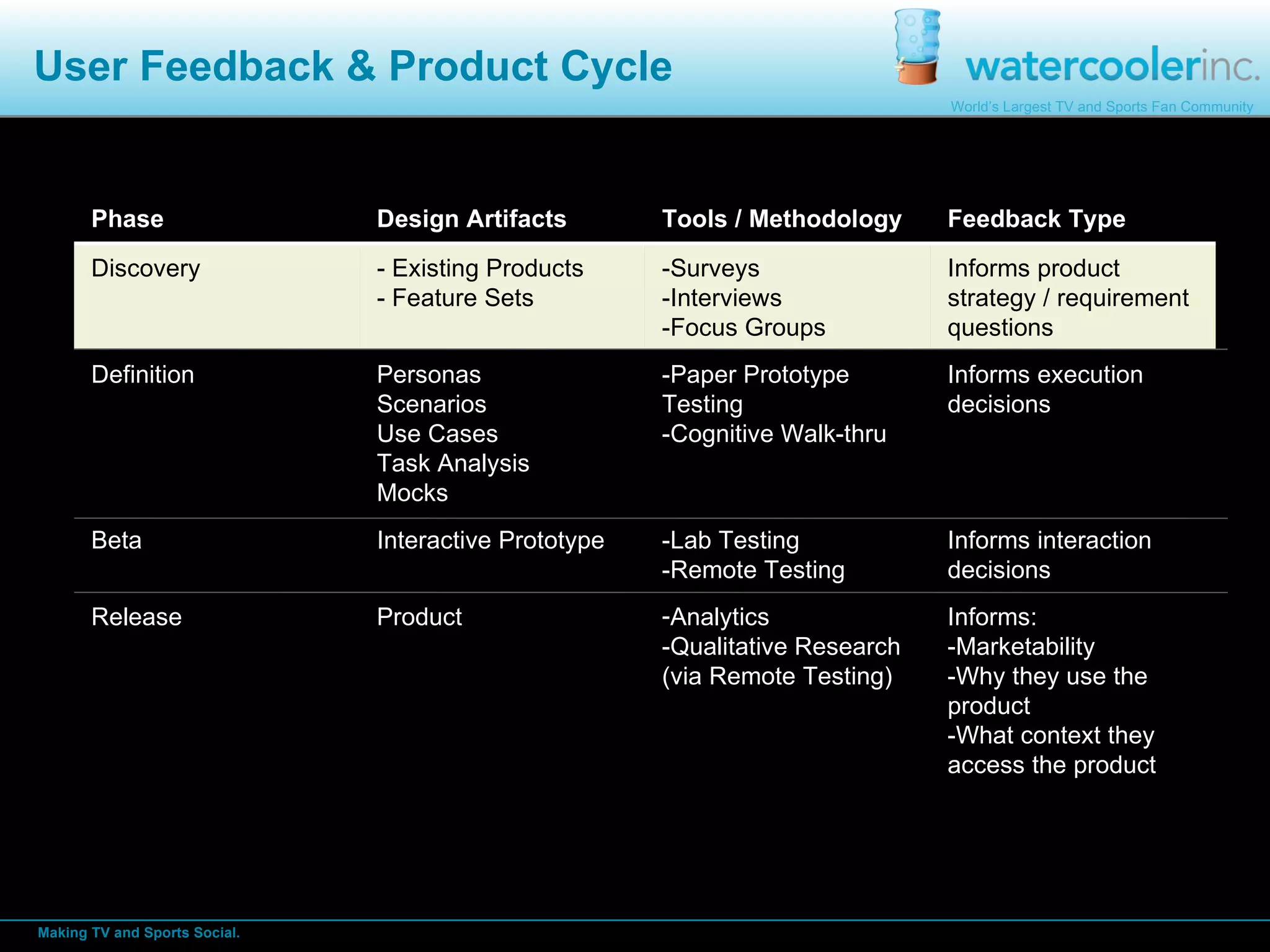
User Feedback & Product Cycle Phase Design Artifacts Tools / Methodology Feedback Type Discovery Feature Sets -Surveys -Interviews -Focus Groups Informs product strategy / requirement questions Definition Personas Use Cases  Scenarios Task Analysis Mocks -Paper Prototype Testing -Cognitive Walk-thru Informs execution decisions Beta Interactive Prototype -Lab Testing -Remote Testing Informs interaction decisions Release Product Analytics -Qualitative Research (via Remote Testing) Informs: -Marketability -Why they use the product -What context they access the product
Exercise – Design a Better ATM
Discovery - Survey When do you go to ATM machines? How often do you go to ATM machines?  Where did you last access ATM machines? (Location) Why did you need to go to the ATM machine? What is frustrating about ATM machines? What do you wish ATM machines had? Ask about current behavior.
User Feedback & Product Cycle Phase Design Artifacts Tools / Methodology Feedback Type Discovery - Existing Products - Feature Sets -Surveys -Interviews -Focus Groups Informs product strategy / requirement questions Definition Personas Scenarios Use Cases  Task Analysis Mocks -Paper Prototype Testing -Cognitive Walk-thru Informs execution decisions Beta Interactive Prototype -Lab Testing -Remote Testing Informs interaction decisions Release Product Analytics -Qualitative Research (via Remote Testing) Informs: -Marketability -Why they use the product -What context they access the product
Definition –Persona What type of people would go to an ATM? Describe what they are like. Do they have kids? What kind of car do they drive? What kind of job do they go to?
Definition –Use Cases What are things a user would want to do at an ATM?
Definition –Task Analysis What tasks someone would want to do at an ATM?
Definition –Feature Set & Mocks What feature set should an ATM machine have?
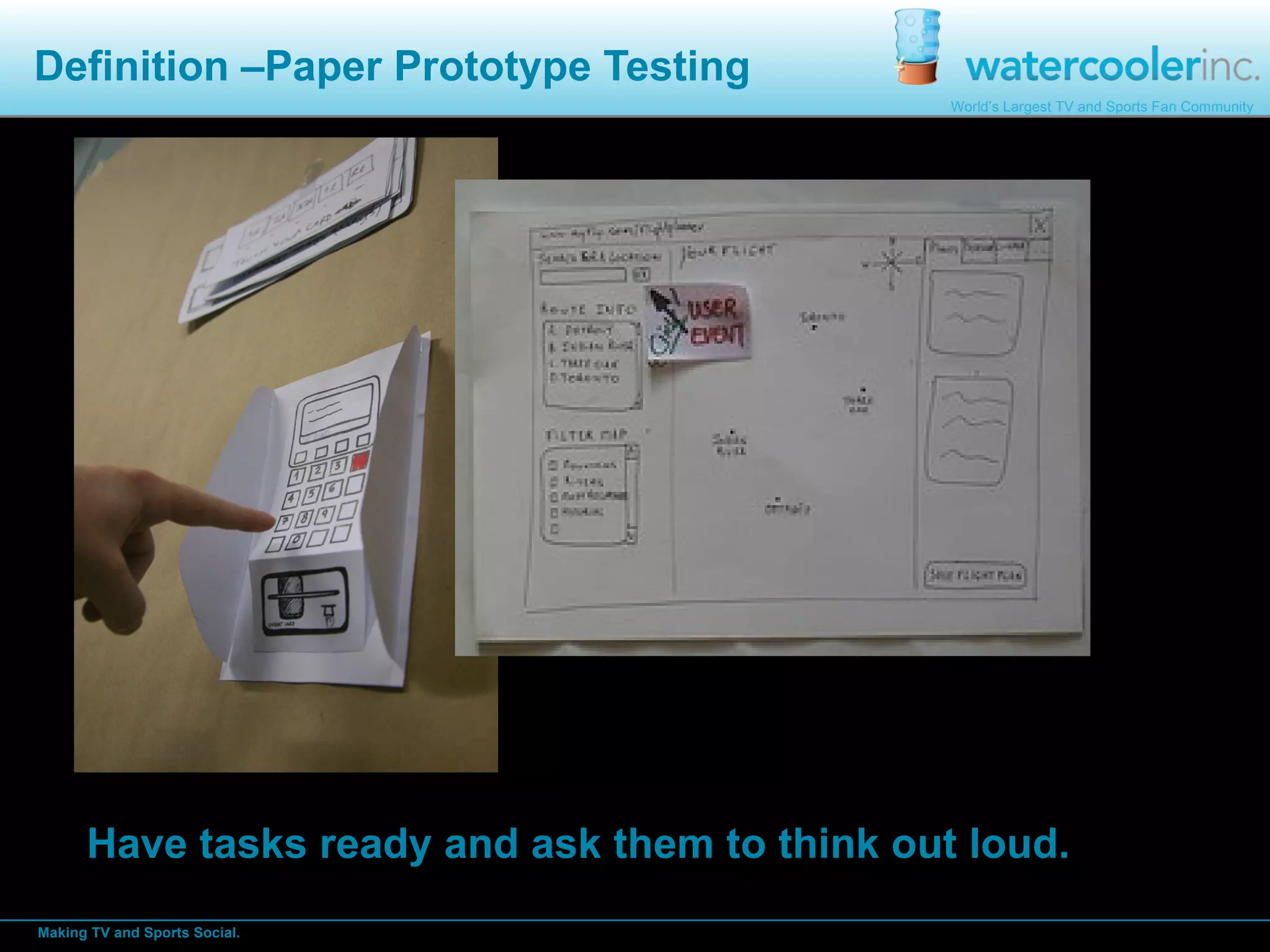
Definition –Paper Prototype Testing Have tasks ready and ask them to think out loud.
User Feedback & Product Cycle Phase Design Artifacts Tools / Methodology Feedback Type Discovery - Existing Products - Feature Sets -Surveys -Interviews -Focus Groups Informs product strategy / requirement questions Definition Personas Scenarios Use Cases  Task Analysis Mocks -Paper Prototype Testing -Cognitive Walk-thru Informs execution decisions Beta Interactive Prototype -Lab Testing -Remote Testing Informs interaction decisions Release Product Analytics -Qualitative Research (via Remote Testing) Informs: -Marketability -Why they use the product -What context they access the product
Building SN Applications A Watercooler Case Study  –  How to cheat the cycle and build what users want.
User Feedback & Product Cycle Phase Design Artifacts Tools / Methodology Feedback Type Discovery - Existing Products - Feature Sets -Surveys -Interviews -Focus Groups Informs product strategy / requirement questions Definition Personas Scenarios Use Cases  Task Analysis Mocks -Paper Prototype Testing -Cognitive Walk-thru Informs execution decisions Beta Interactive Prototype -Lab Testing -Remote Testing Informs interaction decisions Release Product Analytics -Qualitative Research (via Remote Testing) Informs: -Marketability -Why they use the product -What context they access the product
Building SN Applications Just build it and get user feedback. WHY? Cheap to build and market If it’s taking you a long time to define/build the product, it’s probably too complicated It’s better to see what people “do” rather than what they “say” they’ll do.  Within a social network, there are much more “knowns” – fast forward through everything you just learned
The Mystery Analytics Point to what people are doing, but not why.
Building SN Applications
Building SN Applications Qualitative Research Asking the whys Gaining Context
How to Test Bring them in or leave them there? In Person Testing -Richness of feedback -Discover usability problems and quell religious debates -Get other teams on board -Recruiting bias -Harder to gain context Remote Testing -Less feedback -Discover usability problems and quell religious debates -Catch them in a familiar context -Recruit users who aren’t local -Recruit real users
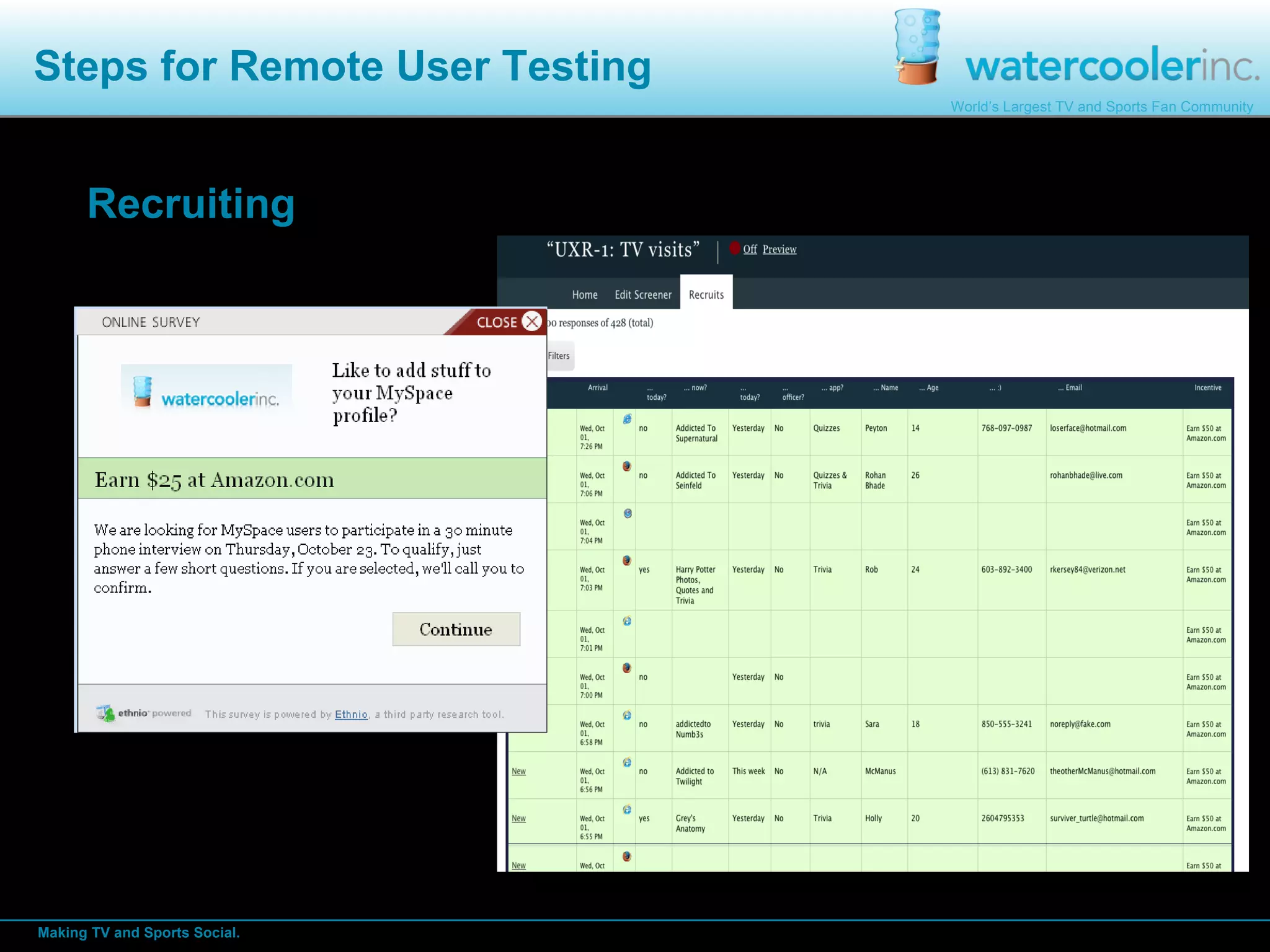
Steps for Remote User Testing Recruiting
Executing the Test Called 6-8 users Show us what they were doing How did they get to the app? When was the last time they invited people? What did they do?  Be concrete and ask them to show you what they did. Don’t lead.
Synthesizing Data Look for patterns. Be concise and actionable.
Findings -Copy Navigation issues
Moving Forward You can get user feedback at anytime Use it to inform your decisions. Phase Design Artifacts Tools / Methodology Feedback Type Discovery Feature Sets -Surveys -Interviews -Focus Groups Informs product strategy / requirement questions Definition Personas Use Cases  Scenarios Task Analysis Mocks -Paper Prototype Testing -Cognitive Walk-thru Informs execution decisions Beta Interactive Prototype -Lab Testing -Remote Testing Informs interaction decisions Release Product Analytics -Qualitative Research (via Remote Testing) Informs: -Marketability -Why they use the product -What context they access the product
Resources Suggested Reading Don’t Make Me Think by Steve Krug The Design of Everyday Things  by Donald Norman The Inmates Are Running the Asylum  by Alan Cooper. Remote Testing – Items You Need Hands-free corded headset Ethnio Recruiting Software  http://www.ethnio.com Uservue Screen Sharing Software http://uservue.techsmith.com
Thank You! [email_address]

What Users Want

  • 1.
    What users want(Building Applications Based on User Behavior/Interests)
  • 2.
    Who are you?Name What you do
  • 3.
  • 5.
    Short Exercise Whatare things that frustrate you while using them?
  • 7.
    Why Are WeHere? Turn user frustrations into things they want. Find out what users want at any point of the product cycle. Ultimately, build applications based on user behavior and interests.
  • 8.
    What users can’ttell you How you should solve product problems. Marketability of the product. What is a better product idea Your business plan
  • 9.
    Why Talk toThem? They can inform your product and design decisions. You can catch usability problems. You can find usage patterns. Gain context into how they are using their product User feedback can only inform, but can’t tell you the answer.
  • 10.
    User Feedback &Product Cycle Phase Design Artifacts Tools / Methodology Feedback Type Discovery Feature Sets -Surveys -Interviews -Focus Groups Informs product strategy / requirement questions Definition Personas Use Cases Scenarios Task Analysis Mocks -Paper Prototype Testing -Cognitive Walk-thru Informs execution decisions Beta Interactive Prototype -Lab Testing -Remote Testing Informs interaction decisions Release Product Analytics -Qualitative Research (via Remote Testing) Informs: -Marketability -Why they use the product -What context they access the product
  • 11.
    Exercise – Designa Better ATM
  • 12.
    Discovery - SurveyWhen do you go to ATM machines? How often do you go to ATM machines? Where did you last access ATM machines? (Location) Why did you need to go to the ATM machine? What is frustrating about ATM machines? What do you wish ATM machines had? Ask about current behavior.
  • 13.
    User Feedback &Product Cycle Phase Design Artifacts Tools / Methodology Feedback Type Discovery - Existing Products - Feature Sets -Surveys -Interviews -Focus Groups Informs product strategy / requirement questions Definition Personas Scenarios Use Cases Task Analysis Mocks -Paper Prototype Testing -Cognitive Walk-thru Informs execution decisions Beta Interactive Prototype -Lab Testing -Remote Testing Informs interaction decisions Release Product Analytics -Qualitative Research (via Remote Testing) Informs: -Marketability -Why they use the product -What context they access the product
  • 14.
    Definition –Persona Whattype of people would go to an ATM? Describe what they are like. Do they have kids? What kind of car do they drive? What kind of job do they go to?
  • 15.
    Definition –Use CasesWhat are things a user would want to do at an ATM?
  • 16.
    Definition –Task AnalysisWhat tasks someone would want to do at an ATM?
  • 17.
    Definition –Feature Set& Mocks What feature set should an ATM machine have?
  • 18.
    Definition –Paper PrototypeTesting Have tasks ready and ask them to think out loud.
  • 19.
    User Feedback &Product Cycle Phase Design Artifacts Tools / Methodology Feedback Type Discovery - Existing Products - Feature Sets -Surveys -Interviews -Focus Groups Informs product strategy / requirement questions Definition Personas Scenarios Use Cases Task Analysis Mocks -Paper Prototype Testing -Cognitive Walk-thru Informs execution decisions Beta Interactive Prototype -Lab Testing -Remote Testing Informs interaction decisions Release Product Analytics -Qualitative Research (via Remote Testing) Informs: -Marketability -Why they use the product -What context they access the product
  • 20.
    Building SN ApplicationsA Watercooler Case Study – How to cheat the cycle and build what users want.
  • 21.
    User Feedback &Product Cycle Phase Design Artifacts Tools / Methodology Feedback Type Discovery - Existing Products - Feature Sets -Surveys -Interviews -Focus Groups Informs product strategy / requirement questions Definition Personas Scenarios Use Cases Task Analysis Mocks -Paper Prototype Testing -Cognitive Walk-thru Informs execution decisions Beta Interactive Prototype -Lab Testing -Remote Testing Informs interaction decisions Release Product Analytics -Qualitative Research (via Remote Testing) Informs: -Marketability -Why they use the product -What context they access the product
  • 22.
    Building SN ApplicationsJust build it and get user feedback. WHY? Cheap to build and market If it’s taking you a long time to define/build the product, it’s probably too complicated It’s better to see what people “do” rather than what they “say” they’ll do. Within a social network, there are much more “knowns” – fast forward through everything you just learned
  • 23.
    The Mystery AnalyticsPoint to what people are doing, but not why.
  • 24.
  • 25.
    Building SN ApplicationsQualitative Research Asking the whys Gaining Context
  • 26.
    How to TestBring them in or leave them there? In Person Testing -Richness of feedback -Discover usability problems and quell religious debates -Get other teams on board -Recruiting bias -Harder to gain context Remote Testing -Less feedback -Discover usability problems and quell religious debates -Catch them in a familiar context -Recruit users who aren’t local -Recruit real users
  • 27.
    Steps for RemoteUser Testing Recruiting
  • 28.
    Executing the TestCalled 6-8 users Show us what they were doing How did they get to the app? When was the last time they invited people? What did they do? Be concrete and ask them to show you what they did. Don’t lead.
  • 29.
    Synthesizing Data Lookfor patterns. Be concise and actionable.
  • 30.
  • 31.
    Moving Forward Youcan get user feedback at anytime Use it to inform your decisions. Phase Design Artifacts Tools / Methodology Feedback Type Discovery Feature Sets -Surveys -Interviews -Focus Groups Informs product strategy / requirement questions Definition Personas Use Cases Scenarios Task Analysis Mocks -Paper Prototype Testing -Cognitive Walk-thru Informs execution decisions Beta Interactive Prototype -Lab Testing -Remote Testing Informs interaction decisions Release Product Analytics -Qualitative Research (via Remote Testing) Informs: -Marketability -Why they use the product -What context they access the product
  • 32.
    Resources Suggested ReadingDon’t Make Me Think by Steve Krug The Design of Everyday Things by Donald Norman The Inmates Are Running the Asylum by Alan Cooper. Remote Testing – Items You Need Hands-free corded headset Ethnio Recruiting Software http://www.ethnio.com Uservue Screen Sharing Software http://uservue.techsmith.com
  • 33.