Different types
of
Software Testing
Presented by :
Makan Singh
Chauhan
2
What is Testing or Software
Testing.?
Testing means to check whether a
system , software or a application is
working correctelly or not and find
the error , apart from finding errors,
is also used to test performance,
safety, fault-tolerance or security.
Software Testing is a process used
to identify the correctness,
completeness and quality of
developed computer software. It
include a set of activities
conducted with the intent of
finding error in software so that it
could be corrected before the
product is released to end user.
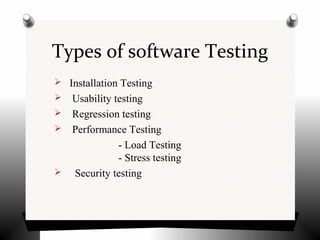
Types of software Testing
 Installation Testing
 Usability testing
 Regression testing
 Performance Testing
- Load Testing
- Stress testing
 Security testing
Installation Testing
An installation test assures that the system is
installed correctly and working at actual
customer's hardware and,
Check correctness of implementation
procedures.
Determine how well and how easy a product is
install on a verity of platform configuration.
It is also known as Implementation testing.
O Installation testing is a kind of quality
assurance work in the software industry that
focuses on what customers will need to do to
install and set up the new software
successfully.
O This testing is typically done by the software
testing engineer in conjunction with the
configuration manager.
7
Usability Testing
 Usability testing is the process of observing
users’ reactions to a product and adjusting the
design to suit their needs.
 The typical aim of usability testing is to cause
the application to fail to meet its usability
requirements so that the underlying defects
can be identified, analyzed, fixed, and
prevented in the future.
Some fairly important things of usability
testing that must be understood.
 Users are not testers, engineers or designers.
 You are testing the product and not the users.
 Selection of end-user evaluators is critical.
 Usability testing is a design tool.
Regression Testing
In regression testing to test the program again
when changes are made to the program.
 It checks whether a small change in any
component of the application affects the
unchanged components or not. This is done by
re-executing and by retesting the program the
previous versions of the application.
When is Regression Testing
necessary?
 Regression Testing plays an important role in
any Scenario where a change has been made
to a previously tested software code.
 Any Software Development Project is
invariably faced with requests for changing
Design, code, features or all of them.
 Defect fixing.
Performance Testing:
 Performance testing is testing that is
performed, to determine how fast some aspect
of a system performs under a particular
workload
 This testing checks whether the system is
performing properly, according to the user's
requirements.
 Determine how quickly a product execute
verity of event.
 It include report on response time of user
command , system throughput, or latency .
Performance testing can serve different
purposes.
 It can demonstrate that the system meets
performance criteria.
It can compare two systems to find which
performs better.
It can measure what parts of the system or
workload causes the system to perform badly.
Performance testing is further divided into
1. Load testing
2. Stress testing
Load testing
In Load testing we check performance by
multiple users accessing the program
concurrently.
Its a performance testing to check system
behavior under load. Testing an application
under heavy loads, such as testing of a web site
under a range of loads to determine at what point
the system’s response time degrades or fails.
14
There are numerous possible causes for slow
system performance, including the following:
 Application server(s) or software
 Database server(s)
 Network – latency, congestion, etc.
 Client-side processing
 Load balancing between multiple servers
Load testing is especially important if the
application, system or service will be subject to a
service level agreement or SLA.
Stress testing
 Stress testing is a form of testing that is used
to determine the stability of a given system or
entity.
 System is stressed beyond its specifications to
check how and when it fails. Performed under
heavy load like putting large number beyond
storage capacity, complex database queries,
continuous input to system or database load.
In software testing, a system stress test refers to
tests that put a greater emphasis on robustness,
availability, and error handling under a heavy
load, rather than on what would be considered
correct behavior under normal circumstances.
Examples: A web server may be stress tested
using scripts, bots, and various denial of service
tools to observe the performance of a web site
during peak loads.
17
Security Testing
Security testing tries to confirm
whether the system is capable of
protection from unauthorized
access. During security testing
password cracking, unauthozation
entry into software, network
security are all taken
consideration.
Testing that confirms, how well a
system protects itself against
unauthorized internal or external,
or willful damage of code; means
security testing of the system.
Security testing assures that the
program is accessed by the
authorized personnel only.
The six basic security concepts that need to
be covered by security testing are:
Confidentiality,
Integrity,
Authentication,
Availability,
Authorization
Non-repudiation
THANKING
YOU.

Types of Software testing

  • 1.
  • 2.
    2 What is Testingor Software Testing.? Testing means to check whether a system , software or a application is working correctelly or not and find the error , apart from finding errors, is also used to test performance, safety, fault-tolerance or security.
  • 3.
    Software Testing isa process used to identify the correctness, completeness and quality of developed computer software. It include a set of activities conducted with the intent of finding error in software so that it could be corrected before the product is released to end user.
  • 4.
    Types of softwareTesting  Installation Testing  Usability testing  Regression testing  Performance Testing - Load Testing - Stress testing  Security testing
  • 5.
    Installation Testing An installationtest assures that the system is installed correctly and working at actual customer's hardware and, Check correctness of implementation procedures. Determine how well and how easy a product is install on a verity of platform configuration. It is also known as Implementation testing.
  • 6.
    O Installation testingis a kind of quality assurance work in the software industry that focuses on what customers will need to do to install and set up the new software successfully. O This testing is typically done by the software testing engineer in conjunction with the configuration manager.
  • 7.
    7 Usability Testing  Usabilitytesting is the process of observing users’ reactions to a product and adjusting the design to suit their needs.  The typical aim of usability testing is to cause the application to fail to meet its usability requirements so that the underlying defects can be identified, analyzed, fixed, and prevented in the future.
  • 8.
    Some fairly importantthings of usability testing that must be understood.  Users are not testers, engineers or designers.  You are testing the product and not the users.  Selection of end-user evaluators is critical.  Usability testing is a design tool.
  • 9.
    Regression Testing In regressiontesting to test the program again when changes are made to the program.  It checks whether a small change in any component of the application affects the unchanged components or not. This is done by re-executing and by retesting the program the previous versions of the application.
  • 10.
    When is RegressionTesting necessary?  Regression Testing plays an important role in any Scenario where a change has been made to a previously tested software code.  Any Software Development Project is invariably faced with requests for changing Design, code, features or all of them.  Defect fixing.
  • 11.
    Performance Testing:  Performancetesting is testing that is performed, to determine how fast some aspect of a system performs under a particular workload  This testing checks whether the system is performing properly, according to the user's requirements.  Determine how quickly a product execute verity of event.  It include report on response time of user command , system throughput, or latency .
  • 12.
    Performance testing canserve different purposes.  It can demonstrate that the system meets performance criteria. It can compare two systems to find which performs better. It can measure what parts of the system or workload causes the system to perform badly. Performance testing is further divided into 1. Load testing 2. Stress testing
  • 13.
    Load testing In Loadtesting we check performance by multiple users accessing the program concurrently. Its a performance testing to check system behavior under load. Testing an application under heavy loads, such as testing of a web site under a range of loads to determine at what point the system’s response time degrades or fails.
  • 14.
    14 There are numerouspossible causes for slow system performance, including the following:  Application server(s) or software  Database server(s)  Network – latency, congestion, etc.  Client-side processing  Load balancing between multiple servers Load testing is especially important if the application, system or service will be subject to a service level agreement or SLA.
  • 15.
    Stress testing  Stresstesting is a form of testing that is used to determine the stability of a given system or entity.  System is stressed beyond its specifications to check how and when it fails. Performed under heavy load like putting large number beyond storage capacity, complex database queries, continuous input to system or database load.
  • 16.
    In software testing,a system stress test refers to tests that put a greater emphasis on robustness, availability, and error handling under a heavy load, rather than on what would be considered correct behavior under normal circumstances. Examples: A web server may be stress tested using scripts, bots, and various denial of service tools to observe the performance of a web site during peak loads.
  • 17.
    17 Security Testing Security testingtries to confirm whether the system is capable of protection from unauthorized access. During security testing password cracking, unauthozation entry into software, network security are all taken consideration.
  • 18.
    Testing that confirms,how well a system protects itself against unauthorized internal or external, or willful damage of code; means security testing of the system. Security testing assures that the program is accessed by the authorized personnel only.
  • 19.
    The six basicsecurity concepts that need to be covered by security testing are: Confidentiality, Integrity, Authentication, Availability, Authorization Non-repudiation
  • 20.