
Software Testing Life
Cycle
-by Nikhil Sharma
1
What we are going to see in
this presentation!
O What is STLC i.e. Software Testing Life
Cycle?
O Why STLC?
O What is Entry & Exit Criteria?
O What are Activities and Deliverables?
O Phases of STLC.
O How it is different from SDLC.
O One Quote for everyone!
2
What is STLC?
O Software Testing Life Cycle (STLC) is a set of
steps used to test software products.
O Or we can say that it is a testing process which is
executed in systematic and planned manner.
O It is the sequence of activities carried out by the
testing team from the beginning of the project till
the end of the project.
3
Why STLC?
O Just like developers follow the Software
Development Life Cycle (SDLC) likewise testers
also follow the Software Testing Life Cycle in
order to meet quality goals.
O As Software testing is a critical part of preparing
software for use, STLC helps make this process
more sophisticated, consistent and effective.
4
What is Entry & Exit Criteria?
O Entry Criteria are the conditions that must be
present before phases can begin successfully. In
short, “What needs to be done before the phases
can start”.
O Exit Criteria are the conditions that a product
must meet before a particular milestone is
completed. In short, “defines the items that must
be completed before testing can be concluded”.
5
What are Activities and
Deliverables?
O Activities are nothing but the conditions in which
processes are going to happen or being done.
O A deliverable is a tangible or intangible good
produced as a result of a process that is
intended to be delivered to a customer (either
internal or external). A deliverable could be a
report, a document, a software product, etc.
6
POINTS TO BE REMEBERED!
O Each Phases present in STLC have a definite
Entry and Exit criteria, Activities & Deliverables
associated with it.
O There is no fixed standard STLC in the world and
it basically varies as per the following:
 Software Development Life Cycle
 Whims of the Management or Team
7
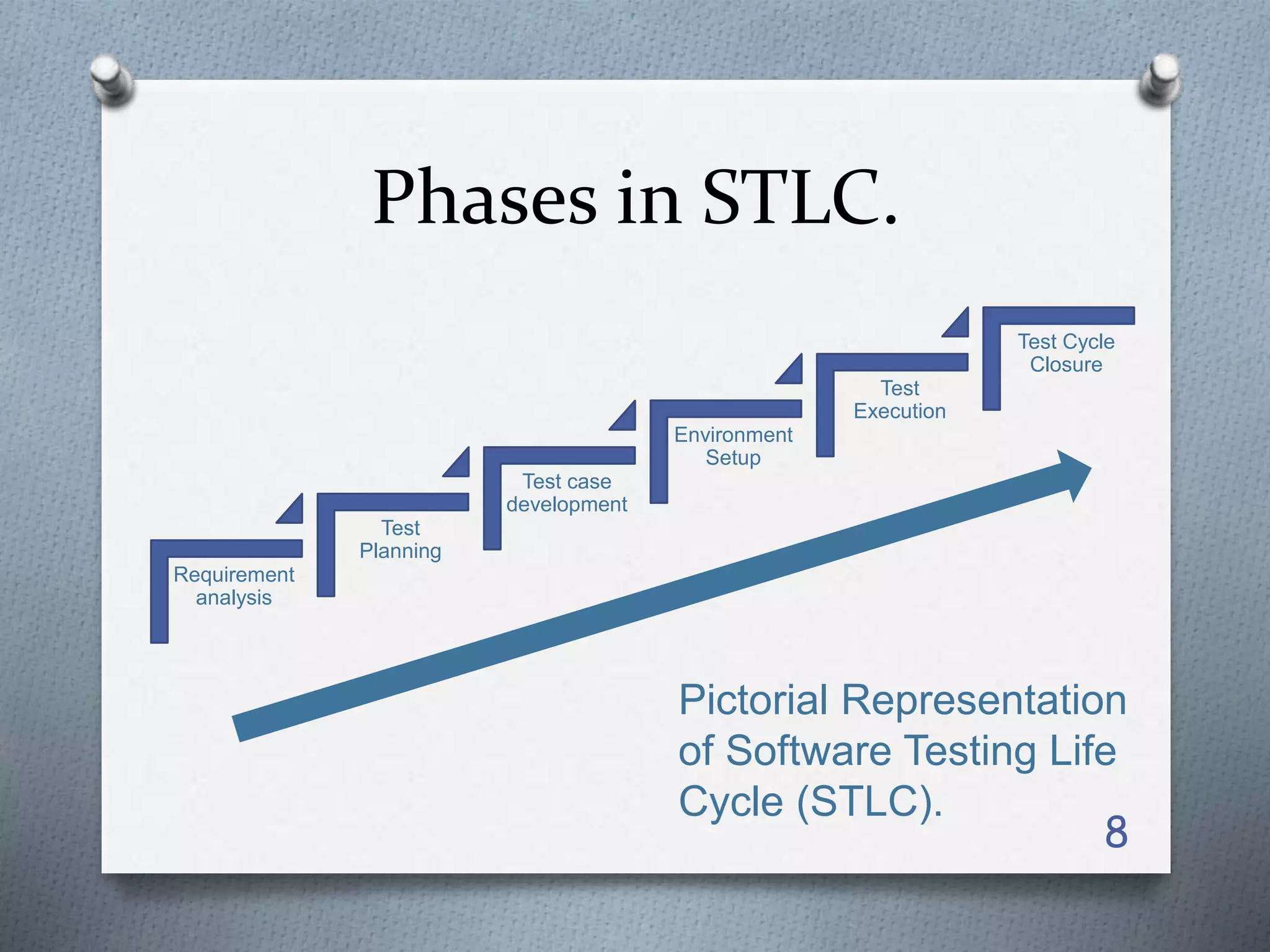
Phases in STLC.
Requirement
analysis
Test
Planning
Test case
development
Environment
Setup
Test
Execution
Test Cycle
Closure
Pictorial Representation
of Software Testing Life
Cycle (STLC).
8
Phases of STLC(Contd.)
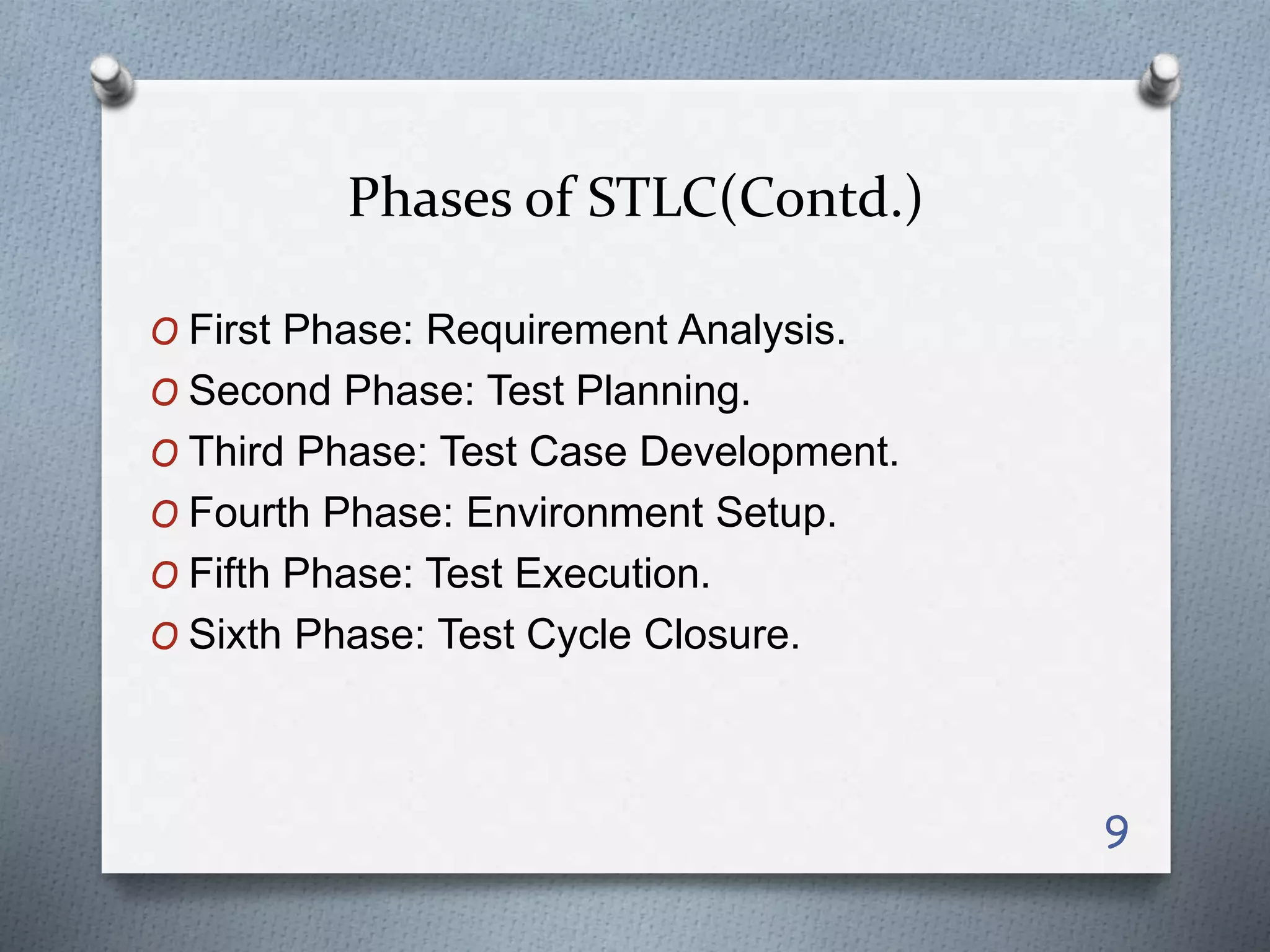
O First Phase: Requirement Analysis.
O Second Phase: Test Planning.
O Third Phase: Test Case Development.
O Fourth Phase: Environment Setup.
O Fifth Phase: Test Execution.
O Sixth Phase: Test Cycle Closure.
9
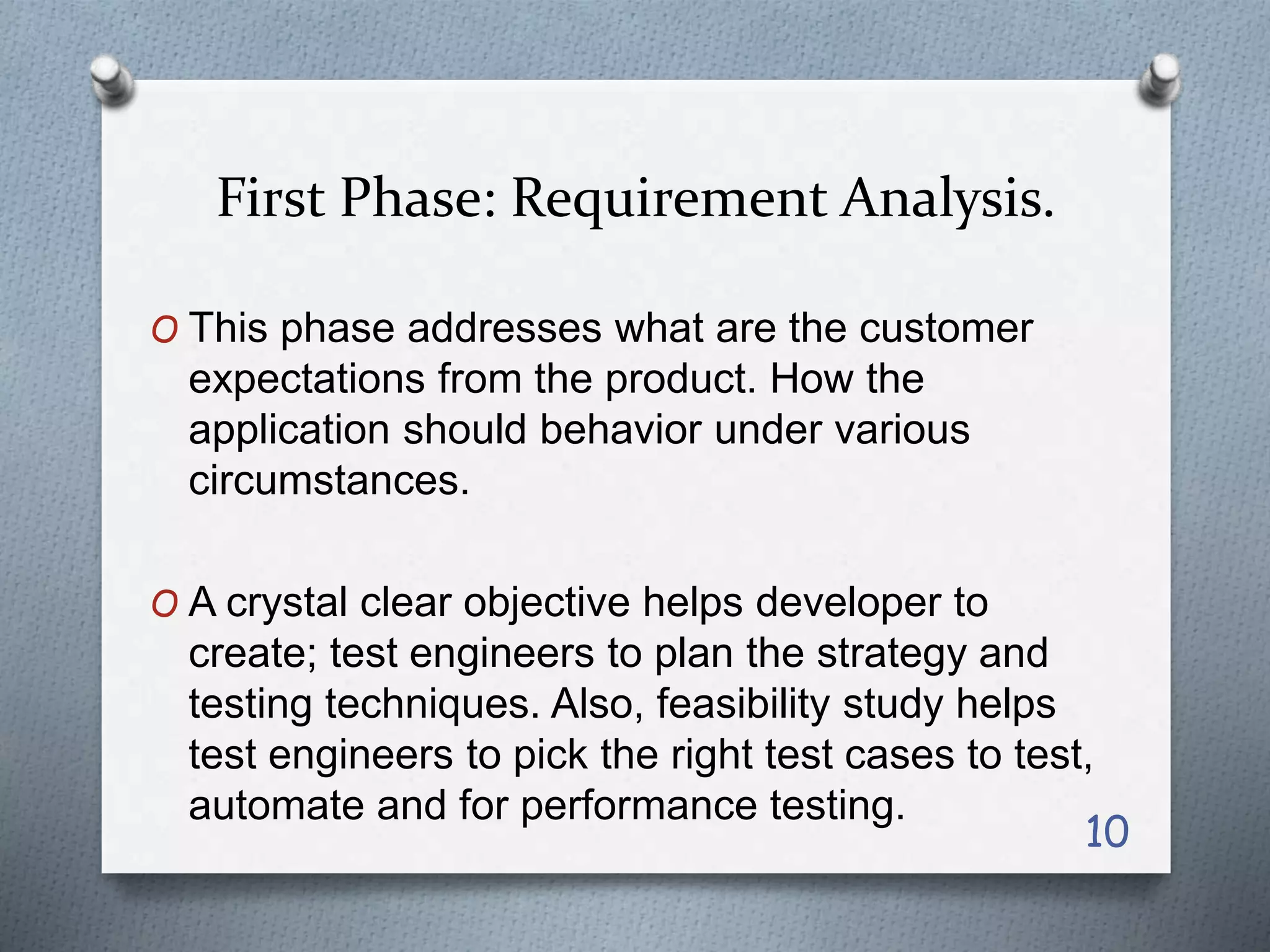
First Phase: Requirement Analysis.
O This phase addresses what are the customer
expectations from the product. How the
application should behavior under various
circumstances.
O A crystal clear objective helps developer to
create; test engineers to plan the strategy and
testing techniques. Also, feasibility study helps
test engineers to pick the right test cases to test,
automate and for performance testing.
10
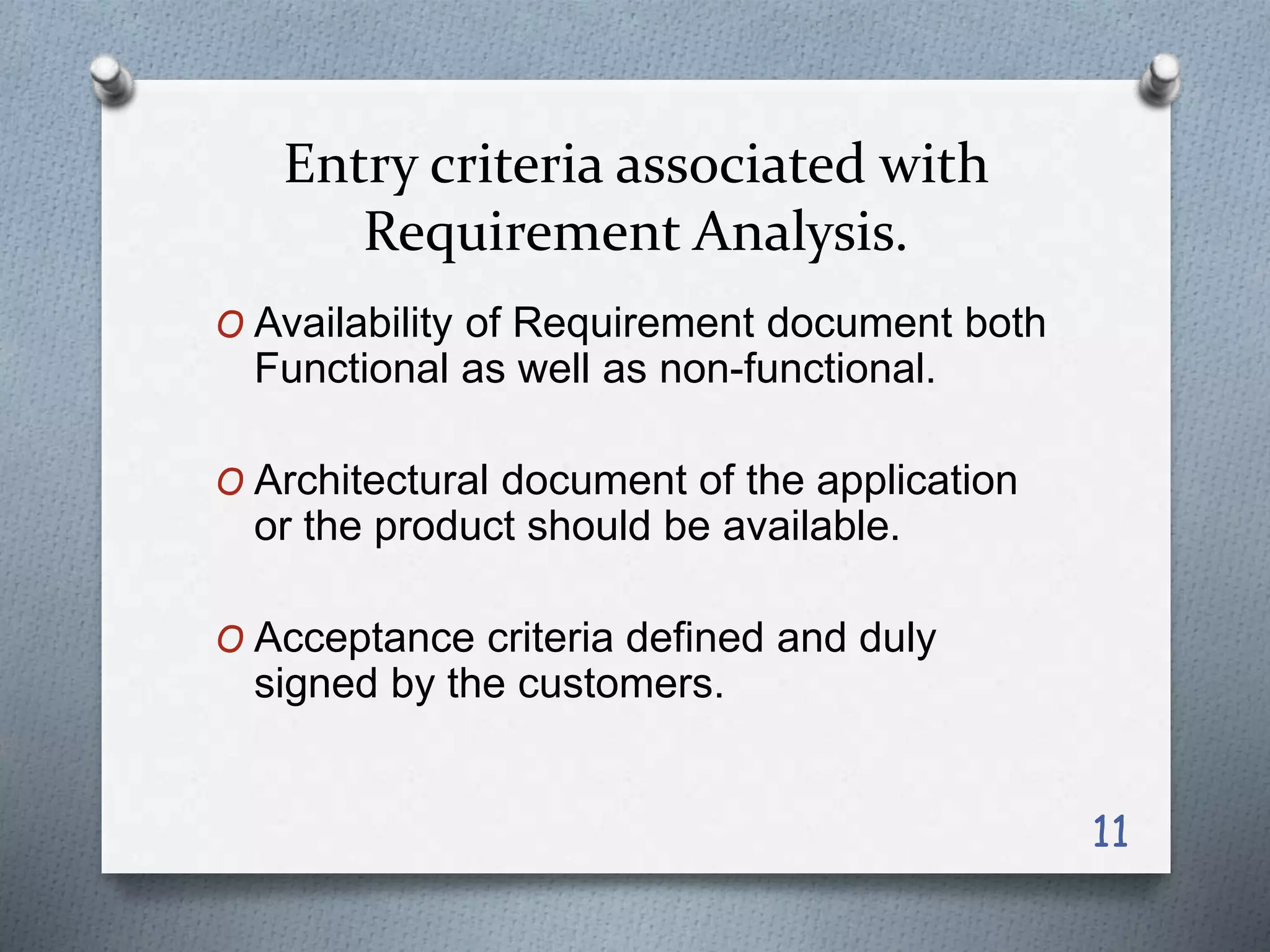
Entry criteria associated with
Requirement Analysis.
O Availability of Requirement document both
Functional as well as non-functional.
O Architectural document of the application
or the product should be available.
O Acceptance criteria defined and duly
signed by the customers.
11
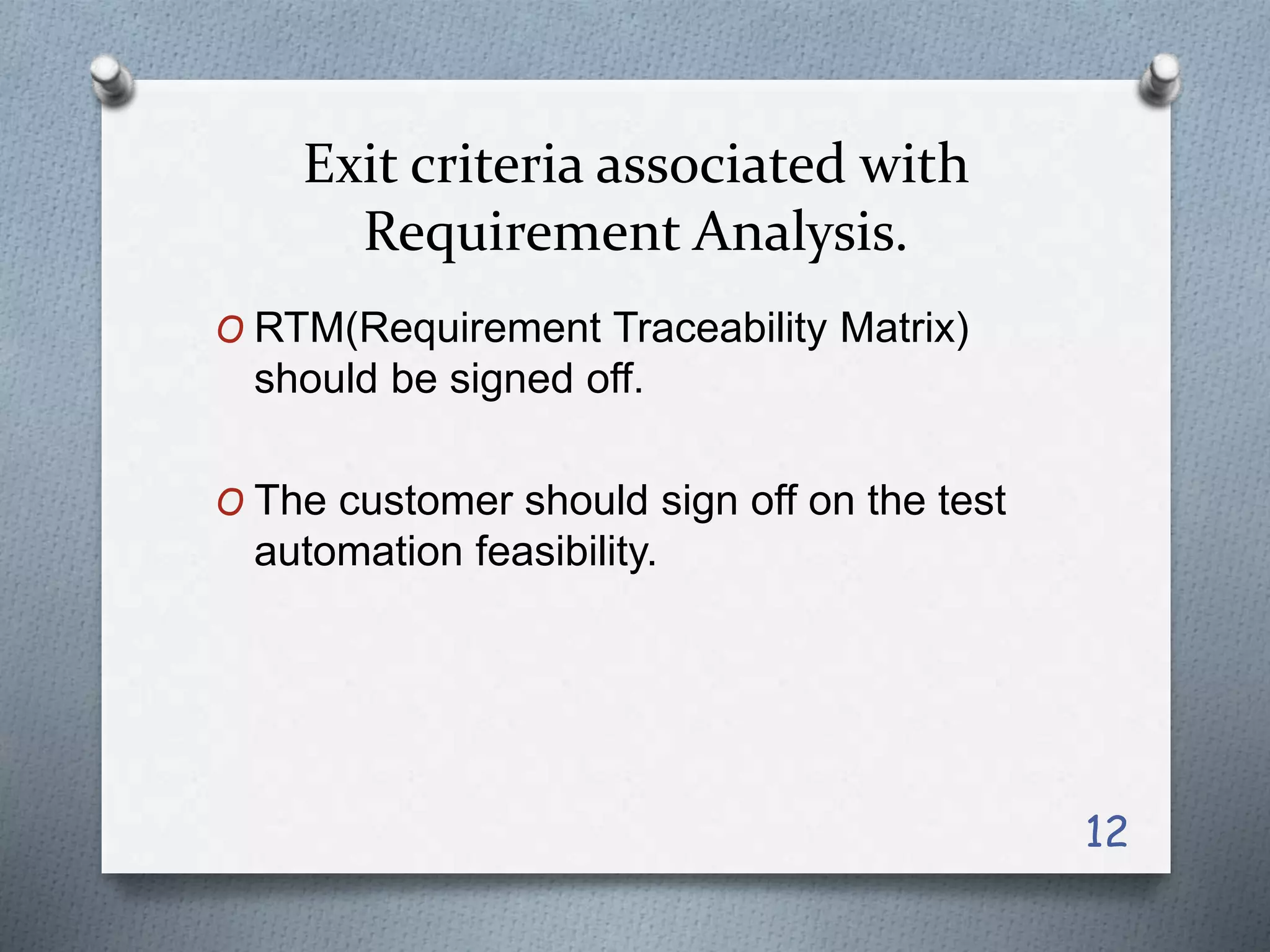
Exit criteria associated with
Requirement Analysis.
O RTM(Requirement Traceability Matrix)
should be signed off.
O The customer should sign off on the test
automation feasibility.
12
Activities associated with
Requirement Analysis.
O Analysis of System Requirement specifications to
understand the different business modules and it’s
functionalities.
O To identify the user profile, user interface and user
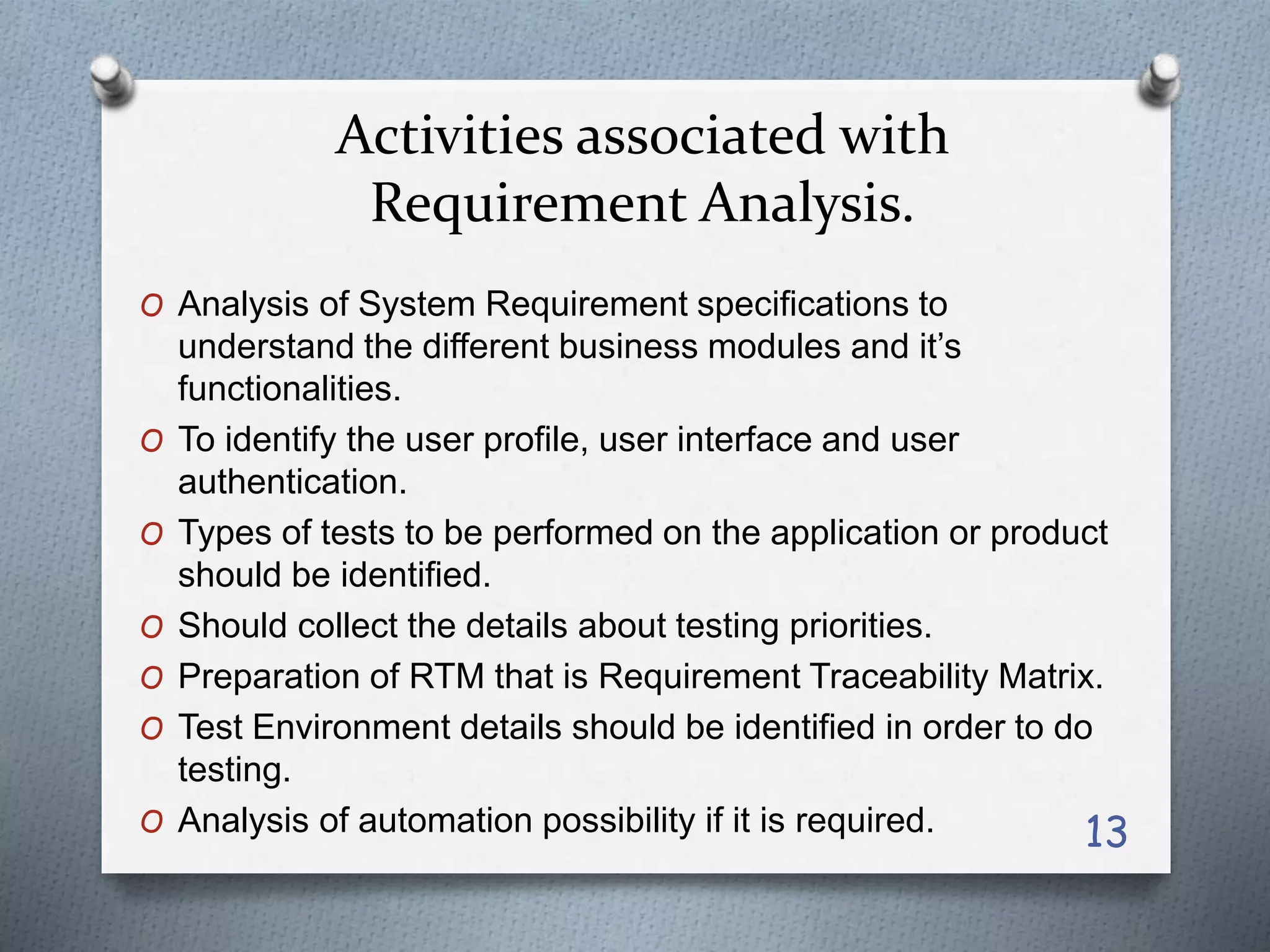
authentication.
O Types of tests to be performed on the application or product
should be identified.
O Should collect the details about testing priorities.
O Preparation of RTM that is Requirement Traceability Matrix.
O Test Environment details should be identified in order to do
testing.
O Analysis of automation possibility if it is required. 13
Deliverables associated with
Requirement Analysis.
O Requirement Traceability Matrix (RTM).
O Report on Automation Feasibility if it is applicable.
14
Second Phase: Test Planning.
O Test Planning phase starts soon after the
completion of the Requirement Analysis phase.
O In this phase the QA manager or QA Lead will
prepare the Test Plan and Test strategy
documents.
O As per these documents they will also come up
with the testing effort estimations.
15
Entry criteria associated with Test
Planning.
O Detailed requirement document.
O Requirement Traceability Matrix (RTM).
O Automation Feasibility Report.
16
Exit criteria associated with Test
Planning.
O Approved Test Plan document.
O Approved Test Strategy document.
O Document of Effort estimation.
17
Activities associated with Test
Planning.
O Preparation of Test Plan document.
O Preparation of Test strategy document.
O To analyze the best suited testing approach for the
application or product.
O To analyze the testing techniques and the types of testing to
be carried out in order to maintain the quality.
O Selection of the testing tool.
O Estimation on the testing efforts.
O Resource planning as per the skill required for testing and
also assigning roles and responsibility to them.
18
Deliverables associated with Test
Planning.
OTest Plan document.
OTest Strategy document.
OEffort estimation document.
19
Third Phase: Test Case Development.
O In this phase the QA team write test cases. They
also write scripts for automation if required.
O Verification of both the test cases and test scripts
are done by peers.
O Creation of Test Data is done in this phase.
2
0
Entry criteria associated with Test
Case Development.
O Detailed Requirement document
O Test Plan and Test strategy documents
O Automation Feasibility Report
21
Exit criteria associated with Test Case
Development.
O Reviewed Test cases
O Reviewed Test automation scripts
O Test data creation ready for testing
2
2
Activities associated with Test Case
Development.
O Creation of test cases for all the modules or
features in the application or product.
O Creation of automation scripts if required.
O Review of test cases and test automation
scripts.
O Test data creation. 2
3
Deliverables associated with Test Case
Development.
OTest cases.
OTest automation scripts.
OTest data
2
4
Fourth Phase: Test Environment setup.
O This phase includes the setup or installation process of
software and hardware which is required for testing the
application. In this phase the integration of the third party
application is also carried out if required in the project.
O After setting up the required software and hardware the
installation of build is tested. Once the installation of build
is successful and complete then the Test Data is
generated.
O After the creation of Test data the Smoke testing is
executed on the build in order to check whether the basic
functionalities are working fine or not. This phase can be
done in parallel with the Test Case Development phase.
2
5
Entry criteria associated with Test
Environment setup.
O System design documents should be
available.
O Architectural document of the application
should be available.
O Environment set-up plan document should
be available
2
6
Exit criteria associated with Test
Environment setup.
O Environment setup is ready for testing.
O All the required software and hardware are installed.
O Build installation is complete and successful.
O Test data creation is complete.
O Smoke testing is done.
2
7
Activities associated with Test
Environment setup.
O Understanding the design and architecture of the
application
O Setting up the test environment
O Installation of required hardware and software in order to
start testing the application
O Integration of any third party application (if required)
O Installation of build
O Creation of test data
O Execution of smoke testing on the build
O Accepting or rejecting the build as per the smoke test
result 2
8
Deliverables associated with Test
Environment setup.
OTest environment along with test data.
OSmoke test result.
2
9
Fifth Phase: Test Execution.
O Before starting the Test Execution phase the Test
Environment setup should be ready. In Test
Execution phase the test cases are executed in
the testing environment.
O While execution of the test cases the QA team
may find bugs which will be reported against that
test case. This bug is fixed by the developer and
is retested by the QA.
3
0
Entry criteria associated with Test
Execution.
O Documents like RTM, Test Plan, Test strategy,
Test cases and Test scripts should be ready.
O Test environment should be ready.
O Test data should be ready.
O Integration of third party application (if required)
should be successful.
O Smoke testing of the application should be
successful.
31
Exit criteria associated with Test
Execution.
O All test cases are executed.
O Defects are logged and tracked for closure.
3
2
Activities associated with Test
Execution.
O Execution of test cases
O Preparation of test result document
O Logging defects for the failed test cases
O Mapping of defects with the test cases
O To update the test cases and test strategy if required
O Fixed defects should be retested
O Closure of the defects if they are working as expected
O Execution of regression testing of the application or
product in order to ensure its stability post defect closure
3
3
Deliverables associated with Test
Execution.
OCompleted the test case execution.
OUpdated the test cases wherever required.
ODefects reported.
3
4
Sixth Phase: Test cycle closure.
O In order to start the Test Cycle Closure activity
the Test Execution phase should be completed.
In Test Cycle phase the QA team will meet and
discuss about the testing artifacts.
O The whole intent of this discussion is to learn
lessons from the bad practices. This will help in
future projects.
3
5
Entry Criteria associated with Test
Cycle Closure.
OAll the test cases are executed and
updated.
OTest results are documented.
ODefect logs are available.
3
6
Exit Criteria associated with Test Cycle
Closure.
OSigned off Test Closure report by the client.
3
7
Activities associated with Test Cycle
Closure.
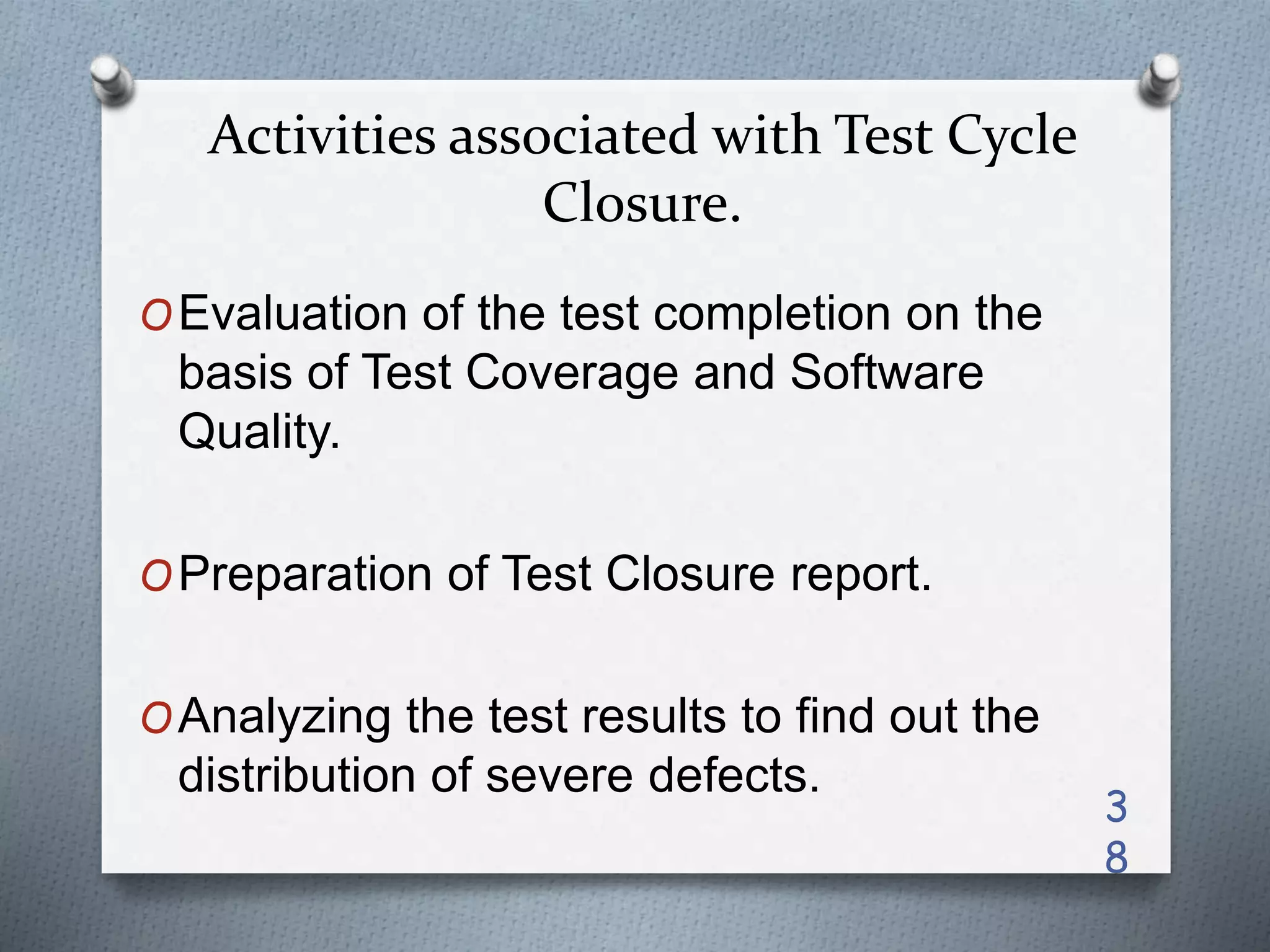
OEvaluation of the test completion on the
basis of Test Coverage and Software
Quality.
OPreparation of Test Closure report.
OAnalyzing the test results to find out the
distribution of severe defects.
3
8
Deliverables associated with Test Cycle
Closure.
OTest closure Report.
3
9
SDLC VS STLC
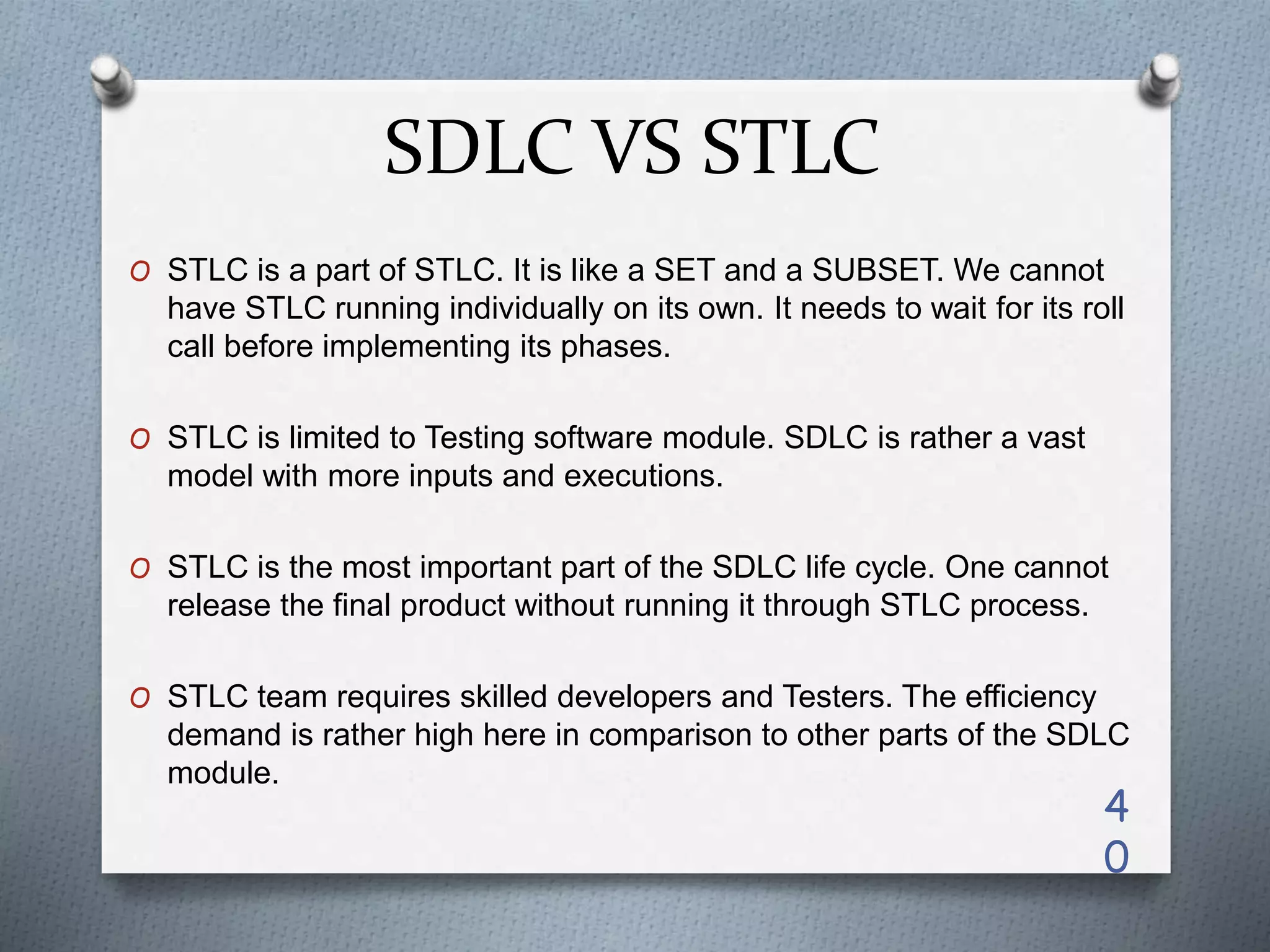
O STLC is a part of STLC. It is like a SET and a SUBSET. We cannot
have STLC running individually on its own. It needs to wait for its roll
call before implementing its phases.
O STLC is limited to Testing software module. SDLC is rather a vast
model with more inputs and executions.
O STLC is the most important part of the SDLC life cycle. One cannot
release the final product without running it through STLC process.
O STLC team requires skilled developers and Testers. The efficiency
demand is rather high here in comparison to other parts of the SDLC
module.
4
0
Here it is!!
Have Fun Guys!
41

Software testing life cycle

  • 1.
  • 2.
    What we aregoing to see in this presentation! O What is STLC i.e. Software Testing Life Cycle? O Why STLC? O What is Entry & Exit Criteria? O What are Activities and Deliverables? O Phases of STLC. O How it is different from SDLC. O One Quote for everyone! 2
  • 3.
    What is STLC? OSoftware Testing Life Cycle (STLC) is a set of steps used to test software products. O Or we can say that it is a testing process which is executed in systematic and planned manner. O It is the sequence of activities carried out by the testing team from the beginning of the project till the end of the project. 3
  • 4.
    Why STLC? O Justlike developers follow the Software Development Life Cycle (SDLC) likewise testers also follow the Software Testing Life Cycle in order to meet quality goals. O As Software testing is a critical part of preparing software for use, STLC helps make this process more sophisticated, consistent and effective. 4
  • 5.
    What is Entry& Exit Criteria? O Entry Criteria are the conditions that must be present before phases can begin successfully. In short, “What needs to be done before the phases can start”. O Exit Criteria are the conditions that a product must meet before a particular milestone is completed. In short, “defines the items that must be completed before testing can be concluded”. 5
  • 6.
    What are Activitiesand Deliverables? O Activities are nothing but the conditions in which processes are going to happen or being done. O A deliverable is a tangible or intangible good produced as a result of a process that is intended to be delivered to a customer (either internal or external). A deliverable could be a report, a document, a software product, etc. 6
  • 7.
    POINTS TO BEREMEBERED! O Each Phases present in STLC have a definite Entry and Exit criteria, Activities & Deliverables associated with it. O There is no fixed standard STLC in the world and it basically varies as per the following:  Software Development Life Cycle  Whims of the Management or Team 7
  • 8.
    Phases in STLC. Requirement analysis Test Planning Testcase development Environment Setup Test Execution Test Cycle Closure Pictorial Representation of Software Testing Life Cycle (STLC). 8
  • 9.
    Phases of STLC(Contd.) OFirst Phase: Requirement Analysis. O Second Phase: Test Planning. O Third Phase: Test Case Development. O Fourth Phase: Environment Setup. O Fifth Phase: Test Execution. O Sixth Phase: Test Cycle Closure. 9
  • 10.
    First Phase: RequirementAnalysis. O This phase addresses what are the customer expectations from the product. How the application should behavior under various circumstances. O A crystal clear objective helps developer to create; test engineers to plan the strategy and testing techniques. Also, feasibility study helps test engineers to pick the right test cases to test, automate and for performance testing. 10
  • 11.
    Entry criteria associatedwith Requirement Analysis. O Availability of Requirement document both Functional as well as non-functional. O Architectural document of the application or the product should be available. O Acceptance criteria defined and duly signed by the customers. 11
  • 12.
    Exit criteria associatedwith Requirement Analysis. O RTM(Requirement Traceability Matrix) should be signed off. O The customer should sign off on the test automation feasibility. 12
  • 13.
    Activities associated with RequirementAnalysis. O Analysis of System Requirement specifications to understand the different business modules and it’s functionalities. O To identify the user profile, user interface and user authentication. O Types of tests to be performed on the application or product should be identified. O Should collect the details about testing priorities. O Preparation of RTM that is Requirement Traceability Matrix. O Test Environment details should be identified in order to do testing. O Analysis of automation possibility if it is required. 13
  • 14.
    Deliverables associated with RequirementAnalysis. O Requirement Traceability Matrix (RTM). O Report on Automation Feasibility if it is applicable. 14
  • 15.
    Second Phase: TestPlanning. O Test Planning phase starts soon after the completion of the Requirement Analysis phase. O In this phase the QA manager or QA Lead will prepare the Test Plan and Test strategy documents. O As per these documents they will also come up with the testing effort estimations. 15
  • 16.
    Entry criteria associatedwith Test Planning. O Detailed requirement document. O Requirement Traceability Matrix (RTM). O Automation Feasibility Report. 16
  • 17.
    Exit criteria associatedwith Test Planning. O Approved Test Plan document. O Approved Test Strategy document. O Document of Effort estimation. 17
  • 18.
    Activities associated withTest Planning. O Preparation of Test Plan document. O Preparation of Test strategy document. O To analyze the best suited testing approach for the application or product. O To analyze the testing techniques and the types of testing to be carried out in order to maintain the quality. O Selection of the testing tool. O Estimation on the testing efforts. O Resource planning as per the skill required for testing and also assigning roles and responsibility to them. 18
  • 19.
    Deliverables associated withTest Planning. OTest Plan document. OTest Strategy document. OEffort estimation document. 19
  • 20.
    Third Phase: TestCase Development. O In this phase the QA team write test cases. They also write scripts for automation if required. O Verification of both the test cases and test scripts are done by peers. O Creation of Test Data is done in this phase. 2 0
  • 21.
    Entry criteria associatedwith Test Case Development. O Detailed Requirement document O Test Plan and Test strategy documents O Automation Feasibility Report 21
  • 22.
    Exit criteria associatedwith Test Case Development. O Reviewed Test cases O Reviewed Test automation scripts O Test data creation ready for testing 2 2
  • 23.
    Activities associated withTest Case Development. O Creation of test cases for all the modules or features in the application or product. O Creation of automation scripts if required. O Review of test cases and test automation scripts. O Test data creation. 2 3
  • 24.
    Deliverables associated withTest Case Development. OTest cases. OTest automation scripts. OTest data 2 4
  • 25.
    Fourth Phase: TestEnvironment setup. O This phase includes the setup or installation process of software and hardware which is required for testing the application. In this phase the integration of the third party application is also carried out if required in the project. O After setting up the required software and hardware the installation of build is tested. Once the installation of build is successful and complete then the Test Data is generated. O After the creation of Test data the Smoke testing is executed on the build in order to check whether the basic functionalities are working fine or not. This phase can be done in parallel with the Test Case Development phase. 2 5
  • 26.
    Entry criteria associatedwith Test Environment setup. O System design documents should be available. O Architectural document of the application should be available. O Environment set-up plan document should be available 2 6
  • 27.
    Exit criteria associatedwith Test Environment setup. O Environment setup is ready for testing. O All the required software and hardware are installed. O Build installation is complete and successful. O Test data creation is complete. O Smoke testing is done. 2 7
  • 28.
    Activities associated withTest Environment setup. O Understanding the design and architecture of the application O Setting up the test environment O Installation of required hardware and software in order to start testing the application O Integration of any third party application (if required) O Installation of build O Creation of test data O Execution of smoke testing on the build O Accepting or rejecting the build as per the smoke test result 2 8
  • 29.
    Deliverables associated withTest Environment setup. OTest environment along with test data. OSmoke test result. 2 9
  • 30.
    Fifth Phase: TestExecution. O Before starting the Test Execution phase the Test Environment setup should be ready. In Test Execution phase the test cases are executed in the testing environment. O While execution of the test cases the QA team may find bugs which will be reported against that test case. This bug is fixed by the developer and is retested by the QA. 3 0
  • 31.
    Entry criteria associatedwith Test Execution. O Documents like RTM, Test Plan, Test strategy, Test cases and Test scripts should be ready. O Test environment should be ready. O Test data should be ready. O Integration of third party application (if required) should be successful. O Smoke testing of the application should be successful. 31
  • 32.
    Exit criteria associatedwith Test Execution. O All test cases are executed. O Defects are logged and tracked for closure. 3 2
  • 33.
    Activities associated withTest Execution. O Execution of test cases O Preparation of test result document O Logging defects for the failed test cases O Mapping of defects with the test cases O To update the test cases and test strategy if required O Fixed defects should be retested O Closure of the defects if they are working as expected O Execution of regression testing of the application or product in order to ensure its stability post defect closure 3 3
  • 34.
    Deliverables associated withTest Execution. OCompleted the test case execution. OUpdated the test cases wherever required. ODefects reported. 3 4
  • 35.
    Sixth Phase: Testcycle closure. O In order to start the Test Cycle Closure activity the Test Execution phase should be completed. In Test Cycle phase the QA team will meet and discuss about the testing artifacts. O The whole intent of this discussion is to learn lessons from the bad practices. This will help in future projects. 3 5
  • 36.
    Entry Criteria associatedwith Test Cycle Closure. OAll the test cases are executed and updated. OTest results are documented. ODefect logs are available. 3 6
  • 37.
    Exit Criteria associatedwith Test Cycle Closure. OSigned off Test Closure report by the client. 3 7
  • 38.
    Activities associated withTest Cycle Closure. OEvaluation of the test completion on the basis of Test Coverage and Software Quality. OPreparation of Test Closure report. OAnalyzing the test results to find out the distribution of severe defects. 3 8
  • 39.
    Deliverables associated withTest Cycle Closure. OTest closure Report. 3 9
  • 40.
    SDLC VS STLC OSTLC is a part of STLC. It is like a SET and a SUBSET. We cannot have STLC running individually on its own. It needs to wait for its roll call before implementing its phases. O STLC is limited to Testing software module. SDLC is rather a vast model with more inputs and executions. O STLC is the most important part of the SDLC life cycle. One cannot release the final product without running it through STLC process. O STLC team requires skilled developers and Testers. The efficiency demand is rather high here in comparison to other parts of the SDLC module. 4 0
  • 41.
    Here it is!! HaveFun Guys! 41