What is Software?
Software is a set of
instructions stored digitally
within the computer's memory,
which tells the computer system
what to do.
What is Testing?
Testing is the process of executing a
program with the intention of
finding errors
Software testing
Software testing is a process
that should be done during the
development process. In other
words software testing is a
verification and validation
process.
What is Verification?
Verification is the process to
make sure the product satisfies
the conditions imposed at the
start of the development phase.
to make sure the product
behaves the way we want it to.
What is Validation?
Validation is the process to make
sure the product satisfies the
specified requirements at the end
of the development phase.
to make sure the product is built
as per customer requirements.
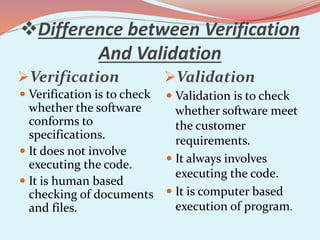
Difference between Verification
And Validation
Verification Validation
 Verification is to check
whether the software
conforms to
specifications.
 It does not involve
executing the code.
 It is human based
checking of documents
and files.
 Validation is to check
whether software meet
the customer
requirements.
 It always involves
executing the code.
 It is computer based
execution of program.
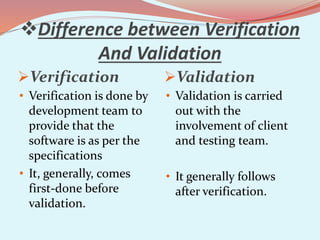
Difference between Verification
And Validation
Verification Validation
• Verification is done by
development team to
provide that the
software is as per the
specifications
• It, generally, comes
first-done before
validation.
• Validation is carried
out with the
involvement of client
and testing team.
• It generally follows
after verification.
Purpose of Software Testing
Testing verifies that the system
meets the different requirements
including, functional, performance,
reliability, security, usability and so
on.This verification is done to
ensure that we are building the
system right.
Basics of Software Testing
There are two basics of software
testing:
Whitebox testing.
Blackbox testing
What is Whitebox Testing?
 Whitebox Testing is a software testing
method in which the internal structure of
the item being tested is known to the tester.
 White box testing is often used for
verification.
 White box testing is done by the
Developers.
Advantage of Whitebox Testing
 Testing can be commenced at an earlier
stage. One need not wait for the GUI to be
available.
 Testing is more thorough, with the
possibility of covering most paths.
 The other advantage of white box testing is
that it helps in optimizing the code
Disadvantage of Whitebox Testing
 As knowledge of code and internal structure
is a prerequisite, a skilled tester is needed to
carry out this type of testing, which
increases the cost
 Not looking at the code in a runtime
environment...
What is Blackbox Testing?
 Blackbox Testing is a software testing
method in which the internal structure of
the item being tested is not known to the
tester..
 Blackbox testing is often used for
Validation..
 Black box testing is done by the professional
testing team.
Advantage of Blackbox Testing
Tester can be non-technical.
Tester needs no knowledge of
implementation, including specific
programming languages
Tests will be done from an end user's
point of view. Because end user should
accept the system.
Disadvantage of Blackbox Testing
Not all properties of a software product
can be tested
The reason for a failure is not found.
Only a small number of possible inputs
can be tested and many program paths
will be left untested..
 Types of Testing
There are many types of testing like
Unit Testing
Integration Testing
Functional Testing
System Testing
Stress Testing
Types of Testing
Performance Testing
Usability Testing
Acceptance Testing
Regression Testing
Beta Testing
Unit Testing
Unit testing is that validate individual
unit of source code working properly…
Unit is smallest testable part of an
application..
Mostly done by developers of the
modules..
Goal of Unit Testing
• To isolate each part of program
and show that individual parts
are correct..
Advantage of Unit Testing
 Unit Testing reduces the level of bugs
in production code..
 Unit Testing inspires confidence..
 Unit Testing makes it easier to change
and refactor code.
Disadvantage of Unit Testing
Unit-testing will not catch every
error in the program. By definition,
it only tests the functionality of the
units….
Integration Testing
Integration testing is testing in which a
group of components are combined to
produce output.
 Also, the interaction between software
and hardware is tested in integration
testing if software and hardware
components have any relation.
Integration Testing
• Prerequisite of Integration Testing
•Before We begin Integration Testing
it is important that all the
components have been successfully
unit tested..
Goal of Integration Testing
To discover faults that are due to
incorrect interaction
Between different software module.
Integration Testing
Types of Integration Testing
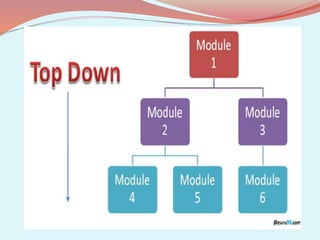
Top-down testing
 Top Down Integration as the term
suggests, starts always at the top of the
program hierarchy and travels towards
its branches..
Integration Testing
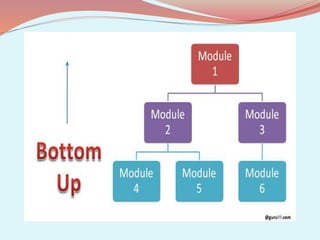
• Bottom –Up Testing
•Bottom –Up integration as it name
implies starts at the lowest level in
the program structure.
Functional Testing
Functional testing is the testing to
ensure that the specified
functionality required in the
system requirements works.
it is not concerned about the
source code of the application.
Functional Testing
 What do you test in Functional Testing?
 The prime objective of Functional testing is
checking the functionalities of the software
system.
 Mainline functions: Testing the main
functions of an application
 Basic Usability: It involves basic usability
testing of the system. It checks whether an
user can freely navigate through the screens
without any difficulties.
Functional Testing
 Accessibility: Checks the accessibility of the
system for the user
 Error Conditions: Usage of testing techniques to
check for error conditions. It checks whether
suitable error messages are displayed
Software testing

Software testing

  • 2.
    What is Software? Softwareis a set of instructions stored digitally within the computer's memory, which tells the computer system what to do.
  • 3.
    What is Testing? Testingis the process of executing a program with the intention of finding errors
  • 4.
    Software testing Software testingis a process that should be done during the development process. In other words software testing is a verification and validation process.
  • 5.
    What is Verification? Verificationis the process to make sure the product satisfies the conditions imposed at the start of the development phase. to make sure the product behaves the way we want it to.
  • 6.
    What is Validation? Validationis the process to make sure the product satisfies the specified requirements at the end of the development phase. to make sure the product is built as per customer requirements.
  • 7.
    Difference between Verification AndValidation Verification Validation  Verification is to check whether the software conforms to specifications.  It does not involve executing the code.  It is human based checking of documents and files.  Validation is to check whether software meet the customer requirements.  It always involves executing the code.  It is computer based execution of program.
  • 8.
    Difference between Verification AndValidation Verification Validation • Verification is done by development team to provide that the software is as per the specifications • It, generally, comes first-done before validation. • Validation is carried out with the involvement of client and testing team. • It generally follows after verification.
  • 9.
    Purpose of SoftwareTesting Testing verifies that the system meets the different requirements including, functional, performance, reliability, security, usability and so on.This verification is done to ensure that we are building the system right.
  • 10.
    Basics of SoftwareTesting There are two basics of software testing: Whitebox testing. Blackbox testing
  • 11.
    What is WhiteboxTesting?  Whitebox Testing is a software testing method in which the internal structure of the item being tested is known to the tester.  White box testing is often used for verification.  White box testing is done by the Developers.
  • 12.
    Advantage of WhiteboxTesting  Testing can be commenced at an earlier stage. One need not wait for the GUI to be available.  Testing is more thorough, with the possibility of covering most paths.  The other advantage of white box testing is that it helps in optimizing the code
  • 13.
    Disadvantage of WhiteboxTesting  As knowledge of code and internal structure is a prerequisite, a skilled tester is needed to carry out this type of testing, which increases the cost  Not looking at the code in a runtime environment...
  • 14.
    What is BlackboxTesting?  Blackbox Testing is a software testing method in which the internal structure of the item being tested is not known to the tester..  Blackbox testing is often used for Validation..  Black box testing is done by the professional testing team.
  • 15.
    Advantage of BlackboxTesting Tester can be non-technical. Tester needs no knowledge of implementation, including specific programming languages Tests will be done from an end user's point of view. Because end user should accept the system.
  • 16.
    Disadvantage of BlackboxTesting Not all properties of a software product can be tested The reason for a failure is not found. Only a small number of possible inputs can be tested and many program paths will be left untested..
  • 17.
     Types ofTesting There are many types of testing like Unit Testing Integration Testing Functional Testing System Testing Stress Testing
  • 18.
    Types of Testing PerformanceTesting Usability Testing Acceptance Testing Regression Testing Beta Testing
  • 19.
    Unit Testing Unit testingis that validate individual unit of source code working properly… Unit is smallest testable part of an application.. Mostly done by developers of the modules..
  • 20.
    Goal of UnitTesting • To isolate each part of program and show that individual parts are correct..
  • 21.
    Advantage of UnitTesting  Unit Testing reduces the level of bugs in production code..  Unit Testing inspires confidence..  Unit Testing makes it easier to change and refactor code.
  • 22.
    Disadvantage of UnitTesting Unit-testing will not catch every error in the program. By definition, it only tests the functionality of the units….
  • 23.
    Integration Testing Integration testingis testing in which a group of components are combined to produce output.  Also, the interaction between software and hardware is tested in integration testing if software and hardware components have any relation.
  • 24.
    Integration Testing • Prerequisiteof Integration Testing •Before We begin Integration Testing it is important that all the components have been successfully unit tested..
  • 25.
    Goal of IntegrationTesting To discover faults that are due to incorrect interaction Between different software module.
  • 26.
    Integration Testing Types ofIntegration Testing Top-down testing  Top Down Integration as the term suggests, starts always at the top of the program hierarchy and travels towards its branches..
  • 28.
    Integration Testing • Bottom–Up Testing •Bottom –Up integration as it name implies starts at the lowest level in the program structure.
  • 30.
    Functional Testing Functional testingis the testing to ensure that the specified functionality required in the system requirements works. it is not concerned about the source code of the application.
  • 31.
    Functional Testing  Whatdo you test in Functional Testing?  The prime objective of Functional testing is checking the functionalities of the software system.  Mainline functions: Testing the main functions of an application  Basic Usability: It involves basic usability testing of the system. It checks whether an user can freely navigate through the screens without any difficulties.
  • 32.
    Functional Testing  Accessibility:Checks the accessibility of the system for the user  Error Conditions: Usage of testing techniques to check for error conditions. It checks whether suitable error messages are displayed