TYPES OF SPECIMEN AND NURSE’S
RESPONSIBILITY IN SPECIMEN
COLLECTION
Prepared by
Anamika Harshan C
Roll No : 12
42nd Batch
Bsc Nursing
Govt college of nursing Kozhikode
SPECIMEN
A specimen is a small substance which shows the
kind and quality of a whole sample.
Specimens are crucial for diagnosing medical
conditions, monitoring treatment effectiveness and
overall assessing a patient’s health.
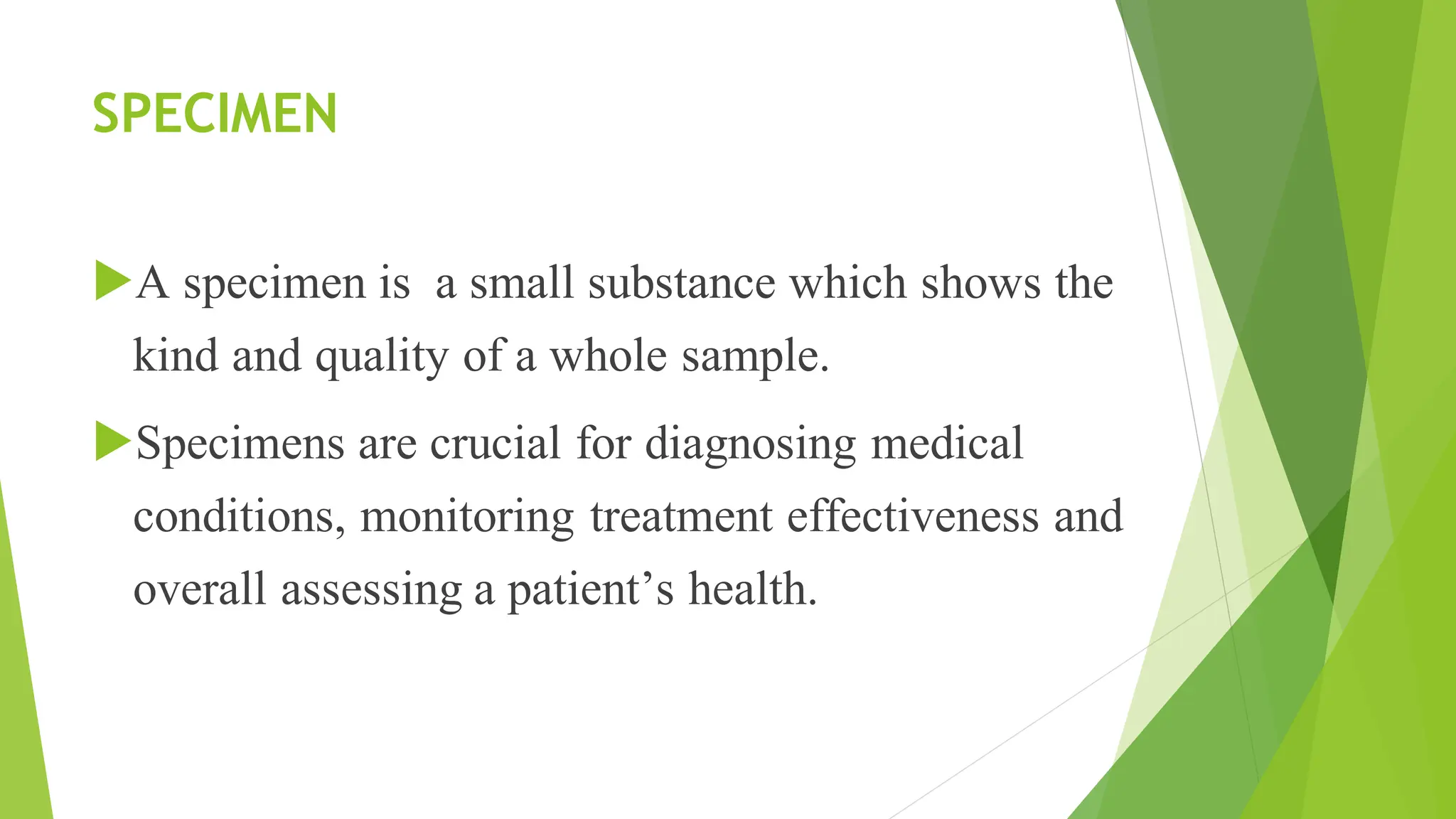
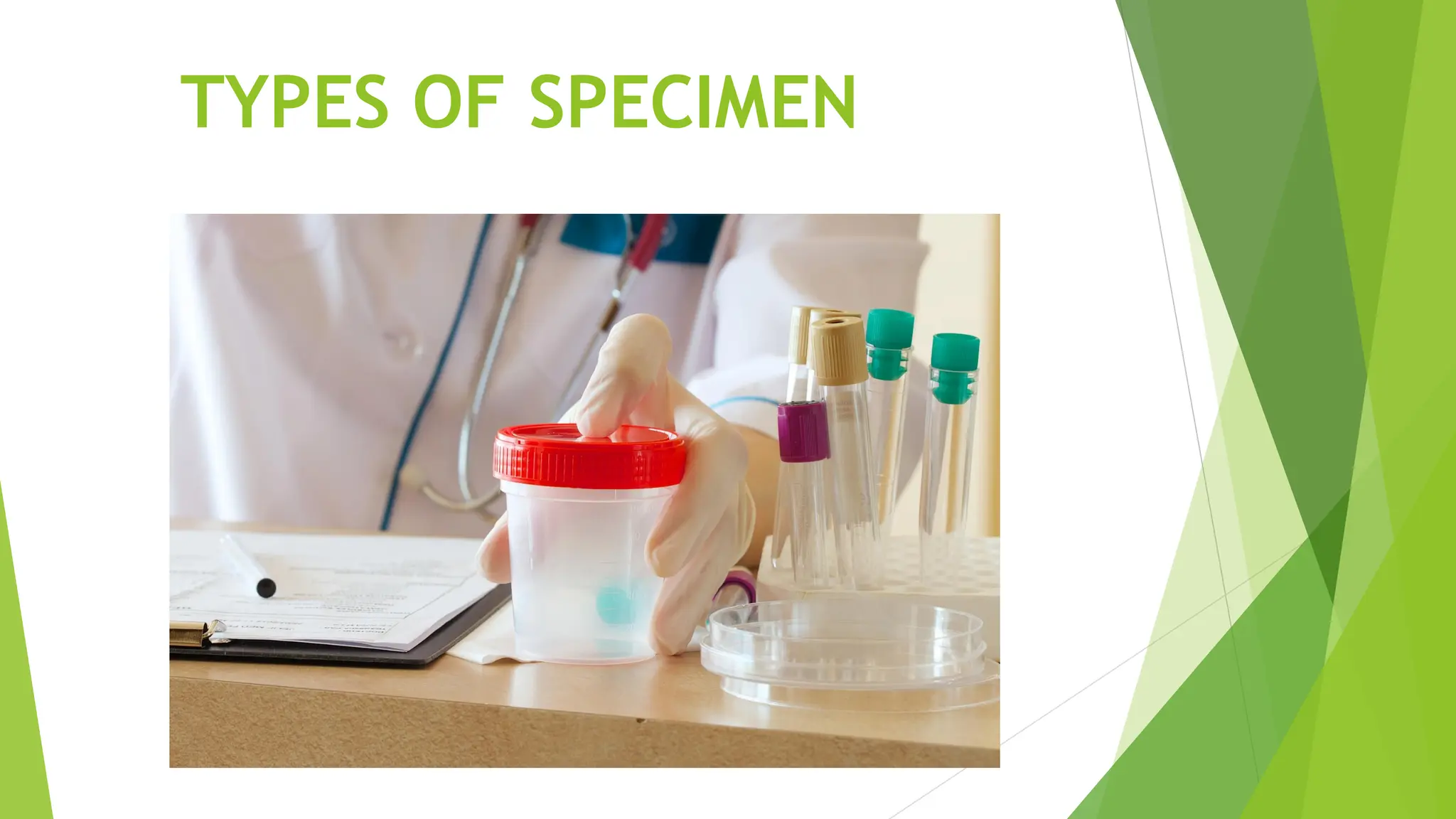
TYPES OF SPECIMEN
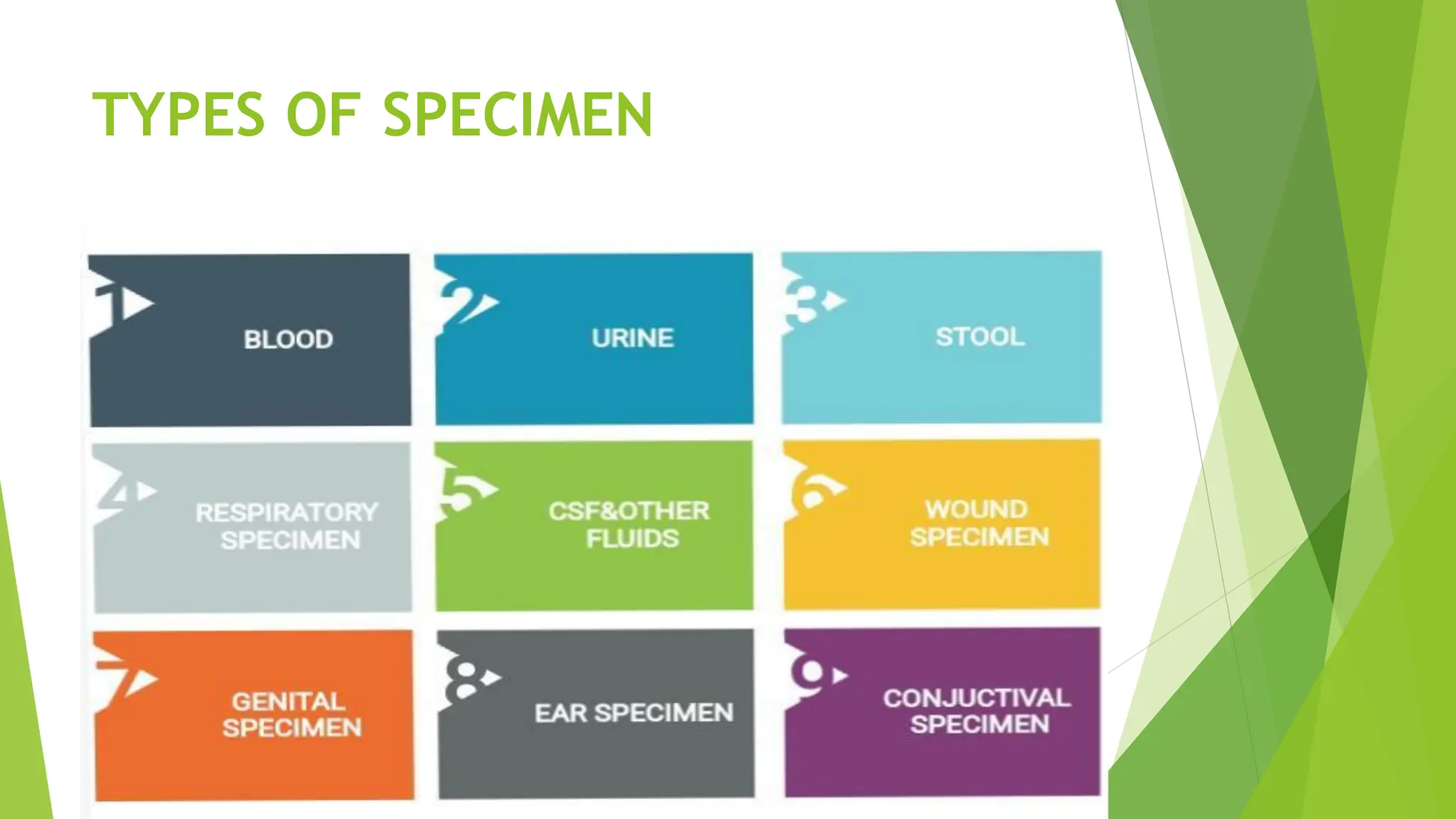
TYPES OF SPECIMEN
1. BLOOD SPECIMEN
 Blood specimen is a small sample of blood collected for analysis,
and often used in medical diagnosis to assess various health
parameters such as complete blood count,chemistry and disease
markers.
 This sample is typically extracted through Venipuncture Or
finger stick technique.
 It contains a wealth of information that can aid in diagnosing
and monitoring various medical conditions.
BLOOD SPECIMEN CONTND.…
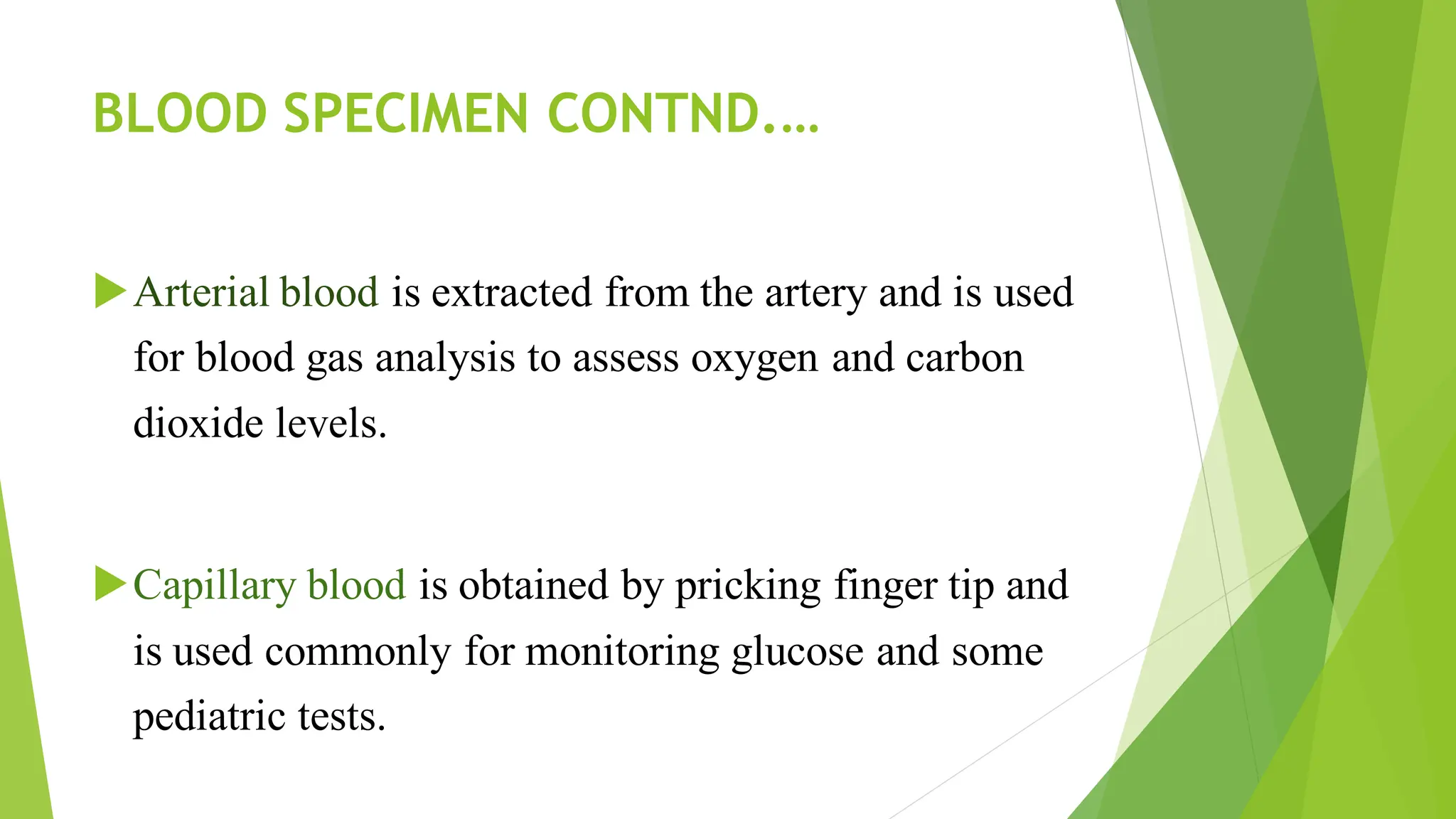
 One of the primarily Components analyzed in a blood specimen is the CBC,
which assess the quantity and quality of different blood cells.
 Additionally the blood chemistry panel examines the levels of various
substances like glucose, electrolytes and enzymes.
BLOOD SPECIMEN CONTND.…
Arterial blood is extracted from the artery and is used
for blood gas analysis to assess oxygen and carbon
dioxide levels.
Capillary blood is obtained by pricking finger tip and
is used commonly for monitoring glucose and some
pediatric tests.
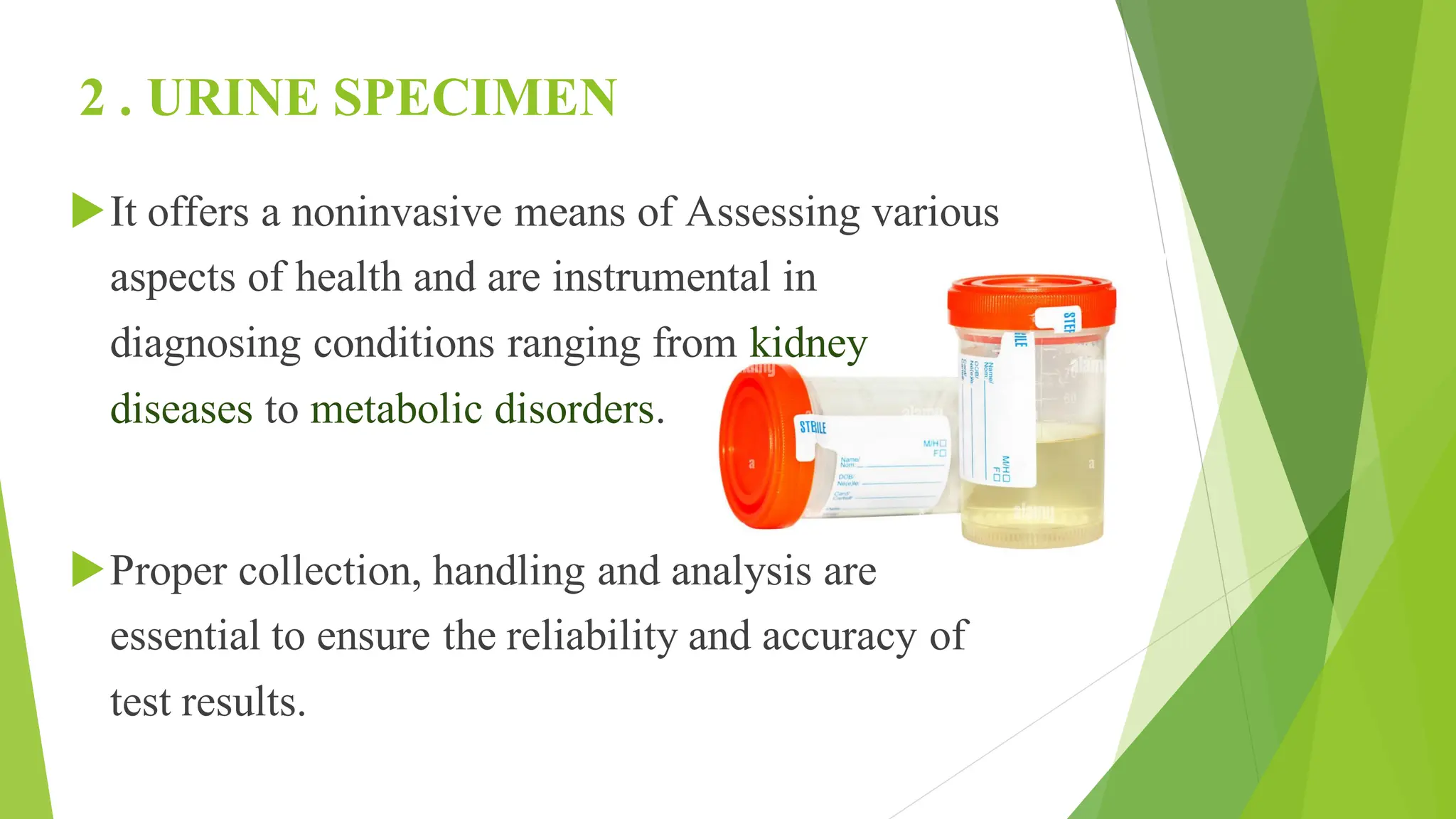
2 . URINE SPECIMEN
It offers a noninvasive means of Assessing various
aspects of health and are instrumental in
diagnosing conditions ranging from kidney
diseases to metabolic disorders.
Proper collection, handling and analysis are
essential to ensure the reliability and accuracy of
test results.
URINE SPECIMEN CONTND.…
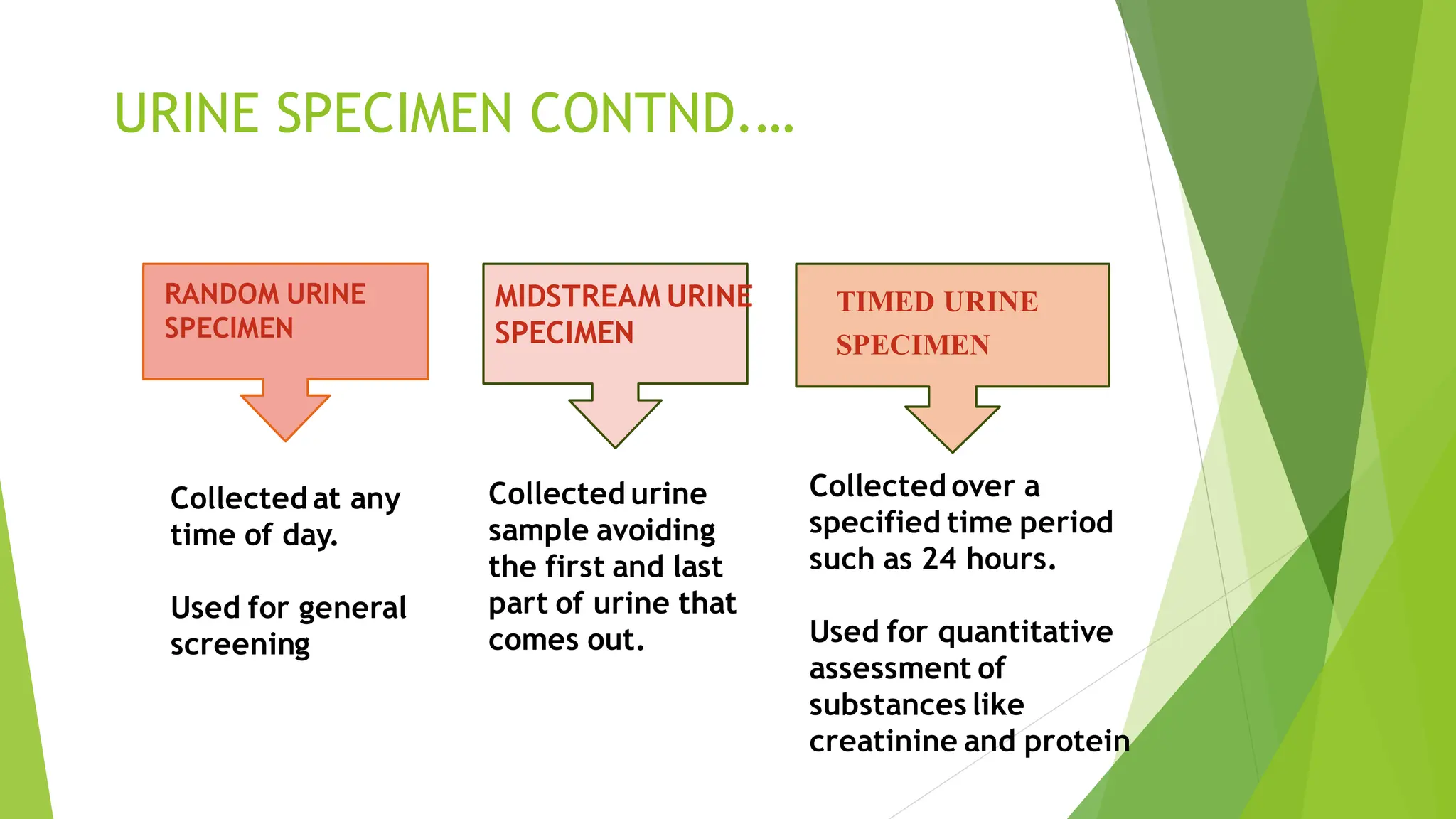
RANDOM URINE
SPECIMEN
MIDSTREAM URINE
SPECIMEN
TIMED URINE
SPECIMEN
Collected at any
time of day.
Used for general
screening
Collected urine
sample avoiding
the first and last
part of urine that
comes out.
Collected over a
specified time period
such as 24 hours.
Used for quantitative
assessment of
substances like
creatinine and protein
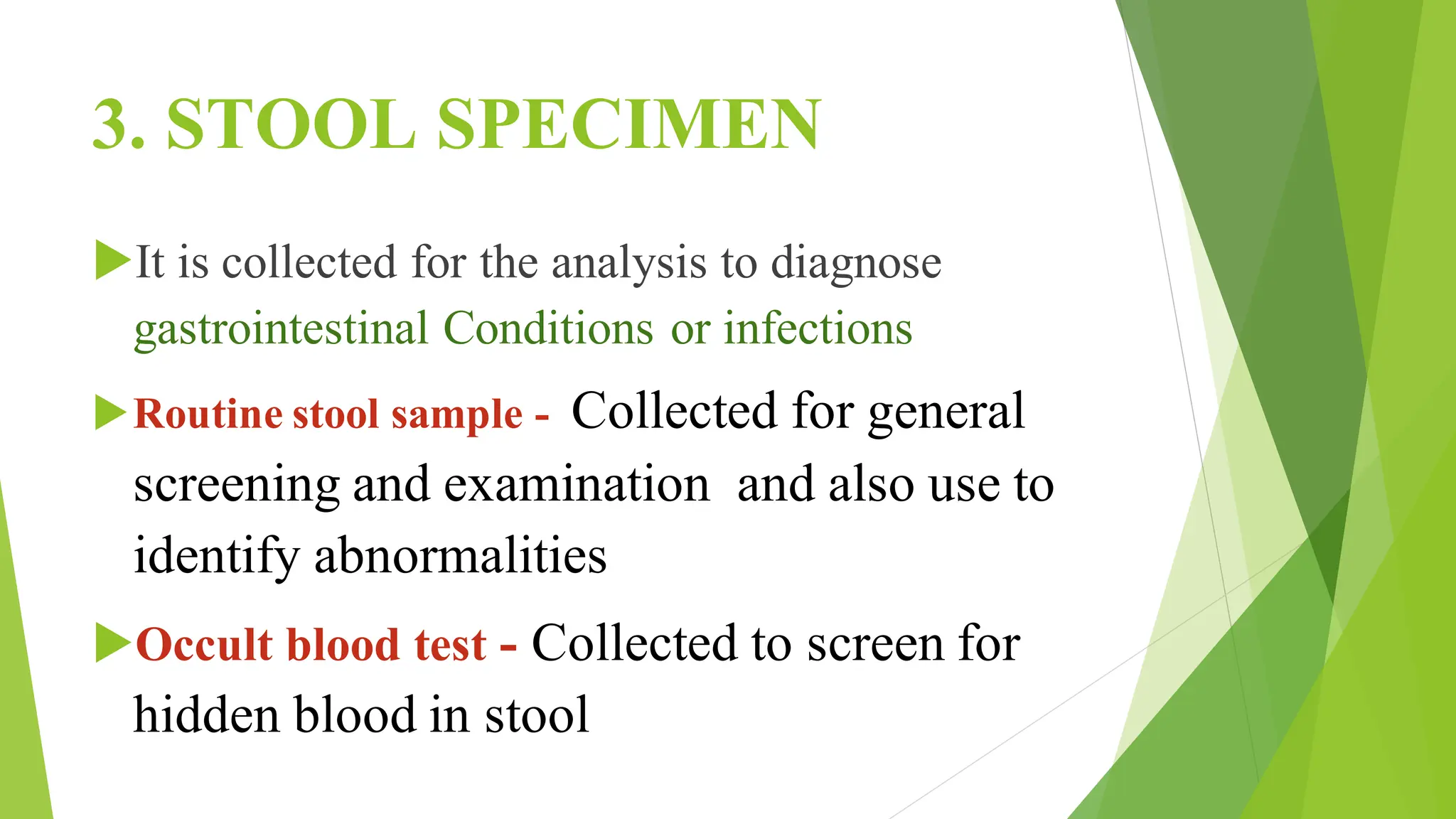
3. STOOL SPECIMEN
It is collected for the analysis to diagnose
gastrointestinal Conditions or infections
Routine stool sample - Collected for general
screening and examination and also use to
identify abnormalities
Occult blood test - Collected to screen for
hidden blood in stool
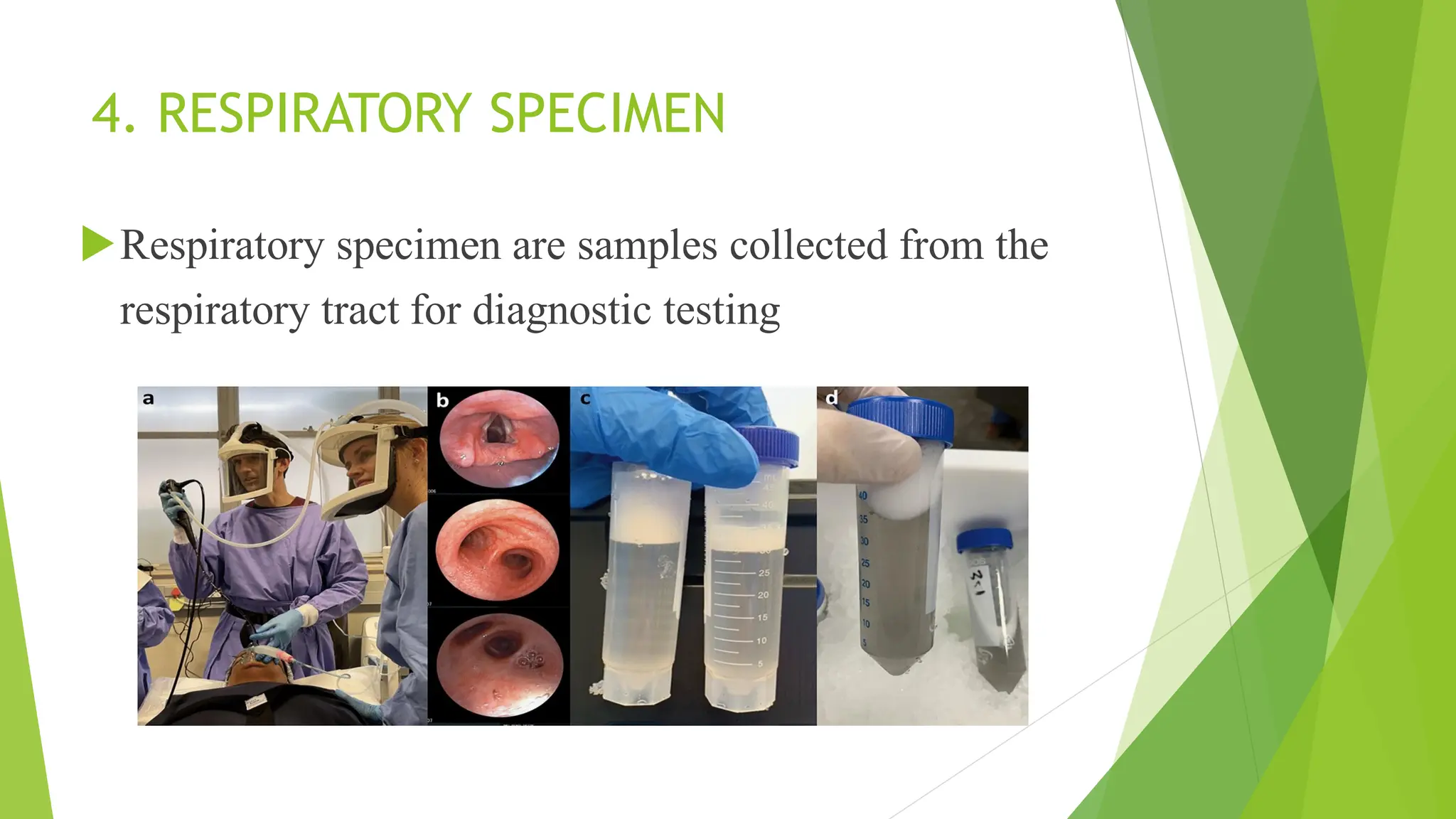
4. RESPIRATORY SPECIMEN
Respiratory specimen are samples collected from the
respiratory tract for diagnostic testing
RESPIRATORY SPECIMEN CONTND.…
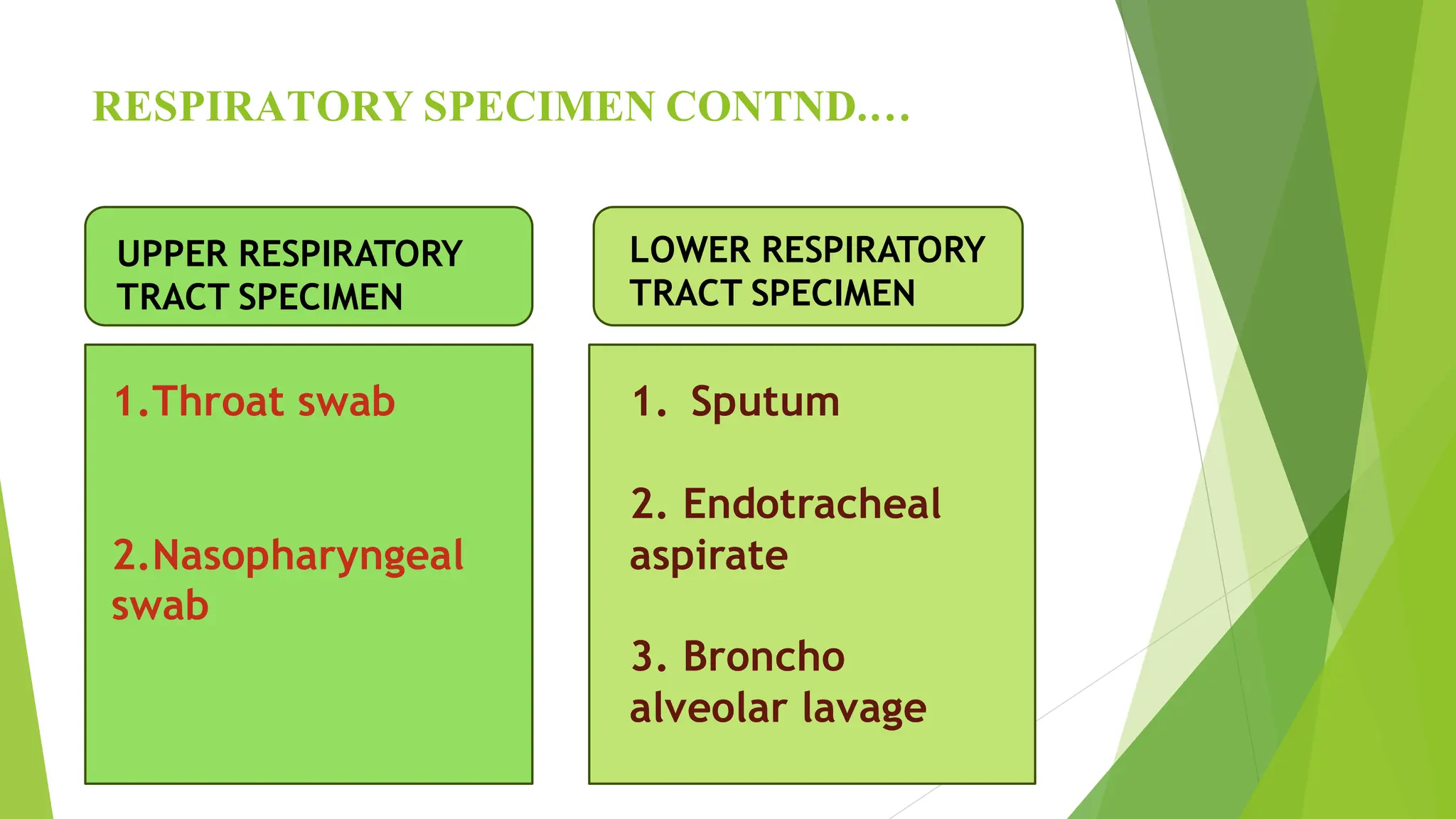
UPPER RESPIRATORY
TRACT SPECIMEN
LOWER RESPIRATORY
TRACT SPECIMEN
1. Sputum
2. Endotracheal
aspirate
3. Broncho
alveolar lavage
1.Throat swab
2.Nasopharyngeal
swab
RESPIRATORY SPECIMEN CONTND….
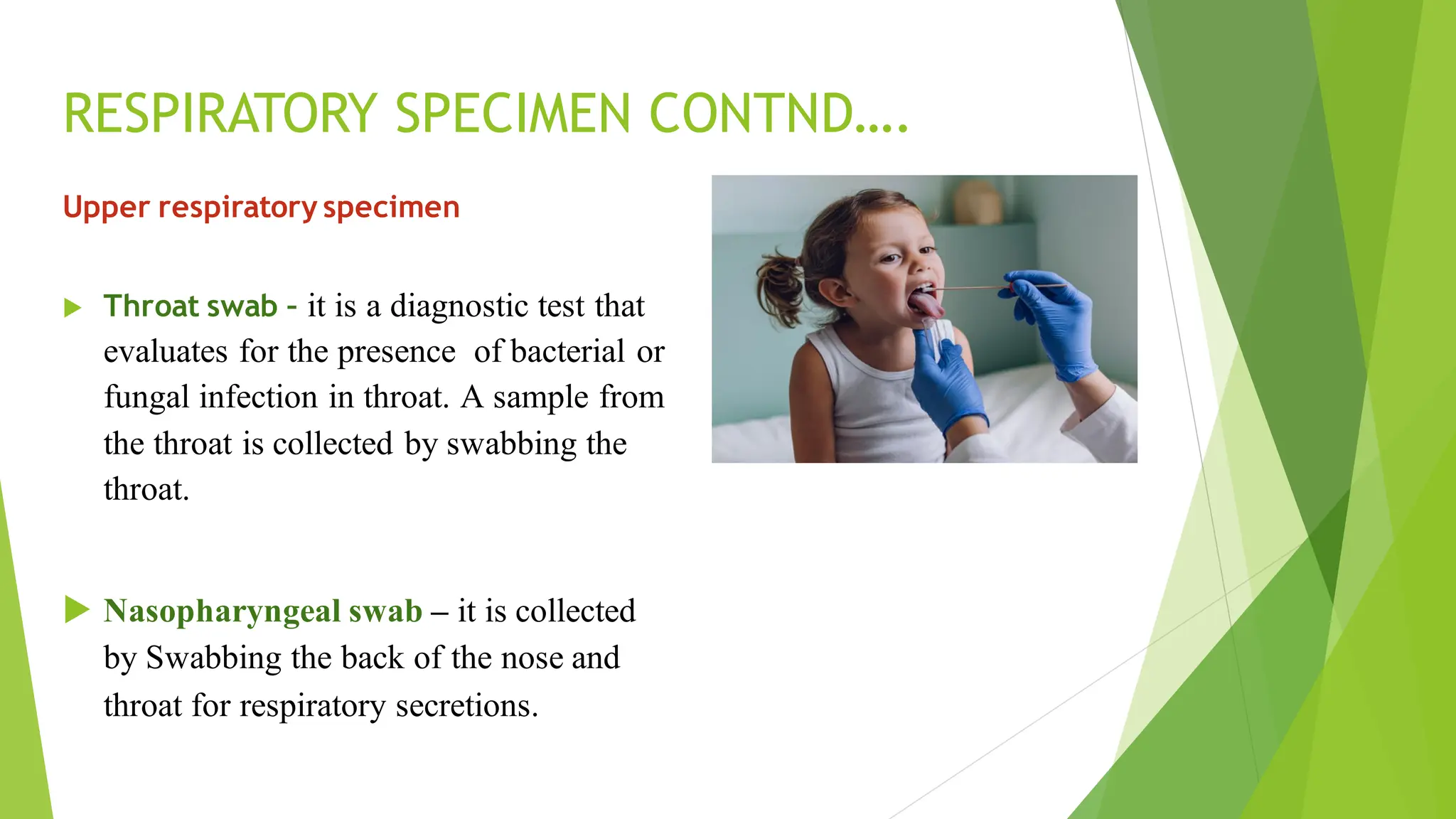
Upper respiratory specimen
 Throat swab – it is a diagnostic test that
evaluates for the presence of bacterial or
fungal infection in throat. A sample from
the throat is collected by swabbing the
throat.
 Nasopharyngeal swab – it is collected
by Swabbing the back of the nose and
throat for respiratory secretions.
RESPIRATORY SPECIMEN CONTND.…
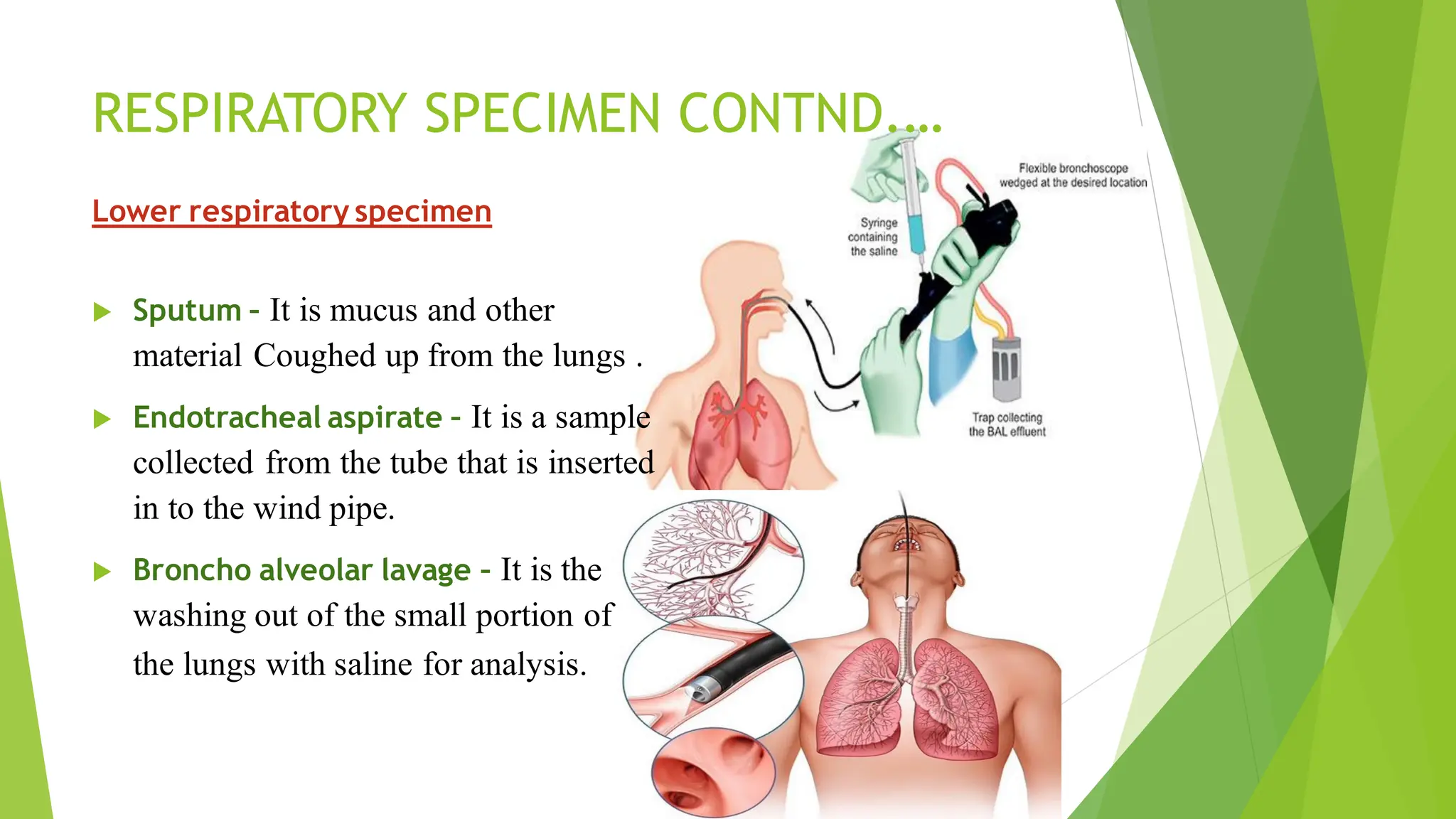
Lower respiratory specimen
 Sputum – It is mucus and other
material Coughed up from the lungs .
 Endotracheal aspirate – It is a sample
collected from the tube that is inserted
in to the wind pipe.
 Broncho alveolar lavage – It is the
washing out of the small portion of
the lungs with saline for analysis.
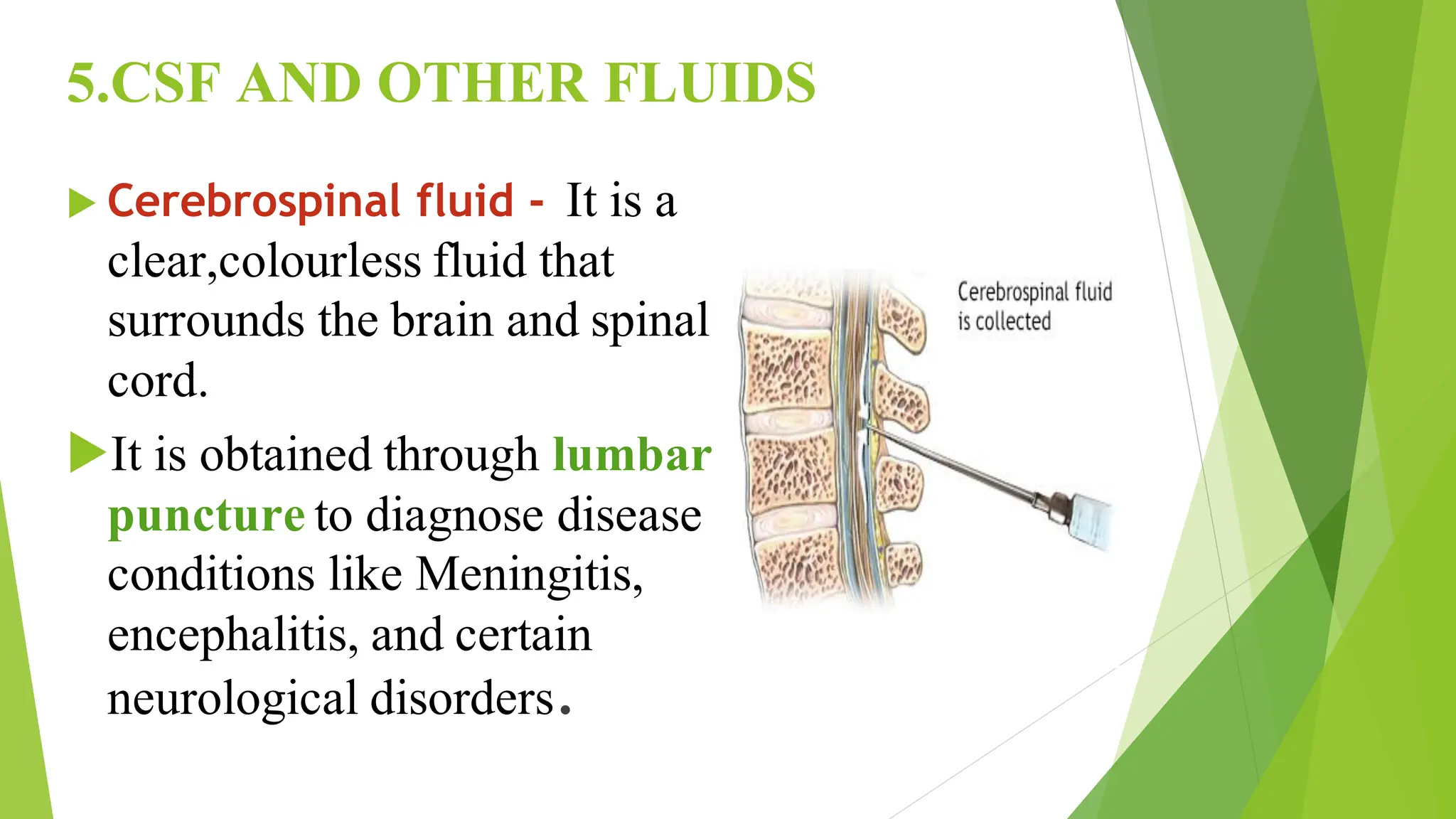
5.CSF AND OTHER FLUIDS
 Cerebrospinal fluid - It is a
clear,colourless fluid that
surrounds the brain and spinal
cord.
It is obtained through lumbar
punctureto diagnose disease
conditions like Meningitis,
encephalitis, and certain
neurological disorders.
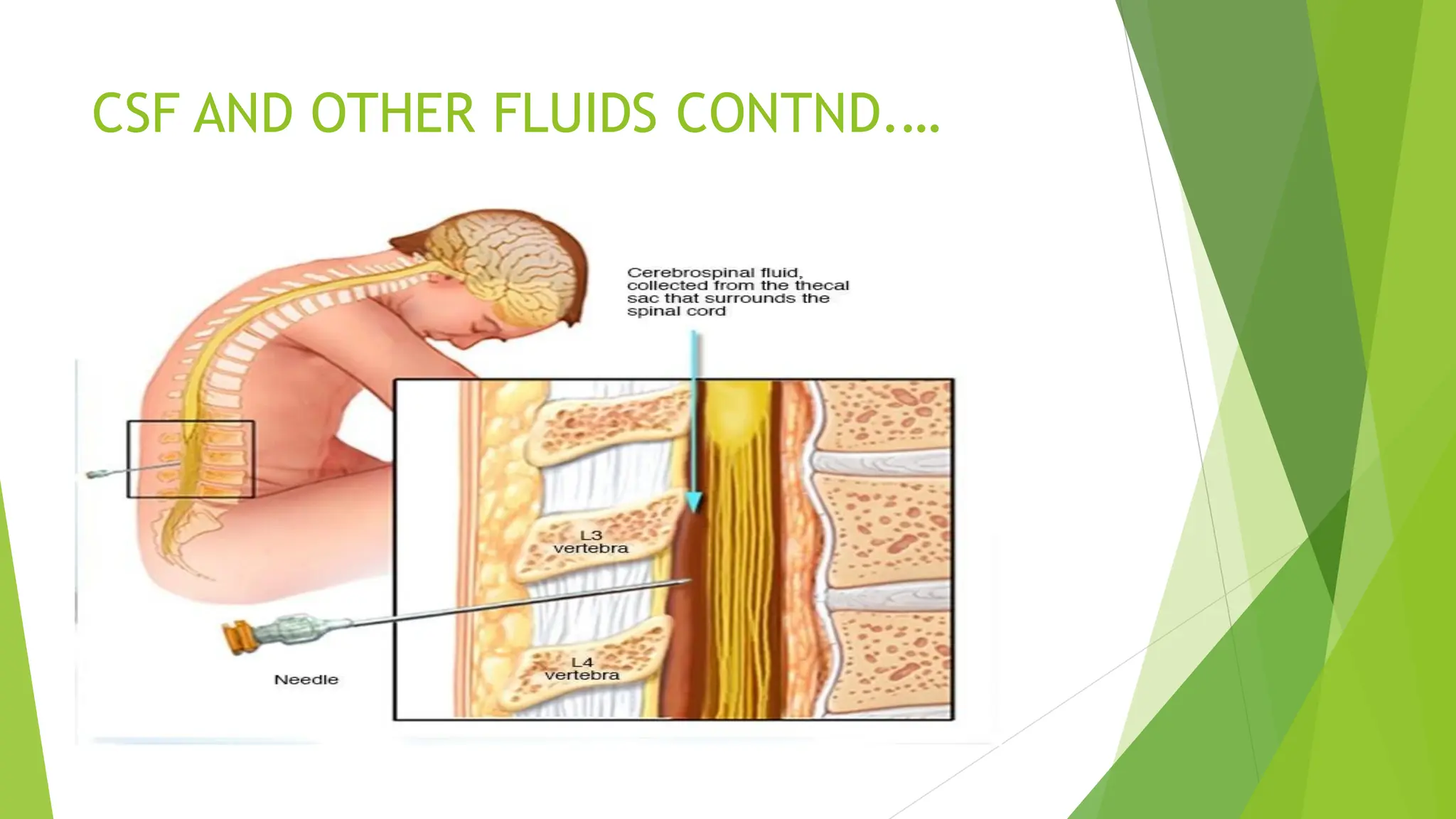
CSF AND OTHER FLUIDS CONTND.…
 Synovial fluid – It is found in joint cavities and it
nourishes and lubricate Joints. Aspiration of synovial Fluids
help diagnose arthritis, infection and joint inflammation.
 Pleural fluids – Accumulates in the pleural space around the
lungs. Aspiration aids in diagnosing disease conditions like
pneumonia, lung cancer or pleuritis.
 Peritoneal fluids – Accumulates in abdominal cavity due to
disease conditions like liver disease or cancer,. Aspiration Assist
in diagnosing the underlying causes and Assessing infection or
malignancy
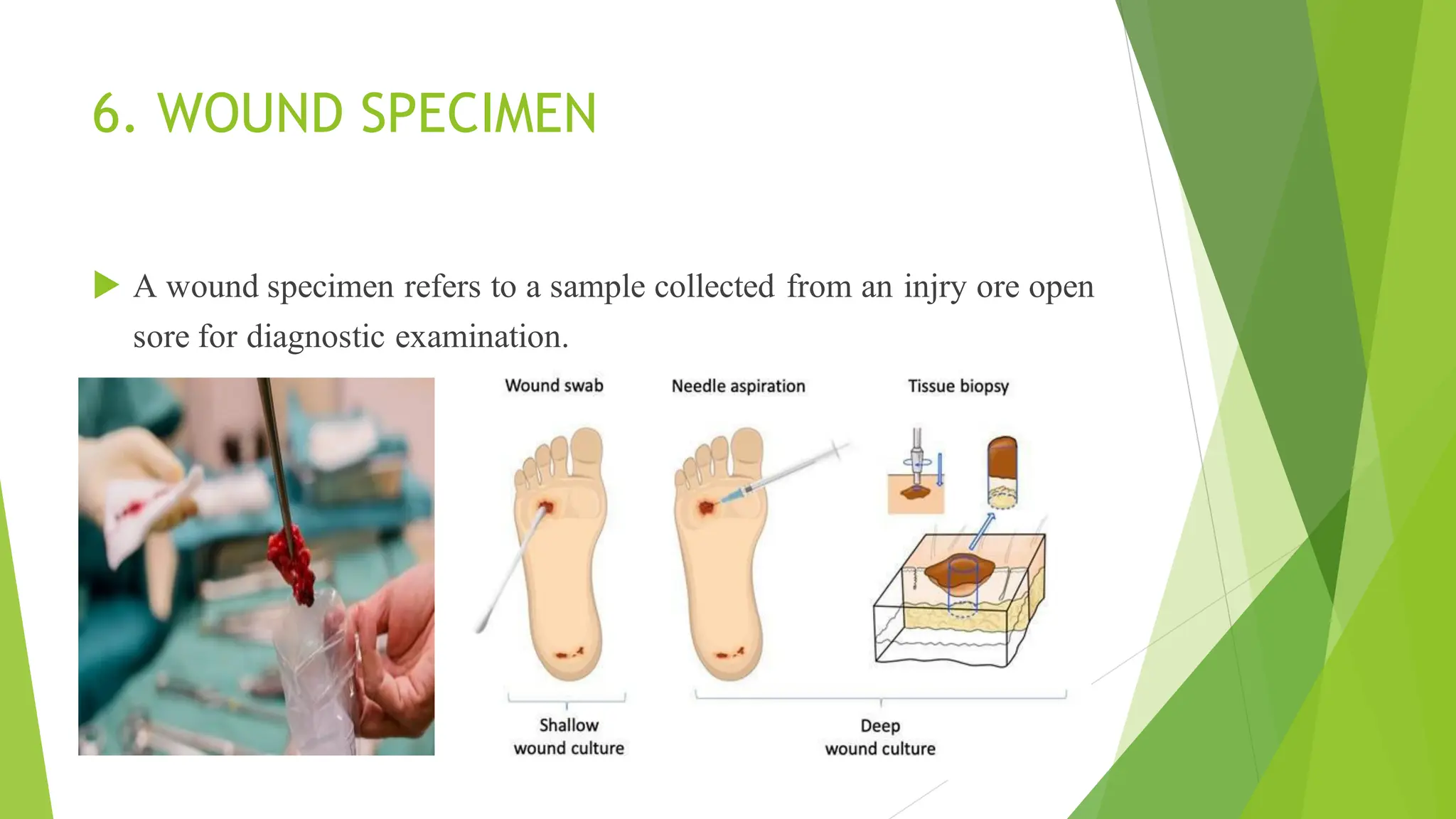
6. WOUND SPECIMEN
 A wound specimen refers to a sample collected from an injry ore open
sore for diagnostic examination.
WOUND SPECIMEN CONTND.…
 Tissue biopsy – Removal of a small piece of
tissue from the wound for microscopic
analysis.
 Swab culture - Swabbing the wound to
collect microbial sample for culture and
identification of Bacteria.
 Fluid aspiration – Extracting fluid from
wound, for useful analyzing the presence of
Infection and other abnormalities
7. GENITAL SPECIMEN
 Urethral swab – It is often done to diagnose or
screen for infections such as STDs
 Cervical swab – It is a sample taken from cervix
for various purposes such as pap smear to screen
for cervical cancer or to test for STDs.
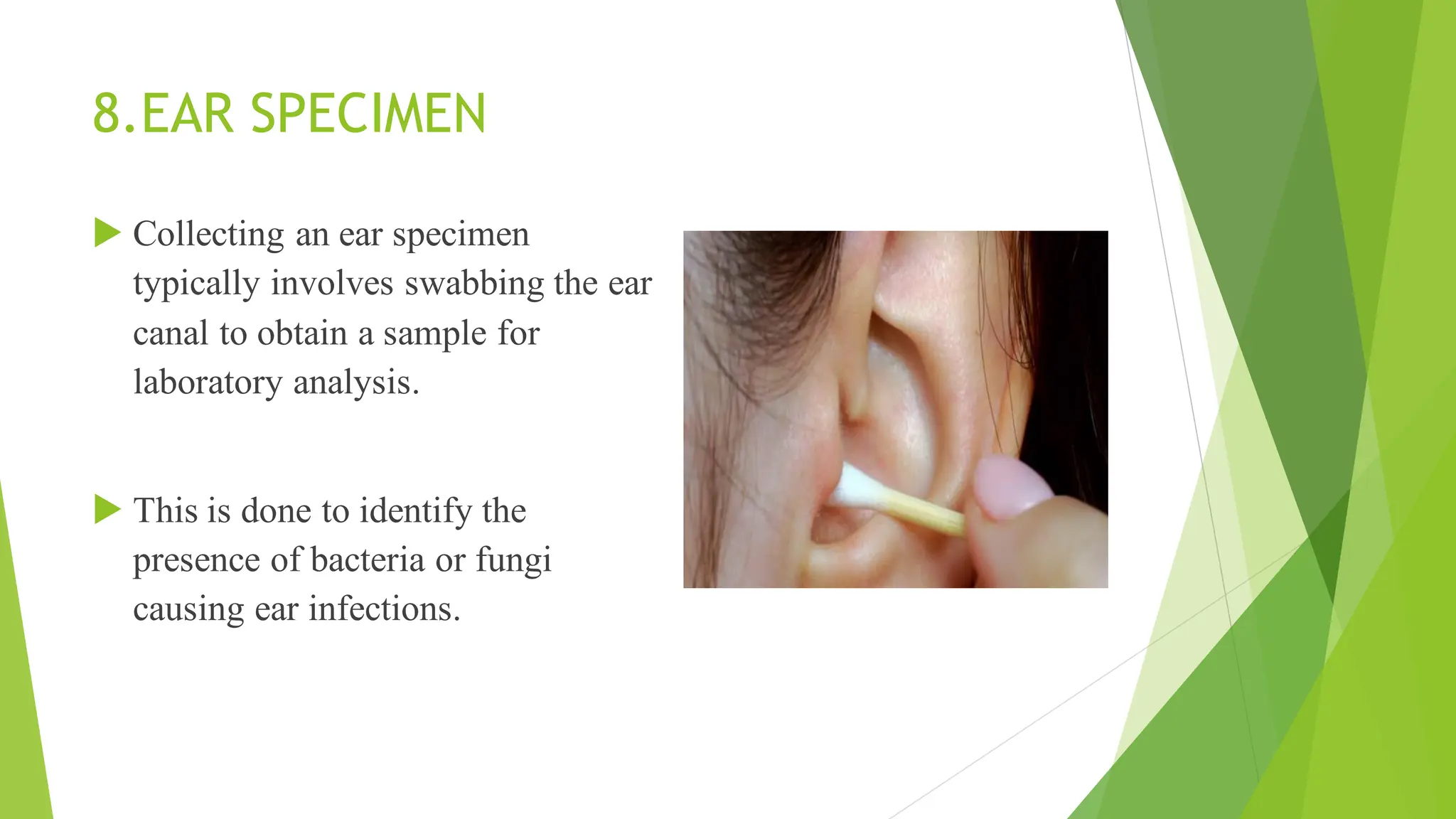
8.EAR SPECIMEN
 Collecting an ear specimen
typically involves swabbing the ear
canal to obtain a sample for
laboratory analysis.
 This is done to identify the
presence of bacteria or fungi
causing ear infections.
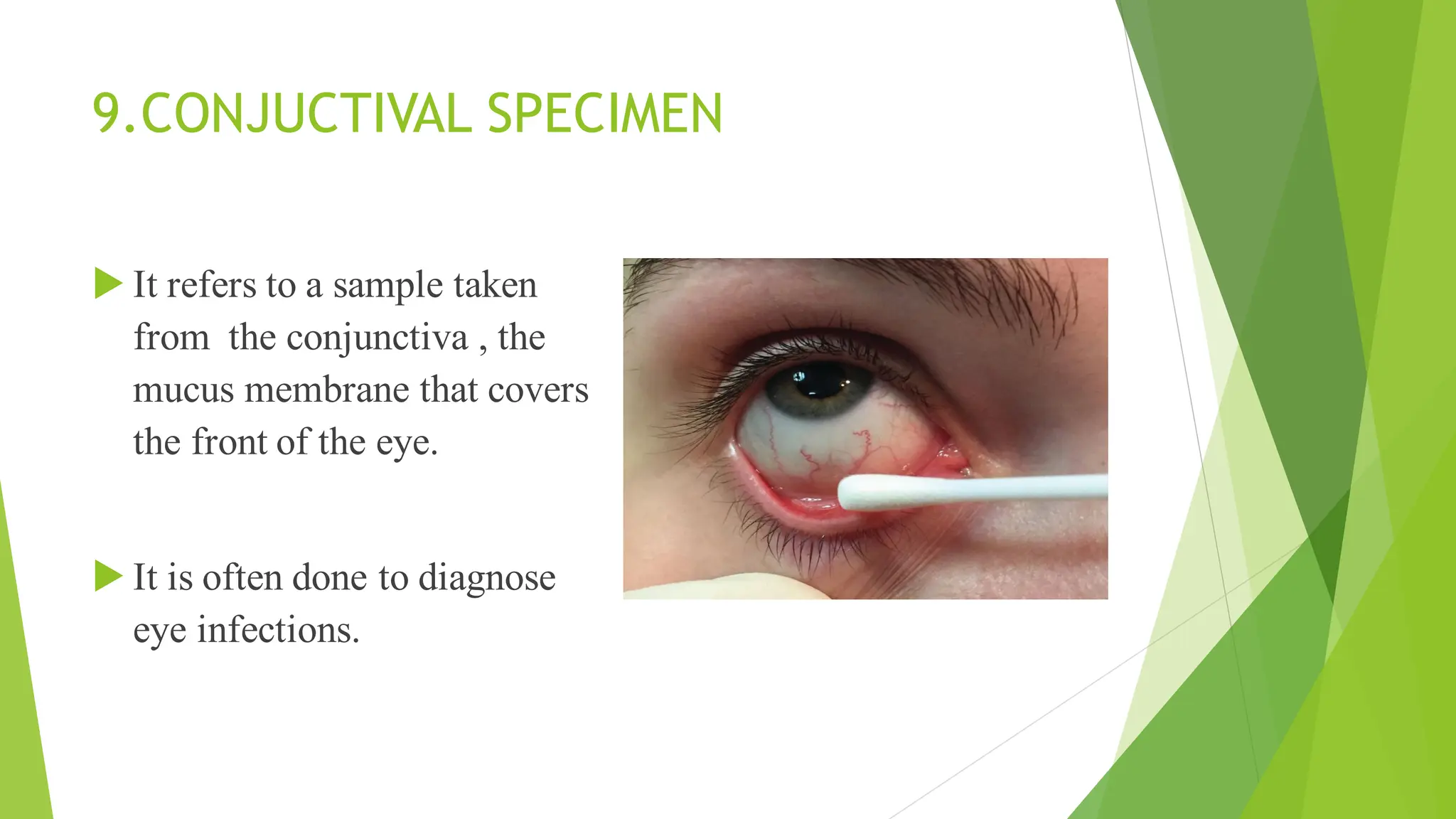
9.CONJUCTIVAL SPECIMEN
 It refers to a sample taken
from the conjunctiva , the
mucus membrane that covers
the front of the eye.
 It is often done to diagnose
eye infections.
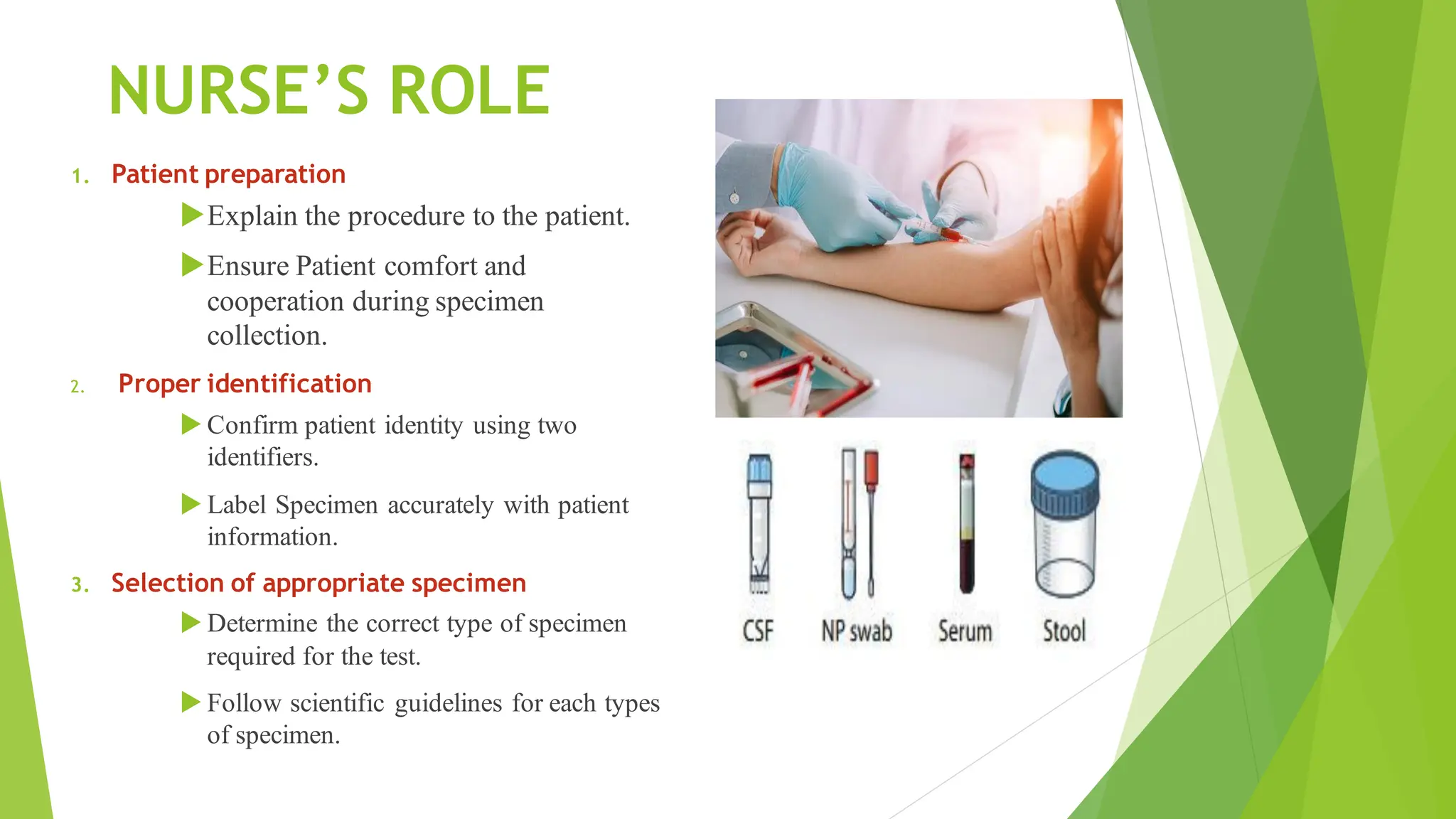
NURSE’S ROLE
1. Patient preparation
Explain the procedure to the patient.
Ensure Patient comfort and
cooperation during specimen
collection.
2. Proper identification
 Confirm patient identity using two
identifiers.
 Label Specimen accurately with patient
information.
3. Selection of appropriate specimen
 Determine the correct type of specimen
required for the test.
 Follow scientific guidelines for each types
of specimen.
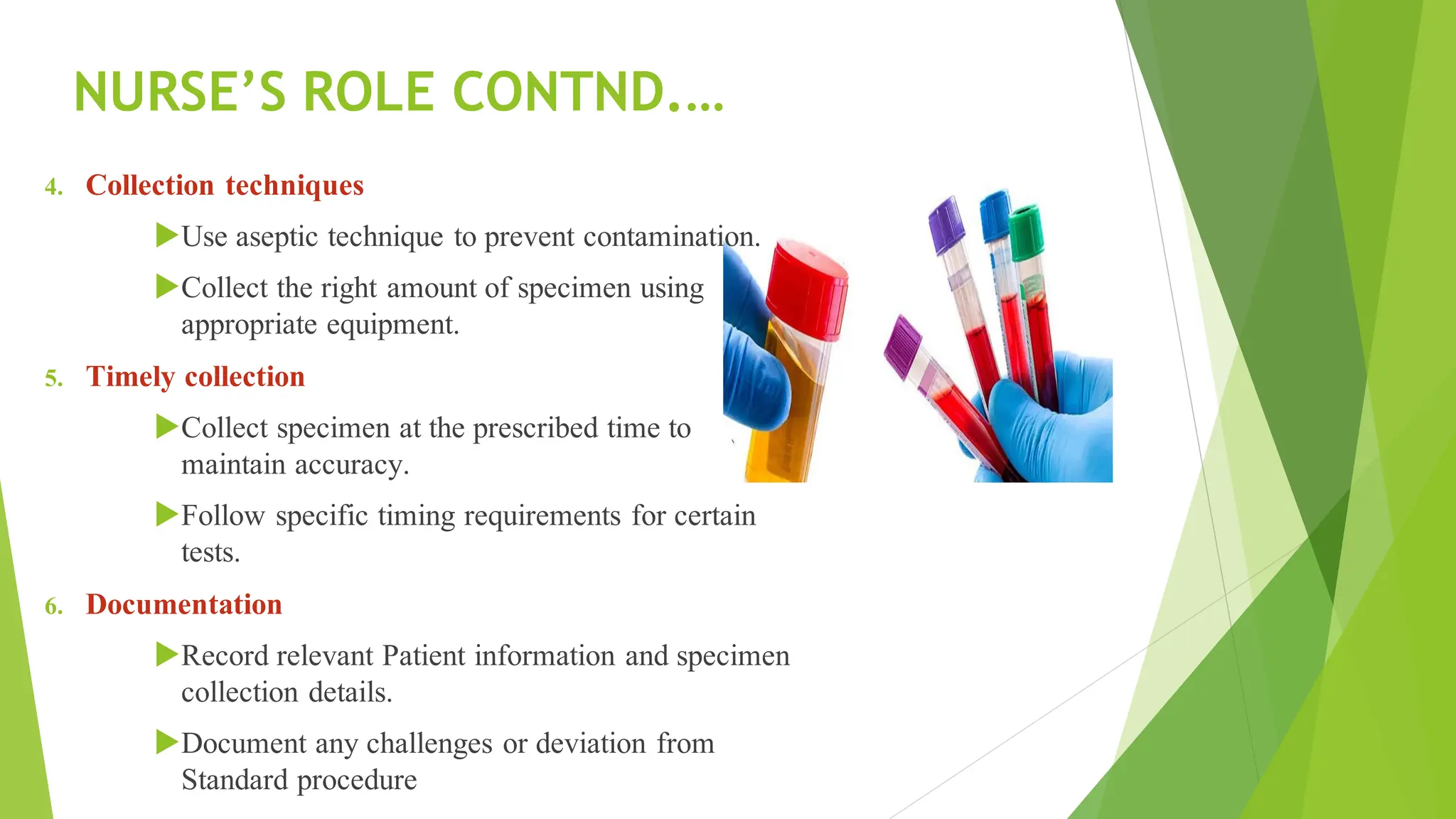
NURSE’S ROLE CONTND.…
4. Collection techniques
Use aseptic technique to prevent contamination.
Collect the right amount of specimen using
appropriate equipment.
5. Timely collection
Collect specimen at the prescribed time to
maintain accuracy.
Follow specific timing requirements for certain
tests.
6. Documentation
Record relevant Patient information and specimen
collection details.
Document any challenges or deviation from
Standard procedure
NURSE’S ROLE CONTND.…
7. Transportationand storage
Ensure proper handling during transportation to the laboratory.
Follow guidelines for storing specimens before transport.
8. Infection control
Adhere to infection control protocols to prevent the spread of infection
Use personal protective equipment as necessary
9. Communication
Communicate effectively with patients, informing them the process and
any potential discomfort
Relay important information to the laboratory staff.
NURSE’S ROLE CONTND.…
10. Quality assurance
Participate in quality control measures to maintain
the integrity of specimen
Monitor expiration dates of collection supplies
11. Patient advocacy
Advocate for patients by ensuring their
Rights and privacy during specimen collection
Address any concerns or questions they may have.
Types of Specimen collection.pdf

Types of Specimen collection.pdf

  • 1.
    TYPES OF SPECIMENAND NURSE’S RESPONSIBILITY IN SPECIMEN COLLECTION Prepared by Anamika Harshan C Roll No : 12 42nd Batch Bsc Nursing Govt college of nursing Kozhikode
  • 2.
    SPECIMEN A specimen isa small substance which shows the kind and quality of a whole sample. Specimens are crucial for diagnosing medical conditions, monitoring treatment effectiveness and overall assessing a patient’s health.
  • 3.
  • 4.
  • 5.
    1. BLOOD SPECIMEN Blood specimen is a small sample of blood collected for analysis, and often used in medical diagnosis to assess various health parameters such as complete blood count,chemistry and disease markers.  This sample is typically extracted through Venipuncture Or finger stick technique.  It contains a wealth of information that can aid in diagnosing and monitoring various medical conditions.
  • 6.
    BLOOD SPECIMEN CONTND.… One of the primarily Components analyzed in a blood specimen is the CBC, which assess the quantity and quality of different blood cells.  Additionally the blood chemistry panel examines the levels of various substances like glucose, electrolytes and enzymes.
  • 7.
    BLOOD SPECIMEN CONTND.… Arterialblood is extracted from the artery and is used for blood gas analysis to assess oxygen and carbon dioxide levels. Capillary blood is obtained by pricking finger tip and is used commonly for monitoring glucose and some pediatric tests.
  • 8.
    2 . URINESPECIMEN It offers a noninvasive means of Assessing various aspects of health and are instrumental in diagnosing conditions ranging from kidney diseases to metabolic disorders. Proper collection, handling and analysis are essential to ensure the reliability and accuracy of test results.
  • 9.
    URINE SPECIMEN CONTND.… RANDOMURINE SPECIMEN MIDSTREAM URINE SPECIMEN TIMED URINE SPECIMEN Collected at any time of day. Used for general screening Collected urine sample avoiding the first and last part of urine that comes out. Collected over a specified time period such as 24 hours. Used for quantitative assessment of substances like creatinine and protein
  • 10.
    3. STOOL SPECIMEN Itis collected for the analysis to diagnose gastrointestinal Conditions or infections Routine stool sample - Collected for general screening and examination and also use to identify abnormalities Occult blood test - Collected to screen for hidden blood in stool
  • 11.
    4. RESPIRATORY SPECIMEN Respiratoryspecimen are samples collected from the respiratory tract for diagnostic testing
  • 12.
    RESPIRATORY SPECIMEN CONTND.… UPPERRESPIRATORY TRACT SPECIMEN LOWER RESPIRATORY TRACT SPECIMEN 1. Sputum 2. Endotracheal aspirate 3. Broncho alveolar lavage 1.Throat swab 2.Nasopharyngeal swab
  • 13.
    RESPIRATORY SPECIMEN CONTND…. Upperrespiratory specimen  Throat swab – it is a diagnostic test that evaluates for the presence of bacterial or fungal infection in throat. A sample from the throat is collected by swabbing the throat.  Nasopharyngeal swab – it is collected by Swabbing the back of the nose and throat for respiratory secretions.
  • 14.
    RESPIRATORY SPECIMEN CONTND.… Lowerrespiratory specimen  Sputum – It is mucus and other material Coughed up from the lungs .  Endotracheal aspirate – It is a sample collected from the tube that is inserted in to the wind pipe.  Broncho alveolar lavage – It is the washing out of the small portion of the lungs with saline for analysis.
  • 15.
    5.CSF AND OTHERFLUIDS  Cerebrospinal fluid - It is a clear,colourless fluid that surrounds the brain and spinal cord. It is obtained through lumbar punctureto diagnose disease conditions like Meningitis, encephalitis, and certain neurological disorders.
  • 16.
    CSF AND OTHERFLUIDS CONTND.…
  • 17.
    CSF AND OTHERFLUIDS CONTND.…  Synovial fluid – It is found in joint cavities and it nourishes and lubricate Joints. Aspiration of synovial Fluids help diagnose arthritis, infection and joint inflammation.  Pleural fluids – Accumulates in the pleural space around the lungs. Aspiration aids in diagnosing disease conditions like pneumonia, lung cancer or pleuritis.  Peritoneal fluids – Accumulates in abdominal cavity due to disease conditions like liver disease or cancer,. Aspiration Assist in diagnosing the underlying causes and Assessing infection or malignancy
  • 18.
    6. WOUND SPECIMEN A wound specimen refers to a sample collected from an injry ore open sore for diagnostic examination.
  • 19.
    WOUND SPECIMEN CONTND.… Tissue biopsy – Removal of a small piece of tissue from the wound for microscopic analysis.  Swab culture - Swabbing the wound to collect microbial sample for culture and identification of Bacteria.  Fluid aspiration – Extracting fluid from wound, for useful analyzing the presence of Infection and other abnormalities
  • 20.
    7. GENITAL SPECIMEN Urethral swab – It is often done to diagnose or screen for infections such as STDs  Cervical swab – It is a sample taken from cervix for various purposes such as pap smear to screen for cervical cancer or to test for STDs.
  • 21.
    8.EAR SPECIMEN  Collectingan ear specimen typically involves swabbing the ear canal to obtain a sample for laboratory analysis.  This is done to identify the presence of bacteria or fungi causing ear infections.
  • 22.
    9.CONJUCTIVAL SPECIMEN  Itrefers to a sample taken from the conjunctiva , the mucus membrane that covers the front of the eye.  It is often done to diagnose eye infections.
  • 24.
    NURSE’S ROLE 1. Patientpreparation Explain the procedure to the patient. Ensure Patient comfort and cooperation during specimen collection. 2. Proper identification  Confirm patient identity using two identifiers.  Label Specimen accurately with patient information. 3. Selection of appropriate specimen  Determine the correct type of specimen required for the test.  Follow scientific guidelines for each types of specimen.
  • 25.
    NURSE’S ROLE CONTND.… 4.Collection techniques Use aseptic technique to prevent contamination. Collect the right amount of specimen using appropriate equipment. 5. Timely collection Collect specimen at the prescribed time to maintain accuracy. Follow specific timing requirements for certain tests. 6. Documentation Record relevant Patient information and specimen collection details. Document any challenges or deviation from Standard procedure
  • 26.
    NURSE’S ROLE CONTND.… 7.Transportationand storage Ensure proper handling during transportation to the laboratory. Follow guidelines for storing specimens before transport. 8. Infection control Adhere to infection control protocols to prevent the spread of infection Use personal protective equipment as necessary 9. Communication Communicate effectively with patients, informing them the process and any potential discomfort Relay important information to the laboratory staff.
  • 27.
    NURSE’S ROLE CONTND.… 10.Quality assurance Participate in quality control measures to maintain the integrity of specimen Monitor expiration dates of collection supplies 11. Patient advocacy Advocate for patients by ensuring their Rights and privacy during specimen collection Address any concerns or questions they may have.