REFRACTORY- MAGNESIA CARBON
Presented by: Ankita Bilung (919CR5007)
Exe. PhD (Ceramic Engg), NIT Rourkela
Seminar and Technical Writing
Course Instructor: Professor D.Sarkar
Refractory
“...non-metallic materials having those chemical and physical
properties that make them applicable for structures, or as
components of systems, that are exposed to environments
above 1,000 °F (811 K; 538 °C).” ~ASTM C71
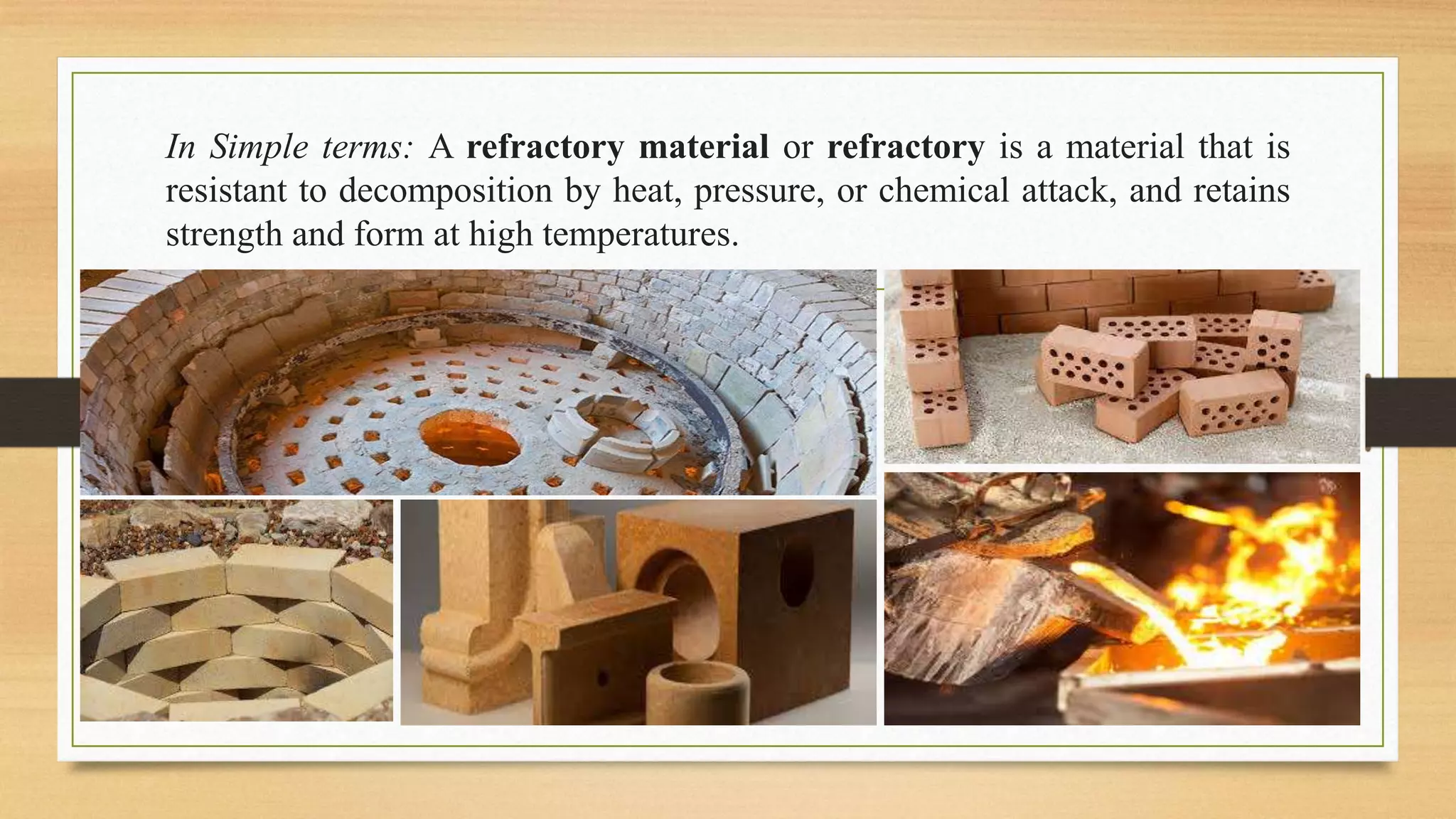
In Simple terms: A refractory material or refractory is a material that is
resistant to decomposition by heat, pressure, or chemical attack, and retains
strength and form at high temperatures.
Basic Properties
• Able to withstand high temperatures
• High Thermal Shock resistance.
• Abrasion Resistant
• Low Thermal expansion
• Heat insulation
• Chemically inactive
• Impermeable to Gases and Liquids
• Low electrical conductivity (if used in Electric Furnaces)
Steel Industry & Refractories
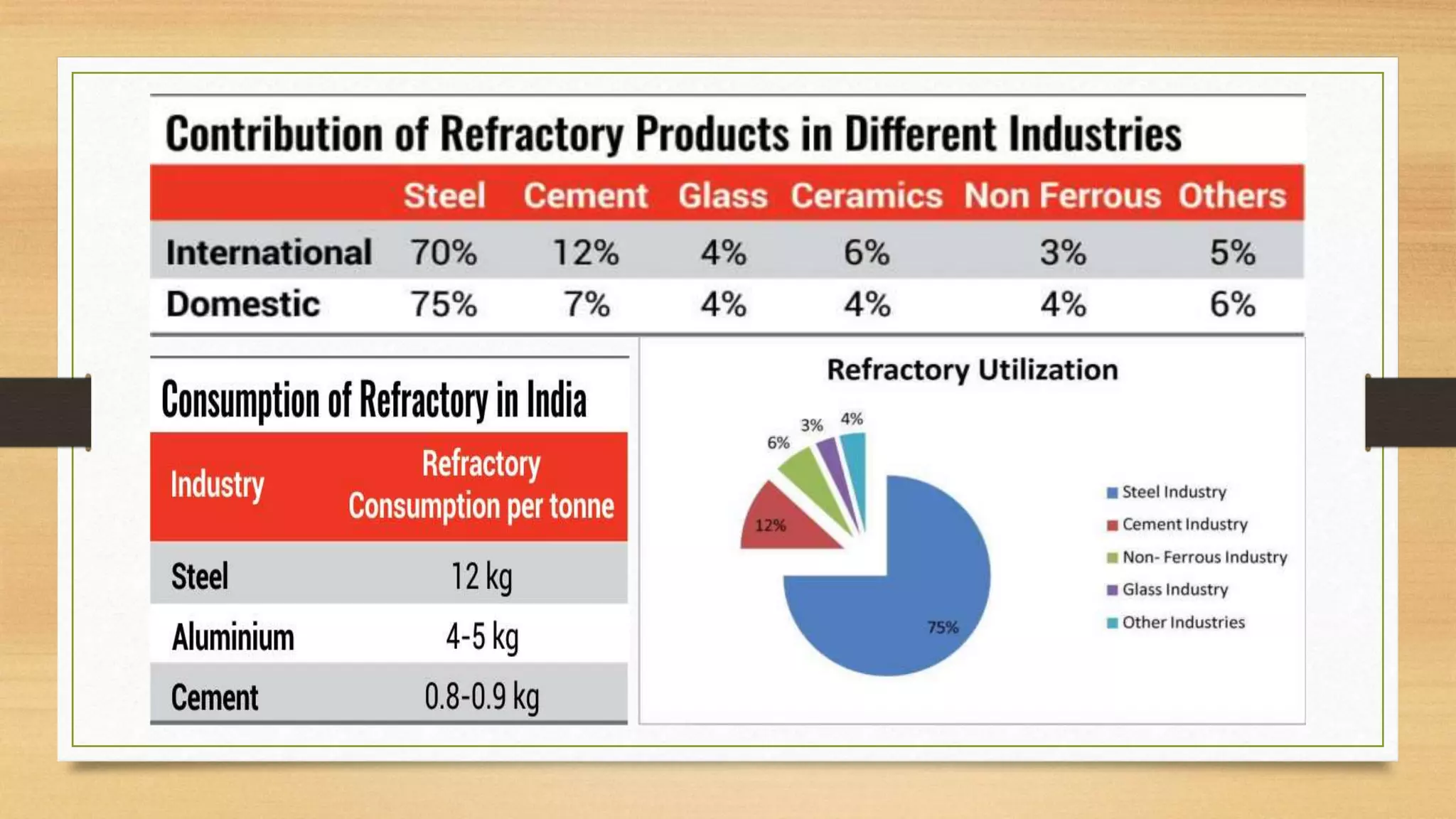
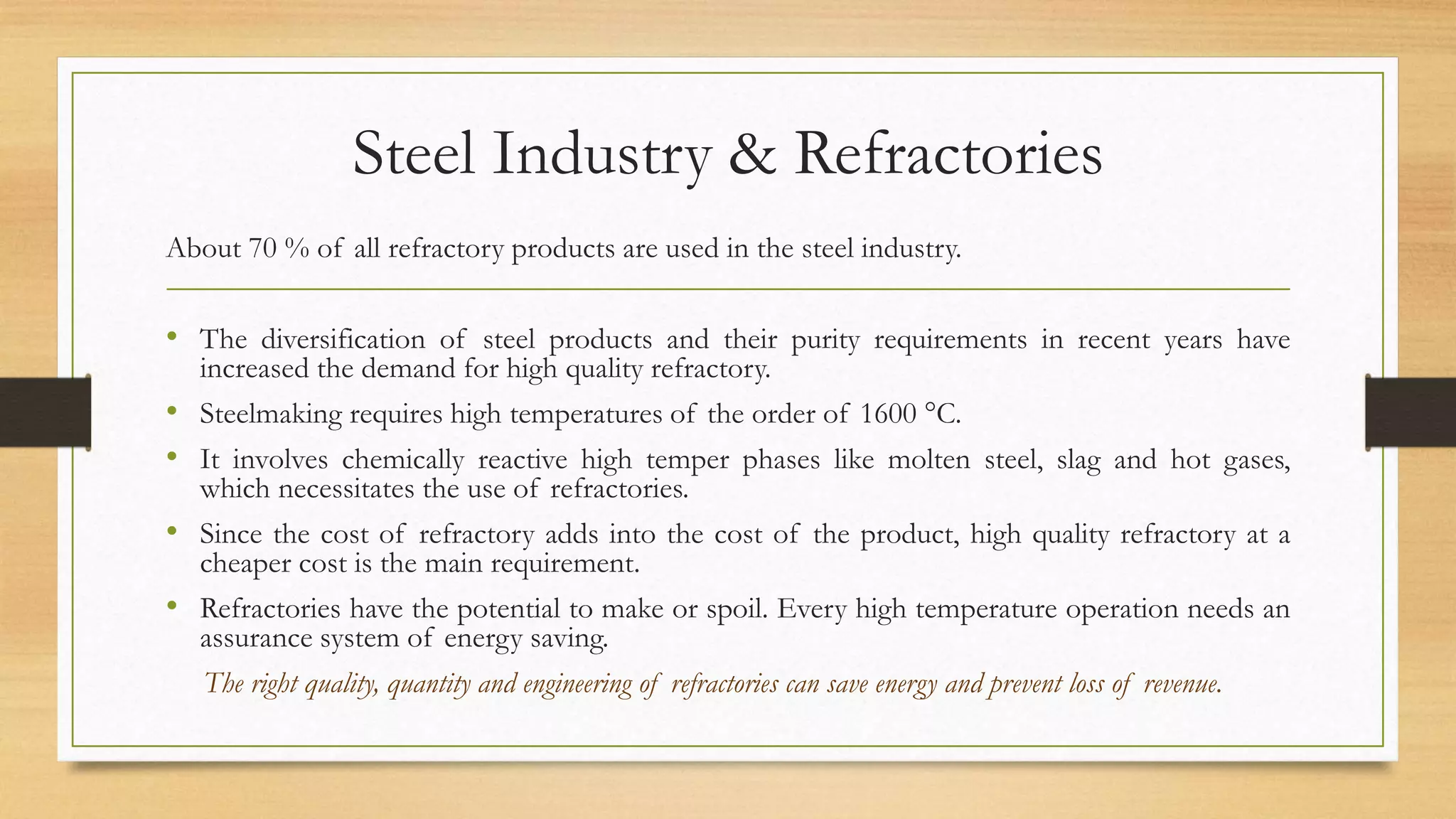
About 70 % of all refractory products are used in the steel industry.
• The diversification of steel products and their purity requirements in recent years have
increased the demand for high quality refractory.
• Steelmaking requires high temperatures of the order of 1600 °C.
• It involves chemically reactive high temper phases like molten steel, slag and hot gases,
which necessitates the use of refractories.
• Since the cost of refractory adds into the cost of the product, high quality refractory at a
cheaper cost is the main requirement.
• Refractories have the potential to make or spoil. Every high temperature operation needs an
assurance system of energy saving.
The right quality, quantity and engineering of refractories can save energy and prevent loss of revenue.
Steel Industry & Refractories
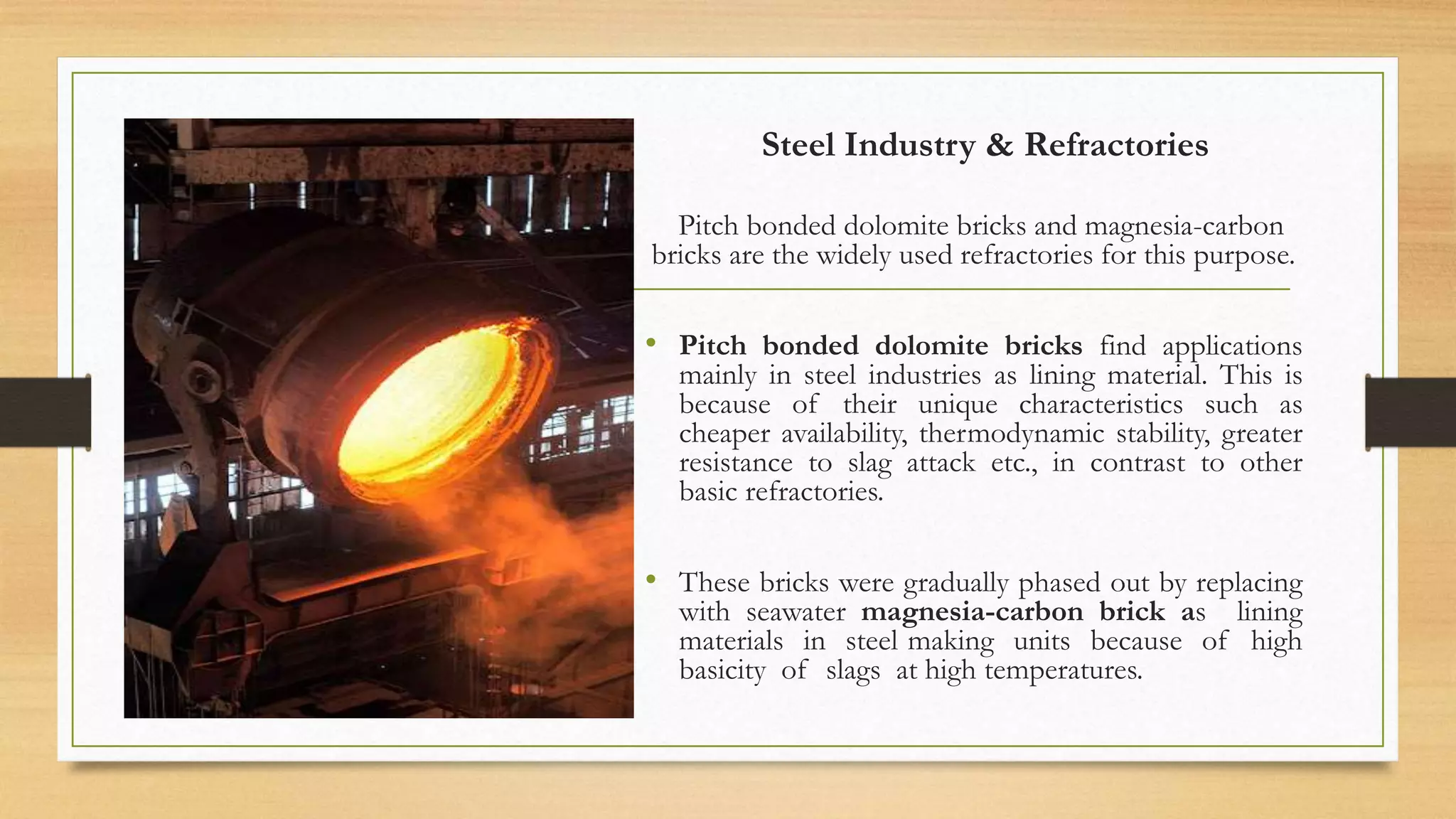
Pitch bonded dolomite bricks and magnesia-carbon
bricks are the widely used refractories for this purpose.
• Pitch bonded dolomite bricks find applications
mainly in steel industries as lining material. This is
because of their unique characteristics such as
cheaper availability, thermodynamic stability, greater
resistance to slag attack etc., in contrast to other
basic refractories.
• These bricks were gradually phased out by replacing
with seawater magnesia-carbon brick as lining
materials in steel making units because of high
basicity of slags at high temperatures.
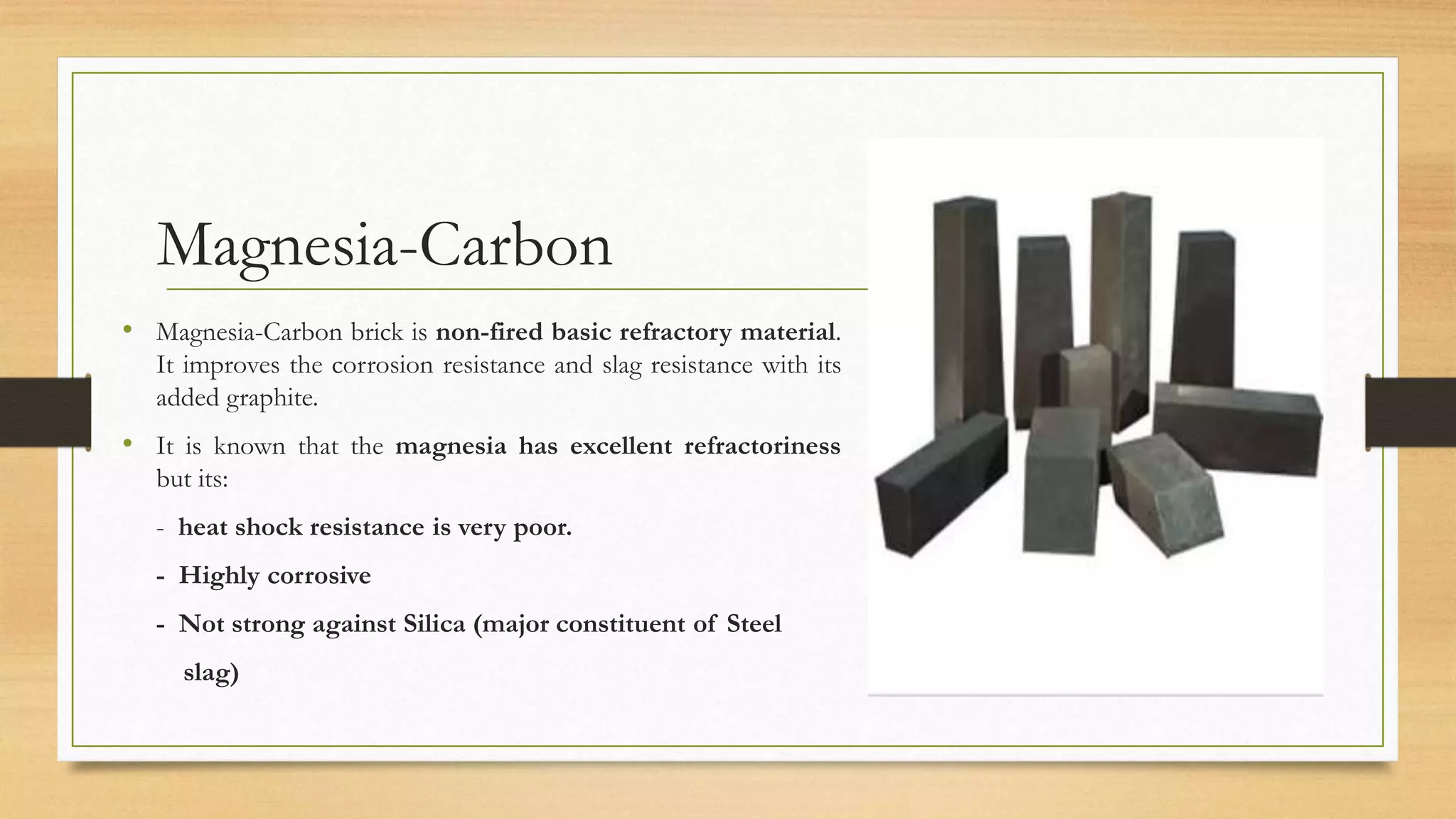
Magnesia-Carbon
• Magnesia-Carbon brick is non-fired basic refractory material.
It improves the corrosion resistance and slag resistance with its
added graphite.
• It is known that the magnesia has excellent refractoriness
but its:
- heat shock resistance is very poor.
- Highly corrosive
- Not strong against Silica (major constituent of Steel
slag)
However, graphite has the characteristics stated below:
• Resistance to corrosion and infiltration from furnace slag and steel fluid.
• Resistance to high-temperature attack. When in the reduction, it can resist
extremely high temperature.
• Proper high temperature strength can be retained.
• But it is a natural mineral, hence has lot of impurities esp Ash.
Ash + Silica  Reduces the Application Temp
Preparation of MgO-C bricks
• Pitch impregnated MgO
− Initially Pitch / Tar were used but now resin is
used instead.
− These require no firing and are only pressed,
hence is quite profitable.
− The pitch is kept in Liquid form under pressure.
As pitch contains volatile matters, which
evaporates under pressure, leaving a net Carbon
coating of about 2.5%.
− Although it is better than MgO bricks, its life does
not increase.
• Pitch bonded MgO
− In this type, pitch is pressed into MgO
bricks at very High temperature and
then cured to remove the volatile
material.
− It leaves a net Carbon coating of about
5%.
− This is used for economical purposes
especially in Ladle's of Basic Oxygen
Furnace (BOF), where wear is less.
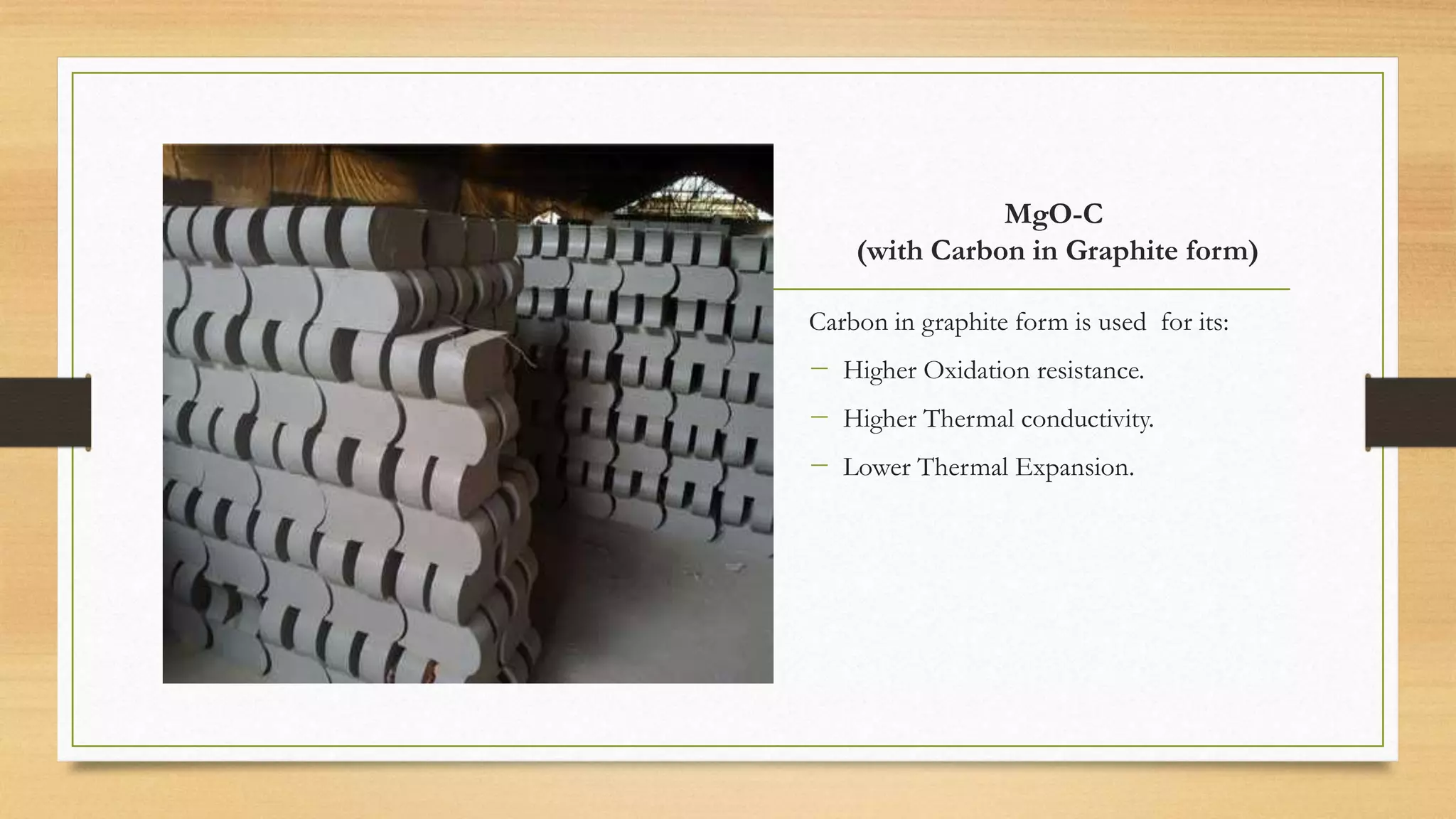
MgO-C
(with Carbon in Graphite form)
Carbon in graphite form is used for its:
− Higher Oxidation resistance.
− Higher Thermal conductivity.
− Lower Thermal Expansion.
• The MgO–carbon bricks of varying carbon concentration are used as refractory lining
material in BOF. Laser profiling of the lining is done at regular intervals to keep track of
refractory wear in different parts of vessels.
• The main factors which affect the kinetics of dissolution of graphite flakes lying between
the MgO grains in the belly region are attack by CO2 in gas and FeO in slag, and
temperature.
• FeO can easily penetrate the MgO grains along grain boundaries and reach those places
where graphite flakes are present.
• Kinetic models of refractory wear are analyzed on the basis of data obtained from actual
laser profile measurements. The bricks salvaged from the top cone region at the end of
the campaign have been subjected to scanning electron microscope (SEM) and electron
probe micro analyzer (EPMA) investigations.
• The possible cause of wear in topcone region is also the oxidation of carbonin the brick
by CO2 gas and direct attack by FeO thrown from the jet impact region.
Mechanism of FeO Attack on the
Refractory Lining.
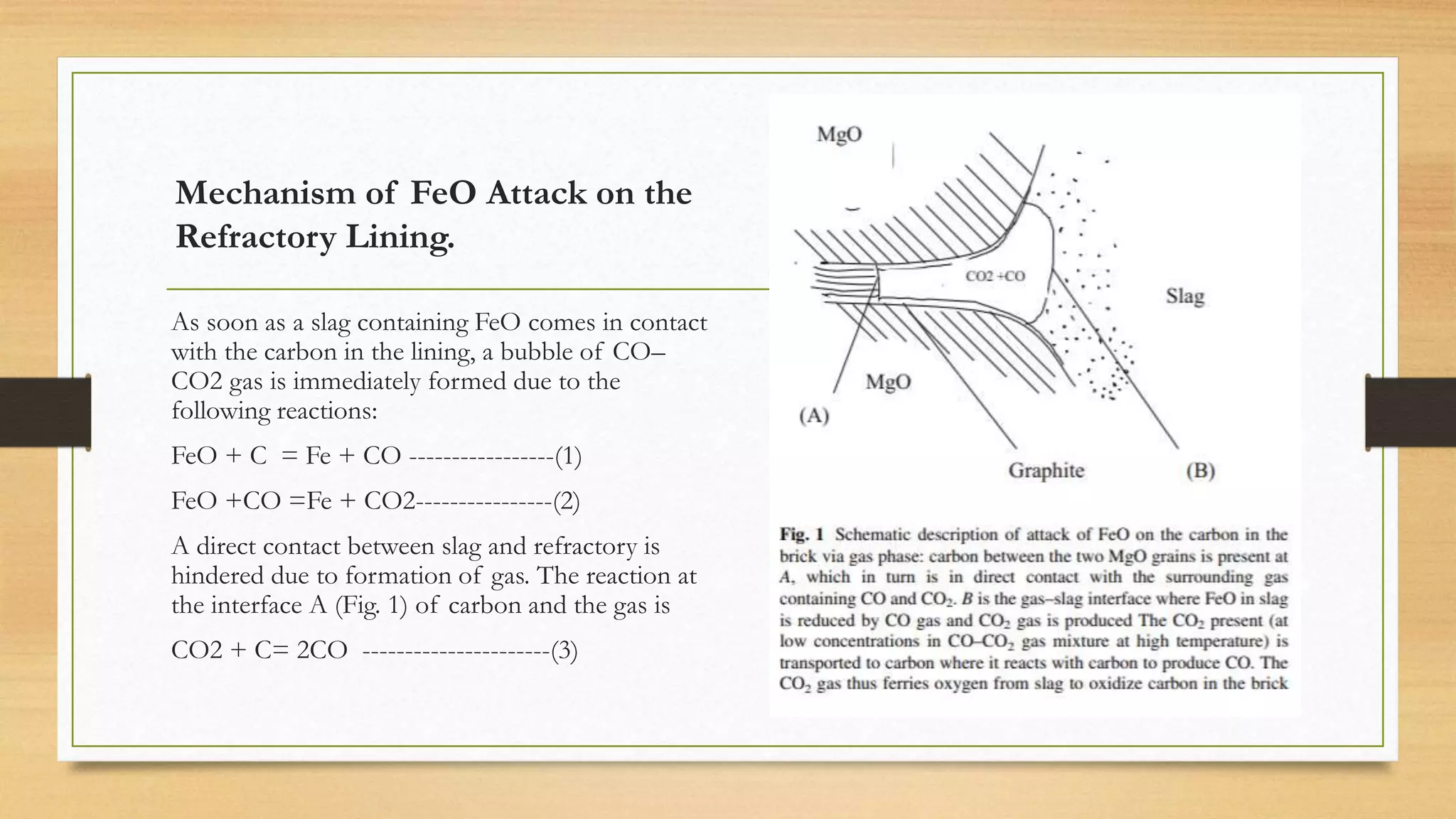
As soon as a slag containing FeO comes in contact
with the carbon in the lining, a bubble of CO–
CO2 gas is immediately formed due to the
following reactions:
FeO + C = Fe + CO -----------------(1)
FeO +CO =Fe + CO2----------------(2)
A direct contact between slag and refractory is
hindered due to formation of gas. The reaction at
the interface A (Fig. 1) of carbon and the gas is
CO2 + C= 2CO ----------------------(3)
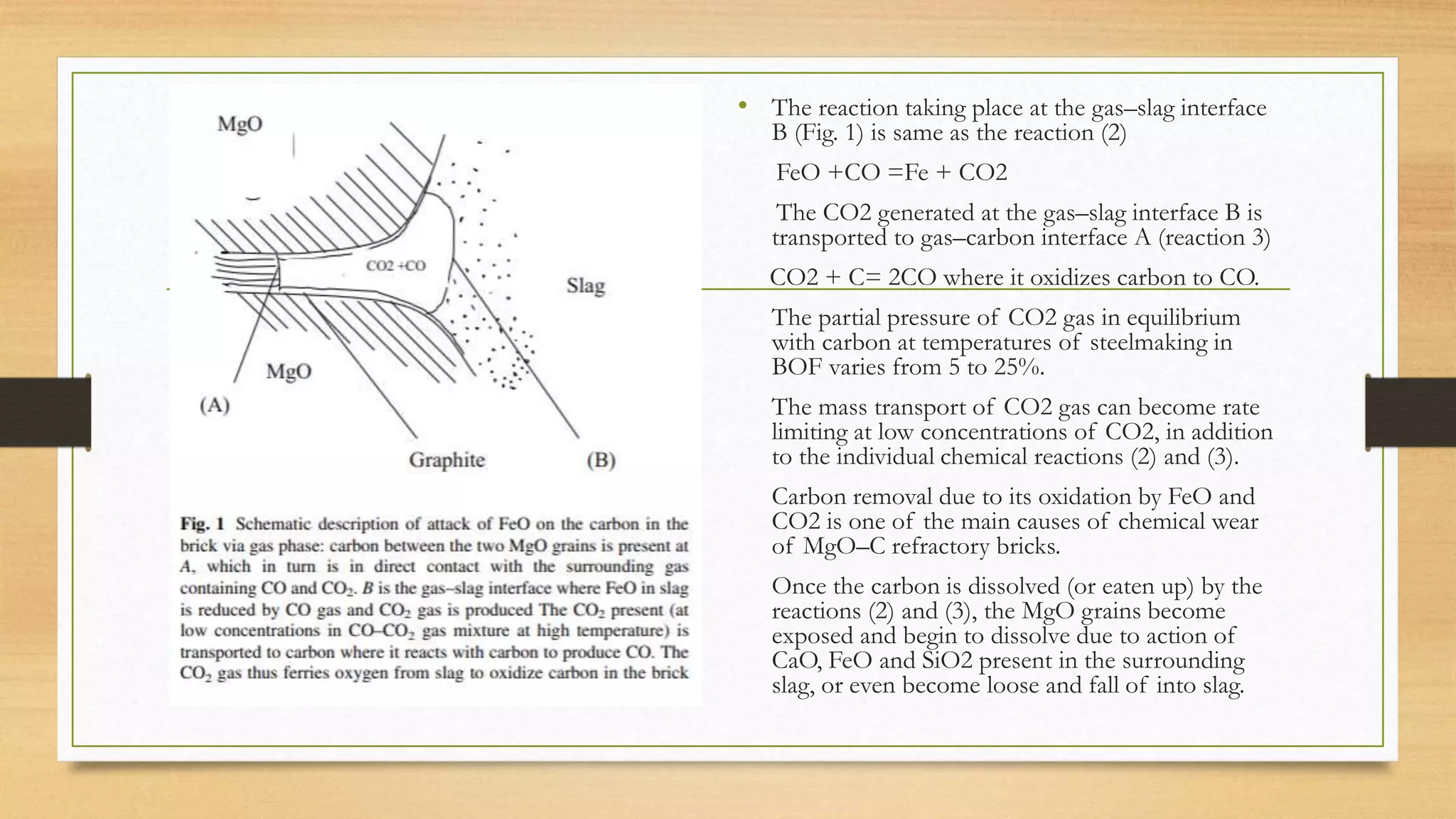
• The reaction taking place at the gas–slag interface
B (Fig. 1) is same as the reaction (2)
FeO +CO =Fe + CO2
The CO2 generated at the gas–slag interface B is
transported to gas–carbon interface A (reaction 3)
CO2 + C= 2CO where it oxidizes carbon to CO.
The partial pressure of CO2 gas in equilibrium
with carbon at temperatures of steelmaking in
BOF varies from 5 to 25%.
The mass transport of CO2 gas can become rate
limiting at low concentrations of CO2, in addition
to the individual chemical reactions (2) and (3).
Carbon removal due to its oxidation by FeO and
CO2 is one of the main causes of chemical wear
of MgO–C refractory bricks.
Once the carbon is dissolved (or eaten up) by the
reactions (2) and (3), the MgO grains become
exposed and begin to dissolve due to action of
CaO, FeO and SiO2 present in the surrounding
slag, or even become loose and fall of into slag.
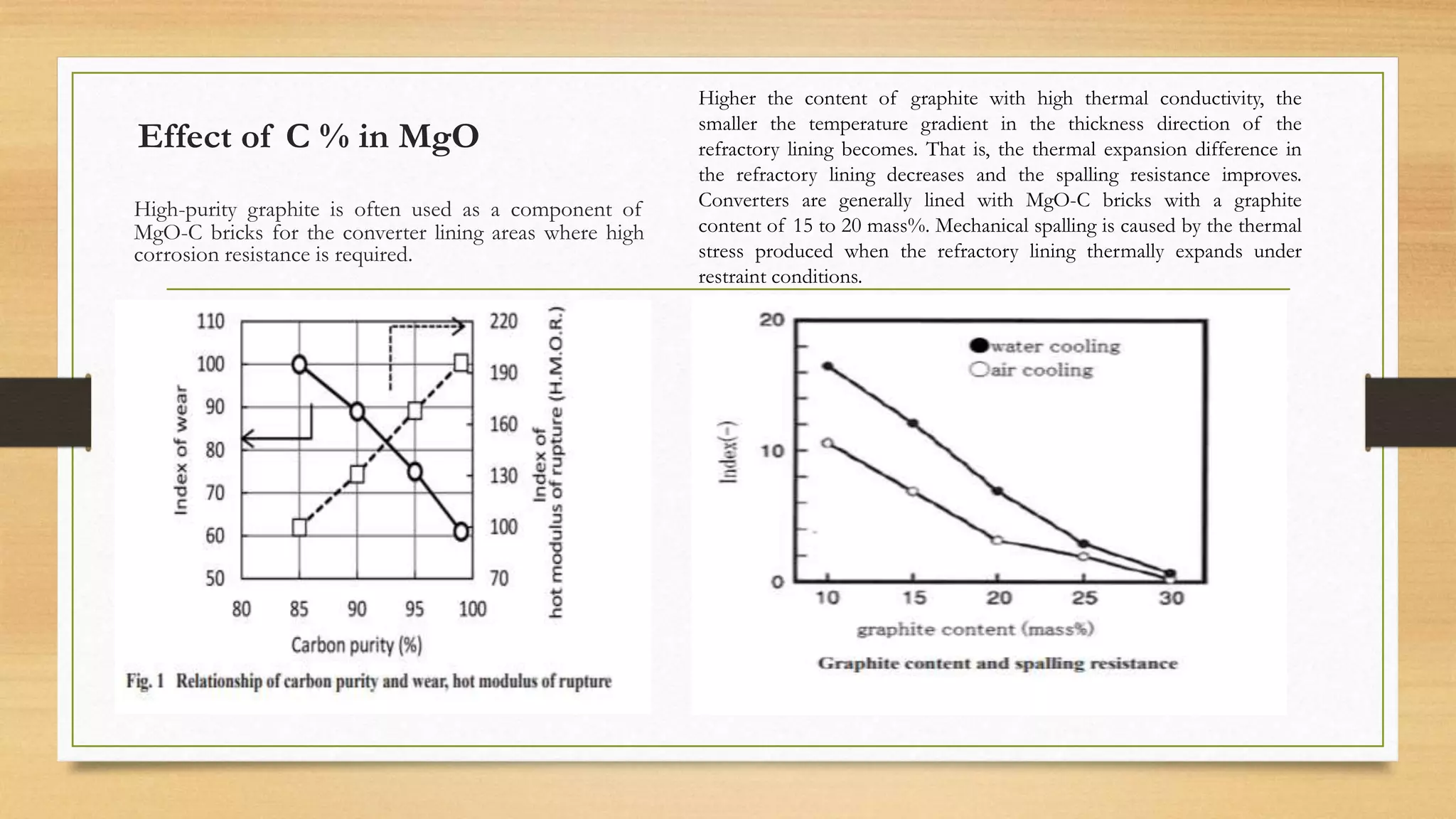
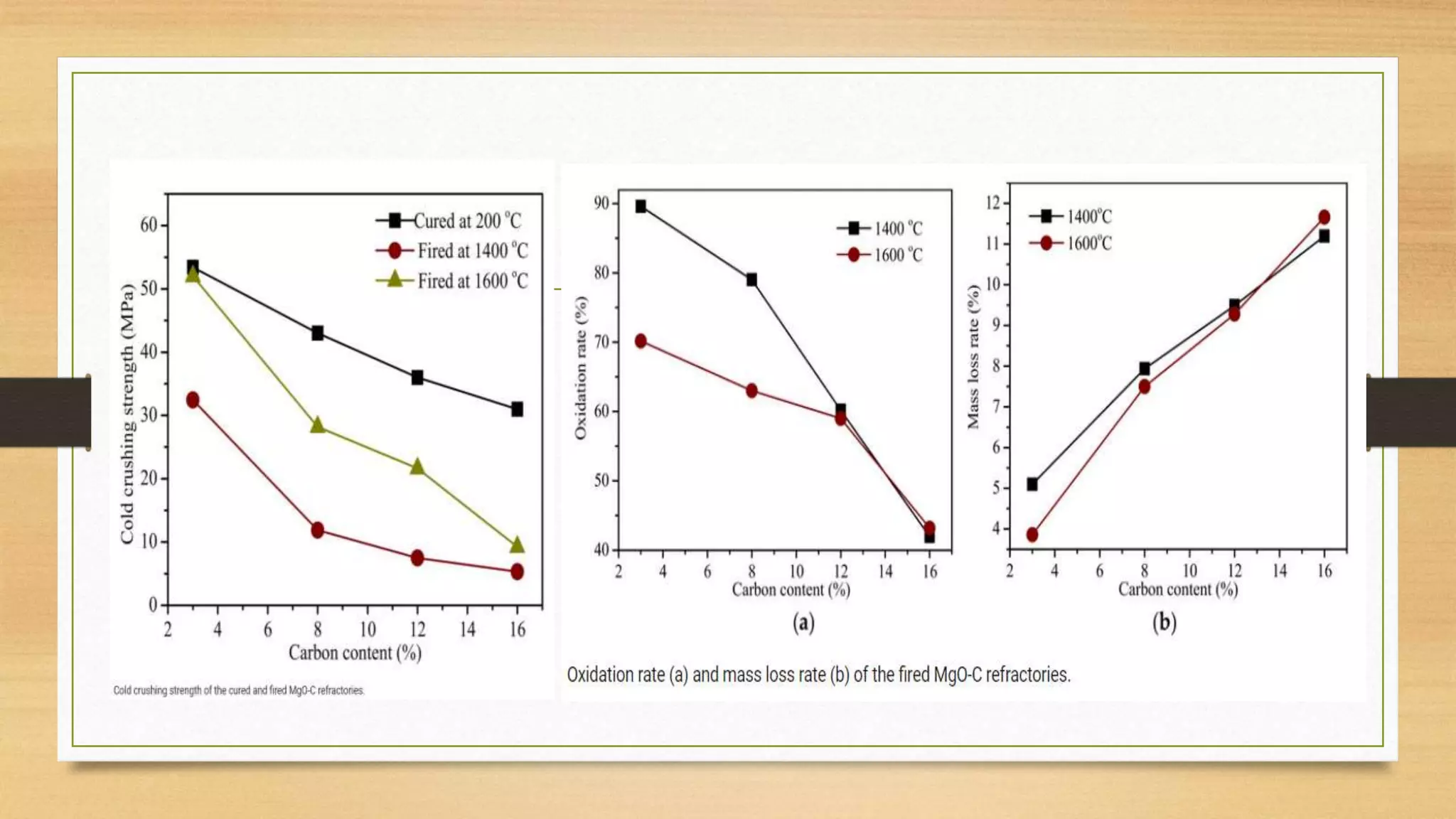
High-purity graphite is often used as a component of
MgO-C bricks for the converter lining areas where high
corrosion resistance is required.
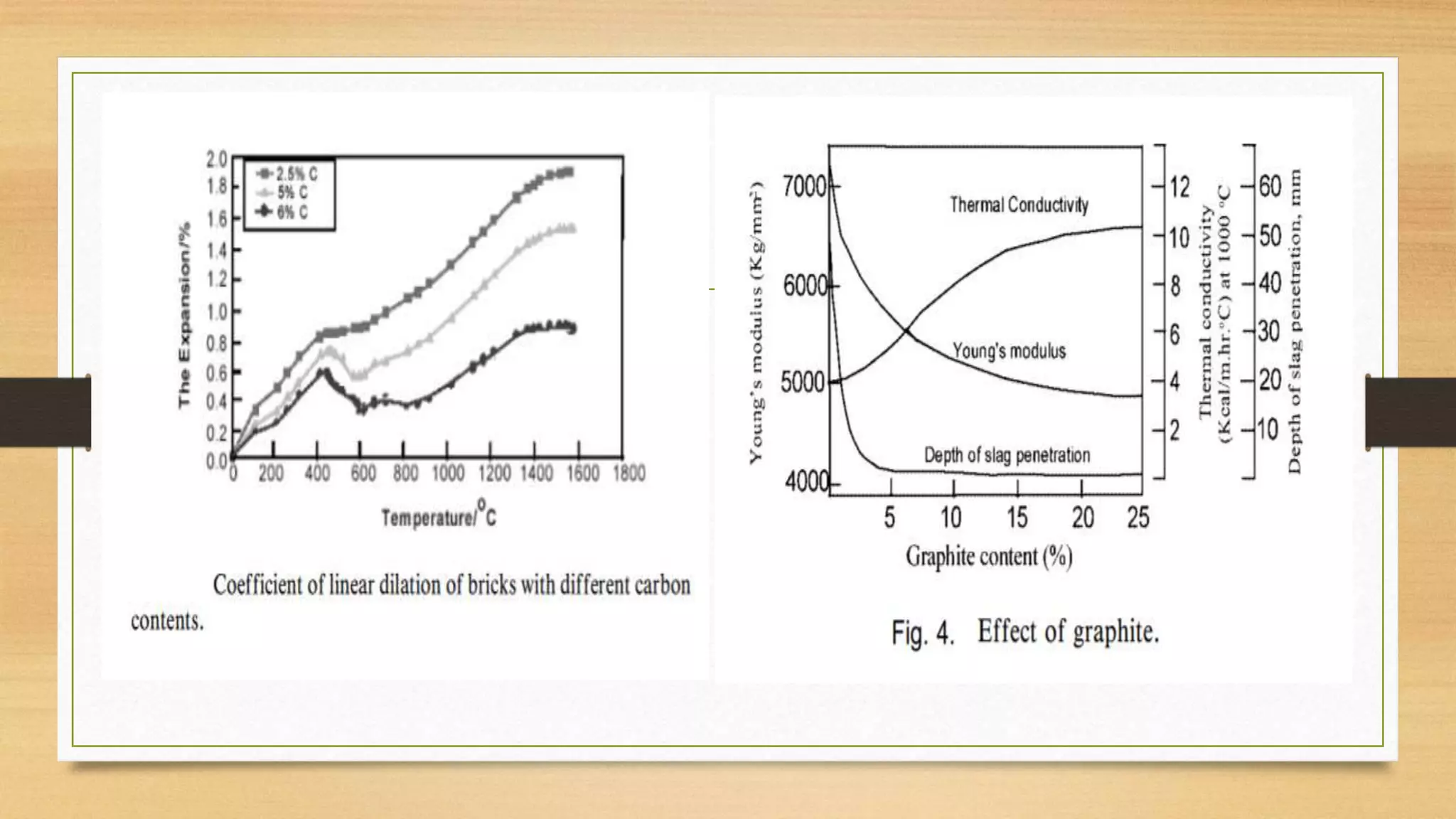
Higher the content of graphite with high thermal conductivity, the
smaller the temperature gradient in the thickness direction of the
refractory lining becomes. That is, the thermal expansion difference in
the refractory lining decreases and the spalling resistance improves.
Converters are generally lined with MgO-C bricks with a graphite
content of 15 to 20 mass%. Mechanical spalling is caused by the thermal
stress produced when the refractory lining thermally expands under
restraint conditions.
Effect of C % in MgO
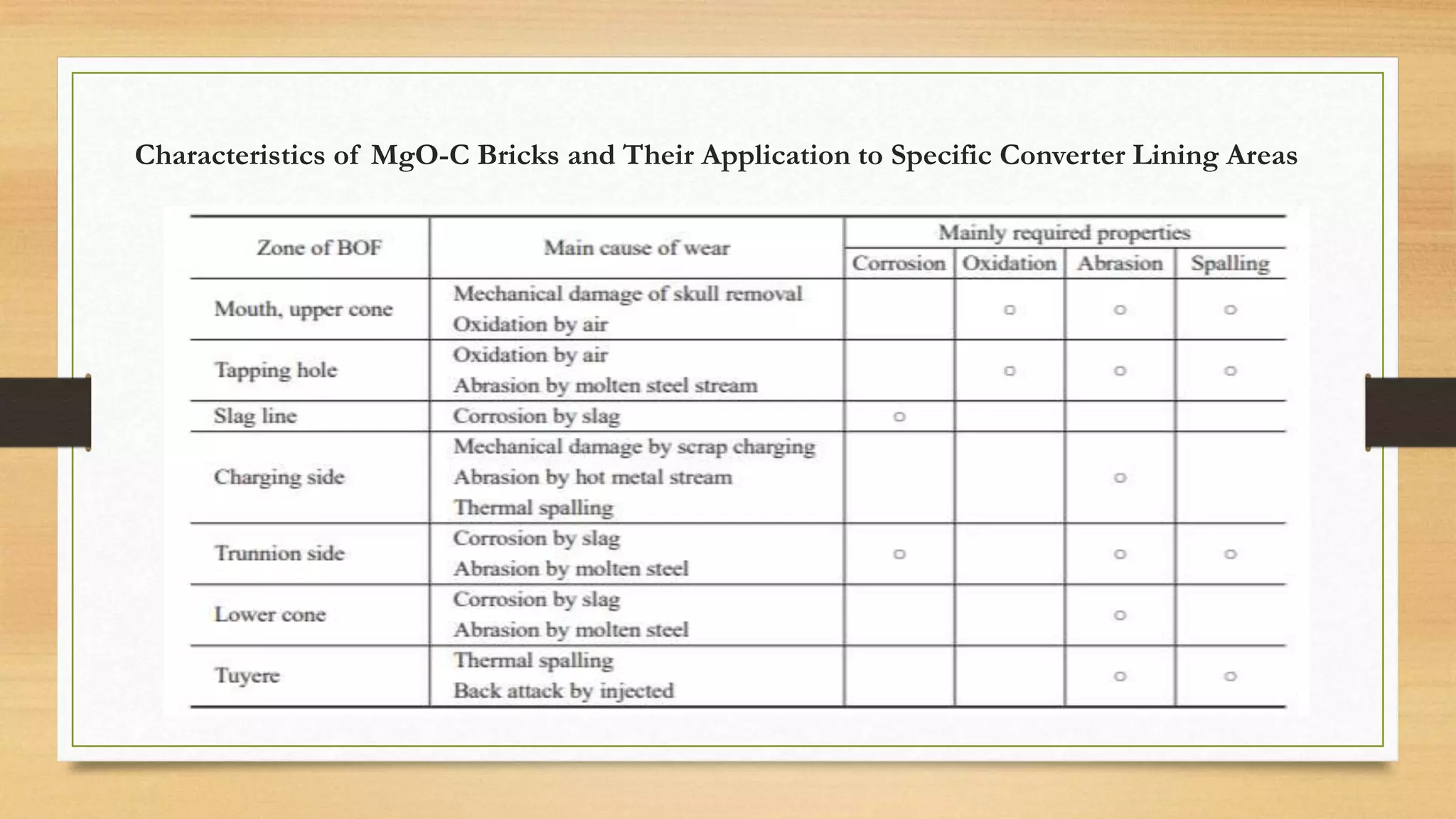
Characteristics of MgO-C Bricks and Their Application to Specific Converter Lining Areas
 Good high temperature resistance
property
 Strong slag erosion resistance of
magnesia
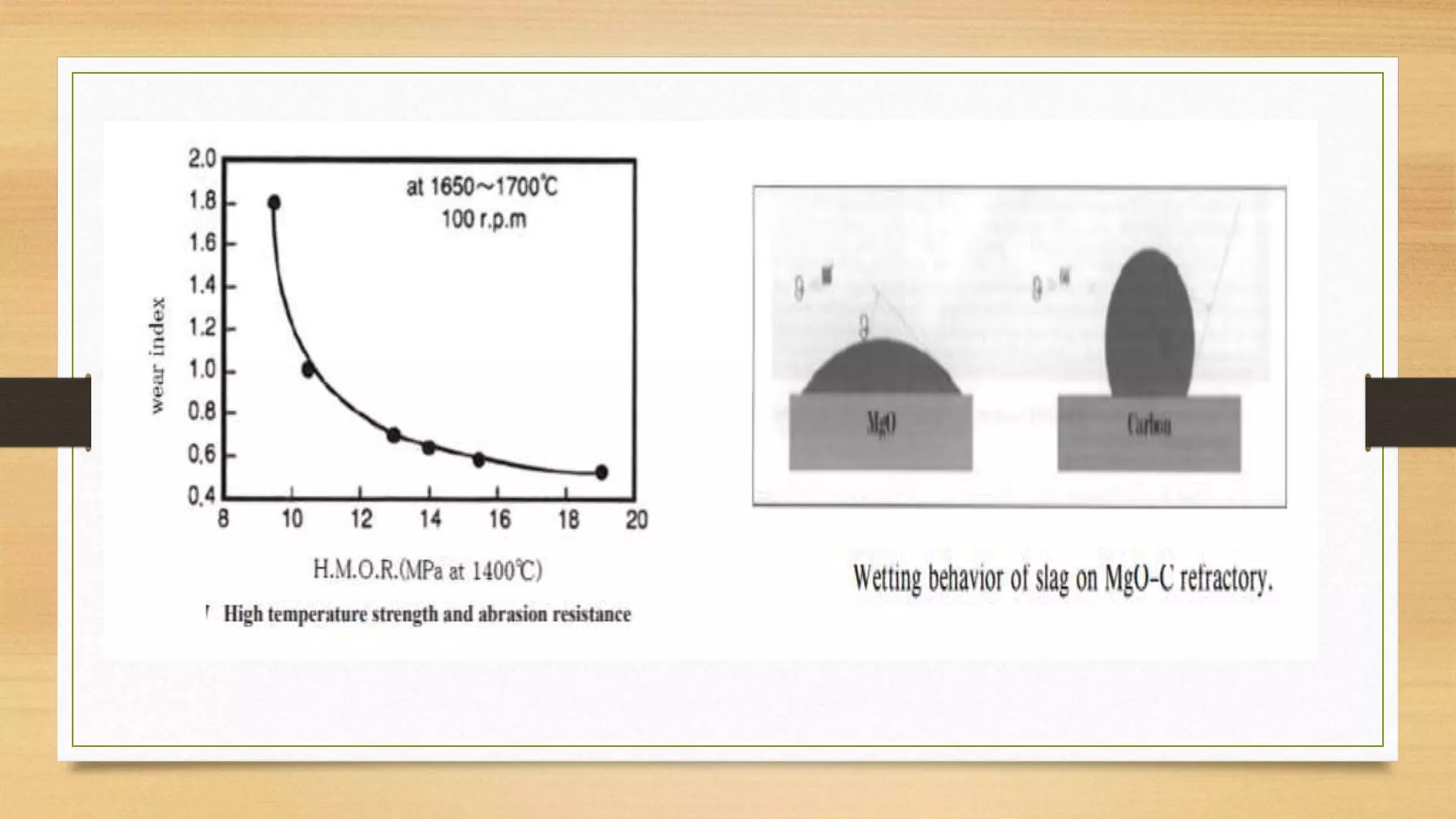
 Non-wetting nature
 Good thermal shock resistance
 Low high-temperature creep
 Good heat stability
 High thermal conductivity and low
expansibility of carbon efficiently
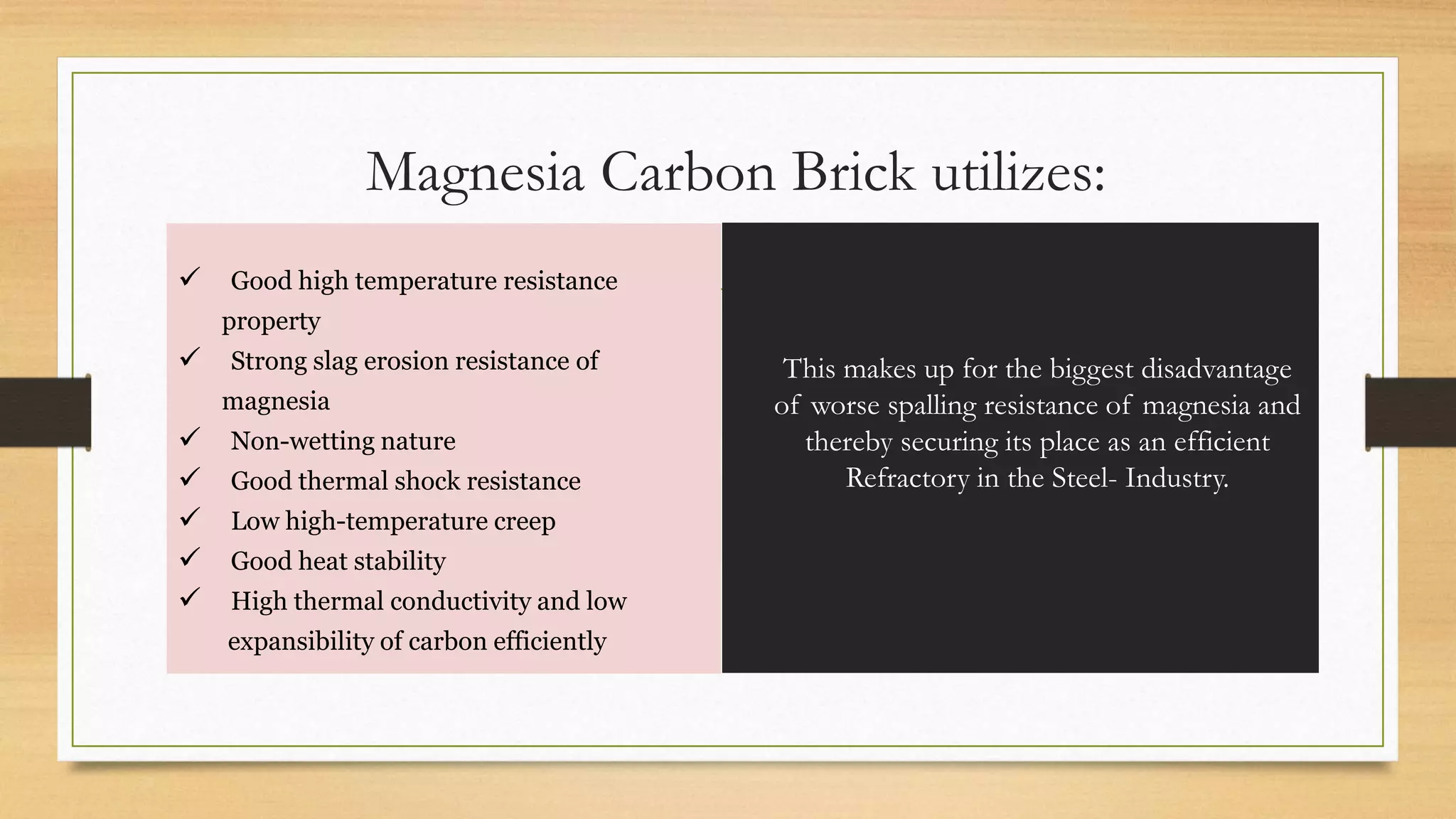
Magnesia Carbon Brick utilizes:
This makes up for the biggest disadvantage
of worse spalling resistance of magnesia and
thereby securing its place as an efficient
Refractory in the Steel- Industry.
Thank You

Refractory MgO-C

  • 1.
    REFRACTORY- MAGNESIA CARBON Presentedby: Ankita Bilung (919CR5007) Exe. PhD (Ceramic Engg), NIT Rourkela Seminar and Technical Writing Course Instructor: Professor D.Sarkar
  • 2.
    Refractory “...non-metallic materials havingthose chemical and physical properties that make them applicable for structures, or as components of systems, that are exposed to environments above 1,000 °F (811 K; 538 °C).” ~ASTM C71
  • 3.
    In Simple terms:A refractory material or refractory is a material that is resistant to decomposition by heat, pressure, or chemical attack, and retains strength and form at high temperatures.
  • 4.
    Basic Properties • Ableto withstand high temperatures • High Thermal Shock resistance. • Abrasion Resistant • Low Thermal expansion • Heat insulation • Chemically inactive • Impermeable to Gases and Liquids • Low electrical conductivity (if used in Electric Furnaces)
  • 6.
    Steel Industry &Refractories About 70 % of all refractory products are used in the steel industry. • The diversification of steel products and their purity requirements in recent years have increased the demand for high quality refractory. • Steelmaking requires high temperatures of the order of 1600 °C. • It involves chemically reactive high temper phases like molten steel, slag and hot gases, which necessitates the use of refractories. • Since the cost of refractory adds into the cost of the product, high quality refractory at a cheaper cost is the main requirement. • Refractories have the potential to make or spoil. Every high temperature operation needs an assurance system of energy saving. The right quality, quantity and engineering of refractories can save energy and prevent loss of revenue.
  • 7.
    Steel Industry &Refractories Pitch bonded dolomite bricks and magnesia-carbon bricks are the widely used refractories for this purpose. • Pitch bonded dolomite bricks find applications mainly in steel industries as lining material. This is because of their unique characteristics such as cheaper availability, thermodynamic stability, greater resistance to slag attack etc., in contrast to other basic refractories. • These bricks were gradually phased out by replacing with seawater magnesia-carbon brick as lining materials in steel making units because of high basicity of slags at high temperatures.
  • 8.
    Magnesia-Carbon • Magnesia-Carbon brickis non-fired basic refractory material. It improves the corrosion resistance and slag resistance with its added graphite. • It is known that the magnesia has excellent refractoriness but its: - heat shock resistance is very poor. - Highly corrosive - Not strong against Silica (major constituent of Steel slag)
  • 9.
    However, graphite hasthe characteristics stated below: • Resistance to corrosion and infiltration from furnace slag and steel fluid. • Resistance to high-temperature attack. When in the reduction, it can resist extremely high temperature. • Proper high temperature strength can be retained. • But it is a natural mineral, hence has lot of impurities esp Ash. Ash + Silica  Reduces the Application Temp
  • 10.
    Preparation of MgO-Cbricks • Pitch impregnated MgO − Initially Pitch / Tar were used but now resin is used instead. − These require no firing and are only pressed, hence is quite profitable. − The pitch is kept in Liquid form under pressure. As pitch contains volatile matters, which evaporates under pressure, leaving a net Carbon coating of about 2.5%. − Although it is better than MgO bricks, its life does not increase. • Pitch bonded MgO − In this type, pitch is pressed into MgO bricks at very High temperature and then cured to remove the volatile material. − It leaves a net Carbon coating of about 5%. − This is used for economical purposes especially in Ladle's of Basic Oxygen Furnace (BOF), where wear is less.
  • 11.
    MgO-C (with Carbon inGraphite form) Carbon in graphite form is used for its: − Higher Oxidation resistance. − Higher Thermal conductivity. − Lower Thermal Expansion.
  • 12.
    • The MgO–carbonbricks of varying carbon concentration are used as refractory lining material in BOF. Laser profiling of the lining is done at regular intervals to keep track of refractory wear in different parts of vessels. • The main factors which affect the kinetics of dissolution of graphite flakes lying between the MgO grains in the belly region are attack by CO2 in gas and FeO in slag, and temperature. • FeO can easily penetrate the MgO grains along grain boundaries and reach those places where graphite flakes are present. • Kinetic models of refractory wear are analyzed on the basis of data obtained from actual laser profile measurements. The bricks salvaged from the top cone region at the end of the campaign have been subjected to scanning electron microscope (SEM) and electron probe micro analyzer (EPMA) investigations. • The possible cause of wear in topcone region is also the oxidation of carbonin the brick by CO2 gas and direct attack by FeO thrown from the jet impact region.
  • 13.
    Mechanism of FeOAttack on the Refractory Lining. As soon as a slag containing FeO comes in contact with the carbon in the lining, a bubble of CO– CO2 gas is immediately formed due to the following reactions: FeO + C = Fe + CO -----------------(1) FeO +CO =Fe + CO2----------------(2) A direct contact between slag and refractory is hindered due to formation of gas. The reaction at the interface A (Fig. 1) of carbon and the gas is CO2 + C= 2CO ----------------------(3)
  • 14.
    • The reactiontaking place at the gas–slag interface B (Fig. 1) is same as the reaction (2) FeO +CO =Fe + CO2 The CO2 generated at the gas–slag interface B is transported to gas–carbon interface A (reaction 3) CO2 + C= 2CO where it oxidizes carbon to CO. The partial pressure of CO2 gas in equilibrium with carbon at temperatures of steelmaking in BOF varies from 5 to 25%. The mass transport of CO2 gas can become rate limiting at low concentrations of CO2, in addition to the individual chemical reactions (2) and (3). Carbon removal due to its oxidation by FeO and CO2 is one of the main causes of chemical wear of MgO–C refractory bricks. Once the carbon is dissolved (or eaten up) by the reactions (2) and (3), the MgO grains become exposed and begin to dissolve due to action of CaO, FeO and SiO2 present in the surrounding slag, or even become loose and fall of into slag.
  • 15.
    High-purity graphite isoften used as a component of MgO-C bricks for the converter lining areas where high corrosion resistance is required. Higher the content of graphite with high thermal conductivity, the smaller the temperature gradient in the thickness direction of the refractory lining becomes. That is, the thermal expansion difference in the refractory lining decreases and the spalling resistance improves. Converters are generally lined with MgO-C bricks with a graphite content of 15 to 20 mass%. Mechanical spalling is caused by the thermal stress produced when the refractory lining thermally expands under restraint conditions. Effect of C % in MgO
  • 19.
    Characteristics of MgO-CBricks and Their Application to Specific Converter Lining Areas
  • 20.
     Good hightemperature resistance property  Strong slag erosion resistance of magnesia  Non-wetting nature  Good thermal shock resistance  Low high-temperature creep  Good heat stability  High thermal conductivity and low expansibility of carbon efficiently Magnesia Carbon Brick utilizes: This makes up for the biggest disadvantage of worse spalling resistance of magnesia and thereby securing its place as an efficient Refractory in the Steel- Industry.
  • 21.