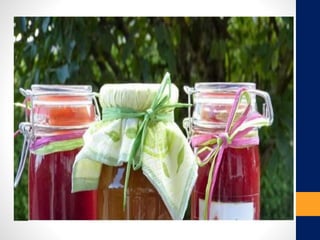
Types of packaging
materials
BY
S.SATYA SHREE
B.Tech(Horticulture)
Packaging
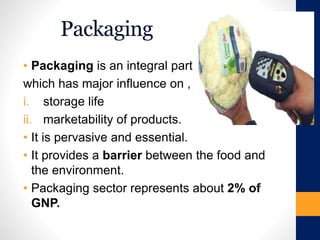
• Packaging is an integral part
which has major influence on ,
i. storage life
ii. marketability of products.
• It is pervasive and essential.
• It provides a barrier between the food and
the environment.
• Packaging sector represents about 2% of
GNP.
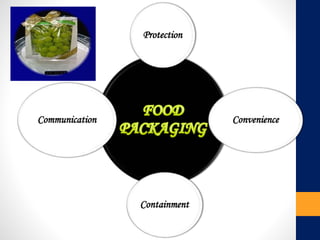
Protection
Convenience
Containment
Communication
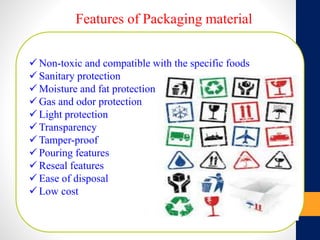
 Non-toxic and compatible with the specific foods
 Sanitary protection
 Moisture and fat protection
 Gas and odor protection
 Light protection
 Transparency
 Tamper-proof
 Pouring features
 Reseal features
 Ease of disposal
 Low cost
Features of Packaging material
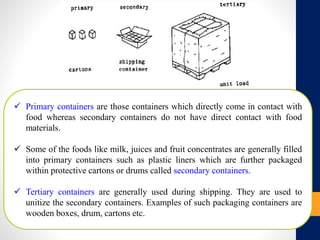
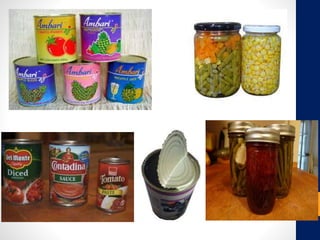
 Primary containers are those containers which directly come in contact with
food whereas secondary containers do not have direct contact with food
materials.
 Some of the foods like milk, juices and fruit concentrates are generally filled
into primary containers such as plastic liners which are further packaged
within protective cartons or drums called secondary containers.
 Tertiary containers are generally used during shipping. They are used to
unitize the secondary containers. Examples of such packaging containers are
wooden boxes, drum, cartons etc.
•
Natural materials
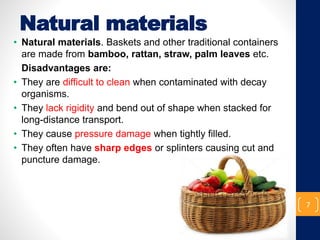
• Natural materials. Baskets and other traditional containers
are made from bamboo, rattan, straw, palm leaves etc.
Disadvantages are:
• They are difficult to clean when contaminated with decay
organisms.
• They lack rigidity and bend out of shape when stacked for
long-distance transport.
• They cause pressure damage when tightly filled.
• They often have sharp edges or splinters causing cut and
puncture damage.
7
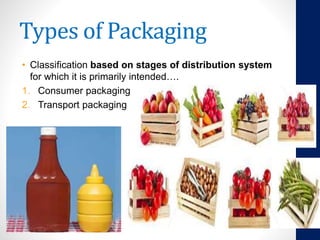
Types of Packaging
• Classification based on stages of distribution system
for which it is primarily intended….
1. Consumer packaging
2. Transport packaging
1.Consumer packaging
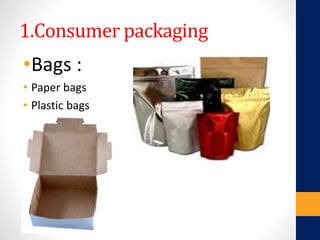
•Bags :
• Paper bags
• Plastic bags
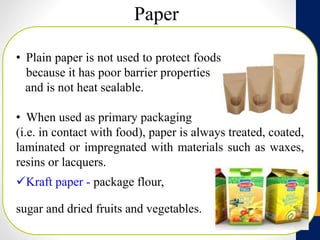
• Plain paper is not used to protect foods for long periods
because it has poor barrier properties
and is not heat sealable.
• When used as primary packaging
(i.e. in contact with food), paper is always treated, coated,
laminated or impregnated with materials such as waxes,
resins or lacquers.
Kraft paper - package flour,
sugar and dried fruits and vegetables.
Paper
Extruded nets & Rachel bags
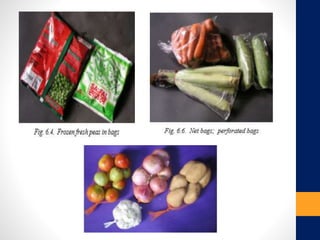
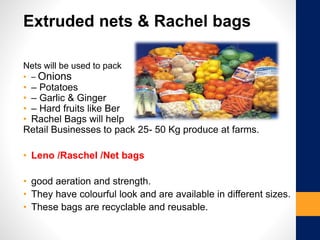
Nets will be used to pack
• – Onions
• – Potatoes
• – Garlic & Ginger
• – Hard fruits like Ber
• Rachel Bags will help
Retail Businesses to pack 25- 50 Kg produce at farms.
• Leno /Raschel /Net bags
• good aeration and strength.
• They have colourful look and are available in different sizes.
• These bags are recyclable and reusable.
Plastic Bags
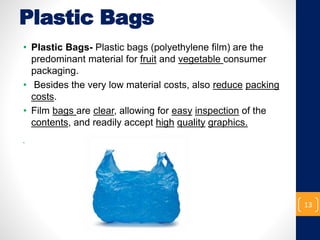
• Plastic Bags- Plastic bags (polyethylene film) are the
predominant material for fruit and vegetable consumer
packaging.
• Besides the very low material costs, also reduce packing
costs.
• Film bags are clear, allowing for easy inspection of the
contents, and readily accept high quality graphics.
•
13
Shrink Wrap
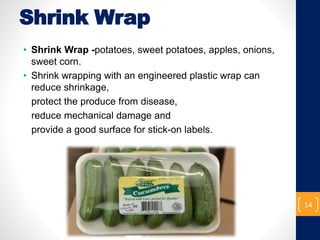
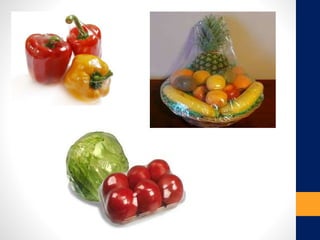
• Shrink Wrap -potatoes, sweet potatoes, apples, onions,
sweet corn.
• Shrink wrapping with an engineered plastic wrap can
reduce shrinkage,
protect the produce from disease,
reduce mechanical damage and
provide a good surface for stick-on labels.
14
•
Rigid Plastic Packages
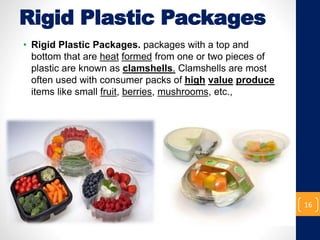
• Rigid Plastic Packages. packages with a top and
bottom that are heat formed from one or two pieces of
plastic are known as clamshells. Clamshells are most
often used with consumer packs of high value produce
items like small fruit, berries, mushrooms, etc.,
16
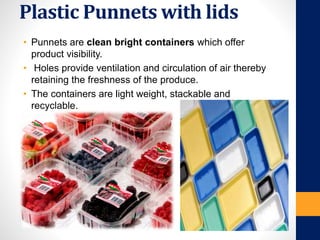
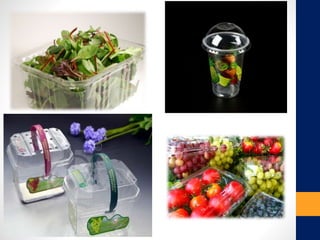
Plastic Punnets with lids
• Punnets are clean bright containers which offer
product visibility.
• Holes provide ventilation and circulation of air thereby
retaining the freshness of the produce.
• The containers are light weight, stackable and
recyclable.
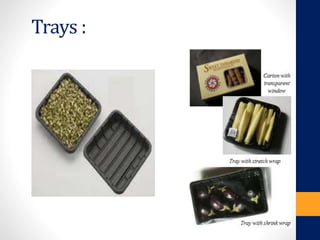
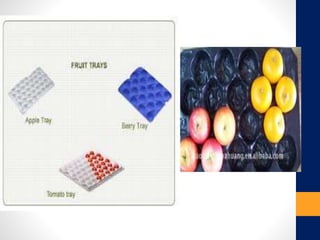
Trays :
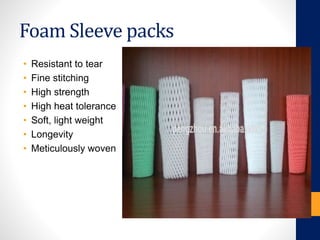
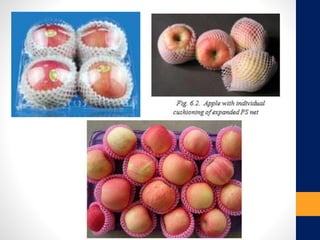
Foam Sleeve packs
• Resistant to tear
• Fine stitching
• High strength
• High heat tolerance
• Soft, light weight
• Longevity
• Meticulously woven
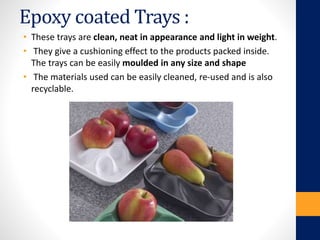
Epoxy coated Trays :
• These trays are clean, neat in appearance and light in weight.
• They give a cushioning effect to the products packed inside.
The trays can be easily moulded in any size and shape
• The materials used can be easily cleaned, re-used and is also
recyclable.
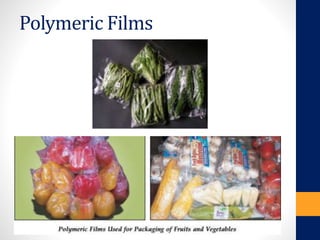
Polymeric Films
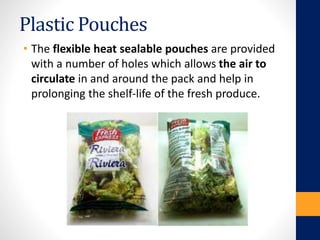
Plastic Pouches
• The flexible heat sealable pouches are provided
with a number of holes which allows the air to
circulate in and around the pack and help in
prolonging the shelf-life of the fresh produce.
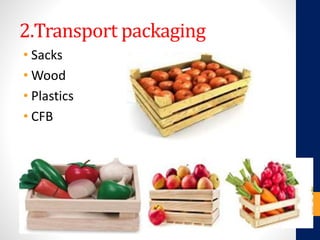
2.Transport packaging
• Sacks
• Wood
• Plastics
• CFB
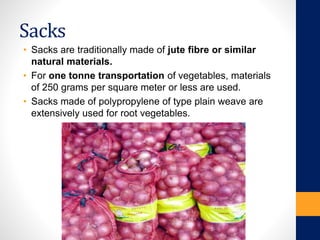
Sacks
• Sacks are traditionally made of jute fibre or similar
natural materials.
• For one tonne transportation of vegetables, materials
of 250 grams per square meter or less are used.
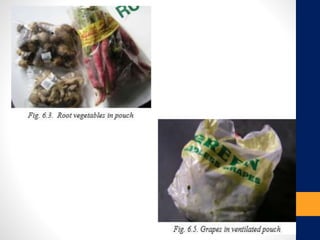
• Sacks made of polypropylene of type plain weave are
extensively used for root vegetables.
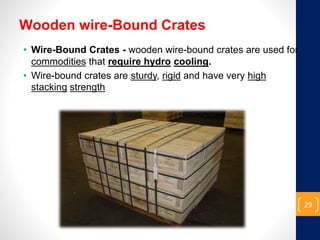
Wooden wire-Bound Crates
• Wire-Bound Crates - wooden wire-bound crates are used for
commodities that require hydro cooling.
• Wire-bound crates are sturdy, rigid and have very high
stacking strength
29
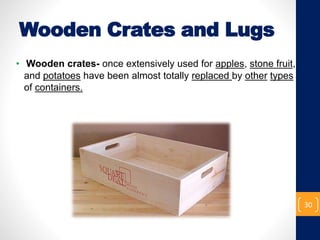
Wooden Crates and Lugs
• Wooden crates- once extensively used for apples, stone fruit,
and potatoes have been almost totally replaced by other types
of containers.
30
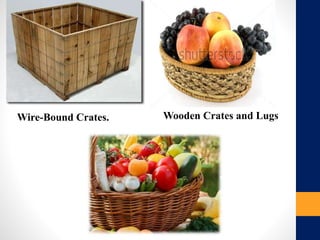
Wire-Bound Crates. Wooden Crates and Lugs
Corrugated fibre board boxes
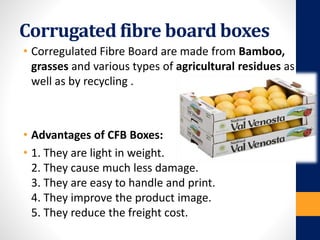
• Corregulated Fibre Board are made from Bamboo,
grasses and various types of agricultural residues as
well as by recycling .
• Advantages of CFB Boxes:
• 1. They are light in weight.
2. They cause much less damage.
3. They are easy to handle and print.
4. They improve the product image.
5. They reduce the freight cost.
Pulp Containers
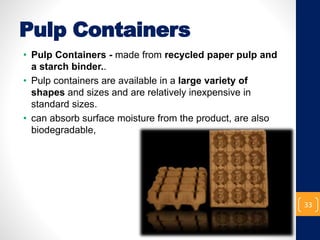
• Pulp Containers - made from recycled paper pulp and
a starch binder..
• Pulp containers are available in a large variety of
shapes and sizes and are relatively inexpensive in
standard sizes.
• can absorb surface moisture from the product, are also
biodegradable,
33
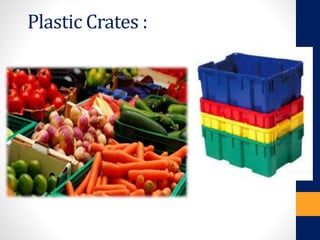
Plastic Crates :
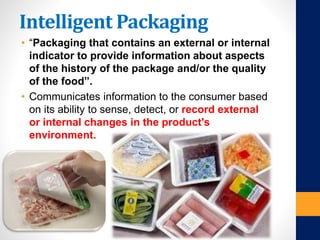
Intelligent Packaging
• “Packaging that contains an external or internal
indicator to provide information about aspects
of the history of the package and/or the quality
of the food”.
• Communicates information to the consumer based
on its ability to sense, detect, or record external
or internal changes in the product's
environment.
Quality Indicators
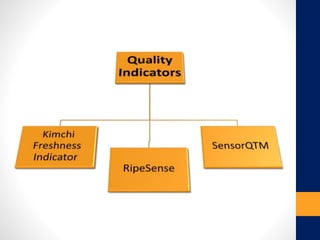
• Quality or freshness indicators – indicates
1. the quality of the product have become unacceptable
2. the spoilage or lack or freshness of the product,
3. Temperature Abuse
4. Packet leakage
• Based on the reaction with volatile metabolites
produced during ageing of foods and gives a visible
colour change as an indicator of :
• CO2
• Amines
• Ammonia
• H2S
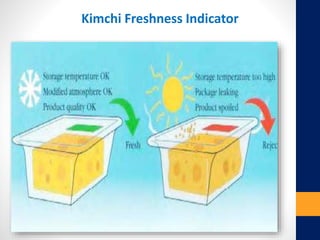
Kimchi Freshness Indicator
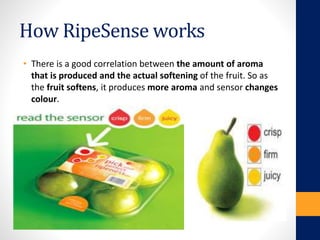
How RipeSense works
• There is a good correlation between the amount of aroma
that is produced and the actual softening of the fruit. So as
the fruit softens, it produces more aroma and sensor changes
colour.
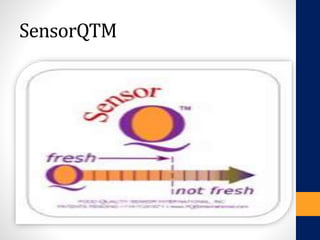
SensorQTM
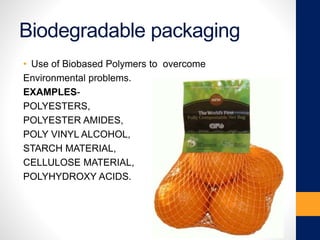
Biodegradable packaging
• Use of Biobased Polymers to overcome
Environmental problems.
EXAMPLES-
POLYESTERS,
POLYESTER AMIDES,
POLY VINYL ALCOHOL,
STARCH MATERIAL,
CELLULOSE MATERIAL,
POLYHYDROXY ACIDS.
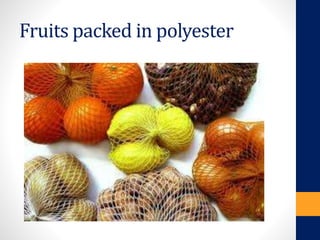
Fruits packed in polyester
•
Conclusion
 Packaging of processed fruits and vegetables is
an essential part of processing - ensures the
safety and maintains value of food.
 Processing of fruits and vegetables without
packaging has no meaning.
 Hence ,choose appropriate packaging system
thereby to reduce the losses.
References :
S.No Book Author
1. Post Harvest technology of
Horticultural crops
K.P.Sudheer
V.Indira
2. Food packaging
(Principles and practice)
Gordon L.Robertson
3. Food Packaging Neelam khetarpaul
Darshan Punia
Types of Packaging materials

Types of Packaging materials

  • 1.
    Types of packaging materials BY S.SATYASHREE B.Tech(Horticulture)
  • 2.
    Packaging • Packaging isan integral part which has major influence on , i. storage life ii. marketability of products. • It is pervasive and essential. • It provides a barrier between the food and the environment. • Packaging sector represents about 2% of GNP.
  • 3.
  • 4.
     Non-toxic andcompatible with the specific foods  Sanitary protection  Moisture and fat protection  Gas and odor protection  Light protection  Transparency  Tamper-proof  Pouring features  Reseal features  Ease of disposal  Low cost Features of Packaging material
  • 5.
     Primary containersare those containers which directly come in contact with food whereas secondary containers do not have direct contact with food materials.  Some of the foods like milk, juices and fruit concentrates are generally filled into primary containers such as plastic liners which are further packaged within protective cartons or drums called secondary containers.  Tertiary containers are generally used during shipping. They are used to unitize the secondary containers. Examples of such packaging containers are wooden boxes, drum, cartons etc.
  • 6.
  • 7.
    Natural materials • Naturalmaterials. Baskets and other traditional containers are made from bamboo, rattan, straw, palm leaves etc. Disadvantages are: • They are difficult to clean when contaminated with decay organisms. • They lack rigidity and bend out of shape when stacked for long-distance transport. • They cause pressure damage when tightly filled. • They often have sharp edges or splinters causing cut and puncture damage. 7
  • 8.
    Types of Packaging •Classification based on stages of distribution system for which it is primarily intended…. 1. Consumer packaging 2. Transport packaging
  • 9.
    1.Consumer packaging •Bags : •Paper bags • Plastic bags
  • 10.
    • Plain paperis not used to protect foods for long periods because it has poor barrier properties and is not heat sealable. • When used as primary packaging (i.e. in contact with food), paper is always treated, coated, laminated or impregnated with materials such as waxes, resins or lacquers. Kraft paper - package flour, sugar and dried fruits and vegetables. Paper
  • 12.
    Extruded nets &Rachel bags Nets will be used to pack • – Onions • – Potatoes • – Garlic & Ginger • – Hard fruits like Ber • Rachel Bags will help Retail Businesses to pack 25- 50 Kg produce at farms. • Leno /Raschel /Net bags • good aeration and strength. • They have colourful look and are available in different sizes. • These bags are recyclable and reusable.
  • 13.
    Plastic Bags • PlasticBags- Plastic bags (polyethylene film) are the predominant material for fruit and vegetable consumer packaging. • Besides the very low material costs, also reduce packing costs. • Film bags are clear, allowing for easy inspection of the contents, and readily accept high quality graphics. • 13
  • 14.
    Shrink Wrap • ShrinkWrap -potatoes, sweet potatoes, apples, onions, sweet corn. • Shrink wrapping with an engineered plastic wrap can reduce shrinkage, protect the produce from disease, reduce mechanical damage and provide a good surface for stick-on labels. 14
  • 15.
  • 16.
    Rigid Plastic Packages •Rigid Plastic Packages. packages with a top and bottom that are heat formed from one or two pieces of plastic are known as clamshells. Clamshells are most often used with consumer packs of high value produce items like small fruit, berries, mushrooms, etc., 16
  • 17.
    Plastic Punnets withlids • Punnets are clean bright containers which offer product visibility. • Holes provide ventilation and circulation of air thereby retaining the freshness of the produce. • The containers are light weight, stackable and recyclable.
  • 19.
  • 20.
    Foam Sleeve packs •Resistant to tear • Fine stitching • High strength • High heat tolerance • Soft, light weight • Longevity • Meticulously woven
  • 22.
    Epoxy coated Trays: • These trays are clean, neat in appearance and light in weight. • They give a cushioning effect to the products packed inside. The trays can be easily moulded in any size and shape • The materials used can be easily cleaned, re-used and is also recyclable.
  • 23.
  • 25.
    Plastic Pouches • Theflexible heat sealable pouches are provided with a number of holes which allows the air to circulate in and around the pack and help in prolonging the shelf-life of the fresh produce.
  • 27.
    2.Transport packaging • Sacks •Wood • Plastics • CFB
  • 28.
    Sacks • Sacks aretraditionally made of jute fibre or similar natural materials. • For one tonne transportation of vegetables, materials of 250 grams per square meter or less are used. • Sacks made of polypropylene of type plain weave are extensively used for root vegetables.
  • 29.
    Wooden wire-Bound Crates •Wire-Bound Crates - wooden wire-bound crates are used for commodities that require hydro cooling. • Wire-bound crates are sturdy, rigid and have very high stacking strength 29
  • 30.
    Wooden Crates andLugs • Wooden crates- once extensively used for apples, stone fruit, and potatoes have been almost totally replaced by other types of containers. 30
  • 31.
  • 32.
    Corrugated fibre boardboxes • Corregulated Fibre Board are made from Bamboo, grasses and various types of agricultural residues as well as by recycling . • Advantages of CFB Boxes: • 1. They are light in weight. 2. They cause much less damage. 3. They are easy to handle and print. 4. They improve the product image. 5. They reduce the freight cost.
  • 33.
    Pulp Containers • PulpContainers - made from recycled paper pulp and a starch binder.. • Pulp containers are available in a large variety of shapes and sizes and are relatively inexpensive in standard sizes. • can absorb surface moisture from the product, are also biodegradable, 33
  • 35.
  • 36.
    Intelligent Packaging • “Packagingthat contains an external or internal indicator to provide information about aspects of the history of the package and/or the quality of the food”. • Communicates information to the consumer based on its ability to sense, detect, or record external or internal changes in the product's environment.
  • 37.
    Quality Indicators • Qualityor freshness indicators – indicates 1. the quality of the product have become unacceptable 2. the spoilage or lack or freshness of the product, 3. Temperature Abuse 4. Packet leakage • Based on the reaction with volatile metabolites produced during ageing of foods and gives a visible colour change as an indicator of : • CO2 • Amines • Ammonia • H2S
  • 39.
  • 40.
    How RipeSense works •There is a good correlation between the amount of aroma that is produced and the actual softening of the fruit. So as the fruit softens, it produces more aroma and sensor changes colour.
  • 41.
  • 42.
    Biodegradable packaging • Useof Biobased Polymers to overcome Environmental problems. EXAMPLES- POLYESTERS, POLYESTER AMIDES, POLY VINYL ALCOHOL, STARCH MATERIAL, CELLULOSE MATERIAL, POLYHYDROXY ACIDS.
  • 43.
  • 44.
  • 45.
    Conclusion  Packaging ofprocessed fruits and vegetables is an essential part of processing - ensures the safety and maintains value of food.  Processing of fruits and vegetables without packaging has no meaning.  Hence ,choose appropriate packaging system thereby to reduce the losses.
  • 46.
    References : S.No BookAuthor 1. Post Harvest technology of Horticultural crops K.P.Sudheer V.Indira 2. Food packaging (Principles and practice) Gordon L.Robertson 3. Food Packaging Neelam khetarpaul Darshan Punia

Editor's Notes

  • #30 wooden wire-bound crates are used extensively for snap beans, sweet corn and several other commodities that require hydro cooling
  • #31 The relative expense of the container, a greater concern for tare weight, and