WELCOME
Packaging & Packaging 
Materials of Fruits & 
Vegetables
Contents 
 Introduction 
 Requirements & Functions of Packaging Materials 
 Packaging Points 
 Primary & Secondary Containers 
 Types of Packaging Materials 
 Packaging Process of Apple
Introduction 
 Packaging fresh fruits and vegetables is one of the more 
important steps in the long and complicated journey from 
grower to consumer. 
 Bags, crates, hampers, baskets, cartons, bulk bins, and 
palletized containers are convenient containers for handling, 
transporting, and marketing fresh produce. 
 More than 1,500 different types of packages are used for 
produce and the number continues to increase as the 
industry introduces new packaging materials and concepts. 
 Packing and packaging materials contribute a significant 
cost to the produce industry; therefore it is important that 
packers, shippers, buyers, and consumers have a clear 
understanding of the wide range of packaging options 
available.
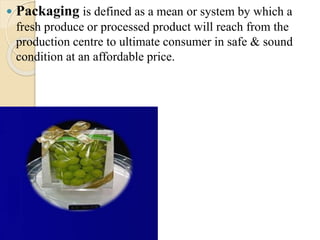
 Packaging is defined as a mean or system by which a 
fresh produce or processed product will reach from the 
production centre to ultimate consumer in safe & sound 
condition at an affordable price.
Packaging materials 
The following are among the more important general 
requirements and functions of food packaging materials/ 
containers: 
 they must be non-toxic and compatible with the specific 
foods; 
 sanitary protection; 
 moisture and fat protection; 
 gas and odor protection; 
 light protection; 
 resistance to impact; 
 transparency; 
 Tamper proofness; 
 ease of opening;
 pouring features; 
 reseal features; 
 ease of disposal; 
 size, shape, weight limitations; 
 appearance, printability; 
 low cost; 
 Special features.
The Function of Packaging 
 To assemble the produce into convenient units for handling. 
 A properly designed produce container should contain, 
protect, and identify the produce, satisfying everyone from 
grower to consumer. 
PACKAGING POINTS 
 Recyclability/Biodegradability. 
 Variety. 
 Sales Appeal. 
 Shelf Life.
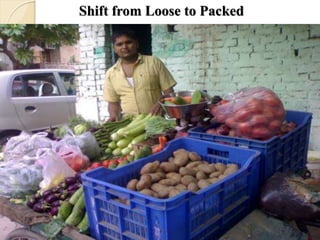
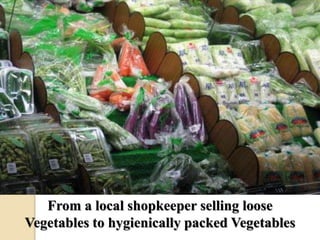
Shift from Loose to Packed
From a local shopkeeper selling loose 
Vegetables to hygienically packed Vegetables
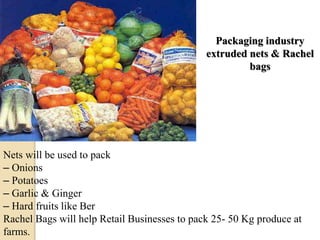
Packaging industry 
extruded nets & Rachel 
bags 
Nets will be used to pack 
– Onions 
– Potatoes 
– Garlic & Ginger 
– Hard fruits like Ber 
Rachel Bags will help Retail Businesses to pack 25- 50 Kg produce at 
farms.
Primary and secondary containers 
 Some materials are provided with efficient primary containers 
by nature, such as nuts, oranges, eggs and the like. In packaging 
these, we generally need only a secondary outer box, wrap, or 
drum to hold units together and give gross protection. 
Hermetic closure 
 Two conditions of the greatest significance in packaging are 
hermetic and non-hermetic closure. 
 The term hermetic means a container which is absolutely 
impermeable to gases and vapors throughout its entirety, 
including its seams. 
 On the other hand, a container which prevents entry of micro-organisms, 
in many instances will be non-hermetic. 
 The most common hermetic containers are rigid metal cans and 
glass bottles, although faulty closures can make them non-hermetic.
Types of Packaging Materials 
Moisture Resistant materials-a) 
Polythene films 
b) Polyester films 
c) Polyvinyl films 
d) Aluminium foils 
e) Laminations 
f) Cellulose film (coated) 
g) Rubber hydrochloride 
h) Cellulose acetate 
i) Glass containers
Wood 
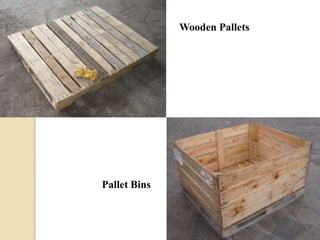
Pallets. literally form the base on which most fresh produce 
is delivered to the consumer. Pallets were first used during 
World War II as an efficient way to move goods. 
 Depending on the size of produce package, a single pallet 
may carry from 20 to over 100 individual packages. 
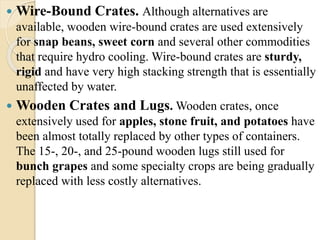
Pallet Bins. Substantial wooden pallet bins of milled lumber 
or plywood are primarily used to move produce from the 
field or orchard to the packing house. Depending on the 
application, capacities may range from 12 to more than 50 
bushels.
Wooden Pallets 
Pallet Bins
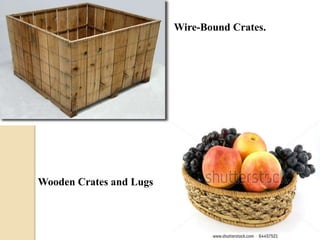
 Wire-Bound Crates. Although alternatives are 
available, wooden wire-bound crates are used extensively 
for snap beans, sweet corn and several other commodities 
that require hydro cooling. Wire-bound crates are sturdy, 
rigid and have very high stacking strength that is essentially 
unaffected by water. 
 Wooden Crates and Lugs.Wooden crates, once 
extensively used for apples, stone fruit, and potatoes have 
been almost totally replaced by other types of containers. 
The 15-, 20-, and 25-pound wooden lugs still used for 
bunch grapes and some specialty crops are being gradually 
replaced with less costly alternatives.
Wire-Bound Crates. 
Wooden Crates and Lugs
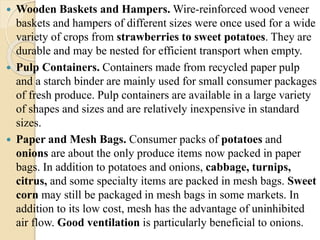
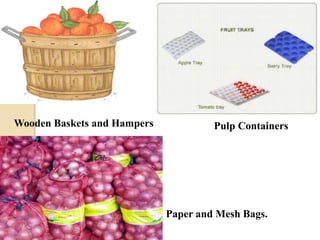
 Wooden Baskets and Hampers.Wire-reinforced wood veneer 
baskets and hampers of different sizes were once used for a wide 
variety of crops from strawberries to sweet potatoes. They are 
durable and may be nested for efficient transport when empty. 
 Pulp Containers. Containers made from recycled paper pulp 
and a starch binder are mainly used for small consumer packages 
of fresh produce. Pulp containers are available in a large variety 
of shapes and sizes and are relatively inexpensive in standard 
sizes. 
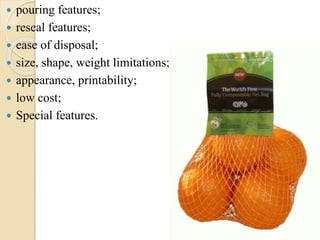
 Paper and Mesh Bags. Consumer packs of potatoes and 
onions are about the only produce items now packed in paper 
bags. In addition to potatoes and onions, cabbage, turnips, 
citrus, and some specialty items are packed in mesh bags. Sweet 
corn may still be packaged in mesh bags in some markets. In 
addition to its low cost, mesh has the advantage of uninhibited 
air flow. Good ventilation is particularly beneficial to onions.
Wooden Baskets and Hampers Pulp Containers 
Paper and Mesh Bags.
 Plastic Bags. Plastic bags (polyethylene film) are the predominant 
material for fruit and vegetable consumer packaging. Plastic films 
are available in a wide range of thicknesses and grades and may be 
engineered to control the environmental gases inside the bag. 
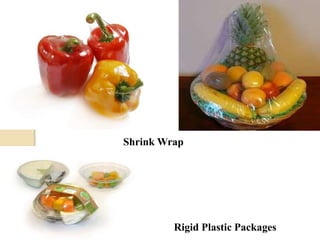
 Shrink Wrap. One of the newest trends in produce packaging is 
the shrink wrapping of individual produce items. Shrink wrapping 
has been used successfully to package potatoes, sweet potatoes, 
apples, onions, sweet corn, cucumbers and a variety of tropical 
fruit. 
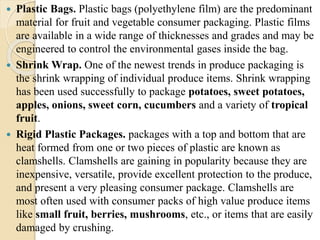
 Rigid Plastic Packages. packages with a top and bottom that are 
heat formed from one or two pieces of plastic are known as 
clamshells. Clamshells are gaining in popularity because they are 
inexpensive, versatile, provide excellent protection to the produce, 
and present a very pleasing consumer package. Clamshells are 
most often used with consumer packs of high value produce items 
like small fruit, berries, mushrooms, etc., or items that are easily 
damaged by crushing.
Shrink Wrap 
Rigid Plastic Packages
Packaging of Apples 
 At the packing facility, apples are washed, rinsed, sorted 
and graded. Next, apples are waxed to help keep them moist 
and firm. 
 The wax helps maintain the color and freshness of the 
apples after harvest. one apple is covered by less than 0.002 
grams of wax. 
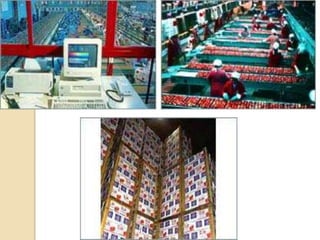
 On the computerized packing line, each apple is either 
photographed or weighed to determine the size of the fruit. 
 After apples are sorted according to size, workers hand-pack 
the fruit into trays. 
 Apples are then inspected and boxed and the boxes are put 
on pallets for transport to cold storage facilities.
THANK U

Packaging

  • 1.
  • 3.
    Packaging & Packaging Materials of Fruits & Vegetables
  • 4.
    Contents  Introduction  Requirements & Functions of Packaging Materials  Packaging Points  Primary & Secondary Containers  Types of Packaging Materials  Packaging Process of Apple
  • 5.
    Introduction  Packagingfresh fruits and vegetables is one of the more important steps in the long and complicated journey from grower to consumer.  Bags, crates, hampers, baskets, cartons, bulk bins, and palletized containers are convenient containers for handling, transporting, and marketing fresh produce.  More than 1,500 different types of packages are used for produce and the number continues to increase as the industry introduces new packaging materials and concepts.  Packing and packaging materials contribute a significant cost to the produce industry; therefore it is important that packers, shippers, buyers, and consumers have a clear understanding of the wide range of packaging options available.
  • 6.
     Packaging isdefined as a mean or system by which a fresh produce or processed product will reach from the production centre to ultimate consumer in safe & sound condition at an affordable price.
  • 7.
    Packaging materials Thefollowing are among the more important general requirements and functions of food packaging materials/ containers:  they must be non-toxic and compatible with the specific foods;  sanitary protection;  moisture and fat protection;  gas and odor protection;  light protection;  resistance to impact;  transparency;  Tamper proofness;  ease of opening;
  • 8.
     pouring features;  reseal features;  ease of disposal;  size, shape, weight limitations;  appearance, printability;  low cost;  Special features.
  • 9.
    The Function ofPackaging  To assemble the produce into convenient units for handling.  A properly designed produce container should contain, protect, and identify the produce, satisfying everyone from grower to consumer. PACKAGING POINTS  Recyclability/Biodegradability.  Variety.  Sales Appeal.  Shelf Life.
  • 10.
  • 11.
    From a localshopkeeper selling loose Vegetables to hygienically packed Vegetables
  • 12.
    Packaging industry extrudednets & Rachel bags Nets will be used to pack – Onions – Potatoes – Garlic & Ginger – Hard fruits like Ber Rachel Bags will help Retail Businesses to pack 25- 50 Kg produce at farms.
  • 13.
    Primary and secondarycontainers  Some materials are provided with efficient primary containers by nature, such as nuts, oranges, eggs and the like. In packaging these, we generally need only a secondary outer box, wrap, or drum to hold units together and give gross protection. Hermetic closure  Two conditions of the greatest significance in packaging are hermetic and non-hermetic closure.  The term hermetic means a container which is absolutely impermeable to gases and vapors throughout its entirety, including its seams.  On the other hand, a container which prevents entry of micro-organisms, in many instances will be non-hermetic.  The most common hermetic containers are rigid metal cans and glass bottles, although faulty closures can make them non-hermetic.
  • 14.
    Types of PackagingMaterials Moisture Resistant materials-a) Polythene films b) Polyester films c) Polyvinyl films d) Aluminium foils e) Laminations f) Cellulose film (coated) g) Rubber hydrochloride h) Cellulose acetate i) Glass containers
  • 15.
    Wood Pallets. literallyform the base on which most fresh produce is delivered to the consumer. Pallets were first used during World War II as an efficient way to move goods.  Depending on the size of produce package, a single pallet may carry from 20 to over 100 individual packages. Pallet Bins. Substantial wooden pallet bins of milled lumber or plywood are primarily used to move produce from the field or orchard to the packing house. Depending on the application, capacities may range from 12 to more than 50 bushels.
  • 16.
  • 17.
     Wire-Bound Crates.Although alternatives are available, wooden wire-bound crates are used extensively for snap beans, sweet corn and several other commodities that require hydro cooling. Wire-bound crates are sturdy, rigid and have very high stacking strength that is essentially unaffected by water.  Wooden Crates and Lugs.Wooden crates, once extensively used for apples, stone fruit, and potatoes have been almost totally replaced by other types of containers. The 15-, 20-, and 25-pound wooden lugs still used for bunch grapes and some specialty crops are being gradually replaced with less costly alternatives.
  • 18.
  • 19.
     Wooden Basketsand Hampers.Wire-reinforced wood veneer baskets and hampers of different sizes were once used for a wide variety of crops from strawberries to sweet potatoes. They are durable and may be nested for efficient transport when empty.  Pulp Containers. Containers made from recycled paper pulp and a starch binder are mainly used for small consumer packages of fresh produce. Pulp containers are available in a large variety of shapes and sizes and are relatively inexpensive in standard sizes.  Paper and Mesh Bags. Consumer packs of potatoes and onions are about the only produce items now packed in paper bags. In addition to potatoes and onions, cabbage, turnips, citrus, and some specialty items are packed in mesh bags. Sweet corn may still be packaged in mesh bags in some markets. In addition to its low cost, mesh has the advantage of uninhibited air flow. Good ventilation is particularly beneficial to onions.
  • 20.
    Wooden Baskets andHampers Pulp Containers Paper and Mesh Bags.
  • 21.
     Plastic Bags.Plastic bags (polyethylene film) are the predominant material for fruit and vegetable consumer packaging. Plastic films are available in a wide range of thicknesses and grades and may be engineered to control the environmental gases inside the bag.  Shrink Wrap. One of the newest trends in produce packaging is the shrink wrapping of individual produce items. Shrink wrapping has been used successfully to package potatoes, sweet potatoes, apples, onions, sweet corn, cucumbers and a variety of tropical fruit.  Rigid Plastic Packages. packages with a top and bottom that are heat formed from one or two pieces of plastic are known as clamshells. Clamshells are gaining in popularity because they are inexpensive, versatile, provide excellent protection to the produce, and present a very pleasing consumer package. Clamshells are most often used with consumer packs of high value produce items like small fruit, berries, mushrooms, etc., or items that are easily damaged by crushing.
  • 22.
    Shrink Wrap RigidPlastic Packages
  • 23.
    Packaging of Apples  At the packing facility, apples are washed, rinsed, sorted and graded. Next, apples are waxed to help keep them moist and firm.  The wax helps maintain the color and freshness of the apples after harvest. one apple is covered by less than 0.002 grams of wax.  On the computerized packing line, each apple is either photographed or weighed to determine the size of the fruit.  After apples are sorted according to size, workers hand-pack the fruit into trays.  Apples are then inspected and boxed and the boxes are put on pallets for transport to cold storage facilities.
  • 25.