Types of Mixtures and
Their Characteristics
Lesson 1
Prepared by:
Ma. Rhodora Theodorosa S. Ma. Nieva, LPT
MIXTURE
A physical combination of two or
more substances in which each of
the substances in the mixture
retains its individual composition
and properties.
Prepared by:
Ma. Rhodora Theodorosa S. Ma. Nieva, LPT
TYPES OF MIXTURE
The particles of the
substances in the
mixture can still be
seen and identified.
All the substances are
evenly distributed and
create a uniform
composition.
HOMOGENEOUS
MIXTURES
HETEROGENEOUS
MIXTURES
Prepared by:
Ma. Rhodora Theodorosa S. Ma. Nieva, LPT
TYPES OF MIXTURE
SOLUTION
SUSPENSION
COLLOID
Prepared by:
Ma. Rhodora Theodorosa S. Ma. Nieva, LPT
HOMOGENEOUS MIXTURE
A solution is a homogeneous mixture. Its particles
are evenly spread out and blended thoroughly.
Examples:
Prepared by:
Ma. Rhodora Theodorosa S. Ma. Nieva, LPT
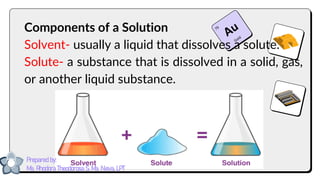
Components of a Solution
Solvent- usually a liquid that dissolves a solute.
Solute- a substance that is dissolved in a solid, gas,
or another liquid substance.
Prepared by:
Ma. Rhodora Theodorosa S. Ma. Nieva, LPT
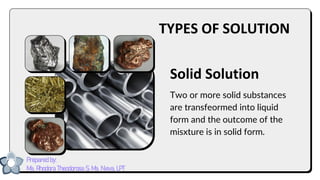
Solid Solution
Two or more solid substances
are transfeormed into liquid
form and the outcome of the
misxture is in solid form.
TYPES OF SOLUTION
Prepared by:
Ma. Rhodora Theodorosa S. Ma. Nieva, LPT
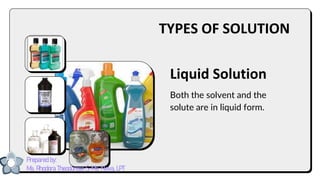
Liquid Solution
Both the solvent and the
solute are in liquid form.
TYPES OF SOLUTION
Prepared by:
Ma. Rhodora Theodorosa S. Ma. Nieva, LPT
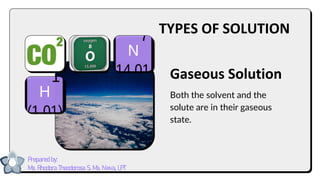
Gaseous Solution
Both the solvent and the
solute are in their gaseous
state.
TYPES OF SOLUTION
Prepared by:
Ma. Rhodora Theodorosa S. Ma. Nieva, LPT
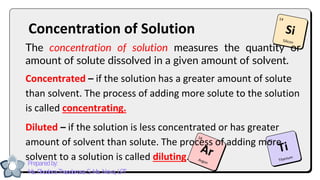
Concentration of Solution
The concentration of solution measures the quantity or
amount of solute dissolved in a given amount of solvent.
Concentrated – if the solution has a greater amount of solute
than solvent. The process of adding more solute to the solution
is called concentrating.
Diluted – if the solution is less concentrated or has greater
amount of solvent than solute. The process of adding more
solvent to a solution is called diluting.
Prepared by:
Ma. Rhodora Theodorosa S. Ma. Nieva, LPT
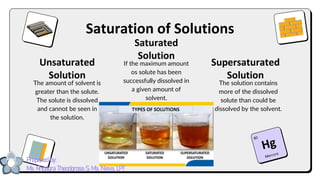
Saturation of Solutions
The amount of solvent is
greater than the solute.
The solute is dissolved
and cannot be seen in
the solution.
If the maximum amount
os solute has been
successfully dissolved in
a given amount of
solvent.
The solution contains
more of the dissolved
solute than could be
dissolved by the solvent.
Unsaturated
Solution
Saturated
Solution
Supersaturated
Solution
Prepared by:
Ma. Rhodora Theodorosa S. Ma. Nieva, LPT
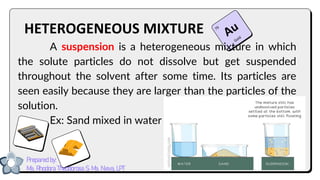
HETEROGENEOUS MIXTURE
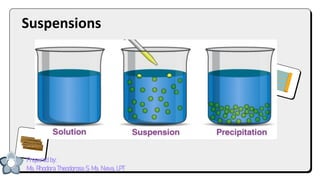
A suspension is a heterogeneous mixture in which
the solute particles do not dissolve but get suspended
throughout the solvent after some time. Its particles are
seen easily because they are larger than the particles of the
solution.
Ex: Sand mixed in water
Prepared by:
Ma. Rhodora Theodorosa S. Ma. Nieva, LPT
Suspensions
Prepared by:
Ma. Rhodora Theodorosa S. Ma. Nieva, LPT
Uses of Suspensions
1. Paint is used to decorate, protect and prolong the life of a material.
2. Flour is used to make a slurry.
3. Medicines are prescribed by doctors.
Prepared by:
Ma. Rhodora Theodorosa S. Ma. Nieva, LPT
HETEROGENEOUS MIXTURE
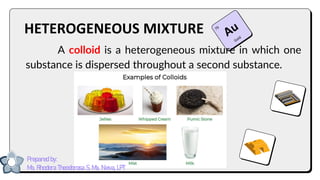
A colloid is a heterogeneous mixture in which one
substance is dispersed throughout a second substance.
Prepared by:
Ma. Rhodora Theodorosa S. Ma. Nieva, LPT
Components of a Colloid
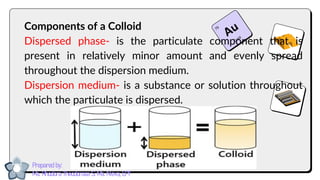
Dispersed phase- is the particulate component that is
present in relatively minor amount and evenly spread
throughout the dispersion medium.
Dispersion medium- is a substance or solution throughout
which the particulate is dispersed.
Prepared by:
Ma. Rhodora Theodorosa S. Ma. Nieva, LPT
Characteristics of Colloid
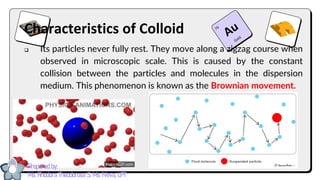
❑ Its particles never fully rest. They move along a zigzag course when
observed in microscopic scale. This is caused by the constant
collision between the particles and molecules in the dispersion
medium. This phenomenon is known as the Brownian movement.
Prepared by:
Ma. Rhodora Theodorosa S. Ma. Nieva, LPT
Characteristics of Colloid
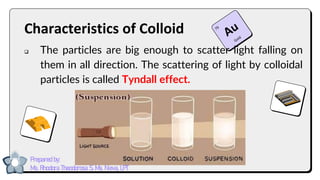
❑ The particles are big enough to scatter light falling on
them in all direction. The scattering of light by colloidal
particles is called Tyndall effect.
Prepared by:
Ma. Rhodora Theodorosa S. Ma. Nieva, LPT
Prepared by:
Ma. Rhodora Theodorosa S. Ma. Nieva, LPT
Prepared by:
Ma. Rhodora Theodorosa S. Ma. Nieva, LPT

Types of Mixture.pdf

  • 1.
    Types of Mixturesand Their Characteristics Lesson 1 Prepared by: Ma. Rhodora Theodorosa S. Ma. Nieva, LPT
  • 2.
    MIXTURE A physical combinationof two or more substances in which each of the substances in the mixture retains its individual composition and properties. Prepared by: Ma. Rhodora Theodorosa S. Ma. Nieva, LPT
  • 3.
    TYPES OF MIXTURE Theparticles of the substances in the mixture can still be seen and identified. All the substances are evenly distributed and create a uniform composition. HOMOGENEOUS MIXTURES HETEROGENEOUS MIXTURES Prepared by: Ma. Rhodora Theodorosa S. Ma. Nieva, LPT
  • 4.
    TYPES OF MIXTURE SOLUTION SUSPENSION COLLOID Preparedby: Ma. Rhodora Theodorosa S. Ma. Nieva, LPT
  • 5.
    HOMOGENEOUS MIXTURE A solutionis a homogeneous mixture. Its particles are evenly spread out and blended thoroughly. Examples: Prepared by: Ma. Rhodora Theodorosa S. Ma. Nieva, LPT
  • 6.
    Components of aSolution Solvent- usually a liquid that dissolves a solute. Solute- a substance that is dissolved in a solid, gas, or another liquid substance. Prepared by: Ma. Rhodora Theodorosa S. Ma. Nieva, LPT
  • 7.
    Solid Solution Two ormore solid substances are transfeormed into liquid form and the outcome of the misxture is in solid form. TYPES OF SOLUTION Prepared by: Ma. Rhodora Theodorosa S. Ma. Nieva, LPT
  • 8.
    Liquid Solution Both thesolvent and the solute are in liquid form. TYPES OF SOLUTION Prepared by: Ma. Rhodora Theodorosa S. Ma. Nieva, LPT
  • 9.
    Gaseous Solution Both thesolvent and the solute are in their gaseous state. TYPES OF SOLUTION Prepared by: Ma. Rhodora Theodorosa S. Ma. Nieva, LPT
  • 10.
    Concentration of Solution Theconcentration of solution measures the quantity or amount of solute dissolved in a given amount of solvent. Concentrated – if the solution has a greater amount of solute than solvent. The process of adding more solute to the solution is called concentrating. Diluted – if the solution is less concentrated or has greater amount of solvent than solute. The process of adding more solvent to a solution is called diluting. Prepared by: Ma. Rhodora Theodorosa S. Ma. Nieva, LPT
  • 11.
    Saturation of Solutions Theamount of solvent is greater than the solute. The solute is dissolved and cannot be seen in the solution. If the maximum amount os solute has been successfully dissolved in a given amount of solvent. The solution contains more of the dissolved solute than could be dissolved by the solvent. Unsaturated Solution Saturated Solution Supersaturated Solution Prepared by: Ma. Rhodora Theodorosa S. Ma. Nieva, LPT
  • 12.
    HETEROGENEOUS MIXTURE A suspensionis a heterogeneous mixture in which the solute particles do not dissolve but get suspended throughout the solvent after some time. Its particles are seen easily because they are larger than the particles of the solution. Ex: Sand mixed in water Prepared by: Ma. Rhodora Theodorosa S. Ma. Nieva, LPT
  • 13.
    Suspensions Prepared by: Ma. RhodoraTheodorosa S. Ma. Nieva, LPT
  • 14.
    Uses of Suspensions 1.Paint is used to decorate, protect and prolong the life of a material. 2. Flour is used to make a slurry. 3. Medicines are prescribed by doctors. Prepared by: Ma. Rhodora Theodorosa S. Ma. Nieva, LPT
  • 15.
    HETEROGENEOUS MIXTURE A colloidis a heterogeneous mixture in which one substance is dispersed throughout a second substance. Prepared by: Ma. Rhodora Theodorosa S. Ma. Nieva, LPT
  • 16.
    Components of aColloid Dispersed phase- is the particulate component that is present in relatively minor amount and evenly spread throughout the dispersion medium. Dispersion medium- is a substance or solution throughout which the particulate is dispersed. Prepared by: Ma. Rhodora Theodorosa S. Ma. Nieva, LPT
  • 17.
    Characteristics of Colloid ❑Its particles never fully rest. They move along a zigzag course when observed in microscopic scale. This is caused by the constant collision between the particles and molecules in the dispersion medium. This phenomenon is known as the Brownian movement. Prepared by: Ma. Rhodora Theodorosa S. Ma. Nieva, LPT
  • 18.
    Characteristics of Colloid ❑The particles are big enough to scatter light falling on them in all direction. The scattering of light by colloidal particles is called Tyndall effect. Prepared by: Ma. Rhodora Theodorosa S. Ma. Nieva, LPT
  • 19.
    Prepared by: Ma. RhodoraTheodorosa S. Ma. Nieva, LPT
  • 20.
    Prepared by: Ma. RhodoraTheodorosa S. Ma. Nieva, LPT