Name : Samarth Nandkumar Pawar
Roll No: 1536
Subject: Microprocessor
Topic: Types of instruction
K.P. Mangalvedhekar institute of management
career development and research solapur
Types of instruction in 8085
Microprocessor
INSTRUCTION SET OF 8085
Instruction Set of 8085
⚫ An instruction is a binary pattern designed inside a microprocessor
to perform a specific function.
⚫ The entire group of instructions that a microprocessor supports is
called Instruction Set.
⚫ 8085 has 246 instructions.
⚫ Each instruction is represented by an 8-bit binary value.
⚫ These 8-bits of binary value is called Op-Code or Instruction Byte.
Classification of Instruction Set
• Data Transfer Instruction
• Arithmetic Instructions
• Logical Instructions
• Branching Instructions
• Control Instructions
Data Transfer Instructions
• These instructions move data between registers, or between
memory and registers.
• These instructions copy data from source to destination.
• While copying, the contents of source are not modified.
Data Transfer Instructions
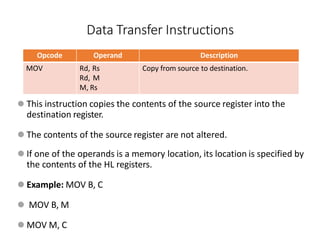
Opcode Operand Description
MOV Rd, Rs
Rd, M
M, Rs
Copy from source to destination.
⚫ This instruction copies the contents of the source register into the
destination register.
⚫ The contents of the source register are not altered.
⚫ If one of the operands is a memory location, its location is specified by
the contents of the HL registers.
⚫ Example: MOV B, C
⚫ MOV B, M
⚫ MOV M, C
Data Transfer Instructions
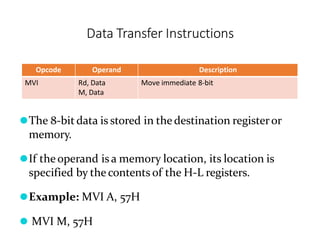
Opcode Operand Description
MVI Rd, Data
M, Data
Move immediate 8-bit
⚫The 8-bit data is stored in the destination registeror
memory.
⚫If theoperand is a memory location, its location is
specified by the contents of the H-L registers.
⚫Example: MVI A, 57H
⚫ MVI M, 57H
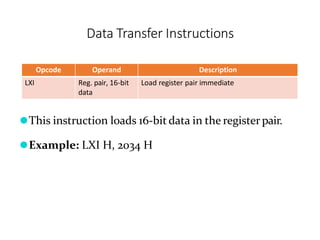
Opcode Operand Description
LXI Reg. pair, 16-bit
data
Load register pair immediate
⚫This instruction loads 16-bit data in the register pair.
⚫Example: LXI H, 2034 H
Data Transfer Instructions
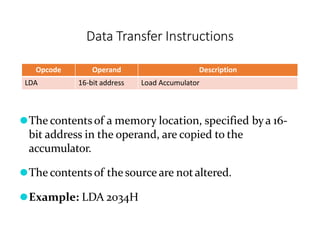
Opcode Operand Description
LDA 16-bit address Load Accumulator
⚫The contents of a memory location, specified bya 16-
bit address in the operand, are copied to the
accumulator.
⚫The contents of the source are notaltered.
⚫Example: LDA 2034H
Opcode Operand Description
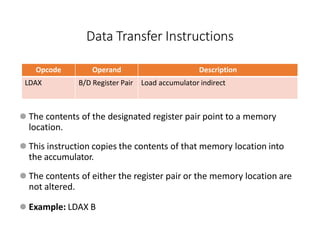
LDAX B/D Register Pair Load accumulator indirect
⚫ The contents of the designated register pair point to a memory
location.
⚫ This instruction copies the contents of that memory location into
the accumulator.
⚫ The contents of either the register pair or the memory location are
not altered.
⚫ Example: LDAX B
Data Transfer Instructions
Opcode Operand Description
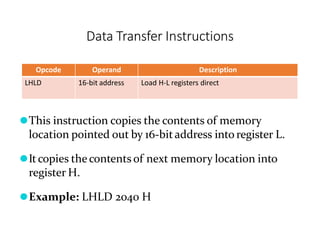
LHLD 16-bit address Load H-L registers direct
⚫This instruction copies the contents of memory
location pointed out by 16-bitaddress into register L.
⚫Itcopies the contents of next memory location into
register H.
⚫Example: LHLD 2040 H
Data Transfer Instructions
Opcode Operand Description
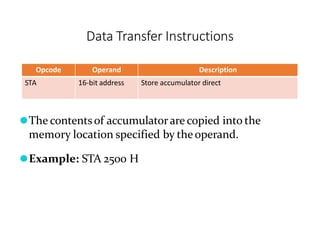
STA 16-bit address Store accumulator direct
⚫The contentsof accumulatorare copied into the
memory location specified by theoperand.
⚫Example: STA 2500 H
Data Transfer Instructions
Opcode Operand Description
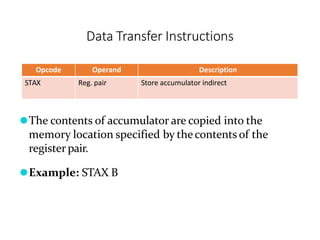
STAX Reg. pair Store accumulator indirect
⚫The contents of accumulator are copied into the
memory location specified by thecontents of the
register pair.
⚫Example: STAX B
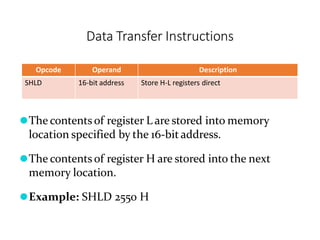
Data Transfer Instructions
Opcode Operand Description
SHLD 16-bit address Store H-L registers direct
⚫The contents of register L are stored into memory
location specified by the 16-bitaddress.
⚫The contentsof register H are stored into the next
memory location.
⚫Example: SHLD 2550 H
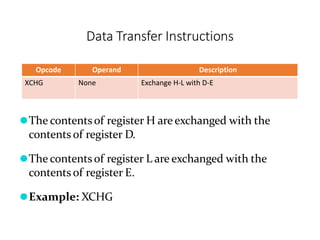
Data Transfer Instructions
Opcode Operand Description
XCHG None Exchange H-L with D-E
⚫The contentsof register H are exchanged with the
contents of register D.
⚫The contentsof register L are exchanged with the
contents of register E.
⚫Example: XCHG
Data Transfer Instructions
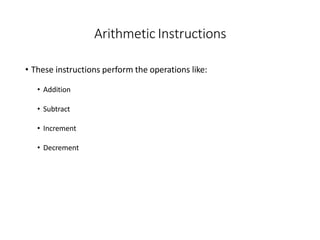
Arithmetic Instructions
• These instructions perform the operations like:
• Addition
• Subtract
• Increment
• Decrement
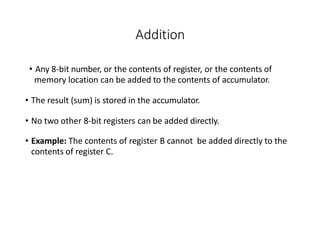
Addition
• Any 8-bit number, or the contents of register, or the contents of
memory location can be added to the contents of accumulator.
• The result (sum) is stored in the accumulator.
• No two other 8-bit registers can be added directly.
• Example: The contents of register B cannot be added directly to the
contents of register C.
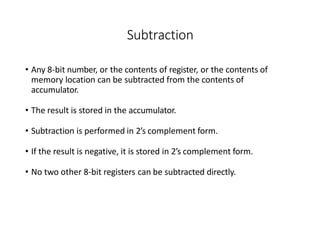
Subtraction
• Any 8-bit number, or the contents of register, or the contents of
memory location can be subtracted from the contents of
accumulator.
• The result is stored in the accumulator.
• Subtraction is performed in 2’s complement form.
• If the result is negative, it is stored in 2’s complement form.
• No two other 8-bit registers can be subtracted directly.
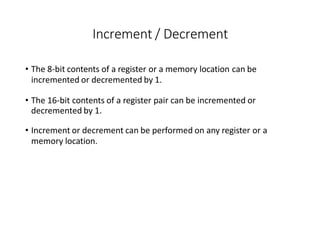
Increment / Decrement
• The 8-bit contents of a register or a memory location can be
incremented or decremented by 1.
• The 16-bit contents of a register pair can be incremented or
decremented by 1.
• Increment or decrement can be performed on any register or a
memory location.
Arithmetic Instructions
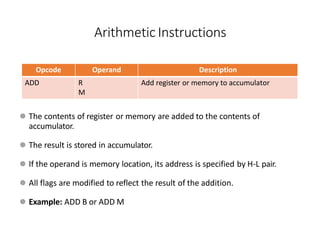
Opcode Operand Description
ADD R
M
Add register or memory to accumulator
⚫ The contents of register or memory are added to the contents of
accumulator.
⚫ The result is stored in accumulator.
⚫ If the operand is memory location, its address is specified by H-L pair.
⚫ All flags are modified to reflect the result of the addition.
⚫ Example: ADD B or ADD M
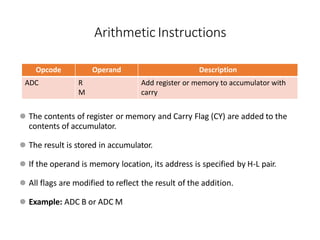
Opcode Operand Description
ADC R
M
Add register or memory to accumulator with
carry
⚫ The contents of register or memory and Carry Flag (CY) are added to the
contents of accumulator.
⚫ The result is stored in accumulator.
⚫ If the operand is memory location, its address is specified by H-L pair.
⚫ All flags are modified to reflect the result of the addition.
⚫ Example: ADC B or ADC M
Arithmetic Instructions
Opcode Operand Description
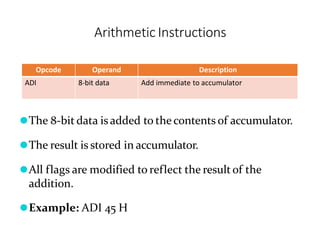
ADI 8-bit data Add immediate to accumulator
⚫The 8-bit data isadded to the contents of accumulator.
⚫The result is stored in accumulator.
⚫All flags are modified to reflect the result of the
addition.
⚫Example: ADI 45 H
Arithmetic Instructions
Opcode Operand Description
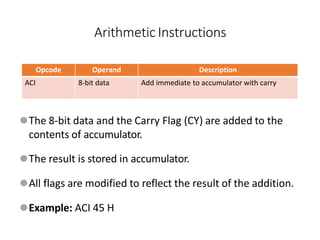
ACI 8-bit data Add immediate to accumulator with carry
⚫The 8-bit data and the Carry Flag (CY) are added to the
contents of accumulator.
⚫The result is stored in accumulator.
⚫All flags are modified to reflect the result of the addition.
⚫Example: ACI 45 H
Arithmetic Instructions
Opcode Operand Description
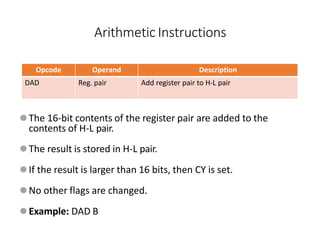
DAD Reg. pair Add register pair to H-L pair
⚫The 16-bit contents of the register pair are added to the
contents of H-L pair.
⚫The result is stored in H-L pair.
⚫If the result is larger than 16 bits, then CY is set.
⚫No other flags are changed.
⚫Example: DAD B
Arithmetic Instructions
Opcode Operand Description
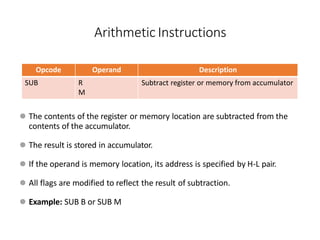
SUB R
M
Subtract register or memory from accumulator
⚫ The contents of the register or memory location are subtracted from the
contents of the accumulator.
⚫ The result is stored in accumulator.
⚫ If the operand is memory location, its address is specified by H-L pair.
⚫ All flags are modified to reflect the result of subtraction.
⚫ Example: SUB B or SUB M
Arithmetic Instructions
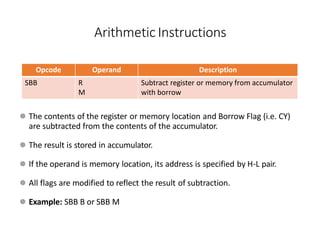
Opcode Operand Description
SBB R
M
Subtract register or memory from accumulator
with borrow
⚫ The contents of the register or memory location and Borrow Flag (i.e. CY)
are subtracted from the contents of the accumulator.
⚫ The result is stored in accumulator.
⚫ If the operand is memory location, its address is specified by H-L pair.
⚫ All flags are modified to reflect the result of subtraction.
⚫ Example: SBB B or SBB M
Arithmetic Instructions
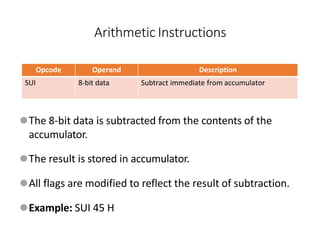
Opcode Operand Description
SUI 8-bit data Subtract immediate from accumulator
⚫The 8-bit data is subtracted from the contents of the
accumulator.
⚫The result is stored in accumulator.
⚫All flags are modified to reflect the result of subtraction.
⚫Example: SUI 45 H
Arithmetic Instructions
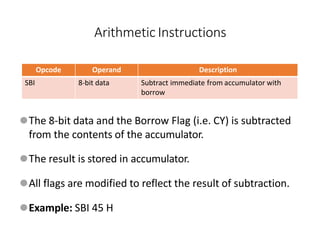
Opcode Operand Description
SBI 8-bit data Subtract immediate from accumulator with
borrow
⚫The 8-bit data and the Borrow Flag (i.e. CY) is subtracted
from the contents of the accumulator.
⚫The result is stored in accumulator.
⚫All flags are modified to reflect the result of subtraction.
⚫Example: SBI 45 H
Arithmetic Instructions
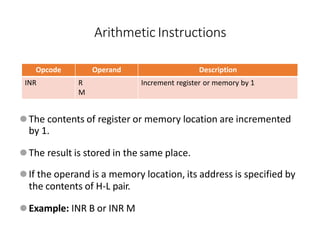
Opcode Operand Description
INR R
M
Increment register or memory by 1
⚫The contents of register or memory location are incremented
by 1.
⚫The result is stored in the same place.
⚫If the operand is a memory location, its address is specified by
the contents of H-L pair.
⚫Example: INR B or INR M
Arithmetic Instructions
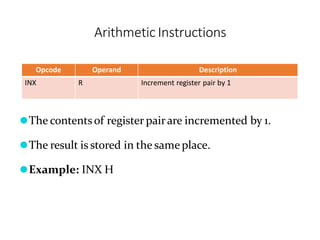
Opcode Operand Description
INX R Increment register pair by 1
⚫The contentsof register pairare incremented by 1.
⚫The result is stored in the same place.
⚫Example: INX H
Arithmetic Instructions
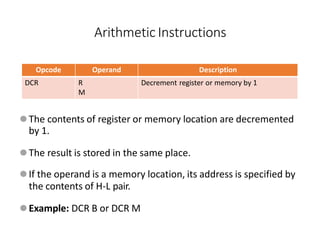
Opcode Operand Description
DCR R
M
Decrement register or memory by 1
⚫The contents of register or memory location are decremented
by 1.
⚫The result is stored in the same place.
⚫If the operand is a memory location, its address is specified by
the contents of H-L pair.
⚫Example: DCR B or DCR M
Arithmetic Instructions
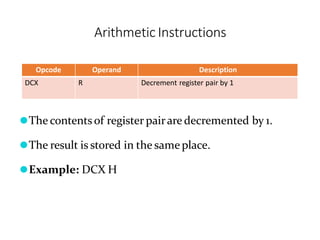
Opcode Operand Description
DCX R Decrement register pair by 1
⚫The contents of register pairare decremented by 1.
⚫The result is stored in the same place.
⚫Example: DCX H
Arithmetic Instructions
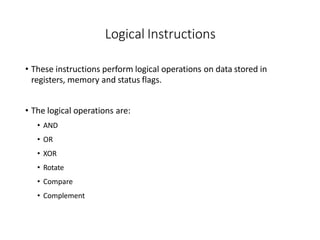
Logical Instructions
• These instructions perform logical operations on data stored in
registers, memory and status flags.
• The logical operations are:
• AND
• OR
• XOR
• Rotate
• Compare
• Complement
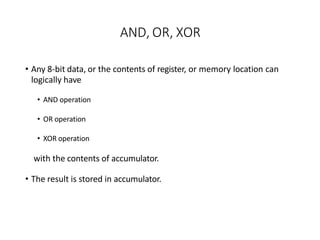
AND, OR, XOR
• Any 8-bit data, or the contents of register, or memory location can
logically have
• AND operation
• OR operation
• XOR operation
with the contents of accumulator.
• The result is stored in accumulator.
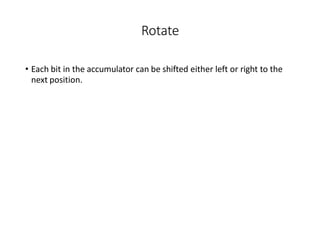
Rotate
• Each bit in the accumulator can be shifted either left or right to the
next position.
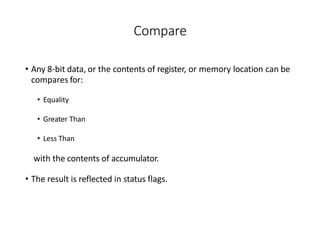
Compare
• Any 8-bit data, or the contents of register, or memory location can be
compares for:
• Equality
• Greater Than
• Less Than
with the contents of accumulator.
• The result is reflected in status flags.
Complement
• The contents of accumulator can be complemented.
• Each 0 is replaced by 1 and each 1 is replaced by 0.
Logical Instructions
Opcode Operand Description
CMP R
M
Compare register or memory with accumulator
⚫The contentsof theoperand (registeror memory) are
compared with thecontents of the accumulator.
⚫Both contents are preserved .
⚫The result of the comparison is shown by setting the
flags of the PSW as follows:
Opcode Operand Description
CMP R
M
Compare register or memory with accumulator
⚫if (A) < (reg/mem): carry flag is set
⚫if (A) = (reg/mem): zero flag is set
⚫if (A) > (reg/mem): carry and zero flags are reset.
⚫Example: CMP B or CMP M
Logical Instructions
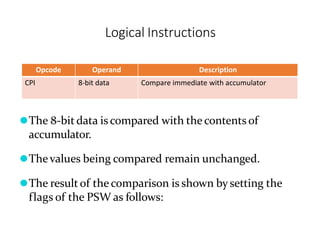
Opcode Operand Description
CPI 8-bit data Compare immediate with accumulator
⚫The 8-bit data is compared with the contents of
accumulator.
⚫Thevalues being compared remain unchanged.
⚫The result of the comparison is shown by setting the
flags of the PSW as follows:
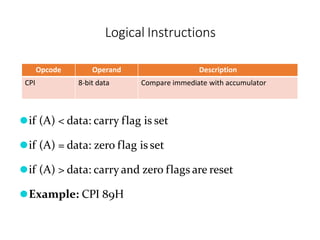
Logical Instructions
Opcode Operand Description
CPI 8-bit data Compare immediate with accumulator
⚫if (A) < data: carry flag is set
⚫if (A) = data: zero flag is set
⚫if (A) > data: carry and zero flags are reset
⚫Example: CPI 89H
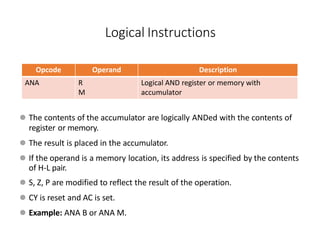
Logical Instructions
Opcode Operand Description
ANA R
M
Logical AND register or memory with
accumulator
⚫ The contents of the accumulator are logically ANDed with the contents of
register or memory.
⚫ The result is placed in the accumulator.
⚫ If the operand is a memory location, its address is specified by the contents
of H-L pair.
⚫ S, Z, P are modified to reflect the result of the operation.
⚫ CY is reset and AC is set.
⚫ Example: ANA B or ANA M.
Logical Instructions
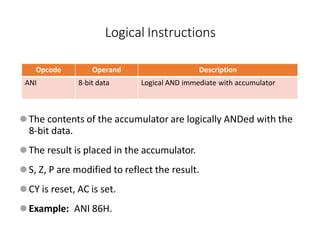
Opcode Operand Description
ANI 8-bit data Logical AND immediate with accumulator
⚫The contents of the accumulator are logically ANDed with the
8-bit data.
⚫The result is placed in the accumulator.
⚫S, Z, P are modified to reflect the result.
⚫CY is reset, AC is set.
⚫Example: ANI 86H.
Logical Instructions
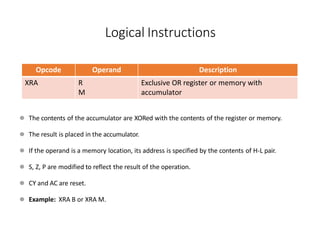
Opcode Operand Description
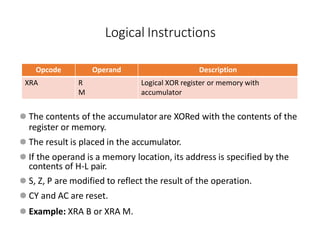
XRA R
M
Exclusive OR register or memory with
accumulator
⚫ The contents of the accumulator are XORed with the contents of the register or memory.
⚫ The result is placed in the accumulator.
⚫ If the operand is a memory location, its address is specified by the contents of H-L pair.
⚫ S, Z, P are modified to reflect the result of the operation.
⚫ CY and AC are reset.
⚫ Example: XRA B or XRA M.
Logical Instructions
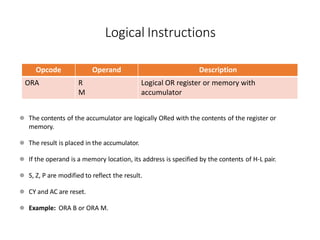
Opcode Operand Description
ORA R
M
Logical OR register or memory with
accumulator
⚫ The contents of the accumulator are logically ORed with the contents of the register or
memory.
⚫ The result is placed in the accumulator.
⚫ If the operand is a memory location, its address is specified by the contents of H-L pair.
⚫ S, Z, P are modified to reflect the result.
⚫ CY and AC are reset.
⚫ Example: ORA B or ORA M.
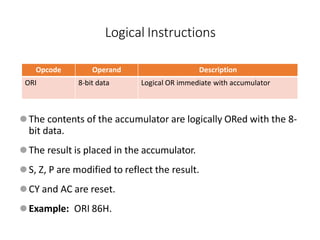
Logical Instructions
Opcode Operand Description
ORI 8-bit data Logical OR immediate with accumulator
⚫The contents of the accumulator are logically ORed with the 8-
bit data.
⚫The result is placed in the accumulator.
⚫S, Z, P are modified to reflect the result.
⚫CY and AC are reset.
⚫Example: ORI 86H.
Logical Instructions
Opcode Operand Description
XRA R
M
Logical XOR register or memory with
accumulator
⚫ The contents of the accumulator are XORed with the contents of the
register or memory.
⚫ The result is placed in the accumulator.
⚫ If the operand is a memory location, its address is specified by the
contents of H-L pair.
⚫ S, Z, P are modified to reflect the result of the operation.
⚫ CY and AC are reset.
⚫ Example: XRA B or XRA M.
Logical Instructions
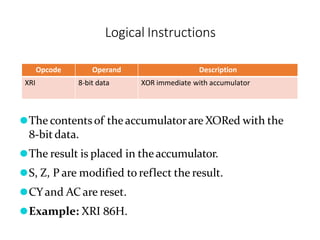
Opcode Operand Description
XRI 8-bit data XOR immediate with accumulator
⚫The contents of theaccumulatorare XORed with the
8-bit data.
⚫The result is placed in theaccumulator.
⚫S, Z, P are modified to reflect the result.
⚫CYand AC are reset.
⚫Example: XRI 86H.
Logical Instructions
Opcode Operand Description
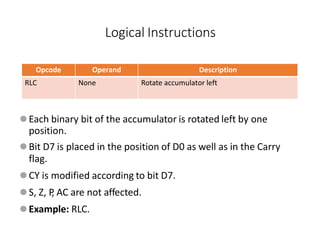
RLC None Rotate accumulator left
⚫Each binary bit of the accumulator is rotated left by one
position.
⚫Bit D7 is placed in the position of D0 as well as in the Carry
flag.
⚫CY is modified according to bit D7.
⚫S, Z, P
, AC are not affected.
⚫Example: RLC.
Logical Instructions
Opcode Operand Description
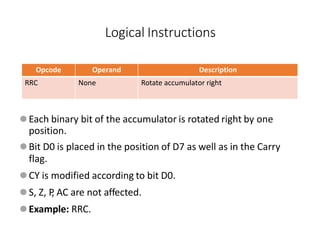
RRC None Rotate accumulator right
⚫Each binary bit of the accumulator is rotated right by one
position.
⚫Bit D0 is placed in the position of D7 as well as in the Carry
flag.
⚫CY is modified according to bit D0.
⚫S, Z, P
, AC are not affected.
⚫Example: RRC.
Logical Instructions
Opcode Operand Description
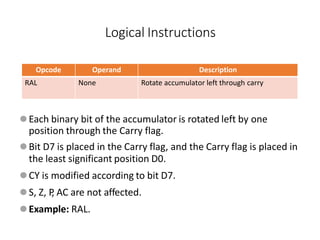
RAL None Rotate accumulator left through carry
⚫Each binary bit of the accumulator is rotated left by one
position through the Carry flag.
⚫Bit D7 is placed in the Carry flag, and the Carry flag is placed in
the least significant position D0.
⚫CY is modified according to bit D7.
⚫S, Z, P
, AC are not affected.
⚫Example: RAL.
Logical Instructions
Opcode Operand Description
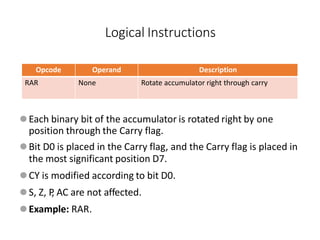
RAR None Rotate accumulator right through carry
⚫Each binary bit of the accumulator is rotated right by one
position through the Carry flag.
⚫Bit D0 is placed in the Carry flag, and the Carry flag is placed in
the most significant position D7.
⚫CY is modified according to bit D0.
⚫S, Z, P
, AC are not affected.
⚫Example: RAR.
Logical Instructions
Opcode Operand Description
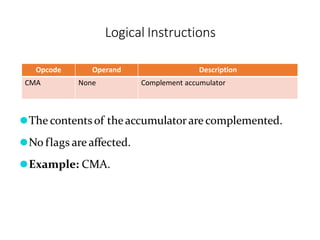
CMA None Complement accumulator
⚫The contents of theaccumulatorare complemented.
⚫No flags are affected.
⚫Example: CMA.
Logical Instructions
Opcode Operand Description
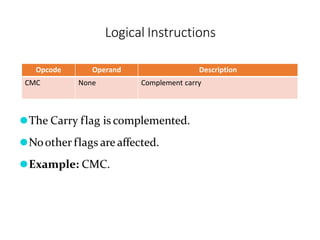
CMC None Complement carry
⚫The Carry flag is complemented.
⚫Noother flags are affected.
⚫Example: CMC.
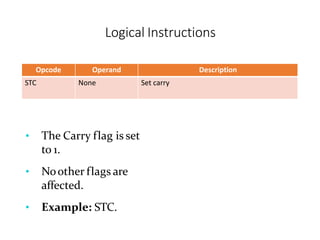
Logical Instructions
Opcode Operand Description
STC None Set carry
• The Carry flag is set
to 1.
• Noother flags are
affected.
• Example: STC.
Logical Instructions
Branching Instructions
• The branching instruction alter the normal sequential flow.
• These instructions alter either unconditionally or conditionally.
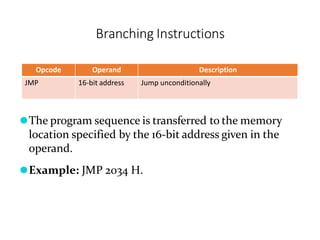
Opcode Operand Description
JMP 16-bit address Jump unconditionally
⚫The program sequence is transferred to the memory
location specified by the 16-bit address given in the
operand.
⚫Example: JMP 2034 H.
Branching Instructions
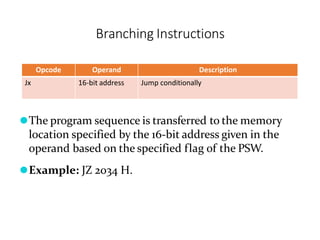
Opcode Operand Description
Jx 16-bit address Jump conditionally
⚫The program sequence is transferred to the memory
location specified by the 16-bit address given in the
operand based on the specified flag of the PSW.
⚫Example: JZ 2034 H.
Branching Instructions
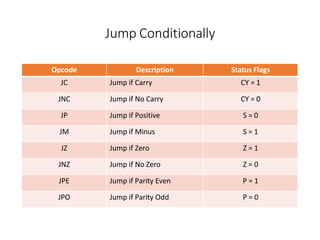
Jump Conditionally
Opcode Description Status Flags
JC Jump if Carry CY = 1
JNC Jump if No Carry CY = 0
JP Jump if Positive S = 0
JM Jump if Minus S = 1
JZ Jump if Zero Z = 1
JNZ Jump if No Zero Z = 0
JPE Jump if Parity Even P = 1
JPO Jump if Parity Odd P = 0
Branching Instructions
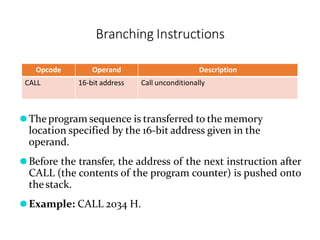
Opcode Operand Description
CALL 16-bit address Call unconditionally
⚫The program sequence is transferred to the memory
location specified by the 16-bit address given in the
operand.
⚫Before the transfer, the address of the next instruction after
CALL (the contents of the program counter) is pushed onto
the stack.
⚫Example: CALL 2034 H.
Branching Instructions
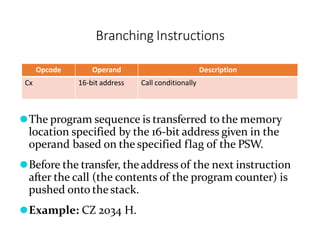
Opcode Operand Description
Cx 16-bit address Call conditionally
⚫The program sequence is transferred to the memory
location specified by the 16-bit address given in the
operand based on the specified flag of the PSW.
⚫Before the transfer, the address of the next instruction
after the call (the contents of the program counter) is
pushed onto the stack.
⚫Example: CZ 2034 H.
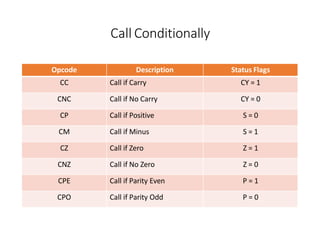
Call Conditionally
Opcode Description Status Flags
CC Call if Carry CY = 1
CNC Call if No Carry CY = 0
CP Call if Positive S = 0
CM Call if Minus S = 1
CZ Call if Zero Z = 1
CNZ Call if No Zero Z = 0
CPE Call if Parity Even P = 1
CPO Call if Parity Odd P = 0
Branching Instructions
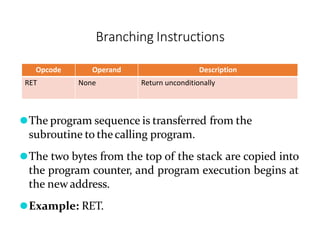
Opcode Operand Description
RET None Return unconditionally
⚫The program sequence is transferred from the
subroutine to thecalling program.
⚫The two bytes from the top of the stack are copied into
the program counter, and program execution begins at
the newaddress.
⚫Example: RET.
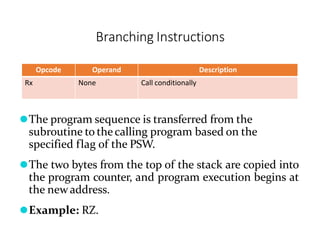
Branching Instructions
Opcode Operand Description
Rx None Call conditionally
⚫The program sequence is transferred from the
subroutine to thecalling program based on the
specified flag of the PSW.
⚫The two bytes from the top of the stack are copied into
the program counter, and program execution begins at
the newaddress.
⚫Example: RZ.
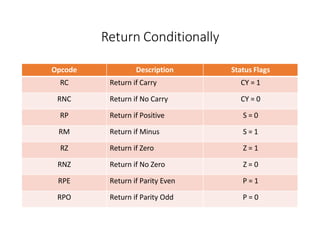
Return Conditionally
Opcode Description Status Flags
RC Return if Carry CY = 1
RNC Return if No Carry CY = 0
RP Return if Positive S = 0
RM Return if Minus S = 1
RZ Return if Zero Z = 1
RNZ Return if No Zero Z = 0
RPE Return if Parity Even P = 1
RPO Return if Parity Odd P = 0
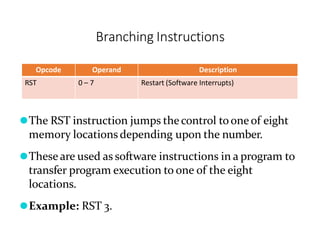
Branching Instructions
Opcode Operand Description
RST 0 – 7 Restart (Software Interrupts)
⚫The RST instruction jumps thecontrol toone of eight
memory locations depending upon the number.
⚫These are used as software instructions in a program to
transfer program execution to one of the eight
locations.
⚫Example: RST 3.
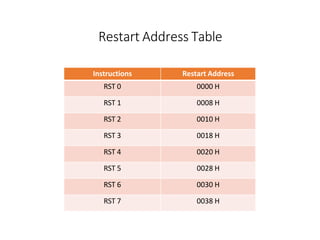
Restart Address Table
Instructions Restart Address
RST 0 0000 H
RST 1 0008 H
RST 2 0010 H
RST 3 0018 H
RST 4 0020 H
RST 5 0028 H
RST 6 0030 H
RST 7 0038 H
Control Instructions
• The control instructions control the operation of microprocessor.
Control Instructions
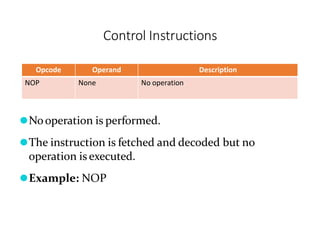
Opcode Operand Description
NOP None No operation
⚫Nooperation is performed.
⚫The instruction is fetched and decoded but no
operation is executed.
⚫Example: NOP
Control Instructions
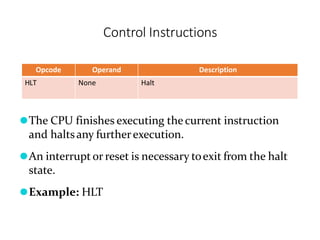
Opcode Operand Description
HLT None Halt
⚫The CPU finishes executing the current instruction
and haltsany furtherexecution.
⚫An interrupt or reset is necessary toexit from the halt
state.
⚫Example: HLT
Control Instructions
Opcode Operand Description
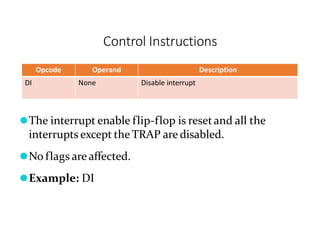
DI None Disable interrupt
⚫The interrupt enable flip-flop is resetand all the
interrupts except the TRAP are disabled.
⚫No flags are affected.
⚫Example: DI
Control Instructions
Opcode Operand Description
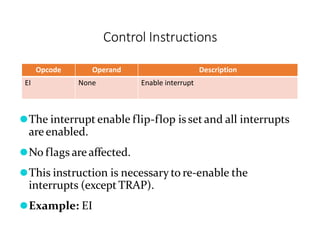
EI None Enable interrupt
⚫The interrupt enable flip-flop issetand all interrupts
are enabled.
⚫No flags areaffected.
⚫This instruction is necessary to re-enable the
interrupts (except TRAP).
⚫Example: EI
Control Instructions
Opcode Operand Description
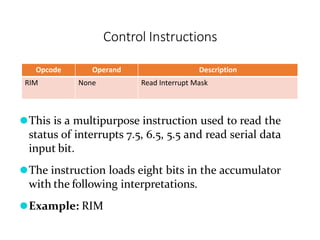
RIM None Read Interrupt Mask
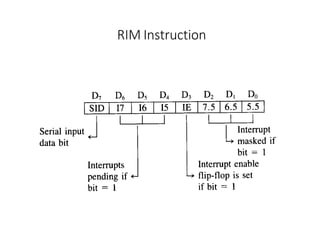
⚫This is a multipurpose instruction used to read the
status of interrupts 7.5, 6.5, 5.5 and read serial data
input bit.
⚫The instruction loads eight bits in the accumulator
with the following interpretations.
⚫Example: RIM
RIM Instruction
Control Instructions
Opcode Operand Description
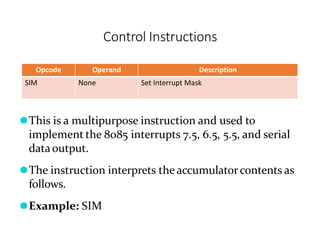
SIM None Set Interrupt Mask
⚫This is a multipurpose instruction and used to
implement the 8085 interrupts 7.5, 6.5, 5.5, and serial
dataoutput.
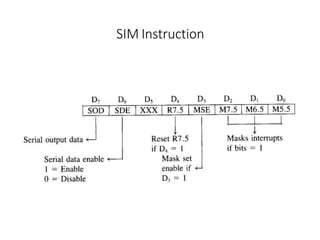
⚫The instruction interprets the accumulatorcontents as
follows.
⚫Example: SIM
SIM Instruction
Thank you

Types of instruction in 8085 microprocessor

  • 1.
    Name : SamarthNandkumar Pawar Roll No: 1536 Subject: Microprocessor Topic: Types of instruction K.P. Mangalvedhekar institute of management career development and research solapur Types of instruction in 8085 Microprocessor
  • 2.
  • 3.
    Instruction Set of8085 ⚫ An instruction is a binary pattern designed inside a microprocessor to perform a specific function. ⚫ The entire group of instructions that a microprocessor supports is called Instruction Set. ⚫ 8085 has 246 instructions. ⚫ Each instruction is represented by an 8-bit binary value. ⚫ These 8-bits of binary value is called Op-Code or Instruction Byte.
  • 4.
    Classification of InstructionSet • Data Transfer Instruction • Arithmetic Instructions • Logical Instructions • Branching Instructions • Control Instructions
  • 5.
    Data Transfer Instructions •These instructions move data between registers, or between memory and registers. • These instructions copy data from source to destination. • While copying, the contents of source are not modified.
  • 6.
    Data Transfer Instructions OpcodeOperand Description MOV Rd, Rs Rd, M M, Rs Copy from source to destination. ⚫ This instruction copies the contents of the source register into the destination register. ⚫ The contents of the source register are not altered. ⚫ If one of the operands is a memory location, its location is specified by the contents of the HL registers. ⚫ Example: MOV B, C ⚫ MOV B, M ⚫ MOV M, C
  • 7.
    Data Transfer Instructions OpcodeOperand Description MVI Rd, Data M, Data Move immediate 8-bit ⚫The 8-bit data is stored in the destination registeror memory. ⚫If theoperand is a memory location, its location is specified by the contents of the H-L registers. ⚫Example: MVI A, 57H ⚫ MVI M, 57H
  • 8.
    Opcode Operand Description LXIReg. pair, 16-bit data Load register pair immediate ⚫This instruction loads 16-bit data in the register pair. ⚫Example: LXI H, 2034 H Data Transfer Instructions
  • 9.
    Data Transfer Instructions OpcodeOperand Description LDA 16-bit address Load Accumulator ⚫The contents of a memory location, specified bya 16- bit address in the operand, are copied to the accumulator. ⚫The contents of the source are notaltered. ⚫Example: LDA 2034H
  • 10.
    Opcode Operand Description LDAXB/D Register Pair Load accumulator indirect ⚫ The contents of the designated register pair point to a memory location. ⚫ This instruction copies the contents of that memory location into the accumulator. ⚫ The contents of either the register pair or the memory location are not altered. ⚫ Example: LDAX B Data Transfer Instructions
  • 11.
    Opcode Operand Description LHLD16-bit address Load H-L registers direct ⚫This instruction copies the contents of memory location pointed out by 16-bitaddress into register L. ⚫Itcopies the contents of next memory location into register H. ⚫Example: LHLD 2040 H Data Transfer Instructions
  • 12.
    Opcode Operand Description STA16-bit address Store accumulator direct ⚫The contentsof accumulatorare copied into the memory location specified by theoperand. ⚫Example: STA 2500 H Data Transfer Instructions
  • 13.
    Opcode Operand Description STAXReg. pair Store accumulator indirect ⚫The contents of accumulator are copied into the memory location specified by thecontents of the register pair. ⚫Example: STAX B Data Transfer Instructions
  • 14.
    Opcode Operand Description SHLD16-bit address Store H-L registers direct ⚫The contents of register L are stored into memory location specified by the 16-bitaddress. ⚫The contentsof register H are stored into the next memory location. ⚫Example: SHLD 2550 H Data Transfer Instructions
  • 15.
    Opcode Operand Description XCHGNone Exchange H-L with D-E ⚫The contentsof register H are exchanged with the contents of register D. ⚫The contentsof register L are exchanged with the contents of register E. ⚫Example: XCHG Data Transfer Instructions
  • 16.
    Arithmetic Instructions • Theseinstructions perform the operations like: • Addition • Subtract • Increment • Decrement
  • 17.
    Addition • Any 8-bitnumber, or the contents of register, or the contents of memory location can be added to the contents of accumulator. • The result (sum) is stored in the accumulator. • No two other 8-bit registers can be added directly. • Example: The contents of register B cannot be added directly to the contents of register C.
  • 18.
    Subtraction • Any 8-bitnumber, or the contents of register, or the contents of memory location can be subtracted from the contents of accumulator. • The result is stored in the accumulator. • Subtraction is performed in 2’s complement form. • If the result is negative, it is stored in 2’s complement form. • No two other 8-bit registers can be subtracted directly.
  • 19.
    Increment / Decrement •The 8-bit contents of a register or a memory location can be incremented or decremented by 1. • The 16-bit contents of a register pair can be incremented or decremented by 1. • Increment or decrement can be performed on any register or a memory location.
  • 20.
    Arithmetic Instructions Opcode OperandDescription ADD R M Add register or memory to accumulator ⚫ The contents of register or memory are added to the contents of accumulator. ⚫ The result is stored in accumulator. ⚫ If the operand is memory location, its address is specified by H-L pair. ⚫ All flags are modified to reflect the result of the addition. ⚫ Example: ADD B or ADD M
  • 21.
    Opcode Operand Description ADCR M Add register or memory to accumulator with carry ⚫ The contents of register or memory and Carry Flag (CY) are added to the contents of accumulator. ⚫ The result is stored in accumulator. ⚫ If the operand is memory location, its address is specified by H-L pair. ⚫ All flags are modified to reflect the result of the addition. ⚫ Example: ADC B or ADC M Arithmetic Instructions
  • 22.
    Opcode Operand Description ADI8-bit data Add immediate to accumulator ⚫The 8-bit data isadded to the contents of accumulator. ⚫The result is stored in accumulator. ⚫All flags are modified to reflect the result of the addition. ⚫Example: ADI 45 H Arithmetic Instructions
  • 23.
    Opcode Operand Description ACI8-bit data Add immediate to accumulator with carry ⚫The 8-bit data and the Carry Flag (CY) are added to the contents of accumulator. ⚫The result is stored in accumulator. ⚫All flags are modified to reflect the result of the addition. ⚫Example: ACI 45 H Arithmetic Instructions
  • 24.
    Opcode Operand Description DADReg. pair Add register pair to H-L pair ⚫The 16-bit contents of the register pair are added to the contents of H-L pair. ⚫The result is stored in H-L pair. ⚫If the result is larger than 16 bits, then CY is set. ⚫No other flags are changed. ⚫Example: DAD B Arithmetic Instructions
  • 25.
    Opcode Operand Description SUBR M Subtract register or memory from accumulator ⚫ The contents of the register or memory location are subtracted from the contents of the accumulator. ⚫ The result is stored in accumulator. ⚫ If the operand is memory location, its address is specified by H-L pair. ⚫ All flags are modified to reflect the result of subtraction. ⚫ Example: SUB B or SUB M Arithmetic Instructions
  • 26.
    Opcode Operand Description SBBR M Subtract register or memory from accumulator with borrow ⚫ The contents of the register or memory location and Borrow Flag (i.e. CY) are subtracted from the contents of the accumulator. ⚫ The result is stored in accumulator. ⚫ If the operand is memory location, its address is specified by H-L pair. ⚫ All flags are modified to reflect the result of subtraction. ⚫ Example: SBB B or SBB M Arithmetic Instructions
  • 27.
    Opcode Operand Description SUI8-bit data Subtract immediate from accumulator ⚫The 8-bit data is subtracted from the contents of the accumulator. ⚫The result is stored in accumulator. ⚫All flags are modified to reflect the result of subtraction. ⚫Example: SUI 45 H Arithmetic Instructions
  • 28.
    Opcode Operand Description SBI8-bit data Subtract immediate from accumulator with borrow ⚫The 8-bit data and the Borrow Flag (i.e. CY) is subtracted from the contents of the accumulator. ⚫The result is stored in accumulator. ⚫All flags are modified to reflect the result of subtraction. ⚫Example: SBI 45 H Arithmetic Instructions
  • 29.
    Opcode Operand Description INRR M Increment register or memory by 1 ⚫The contents of register or memory location are incremented by 1. ⚫The result is stored in the same place. ⚫If the operand is a memory location, its address is specified by the contents of H-L pair. ⚫Example: INR B or INR M Arithmetic Instructions
  • 30.
    Opcode Operand Description INXR Increment register pair by 1 ⚫The contentsof register pairare incremented by 1. ⚫The result is stored in the same place. ⚫Example: INX H Arithmetic Instructions
  • 31.
    Opcode Operand Description DCRR M Decrement register or memory by 1 ⚫The contents of register or memory location are decremented by 1. ⚫The result is stored in the same place. ⚫If the operand is a memory location, its address is specified by the contents of H-L pair. ⚫Example: DCR B or DCR M Arithmetic Instructions
  • 32.
    Opcode Operand Description DCXR Decrement register pair by 1 ⚫The contents of register pairare decremented by 1. ⚫The result is stored in the same place. ⚫Example: DCX H Arithmetic Instructions
  • 33.
    Logical Instructions • Theseinstructions perform logical operations on data stored in registers, memory and status flags. • The logical operations are: • AND • OR • XOR • Rotate • Compare • Complement
  • 34.
    AND, OR, XOR •Any 8-bit data, or the contents of register, or memory location can logically have • AND operation • OR operation • XOR operation with the contents of accumulator. • The result is stored in accumulator.
  • 35.
    Rotate • Each bitin the accumulator can be shifted either left or right to the next position.
  • 36.
    Compare • Any 8-bitdata, or the contents of register, or memory location can be compares for: • Equality • Greater Than • Less Than with the contents of accumulator. • The result is reflected in status flags.
  • 37.
    Complement • The contentsof accumulator can be complemented. • Each 0 is replaced by 1 and each 1 is replaced by 0.
  • 38.
    Logical Instructions Opcode OperandDescription CMP R M Compare register or memory with accumulator ⚫The contentsof theoperand (registeror memory) are compared with thecontents of the accumulator. ⚫Both contents are preserved . ⚫The result of the comparison is shown by setting the flags of the PSW as follows:
  • 39.
    Opcode Operand Description CMPR M Compare register or memory with accumulator ⚫if (A) < (reg/mem): carry flag is set ⚫if (A) = (reg/mem): zero flag is set ⚫if (A) > (reg/mem): carry and zero flags are reset. ⚫Example: CMP B or CMP M Logical Instructions
  • 40.
    Opcode Operand Description CPI8-bit data Compare immediate with accumulator ⚫The 8-bit data is compared with the contents of accumulator. ⚫Thevalues being compared remain unchanged. ⚫The result of the comparison is shown by setting the flags of the PSW as follows: Logical Instructions
  • 41.
    Opcode Operand Description CPI8-bit data Compare immediate with accumulator ⚫if (A) < data: carry flag is set ⚫if (A) = data: zero flag is set ⚫if (A) > data: carry and zero flags are reset ⚫Example: CPI 89H Logical Instructions
  • 42.
    Opcode Operand Description ANAR M Logical AND register or memory with accumulator ⚫ The contents of the accumulator are logically ANDed with the contents of register or memory. ⚫ The result is placed in the accumulator. ⚫ If the operand is a memory location, its address is specified by the contents of H-L pair. ⚫ S, Z, P are modified to reflect the result of the operation. ⚫ CY is reset and AC is set. ⚫ Example: ANA B or ANA M. Logical Instructions
  • 43.
    Opcode Operand Description ANI8-bit data Logical AND immediate with accumulator ⚫The contents of the accumulator are logically ANDed with the 8-bit data. ⚫The result is placed in the accumulator. ⚫S, Z, P are modified to reflect the result. ⚫CY is reset, AC is set. ⚫Example: ANI 86H. Logical Instructions
  • 44.
    Opcode Operand Description XRAR M Exclusive OR register or memory with accumulator ⚫ The contents of the accumulator are XORed with the contents of the register or memory. ⚫ The result is placed in the accumulator. ⚫ If the operand is a memory location, its address is specified by the contents of H-L pair. ⚫ S, Z, P are modified to reflect the result of the operation. ⚫ CY and AC are reset. ⚫ Example: XRA B or XRA M. Logical Instructions
  • 45.
    Opcode Operand Description ORAR M Logical OR register or memory with accumulator ⚫ The contents of the accumulator are logically ORed with the contents of the register or memory. ⚫ The result is placed in the accumulator. ⚫ If the operand is a memory location, its address is specified by the contents of H-L pair. ⚫ S, Z, P are modified to reflect the result. ⚫ CY and AC are reset. ⚫ Example: ORA B or ORA M. Logical Instructions
  • 46.
    Opcode Operand Description ORI8-bit data Logical OR immediate with accumulator ⚫The contents of the accumulator are logically ORed with the 8- bit data. ⚫The result is placed in the accumulator. ⚫S, Z, P are modified to reflect the result. ⚫CY and AC are reset. ⚫Example: ORI 86H. Logical Instructions
  • 47.
    Opcode Operand Description XRAR M Logical XOR register or memory with accumulator ⚫ The contents of the accumulator are XORed with the contents of the register or memory. ⚫ The result is placed in the accumulator. ⚫ If the operand is a memory location, its address is specified by the contents of H-L pair. ⚫ S, Z, P are modified to reflect the result of the operation. ⚫ CY and AC are reset. ⚫ Example: XRA B or XRA M. Logical Instructions
  • 48.
    Opcode Operand Description XRI8-bit data XOR immediate with accumulator ⚫The contents of theaccumulatorare XORed with the 8-bit data. ⚫The result is placed in theaccumulator. ⚫S, Z, P are modified to reflect the result. ⚫CYand AC are reset. ⚫Example: XRI 86H. Logical Instructions
  • 49.
    Opcode Operand Description RLCNone Rotate accumulator left ⚫Each binary bit of the accumulator is rotated left by one position. ⚫Bit D7 is placed in the position of D0 as well as in the Carry flag. ⚫CY is modified according to bit D7. ⚫S, Z, P , AC are not affected. ⚫Example: RLC. Logical Instructions
  • 50.
    Opcode Operand Description RRCNone Rotate accumulator right ⚫Each binary bit of the accumulator is rotated right by one position. ⚫Bit D0 is placed in the position of D7 as well as in the Carry flag. ⚫CY is modified according to bit D0. ⚫S, Z, P , AC are not affected. ⚫Example: RRC. Logical Instructions
  • 51.
    Opcode Operand Description RALNone Rotate accumulator left through carry ⚫Each binary bit of the accumulator is rotated left by one position through the Carry flag. ⚫Bit D7 is placed in the Carry flag, and the Carry flag is placed in the least significant position D0. ⚫CY is modified according to bit D7. ⚫S, Z, P , AC are not affected. ⚫Example: RAL. Logical Instructions
  • 52.
    Opcode Operand Description RARNone Rotate accumulator right through carry ⚫Each binary bit of the accumulator is rotated right by one position through the Carry flag. ⚫Bit D0 is placed in the Carry flag, and the Carry flag is placed in the most significant position D7. ⚫CY is modified according to bit D0. ⚫S, Z, P , AC are not affected. ⚫Example: RAR. Logical Instructions
  • 53.
    Opcode Operand Description CMANone Complement accumulator ⚫The contents of theaccumulatorare complemented. ⚫No flags are affected. ⚫Example: CMA. Logical Instructions
  • 54.
    Opcode Operand Description CMCNone Complement carry ⚫The Carry flag is complemented. ⚫Noother flags are affected. ⚫Example: CMC. Logical Instructions
  • 55.
    Opcode Operand Description STCNone Set carry • The Carry flag is set to 1. • Noother flags are affected. • Example: STC. Logical Instructions
  • 56.
    Branching Instructions • Thebranching instruction alter the normal sequential flow. • These instructions alter either unconditionally or conditionally.
  • 57.
    Opcode Operand Description JMP16-bit address Jump unconditionally ⚫The program sequence is transferred to the memory location specified by the 16-bit address given in the operand. ⚫Example: JMP 2034 H. Branching Instructions
  • 58.
    Opcode Operand Description Jx16-bit address Jump conditionally ⚫The program sequence is transferred to the memory location specified by the 16-bit address given in the operand based on the specified flag of the PSW. ⚫Example: JZ 2034 H. Branching Instructions
  • 59.
    Jump Conditionally Opcode DescriptionStatus Flags JC Jump if Carry CY = 1 JNC Jump if No Carry CY = 0 JP Jump if Positive S = 0 JM Jump if Minus S = 1 JZ Jump if Zero Z = 1 JNZ Jump if No Zero Z = 0 JPE Jump if Parity Even P = 1 JPO Jump if Parity Odd P = 0
  • 60.
    Branching Instructions Opcode OperandDescription CALL 16-bit address Call unconditionally ⚫The program sequence is transferred to the memory location specified by the 16-bit address given in the operand. ⚫Before the transfer, the address of the next instruction after CALL (the contents of the program counter) is pushed onto the stack. ⚫Example: CALL 2034 H.
  • 61.
    Branching Instructions Opcode OperandDescription Cx 16-bit address Call conditionally ⚫The program sequence is transferred to the memory location specified by the 16-bit address given in the operand based on the specified flag of the PSW. ⚫Before the transfer, the address of the next instruction after the call (the contents of the program counter) is pushed onto the stack. ⚫Example: CZ 2034 H.
  • 62.
    Call Conditionally Opcode DescriptionStatus Flags CC Call if Carry CY = 1 CNC Call if No Carry CY = 0 CP Call if Positive S = 0 CM Call if Minus S = 1 CZ Call if Zero Z = 1 CNZ Call if No Zero Z = 0 CPE Call if Parity Even P = 1 CPO Call if Parity Odd P = 0
  • 63.
    Branching Instructions Opcode OperandDescription RET None Return unconditionally ⚫The program sequence is transferred from the subroutine to thecalling program. ⚫The two bytes from the top of the stack are copied into the program counter, and program execution begins at the newaddress. ⚫Example: RET.
  • 64.
    Branching Instructions Opcode OperandDescription Rx None Call conditionally ⚫The program sequence is transferred from the subroutine to thecalling program based on the specified flag of the PSW. ⚫The two bytes from the top of the stack are copied into the program counter, and program execution begins at the newaddress. ⚫Example: RZ.
  • 65.
    Return Conditionally Opcode DescriptionStatus Flags RC Return if Carry CY = 1 RNC Return if No Carry CY = 0 RP Return if Positive S = 0 RM Return if Minus S = 1 RZ Return if Zero Z = 1 RNZ Return if No Zero Z = 0 RPE Return if Parity Even P = 1 RPO Return if Parity Odd P = 0
  • 66.
    Branching Instructions Opcode OperandDescription RST 0 – 7 Restart (Software Interrupts) ⚫The RST instruction jumps thecontrol toone of eight memory locations depending upon the number. ⚫These are used as software instructions in a program to transfer program execution to one of the eight locations. ⚫Example: RST 3.
  • 67.
    Restart Address Table InstructionsRestart Address RST 0 0000 H RST 1 0008 H RST 2 0010 H RST 3 0018 H RST 4 0020 H RST 5 0028 H RST 6 0030 H RST 7 0038 H
  • 68.
    Control Instructions • Thecontrol instructions control the operation of microprocessor.
  • 69.
    Control Instructions Opcode OperandDescription NOP None No operation ⚫Nooperation is performed. ⚫The instruction is fetched and decoded but no operation is executed. ⚫Example: NOP
  • 70.
    Control Instructions Opcode OperandDescription HLT None Halt ⚫The CPU finishes executing the current instruction and haltsany furtherexecution. ⚫An interrupt or reset is necessary toexit from the halt state. ⚫Example: HLT
  • 71.
    Control Instructions Opcode OperandDescription DI None Disable interrupt ⚫The interrupt enable flip-flop is resetand all the interrupts except the TRAP are disabled. ⚫No flags are affected. ⚫Example: DI
  • 72.
    Control Instructions Opcode OperandDescription EI None Enable interrupt ⚫The interrupt enable flip-flop issetand all interrupts are enabled. ⚫No flags areaffected. ⚫This instruction is necessary to re-enable the interrupts (except TRAP). ⚫Example: EI
  • 73.
    Control Instructions Opcode OperandDescription RIM None Read Interrupt Mask ⚫This is a multipurpose instruction used to read the status of interrupts 7.5, 6.5, 5.5 and read serial data input bit. ⚫The instruction loads eight bits in the accumulator with the following interpretations. ⚫Example: RIM
  • 74.
  • 75.
    Control Instructions Opcode OperandDescription SIM None Set Interrupt Mask ⚫This is a multipurpose instruction and used to implement the 8085 interrupts 7.5, 6.5, 5.5, and serial dataoutput. ⚫The instruction interprets the accumulatorcontents as follows. ⚫Example: SIM
  • 76.
  • 77.