What is Force?
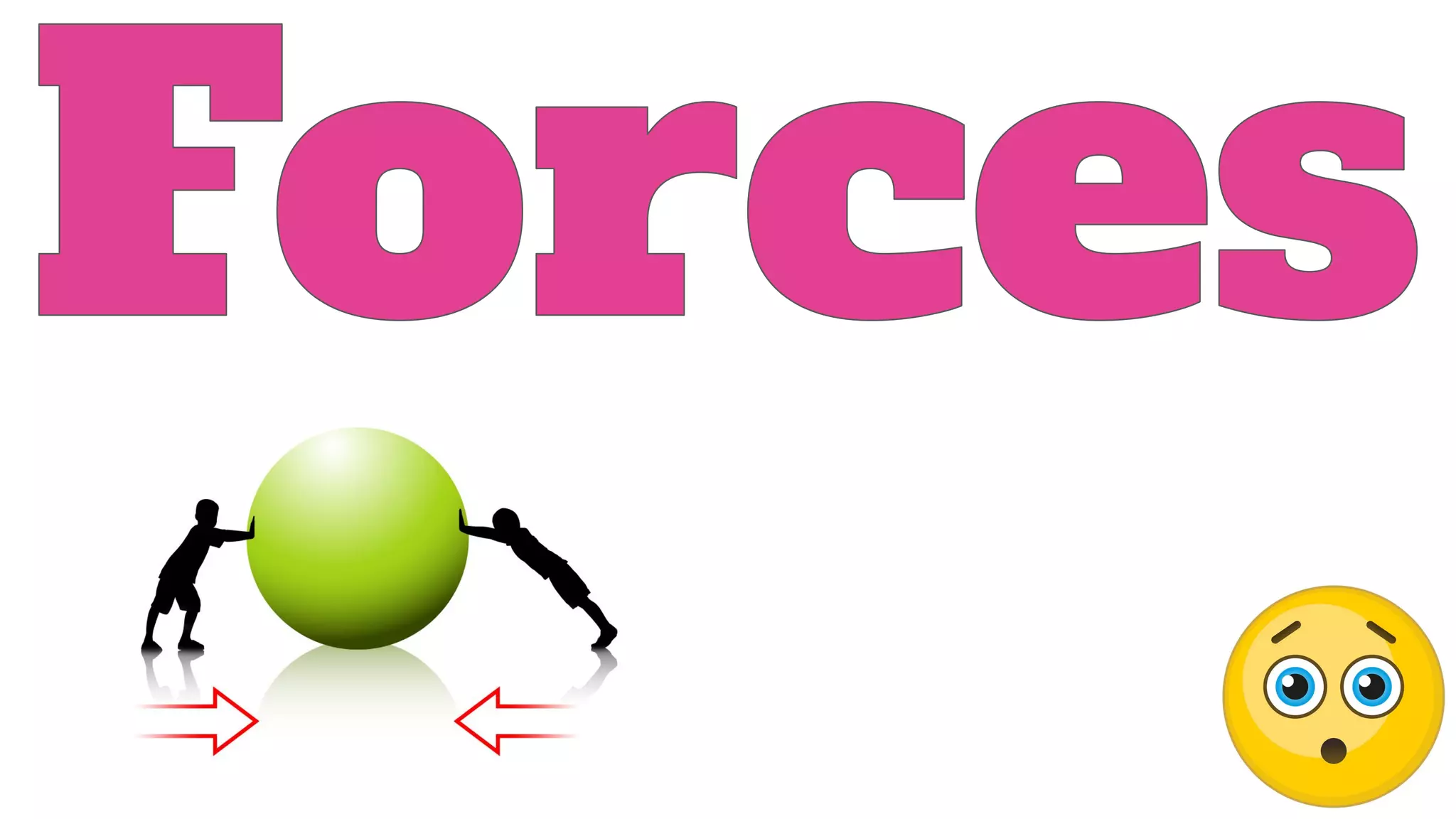
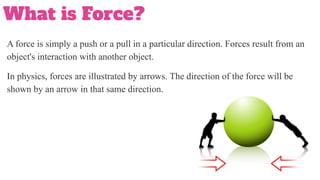
A force is simply a push or a pull in a particular direction. Forces result from an
object's interaction with another object.
In physics, forces are illustrated by arrows. The direction of the force will be
shown by an arrow in that same direction.
What are the Different Types of Forces?
There are two main types of forces: contact forces and non-contact forces.
Contact Force
Contact forces result from two objects touching each other.
The following forces are contact forces:
● Frictional force: whenever objects rub against each other they cause friction. Friction
works against the movement of an object and acts in the opposite direction.
● Normal force: the force that supports the weight of an object on a surface. It’s the force
that the ground or a surface pushes back up with. It helps us not to fall through the ground!
● Tension force: a pulling force exerted by a string or chain on an object.
● Applied force: a force that is applied to an object by another object or person.
● Air resistance force: a type of frictional force that acts on an object as it moves through
the air.
● Spring force: a force applied upon an object by a compressed or stretched spring that is
attached to it.
Non-Contact Force
Non-contact forces are at play when an object is able to push or pull another object without
coming into contact with it.
The following forces are non-contact forces:
● Gravitational force: a force by which an object attracts another object towards
itself. All objects have a gravitational force, but it is most noticeable in massively
large objects like the Earth or the Sun. The Earth pulls all objects towards itself
due to its gravitational force.
● Electrical force: a force exerted between two charged objects.
● Magnetic force: or magnetism is a force that attracts or repels magnetic objects.
Iron, nickel and cobalt are magnetic metals so they are attracted to magnets.

forces

  • 5.
    What is Force? Aforce is simply a push or a pull in a particular direction. Forces result from an object's interaction with another object. In physics, forces are illustrated by arrows. The direction of the force will be shown by an arrow in that same direction.
  • 7.
    What are theDifferent Types of Forces? There are two main types of forces: contact forces and non-contact forces.
  • 8.
    Contact Force Contact forcesresult from two objects touching each other. The following forces are contact forces: ● Frictional force: whenever objects rub against each other they cause friction. Friction works against the movement of an object and acts in the opposite direction. ● Normal force: the force that supports the weight of an object on a surface. It’s the force that the ground or a surface pushes back up with. It helps us not to fall through the ground! ● Tension force: a pulling force exerted by a string or chain on an object. ● Applied force: a force that is applied to an object by another object or person. ● Air resistance force: a type of frictional force that acts on an object as it moves through the air. ● Spring force: a force applied upon an object by a compressed or stretched spring that is attached to it.
  • 9.
    Non-Contact Force Non-contact forcesare at play when an object is able to push or pull another object without coming into contact with it. The following forces are non-contact forces: ● Gravitational force: a force by which an object attracts another object towards itself. All objects have a gravitational force, but it is most noticeable in massively large objects like the Earth or the Sun. The Earth pulls all objects towards itself due to its gravitational force. ● Electrical force: a force exerted between two charged objects. ● Magnetic force: or magnetism is a force that attracts or repels magnetic objects. Iron, nickel and cobalt are magnetic metals so they are attracted to magnets.