Exploring Float
Types in
Construction
Project
Management
Exploring Float
Types in
Construction
Project
Management
Introduction
Introduction
Float types in construction project
management refer to the amount
of time that a task can be delayed
without affecting the project's
overall timeline. Understanding
float types is crucial for effective
project scheduling and resource
allocation. This presentation will
explore the different types of float
and their significance in
construction project management.
Float types in construction project
management refer to the amount
of time that a task can be delayed
without affecting the project's
overall timeline. Understanding
float types is crucial for effective
project scheduling and resource
allocation. This presentation will
explore the different types of float
and their significance in
construction project management.
Total Float
Total Float
Total float, also known as slack,
represents the maximum amount of
time a task can be delayed without
delaying the project's completion
date. It helps project managers
identify tasks that have flexibility in
their scheduling. By effectively
managing total float, project teams
can optimize resource allocation and
minimize project delays.
Total float, also known as slack,
represents the maximum amount of
time a task can be delayed without
delaying the project's completion
date. It helps project managers
identify tasks that have flexibility in
their scheduling. By effectively
managing total float, project teams
can optimize resource allocation and
minimize project delays.
Free Float
Free Float
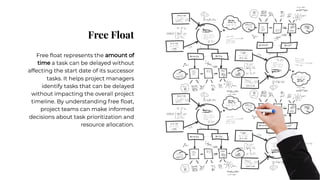
Free float represents the amount of
time a task can be delayed without
affecting the start date of its successor
tasks. It helps project managers
identify tasks that can be delayed
without impacting the overall project
timeline. By understanding free float,
project teams can make informed
decisions about task prioritization and
resource allocation.
Free float represents the amount of
time a task can be delayed without
affecting the start date of its successor
tasks. It helps project managers
identify tasks that can be delayed
without impacting the overall project
timeline. By understanding free float,
project teams can make informed
decisions about task prioritization and
resource allocation.
Independent Float
Independent Float
Independent float, also known as interfering
float, represents the amount of time a task can
be delayed without delaying any other task in
the project. It helps project managers identify
tasks that can be delayed without causing
disruptions to other project activities. By
effectively managing independent float, project
teams can optimize task sequencing and
minimize project risks.
Independent float, also known as interfering
float, represents the amount of time a task can
be delayed without delaying any other task in
the project. It helps project managers identify
tasks that can be delayed without causing
disruptions to other project activities. By
effectively managing independent float, project
teams can optimize task sequencing and
minimize project risks.
Critical Path
Critical Path
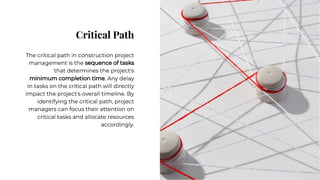
The critical path in construction project
management is the sequence of tasks
that determines the project's
minimum completion time. Any delay
in tasks on the critical path will directly
impact the project's overall timeline. By
identifying the critical path, project
managers can focus their attention on
critical tasks and allocate resources
accordingly.
The critical path in construction project
management is the sequence of tasks
that determines the project's
minimum completion time. Any delay
in tasks on the critical path will directly
impact the project's overall timeline. By
identifying the critical path, project
managers can focus their attention on
critical tasks and allocate resources
accordingly.
Conclusion
Conclusion
Float types play a crucial role in construction project management
by providing insights into task flexibility and project scheduling.
Total float, free float, and independent float help project teams
optimize resource allocation, prioritize tasks, and minimize project
delays. Understanding the critical path is essential for identifying
tasks that directly impact the project's timeline. By effectively
managing float types, project managers can enhance project
efficiency and ensure successful project delivery.

Float types play a crucial role in construction project management
by providing insights into task flexibility and project scheduling.
Total float, free float, and independent float help project teams
optimize resource allocation, prioritize tasks, and minimize project
delays. Understanding the critical path is essential for identifying
tasks that directly impact the project's timeline. By effectively
managing float types, project managers can enhance project
efficiency and ensure successful project delivery.
Thanks!
Thanks!
Do you have any questions? addyouremail@freepik.com
+91 620 421 838
yourcompany.com
Do you have any questions? addyouremail@freepik.com
+91 620 421 838
yourcompany.com

TYPES OF FLOAT ING CPM

  • 1.
    Exploring Float Types in Construction Project Management ExploringFloat Types in Construction Project Management
  • 2.
    Introduction Introduction Float types inconstruction project management refer to the amount of time that a task can be delayed without affecting the project's overall timeline. Understanding float types is crucial for effective project scheduling and resource allocation. This presentation will explore the different types of float and their significance in construction project management. Float types in construction project management refer to the amount of time that a task can be delayed without affecting the project's overall timeline. Understanding float types is crucial for effective project scheduling and resource allocation. This presentation will explore the different types of float and their significance in construction project management.
  • 3.
    Total Float Total Float Totalfloat, also known as slack, represents the maximum amount of time a task can be delayed without delaying the project's completion date. It helps project managers identify tasks that have flexibility in their scheduling. By effectively managing total float, project teams can optimize resource allocation and minimize project delays. Total float, also known as slack, represents the maximum amount of time a task can be delayed without delaying the project's completion date. It helps project managers identify tasks that have flexibility in their scheduling. By effectively managing total float, project teams can optimize resource allocation and minimize project delays.
  • 4.
    Free Float Free Float Freefloat represents the amount of time a task can be delayed without affecting the start date of its successor tasks. It helps project managers identify tasks that can be delayed without impacting the overall project timeline. By understanding free float, project teams can make informed decisions about task prioritization and resource allocation. Free float represents the amount of time a task can be delayed without affecting the start date of its successor tasks. It helps project managers identify tasks that can be delayed without impacting the overall project timeline. By understanding free float, project teams can make informed decisions about task prioritization and resource allocation.
  • 5.
    Independent Float Independent Float Independentfloat, also known as interfering float, represents the amount of time a task can be delayed without delaying any other task in the project. It helps project managers identify tasks that can be delayed without causing disruptions to other project activities. By effectively managing independent float, project teams can optimize task sequencing and minimize project risks. Independent float, also known as interfering float, represents the amount of time a task can be delayed without delaying any other task in the project. It helps project managers identify tasks that can be delayed without causing disruptions to other project activities. By effectively managing independent float, project teams can optimize task sequencing and minimize project risks.
  • 6.
    Critical Path Critical Path Thecritical path in construction project management is the sequence of tasks that determines the project's minimum completion time. Any delay in tasks on the critical path will directly impact the project's overall timeline. By identifying the critical path, project managers can focus their attention on critical tasks and allocate resources accordingly. The critical path in construction project management is the sequence of tasks that determines the project's minimum completion time. Any delay in tasks on the critical path will directly impact the project's overall timeline. By identifying the critical path, project managers can focus their attention on critical tasks and allocate resources accordingly.
  • 7.
    Conclusion Conclusion Float types playa crucial role in construction project management by providing insights into task flexibility and project scheduling. Total float, free float, and independent float help project teams optimize resource allocation, prioritize tasks, and minimize project delays. Understanding the critical path is essential for identifying tasks that directly impact the project's timeline. By effectively managing float types, project managers can enhance project efficiency and ensure successful project delivery. Float types play a crucial role in construction project management by providing insights into task flexibility and project scheduling. Total float, free float, and independent float help project teams optimize resource allocation, prioritize tasks, and minimize project delays. Understanding the critical path is essential for identifying tasks that directly impact the project's timeline. By effectively managing float types, project managers can enhance project efficiency and ensure successful project delivery.
  • 8.
    Thanks! Thanks! Do you haveany questions? addyouremail@freepik.com +91 620 421 838 yourcompany.com Do you have any questions? addyouremail@freepik.com +91 620 421 838 yourcompany.com