PROJECT SCHEDULING
CRITICAL PATH METHOD (CPM)
TYPES OF SCHEDULE FLOATS
&
ARGUMENTS ABOUT FLOAT OWNERSHIP
MATHEW JOSEPH
MSc (Const. Law) BEng (Civil) PGDip (Mgmt.) MRICS MCIArb FEI PMP
TYPES OF SCHEDULE FLOAT
 Float / Slack indicates scheduling flexibility, the spare time available in which an activity (or chain of
activities) can be delayed or prolonged without it causing impact on the succeeding activities and / or
the planned completion date of the project.
 Float corresponds to activities and hence to CPM, whereas, Slack corresponds to events and hence to
PERT.
 Total Float (TF): Difference between the maximum time available to perform an activity and the
planned activity duration time. Indicates the amount of time by which the actual completion of an
activity can exceed its earliest expected completion time without causing delay to the end of the project
schedule or an imposed constraint.
• TF = LFT – EST - D
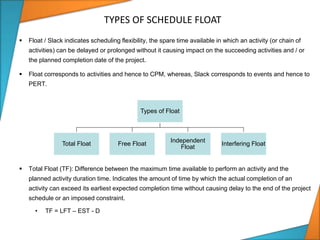
Types of Float
Total Float Free Float
Independent
Float
Interfering Float
TYPES OF SCHEDULE FLOAT
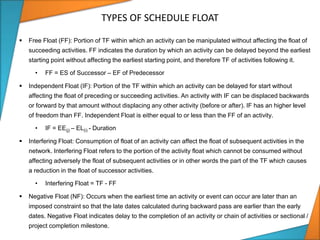
 Free Float (FF): Portion of TF within which an activity can be manipulated without affecting the float of
succeeding activities. FF indicates the duration by which an activity can be delayed beyond the earliest
starting point without affecting the earliest starting point, and therefore TF of activities following it.
• FF = ES of Successor – EF of Predecessor
 Independent Float (IF): Portion of the TF within which an activity can be delayed for start without
affecting the float of preceding or succeeding activities. An activity with IF can be displaced backwards
or forward by that amount without displacing any other activity (before or after). IF has an higher level
of freedom than FF. Independent Float is either equal to or less than the FF of an activity.
• IF = EE(j) – EL(i) - Duration
 Interfering Float: Consumption of float of an activity can affect the float of subsequent activities in the
network. Interfering Float refers to the portion of the activity float which cannot be consumed without
affecting adversely the float of subsequent activities or in other words the part of the TF which causes
a reduction in the float of successor activities.
• Interfering Float = TF - FF
 Negative Float (NF): Occurs when the earliest time an activity or event can occur are later than an
imposed constraint so that the late dates calculated during backward pass are earlier than the early
dates. Negative Float indicates delay to the completion of an activity or chain of activities or sectional /
project completion milestone.
TYPES OF SCHEDULE FLOAT
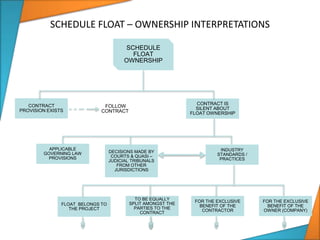
SCHEDULE FLOAT – OWNERSHIP INTERPRETATIONS
SCHEDULE
FLOAT
OWNERSHIP
CONTRACT
PROVISION EXISTS
CONTRACT IS
SILENT ABOUT
FLOAT OWNERSHIP
INDUSTRY
STANDARDS /
PRACTICES
DECISIONS MADE BY
COURTS & QUASI –
JUDICIAL TRIBUNALS
FROM OTHER
JURISDICTIONS
APPLICABLE
GOVERNING LAW
PROVISIONS
FOR THE EXCLUSIVE
BENEFIT OF THE
OWNER (COMPANY)
FOR THE EXCLUSIVE
BENEFIT OF THE
CONTRACTOR
TO BE EQUALLY
SPLIT AMONGST THE
PARTIES TO THE
CONTRACT
FLOAT BELONGS TO
THE PROJECT
FOLLOW
CONTRACT

CPM Schedule Float.pptx

  • 1.
    PROJECT SCHEDULING CRITICAL PATHMETHOD (CPM) TYPES OF SCHEDULE FLOATS & ARGUMENTS ABOUT FLOAT OWNERSHIP MATHEW JOSEPH MSc (Const. Law) BEng (Civil) PGDip (Mgmt.) MRICS MCIArb FEI PMP
  • 2.
    TYPES OF SCHEDULEFLOAT  Float / Slack indicates scheduling flexibility, the spare time available in which an activity (or chain of activities) can be delayed or prolonged without it causing impact on the succeeding activities and / or the planned completion date of the project.  Float corresponds to activities and hence to CPM, whereas, Slack corresponds to events and hence to PERT.  Total Float (TF): Difference between the maximum time available to perform an activity and the planned activity duration time. Indicates the amount of time by which the actual completion of an activity can exceed its earliest expected completion time without causing delay to the end of the project schedule or an imposed constraint. • TF = LFT – EST - D Types of Float Total Float Free Float Independent Float Interfering Float
  • 3.
    TYPES OF SCHEDULEFLOAT  Free Float (FF): Portion of TF within which an activity can be manipulated without affecting the float of succeeding activities. FF indicates the duration by which an activity can be delayed beyond the earliest starting point without affecting the earliest starting point, and therefore TF of activities following it. • FF = ES of Successor – EF of Predecessor  Independent Float (IF): Portion of the TF within which an activity can be delayed for start without affecting the float of preceding or succeeding activities. An activity with IF can be displaced backwards or forward by that amount without displacing any other activity (before or after). IF has an higher level of freedom than FF. Independent Float is either equal to or less than the FF of an activity. • IF = EE(j) – EL(i) - Duration  Interfering Float: Consumption of float of an activity can affect the float of subsequent activities in the network. Interfering Float refers to the portion of the activity float which cannot be consumed without affecting adversely the float of subsequent activities or in other words the part of the TF which causes a reduction in the float of successor activities. • Interfering Float = TF - FF  Negative Float (NF): Occurs when the earliest time an activity or event can occur are later than an imposed constraint so that the late dates calculated during backward pass are earlier than the early dates. Negative Float indicates delay to the completion of an activity or chain of activities or sectional / project completion milestone.
  • 4.
  • 5.
    SCHEDULE FLOAT –OWNERSHIP INTERPRETATIONS SCHEDULE FLOAT OWNERSHIP CONTRACT PROVISION EXISTS CONTRACT IS SILENT ABOUT FLOAT OWNERSHIP INDUSTRY STANDARDS / PRACTICES DECISIONS MADE BY COURTS & QUASI – JUDICIAL TRIBUNALS FROM OTHER JURISDICTIONS APPLICABLE GOVERNING LAW PROVISIONS FOR THE EXCLUSIVE BENEFIT OF THE OWNER (COMPANY) FOR THE EXCLUSIVE BENEFIT OF THE CONTRACTOR TO BE EQUALLY SPLIT AMONGST THE PARTIES TO THE CONTRACT FLOAT BELONGS TO THE PROJECT FOLLOW CONTRACT