QUANTITY SURVEYING AND
VALUATION
Department of Civil
Engineering
TAUHEED ALAM KHAN
ASSISTANT PROFESSOR
JAHANGIRABAD INSTITUTE OF TECHNOLOGY
ESTIMATION
Estimation is the scientific way of working
out the approximate cost of an n is
engineering project before execution of the
work.
 It may differ from the calculation of the exact
cost after completion of the project.
 Estimation requires a thorough Knowledge of
the construction procedures, cost of materials &
labour in addition to the skill, experience,
foresight and good judgment.
ESTIMATE
An estimate of the cost of a construction job is
the probable cost of that job as computed from
plans and specifications.
 For a good estimate the actual cost of the
proposed work after completion should not differ
by more than 5 to 10 % from its approximate
cost estimate.
UNITS OF
MEASUREMENTS
The units of measurements are mainly categorized for their nature, shape
and size and for making payments to the contractor.
a) Single units work like doors, windows etc, is expressed in
numbers.
b) Works consists linear measurements involve length like
cornice, fencing, hand rail etc., are expressed in running
meters (RM)
c) Works consists areal surface measurements like plastering,
white washing, partitions of specified thickness etc., are
expressed in square meters.
d) Works consists cubical contents which involve volume like
earth work, cement concrete, Masonry etc., are expressed in
Cubic meters.
NEED OF ESTIMATION & COSTING
1. It help to work out the approximate cost of the project in order to
decide its feasibility with respect to the cost and to ensure the
financial resources.
2. Requirements of controlled materials, such as cement and steel
can be estimated.
3. It is used for framing the tenders for the works and to check
contractor’s work during and after the its execution for the
purpose of making payments to the contractor.
4. From quantities of different items of work calculated in detailed
estimation, resources are allocated to different activities of the
project and ultimately their durations and whole planning and
scheduling of the project is carried out.
DATA REQUIRED TO PREPARE AN
ESTIMATE
1) DRAWINGS
If the drawings are not clear and without complete
dimensions the preparation of estimation become very
difficult. So, it is very essential before preparing an estimate.
2) SPECIFICATIONS
a) General Specifications:
This gives the nature, quality of work and materials in general
terms to be used in various parts of wok. It helps to form a general
idea of building.
b) Detailed Specifications:
This gives the detailed description of the various items of work
laying down the Quantities and qualities of materials, their
proportions, the method of preparation workmanship and execution
of work.
3) RATES
For preparing the estimate the unit rates of each item of work
are required.
1. For arriving at the unit rates of each item.
2. The rates of various materials to be used in the construction.
3. The cost of transport materials.
4. The wages of labor, skilled or unskilled of masons,
carpenters, Amador, etc.,
LUMPSUM:
While preparing an estimate, it is not possible to work out in
detail in case of petty items. Items other than civil engineering
such items are called lump sum items or simply L.S.Items.
Factors to be considered for estimation
1. Each type of work requires a different method of
construction. Construction may be of an ordinary house or
office and it may also be of a Dam, Tunnel, Multistory
building, Airport, Bridge, or a Road, already in operation.
Each of these works requires totally different construction
techniques, type of machinery, and formwork.
2. Quality of labour and labour output varies in different
localities.
3. Weather conditions greatly affect the output and, hence,
the overall cost.
Factors to be considered for estimation (-ctd-)
4. Ground conditions vary and change the method of
construction. For example, excavation may be dry, wet,
hard, soft, shallow or deep requiring different efforts.
5. The source of availability of a sufficient supply of
materials of good quality.
6. The availability of construction machinery also affects
the method of construction.
7. Access to the site must be reasonable. If the access is
poor, temporary roads may be constructed.
TYPES OF ESTIMATES
There are two main types of estimates:-
 Rough (or) approximate estimate.
 Detailed estimate.
Rough (or) approximate estimate
 Preliminary or approximate estimate is required for studies of various
aspects of work of project and for its administrative approval.
 It can decide, in case of commercial projects, whether the net income
earned justifies the amount invested or not. The approximate estimate
is prepared from the practical knowledge and cost of similar works.
 The following are the methods used for preparation of approximate
estimates.
1) Plinth area method
2) Cubical contents methods
3) Unit base method.
1) Plinth area method
cost of construction = Plinth area x plinth area rate.
2) Cubical Contents Method
It is more accurate that the other two methods viz., plinth area method
and unit base method.
cost of construction = Total cubical contents x Local Cubic Rate.
3) Unit Base Method
. For public buildings, cost. Per person (cost per capita) is used. For
example,
Students hostel - cost per student
Hospital - Cost per bed
Hotel - Cost per Guest
DETAILED ESTIMATE
• Detailed estimates are prepared by carefully and
separately calculating the costs of various item of the
work that constitute the whole project from the detailed
working drawings after the design has been finalized.
• The mistakes, if any, in the rough cost estimate are
eliminated in the detailed estimate.
• Detailed estimates are submitted to the competent
authorities for obtaining technical sanction.
DETAILED ESTIMATE
 The whole project is sub-divided into different items of
work or activities. The quantity for each item is then
calculated separately from the drawings as accurately as
possible. The procedure is known as "taking out of
quantities".
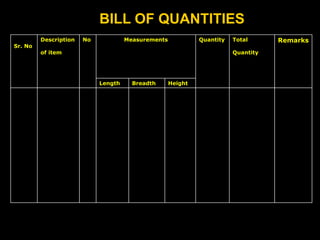
 The quantities for each item may be estimated and shown
in the pattern which is called "Bill of quantities."
 The unit, in which each item of the wok is to be
calculated, should be according to the prevailing practice
as followed in various departments of the country.
BILL OF QUANTITIES
Sr. No
Description
of item
No Measurements Quantity Total
Quantity
Remarks
Length Breadth Height
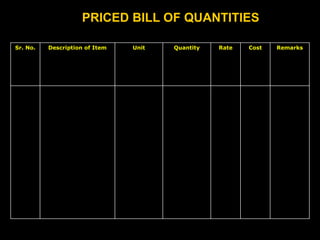
PRICED BILL OF QUANTITIES
Sr. No. Description of Item Unit Quantity Rate Cost Remarks
DETAILED ESTIMATE
 Each item of the work is then multiplied by its estimated
current rate calculated by a fixed procedure to find out cost of
the item.
 At the end, a total of all items of the work are made to get the
total estimated cost.
 The rates are usually as per Schedule of Rates for the
locality plus a premium to allow for rise in labor and material
rates over and above the schedule of rates.
 A percentage, usually 5% is also provided on the total
estimated cost for the work to allow for the possible
contingencies due to unforeseen items or expenditure or
other causes, besides 2% establishment charges.
DETAILED ESTIMATE
Besides drawings and details of measurements and
calculation of quantities (Bill of Quantities), the following
documents are also usually submitted with the detailed
estimate for obtaining Technical Sanction:
1. A report explaining History, necessity, scope and main features of the
project, its design, and estimate, etc.
2. Specifications lying down the nature and class of work and material
to be used in various parts of the work.
3. The abstract of cost (priced Bill of Quantities) showing the total
quantities under each sub-head, rate per unit of measurement, and
cost.
4. Calculation sheets showing calculations for important parts of the
structure. In fact, in estimating the art and skill lies only in the
computation of details without any omissions, of all parts of the
building or work.
METHODS OF DETAILED ESTIMATE
 The dimensions, length, breadth and height or depth are to
be taken out from the working drawings (plan, elevation and
section).
 Junctions of walls, corners and the meeting points of walls
require special attention.
 For symmetrical footings, which is the usual case, earthwork
in excavation in foundations, foundation concrete, brickwork
in foundation and plinth, and brickwork in superstructure may
be estimated by either of the two methods:
(1) LONG WALL & SHORT WALL METHOD
(2) CENTER LINE METHOD
LONG WALL & SHORT WALL METHOD (or)
SEPARATE WALL METHOD
• The walls running in one direction are termed as
"long walls” and the walls running in the
transverse direction, as "Short walls.
• Lengths of long walls are measured or found
"Out-to out" and those of short walls as "In-to-
in".
• Different quantities are calculated by multiplying
the length by the breadth and the height of the
wall.
LONG WALL & SHORT WALL METHOD
• Long wall length out-to-out
= Center to center length + half breadth on one Side
+ half breadth on other side.
= Center to center length + one breadth
• Short wall length in-to-in
= Center to Center length - one breadth.
CENTER LINE METHOD
 In this method, total length of center lines of walls, long
and short, has to be found out.
 In this method, the length will remain the same for
excavation in foundations, for concrete in foundations,
for all footings, and for superstructure (with slight
difference when there are cross walls or number of
junctions).
 This method is quicker but requires special attention
and considerations at the junctions, meeting points of
partition or cross walls.
CENTER LINE METHOD
For rectangular, circular polygonal (hexagonal,
octagonal etc.,) buildings having no inter or cross
walls, this method is quite simple.
For buildings having cross or partition walls, for every
junction, half breadth of the respective item or footing
is to be deducted from the total center length.
Thus in the case of a building with one partition wall or
cross wall having two junctions, deduct one breadth of
the respective item of work from the total center
length.
References:
 Dutta, B.N., “Estimating and Costing in Civil Engineering”,
UBS Publishers & Distributors Pvt. Ltd., New Delhi, 2003.
 https://www.wikipedia.org/
 https://nptel.ac.in/course.php
 https://www.vidyarthiplus.com/studymaterials.php

Quantity Surveying & valuation.ppt

  • 1.
    QUANTITY SURVEYING AND VALUATION Departmentof Civil Engineering TAUHEED ALAM KHAN ASSISTANT PROFESSOR JAHANGIRABAD INSTITUTE OF TECHNOLOGY
  • 2.
    ESTIMATION Estimation is thescientific way of working out the approximate cost of an n is engineering project before execution of the work.  It may differ from the calculation of the exact cost after completion of the project.  Estimation requires a thorough Knowledge of the construction procedures, cost of materials & labour in addition to the skill, experience, foresight and good judgment.
  • 3.
    ESTIMATE An estimate ofthe cost of a construction job is the probable cost of that job as computed from plans and specifications.  For a good estimate the actual cost of the proposed work after completion should not differ by more than 5 to 10 % from its approximate cost estimate.
  • 4.
    UNITS OF MEASUREMENTS The unitsof measurements are mainly categorized for their nature, shape and size and for making payments to the contractor. a) Single units work like doors, windows etc, is expressed in numbers. b) Works consists linear measurements involve length like cornice, fencing, hand rail etc., are expressed in running meters (RM) c) Works consists areal surface measurements like plastering, white washing, partitions of specified thickness etc., are expressed in square meters. d) Works consists cubical contents which involve volume like earth work, cement concrete, Masonry etc., are expressed in Cubic meters.
  • 5.
    NEED OF ESTIMATION& COSTING 1. It help to work out the approximate cost of the project in order to decide its feasibility with respect to the cost and to ensure the financial resources. 2. Requirements of controlled materials, such as cement and steel can be estimated. 3. It is used for framing the tenders for the works and to check contractor’s work during and after the its execution for the purpose of making payments to the contractor. 4. From quantities of different items of work calculated in detailed estimation, resources are allocated to different activities of the project and ultimately their durations and whole planning and scheduling of the project is carried out.
  • 6.
    DATA REQUIRED TOPREPARE AN ESTIMATE 1) DRAWINGS If the drawings are not clear and without complete dimensions the preparation of estimation become very difficult. So, it is very essential before preparing an estimate. 2) SPECIFICATIONS a) General Specifications: This gives the nature, quality of work and materials in general terms to be used in various parts of wok. It helps to form a general idea of building. b) Detailed Specifications: This gives the detailed description of the various items of work laying down the Quantities and qualities of materials, their proportions, the method of preparation workmanship and execution of work.
  • 7.
    3) RATES For preparingthe estimate the unit rates of each item of work are required. 1. For arriving at the unit rates of each item. 2. The rates of various materials to be used in the construction. 3. The cost of transport materials. 4. The wages of labor, skilled or unskilled of masons, carpenters, Amador, etc., LUMPSUM: While preparing an estimate, it is not possible to work out in detail in case of petty items. Items other than civil engineering such items are called lump sum items or simply L.S.Items.
  • 8.
    Factors to beconsidered for estimation 1. Each type of work requires a different method of construction. Construction may be of an ordinary house or office and it may also be of a Dam, Tunnel, Multistory building, Airport, Bridge, or a Road, already in operation. Each of these works requires totally different construction techniques, type of machinery, and formwork. 2. Quality of labour and labour output varies in different localities. 3. Weather conditions greatly affect the output and, hence, the overall cost.
  • 9.
    Factors to beconsidered for estimation (-ctd-) 4. Ground conditions vary and change the method of construction. For example, excavation may be dry, wet, hard, soft, shallow or deep requiring different efforts. 5. The source of availability of a sufficient supply of materials of good quality. 6. The availability of construction machinery also affects the method of construction. 7. Access to the site must be reasonable. If the access is poor, temporary roads may be constructed.
  • 10.
    TYPES OF ESTIMATES Thereare two main types of estimates:-  Rough (or) approximate estimate.  Detailed estimate.
  • 11.
    Rough (or) approximateestimate  Preliminary or approximate estimate is required for studies of various aspects of work of project and for its administrative approval.  It can decide, in case of commercial projects, whether the net income earned justifies the amount invested or not. The approximate estimate is prepared from the practical knowledge and cost of similar works.  The following are the methods used for preparation of approximate estimates. 1) Plinth area method 2) Cubical contents methods 3) Unit base method.
  • 12.
    1) Plinth areamethod cost of construction = Plinth area x plinth area rate. 2) Cubical Contents Method It is more accurate that the other two methods viz., plinth area method and unit base method. cost of construction = Total cubical contents x Local Cubic Rate. 3) Unit Base Method . For public buildings, cost. Per person (cost per capita) is used. For example, Students hostel - cost per student Hospital - Cost per bed Hotel - Cost per Guest
  • 13.
    DETAILED ESTIMATE • Detailedestimates are prepared by carefully and separately calculating the costs of various item of the work that constitute the whole project from the detailed working drawings after the design has been finalized. • The mistakes, if any, in the rough cost estimate are eliminated in the detailed estimate. • Detailed estimates are submitted to the competent authorities for obtaining technical sanction.
  • 14.
    DETAILED ESTIMATE  Thewhole project is sub-divided into different items of work or activities. The quantity for each item is then calculated separately from the drawings as accurately as possible. The procedure is known as "taking out of quantities".  The quantities for each item may be estimated and shown in the pattern which is called "Bill of quantities."  The unit, in which each item of the wok is to be calculated, should be according to the prevailing practice as followed in various departments of the country.
  • 15.
    BILL OF QUANTITIES Sr.No Description of item No Measurements Quantity Total Quantity Remarks Length Breadth Height
  • 16.
    PRICED BILL OFQUANTITIES Sr. No. Description of Item Unit Quantity Rate Cost Remarks
  • 17.
    DETAILED ESTIMATE  Eachitem of the work is then multiplied by its estimated current rate calculated by a fixed procedure to find out cost of the item.  At the end, a total of all items of the work are made to get the total estimated cost.  The rates are usually as per Schedule of Rates for the locality plus a premium to allow for rise in labor and material rates over and above the schedule of rates.  A percentage, usually 5% is also provided on the total estimated cost for the work to allow for the possible contingencies due to unforeseen items or expenditure or other causes, besides 2% establishment charges.
  • 18.
    DETAILED ESTIMATE Besides drawingsand details of measurements and calculation of quantities (Bill of Quantities), the following documents are also usually submitted with the detailed estimate for obtaining Technical Sanction: 1. A report explaining History, necessity, scope and main features of the project, its design, and estimate, etc. 2. Specifications lying down the nature and class of work and material to be used in various parts of the work. 3. The abstract of cost (priced Bill of Quantities) showing the total quantities under each sub-head, rate per unit of measurement, and cost. 4. Calculation sheets showing calculations for important parts of the structure. In fact, in estimating the art and skill lies only in the computation of details without any omissions, of all parts of the building or work.
  • 19.
    METHODS OF DETAILEDESTIMATE  The dimensions, length, breadth and height or depth are to be taken out from the working drawings (plan, elevation and section).  Junctions of walls, corners and the meeting points of walls require special attention.  For symmetrical footings, which is the usual case, earthwork in excavation in foundations, foundation concrete, brickwork in foundation and plinth, and brickwork in superstructure may be estimated by either of the two methods: (1) LONG WALL & SHORT WALL METHOD (2) CENTER LINE METHOD
  • 20.
    LONG WALL &SHORT WALL METHOD (or) SEPARATE WALL METHOD • The walls running in one direction are termed as "long walls” and the walls running in the transverse direction, as "Short walls. • Lengths of long walls are measured or found "Out-to out" and those of short walls as "In-to- in". • Different quantities are calculated by multiplying the length by the breadth and the height of the wall.
  • 21.
    LONG WALL &SHORT WALL METHOD • Long wall length out-to-out = Center to center length + half breadth on one Side + half breadth on other side. = Center to center length + one breadth • Short wall length in-to-in = Center to Center length - one breadth.
  • 22.
    CENTER LINE METHOD In this method, total length of center lines of walls, long and short, has to be found out.  In this method, the length will remain the same for excavation in foundations, for concrete in foundations, for all footings, and for superstructure (with slight difference when there are cross walls or number of junctions).  This method is quicker but requires special attention and considerations at the junctions, meeting points of partition or cross walls.
  • 23.
    CENTER LINE METHOD Forrectangular, circular polygonal (hexagonal, octagonal etc.,) buildings having no inter or cross walls, this method is quite simple. For buildings having cross or partition walls, for every junction, half breadth of the respective item or footing is to be deducted from the total center length. Thus in the case of a building with one partition wall or cross wall having two junctions, deduct one breadth of the respective item of work from the total center length.
  • 24.
    References:  Dutta, B.N.,“Estimating and Costing in Civil Engineering”, UBS Publishers & Distributors Pvt. Ltd., New Delhi, 2003.  https://www.wikipedia.org/  https://nptel.ac.in/course.php  https://www.vidyarthiplus.com/studymaterials.php