Types Of Environment
6
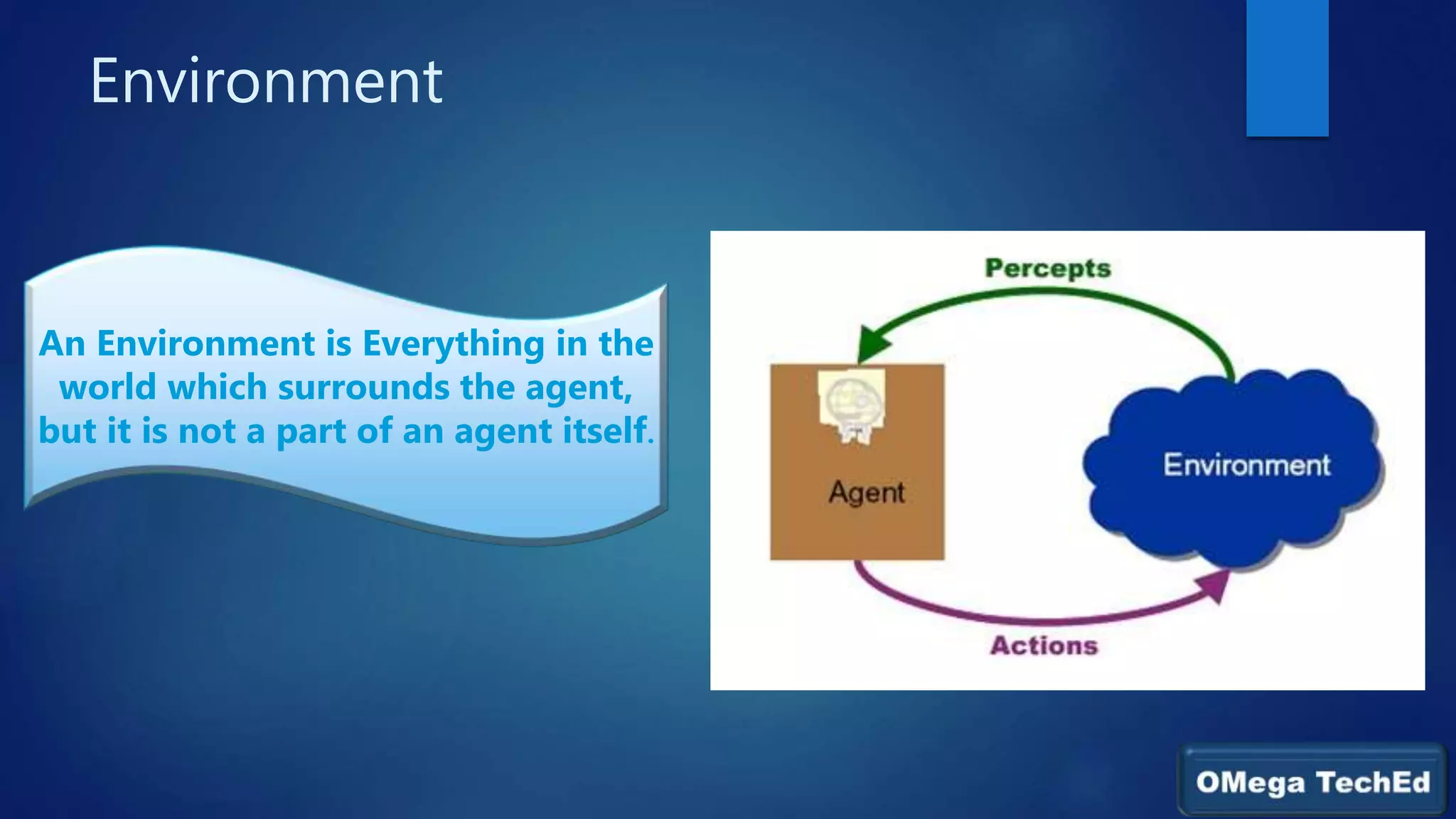
Environment
An Environment is Everything in the
world which surrounds the agent,
but it is not a part of an agent itself.
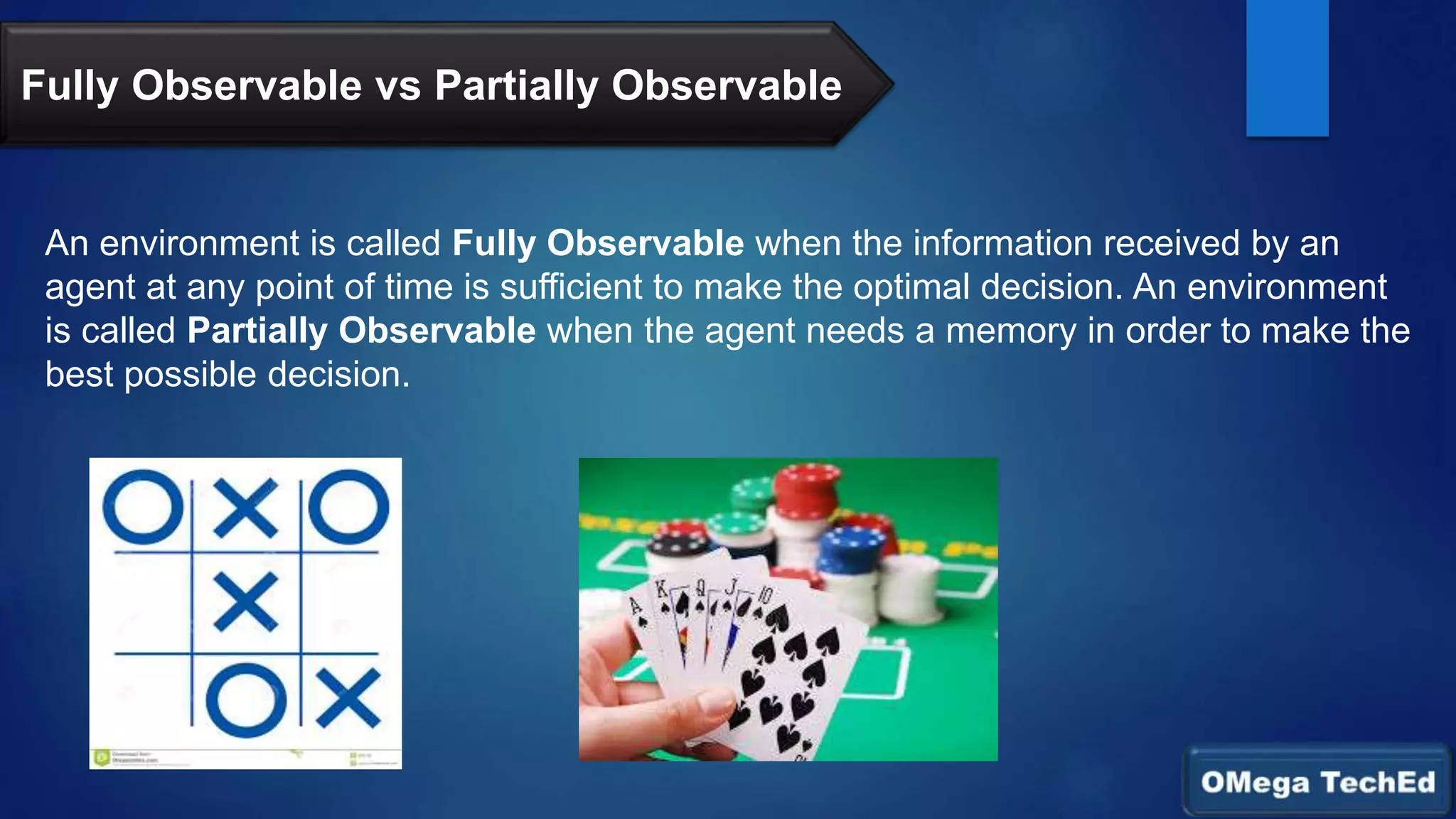
Fully Observable vs Partially Observable
An environment is called Fully Observable when the information received by an
agent at any point of time is sufficient to make the optimal decision. An environment
is called Partially Observable when the agent needs a memory in order to make the
best possible decision.
Deterministic vs Stochastic
An environment is called Deterministic when agent's actions
uniquely determine the outcome. An environment is
called Stochastic when an agent's actions don't uniquely
determine the outcome.
Episodic vs Sequential
In an episodic environment, there is a series of one-shot
actions, and only the current percept is required for the
action. However, in Sequential environment, an agent
requires memory of past actions to determine the next best
actions.
Static vs Dynamic
If the environment can change while an agent is deliberating,
then we say the environment is dynamic for that agent;
otherwise, it is static.
Discrete vs Continuous
Discrete environments are those on which a finite [although
arbitrarily large] set of possibilities can drive the outcome of the
task. Continuous environments rely on unknown and rapidly
changing data sources.
Single Agent vs Multiagent
If only one agent is involved in an environment and operating by itself
then such an environment is called single agent environment.
However, if multiple agents are operating in an environment, then
such an environment is called a multi-agent environment.
Known vs Unknown
 In a known environment, the results for all actions
are known to the agent. While in unknown environment,
agent needs to learn how it works in order to perform an
action.
 In known environment , the outcomes for all actions are given.
Examples : Solitaire, card games.
 If the environment is unknown , the agent will have to learn
how it work in order to make good decisions.
Example: New video game.
Thanks For
Watching
Reference:
Artificial Intelligence
A Modern Approach Third Edition
Peter Norvig and Stuart J. Russell
Next Topic:
The Structure of Agents.
.
Subscribe
Like
Share
OMega TechEd
About the Channel
This channel helps you to prepare for BSc IT and BSc computer science subjects.
In this channel we will learn Business Intelligence ,Artificial Intelligence, Digital Electronics,
Internet OF Things Python programming , Data-Structure etc.
Which is useful for upcoming university exams.
Gmail: omega.teched@gmail.com
Social Media Handles:
omega.teched
megha_with
Subscribe

Types of environment

  • 1.
  • 2.
    Environment An Environment isEverything in the world which surrounds the agent, but it is not a part of an agent itself.
  • 3.
    Fully Observable vsPartially Observable An environment is called Fully Observable when the information received by an agent at any point of time is sufficient to make the optimal decision. An environment is called Partially Observable when the agent needs a memory in order to make the best possible decision.
  • 4.
    Deterministic vs Stochastic Anenvironment is called Deterministic when agent's actions uniquely determine the outcome. An environment is called Stochastic when an agent's actions don't uniquely determine the outcome.
  • 5.
    Episodic vs Sequential Inan episodic environment, there is a series of one-shot actions, and only the current percept is required for the action. However, in Sequential environment, an agent requires memory of past actions to determine the next best actions.
  • 6.
    Static vs Dynamic Ifthe environment can change while an agent is deliberating, then we say the environment is dynamic for that agent; otherwise, it is static.
  • 7.
    Discrete vs Continuous Discreteenvironments are those on which a finite [although arbitrarily large] set of possibilities can drive the outcome of the task. Continuous environments rely on unknown and rapidly changing data sources.
  • 8.
    Single Agent vsMultiagent If only one agent is involved in an environment and operating by itself then such an environment is called single agent environment. However, if multiple agents are operating in an environment, then such an environment is called a multi-agent environment.
  • 9.
    Known vs Unknown In a known environment, the results for all actions are known to the agent. While in unknown environment, agent needs to learn how it works in order to perform an action.  In known environment , the outcomes for all actions are given. Examples : Solitaire, card games.  If the environment is unknown , the agent will have to learn how it work in order to make good decisions. Example: New video game.
  • 11.
    Thanks For Watching Reference: Artificial Intelligence AModern Approach Third Edition Peter Norvig and Stuart J. Russell Next Topic: The Structure of Agents. . Subscribe Like Share
  • 12.
    OMega TechEd About theChannel This channel helps you to prepare for BSc IT and BSc computer science subjects. In this channel we will learn Business Intelligence ,Artificial Intelligence, Digital Electronics, Internet OF Things Python programming , Data-Structure etc. Which is useful for upcoming university exams. Gmail: omega.teched@gmail.com Social Media Handles: omega.teched megha_with Subscribe