74.419 Artificial Intelligence
Intelligent Agents 1
Russell and Norvig, Ch. 2
Outline
 Agents and environments
 Rationality
 PEAS (Performance measure,
Environment, Actuators, Sensors)
 Environment types
 Agent types
Agents
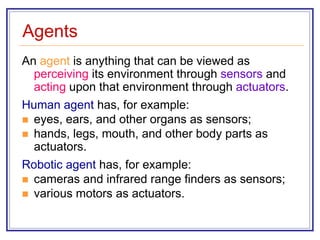
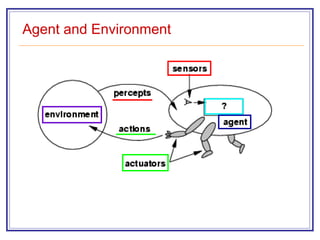
An agent is anything that can be viewed as
perceiving its environment through sensors and
acting upon that environment through actuators.
Human agent has, for example:
 eyes, ears, and other organs as sensors;
 hands, legs, mouth, and other body parts as
actuators.
Robotic agent has, for example:
 cameras and infrared range finders as sensors;
 various motors as actuators.
Agent and Environment
The Vacuum-Cleaner Mini-World
 Environment: square A and B
 Percepts: location and status, e.g., [A, Dirty]
 Actions: left, right, suck, and no-op
The Vacuum-Cleaner Mini-World
World State Action
[A,Clean] Right
[A, Dirty] Suck
[B, Clean] Left
[B, Dirty] Suck
[A, Dirty], [A, Clean] Right
[A, Clean], [B, Dirty]
[A, Clean], [B, Clean]
...
Suck
No-op
...
Agent Function
 The agent function maps from percept histories to
actions:
[f: P*  A]
 An agent is completely specified by the agent
function mapping percept sequences to actions
 The agent program runs on the physical
architecture to produce f.
 agent = architecture + program
The Vacuum-Cleaner Mini-World
function REFLEX-VACUUM-AGENT ([location, status]) return an
action
if status == Dirty then return Suck
else if location == A then return Right
else if location == B then return Left
Does not work this way. Need full state space (table) or memory.
The Vacuum-Cleaner Mini-World
World State Action
[A, Clean]
[A, Dirty]
[B, Clean]
[B, Dirty]
[A, Dirty], [A, Clean]
[A, Clean], [B, Dirty]
[B, Dirty], [B, Clean]
[B, Clean], [A, Dirty]
[A, Clean], [B, Clean]
[B, Clean], [A, Clean]
Right
Suck
Left
Suck
Right
Suck
Left
Suck
No-op
No-op
Rational Agents
 Rational Agent: For each possible percept
sequence, a rational agent should select an
action that is expected to maximize its
performance measure, given the evidence
provided by the percept sequence and
whatever built-in knowledge the agent has.
Rationality
 Rationality  omniscience
 An omniscient agent knows the actual outcome
of its actions.
 Rationality  perfection
 Rationality maximizes expected performance,
while perfection maximizes actual performance.
 "Ideal Rational Agent": Always does "the
right thing".
Rationality
 The proposed definition requires:
 Information gathering/exploration
 To maximize future rewards
 Learn from percepts
 Extending prior knowledge
 Agent autonomy
 Compensate for incorrect prior knowledge
Rationality
 What is rational at a given time depends on:
 Performance measure,
 Prior environment knowledge,
 Actions,
 Percept sequence to date (sensors).
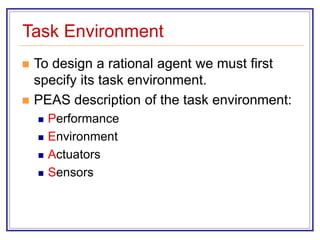
Task Environment
 To design a rational agent we must first
specify its task environment.
 PEAS description of the task environment:
 Performance
 Environment
 Actuators
 Sensors
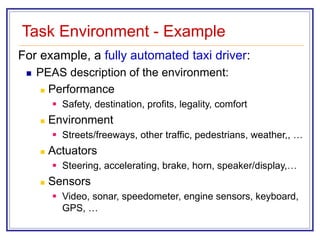
Task Environment - Example
For example, a fully automated taxi driver:
 PEAS description of the environment:
 Performance
 Safety, destination, profits, legality, comfort
 Environment
 Streets/freeways, other traffic, pedestrians, weather,, …
 Actuators
 Steering, accelerating, brake, horn, speaker/display,…
 Sensors
 Video, sonar, speedometer, engine sensors, keyboard,
GPS, …
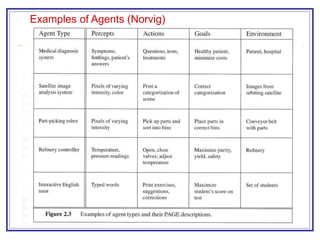
Examples of Agents (Norvig)
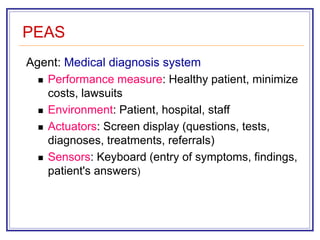
PEAS
Agent: Medical diagnosis system
 Performance measure: Healthy patient, minimize
costs, lawsuits
 Environment: Patient, hospital, staff
 Actuators: Screen display (questions, tests,
diagnoses, treatments, referrals)
 Sensors: Keyboard (entry of symptoms, findings,
patient's answers)
PEAS
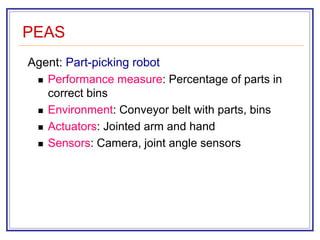
Agent: Part-picking robot
 Performance measure: Percentage of parts in
correct bins
 Environment: Conveyor belt with parts, bins
 Actuators: Jointed arm and hand
 Sensors: Camera, joint angle sensors
PEAS
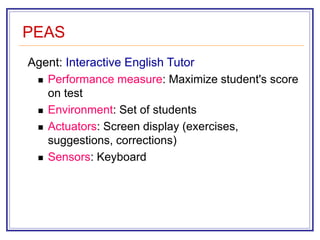
Agent: Interactive English Tutor
 Performance measure: Maximize student's score
on test
 Environment: Set of students
 Actuators: Screen display (exercises,
suggestions, corrections)
 Sensors: Keyboard
Classification of Environment Types
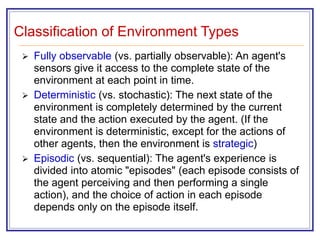
 Fully observable (vs. partially observable): An agent's
sensors give it access to the complete state of the
environment at each point in time.
 Deterministic (vs. stochastic): The next state of the
environment is completely determined by the current
state and the action executed by the agent. (If the
environment is deterministic, except for the actions of
other agents, then the environment is strategic)
 Episodic (vs. sequential): The agent's experience is
divided into atomic "episodes" (each episode consists of
the agent perceiving and then performing a single
action), and the choice of action in each episode
depends only on the episode itself.
Environment types
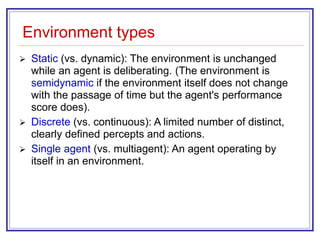
 Static (vs. dynamic): The environment is unchanged
while an agent is deliberating. (The environment is
semidynamic if the environment itself does not change
with the passage of time but the agent's performance
score does).
 Discrete (vs. continuous): A limited number of distinct,
clearly defined percepts and actions.
 Single agent (vs. multiagent): An agent operating by
itself in an environment.
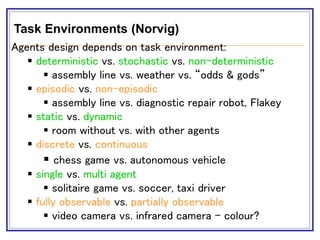
Task Environments (Norvig)
Agents design depends on task environment:
 deterministic vs. stochastic vs. non-deterministic
 assembly line vs. weather vs. “odds & gods”
 episodic vs. non-episodic
 assembly line vs. diagnostic repair robot, Flakey
 static vs. dynamic
 room without vs. with other agents
 discrete vs. continuous
 chess game vs. autonomous vehicle
 single vs. multi agent
 solitaire game vs. soccer, taxi driver
 fully observable vs. partially observable
 video camera vs. infrared camera - colour?
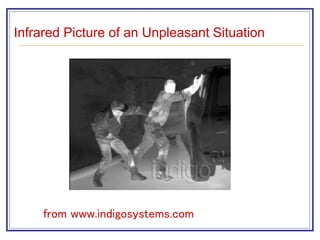
Infrared Picture of an Unpleasant Situation
from www.indigosystems.com
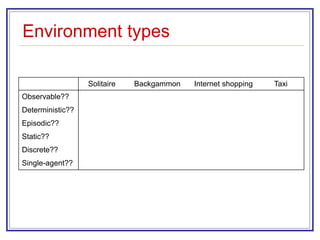
Environment types
Solitaire Backgammon Internet shopping Taxi
Observable??
Deterministic??
Episodic??
Static??
Discrete??
Single-agent??
Environment types
Solitaire Backgammon Internet shopping Taxi
Observable??
Deterministic??
Episodic??
Static??
Discrete??
Single-agent??
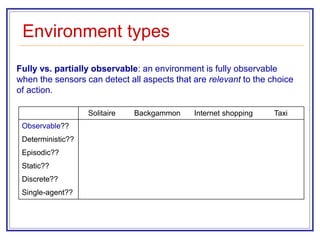
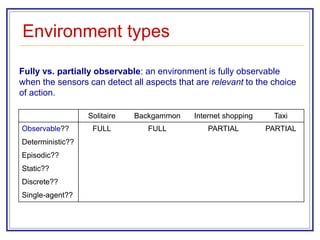
Fully vs. partially observable: an environment is fully observable
when the sensors can detect all aspects that are relevant to the choice
of action.
Environment types
Solitaire Backgammon Internet shopping Taxi
Observable?? FULL FULL PARTIAL PARTIAL
Deterministic??
Episodic??
Static??
Discrete??
Single-agent??
Fully vs. partially observable: an environment is fully observable
when the sensors can detect all aspects that are relevant to the choice
of action.
Environment types
Solitaire Backgammon Internet shopping Taxi
Observable?? FULL FULL PARTIAL PARTIAL
Deterministic??
Episodic??
Static??
Discrete??
Single-agent??
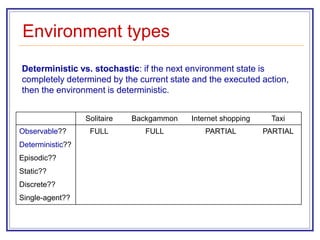
Deterministic vs. stochastic: if the next environment state is
completely determined by the current state and the executed action,
then the environment is deterministic.
Environment types
Solitaire Backgammon Internet shopping Taxi
Observable?? FULL FULL PARTIAL PARTIAL
Deterministic?? YES NO YES NO
Episodic??
Static??
Discrete??
Single-agent??
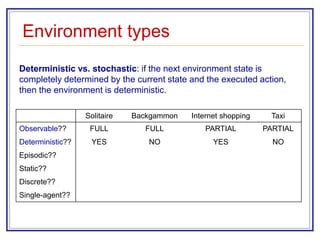
Deterministic vs. stochastic: if the next environment state is
completely determined by the current state and the executed action,
then the environment is deterministic.
Environment types
Solitaire Backgammon Internet shopping Taxi
Observable?? FULL FULL PARTIAL PARTIAL
Deterministic?? YES NO YES NO
Episodic??
Static??
Discrete??
Single-agent??
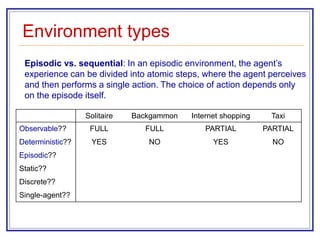
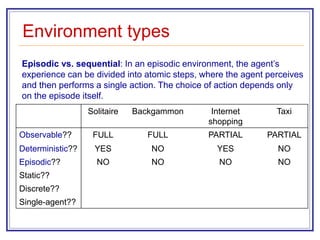
Episodic vs. sequential: In an episodic environment, the agent’s
experience can be divided into atomic steps, where the agent perceives
and then performs a single action. The choice of action depends only
on the episode itself.
Environment types
Solitaire Backgammon Internet
shopping
Taxi
Observable?? FULL FULL PARTIAL PARTIAL
Deterministic?? YES NO YES NO
Episodic?? NO NO NO NO
Static??
Discrete??
Single-agent??
Episodic vs. sequential: In an episodic environment, the agent’s
experience can be divided into atomic steps, where the agent perceives
and then performs a single action. The choice of action depends only
on the episode itself.
Environment types
Solitaire Backgammon Internet shopping Taxi
Observable?? FULL FULL PARTIAL PARTIAL
Deterministic?? YES NO YES NO
Episodic?? NO NO NO NO
Static??
Discrete??
Single-agent??
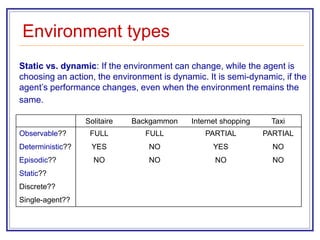
Static vs. dynamic: If the environment can change, while the agent is
choosing an action, the environment is dynamic. It is semi-dynamic, if the
agent’s performance changes, even when the environment remains the
same.
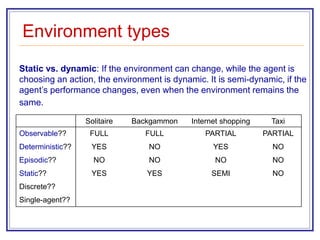
Environment types
Solitaire Backgammon Internet shopping Taxi
Observable?? FULL FULL PARTIAL PARTIAL
Deterministic?? YES NO YES NO
Episodic?? NO NO NO NO
Static?? YES YES SEMI NO
Discrete??
Single-agent??
Static vs. dynamic: If the environment can change, while the agent is
choosing an action, the environment is dynamic. It is semi-dynamic, if the
agent’s performance changes, even when the environment remains the
same.
Environment types
Solitaire Backgammon Internet shopping Taxi
Observable?? FULL FULL PARTIAL PARTIAL
Deterministic?? YES NO YES NO
Episodic?? NO NO NO NO
Static?? YES YES SEMI NO
Discrete??
Single-agent??
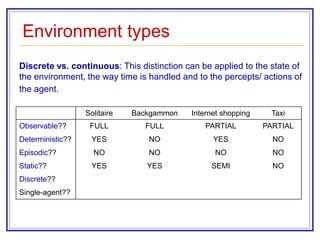
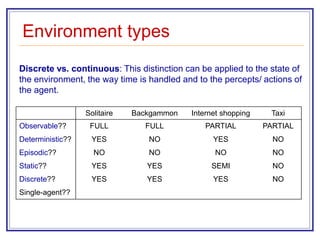
Discrete vs. continuous: This distinction can be applied to the state of
the environment, the way time is handled and to the percepts/ actions of
the agent.
Environment types
Solitaire Backgammon Internet shopping Taxi
Observable?? FULL FULL PARTIAL PARTIAL
Deterministic?? YES NO YES NO
Episodic?? NO NO NO NO
Static?? YES YES SEMI NO
Discrete?? YES YES YES NO
Single-agent??
Discrete vs. continuous: This distinction can be applied to the state of
the environment, the way time is handled and to the percepts/ actions of
the agent.
Environment types
Solitaire Backgammon Internet shopping Taxi
Observable?? FULL FULL PARTIAL PARTIAL
Deterministic?? YES NO YES NO
Episodic?? NO NO NO NO
Static?? YES YES SEMI NO
Discrete?? YES YES YES NO
Single-agent??
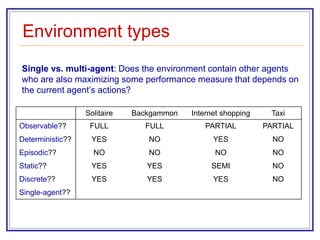
Single vs. multi-agent: Does the environment contain other agents
who are also maximizing some performance measure that depends on
the current agent’s actions?
Environment types
Solitaire Backgammon Internet shopping Taxi
Observable?? FULL FULL PARTIAL PARTIAL
Deterministic?? YES NO YES NO
Episodic?? NO NO NO NO
Static?? YES YES SEMI NO
Discrete?? YES YES YES NO
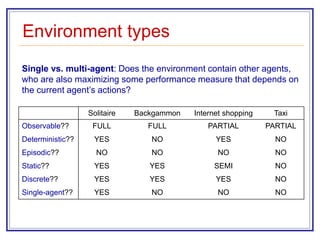
Single-agent?? YES NO NO NO
Single vs. multi-agent: Does the environment contain other agents,
who are also maximizing some performance measure that depends on
the current agent’s actions?
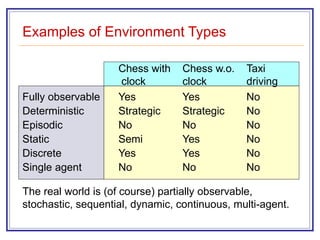
Chess with Chess w.o. Taxi
clock clock driving
Fully observable Yes Yes No
Deterministic Strategic Strategic No
Episodic No No No
Static Semi Yes No
Discrete Yes Yes No
Single agent No No No
The real world is (of course) partially observable,
stochastic, sequential, dynamic, continuous, multi-agent.
Examples of Environment Types
Environment types
 The simplest environment is
 Fully observable, deterministic, episodic, static,
discrete and single-agent.
 Most real situations are:
 Partially observable, stochastic, sequential,
dynamic, continuous and multi-agent.
Agent types
 How does the inside of the agent work?
 Agent = architecture + program
 All agents have the same skeleton:
 Input = current percepts
 Output = action
 Program= manipulates input to produce output
 Note difference with agent function.
Agent types
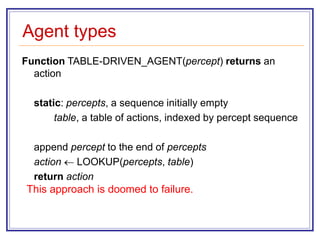
Function TABLE-DRIVEN_AGENT(percept) returns an
action
static: percepts, a sequence initially empty
table, a table of actions, indexed by percept sequence
append percept to the end of percepts
action  LOOKUP(percepts, table)
return action
This approach is doomed to failure.
Agent types
 Four basic kinds of agent programs will be
discussed:
 Simple reflex agents
 Model-based reflex agents
 Goal-based agents
 Utility-based agents
 All these can be turned into learning
agents.
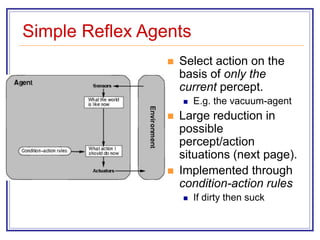
Simple Reflex Agents
 Select action on the
basis of only the
current percept.
 E.g. the vacuum-agent
 Large reduction in
possible
percept/action
situations (next page).
 Implemented through
condition-action rules
 If dirty then suck
Simple Reflex Agent – Example (Nilsson)
Robot in Maze
• perceives 8 squares around it
• low-level percept: can robot move to square or
not
• higher level percept: 2 unit segments
• 4 basic actions: left (west), right (east), up
(north), down (south)
• task is to move along a border
• no 'tight' spaces, at least two free squares
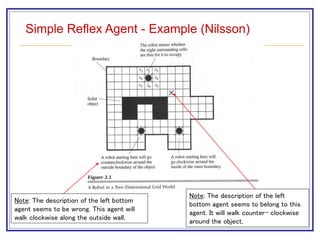
Simple Reflex Agent - Example (Nilsson)
Note: The description of the left bottom
agent seems to be wrong. This agent will
walk clockwise along the outside wall.
Note: The description of the left
bottom agent seems to belong to this
agent. It will walk counter- clockwise
around the object.
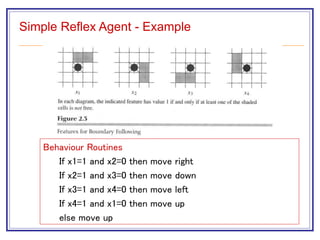
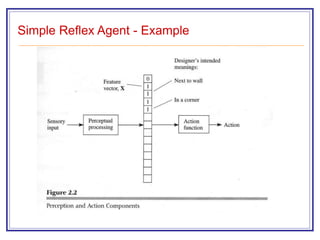
Simple Reflex Agent - Example
Behaviour Routines
If x1=1 and x2=0 then move right
If x2=1 and x3=0 then move down
If x3=1 and x4=0 then move left
If x4=1 and x1=0 then move up
else move up
Simple Reflex Agent - Example
Simple Reflex Agents
function SIMPLE-REFLEX-AGENT(percept)
returns an action
static: rules, a set of condition-action rules
state  INTERPRET-INPUT(percept)
rule  RULE-MATCH(state, rules)
action  RULE-ACTION[rule]
return action
Will only work if the environment is fully observable.
Otherwise infinite loops may occur.
The Vacuum-Cleaner Mini-World
function REFLEX-VACUUM-AGENT ([location, status]) return an
action
if status == Dirty then return Suck
else if location == A then return Right
else if location == B then return Left
Does not work this way. Need full state space (table) or memory.
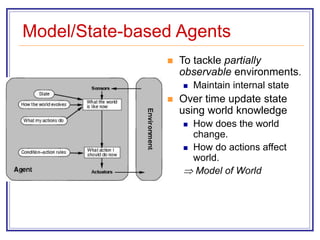
Model/State-based Agents
 To tackle partially
observable environments.
 Maintain internal state
 Over time update state
using world knowledge
 How does the world
change.
 How do actions affect
world.
 Model of World
Model/State-based Agents
function REFLEX-AGENT-WITH-STATE(percept)
returns an action
static: rules, a set of condition-action rules
state, a description of the current world state
(action, the most recent action)
state  UPDATE-STATE(state, (action,) percept)
rule  RULE-MATCH(state, rule)
action  RULE-ACTION[rule]
return action
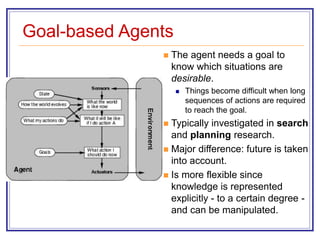
Goal-based Agents
 The agent needs a goal to
know which situations are
desirable.
 Things become difficult when long
sequences of actions are required
to reach the goal.
 Typically investigated in search
and planning research.
 Major difference: future is taken
into account.
 Is more flexible since
knowledge is represented
explicitly - to a certain degree -
and can be manipulated.
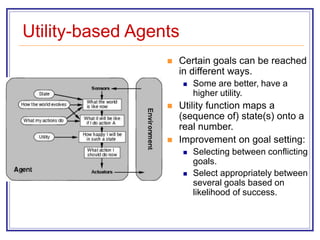
Utility-based Agents
 Certain goals can be reached
in different ways.
 Some are better, have a
higher utility.
 Utility function maps a
(sequence of) state(s) onto a
real number.
 Improvement on goal setting:
 Selecting between conflicting
goals.
 Select appropriately between
several goals based on
likelihood of success.
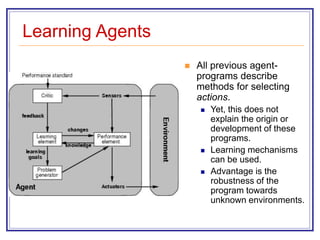
Learning Agents
 All previous agent-
programs describe
methods for selecting
actions.
 Yet, this does not
explain the origin or
development of these
programs.
 Learning mechanisms
can be used.
 Advantage is the
robustness of the
program towards
unknown environments.
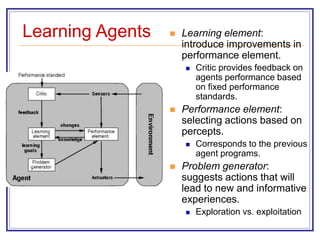
Learning Agents  Learning element:
introduce improvements in
performance element.
 Critic provides feedback on
agents performance based
on fixed performance
standards.
 Performance element:
selecting actions based on
percepts.
 Corresponds to the previous
agent programs.
 Problem generator:
suggests actions that will
lead to new and informative
experiences.
 Exploration vs. exploitation
Robotic Sensors
 (digital) camera
 infrared sensor
 range finders, e.g. radar, sonar
 GPS
 tactile (whiskers, bump panels)
 proprioceptive sensors, e.g. shaft
decoders
 force sensors
 torque sensors
Robotic Effectors
 ‘limbs’ connected through joints;
 degrees of freedom = #directions in
which limb can move (incl. rotation axis)
 drives: wheels (land), propellers, turbines
(air, water)
 driven through electric motors, pneumatic
(gas), or hydraulic (fluids) actuation
 statically stable, dynamically stable

agents in ai ppt

  • 1.
    74.419 Artificial Intelligence IntelligentAgents 1 Russell and Norvig, Ch. 2
  • 2.
    Outline  Agents andenvironments  Rationality  PEAS (Performance measure, Environment, Actuators, Sensors)  Environment types  Agent types
  • 3.
    Agents An agent isanything that can be viewed as perceiving its environment through sensors and acting upon that environment through actuators. Human agent has, for example:  eyes, ears, and other organs as sensors;  hands, legs, mouth, and other body parts as actuators. Robotic agent has, for example:  cameras and infrared range finders as sensors;  various motors as actuators.
  • 4.
  • 5.
    The Vacuum-Cleaner Mini-World Environment: square A and B  Percepts: location and status, e.g., [A, Dirty]  Actions: left, right, suck, and no-op
  • 6.
    The Vacuum-Cleaner Mini-World WorldState Action [A,Clean] Right [A, Dirty] Suck [B, Clean] Left [B, Dirty] Suck [A, Dirty], [A, Clean] Right [A, Clean], [B, Dirty] [A, Clean], [B, Clean] ... Suck No-op ...
  • 7.
    Agent Function  Theagent function maps from percept histories to actions: [f: P*  A]  An agent is completely specified by the agent function mapping percept sequences to actions  The agent program runs on the physical architecture to produce f.  agent = architecture + program
  • 8.
    The Vacuum-Cleaner Mini-World functionREFLEX-VACUUM-AGENT ([location, status]) return an action if status == Dirty then return Suck else if location == A then return Right else if location == B then return Left Does not work this way. Need full state space (table) or memory.
  • 9.
    The Vacuum-Cleaner Mini-World WorldState Action [A, Clean] [A, Dirty] [B, Clean] [B, Dirty] [A, Dirty], [A, Clean] [A, Clean], [B, Dirty] [B, Dirty], [B, Clean] [B, Clean], [A, Dirty] [A, Clean], [B, Clean] [B, Clean], [A, Clean] Right Suck Left Suck Right Suck Left Suck No-op No-op
  • 10.
    Rational Agents  RationalAgent: For each possible percept sequence, a rational agent should select an action that is expected to maximize its performance measure, given the evidence provided by the percept sequence and whatever built-in knowledge the agent has.
  • 11.
    Rationality  Rationality omniscience  An omniscient agent knows the actual outcome of its actions.  Rationality  perfection  Rationality maximizes expected performance, while perfection maximizes actual performance.  "Ideal Rational Agent": Always does "the right thing".
  • 12.
    Rationality  The proposeddefinition requires:  Information gathering/exploration  To maximize future rewards  Learn from percepts  Extending prior knowledge  Agent autonomy  Compensate for incorrect prior knowledge
  • 13.
    Rationality  What isrational at a given time depends on:  Performance measure,  Prior environment knowledge,  Actions,  Percept sequence to date (sensors).
  • 14.
    Task Environment  Todesign a rational agent we must first specify its task environment.  PEAS description of the task environment:  Performance  Environment  Actuators  Sensors
  • 15.
    Task Environment -Example For example, a fully automated taxi driver:  PEAS description of the environment:  Performance  Safety, destination, profits, legality, comfort  Environment  Streets/freeways, other traffic, pedestrians, weather,, …  Actuators  Steering, accelerating, brake, horn, speaker/display,…  Sensors  Video, sonar, speedometer, engine sensors, keyboard, GPS, …
  • 16.
  • 17.
    PEAS Agent: Medical diagnosissystem  Performance measure: Healthy patient, minimize costs, lawsuits  Environment: Patient, hospital, staff  Actuators: Screen display (questions, tests, diagnoses, treatments, referrals)  Sensors: Keyboard (entry of symptoms, findings, patient's answers)
  • 18.
    PEAS Agent: Part-picking robot Performance measure: Percentage of parts in correct bins  Environment: Conveyor belt with parts, bins  Actuators: Jointed arm and hand  Sensors: Camera, joint angle sensors
  • 19.
    PEAS Agent: Interactive EnglishTutor  Performance measure: Maximize student's score on test  Environment: Set of students  Actuators: Screen display (exercises, suggestions, corrections)  Sensors: Keyboard
  • 20.
    Classification of EnvironmentTypes  Fully observable (vs. partially observable): An agent's sensors give it access to the complete state of the environment at each point in time.  Deterministic (vs. stochastic): The next state of the environment is completely determined by the current state and the action executed by the agent. (If the environment is deterministic, except for the actions of other agents, then the environment is strategic)  Episodic (vs. sequential): The agent's experience is divided into atomic "episodes" (each episode consists of the agent perceiving and then performing a single action), and the choice of action in each episode depends only on the episode itself.
  • 21.
    Environment types  Static(vs. dynamic): The environment is unchanged while an agent is deliberating. (The environment is semidynamic if the environment itself does not change with the passage of time but the agent's performance score does).  Discrete (vs. continuous): A limited number of distinct, clearly defined percepts and actions.  Single agent (vs. multiagent): An agent operating by itself in an environment.
  • 22.
    Task Environments (Norvig) Agentsdesign depends on task environment:  deterministic vs. stochastic vs. non-deterministic  assembly line vs. weather vs. “odds & gods”  episodic vs. non-episodic  assembly line vs. diagnostic repair robot, Flakey  static vs. dynamic  room without vs. with other agents  discrete vs. continuous  chess game vs. autonomous vehicle  single vs. multi agent  solitaire game vs. soccer, taxi driver  fully observable vs. partially observable  video camera vs. infrared camera - colour?
  • 23.
    Infrared Picture ofan Unpleasant Situation from www.indigosystems.com
  • 24.
    Environment types Solitaire BackgammonInternet shopping Taxi Observable?? Deterministic?? Episodic?? Static?? Discrete?? Single-agent??
  • 25.
    Environment types Solitaire BackgammonInternet shopping Taxi Observable?? Deterministic?? Episodic?? Static?? Discrete?? Single-agent?? Fully vs. partially observable: an environment is fully observable when the sensors can detect all aspects that are relevant to the choice of action.
  • 26.
    Environment types Solitaire BackgammonInternet shopping Taxi Observable?? FULL FULL PARTIAL PARTIAL Deterministic?? Episodic?? Static?? Discrete?? Single-agent?? Fully vs. partially observable: an environment is fully observable when the sensors can detect all aspects that are relevant to the choice of action.
  • 27.
    Environment types Solitaire BackgammonInternet shopping Taxi Observable?? FULL FULL PARTIAL PARTIAL Deterministic?? Episodic?? Static?? Discrete?? Single-agent?? Deterministic vs. stochastic: if the next environment state is completely determined by the current state and the executed action, then the environment is deterministic.
  • 28.
    Environment types Solitaire BackgammonInternet shopping Taxi Observable?? FULL FULL PARTIAL PARTIAL Deterministic?? YES NO YES NO Episodic?? Static?? Discrete?? Single-agent?? Deterministic vs. stochastic: if the next environment state is completely determined by the current state and the executed action, then the environment is deterministic.
  • 29.
    Environment types Solitaire BackgammonInternet shopping Taxi Observable?? FULL FULL PARTIAL PARTIAL Deterministic?? YES NO YES NO Episodic?? Static?? Discrete?? Single-agent?? Episodic vs. sequential: In an episodic environment, the agent’s experience can be divided into atomic steps, where the agent perceives and then performs a single action. The choice of action depends only on the episode itself.
  • 30.
    Environment types Solitaire BackgammonInternet shopping Taxi Observable?? FULL FULL PARTIAL PARTIAL Deterministic?? YES NO YES NO Episodic?? NO NO NO NO Static?? Discrete?? Single-agent?? Episodic vs. sequential: In an episodic environment, the agent’s experience can be divided into atomic steps, where the agent perceives and then performs a single action. The choice of action depends only on the episode itself.
  • 31.
    Environment types Solitaire BackgammonInternet shopping Taxi Observable?? FULL FULL PARTIAL PARTIAL Deterministic?? YES NO YES NO Episodic?? NO NO NO NO Static?? Discrete?? Single-agent?? Static vs. dynamic: If the environment can change, while the agent is choosing an action, the environment is dynamic. It is semi-dynamic, if the agent’s performance changes, even when the environment remains the same.
  • 32.
    Environment types Solitaire BackgammonInternet shopping Taxi Observable?? FULL FULL PARTIAL PARTIAL Deterministic?? YES NO YES NO Episodic?? NO NO NO NO Static?? YES YES SEMI NO Discrete?? Single-agent?? Static vs. dynamic: If the environment can change, while the agent is choosing an action, the environment is dynamic. It is semi-dynamic, if the agent’s performance changes, even when the environment remains the same.
  • 33.
    Environment types Solitaire BackgammonInternet shopping Taxi Observable?? FULL FULL PARTIAL PARTIAL Deterministic?? YES NO YES NO Episodic?? NO NO NO NO Static?? YES YES SEMI NO Discrete?? Single-agent?? Discrete vs. continuous: This distinction can be applied to the state of the environment, the way time is handled and to the percepts/ actions of the agent.
  • 34.
    Environment types Solitaire BackgammonInternet shopping Taxi Observable?? FULL FULL PARTIAL PARTIAL Deterministic?? YES NO YES NO Episodic?? NO NO NO NO Static?? YES YES SEMI NO Discrete?? YES YES YES NO Single-agent?? Discrete vs. continuous: This distinction can be applied to the state of the environment, the way time is handled and to the percepts/ actions of the agent.
  • 35.
    Environment types Solitaire BackgammonInternet shopping Taxi Observable?? FULL FULL PARTIAL PARTIAL Deterministic?? YES NO YES NO Episodic?? NO NO NO NO Static?? YES YES SEMI NO Discrete?? YES YES YES NO Single-agent?? Single vs. multi-agent: Does the environment contain other agents who are also maximizing some performance measure that depends on the current agent’s actions?
  • 36.
    Environment types Solitaire BackgammonInternet shopping Taxi Observable?? FULL FULL PARTIAL PARTIAL Deterministic?? YES NO YES NO Episodic?? NO NO NO NO Static?? YES YES SEMI NO Discrete?? YES YES YES NO Single-agent?? YES NO NO NO Single vs. multi-agent: Does the environment contain other agents, who are also maximizing some performance measure that depends on the current agent’s actions?
  • 37.
    Chess with Chessw.o. Taxi clock clock driving Fully observable Yes Yes No Deterministic Strategic Strategic No Episodic No No No Static Semi Yes No Discrete Yes Yes No Single agent No No No The real world is (of course) partially observable, stochastic, sequential, dynamic, continuous, multi-agent. Examples of Environment Types
  • 38.
    Environment types  Thesimplest environment is  Fully observable, deterministic, episodic, static, discrete and single-agent.  Most real situations are:  Partially observable, stochastic, sequential, dynamic, continuous and multi-agent.
  • 39.
    Agent types  Howdoes the inside of the agent work?  Agent = architecture + program  All agents have the same skeleton:  Input = current percepts  Output = action  Program= manipulates input to produce output  Note difference with agent function.
  • 40.
    Agent types Function TABLE-DRIVEN_AGENT(percept)returns an action static: percepts, a sequence initially empty table, a table of actions, indexed by percept sequence append percept to the end of percepts action  LOOKUP(percepts, table) return action This approach is doomed to failure.
  • 41.
    Agent types  Fourbasic kinds of agent programs will be discussed:  Simple reflex agents  Model-based reflex agents  Goal-based agents  Utility-based agents  All these can be turned into learning agents.
  • 42.
    Simple Reflex Agents Select action on the basis of only the current percept.  E.g. the vacuum-agent  Large reduction in possible percept/action situations (next page).  Implemented through condition-action rules  If dirty then suck
  • 43.
    Simple Reflex Agent– Example (Nilsson) Robot in Maze • perceives 8 squares around it • low-level percept: can robot move to square or not • higher level percept: 2 unit segments • 4 basic actions: left (west), right (east), up (north), down (south) • task is to move along a border • no 'tight' spaces, at least two free squares
  • 44.
    Simple Reflex Agent- Example (Nilsson) Note: The description of the left bottom agent seems to be wrong. This agent will walk clockwise along the outside wall. Note: The description of the left bottom agent seems to belong to this agent. It will walk counter- clockwise around the object.
  • 45.
    Simple Reflex Agent- Example Behaviour Routines If x1=1 and x2=0 then move right If x2=1 and x3=0 then move down If x3=1 and x4=0 then move left If x4=1 and x1=0 then move up else move up
  • 46.
  • 47.
    Simple Reflex Agents functionSIMPLE-REFLEX-AGENT(percept) returns an action static: rules, a set of condition-action rules state  INTERPRET-INPUT(percept) rule  RULE-MATCH(state, rules) action  RULE-ACTION[rule] return action Will only work if the environment is fully observable. Otherwise infinite loops may occur.
  • 48.
    The Vacuum-Cleaner Mini-World functionREFLEX-VACUUM-AGENT ([location, status]) return an action if status == Dirty then return Suck else if location == A then return Right else if location == B then return Left Does not work this way. Need full state space (table) or memory.
  • 49.
    Model/State-based Agents  Totackle partially observable environments.  Maintain internal state  Over time update state using world knowledge  How does the world change.  How do actions affect world.  Model of World
  • 50.
    Model/State-based Agents function REFLEX-AGENT-WITH-STATE(percept) returnsan action static: rules, a set of condition-action rules state, a description of the current world state (action, the most recent action) state  UPDATE-STATE(state, (action,) percept) rule  RULE-MATCH(state, rule) action  RULE-ACTION[rule] return action
  • 51.
    Goal-based Agents  Theagent needs a goal to know which situations are desirable.  Things become difficult when long sequences of actions are required to reach the goal.  Typically investigated in search and planning research.  Major difference: future is taken into account.  Is more flexible since knowledge is represented explicitly - to a certain degree - and can be manipulated.
  • 52.
    Utility-based Agents  Certaingoals can be reached in different ways.  Some are better, have a higher utility.  Utility function maps a (sequence of) state(s) onto a real number.  Improvement on goal setting:  Selecting between conflicting goals.  Select appropriately between several goals based on likelihood of success.
  • 53.
    Learning Agents  Allprevious agent- programs describe methods for selecting actions.  Yet, this does not explain the origin or development of these programs.  Learning mechanisms can be used.  Advantage is the robustness of the program towards unknown environments.
  • 54.
    Learning Agents Learning element: introduce improvements in performance element.  Critic provides feedback on agents performance based on fixed performance standards.  Performance element: selecting actions based on percepts.  Corresponds to the previous agent programs.  Problem generator: suggests actions that will lead to new and informative experiences.  Exploration vs. exploitation
  • 55.
    Robotic Sensors  (digital)camera  infrared sensor  range finders, e.g. radar, sonar  GPS  tactile (whiskers, bump panels)  proprioceptive sensors, e.g. shaft decoders  force sensors  torque sensors
  • 56.
    Robotic Effectors  ‘limbs’connected through joints;  degrees of freedom = #directions in which limb can move (incl. rotation axis)  drives: wheels (land), propellers, turbines (air, water)  driven through electric motors, pneumatic (gas), or hydraulic (fluids) actuation  statically stable, dynamically stable