Click to add Text
Intelligent Agent
Artificial Intelligence
Intelligent Agents
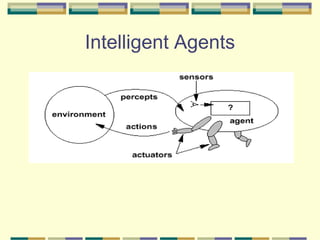
What is an agent ?
 An agent is anything that perceiving its
environment through sensors and acting
upon that environment through actuators
 Example:
 Human is an agent
 A robot is also an agent with cameras and motors
 A thermostat detecting room temperature.
Intelligent Agents
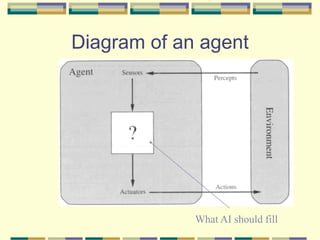
Diagram of an agent
What AI should fill
Simple Terms
Percept
 Agent’s perceptual inputs at any given instant
Percept sequence
 Complete history of everything that the agent
has ever perceived.
Agent function & program
Agent’s behavior is mathematically
described by
 Agent function
 A function mapping any given percept
sequence to an action
Practically it is described by
 An agent program
 The real implementation
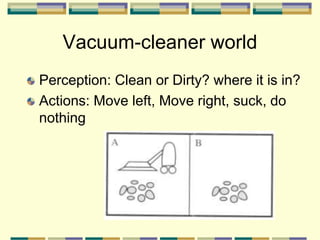
Vacuum-cleaner world
Perception: Clean or Dirty? where it is in?
Actions: Move left, Move right, suck, do
nothing
Concept of Rationality
Rational agent
 One that does the right thing
 = every entry in the table for the agent
function is correct (rational).
What is correct?
 The actions that cause the agent to be
most successful
 So we need ways to measure success.
Performance measure
Performance measure
 An objective function that determines
 How the agent does successfully
 E.g., 90% or 30% ?
An agent, based on its percepts
  action sequence :
if desirable, it is said to be performing well.
 No universal performance measure for all
agents
Performance measure
A general rule:
 Design performance measures according to
 What one actually wants in the environment
 Rather than how one thinks the agent should
behave
E.g., in vacuum-cleaner world
 We want the floor clean, no matter how the
agent behave
 We don’t restrict how the agent behaves
Rationality
What is rational at any given time depends
on four things:
 The performance measure defining the criterion
of success
 The agent’s prior knowledge of the environment
 The actions that the agent can perform
 The agents’s percept sequence up to now
Rational agent
For each possible percept sequence,
 an rational agent should select
 an action expected to maximize its performance
measure, given the evidence provided by the
percept sequence and whatever built-in knowledge
the agent has
E.g., an exam
 Maximize marks, based on
the questions on the paper & your knowledge
Example of a rational agent
Performance measure
 Awards one point for each clean square
 at each time step, over 10000 time steps
Prior knowledge about the environment
 The geography of the environment
 Only two squares
 The effect of the actions
Learning
Does a rational agent depend on only
current percept?
 No, the past percept sequence should also
be used
 This is called learning
 After experiencing an episode, the agent
 should adjust its behaviors to perform better
for the same job next time.
Autonomy
If an agent just relies on the prior knowledge of
its designer rather than its own percepts then
the agent lacks autonomy
A rational agent should be autonomous- it
should learn what it can to compensate for
partial or incorrect prior knowledge.
E.g., a clock
 No input (percepts)
 Run only but its own algorithm (prior knowledge)
 No learning, no experience, etc.
Sometimes, the environment may not be
the real world
 E.g., flight simulator, video games, Internet
 They are all artificial but very complex
environments
 Those agents working in these environments
are called
 Software agent (softbots)
 Because all parts of the agent are software
Software Agents
Task environments
Task environments are the problems
 While the rational agents are the solutions
Specifying the task environment
 PEAS description as fully as possible
Performance
Environment
Actuators
Sensors
Task environments
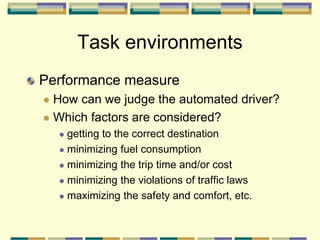
Performance measure
 How can we judge the automated driver?
 Which factors are considered?
 getting to the correct destination
 minimizing fuel consumption
 minimizing the trip time and/or cost
 minimizing the violations of traffic laws
 maximizing the safety and comfort, etc.
Environment
 A taxi must deal with a variety of roads
 Traffic lights, other vehicles, pedestrians,
stray animals, road works, police cars, etc.
 Interact with the customer
Task environments
Actuators (for outputs)
 Control over the accelerator, steering, gear
shifting and braking
 A display to communicate with the
customers
Sensors (for inputs)
 Detect other vehicles, road situations
 GPS (Global Positioning System) to know
where the taxi is
 Many more devices are necessary
Task environments
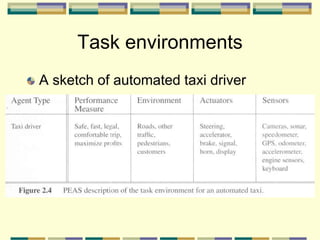
A sketch of automated taxi driver
Task environments
Properties of task environments
Fully observable vs. Partially observable
 If an agent’s sensors give it access to the
complete state of the environment at each
point in time then the environment is
effectively and fully observable
 if the sensors detect all aspects
 That are relevant to the choice of action
Partially observable
An environment might be Partially observable
because of noisy and inaccurate sensors or
because parts of the state are simply missing
from the sensor data.
Example:
 A local dirt sensor of the cleaner cannot tell
 Whether other squares are clean or not
Episodic vs. sequential
 An episode = agent’s single pair of perception & action
 The quality of the agent’s action does not depend on
other episodes
 Every episode is independent of each other
 Episodic environment is simpler
 The agent does not need to think ahead
Sequential
 Current action may affect all future decisions
-Ex. Taxi driving and chess.
Properties of task environments
Static vs. dynamic
 A dynamic environment is always changing
over time
 E.g., the number of people in the street
 While static environment
 E.g., the destination
Semidynamic
 environment is not changed over time
 but the agent’s performance score does
Properties of task environments
Discrete vs. continuous
 If there are a limited number of distinct
states, clearly defined percepts and actions,
the environment is discrete
 E.g., Chess game
 Continuous: Taxi driving
Properties of task environments
Single agent VS. multiagent
 Playing a crossword puzzle – single agent
 Chess playing – two agents
 Competitive multiagent environment
 Chess playing
 Cooperative multiagent environment
 Automated taxi driver
 Avoiding collision
Properties of task environments
Known vs. unknown
This distinction refers not to the environment itslef but to
the agent’s (or designer’s) state of knowledge about
the environment.
-In known environment, the outcomes for all actions are
given. ( example: solitaire card games).
- If the environment is unknown, the agent will have to
learn how it works in order to make good decisions.(
example: new video game).
PEAS for self-driving cars:
Let's suppose a self-driving car then PEAS
representation will be:
Performance: Safety, time, legal drive,
comfort
Environment: Roads, other vehicles, road
signs, pedestrian
Actuators: Steering, accelerator, brake,
signal, horn
Sensors: Camera, GPS, speedometer,
odometer, accelerometer, sonar.
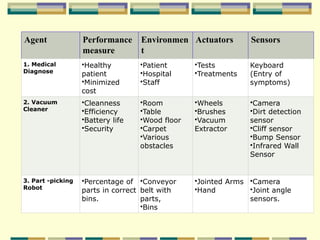
Agent Performance
measure
Environmen
t
Actuators Sensors
1. Medical
Diagnose
•Healthy
patient
•Minimized
cost
•Patient
•Hospital
•Staff
•Tests
•Treatments
Keyboard
(Entry of
symptoms)
2. Vacuum
Cleaner
•Cleanness
•Efficiency
•Battery life
•Security
•Room
•Table
•Wood floor
•Carpet
•Various
obstacles
•Wheels
•Brushes
•Vacuum
Extractor
•Camera
•Dirt detection
sensor
•Cliff sensor
•Bump Sensor
•Infrared Wall
Sensor
3. Part -picking
Robot
•Percentage of
parts in correct
bins.
•Conveyor
belt with
parts,
•Bins
•Jointed Arms
•Hand
•Camera
•Joint angle
sensors.
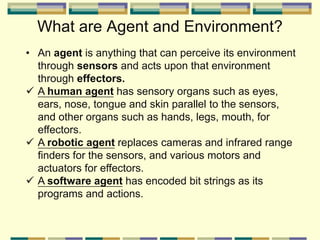
What are Agent and Environment?
• An agent is anything that can perceive its environment
through sensors and acts upon that environment
through effectors.
 A human agent has sensory organs such as eyes,
ears, nose, tongue and skin parallel to the sensors,
and other organs such as hands, legs, mouth, for
effectors.
 A robotic agent replaces cameras and infrared range
finders for the sensors, and various motors and
actuators for effectors.
 A software agent has encoded bit strings as its
programs and actions.
Agent Terminology
• Performance Measure of Agent − It is the criteria, which
determines how successful an agent is.
• Behavior of Agent − It is the action that agent performs
after any given sequence of percepts.
• Percept − It is agent’s perceptual inputs at a given
instance.
• Percept Sequence − It is the history of all that an agent
has perceived till date.
• Agent Function − It is a map from the precept sequence
to an action.
Structure of agents
Agent = architecture + program
 Architecture = some sort of computing
device (sensors + actuators)
 (Agent) Program = some function that
implements the agent mapping = “?”
 Agent Program = Job of AI
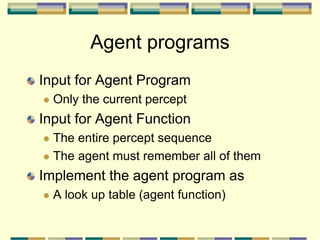
Agent programs
Input for Agent Program
 Only the current percept
Input for Agent Function
 The entire percept sequence
 The agent must remember all of them
Implement the agent program as
 A look up table (agent function)
• Types of agent programs
• Simple Reflex Agent
• Model-based reflex agent
• Goal-based agents
• Utility-based agent
• Learning agent
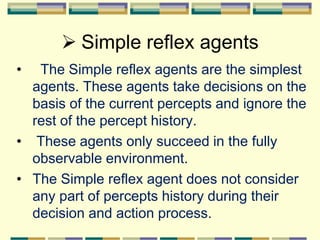
 Simple reflex agents
• The Simple reflex agents are the simplest
agents. These agents take decisions on the
basis of the current percepts and ignore the
rest of the percept history.
• These agents only succeed in the fully
observable environment.
• The Simple reflex agent does not consider
any part of percepts history during their
decision and action process.
Simple reflex agents
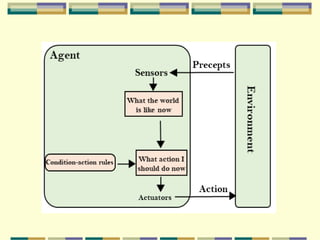
• The Simple reflex agent works on Condition-
action rule, which means it maps the current
state to action. Such as a Room Cleaner
agent, it works only if there is dirt in the room.
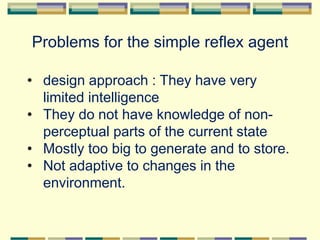
Problems for the simple reflex agent
• design approach : They have very
limited intelligence
• They do not have knowledge of non-
perceptual parts of the current state
• Mostly too big to generate and to store.
• Not adaptive to changes in the
environment.
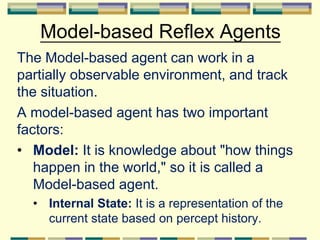
Model-based Reflex Agents
The Model-based agent can work in a
partially observable environment, and track
the situation.
A model-based agent has two important
factors:
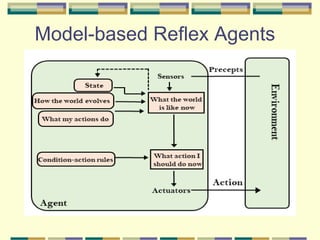
• Model: It is knowledge about "how things
happen in the world," so it is called a
Model-based agent.
• Internal State: It is a representation of the
current state based on percept history.
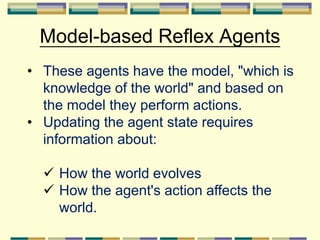
Model-based Reflex Agents
• These agents have the model, "which is
knowledge of the world" and based on
the model they perform actions.
• Updating the agent state requires
information about:
 How the world evolves
 How the agent's action affects the
world.
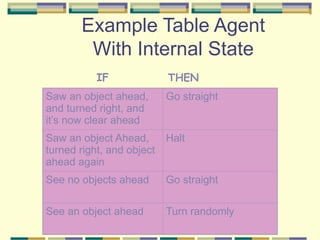
Example Table Agent
With Internal State
Saw an object ahead,
and turned right, and
it’s now clear ahead
Go straight
Saw an object Ahead,
turned right, and object
ahead again
Halt
See no objects ahead Go straight
See an object ahead Turn randomly
IF THEN
Model-based Reflex Agents
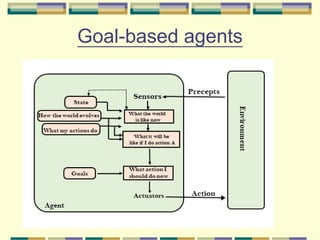
Goal-based agents
• The knowledge of the current state
environment is not always sufficient to
decide for an agent to what to do.
• The agent needs to know its goal which
describes desirable situations.
• Goal-based agents expand the
capabilities of the model-based agent
by having the "goal" information.
Goal-based agents
• They choose an action, so that they can
achieve the goal.
• These agents may have to consider a long
sequence of possible actions before
deciding whether the goal is achieved or
not. Such considerations of different
scenario are called searching and
planning, which makes an agent proactive.
Goal-based agents
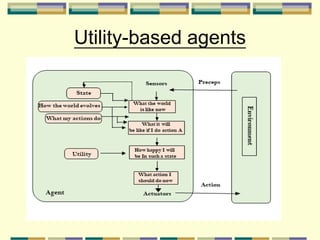
Utility-based agents
• These agents are similar to the goal-
based agent but provide an extra
component of utility measurement
which makes them different by
providing a measure of success at a
given state.
• Utility-based agent act based not only
goals but also the best way to achieve
the goal.
Utility-based agents
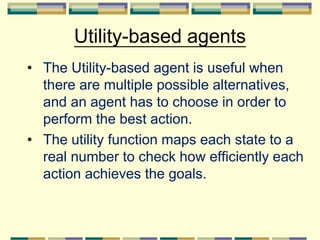
• The Utility-based agent is useful when
there are multiple possible alternatives,
and an agent has to choose in order to
perform the best action.
• The utility function maps each state to a
real number to check how efficiently each
action achieves the goals.
Utility-based agents
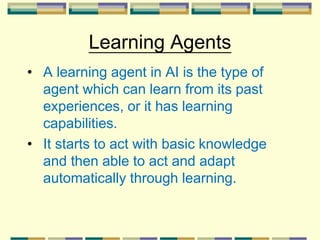
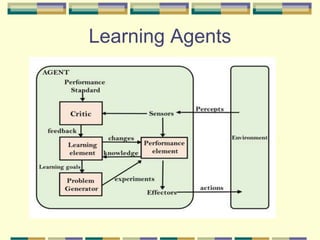
Learning Agents
• A learning agent in AI is the type of
agent which can learn from its past
experiences, or it has learning
capabilities.
• It starts to act with basic knowledge
and then able to act and adapt
automatically through learning.
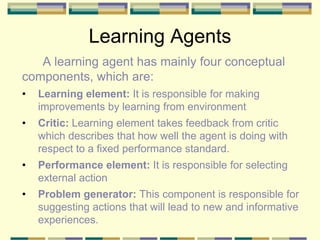
Learning Agents
A learning agent has mainly four conceptual
components, which are:
• Learning element: It is responsible for making
improvements by learning from environment
• Critic: Learning element takes feedback from critic
which describes that how well the agent is doing with
respect to a fixed performance standard.
• Performance element: It is responsible for selecting
external action
• Problem generator: This component is responsible for
suggesting actions that will lead to new and informative
experiences.
Learning Agents
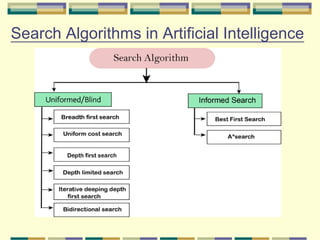
Search Algorithms in Artificial Intelligence
• BFS Algorithms
• DFS Algorithms
THANK YOU

Agents_AI.ppt

  • 1.
    Click to addText Intelligent Agent Artificial Intelligence
  • 2.
    Intelligent Agents What isan agent ?  An agent is anything that perceiving its environment through sensors and acting upon that environment through actuators  Example:  Human is an agent  A robot is also an agent with cameras and motors  A thermostat detecting room temperature.
  • 3.
  • 4.
    Diagram of anagent What AI should fill
  • 5.
    Simple Terms Percept  Agent’sperceptual inputs at any given instant Percept sequence  Complete history of everything that the agent has ever perceived.
  • 6.
    Agent function &program Agent’s behavior is mathematically described by  Agent function  A function mapping any given percept sequence to an action Practically it is described by  An agent program  The real implementation
  • 7.
    Vacuum-cleaner world Perception: Cleanor Dirty? where it is in? Actions: Move left, Move right, suck, do nothing
  • 8.
    Concept of Rationality Rationalagent  One that does the right thing  = every entry in the table for the agent function is correct (rational). What is correct?  The actions that cause the agent to be most successful  So we need ways to measure success.
  • 9.
    Performance measure Performance measure An objective function that determines  How the agent does successfully  E.g., 90% or 30% ? An agent, based on its percepts   action sequence : if desirable, it is said to be performing well.  No universal performance measure for all agents
  • 10.
    Performance measure A generalrule:  Design performance measures according to  What one actually wants in the environment  Rather than how one thinks the agent should behave E.g., in vacuum-cleaner world  We want the floor clean, no matter how the agent behave  We don’t restrict how the agent behaves
  • 11.
    Rationality What is rationalat any given time depends on four things:  The performance measure defining the criterion of success  The agent’s prior knowledge of the environment  The actions that the agent can perform  The agents’s percept sequence up to now
  • 12.
    Rational agent For eachpossible percept sequence,  an rational agent should select  an action expected to maximize its performance measure, given the evidence provided by the percept sequence and whatever built-in knowledge the agent has E.g., an exam  Maximize marks, based on the questions on the paper & your knowledge
  • 13.
    Example of arational agent Performance measure  Awards one point for each clean square  at each time step, over 10000 time steps Prior knowledge about the environment  The geography of the environment  Only two squares  The effect of the actions
  • 14.
    Learning Does a rationalagent depend on only current percept?  No, the past percept sequence should also be used  This is called learning  After experiencing an episode, the agent  should adjust its behaviors to perform better for the same job next time.
  • 15.
    Autonomy If an agentjust relies on the prior knowledge of its designer rather than its own percepts then the agent lacks autonomy A rational agent should be autonomous- it should learn what it can to compensate for partial or incorrect prior knowledge. E.g., a clock  No input (percepts)  Run only but its own algorithm (prior knowledge)  No learning, no experience, etc.
  • 16.
    Sometimes, the environmentmay not be the real world  E.g., flight simulator, video games, Internet  They are all artificial but very complex environments  Those agents working in these environments are called  Software agent (softbots)  Because all parts of the agent are software Software Agents
  • 17.
    Task environments Task environmentsare the problems  While the rational agents are the solutions Specifying the task environment  PEAS description as fully as possible Performance Environment Actuators Sensors
  • 18.
    Task environments Performance measure How can we judge the automated driver?  Which factors are considered?  getting to the correct destination  minimizing fuel consumption  minimizing the trip time and/or cost  minimizing the violations of traffic laws  maximizing the safety and comfort, etc.
  • 19.
    Environment  A taximust deal with a variety of roads  Traffic lights, other vehicles, pedestrians, stray animals, road works, police cars, etc.  Interact with the customer Task environments
  • 20.
    Actuators (for outputs) Control over the accelerator, steering, gear shifting and braking  A display to communicate with the customers Sensors (for inputs)  Detect other vehicles, road situations  GPS (Global Positioning System) to know where the taxi is  Many more devices are necessary Task environments
  • 21.
    A sketch ofautomated taxi driver Task environments
  • 22.
    Properties of taskenvironments Fully observable vs. Partially observable  If an agent’s sensors give it access to the complete state of the environment at each point in time then the environment is effectively and fully observable  if the sensors detect all aspects  That are relevant to the choice of action
  • 23.
    Partially observable An environmentmight be Partially observable because of noisy and inaccurate sensors or because parts of the state are simply missing from the sensor data. Example:  A local dirt sensor of the cleaner cannot tell  Whether other squares are clean or not
  • 24.
    Episodic vs. sequential An episode = agent’s single pair of perception & action  The quality of the agent’s action does not depend on other episodes  Every episode is independent of each other  Episodic environment is simpler  The agent does not need to think ahead Sequential  Current action may affect all future decisions -Ex. Taxi driving and chess. Properties of task environments
  • 25.
    Static vs. dynamic A dynamic environment is always changing over time  E.g., the number of people in the street  While static environment  E.g., the destination Semidynamic  environment is not changed over time  but the agent’s performance score does Properties of task environments
  • 26.
    Discrete vs. continuous If there are a limited number of distinct states, clearly defined percepts and actions, the environment is discrete  E.g., Chess game  Continuous: Taxi driving Properties of task environments
  • 27.
    Single agent VS.multiagent  Playing a crossword puzzle – single agent  Chess playing – two agents  Competitive multiagent environment  Chess playing  Cooperative multiagent environment  Automated taxi driver  Avoiding collision Properties of task environments
  • 28.
    Properties of taskenvironments Known vs. unknown This distinction refers not to the environment itslef but to the agent’s (or designer’s) state of knowledge about the environment. -In known environment, the outcomes for all actions are given. ( example: solitaire card games). - If the environment is unknown, the agent will have to learn how it works in order to make good decisions.( example: new video game).
  • 29.
    PEAS for self-drivingcars: Let's suppose a self-driving car then PEAS representation will be: Performance: Safety, time, legal drive, comfort Environment: Roads, other vehicles, road signs, pedestrian Actuators: Steering, accelerator, brake, signal, horn Sensors: Camera, GPS, speedometer, odometer, accelerometer, sonar.
  • 30.
    Agent Performance measure Environmen t Actuators Sensors 1.Medical Diagnose •Healthy patient •Minimized cost •Patient •Hospital •Staff •Tests •Treatments Keyboard (Entry of symptoms) 2. Vacuum Cleaner •Cleanness •Efficiency •Battery life •Security •Room •Table •Wood floor •Carpet •Various obstacles •Wheels •Brushes •Vacuum Extractor •Camera •Dirt detection sensor •Cliff sensor •Bump Sensor •Infrared Wall Sensor 3. Part -picking Robot •Percentage of parts in correct bins. •Conveyor belt with parts, •Bins •Jointed Arms •Hand •Camera •Joint angle sensors.
  • 31.
    What are Agentand Environment? • An agent is anything that can perceive its environment through sensors and acts upon that environment through effectors.  A human agent has sensory organs such as eyes, ears, nose, tongue and skin parallel to the sensors, and other organs such as hands, legs, mouth, for effectors.  A robotic agent replaces cameras and infrared range finders for the sensors, and various motors and actuators for effectors.  A software agent has encoded bit strings as its programs and actions.
  • 32.
    Agent Terminology • PerformanceMeasure of Agent − It is the criteria, which determines how successful an agent is. • Behavior of Agent − It is the action that agent performs after any given sequence of percepts. • Percept − It is agent’s perceptual inputs at a given instance. • Percept Sequence − It is the history of all that an agent has perceived till date. • Agent Function − It is a map from the precept sequence to an action.
  • 33.
    Structure of agents Agent= architecture + program  Architecture = some sort of computing device (sensors + actuators)  (Agent) Program = some function that implements the agent mapping = “?”  Agent Program = Job of AI
  • 34.
    Agent programs Input forAgent Program  Only the current percept Input for Agent Function  The entire percept sequence  The agent must remember all of them Implement the agent program as  A look up table (agent function)
  • 35.
    • Types ofagent programs • Simple Reflex Agent • Model-based reflex agent • Goal-based agents • Utility-based agent • Learning agent
  • 36.
     Simple reflexagents • The Simple reflex agents are the simplest agents. These agents take decisions on the basis of the current percepts and ignore the rest of the percept history. • These agents only succeed in the fully observable environment. • The Simple reflex agent does not consider any part of percepts history during their decision and action process.
  • 37.
    Simple reflex agents •The Simple reflex agent works on Condition- action rule, which means it maps the current state to action. Such as a Room Cleaner agent, it works only if there is dirt in the room.
  • 38.
    Problems for thesimple reflex agent • design approach : They have very limited intelligence • They do not have knowledge of non- perceptual parts of the current state • Mostly too big to generate and to store. • Not adaptive to changes in the environment.
  • 40.
    Model-based Reflex Agents TheModel-based agent can work in a partially observable environment, and track the situation. A model-based agent has two important factors: • Model: It is knowledge about "how things happen in the world," so it is called a Model-based agent. • Internal State: It is a representation of the current state based on percept history.
  • 41.
    Model-based Reflex Agents •These agents have the model, "which is knowledge of the world" and based on the model they perform actions. • Updating the agent state requires information about:  How the world evolves  How the agent's action affects the world.
  • 42.
    Example Table Agent WithInternal State Saw an object ahead, and turned right, and it’s now clear ahead Go straight Saw an object Ahead, turned right, and object ahead again Halt See no objects ahead Go straight See an object ahead Turn randomly IF THEN
  • 43.
  • 44.
    Goal-based agents • Theknowledge of the current state environment is not always sufficient to decide for an agent to what to do. • The agent needs to know its goal which describes desirable situations. • Goal-based agents expand the capabilities of the model-based agent by having the "goal" information.
  • 45.
    Goal-based agents • Theychoose an action, so that they can achieve the goal. • These agents may have to consider a long sequence of possible actions before deciding whether the goal is achieved or not. Such considerations of different scenario are called searching and planning, which makes an agent proactive.
  • 46.
  • 47.
    Utility-based agents • Theseagents are similar to the goal- based agent but provide an extra component of utility measurement which makes them different by providing a measure of success at a given state. • Utility-based agent act based not only goals but also the best way to achieve the goal.
  • 48.
    Utility-based agents • TheUtility-based agent is useful when there are multiple possible alternatives, and an agent has to choose in order to perform the best action. • The utility function maps each state to a real number to check how efficiently each action achieves the goals.
  • 49.
  • 50.
    Learning Agents • Alearning agent in AI is the type of agent which can learn from its past experiences, or it has learning capabilities. • It starts to act with basic knowledge and then able to act and adapt automatically through learning.
  • 51.
    Learning Agents A learningagent has mainly four conceptual components, which are: • Learning element: It is responsible for making improvements by learning from environment • Critic: Learning element takes feedback from critic which describes that how well the agent is doing with respect to a fixed performance standard. • Performance element: It is responsible for selecting external action • Problem generator: This component is responsible for suggesting actions that will lead to new and informative experiences.
  • 52.
  • 53.
    Search Algorithms inArtificial Intelligence • BFS Algorithms • DFS Algorithms
  • 54.