TYPES OF DESIGN
EXPLORATORY AND DESCRIPTIVE
RESEARCH DESIGN
RESEARCH DESIGN
 A research design is a framework or blueprint for
conducting the marketing research project. It
details the procedures necessary for obtaining
the information needed to structure or solve
marketing research problems. In simple words it
is the general plan of how you will go about your
research.
According to Kerlinger
“Research design is the plan, structure and strategy
of investigation conceived so as to obtain answers
to research questions and to control variance.”
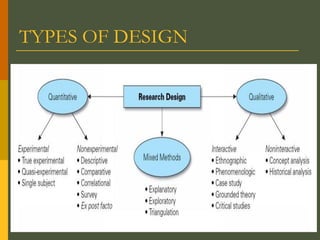
TYPES OF DESIGN
1) EXPLORATORY RESEARCH
DESIGN
 Exploratory research design are those design that
does not aim to provide the final and conclusive
answers to the research questions, but merely
explores the research topic with varying levels of
depth. It has been noted that “exploratory
research is the initial research, which forms the
basis of more conclusive research. It can even
help in determining the research design,
sampling methodology and data collection
method”
Examples of Exploratory Design
 A study into the role of social networking sites as
an effective marketing communication channel
 An investigation into the ways of improvement of
quality of customer services within hospitality
sector in London
 An assessment of the role of corporate social
responsibility on consumer behaviour in
pharmaceutical industry in the USA
Advantages of Exploratory Design
1. Flexibility and adaptability to change
2. Exploratory research is effective in laying
the groundwork that will lead to future
studies.
3. Exploratory studies can potentially save
time and other resources by determining
at the earlier stages the types of research
that are worth pursuing
Disadvantages of Exploratory
Design
 Exploratory studies generate qualitative
information and interpretation of such type of
information is subject to bias
 These types of studies usually make use of a
modest number of samples that may not
adequately represent the target population.
Accordingly, findings of exploratory research
cannot be generalized to a wider population.
 Findings of such type of studies are not
usually useful in decision making in a
practical level.
2) DESCRIPTIVE RESEARCH
DESIGN
 Descriptive research design is a scientific method
which involves observing and describing the
behavior of a subject without influencing it in any
way.
 It is also useful where it is not possible to test and
measure the large number of samples needed for
more quantitative types of experimentation.
 These types of experiments are often used by
anthropologists, psychologists and social scientists
to observe natural behaviors without affecting them
in any way. It is also used by market researchers to
judge the habits of customers, or by companies
wishing to judge the morale of staff.
Examples of Descriptive Research
 What are the most effective intangible
employee motivation tools in hospitality
industry in the 21stcentury?
 What is the impact of viral marketing on
consumer behaviour in consumer amongst
university students in Canada?
 Do corporate leaders of multinational
companies in the 21stcentury possess
moral rights to receive multi-million
bonuses?
Advantages of Descriptive Research
1. Effective to analyse non-quantified topics
and issues
2. possibility to observe the phenomenon in
a completely natural and unchanged
natural environment
3. The opportunity to integrate the
qualitative and quantitative methods of
data collection
4. Less time-consuming than quantitative
experiments
Disadvantages of Descriptive
Research
1. Descriptive studies cannot test or verify the
research problem statistically.
2. Research results may reflect certain level of
bias due to the absence of statistical tests.
3. The majority of descriptive studies are not
‘repeatable’ due to their observational nature.
4. Descriptive studies are not helpful in identifying
cause behind described phenomenon
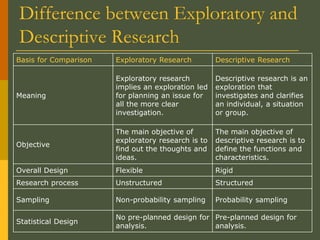
Difference between Exploratory and
Descriptive Research
Basis for Comparison Exploratory Research Descriptive Research
Meaning
Exploratory research
implies an exploration led
for planning an issue for
all the more clear
investigation.
Descriptive research is an
exploration that
investigates and clarifies
an individual, a situation
or group.
Objective
The main objective of
exploratory research is to
find out the thoughts and
ideas.
The main objective of
descriptive research is to
define the functions and
characteristics.
Overall Design Flexible Rigid
Research process Unstructured Structured
Sampling Non-probability sampling Probability sampling
Statistical Design
No pre-planned design for
analysis.
Pre-planned design for
analysis.

Thank You!

Types of design brm

  • 1.
    TYPES OF DESIGN EXPLORATORYAND DESCRIPTIVE RESEARCH DESIGN
  • 2.
    RESEARCH DESIGN  Aresearch design is a framework or blueprint for conducting the marketing research project. It details the procedures necessary for obtaining the information needed to structure or solve marketing research problems. In simple words it is the general plan of how you will go about your research. According to Kerlinger “Research design is the plan, structure and strategy of investigation conceived so as to obtain answers to research questions and to control variance.”
  • 3.
  • 4.
    1) EXPLORATORY RESEARCH DESIGN Exploratory research design are those design that does not aim to provide the final and conclusive answers to the research questions, but merely explores the research topic with varying levels of depth. It has been noted that “exploratory research is the initial research, which forms the basis of more conclusive research. It can even help in determining the research design, sampling methodology and data collection method”
  • 5.
    Examples of ExploratoryDesign  A study into the role of social networking sites as an effective marketing communication channel  An investigation into the ways of improvement of quality of customer services within hospitality sector in London  An assessment of the role of corporate social responsibility on consumer behaviour in pharmaceutical industry in the USA
  • 6.
    Advantages of ExploratoryDesign 1. Flexibility and adaptability to change 2. Exploratory research is effective in laying the groundwork that will lead to future studies. 3. Exploratory studies can potentially save time and other resources by determining at the earlier stages the types of research that are worth pursuing
  • 7.
    Disadvantages of Exploratory Design Exploratory studies generate qualitative information and interpretation of such type of information is subject to bias  These types of studies usually make use of a modest number of samples that may not adequately represent the target population. Accordingly, findings of exploratory research cannot be generalized to a wider population.  Findings of such type of studies are not usually useful in decision making in a practical level.
  • 8.
    2) DESCRIPTIVE RESEARCH DESIGN Descriptive research design is a scientific method which involves observing and describing the behavior of a subject without influencing it in any way.  It is also useful where it is not possible to test and measure the large number of samples needed for more quantitative types of experimentation.  These types of experiments are often used by anthropologists, psychologists and social scientists to observe natural behaviors without affecting them in any way. It is also used by market researchers to judge the habits of customers, or by companies wishing to judge the morale of staff.
  • 9.
    Examples of DescriptiveResearch  What are the most effective intangible employee motivation tools in hospitality industry in the 21stcentury?  What is the impact of viral marketing on consumer behaviour in consumer amongst university students in Canada?  Do corporate leaders of multinational companies in the 21stcentury possess moral rights to receive multi-million bonuses?
  • 10.
    Advantages of DescriptiveResearch 1. Effective to analyse non-quantified topics and issues 2. possibility to observe the phenomenon in a completely natural and unchanged natural environment 3. The opportunity to integrate the qualitative and quantitative methods of data collection 4. Less time-consuming than quantitative experiments
  • 11.
    Disadvantages of Descriptive Research 1.Descriptive studies cannot test or verify the research problem statistically. 2. Research results may reflect certain level of bias due to the absence of statistical tests. 3. The majority of descriptive studies are not ‘repeatable’ due to their observational nature. 4. Descriptive studies are not helpful in identifying cause behind described phenomenon
  • 12.
    Difference between Exploratoryand Descriptive Research Basis for Comparison Exploratory Research Descriptive Research Meaning Exploratory research implies an exploration led for planning an issue for all the more clear investigation. Descriptive research is an exploration that investigates and clarifies an individual, a situation or group. Objective The main objective of exploratory research is to find out the thoughts and ideas. The main objective of descriptive research is to define the functions and characteristics. Overall Design Flexible Rigid Research process Unstructured Structured Sampling Non-probability sampling Probability sampling Statistical Design No pre-planned design for analysis. Pre-planned design for analysis.
  • 13.