
Types Of Demand
PRESENTATION
PRESENTED BY: MOHD SAMEER
Demand
The Demand for the product refers to the quantity of goods
and services that the consumers are willing to buy at a
particular price for a given point of time.
• Individual Demand & Market Demand
• Total Market Demand & Market Segment
Demand
• Derived Demand & Direct Demand
• Industry Demand & Company Demand
• Short-Run Demand & Long-Run Demand
• Price Demand
• Income Demand
• Cross Demand
Types Of Demand
Individual Demand & Market Demand
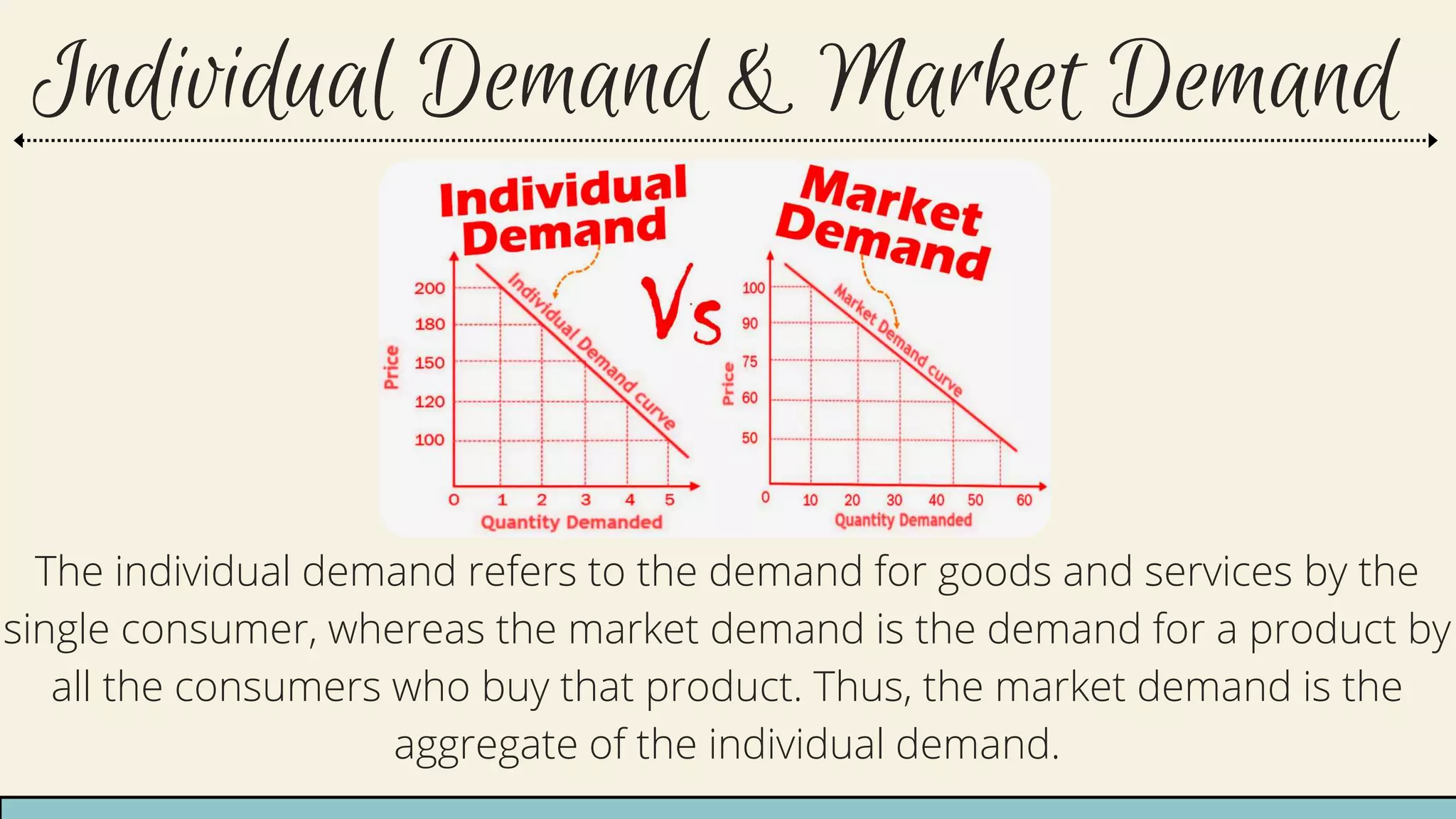
The individual demand refers to the demand for goods and services by the
single consumer, whereas the market demand is the demand for a product by
all the consumers who buy that product. Thus, the market demand is the
aggregate of the individual demand.
Total Market Demand & Market Segment Demand
The total market demand refers to the aggregate
demand for a product by all the consumers in the market who purchase a
specific kind of a product. Further, this aggregate demand can be sub-divided
into the segments on the basis of geographical areas, price sensitivity,
customer size, age, sex, etc. are called as the market segment demand.
Derived Demand & Direct Demand
Lorem ipsum dolor sit amet,
consectetur adipiscing elit, sed do
eiusmod tempor
Your Catchy
Headline Here
When the demand for a product/outcome is associated with the demand for
another product/outcome is called as the derived demand or induced
demand. Such as the demand for cotton yarn is derived from the demand for
cotton cloth. Whereas, when the demand for the products/outcomes is
independent of the demand for another product/outcome is called as the
direct demand or autonomous demand. Such as, in the above example the
demand for a cotton cloth is autonomous.
Industry Demand & Company Demand
The industry demand refers to the total aggregate demand for the products
of a particular industry, such as demand for cement in the construction
industry.
While the company demand is a demand for the product which is particular
to the company and is a part of that industry. Such as demand for tire
manufactured by the Goodyear. Thus, the company demand can be
expressed as the percentage of the industry demand.
Short-Run Demand & Long-Run Demand
The short term demand is more elastic which means that the changes in price
or income are reflected immediately on the quantity demanded. Whereas, the
long run demand is inelastic, which shows that demand for commodity exists
as a result of adjustments following changes in pricing, promotional strategies,
consumption patterns, etc.
Price Demand
Price demand relates to the amount a consumer is willing to spend on a
product at a given price. Businesses use this information to determine at what
price point a new product should enter the market. Consumers will buy items
based on their perception of that product's value. Price elasticity refers to how
the demand will change with fluctuations in price.
Income Demand
As consumers make more income, quantity demand increases. This means
people will buy more overall when they earn more income. Tastes and
expectations also change with an increase in income, reducing the size of one
market and increasing the size of another. Consumers will often buy a product
or service because it is what they can afford but may deem it lower quality.
The demand for those lower-quality products will decrease as income
increases.
Cross Demand
Cross demand from the economic point of view measures the responsiveness
of the change in quantity demand towards the change in price of another
commodity.
FOR LISTENING!
Thank you
Don't hesitate to ask any questions!

Types Of Demand.pptx

  • 1.
  • 2.
    Demand The Demand forthe product refers to the quantity of goods and services that the consumers are willing to buy at a particular price for a given point of time.
  • 3.
    • Individual Demand& Market Demand • Total Market Demand & Market Segment Demand • Derived Demand & Direct Demand • Industry Demand & Company Demand • Short-Run Demand & Long-Run Demand • Price Demand • Income Demand • Cross Demand Types Of Demand
  • 4.
    Individual Demand &Market Demand The individual demand refers to the demand for goods and services by the single consumer, whereas the market demand is the demand for a product by all the consumers who buy that product. Thus, the market demand is the aggregate of the individual demand.
  • 5.
    Total Market Demand& Market Segment Demand The total market demand refers to the aggregate demand for a product by all the consumers in the market who purchase a specific kind of a product. Further, this aggregate demand can be sub-divided into the segments on the basis of geographical areas, price sensitivity, customer size, age, sex, etc. are called as the market segment demand.
  • 6.
    Derived Demand &Direct Demand Lorem ipsum dolor sit amet, consectetur adipiscing elit, sed do eiusmod tempor Your Catchy Headline Here When the demand for a product/outcome is associated with the demand for another product/outcome is called as the derived demand or induced demand. Such as the demand for cotton yarn is derived from the demand for cotton cloth. Whereas, when the demand for the products/outcomes is independent of the demand for another product/outcome is called as the direct demand or autonomous demand. Such as, in the above example the demand for a cotton cloth is autonomous.
  • 7.
    Industry Demand &Company Demand The industry demand refers to the total aggregate demand for the products of a particular industry, such as demand for cement in the construction industry. While the company demand is a demand for the product which is particular to the company and is a part of that industry. Such as demand for tire manufactured by the Goodyear. Thus, the company demand can be expressed as the percentage of the industry demand.
  • 8.
    Short-Run Demand &Long-Run Demand The short term demand is more elastic which means that the changes in price or income are reflected immediately on the quantity demanded. Whereas, the long run demand is inelastic, which shows that demand for commodity exists as a result of adjustments following changes in pricing, promotional strategies, consumption patterns, etc.
  • 9.
    Price Demand Price demandrelates to the amount a consumer is willing to spend on a product at a given price. Businesses use this information to determine at what price point a new product should enter the market. Consumers will buy items based on their perception of that product's value. Price elasticity refers to how the demand will change with fluctuations in price.
  • 10.
    Income Demand As consumersmake more income, quantity demand increases. This means people will buy more overall when they earn more income. Tastes and expectations also change with an increase in income, reducing the size of one market and increasing the size of another. Consumers will often buy a product or service because it is what they can afford but may deem it lower quality. The demand for those lower-quality products will decrease as income increases.
  • 11.
    Cross Demand Cross demandfrom the economic point of view measures the responsiveness of the change in quantity demand towards the change in price of another commodity.
  • 12.
    FOR LISTENING! Thank you Don'thesitate to ask any questions!