Computers can be classified into three main types: analog, digital, and hybrid. Analog computers process continuous data like temperature, while digital computers operate on discrete binary digits and are more versatile. Hybrid computers combine analog and digital components. Computers are also classified by size into microcomputers, minicomputers, mainframes, and supercomputers - with microcomputers being the smallest and most personal, and supercomputers being the largest, fastest and most expensive used for complex simulations.
2
Types of Computers…
•Based on the operational principle, computers
can be classified into three categories:
1. Analog computer
2. Digital computer
3. Hybrid computer
3.
3
Analog Computers
• Analogcomputers are used to process analog
data.
• Analog data is of continuous nature and which is
not discrete or separate such as temperature,
pressure, speed weight, voltage, depth etc.
• Utilize mechanical or electrical energy to
operate.
• Analog computers are the first computers being
developed and provided the basis for the
development of the modern digital computers.
4.
4
Analog Computers…
• Analogcomputers are widely used for certain
specialized engineering and scientific
applications, for calculation and measurement of
analog quantities.
• These computers are ideal in situations where
data can be accepted directly from measuring
instrument without having to convert it into
numbers or codes.
Examples: The Speedometer of a car measures
speed, the change of temperature is measured by
a Thermometer, etc.
5.
5
Digital Computers
• Theyuse digital circuits and are designed to
operate on two states, namely bits 0 and 1. They
are analogous to states ON and OFF.
• Data on these computers is represented as a
series of 0s and 1s.
• Digital computers are suitable for complex
computation and have higher processing speeds.
• They are programmable.
6.
6
Digital Computers…
• Digitalcomputers are either special purpose
computers or general purpose ones.
• Special purpose computers, as their name suggests,
are designed for specific types of data processing
while general purpose computers are meant for
general use.
• Most of the computers available today are digital
computers.
• The most common examples of digital computers
are accounting machines and calculators.
• Analog computers lack digital memory where as
digital computers store information.
8
Hybrid Computers
• Thesecomputers are a combination of both
digital and analog computers.
• In this type of computers, the digital segments
perform process control by conversion of analog
signals to digital ones.
• Hybrid computers for example are used for
scientific calculations, in defense and radar
systems.
9.
9
Hybrid Computers…
• Forexample a petrol pump contains a processor
that converts fuel flow measurements into
quantity and price values.
• In hospital Intensive Care Unit (ICU), an analog
device is used which measures patient's blood
pressure and temperature etc, which are then
converted and displayed in the form of digits.
• Radar systems are another example.
10.
10
Cont’d…
• Based ontheir processing power (speed), cost
and size computers can be classified into 4 types:
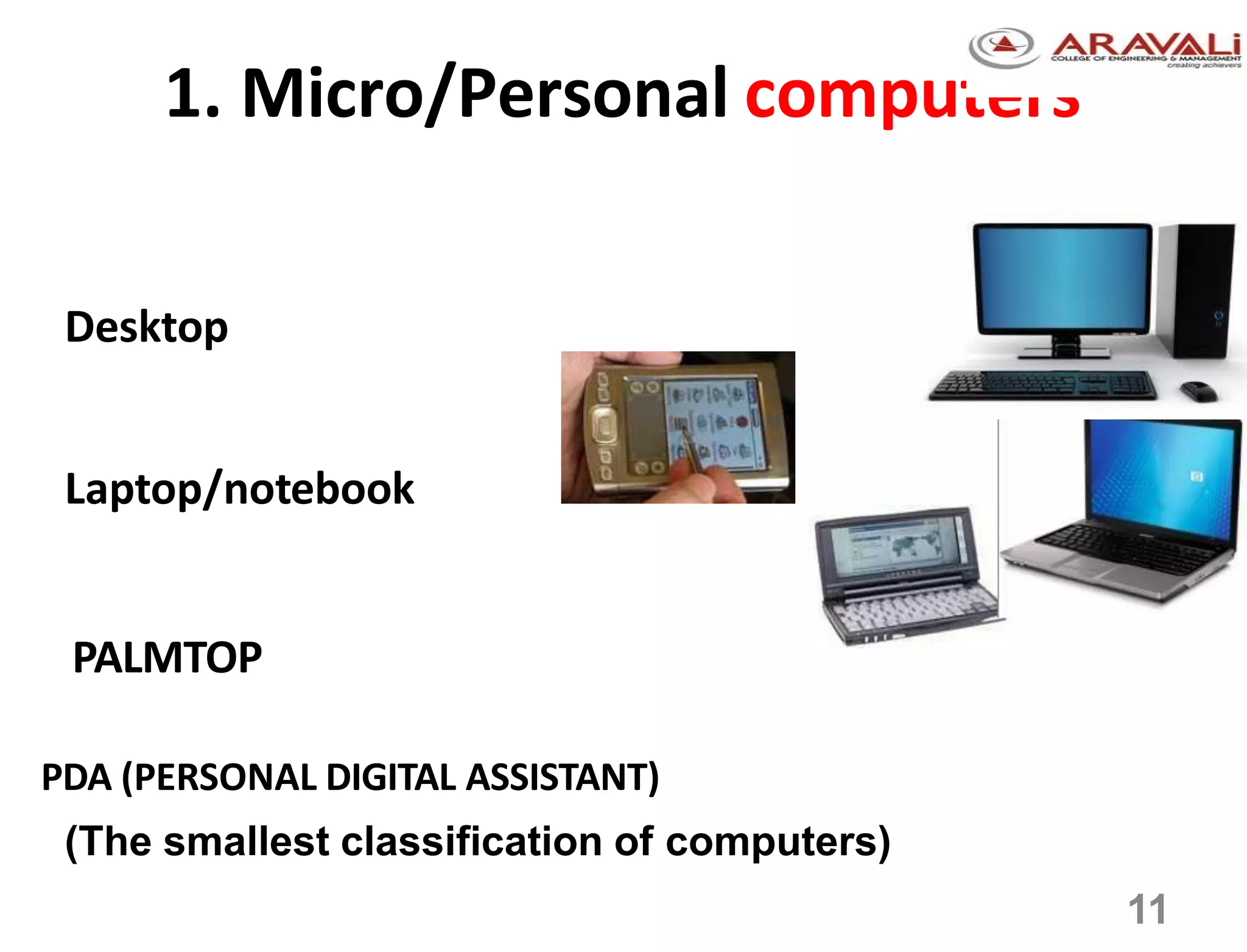
a) Micro computers
b) Minicomputers
c) Mainframe computers
d) Super computers
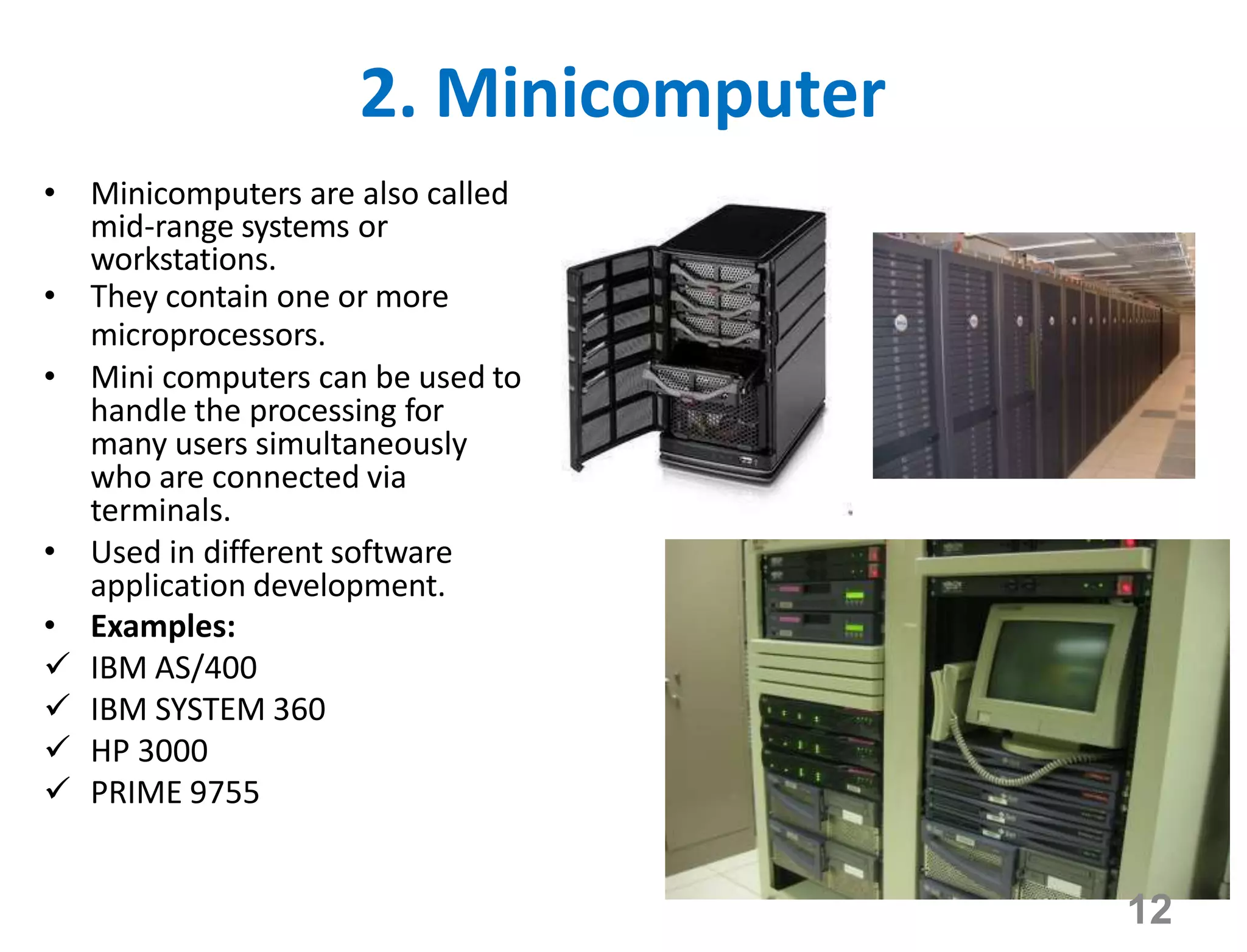
2. Minicomputer
• Minicomputersare also called
mid-range systems or
workstations.
• They contain one or more
microprocessors.
• Mini computers can be used to
handle the processing for
many users simultaneously
who are connected via
terminals.
• Used in different software
application development.
• Examples:
IBM AS/400
IBM SYSTEM 360
HP 3000
PRIME 9755
12
13.
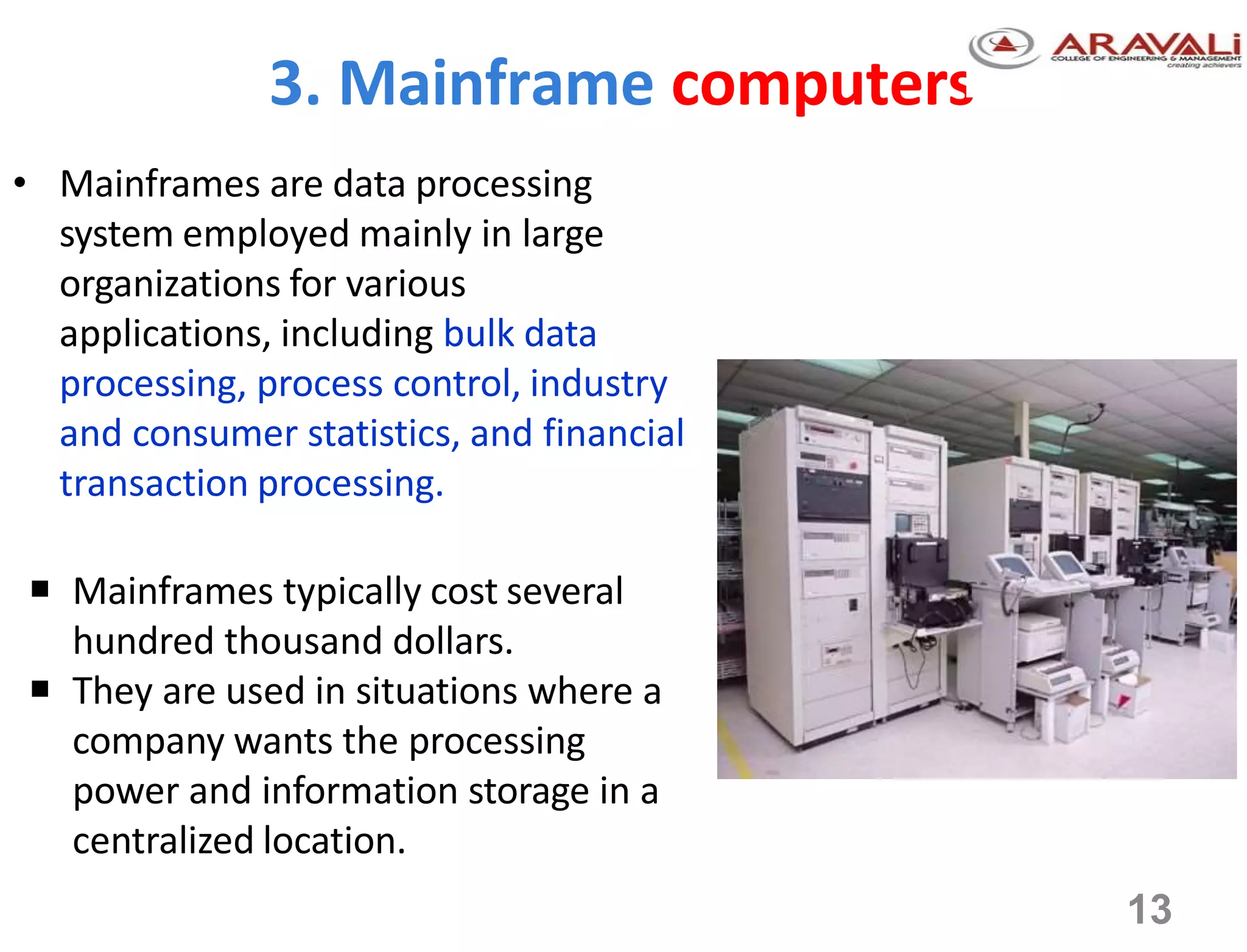
3. Mainframe computers
•Mainframes are data processing
system employed mainly in large
organizations for various
applications, including bulk data
processing, process control, industry
and consumer statistics, and financial
transaction processing.
Mainframes typically cost several
hundred thousand dollars.
They are used in situations where a
company wants the processing
power and information storage in a
centralized location.
13
14.
14
Mainframe computers…
• Amainframe computer may contain several
microprocessors.
• A single mainframe computer can be used by
hundreds of people at once.
• A mainframe computer system is usually composed
of several computers in addition to the mainframe,
or host processor.
Examples:
• IBM S/390
• Amdahl 580
• Control Data Cyber 176
15.
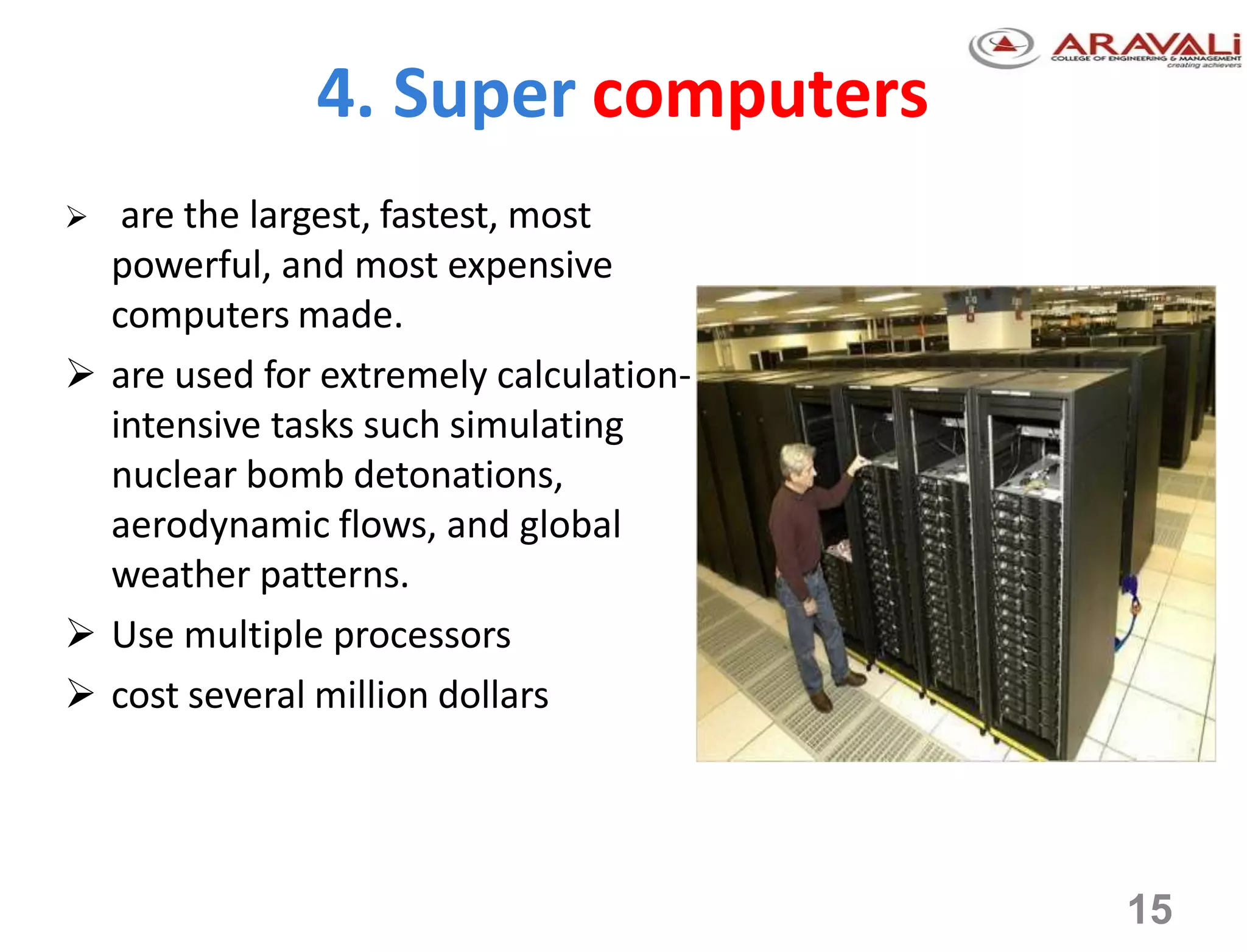
4. Super computers
are the largest, fastest, most
powerful, and most expensive
computers made.
are used for extremely calculation-
intensive tasks such simulating
nuclear bomb detonations,
aerodynamic flows, and global
weather patterns.
Use multiple processors
cost several million dollars
15
16.
16
Super computers…
Features:
• Theaerospace, automotive, chemical, electronics
and petroleum industries use supercomputers
extensively.
• Supercomputers are used in weather forecasting.
• The ultra supercomputer will simulate nuclear
explosions (eliminating the need to explode any
bombs).
• Supercomputers can perform at up to 128 gigaflops,
and use bus widths of 32 or 64 bits. This capability
makes supercomputers suitable for processor-
intensive applications, such as graphics.