BEHAVIORAL PATTERN
ITERATOR PATTERN
• Iterator Pattern is a relatively simple and frequently used design
pattern. There are a lot of data structures/collections available in
every language. Each collection must provide an iterator that lets it
iterate through its objects. However while doing so it should make
sure that it does not expose its implementation.
• Iterator pattern is very commonly used design pattern in Java and
.Net programming environment. This pattern is used to get a way to
access the elements of a collection object in sequential manner
without any need to know its underlying representation.
Implementation
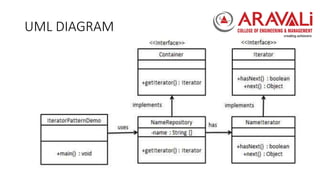
create a Iterator interface which narrates navigation method and
a Containerinterface which retruns the iterator
Concrete classes implementing the Container interface will be
responsible to implement Iterator interface and use it
IteratorPatternDemo, our demo class will use NamesRepository, a
concrete class implementation to print a Names stored as a collection
in NamesRepository.
UML DIAGRAM
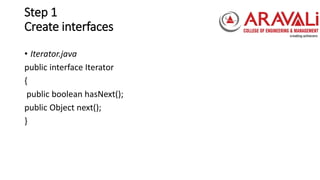
Step 1
Create interfaces
• Iterator.java
public interface Iterator
{
public boolean hasNext();
public Object next();
}
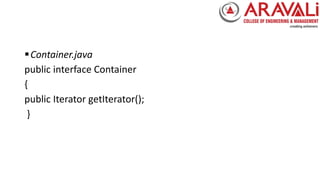
Container.java
public interface Container
{
public Iterator getIterator();
}
Step 2
Create concrete class implementing the Container interface. This
class has inner class NameIterator implementing
the Iterator interface.
• NameRepository.java
public class NameRepository implements Container
{
public String names[] = {"Robert" , "John" ,"Julie" , "Lora"};
@
Override
public Iterator getIterator()
{
return new NameIterator();
}
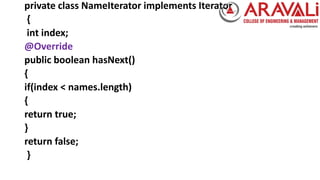
private class NameIterator implements Iterator
{
int index;
@Override
public boolean hasNext()
{
if(index < names.length)
{
return true;
}
return false;
}
@Override
Public Object next()
{
if(this.hasNext()
{
return names[index++];
}
return null;
}
}
}
Step 3
Use the NameRepository to get iterator and print
names.
• IteratorPatternDemo.java
public class IteratorPatternDemo
{
public static void main(String[] args)
{
NameRepository namesRepository = new NameRepository();
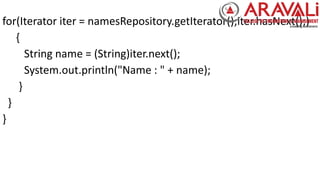
for(Iterator iter = namesRepository.getIterator();iter.hasNext();)
{
String name = (String)iter.next();
System.out.println("Name : " + name);
}
}
}
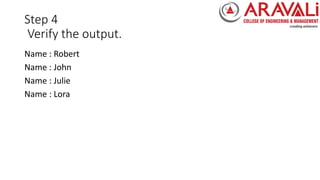
Step 4
Verify the output.
Name : Robert
Name : John
Name : Julie
Name : Lora

Iterator pattern

  • 1.
  • 2.
    • Iterator Patternis a relatively simple and frequently used design pattern. There are a lot of data structures/collections available in every language. Each collection must provide an iterator that lets it iterate through its objects. However while doing so it should make sure that it does not expose its implementation. • Iterator pattern is very commonly used design pattern in Java and .Net programming environment. This pattern is used to get a way to access the elements of a collection object in sequential manner without any need to know its underlying representation.
  • 3.
    Implementation create a Iteratorinterface which narrates navigation method and a Containerinterface which retruns the iterator Concrete classes implementing the Container interface will be responsible to implement Iterator interface and use it IteratorPatternDemo, our demo class will use NamesRepository, a concrete class implementation to print a Names stored as a collection in NamesRepository.
  • 4.
  • 5.
    Step 1 Create interfaces •Iterator.java public interface Iterator { public boolean hasNext(); public Object next(); }
  • 6.
  • 7.
    Step 2 Create concreteclass implementing the Container interface. This class has inner class NameIterator implementing the Iterator interface. • NameRepository.java public class NameRepository implements Container { public String names[] = {"Robert" , "John" ,"Julie" , "Lora"}; @ Override public Iterator getIterator() { return new NameIterator(); }
  • 8.
    private class NameIteratorimplements Iterator { int index; @Override public boolean hasNext() { if(index < names.length) { return true; } return false; }
  • 9.
  • 10.
    Step 3 Use theNameRepository to get iterator and print names. • IteratorPatternDemo.java public class IteratorPatternDemo { public static void main(String[] args) { NameRepository namesRepository = new NameRepository();
  • 11.
    for(Iterator iter =namesRepository.getIterator();iter.hasNext();) { String name = (String)iter.next(); System.out.println("Name : " + name); } } }
  • 12.
    Step 4 Verify theoutput. Name : Robert Name : John Name : Julie Name : Lora