
SUB = ELEMENTS OF CIVIL ENGINEERING
TOPIC = STONE
PREPARED BY:-
1. C-27 PRASHANT A CHELANI
2. C-40 VIJAY D VADHER
3. C-43 NIKHIL R PATIL
4. C-21 PRATIK B PATEL
DR S.&S.S GANDHY
GOVERNMENT ENGINEERING
SURAT.
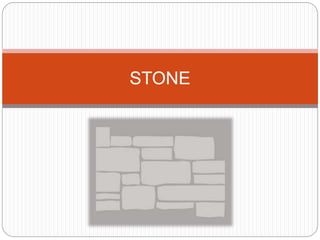
STONE
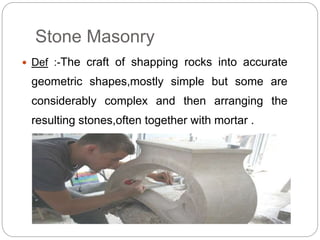
Stone Masonry
 Def :-The craft of shapping rocks into accurate
geometric shapes,mostly simple but some are
considerably complex and then arranging the
resulting stones,often together with mortar .
Uses
1) Building foundations, walls, piers, pillars, and
architectural works.
2) Lintels, Beams, beams Arches, domes etc.,
3) Roofs and Roof coverings.
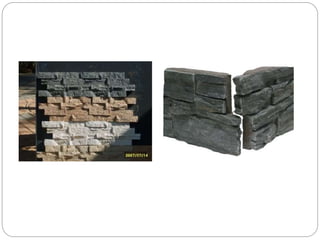
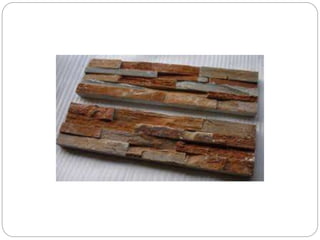
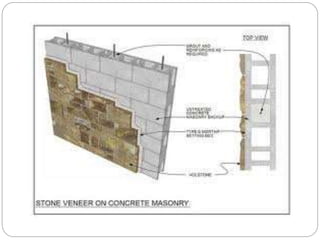
4) Cladding Works
5) Dams, light houses, monumental structures.
6) Paving jobs
7) Railway, ballast, black boards and electrical switch
Selection of stone for stone
masonry:
1) Availability
2) Ease of working
3) Appearance
4) Strength and stability
5) Polishing characteristics
6) Economy
7) Durability
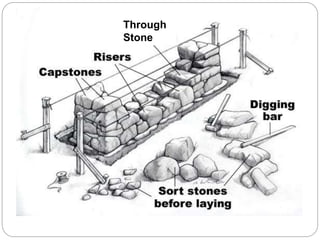
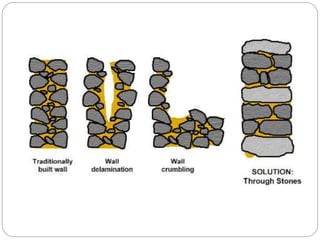
Through
Stone
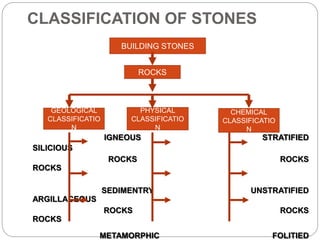
CLASSIFICATION OF STONES
IGNEOUS STRATIFIED
SILICIOUS
ROCKS ROCKS
ROCKS
SEDIMENTRY UNSTRATIFIED
ARGILLACEOUS
ROCKS ROCKS
ROCKS
METAMORPHIC FOLITIED
BUILDING STONES
ROCKS
GEOLOGICAL
CLASSIFICATIO
N
PHYSICAL
CLASSIFICATIO
N
CHEMICAL
CLASSIFICATIO
N
LAYING THE STONE
 Decrease the stone thickness from the bottom to
the top of wall.
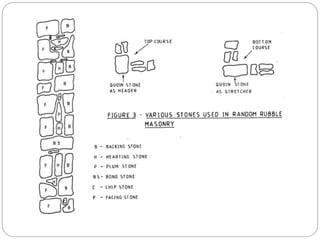
 Ensure that the headers in the heart of the wall
are the same size as in the face and extend at
least 12 in (300 mm) into the core or backing.
(Avoid Dumb-bell shaped stones)
 Ensure that headers in “walls of 2 feet (600 mm)
or less in thickness” extend entirely through the
wall. The headers shall occupy at least 20
percent of the face of the wall.
 Lay the masonry in roughly leveled courses. Ensure
that the bottom of the foundation is large, with
selected stones.
 Lay the courses with leaning beds parallel to the
natural bed of the material.
 Regularly diminish the thicknesses of the courses, if
varied, from the bottom to the top of the wall. Keep a
surplus supply of stones at the site to select from.
 Before laying the stone in the wall, shape and dress it
so that it will not loosen after it is placed. No dressing
or hammering which will loosen the stone will be
permitted after it is placed.
LAYING THE STONE
 Clean each stone and saturate it with water before
setting it. Clean and moisten the bed that will receive
it.
 Bed the stones in freshly made mortar with full joints.
Carefully settle the stones in place before the mortar
sets.
 Ensure that the joints and beds have an average
thickness of not more than 1 inch. (25 mm).
 Ensure that the vertical joints in each course break
with the adjoining courses at least 6 in. (150 mm).
 Do not place vertical joints directly above or below a
 If a stone is moved or if the joint is broken after the
mortar has set, take the stone up and thoroughly
clean the mortar from the bed and joints. Reset the
stone in fresh mortar.
 NOTE: Do not lay the masonry in freezing weather
or when the stone contains frost, except with
permission subjected to the required conditions.
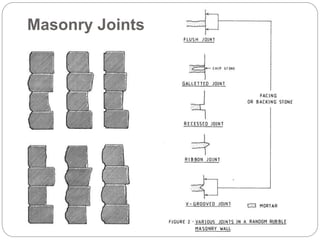
 Whenever possible, properly point the face joints
before the mortar sets. If joints cannot be pointed,
rake them out to a depth of 1 in (25 mm) before the
mortar sets.
 Do not smear the stone face surfaces with the mortar
forced out of the joints or the mortar used in pointing.
 Thoroughly wet the joints pointed after the stone is
laid with clean water and fill with mortar.
 Drive the mortar into the joints and finish with an
approved pointing tool.
 Keep the wall wet while pointing. In hot or dry weather,
protect the pointed masonry from the sun and keep it
wet for at least three days after the pointing is finished.
 NOTE: Do not perform pointing in freezing weather
or when the stone contains frost.
 After the pointing is completed and the mortar is set,
thoroughly clean the walls and leave them in a neat
condition.
CHARACTERISTICS OF GOOD BUILDING
STONES
 A good building stone should essentially have the following
qualities:
 (i) Appearance. For the face work of buildings this property is
of extreme importance. From architectural point of view
colour of the stone should be such as to go well with the
surroundings. Lighter shades should be preferred to the
darker ones as the latter are less durable, Red and the brown
shades of sedimentary rocks are due to the presence of
oxide of iron-which, if present in excess, is liable to disfigure
the stone with rust stains and to disintegrate it. Stones
should be of uniform colour and free from clay holes, bands
or spots of colour whatsoever.
 (ii) General Structure. Stone, when broken in a direction
other than that of cleavage (if it exists), should not give dull
appearance. It should show uniformity of texture. It must be
either crystalline in structure of homogeneous and close-
grained. It should be free from cavities, cracks or patches of
soft or loose material. For ornamental carvings it should be
fine grained. Stratification (found in sedimentary rocks)
should not be visible to naked eye except by difference in
colour. These can be easily split along their planes of
stratification known as planes of cleavage, and are,
therefore, useful for use in pavings, floorings and roofings
etc.
 (iii) Heaviness. Heavier varieties of stones are more
compact, less porous and have greater specific
gravities. For constructions in water, like weirs,
barrages, dams, docks, harbours and for retaining
walls the heavier varieties of stones are to be
preferred. For construction of domes and for roof
coverings and similar other usages the lighter
varieties have to be used.
 (iv) Strength. In usual constructions the stones
used are generally quite strong to withstand the forces
likely to be encountered yet in case of construction
where unusually bigger forces are likely to come the
stone to be used should be tested for its strength.
Stones of igneous class are generally stronger than
those of the sedimentary class. Stones with compact
fine crystalline texture are stronger.
 (v) Hardness. It is the resistance of stone to
abrasive forces caused by much wear and friction as
in floors, pavements and aprons of bridges and weirs
in rivers. Stones to be used at such places should be
hard.
 (vi) Toughness. It is a measure of the impact that a stone
can with stand. Stones used at places subject to vibrations
of machinery and to moving loads should be tough. Stones
used in the construction of roads should be hard and tough.
 (vii) Ease of working. The ease with which the stone can
be worked upon i.e., cut, dressed, carved and moulded etc.,
is an important consideration from economy point of view.
But this property is opposed to strength, durability and
hardness.
 (viii) Porosity and absorption. More pozrous building stones
are unsuitable for use in construction especially for
exposed surfaces of structures. Rain water while coming
down carries some acidic gases forming light acids which
lodge on the surface of stones and soak in them.
 Stones should as such be tested for porosity and care
should be taken to use more porous stones only at places
where they are not likely to encounter frost, rain or moisture
in any other form.
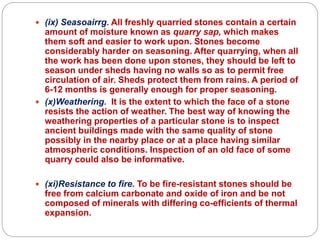
 (ix) Seasoairrg. All freshly quarried stones contain a certain
amount of moisture known as quarry sap, which makes
them soft and easier to work upon. Stones become
considerably harder on seasoning. After quarrying, when all
the work has been done upon stones, they should be left to
season under sheds having no walls so as to permit free
circulation of air. Sheds protect them from rains. A period of
6-12 months is generally enough for proper seasoning.
 (x)Weathering. It is the extent to which the face of a stone
resists the action of weather. The best way of knowing the
weathering properties of a particular stone is to inspect
ancient buildings made with the same quality of stone
possibly in the nearby place or at a place having similar
atmospheric conditions. Inspection of an old face of some
quarry could also be informative.
 (xi)Resistance to fire. To be fire-resistant stones should be
free from calcium carbonate and oxide of iron and be not
composed of minerals with differing co-efficients of thermal
expansion.
Masonry Joints
Types of Stone Masonry:
Based on the arrangement of the stone in the
construction and degree of refinement in the
surface finish, the stone masonry can be
classified broadly in the following two categories
1. Rubble masonry
2. Ashlar masonry
1) Rubble masonry:
In this category, the stones used are either undressed
or roughly dressed having wider joints. This can be
further subdivided as uncoursed, coursed, random,
dry, polygonal and bint.
 (i) Uncoursed rubble masonry: This is the
cheapest, roughest and poorest form of stone
masonry. The stones used in this type of masonry
very much vary in their shape and size and are
directly obtained from quarry. Uncoursed rubble
masonry can be divided into the following.
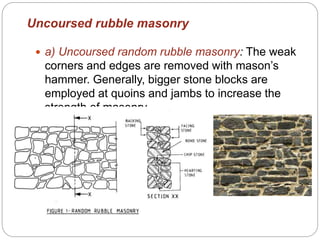
a) Uncoursed random rubble
b) Uncoursed squared rubble
Uncoursed rubble masonry
 a) Uncoursed random rubble masonry: The weak
corners and edges are removed with mason’s
hammer. Generally, bigger stone blocks are
employed at quoins and jambs to increase the
strength of masonry.
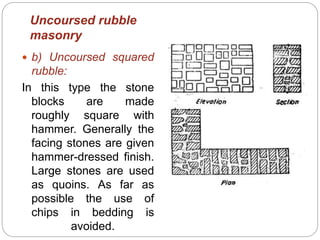
 b) Uncoursed squared
rubble:
In this type the stone
blocks are made
roughly square with
hammer. Generally the
facing stones are given
hammer-dressed finish.
Large stones are used
as quoins. As far as
possible the use of
chips in bedding is
avoided.
Uncoursed rubble
masonry
Regular Course
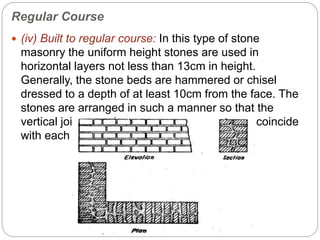
 (iv) Built to regular course: In this type of stone
masonry the uniform height stones are used in
horizontal layers not less than 13cm in height.
Generally, the stone beds are hammered or chisel
dressed to a depth of at least 10cm from the face. The
stones are arranged in such a manner so that the
vertical joints of two consecutive curse do not coincide
with each other as shown in figure below.
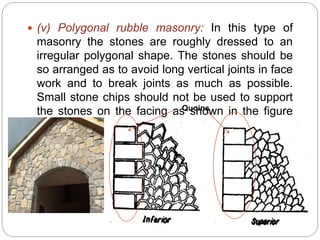
 (v) Polygonal rubble masonry: In this type of
masonry the stones are roughly dressed to an
irregular polygonal shape. The stones should be
so arranged as to avoid long vertical joints in face
work and to break joints as much as possible.
Small stone chips should not be used to support
the stones on the facing as shown in the figure
below.
Quoins
Flint rubble masonry
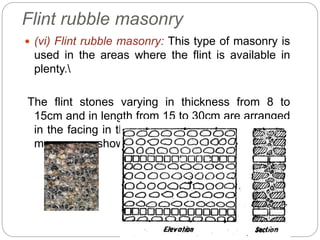
 (vi) Flint rubble masonry: This type of masonry is
used in the areas where the flint is available in
plenty.
The flint stones varying in thickness from 8 to
15cm and in length from 15 to 30cm are arranged
in the facing in the form of coursed or uncoursed
masonry as shown below.
Dry rubble masonry
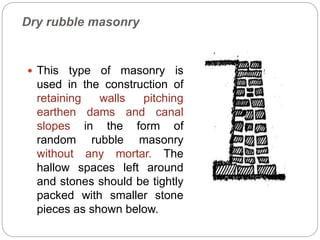
 This type of masonry is
used in the construction of
retaining walls pitching
earthen dams and canal
slopes in the form of
random rubble masonry
without any mortar. The
hallow spaces left around
and stones should be tightly
packed with smaller stone
pieces as shown below.
Ashlar Masonry
 This type of masonry is built from accurately
dressed stones with uniform and fine joints of
about 3mm thickness by arranging the stone
blocks in various patterns.
 The backing of Ashlar masonry walls may be built
of Ashlar masonry or rubble masonry. The size of
stones blocks should be in proportion to wall
thickness.
Ashlar Masonry
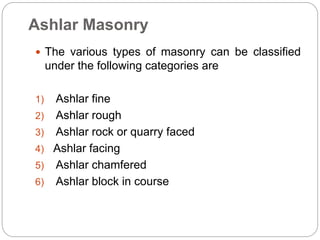
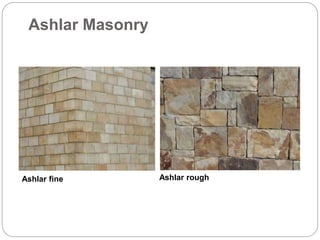
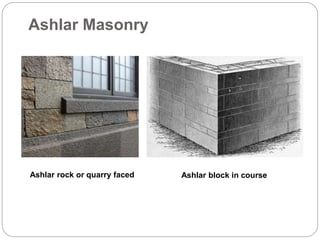
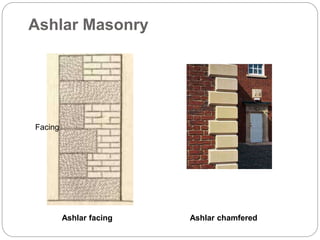
 The various types of masonry can be classified
under the following categories are
1) Ashlar fine
2) Ashlar rough
3) Ashlar rock or quarry faced
4) Ashlar facing
5) Ashlar chamfered
6) Ashlar block in course
Ashlar fine Ashlar rough
Ashlar Masonry
Ashlar rock or quarry faced Ashlar block in course
Ashlar Masonry
Ashlar facing Ashlar chamfered
Facing
Ashlar Masonry
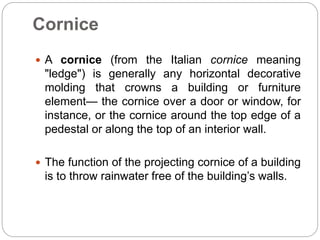
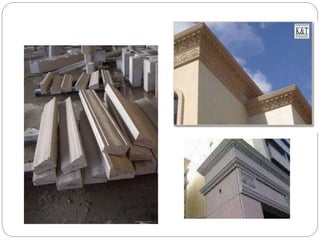
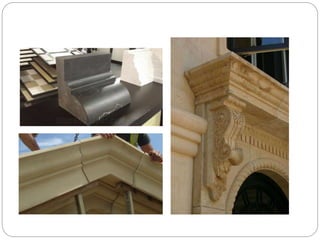
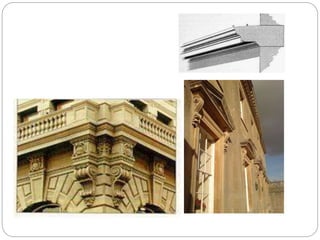
Cornice
 A cornice (from the Italian cornice meaning
"ledge") is generally any horizontal decorative
molding that crowns a building or furniture
element— the cornice over a door or window, for
instance, or the cornice around the top edge of a
pedestal or along the top of an interior wall.
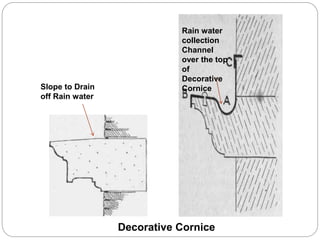
 The function of the projecting cornice of a building
is to throw rainwater free of the building’s walls.
Decorative Cornice
Slope to Drain
off Rain water
Rain water
collection
Channel
over the top
of
Decorative
Cornice
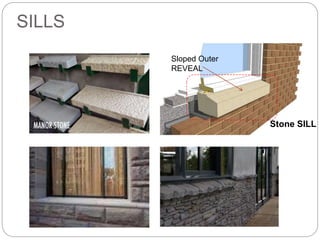
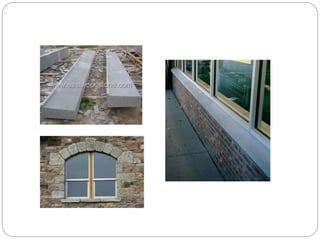
SILLS
Stone SILL
Sloped Outer
REVEAL
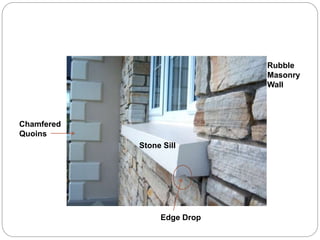
Chamfered
Quoins
Stone Sill
Edge Drop
Rubble
Masonry
Wall
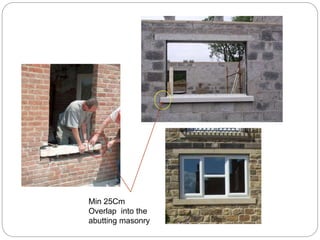
Min 25Cm
Overlap into the
abutting masonry
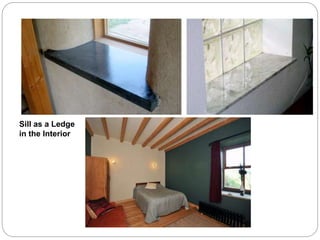
Sill as a Ledge
in the Interior
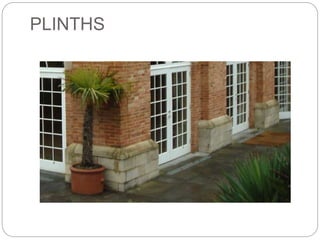
PLINTHS
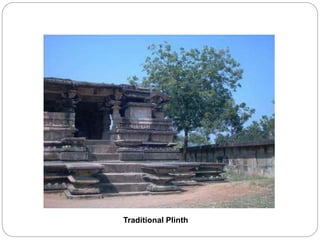
Traditional Plinth
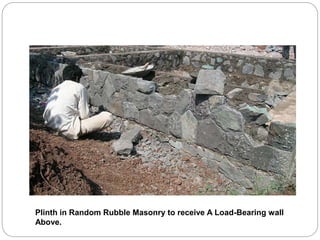
Plinth in Random Rubble Masonry to receive A Load-Bearing wall
Above.
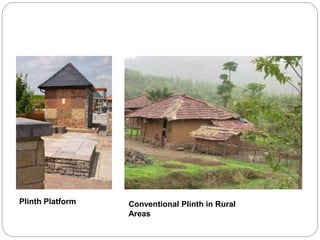
Plinth Platform Conventional Plinth in Rural
Areas
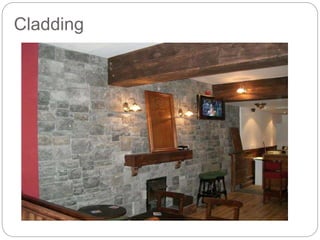
Cladding
THANKYOU

TYPES AND INFORMATION STONES

  • 1.
    SUB = ELEMENTSOF CIVIL ENGINEERING TOPIC = STONE PREPARED BY:- 1. C-27 PRASHANT A CHELANI 2. C-40 VIJAY D VADHER 3. C-43 NIKHIL R PATIL 4. C-21 PRATIK B PATEL DR S.&S.S GANDHY GOVERNMENT ENGINEERING SURAT.
  • 2.
  • 3.
    Stone Masonry  Def:-The craft of shapping rocks into accurate geometric shapes,mostly simple but some are considerably complex and then arranging the resulting stones,often together with mortar .
  • 4.
    Uses 1) Building foundations,walls, piers, pillars, and architectural works. 2) Lintels, Beams, beams Arches, domes etc., 3) Roofs and Roof coverings. 4) Cladding Works 5) Dams, light houses, monumental structures. 6) Paving jobs 7) Railway, ballast, black boards and electrical switch
  • 5.
    Selection of stonefor stone masonry: 1) Availability 2) Ease of working 3) Appearance 4) Strength and stability 5) Polishing characteristics 6) Economy 7) Durability
  • 6.
  • 8.
    CLASSIFICATION OF STONES IGNEOUSSTRATIFIED SILICIOUS ROCKS ROCKS ROCKS SEDIMENTRY UNSTRATIFIED ARGILLACEOUS ROCKS ROCKS ROCKS METAMORPHIC FOLITIED BUILDING STONES ROCKS GEOLOGICAL CLASSIFICATIO N PHYSICAL CLASSIFICATIO N CHEMICAL CLASSIFICATIO N
  • 9.
    LAYING THE STONE Decrease the stone thickness from the bottom to the top of wall.  Ensure that the headers in the heart of the wall are the same size as in the face and extend at least 12 in (300 mm) into the core or backing. (Avoid Dumb-bell shaped stones)  Ensure that headers in “walls of 2 feet (600 mm) or less in thickness” extend entirely through the wall. The headers shall occupy at least 20 percent of the face of the wall.
  • 10.
     Lay themasonry in roughly leveled courses. Ensure that the bottom of the foundation is large, with selected stones.  Lay the courses with leaning beds parallel to the natural bed of the material.  Regularly diminish the thicknesses of the courses, if varied, from the bottom to the top of the wall. Keep a surplus supply of stones at the site to select from.  Before laying the stone in the wall, shape and dress it so that it will not loosen after it is placed. No dressing or hammering which will loosen the stone will be permitted after it is placed. LAYING THE STONE
  • 11.
     Clean eachstone and saturate it with water before setting it. Clean and moisten the bed that will receive it.  Bed the stones in freshly made mortar with full joints. Carefully settle the stones in place before the mortar sets.  Ensure that the joints and beds have an average thickness of not more than 1 inch. (25 mm).  Ensure that the vertical joints in each course break with the adjoining courses at least 6 in. (150 mm).  Do not place vertical joints directly above or below a
  • 12.
     If astone is moved or if the joint is broken after the mortar has set, take the stone up and thoroughly clean the mortar from the bed and joints. Reset the stone in fresh mortar.  NOTE: Do not lay the masonry in freezing weather or when the stone contains frost, except with permission subjected to the required conditions.  Whenever possible, properly point the face joints before the mortar sets. If joints cannot be pointed, rake them out to a depth of 1 in (25 mm) before the mortar sets.  Do not smear the stone face surfaces with the mortar forced out of the joints or the mortar used in pointing.
  • 13.
     Thoroughly wetthe joints pointed after the stone is laid with clean water and fill with mortar.  Drive the mortar into the joints and finish with an approved pointing tool.  Keep the wall wet while pointing. In hot or dry weather, protect the pointed masonry from the sun and keep it wet for at least three days after the pointing is finished.  NOTE: Do not perform pointing in freezing weather or when the stone contains frost.  After the pointing is completed and the mortar is set, thoroughly clean the walls and leave them in a neat condition.
  • 14.
    CHARACTERISTICS OF GOODBUILDING STONES  A good building stone should essentially have the following qualities:  (i) Appearance. For the face work of buildings this property is of extreme importance. From architectural point of view colour of the stone should be such as to go well with the surroundings. Lighter shades should be preferred to the darker ones as the latter are less durable, Red and the brown shades of sedimentary rocks are due to the presence of oxide of iron-which, if present in excess, is liable to disfigure the stone with rust stains and to disintegrate it. Stones should be of uniform colour and free from clay holes, bands or spots of colour whatsoever.  (ii) General Structure. Stone, when broken in a direction other than that of cleavage (if it exists), should not give dull appearance. It should show uniformity of texture. It must be either crystalline in structure of homogeneous and close- grained. It should be free from cavities, cracks or patches of soft or loose material. For ornamental carvings it should be fine grained. Stratification (found in sedimentary rocks) should not be visible to naked eye except by difference in colour. These can be easily split along their planes of stratification known as planes of cleavage, and are, therefore, useful for use in pavings, floorings and roofings etc.
  • 15.
     (iii) Heaviness.Heavier varieties of stones are more compact, less porous and have greater specific gravities. For constructions in water, like weirs, barrages, dams, docks, harbours and for retaining walls the heavier varieties of stones are to be preferred. For construction of domes and for roof coverings and similar other usages the lighter varieties have to be used.  (iv) Strength. In usual constructions the stones used are generally quite strong to withstand the forces likely to be encountered yet in case of construction where unusually bigger forces are likely to come the stone to be used should be tested for its strength. Stones of igneous class are generally stronger than those of the sedimentary class. Stones with compact fine crystalline texture are stronger.  (v) Hardness. It is the resistance of stone to abrasive forces caused by much wear and friction as in floors, pavements and aprons of bridges and weirs in rivers. Stones to be used at such places should be hard.
  • 16.
     (vi) Toughness.It is a measure of the impact that a stone can with stand. Stones used at places subject to vibrations of machinery and to moving loads should be tough. Stones used in the construction of roads should be hard and tough.  (vii) Ease of working. The ease with which the stone can be worked upon i.e., cut, dressed, carved and moulded etc., is an important consideration from economy point of view. But this property is opposed to strength, durability and hardness.  (viii) Porosity and absorption. More pozrous building stones are unsuitable for use in construction especially for exposed surfaces of structures. Rain water while coming down carries some acidic gases forming light acids which lodge on the surface of stones and soak in them.  Stones should as such be tested for porosity and care should be taken to use more porous stones only at places where they are not likely to encounter frost, rain or moisture in any other form.
  • 17.
     (ix) Seasoairrg.All freshly quarried stones contain a certain amount of moisture known as quarry sap, which makes them soft and easier to work upon. Stones become considerably harder on seasoning. After quarrying, when all the work has been done upon stones, they should be left to season under sheds having no walls so as to permit free circulation of air. Sheds protect them from rains. A period of 6-12 months is generally enough for proper seasoning.  (x)Weathering. It is the extent to which the face of a stone resists the action of weather. The best way of knowing the weathering properties of a particular stone is to inspect ancient buildings made with the same quality of stone possibly in the nearby place or at a place having similar atmospheric conditions. Inspection of an old face of some quarry could also be informative.  (xi)Resistance to fire. To be fire-resistant stones should be free from calcium carbonate and oxide of iron and be not composed of minerals with differing co-efficients of thermal expansion.
  • 19.
  • 20.
    Types of StoneMasonry: Based on the arrangement of the stone in the construction and degree of refinement in the surface finish, the stone masonry can be classified broadly in the following two categories 1. Rubble masonry 2. Ashlar masonry
  • 21.
    1) Rubble masonry: Inthis category, the stones used are either undressed or roughly dressed having wider joints. This can be further subdivided as uncoursed, coursed, random, dry, polygonal and bint.  (i) Uncoursed rubble masonry: This is the cheapest, roughest and poorest form of stone masonry. The stones used in this type of masonry very much vary in their shape and size and are directly obtained from quarry. Uncoursed rubble masonry can be divided into the following. a) Uncoursed random rubble b) Uncoursed squared rubble
  • 22.
    Uncoursed rubble masonry a) Uncoursed random rubble masonry: The weak corners and edges are removed with mason’s hammer. Generally, bigger stone blocks are employed at quoins and jambs to increase the strength of masonry.
  • 23.
     b) Uncoursedsquared rubble: In this type the stone blocks are made roughly square with hammer. Generally the facing stones are given hammer-dressed finish. Large stones are used as quoins. As far as possible the use of chips in bedding is avoided. Uncoursed rubble masonry
  • 24.
    Regular Course  (iv)Built to regular course: In this type of stone masonry the uniform height stones are used in horizontal layers not less than 13cm in height. Generally, the stone beds are hammered or chisel dressed to a depth of at least 10cm from the face. The stones are arranged in such a manner so that the vertical joints of two consecutive curse do not coincide with each other as shown in figure below.
  • 25.
     (v) Polygonalrubble masonry: In this type of masonry the stones are roughly dressed to an irregular polygonal shape. The stones should be so arranged as to avoid long vertical joints in face work and to break joints as much as possible. Small stone chips should not be used to support the stones on the facing as shown in the figure below. Quoins
  • 26.
    Flint rubble masonry (vi) Flint rubble masonry: This type of masonry is used in the areas where the flint is available in plenty. The flint stones varying in thickness from 8 to 15cm and in length from 15 to 30cm are arranged in the facing in the form of coursed or uncoursed masonry as shown below.
  • 27.
    Dry rubble masonry This type of masonry is used in the construction of retaining walls pitching earthen dams and canal slopes in the form of random rubble masonry without any mortar. The hallow spaces left around and stones should be tightly packed with smaller stone pieces as shown below.
  • 28.
    Ashlar Masonry  Thistype of masonry is built from accurately dressed stones with uniform and fine joints of about 3mm thickness by arranging the stone blocks in various patterns.  The backing of Ashlar masonry walls may be built of Ashlar masonry or rubble masonry. The size of stones blocks should be in proportion to wall thickness.
  • 29.
    Ashlar Masonry  Thevarious types of masonry can be classified under the following categories are 1) Ashlar fine 2) Ashlar rough 3) Ashlar rock or quarry faced 4) Ashlar facing 5) Ashlar chamfered 6) Ashlar block in course
  • 30.
    Ashlar fine Ashlarrough Ashlar Masonry
  • 31.
    Ashlar rock orquarry faced Ashlar block in course Ashlar Masonry
  • 32.
    Ashlar facing Ashlarchamfered Facing Ashlar Masonry
  • 33.
    Cornice  A cornice(from the Italian cornice meaning "ledge") is generally any horizontal decorative molding that crowns a building or furniture element— the cornice over a door or window, for instance, or the cornice around the top edge of a pedestal or along the top of an interior wall.  The function of the projecting cornice of a building is to throw rainwater free of the building’s walls.
  • 37.
    Decorative Cornice Slope toDrain off Rain water Rain water collection Channel over the top of Decorative Cornice
  • 38.
  • 39.
  • 40.
    Min 25Cm Overlap intothe abutting masonry
  • 42.
    Sill as aLedge in the Interior
  • 43.
  • 44.
  • 45.
    Plinth in RandomRubble Masonry to receive A Load-Bearing wall Above.
  • 46.
    Plinth Platform ConventionalPlinth in Rural Areas
  • 48.
  • 52.