Fractures


Biology 120: Medical Terminology
         By: Amy Slaight
            09/12/2012
What is a Fracture?


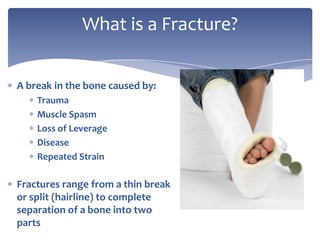
A break in the bone caused by:
    Trauma
    Muscle Spasm
    Loss of Leverage
    Disease
    Repeated Strain

Fractures range from a thin break
or split (hairline) to complete
separation of a bone into two
parts
Types of Fractures

There are many different types of bone fractures
  Some more commonly known such as Simple & Compound

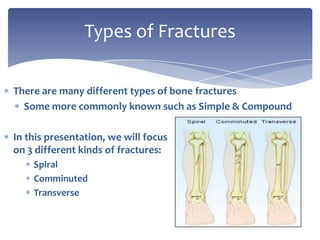
In this presentation, we will focus
on 3 different kinds of fractures:
    Spiral
    Comminuted
    Transverse
Spiral Fractures - Overview


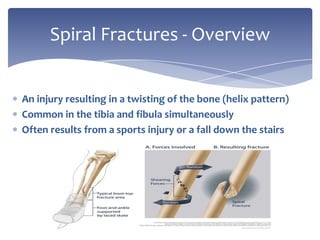
An injury resulting in a twisting of the bone (helix pattern)
Common in the tibia and fibula simultaneously
Often results from a sports injury or a fall down the stairs
Spiral Fractures – Healing &
                  Treatment


Average healing time is between 4 and 6 weeks
If the break is clean:
  Use of a cast and immobilization usually does the trick
If the bones are jagged and uneven
  The rough bone fragments can sever muscles and blood vessels
  The bones are not aligned for proper healing
    Therefore, surgery is necessary to insert pins/rods into the bones
Comminuted Fractures - Overview


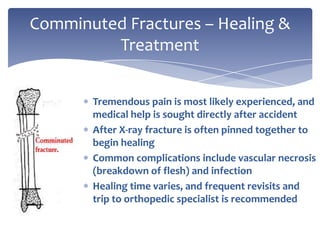
A fracture in which the bone fragments into several pieces
  At least 3 pieces, but often more
Also known as multi-fragmentary fractures
Can occur anywhere along the length of the bone
This type of fracture is most common in:
  Elderly folks
  Frail people (weakened immune systems)
  Result of serious trauma (car accidents)
Comminuted Fractures – Healing &
         Treatment


       Tremendous pain is most likely experienced, and
       medical help is sought directly after accident
       After X-ray fracture is often pinned together to
       begin healing
       Common complications include vascular necrosis
       (breakdown of flesh) and infection
       Healing time varies, and frequent revisits and
       trip to orthopedic specialist is recommended
Transverse Fractures - Overview

Bone is broken in the manner that is
perpendicular to how the bone runs
Typically the result of a direct blow
to a long bone
Can also occur as a consequence to
repeat motions, such as running
  Action can cause bone to separate
Transverse Fractures – Healing &
               Treatment

Very painful, and medical help is sought quickly after injury
Open or closed reduction (manual adjustment) before cast is
applied
Several months of recovery before bones fuse back together
When injury is closed, X-ray helps determine next steps
  Surgical or non-surgical reduction will follow (depend on severity)
With an open transverse fracture, surgery is a must
  This can include metal pins, plates, and screws in addition to
  reduction techinque
Sources

Content:
http://medical-dictionary.thefreedictionary.com/oblique+fracture
http://www.medicinenet.com/fracture/index.htm
http://www.wisegeekhealth.com/what-is-the-treatment-for-a-spiral-fracture.htm
http://www.wisegeek.com/what-is-a-comminuted-fracture.htm
Pearson Prentice Hall – Medical Terminology, 4th Edition , 2009

Photos:
http://www.eorthopod.com/content/adult-femur-fractures-types
http://www.ilizarov.org.uk/images/comm1.jpg
http://upload.wikimedia.org/wikipedia/commons/thumb/4/4a/Displaced_distal_radius_
fracture.jpg/592px-Displaced_distal_radius_fracture.jpg
http://www.medicinenet.com/fracture/page2.htm

Fractures

  • 1.
    Fractures Biology 120: MedicalTerminology By: Amy Slaight 09/12/2012
  • 2.
    What is aFracture? A break in the bone caused by: Trauma Muscle Spasm Loss of Leverage Disease Repeated Strain Fractures range from a thin break or split (hairline) to complete separation of a bone into two parts
  • 3.
    Types of Fractures Thereare many different types of bone fractures Some more commonly known such as Simple & Compound In this presentation, we will focus on 3 different kinds of fractures: Spiral Comminuted Transverse
  • 4.
    Spiral Fractures -Overview An injury resulting in a twisting of the bone (helix pattern) Common in the tibia and fibula simultaneously Often results from a sports injury or a fall down the stairs
  • 5.
    Spiral Fractures –Healing & Treatment Average healing time is between 4 and 6 weeks If the break is clean: Use of a cast and immobilization usually does the trick If the bones are jagged and uneven The rough bone fragments can sever muscles and blood vessels The bones are not aligned for proper healing Therefore, surgery is necessary to insert pins/rods into the bones
  • 6.
    Comminuted Fractures -Overview A fracture in which the bone fragments into several pieces At least 3 pieces, but often more Also known as multi-fragmentary fractures Can occur anywhere along the length of the bone This type of fracture is most common in: Elderly folks Frail people (weakened immune systems) Result of serious trauma (car accidents)
  • 7.
    Comminuted Fractures –Healing & Treatment Tremendous pain is most likely experienced, and medical help is sought directly after accident After X-ray fracture is often pinned together to begin healing Common complications include vascular necrosis (breakdown of flesh) and infection Healing time varies, and frequent revisits and trip to orthopedic specialist is recommended
  • 8.
    Transverse Fractures -Overview Bone is broken in the manner that is perpendicular to how the bone runs Typically the result of a direct blow to a long bone Can also occur as a consequence to repeat motions, such as running Action can cause bone to separate
  • 9.
    Transverse Fractures –Healing & Treatment Very painful, and medical help is sought quickly after injury Open or closed reduction (manual adjustment) before cast is applied Several months of recovery before bones fuse back together When injury is closed, X-ray helps determine next steps Surgical or non-surgical reduction will follow (depend on severity) With an open transverse fracture, surgery is a must This can include metal pins, plates, and screws in addition to reduction techinque
  • 10.
    Sources Content: http://medical-dictionary.thefreedictionary.com/oblique+fracture http://www.medicinenet.com/fracture/index.htm http://www.wisegeekhealth.com/what-is-the-treatment-for-a-spiral-fracture.htm http://www.wisegeek.com/what-is-a-comminuted-fracture.htm Pearson Prentice Hall– Medical Terminology, 4th Edition , 2009 Photos: http://www.eorthopod.com/content/adult-femur-fractures-types http://www.ilizarov.org.uk/images/comm1.jpg http://upload.wikimedia.org/wikipedia/commons/thumb/4/4a/Displaced_distal_radius_ fracture.jpg/592px-Displaced_distal_radius_fracture.jpg http://www.medicinenet.com/fracture/page2.htm

Editor's Notes

  • #2 Sources:Content:http://medical-dictionary.thefreedictionary.com/oblique+fracturehttp://www.medicinenet.com/fracture/index.htmhttp://www.wisegeekhealth.com/what-is-the-treatment-for-a-spiral-fracture.htmhttp://www.wisegeek.com/what-is-a-comminuted-fracture.htmPearson Prentice Hall – Medical Terminology, 4th Edition , 2009Photos: http://www.eorthopod.com/content/adult-femur-fractures-typeshttp://www.ilizarov.org.uk/images/comm1.jpghttp://upload.wikimedia.org/wikipedia/commons/thumb/4/4a/Displaced_distal_radius_fracture.jpg/592px-Displaced_distal_radius_fracture.jpghttp://www.medicinenet.com/fracture/page2.htm