DIABETES
MELLITUS
TYPE 2
INTRODUCTION AND DEFINITION
 Type 2 DM is a chronic disease characterized by hyperglycemia
 Results from a combination of:
• resistance to insulin
• inadequate insulin secretion
• Dysfunctional glucagon secretion
 Poorly controlled type 2 diabetes  an array of microvascular,
macrovascular, and neuropathic complications.
CLASSIFICATION
Type 2 DM patients are not absolutely dependent on insulin for life
and are ty pically older than 40 years, hence the older terms
“non–insulin dependent diabetes” and “adult-onset diabetes”.
However;
 many patients with type 2 diabetes are ultimately treated with
insulin
 type 2 diabetes mellitus is occurring at younger ages due to
the epidemic of obesity and inactivity in children and in case of
a family history of diabetes
SYMPTOMS
 Many patients with type 2 diabetes are asymptomatic
 Clinical manifestations include the following:
• Polyuria, polydipsia, polyphagia, and weight loss
• Blurred vision
• Lower-extremity paresthesias
• Yeast infections (eg, balanitis in men)
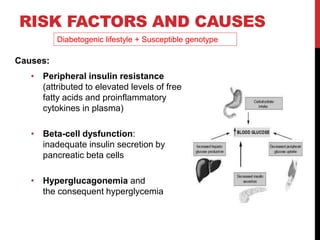
RISK FACTORS AND CAUSES
Causes:
• Peripheral insulin resistance
(attributed to elevated levels of free
fatty acids and proinflammatory
cytokines in plasma)
• Beta-cell dysfunction:
inadequate insulin secretion by
pancreatic beta cells
• Hyperglucagonemia and
the consequent hyperglycemia
Diabetogenic lifestyle + Susceptible genotype
CONT. CAUSES AND RISK FACTORS
• Obesity
• Age >45
• Family history
• Hispanic, Native American, African American, Asian American, or
Pacific Islander descent
• History of previous impaired glucose tolerance (IGT) or impaired
fasting glucose (IFG)
• Hypertension or dyslipidemia
• History of gestational diabetes
• Polycystic ovarian syndrome
• Genetic influences
• High fasting plasma concentrations of 3 amino acids (isoleucine,
phenylalanine, and tyrosine).
DIAGNOSIS AND TESTS
Diagnostic criteria by the American Diabetes Association (ADA):
• Fasting plasma glucose (FPG) level of 126 mg/dL (7.0 mmol/L) or
higher
• 2-hour plasma glucose level of 200 mg/dL (11.1 mmol/L) or higher
during a 75-g oral glucose tolerance test (OGTT)
• A random plasma glucose of 200 mg/dL (11.1 mmol/L) or higher in
a patient with classic symptoms of hyperglycemia or hyperglycemic
crisis
• Optional: Hemoglobin A1c (HbA1c) level of 6.5% or higher
COMPLICATIONS
Cardiovascular risk * *2-4 times greater in patients with
diabetes* *
1. Lipid abnormalities:
•  small, dense low-density lipoprotein (LDL) cholesterol
•  high-density lipoprotein (HDL) cholesterol
•  triglyceride-rich remnant lipoproteins
2. Thrombotic abnormalities:
• type-1 plasminogen activator inhibitor [PAI-1]
•  fibrinogen
3. Hypertension
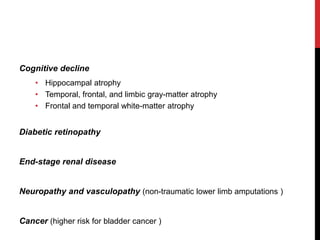
Cognitive decline
• Hippocampal atrophy
• Temporal, frontal, and limbic gray-matter atrophy
• Frontal and temporal white-matter atrophy
Diabetic retinopathy
End-stage renal disease
Neuropathy and vasculopathy (non-traumatic lower limb amputations )
Cancer (higher risk for bladder cancer )
DRUGS AND TREATMENT
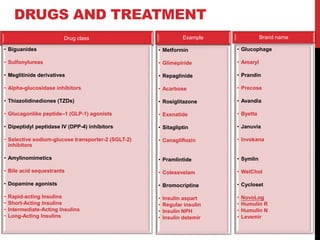
Drug class
• Biguanides
• Sulfonylureas
• Meglitinide derivatives
• Alpha-glucosidase inhibitors
• Thiazolidinediones (TZDs)
• Glucagonlike peptide–1 (GLP-1) agonists
• Dipeptidyl peptidase IV (DPP-4) inhibitors
• Selective sodium-glucose transporter-2 (SGLT-2)
inhibitors
• Amylinomimetics
• Bile acid sequestrants
• Dopamine agonists
• Rapid-acting Insulins
• Short-Acting Insulins
• Intermediate-Acting Insulins
• Long-Acting Insulins
Example
• Metformin
• Glimepiride
• Repaglinide
• Acarbose
• Rosiglitazone
• Exenatide
• Sitagliptin
• Canagliflozin
• Pramlintide
• Colesevelam
• Bromocriptine
• Insulin aspart
• Regular insulin
• Insulin NPH
• Insulin detemir
Brand name
• Glucophage
• Amaryl
• Prandin
• Precose
• Avandia
• Byetta
• Januvia
• Invokana
• Symlin
• WelChol
• Cycloset
• NovoLog
• Humulin R
• Humulin N
• Levemir
TREATMENT REGIMEN AND GOALS
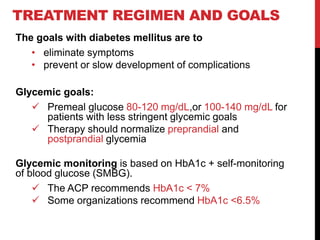
The goals with diabetes mellitus are to
• eliminate symptoms
• prevent or slow development of complications
Glycemic goals:
 Premeal glucose 80-120 mg/dL,or 100-140 mg/dL for
patients with less stringent glycemic goals
 Therapy should normalize preprandial and
postprandial glycemia
Glycemic monitoring is based on HbA1c + self-monitoring
of blood glucose (SMBG).
 The ACP recommends HbA1c < 7%
 Some organizations recommend HbA1c <6.5%
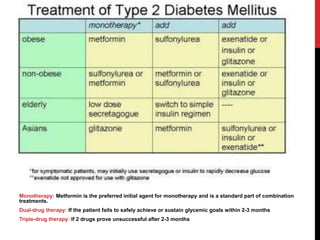
Monotherapy: Metformin is the preferred initial agent for monotherapy and is a standard part of combination
treatments.
Dual-drug therapy: If the patient fails to safely achieve or sustain glycemic goals within 2-3 months
Triple-drug therapy: If 2 drugs prove unsuccessful after 2-3 months
NON-PHARMACOLOGICAL
TREATMENT
• Dietary Modifications and Weight loss
• Caloric restriction
• Modest restriction of saturated fats and simple sugars
• Weight loss has been associated with significant
improvements in cardiovascular disease risk factors
Activity Modifications
• Aerobic exercise improves insulin sensitivity and may improve
glycemia markedly in some patients.
• physical activity +dietary modificaions  lower HbA1c
Bariatric Surgery
In morbidly obese patients to:
• improve diabetes control
• in some situations, normalize glucose tolerance.
PREVENTION
 To prevent type 2 diabetes mellitus in patients at risk:
• Weight reduction
• Proper nutrition
• Regular physical activity
• Cardiovascular risk factor reduction
• Aggressive treatment of hypertension and dyslipidemia
• Pharmacologic prevention using drugs e.g. Metformin,
Thiazolidinediones, Acarbose
 Stroke Prevention in Diabetes
• Regular blood pressure screening
• Physical activity
• Low-sodium, high-potassium diet
• Blood pressure <130/80 mm Hg
• Drug therapy with ACE inhibitors or ARBs
• Statin therapy
BIGUANIDES (METFORMIN)
Mechanism of action
It lowers basal and postprandial plasma glucose levels by:
• decreasing hepatic gluconeogenesis production
• decreasing intestinal absorption of glucose
• improving insulin sensitivity by increasing peripheral glucose
uptake and utilization
 The only oral diabetes drug that reliably facilitates modest
weight loss
CONT. BIGUANIDES (METFORMIN)
Side effects, drug interaction, contraindications
• Taken with food to minimize adverse GI effects.
• Contraindicated in patients with impaired renal function (risk
of lactic acidosis)
• Not be used within 48 hours of IV iodinated contrast medium.
Dose and duration of treatment
• Metformin is available in immediate-release and extended-release
formulations, as well as in combination with other antidiabetic
drugs.
• The dose is titrated over 1-2 months to at least 2000 mg daily,
administered in divided doses
SULFONYLUREAS
Mechanism of action
• Insulin secretagogues that stimulate insulin release from pancreatic
beta cells and probably
• greatest efficacy for glycemic lowering but effect is only short-term
• May also enhance peripheral sensitivity to insulin secondary to an
increase in insulin receptors or to changes in the events following
insulin-receptor binding.
can usually reduce HbA1c by 1-2% and blood glucose concentrations
by about 20%.
CONT. SULFONYLUREAS
Side effects, drug interaction, contraindications
• One study  sulfonylureas were found to be the chief cause of
cardiovascular death in diabetic patients admitted with acute
myocardial infarction
• Induction of weight gain
Dose and duration of treatment
MEGLITINIDE DERIVATIVES
Mechanism of action
• much shorter-acting insulin secretagogues than sulfonylureas
Side effects, drug interaction, contraindications
• inducing weight gain as sulfonylureas
• less risk for hypoglycemia than sulfonylureas
Dose and duration of treatment
ALPHA-GLUCOSIDASE INHIBITORS
Mechanism of action
• prolong the absorption of carbohydrates
• Thus help prevent postprandial glucose surges.
Side effects, drug interaction, contraindications
induction of flatulence
Dose and duration of treatment

Type2 dm

  • 1.
  • 2.
    INTRODUCTION AND DEFINITION Type 2 DM is a chronic disease characterized by hyperglycemia  Results from a combination of: • resistance to insulin • inadequate insulin secretion • Dysfunctional glucagon secretion  Poorly controlled type 2 diabetes  an array of microvascular, macrovascular, and neuropathic complications.
  • 3.
    CLASSIFICATION Type 2 DMpatients are not absolutely dependent on insulin for life and are ty pically older than 40 years, hence the older terms “non–insulin dependent diabetes” and “adult-onset diabetes”. However;  many patients with type 2 diabetes are ultimately treated with insulin  type 2 diabetes mellitus is occurring at younger ages due to the epidemic of obesity and inactivity in children and in case of a family history of diabetes
  • 4.
    SYMPTOMS  Many patientswith type 2 diabetes are asymptomatic  Clinical manifestations include the following: • Polyuria, polydipsia, polyphagia, and weight loss • Blurred vision • Lower-extremity paresthesias • Yeast infections (eg, balanitis in men)
  • 5.
    RISK FACTORS ANDCAUSES Causes: • Peripheral insulin resistance (attributed to elevated levels of free fatty acids and proinflammatory cytokines in plasma) • Beta-cell dysfunction: inadequate insulin secretion by pancreatic beta cells • Hyperglucagonemia and the consequent hyperglycemia Diabetogenic lifestyle + Susceptible genotype
  • 6.
    CONT. CAUSES ANDRISK FACTORS • Obesity • Age >45 • Family history • Hispanic, Native American, African American, Asian American, or Pacific Islander descent • History of previous impaired glucose tolerance (IGT) or impaired fasting glucose (IFG) • Hypertension or dyslipidemia • History of gestational diabetes • Polycystic ovarian syndrome • Genetic influences • High fasting plasma concentrations of 3 amino acids (isoleucine, phenylalanine, and tyrosine).
  • 7.
    DIAGNOSIS AND TESTS Diagnosticcriteria by the American Diabetes Association (ADA): • Fasting plasma glucose (FPG) level of 126 mg/dL (7.0 mmol/L) or higher • 2-hour plasma glucose level of 200 mg/dL (11.1 mmol/L) or higher during a 75-g oral glucose tolerance test (OGTT) • A random plasma glucose of 200 mg/dL (11.1 mmol/L) or higher in a patient with classic symptoms of hyperglycemia or hyperglycemic crisis • Optional: Hemoglobin A1c (HbA1c) level of 6.5% or higher
  • 8.
    COMPLICATIONS Cardiovascular risk **2-4 times greater in patients with diabetes* * 1. Lipid abnormalities: •  small, dense low-density lipoprotein (LDL) cholesterol •  high-density lipoprotein (HDL) cholesterol •  triglyceride-rich remnant lipoproteins 2. Thrombotic abnormalities: • type-1 plasminogen activator inhibitor [PAI-1] •  fibrinogen 3. Hypertension
  • 9.
    Cognitive decline • Hippocampalatrophy • Temporal, frontal, and limbic gray-matter atrophy • Frontal and temporal white-matter atrophy Diabetic retinopathy End-stage renal disease Neuropathy and vasculopathy (non-traumatic lower limb amputations ) Cancer (higher risk for bladder cancer )
  • 10.
    DRUGS AND TREATMENT Drugclass • Biguanides • Sulfonylureas • Meglitinide derivatives • Alpha-glucosidase inhibitors • Thiazolidinediones (TZDs) • Glucagonlike peptide–1 (GLP-1) agonists • Dipeptidyl peptidase IV (DPP-4) inhibitors • Selective sodium-glucose transporter-2 (SGLT-2) inhibitors • Amylinomimetics • Bile acid sequestrants • Dopamine agonists • Rapid-acting Insulins • Short-Acting Insulins • Intermediate-Acting Insulins • Long-Acting Insulins Example • Metformin • Glimepiride • Repaglinide • Acarbose • Rosiglitazone • Exenatide • Sitagliptin • Canagliflozin • Pramlintide • Colesevelam • Bromocriptine • Insulin aspart • Regular insulin • Insulin NPH • Insulin detemir Brand name • Glucophage • Amaryl • Prandin • Precose • Avandia • Byetta • Januvia • Invokana • Symlin • WelChol • Cycloset • NovoLog • Humulin R • Humulin N • Levemir
  • 11.
    TREATMENT REGIMEN ANDGOALS The goals with diabetes mellitus are to • eliminate symptoms • prevent or slow development of complications Glycemic goals:  Premeal glucose 80-120 mg/dL,or 100-140 mg/dL for patients with less stringent glycemic goals  Therapy should normalize preprandial and postprandial glycemia Glycemic monitoring is based on HbA1c + self-monitoring of blood glucose (SMBG).  The ACP recommends HbA1c < 7%  Some organizations recommend HbA1c <6.5%
  • 12.
    Monotherapy: Metformin isthe preferred initial agent for monotherapy and is a standard part of combination treatments. Dual-drug therapy: If the patient fails to safely achieve or sustain glycemic goals within 2-3 months Triple-drug therapy: If 2 drugs prove unsuccessful after 2-3 months
  • 13.
    NON-PHARMACOLOGICAL TREATMENT • Dietary Modificationsand Weight loss • Caloric restriction • Modest restriction of saturated fats and simple sugars • Weight loss has been associated with significant improvements in cardiovascular disease risk factors Activity Modifications • Aerobic exercise improves insulin sensitivity and may improve glycemia markedly in some patients. • physical activity +dietary modificaions  lower HbA1c Bariatric Surgery In morbidly obese patients to: • improve diabetes control • in some situations, normalize glucose tolerance.
  • 14.
    PREVENTION  To preventtype 2 diabetes mellitus in patients at risk: • Weight reduction • Proper nutrition • Regular physical activity • Cardiovascular risk factor reduction • Aggressive treatment of hypertension and dyslipidemia • Pharmacologic prevention using drugs e.g. Metformin, Thiazolidinediones, Acarbose  Stroke Prevention in Diabetes • Regular blood pressure screening • Physical activity • Low-sodium, high-potassium diet • Blood pressure <130/80 mm Hg • Drug therapy with ACE inhibitors or ARBs • Statin therapy
  • 15.
    BIGUANIDES (METFORMIN) Mechanism ofaction It lowers basal and postprandial plasma glucose levels by: • decreasing hepatic gluconeogenesis production • decreasing intestinal absorption of glucose • improving insulin sensitivity by increasing peripheral glucose uptake and utilization  The only oral diabetes drug that reliably facilitates modest weight loss
  • 16.
    CONT. BIGUANIDES (METFORMIN) Sideeffects, drug interaction, contraindications • Taken with food to minimize adverse GI effects. • Contraindicated in patients with impaired renal function (risk of lactic acidosis) • Not be used within 48 hours of IV iodinated contrast medium. Dose and duration of treatment • Metformin is available in immediate-release and extended-release formulations, as well as in combination with other antidiabetic drugs. • The dose is titrated over 1-2 months to at least 2000 mg daily, administered in divided doses
  • 17.
    SULFONYLUREAS Mechanism of action •Insulin secretagogues that stimulate insulin release from pancreatic beta cells and probably • greatest efficacy for glycemic lowering but effect is only short-term • May also enhance peripheral sensitivity to insulin secondary to an increase in insulin receptors or to changes in the events following insulin-receptor binding. can usually reduce HbA1c by 1-2% and blood glucose concentrations by about 20%.
  • 18.
    CONT. SULFONYLUREAS Side effects,drug interaction, contraindications • One study  sulfonylureas were found to be the chief cause of cardiovascular death in diabetic patients admitted with acute myocardial infarction • Induction of weight gain Dose and duration of treatment
  • 19.
    MEGLITINIDE DERIVATIVES Mechanism ofaction • much shorter-acting insulin secretagogues than sulfonylureas Side effects, drug interaction, contraindications • inducing weight gain as sulfonylureas • less risk for hypoglycemia than sulfonylureas Dose and duration of treatment
  • 20.
    ALPHA-GLUCOSIDASE INHIBITORS Mechanism ofaction • prolong the absorption of carbohydrates • Thus help prevent postprandial glucose surges. Side effects, drug interaction, contraindications induction of flatulence Dose and duration of treatment