

Management of diabetes mellitus
((ADA Guidelines
Dr. Faisal Al Hadad
Consultant of Family
Medicine & Occupational
Health
PSMMC
Introduction


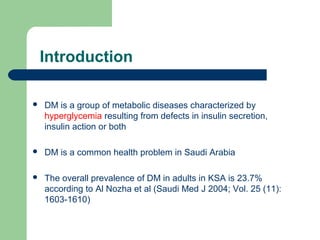
DM is a group of metabolic diseases characterized by
hyperglycemia resulting from defects in insulin secretion,
insulin action or both



DM is a common health problem in Saudi Arabia



The overall prevalence of DM in adults in KSA is 23.7%
according to Al Nozha et al (Saudi Med J 2004; Vol. 25 (11):
1603-1610)
Criteria for the diagnosis of diabetes
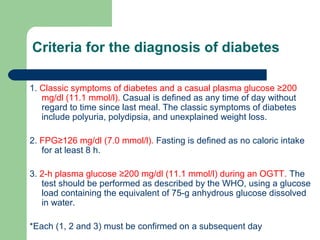
1. Classic symptoms of diabetes and a casual plasma glucose ≥200
mg/dl (11.1 mmol/l). Casual is defined as any time of day without
regard to time since last meal. The classic symptoms of diabetes
include polyuria, polydipsia, and unexplained weight loss.
2. FPG≥126 mg/dl (7.0 mmol/l). Fasting is defined as no caloric intake
for at least 8 h.
3. 2-h plasma glucose ≥200 mg/dl (11.1 mmol/l) during an OGTT. The
test should be performed as described by the WHO, using a glucose
load containing the equivalent of 75-g anhydrous glucose dissolved
in water.
*Each (1, 2 and 3) must be confirmed on a subsequent day
IFG/IGT


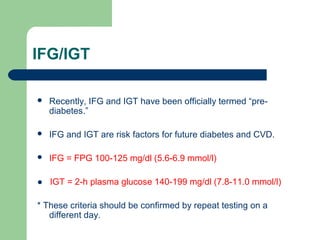
Recently, IFG and IGT have been officially termed “prediabetes.”



IFG and IGT are risk factors for future diabetes and CVD.



IFG = FPG 100-125 mg/dl (5.6-6.9 mmol/l)

● IGT = 2-h plasma glucose 140-199 mg/dl (7.8-11.0 mmol/l)
* These criteria should be confirmed by repeat testing on a
different day.
Gestational DM
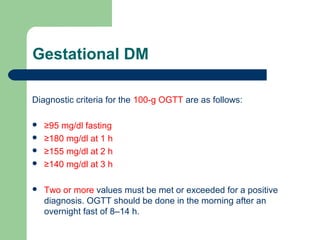
Diagnostic criteria for the 100-g OGTT are as follows:







≥95 mg/dl fasting
≥180 mg/dl at 1 h
≥155 mg/dl at 2 h
≥140 mg/dl at 3 h
Two or more values must be met or exceeded for a positive
diagnosis. OGTT should be done in the morning after an
overnight fast of 8–14 h.
Self-monitoring of blood glucose



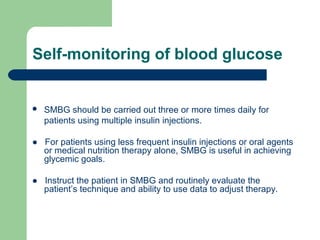
SMBG should be carried out three or more times daily for
patients using multiple insulin injections.

● For patients using less frequent insulin injections or oral agents
or medical nutrition therapy alone, SMBG is useful in achieving
glycemic goals.
● Instruct the patient in SMBG and routinely evaluate the
patient’s technique and ability to use data to adjust therapy.
Glycemic goals
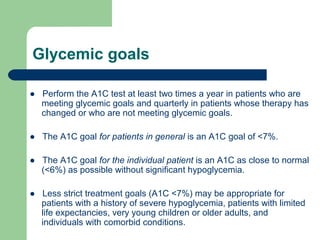
● Perform the A1C test at least two times a year in patients who are
meeting glycemic goals and quarterly in patients whose therapy has
changed or who are not meeting glycemic goals.
● The A1C goal for patients in general is an A1C goal of <7%.
● The A1C goal for the individual patient is an A1C as close to normal
(<6%) as possible without significant hypoglycemia.
● Less strict treatment goals (A1C <7%) may be appropriate for
patients with a history of severe hypoglycemia, patients with limited
life expectancies, very young children or older adults, and
individuals with comorbid conditions.
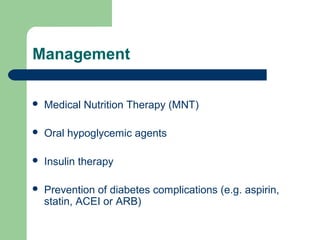
Management


Medical Nutrition Therapy (MNT)



Oral hypoglycemic agents



Insulin therapy



Prevention of diabetes complications (e.g. aspirin,
statin, ACEI or ARB)
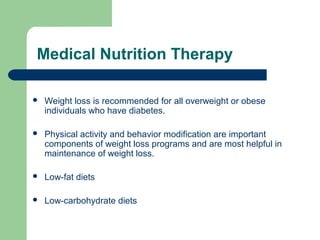
Medical Nutrition Therapy


Weight loss is recommended for all overweight or obese
individuals who have diabetes.



Physical activity and behavior modification are important
components of weight loss programs and are most helpful in
maintenance of weight loss.



Low-fat diets



Low-carbohydrate diets
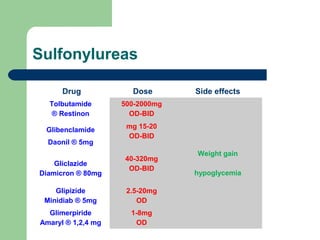
Sulfonylureas
Drug

Dose

Tolbutamide
® Restinon

500-2000mg
OD-BID

Glibenclamide

mg 15-20
OD-BID

Daonil ® 5mg
Gliclazide
Diamicron ® 80mg

40-320mg
OD-BID

Glipizide
Minidiab ® 5mg

2.5-20mg
OD

Glimerpiride
Amaryl ® 1,2,4 mg

1-8mg
OD

Side effects

Weight gain
hypoglycemia
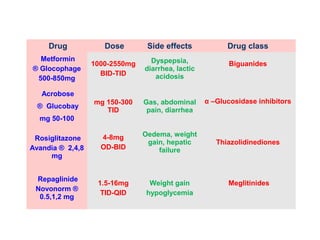
Drug

Dose

Side effects

Drug class

Metformin
® Glocophage
500-850mg

1000-2550mg
BID-TID

Dyspepsia,
diarrhea, lactic
acidosis

Biguanides

mg 150-300
TID

Gas, abdominal
pain, diarrhea

α –Glucosidase inhibitors

4-8mg
OD-BID

Oedema, weight
gain, hepatic
failure

1.5-16mg
TID-QID

Weight gain
hypoglycemia

Acrobose
® Glucobay
mg 50-100
Rosiglitazone
Avandia ® 2,4,8
mg
Repaglinide
Novonorm ®
0.5,1,2 mg

Thiazolidinediones

Meglitinides
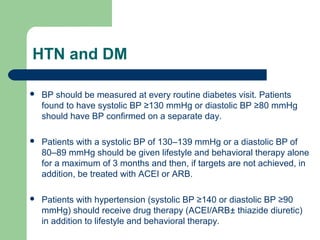
HTN and DM


BP should be measured at every routine diabetes visit. Patients
found to have systolic BP ≥130 mmHg or diastolic BP ≥80 mmHg
should have BP confirmed on a separate day.



Patients with a systolic BP of 130–139 mmHg or a diastolic BP of
80–89 mmHg should be given lifestyle and behavioral therapy alone
for a maximum of 3 months and then, if targets are not achieved, in
addition, be treated with ACEI or ARB.



Patients with hypertension (systolic BP ≥140 or diastolic BP ≥90
mmHg) should receive drug therapy (ACEI/ARB± thiazide diuretic)
in addition to lifestyle and behavioral therapy.
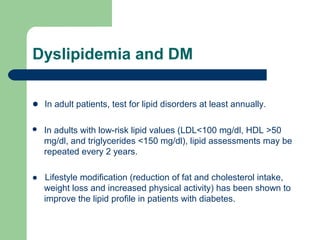
Dyslipidemia and DM
● In adult patients, test for lipid disorders at least annually.


In adults with low-risk lipid values (LDL<100 mg/dl, HDL >50
mg/dl, and triglycerides <150 mg/dl), lipid assessments may be
repeated every 2 years.

● Lifestyle modification (reduction of fat and cholesterol intake,
weight loss and increased physical activity) has been shown to
improve the lipid profile in patients with diabetes.
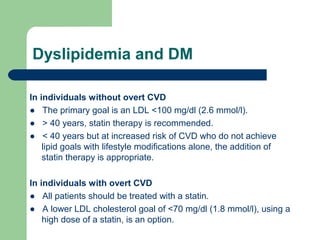
Dyslipidemia and DM
In individuals without overt CVD
● The primary goal is an LDL <100 mg/dl (2.6 mmol/l).
● > 40 years, statin therapy is recommended.
● < 40 years but at increased risk of CVD who do not achieve
lipid goals with lifestyle modifications alone, the addition of
statin therapy is appropriate.
In individuals with overt CVD
● All patients should be treated with a statin.
● A lower LDL cholesterol goal of <70 mg/dl (1.8 mmol/l), using a
high dose of a statin, is an option.
Dyslipidemia and DM


Lower TG to<150 mg/dl (1.7 mmol/l).



Raise HDL cholesterol to >40 mg/dl (1.0 mmol/l) in men and
>50 mg/dl (1.25 mmol/l) in women.

● Combination therapy using statins and other lipid-lowering
agents may be necessary to achieve lipid targets.
● Statin therapy is contraindicated in pregnancy.
Antiplatelet agents


As a secondary prevention strategy in those with diabetes with a
history of CVD.



As a primary prevention strategy in those with diabetes and at
increased CV risk (> 40 years of age or additional risk factors)



Combination therapy using other antiplatelet agents such as
clopidrogel in addition to aspirin should be used in patients with
severe and progressive CVD.
Diabetic Nephropathy
● To reduce the risk and/or slow the progression of
nephropathy, optimize glucose control and BP control.
● Perform an annual test for the presence of microalbuminuria
in type 1 diabetic patients with diabetes duration of ≥5 years
and in all type 2 diabetic patients, starting at diagnosis and
during pregnancy.


In the treatment of both micro- and macroalbuminuria, either
ACEI or ARBs should be used except during pregnancy.
Diabetic Nephropathy


Serum creatinine should be measured at least annually for the
estimation of GFR in all adults with diabetes regardless of the
degree of urine albumin excretion



Consider referral to a physician experienced in the care of diabetic
renal disease when the estimated GFR has fallen to <60 ml/min per
1.73 m2.

● Reduction of protein intake is recommended
Diabetic retinopathy


Optimal glycemic and BP control can substantially reduce the risk
and progression of Diabetic retinopathy .



Annual comprehensive eye examination by an ophthalmologist is
recommended in type 1 diabetic patients with diabetes duration of
≥5 years and in all type 2 diabetic patients.

● Women who are planning pregnancy or who have become pregnant
should have a comprehensive eye examination and should be
counseled on the risk of development and/or progression of diabetic
retinopathy.
Diabetic neuropathy
● All patients should be screened for distal symmetric
polyneuropathy (DPN) at diagnosis and at least annually
thereafter, using simple clinical tests.
● Once the diagnosis of DPN is established, special foot care is
appropriate for insensate feet to decrease the risk of
amputation.
● Simple inspection of insensate feet should be performed at 3to 6-month intervals. An abnormality should trigger referral for
special footwear, preventive specialist, or podiatric care.
Thank you

Diabetes mellitus

  • 1.
    Management of diabetesmellitus ((ADA Guidelines Dr. Faisal Al Hadad Consultant of Family Medicine & Occupational Health PSMMC
  • 2.
    Introduction  DM is agroup of metabolic diseases characterized by hyperglycemia resulting from defects in insulin secretion, insulin action or both  DM is a common health problem in Saudi Arabia  The overall prevalence of DM in adults in KSA is 23.7% according to Al Nozha et al (Saudi Med J 2004; Vol. 25 (11): 1603-1610)
  • 3.
    Criteria for thediagnosis of diabetes 1. Classic symptoms of diabetes and a casual plasma glucose ≥200 mg/dl (11.1 mmol/l). Casual is defined as any time of day without regard to time since last meal. The classic symptoms of diabetes include polyuria, polydipsia, and unexplained weight loss. 2. FPG≥126 mg/dl (7.0 mmol/l). Fasting is defined as no caloric intake for at least 8 h. 3. 2-h plasma glucose ≥200 mg/dl (11.1 mmol/l) during an OGTT. The test should be performed as described by the WHO, using a glucose load containing the equivalent of 75-g anhydrous glucose dissolved in water. *Each (1, 2 and 3) must be confirmed on a subsequent day
  • 4.
    IFG/IGT  Recently, IFG andIGT have been officially termed “prediabetes.”  IFG and IGT are risk factors for future diabetes and CVD.  IFG = FPG 100-125 mg/dl (5.6-6.9 mmol/l) ● IGT = 2-h plasma glucose 140-199 mg/dl (7.8-11.0 mmol/l) * These criteria should be confirmed by repeat testing on a different day.
  • 5.
    Gestational DM Diagnostic criteriafor the 100-g OGTT are as follows:      ≥95 mg/dl fasting ≥180 mg/dl at 1 h ≥155 mg/dl at 2 h ≥140 mg/dl at 3 h Two or more values must be met or exceeded for a positive diagnosis. OGTT should be done in the morning after an overnight fast of 8–14 h.
  • 6.
    Self-monitoring of bloodglucose  SMBG should be carried out three or more times daily for patients using multiple insulin injections. ● For patients using less frequent insulin injections or oral agents or medical nutrition therapy alone, SMBG is useful in achieving glycemic goals. ● Instruct the patient in SMBG and routinely evaluate the patient’s technique and ability to use data to adjust therapy.
  • 7.
    Glycemic goals ● Performthe A1C test at least two times a year in patients who are meeting glycemic goals and quarterly in patients whose therapy has changed or who are not meeting glycemic goals. ● The A1C goal for patients in general is an A1C goal of <7%. ● The A1C goal for the individual patient is an A1C as close to normal (<6%) as possible without significant hypoglycemia. ● Less strict treatment goals (A1C <7%) may be appropriate for patients with a history of severe hypoglycemia, patients with limited life expectancies, very young children or older adults, and individuals with comorbid conditions.
  • 8.
    Management  Medical Nutrition Therapy(MNT)  Oral hypoglycemic agents  Insulin therapy  Prevention of diabetes complications (e.g. aspirin, statin, ACEI or ARB)
  • 9.
    Medical Nutrition Therapy  Weightloss is recommended for all overweight or obese individuals who have diabetes.  Physical activity and behavior modification are important components of weight loss programs and are most helpful in maintenance of weight loss.  Low-fat diets  Low-carbohydrate diets
  • 12.
    Sulfonylureas Drug Dose Tolbutamide ® Restinon 500-2000mg OD-BID Glibenclamide mg 15-20 OD-BID Daonil® 5mg Gliclazide Diamicron ® 80mg 40-320mg OD-BID Glipizide Minidiab ® 5mg 2.5-20mg OD Glimerpiride Amaryl ® 1,2,4 mg 1-8mg OD Side effects Weight gain hypoglycemia
  • 13.
    Drug Dose Side effects Drug class Metformin ®Glocophage 500-850mg 1000-2550mg BID-TID Dyspepsia, diarrhea, lactic acidosis Biguanides mg 150-300 TID Gas, abdominal pain, diarrhea α –Glucosidase inhibitors 4-8mg OD-BID Oedema, weight gain, hepatic failure 1.5-16mg TID-QID Weight gain hypoglycemia Acrobose ® Glucobay mg 50-100 Rosiglitazone Avandia ® 2,4,8 mg Repaglinide Novonorm ® 0.5,1,2 mg Thiazolidinediones Meglitinides
  • 14.
    HTN and DM  BPshould be measured at every routine diabetes visit. Patients found to have systolic BP ≥130 mmHg or diastolic BP ≥80 mmHg should have BP confirmed on a separate day.  Patients with a systolic BP of 130–139 mmHg or a diastolic BP of 80–89 mmHg should be given lifestyle and behavioral therapy alone for a maximum of 3 months and then, if targets are not achieved, in addition, be treated with ACEI or ARB.  Patients with hypertension (systolic BP ≥140 or diastolic BP ≥90 mmHg) should receive drug therapy (ACEI/ARB± thiazide diuretic) in addition to lifestyle and behavioral therapy.
  • 15.
    Dyslipidemia and DM ●In adult patients, test for lipid disorders at least annually.  In adults with low-risk lipid values (LDL<100 mg/dl, HDL >50 mg/dl, and triglycerides <150 mg/dl), lipid assessments may be repeated every 2 years. ● Lifestyle modification (reduction of fat and cholesterol intake, weight loss and increased physical activity) has been shown to improve the lipid profile in patients with diabetes.
  • 16.
    Dyslipidemia and DM Inindividuals without overt CVD ● The primary goal is an LDL <100 mg/dl (2.6 mmol/l). ● > 40 years, statin therapy is recommended. ● < 40 years but at increased risk of CVD who do not achieve lipid goals with lifestyle modifications alone, the addition of statin therapy is appropriate. In individuals with overt CVD ● All patients should be treated with a statin. ● A lower LDL cholesterol goal of <70 mg/dl (1.8 mmol/l), using a high dose of a statin, is an option.
  • 17.
    Dyslipidemia and DM  LowerTG to<150 mg/dl (1.7 mmol/l).  Raise HDL cholesterol to >40 mg/dl (1.0 mmol/l) in men and >50 mg/dl (1.25 mmol/l) in women. ● Combination therapy using statins and other lipid-lowering agents may be necessary to achieve lipid targets. ● Statin therapy is contraindicated in pregnancy.
  • 18.
    Antiplatelet agents  As asecondary prevention strategy in those with diabetes with a history of CVD.  As a primary prevention strategy in those with diabetes and at increased CV risk (> 40 years of age or additional risk factors)  Combination therapy using other antiplatelet agents such as clopidrogel in addition to aspirin should be used in patients with severe and progressive CVD.
  • 19.
    Diabetic Nephropathy ● Toreduce the risk and/or slow the progression of nephropathy, optimize glucose control and BP control. ● Perform an annual test for the presence of microalbuminuria in type 1 diabetic patients with diabetes duration of ≥5 years and in all type 2 diabetic patients, starting at diagnosis and during pregnancy.  In the treatment of both micro- and macroalbuminuria, either ACEI or ARBs should be used except during pregnancy.
  • 20.
    Diabetic Nephropathy  Serum creatinineshould be measured at least annually for the estimation of GFR in all adults with diabetes regardless of the degree of urine albumin excretion  Consider referral to a physician experienced in the care of diabetic renal disease when the estimated GFR has fallen to <60 ml/min per 1.73 m2. ● Reduction of protein intake is recommended
  • 21.
    Diabetic retinopathy  Optimal glycemicand BP control can substantially reduce the risk and progression of Diabetic retinopathy .  Annual comprehensive eye examination by an ophthalmologist is recommended in type 1 diabetic patients with diabetes duration of ≥5 years and in all type 2 diabetic patients. ● Women who are planning pregnancy or who have become pregnant should have a comprehensive eye examination and should be counseled on the risk of development and/or progression of diabetic retinopathy.
  • 22.
    Diabetic neuropathy ● Allpatients should be screened for distal symmetric polyneuropathy (DPN) at diagnosis and at least annually thereafter, using simple clinical tests. ● Once the diagnosis of DPN is established, special foot care is appropriate for insensate feet to decrease the risk of amputation. ● Simple inspection of insensate feet should be performed at 3to 6-month intervals. An abnormality should trigger referral for special footwear, preventive specialist, or podiatric care.
  • 23.