SERIES   TEACHING FILM AND MEDIA STUDIES


                                         Teaching
                                        TV Drama

                                                     Jeremy Points
British Film Institute


                                              Series Editor: Vivienne Clark
worksheet             1
                                                          Thinking about genre

                                                          Genre means a ‘kind’ or ‘type’ and is a way of categorising films and
                                                          TV programmes. Before you start studying TV drama, a broad
                                                          television genre, you need to think about the role genre plays in
                                                          broadcasters’ and television producers’ thinking as well as in
                                                          audiences’ viewing. This will help put into context your detailed work
                                                          on the TV drama genre.

                                                          Your television viewing
                                                          G What are some of your favourite TV programmes?
                                                          G Why do you like them?
                                                          G Are you aware that you are looking at a programme in a particular
                                                             genre?

                                                          Look at extracts from at least three contrasting television genres.
                                                          You might try watching one without sound and one with sound only.
                                                          G Can you identify the genre you are watching/ listening to?
                                                          G What features enable you to identify the genre?


                                                          Look at examples of programmes and TV dramas which combine
                                                          elements of different genres – called hybrids. Examples include
                                                          Big Brother, The Sopranos, Extras, Doctor Who, Sea of Souls.
                                                          G Which elements of different genres can you identify in each
                                                              programme?
                                                          G Why do you think programmes like these are produced?
                                                          G How would you label programmes like these?
                                                          G How do broadcasters label them?
©British Film Institute 2007


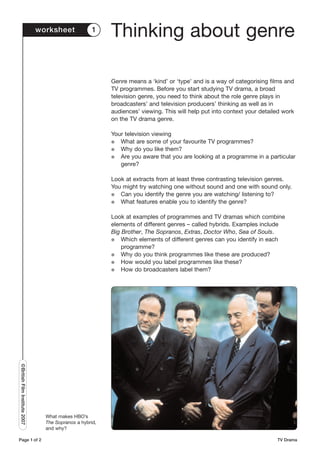
                                 What makes HBO’s
                                 The Sopranos a hybrid,
                                 and why?

Page 1 of 2                                                                                                              TV Drama
worksheet   1   Thinking about genre


                                               G   Do you think that broadcasters and producers consider the
                                                   different programmes they produce in terms of genre?
                                               G   How far are the generic features of a programme part of
                                                   audiences’ viewing experience? In what ways?
                                               G   In what ways do you think a programme’s genre affects the kind
                                                   of programme which is produced?

                                               Audiences’ ability to recognise the genre of a programme almost
                                               instantly means that they have assimilated the ingredients
                                               (‘conventions’ – see Worksheet 2) of a genre without realising it.
                                               As you study TV drama, you should think about how far the genre
                                               affects the nature of the drama.
©British Film Institute 2007


Page 2 of 2                                                                                                  TV Drama
worksheet             2
                                                              What is TV drama?

                                                              TV drama is a broad genre. At its simplest, it is fictionalised action in
                                                              narrative form. It is important to gain some basic understanding of
                                                              how and why TV drama splits into the different types broadcast today.

                                                              G   List as many examples of TV drama as you can. (Use a website,
                                                                  like the BBC’s, or a listings magazine to prompt you.)
                                                              G   Find examples of TV dramas which appear to be both a TV drama
                                                                  and something else, eg, a TV drama and a crime series like
                                                                  Prime Suspect. What is the reason for this kind of combination?
                                                              G   Name as many different kinds of TV drama as you can.

                                                              What you have been doing is uncovering the various subgenres
                                                              (genres within genres) of TV drama.

                                                                                         G   Genre means ‘kind’ or ‘type’. (Think of
                                                                                             the way biologists refer to ‘genus’ to
                                                                                             describe a type of plant or animal
                                                                                             species.)
                                                                                         G   A television genre thus refers to
                                                                                             programmes which can be categorised
                                                                                             by the things they have in common – the
                                                                                             conventions of a genre.
                                                                                         G   Many genres break down into subgenres.
                                                                                             Crime drama is a TV drama which has
                                                                                             become a genre in its own right.
                                                                                         G   TV drama has given rise to a number of
                                                                                             subgenres. What started out as drama on
                                                                                             television, single plays, quickly gave rise
                                                                                             to different kinds of drama: costume
                                                                                             dramas, children’s classic dramas, soap
                                                                                             operas, crime dramas, hospital dramas,
                                                                                             sci-fi dramas and historical adventures.
                                                                                             This took place in the 1950s as the BBC
                                                                                             was evolving and ITV first began
                                                                                             broadcasting. Why do you think this
                                                                                             happened? Why are there still so many
                                                                                             different kinds of TV drama? (See the
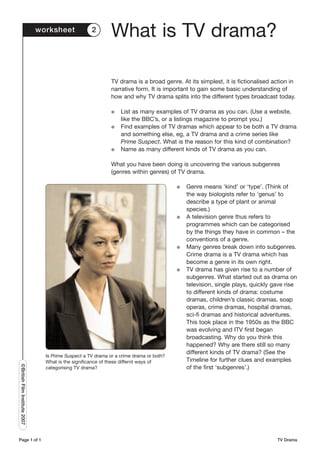
                                 Is Prime Suspect a TV drama or a crime drama or both?
                                 What is the significance of these differnt ways of          Timeline for further clues and examples
©British Film Institute 2007


                                 categorising TV drama?                                      of the first ‘subgenres’.)


Page 1 of 1                                                                                                                     TV Drama
worksheet              3
                                                             TV drama
                                                             conventions 1
                                                             The conventions of a genre are the ingredients which all examples of
                                                             a genre share. They act a little like rules – not necessarily rigid rules
                                                             but rules you need to follow in order to create something which
                                                             audiences will recognise as part of a particular genre. Like other
                                                             conventions – governing speech and behaviour, for example –
                                                             audiences seem to assimilate the conventions of genres
                                                             unconsciously.

                                                             Establishing the conventions of TV drama
                                                             Choose three or four contrasting TV dramas and look at short
                                                             extracts from them. Here are some suggestions: a single drama like
                                                             Yasmin, a crime or medical series like The Shield or Green Wing, a
                                                             US drama series like 24 (2001), Lost or Desperate Housewives, a
                                                             drama serial like the classic literary adaptation Bleak House (2005),
                                                             a sensational drama like Footballers’ Wives or a teen drama like
                                                             The OC.
©British Film Institute 2007


                                 What is different about
                                 the drama series 24? Did
                                 it establish a new trend?

Page 1 of 2                                                                                                                    TV Drama
worksheet   3   TV drama conventions 1


                                               What do they have in common?
                                               You will find that TV dramas all have the following ingredients:
                                               G   Characters – even particular kinds of characters: eg, at its most
                                                   simple, ‘good’ and ‘bad’ characters.
                                               G   Stories – they all tell stories, whether those stories involve
                                                   adventure, crime or romance and they often, but not always, end
                                                   happily.
                                               G   The stories are told against familiar backdrops: – eg, homes,
                                                   police stations and offices (for crime dramas), hospitals (for
                                                   medical dramas) – most of which are created in studios. However,
                                                   most dramas also use outside locations to create particular
                                                   effects.
                                               G   Camerawork – particular kinds of shots are used: eg, sequences
                                                   involving establishing shots followed by mid-shots of characters,
                                                   shot/reverse shots to show character interaction and, in particular,
                                                   close-ups to show the characters’ emotions.
                                               G   Stories use dialogue to tell the stories. Occasionally, monologues
                                                   are built in (as voiceovers, a character telling a story).
                                               G   Music is used to punctuate the action, create effects (suspense,
                                                   tension) and underline emotional moments.
                                               G   Particular subgenres tend to have items which make them
                                                   immediately identifiable – police cars, blue lights, operating
                                                   theatres and scalpels, triage/reception areas in hospitals. Icons of
                                                   the genre, they symbolise the (sub)genre.
©British Film Institute 2007


Page 2 of 2                                                                                                       TV Drama
worksheet               4
                                                           TV drama
                                                           conventions 2

                                                           The conventions of TV drama revolve around:
                                                           G   Characters.
                                                           G   Narrative – both its overall structure and how it is constructed.
                                                           G   Sets and settings – locations against which the story unfolds and
                                                               which frequently take on a symbolic significance.
                                                           G   Camerawork – particular kinds of camerawork are often
                                                               associated with particular subgenres.
                                                           G   Dialogue, sound and music – sound and music create effects and
                                                               often underline emotional content.
                                                           G   Icons – these tend to be associated with particular subgenres.

                                                           Watching extracts from a selection of TV dramas, fill in the attached
                                                           table.
                                                           The key issue to identify is how these basic conventions are used in
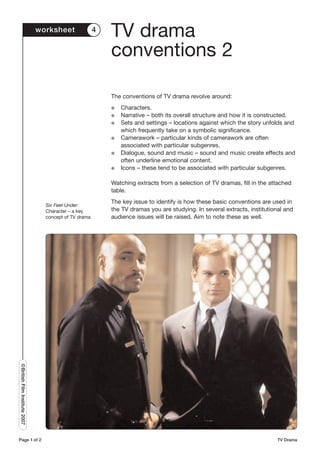
                                 Six Feet Under:
                                 Character – a key         the TV dramas you are studying. In several extracts, institutional and
                                 concept of TV drama       audience issues will be raised. Aim to note these as well.
©British Film Institute 2007


Page 1 of 2                                                                                                               TV Drama
worksheet            4        TV drama conventions 2


                                  Name of drama
                                  Broadcaster/
                                  scheduling details
                                  Writer/director/producer
                                  Conventions
                                  Characters


                                  Narrative


                                  Mise en scène (particularly
                                  locations, sets, lighting
                                  and costume)


                                  Sound: key dialogue,
                                  sound effects, music


                                  Icons


                                  Industry
                                  G Production, broadcast channel, scheduling, sponsorship, marketing and promotion, other available
                                    platforms etc.
                                  G Do you think any of the elements you have listed have shaped the drama?


                                  Audiences
©British Film Institute 2007


                                  G Main target audience, male/female, different ways different audiences might respond to the drama,
                                    encouraging fandom etc.
                                  G Do you think the drama will shape audiences’ points of view about people, issues or events?


Page 2 of 2                                                                                                                   TV Drama
worksheet   5
                                               Working with
                                               characters
                                               Characters (and the narratives which flow from them) are at the
                                               centre of audiences’ enthusiasm for TV drama. They are also key to
                                               influencing audiences, how they think of people and groups of
                                               people, or particular issues. It is therefore important to ask how
                                               audiences relate to characters in a drama.
                                               Look at extracts from three or four contrasting dramas like Charmed,
                                               Pride and Prejudice, Footballers’ Wives or House.
                                               G   What kinds of characters appear in the dramas? Are there
                                                   similarities between characters in different dramas?
                                               G   Do you respond emotionally to some characters? In what ways
                                                   and why?
                                               G   What do you understand by ‘identifying’ with a character?
                                               G   Do you think all audiences respond in the same way to
                                                   characters?
                                               G   Are the producers, writers and/or directors of dramas trying to get
                                                   you to respond in a particular way to characters? How?
                                               You have probably already realised that many TV drama narratives
                                               feature characters who are the opposite of one another, and that they
                                               are frequently set up in conflict. The most obvious conflict is between
                                               the good and bad characters. This simple idea appears to underlie
                                               many narratives and is generally described as ‘binary opposition’,
                                               after the French writer Claude Lévi-Strauss (who used it in his
                                               explorations of myths).
                                               Look at extracts from two or three dramas to explore how these
                                               character oppositions work. Again, choose contrasting dramas like
                                               Buffy the Vampire Slayer, Desperate Housewives, Blackpool or
                                               Spooks. Identify the good and bad characters.
                                               G   How do you know which is which?
                                               G   Are we as audiences being encouraged to sympathise with the
                                                   good characters and be antagonistic to the bad?
                                               G   How is this process underlined by editing and camerawork,
                                                   mise en scène (like locations, settings, lighting and costume)?
                                               G   Do the good characters succeed and the bad fail? Why is this?
                                                   What effect does this have on audiences?
©British Film Institute 2007


Page 1 of 1                                                                                                   TV Drama
worksheet   6
                                               TV drama
                                               conventions 3
                                               In order for television producers to keep audiences interested, they
                                               frequently make slight variations on the standard conventions of the
                                               genre. This is often noticeable in the way mise en scène, camerawork
                                               and sound/music is used. These elements are also used to underline
                                               issues raised by the drama.

                                               Mise en scène
                                               Choose extracts from three contrasting dramas such as Lost,
                                               Doctor Who, Funland, Rebus and Tipping the Velvet. The opening of
                                               an episode is frequently revealing.
                                               G   What are the connotations of the mise en scène?
                                               G   Does the mise en scène underline any particular issues which the
                                                   drama might be raising?
                                               Choose dramas which you consider are slightly unconventional
                                               examples of a particular TV drama subgenre (like medical dramas). In
                                               what ways is the mise en scène different from the conventional kind
                                               of mise en scène used in that subgenre. Here is an example based on
                                               medical dramas.
                                               Conventional mise en scène? Casualty, Holby City and ER
                                               G Do you think these dramas have a conventional mise en scène?
                                                  What makes it conventional?
                                               Unconventional mise en scène? Bodies and House
                                               G How far is the mise en scène in Bodies and House unconventional?
                                                  Give reasons for any variations on the conventional.

                                               Camerawork
                                               Explore the way camerawork is used in three contrasting dramas.
                                               Some innovative examples from the 1990s are: NYPD Blue, This Life
                                               and Cops. Interesting contemporary examples include: Messiah 4,
                                               Ghost Squad, Bleak House and 24.
                                               G   What kinds of camerawork are used and why?

                                               Sound and music
                                               Sound and music have taken an increasingly prominent role in TV
©British Film Institute 2007


                                               drama, although they have always been significant. The most obvious
                                               role sound plays – in particular, but not exclusively, music – is in
                                               underlining emotional response and thus positioning audiences. In
                                               exploring this, play scenes without sound to highlight what you think
                                               sound will contribute and play sound without vision to explore what
                                               the sound suggests.


Page 1 of 2                                                                                                 TV Drama
worksheet   6   TV drama conventions 3


                                               For example (in key dramas from the past):
                                               G   What role does the non-diegetic sound play at the end of a typical
                                                   ER episode?
                                               G   What role does the title music play inthe 2005 US drama Rome?
                                               G   What kind of soundtrack is used in the different CSI series?
                                                   Take one example and explore how and why it is used.
                                               G   At the moment when Darcy and Elizabeth first exchange glances
                                                   of love in Episode 5 of Andrew Davies’s Pride and Prejudice, the
                                                   volume of the non-diegetic music increases. This is a common
                                                   technique to position audiences and is frequently used in
                                                   romantic dramas. Look for your own examples.
                                               G   In a classic drama from 1982, ‘Yosser’s Story’ from Alan Bleasdale’s
                                                   Boys from the Blackstuff, a repeated harpsichord phrase is used
                                                   throughout the drama to underline Yosser’s psychological
                                                   isolation and imbalance. Look for another example of where
                                                   music underlines a psychological effect.

                                               Music is sometimes used in an ironic way to counterpoint the
                                               action. Martin Scorsese exploits music ironically in many of his films.
                                               In Six Feet Under, Series 1/Episode 2, a character dies following a
                                               diving accident in his own swimming pool (accompanied by Dean
                                               Martin’s ‘Ain’t That a Kick in the Head’.)
                                               G   Explore how sound and/or music is used ironically in drama.
                                                   Good examples can be found in the opening of the recent
                                                   adaptation of Much Ado about Nothing, Blackpool, Doctor Who or
                                                   (from the past) Dennis Potter’s The Singing Detective and David
                                                   Lynch’s Twin Peaks.
©British Film Institute 2007


Page 2 of 2                                                                                                    TV Drama
worksheet   7
                                               Genre –
                                               Open to change
                                               Genre variations
                                               Genres are always open to change.
                                               G   Producers aim to vary the standard conventions to maintain
                                                   audience interest without departing from them so much that they
                                                   alienate audiences.
                                               G   Audiences do not want slavish imitations but subtle variations on
                                                   the expected. They are attracted to the slight variation but gain
                                                   pleasure from the genre’s expectations being fulfilled.
                                               Explore variations in the crime genre. Look, for example, at the
                                               different kinds of investigators in crime dramas. Find out about the
                                               ones you are unfamiliar with. Extracts from several are available on
                                               www.screenonline.co.uk. For example:
                                               Dixon of Dock Green, Z Cars, The Sweeney, Cagney and Lacey,
                                               Starsky and Hutch, Hill Street Blues, NYPD Blue, Homicide, Cracker,
                                               Prime Suspect, Linda Lee, Murder in Suburbia, CSI, Silent Witness,
                                               Waking the Dead, New Tricks, Ghost Squad, Murphy’s Law.
                                               G   Name other variations used in crime drama. Consider, for example,
                                                   narrative and mise en scène.

                                               Hybrids
                                               Another way of varying and extending a genre is by creating hybrids.
                                               It may be that hybrids are not a new phenomenon, as is sometimes
                                               claimed, but something broadcasters and film producers have always
                                               employed.
                                               G   In what ways do you think the following dramas are hybrids?
                                                   List the genres which are blended to create the hybrid.
                                                   The Singing Detective
                                                   Blackpool
                                                   Sea of Souls
                                                   Murder Prevention
                                                   Buffy the Vampire Slayer
                                                   Charmed
                                                   Doctor Who
                                                   Footballers’ Wives
©British Film Institute 2007


                                                   Mayo
                                               G   Why do you think broadcasting organisations commission and
                                                   produce hybrid dramas?
                                               G   Do audiences see these dramas as hybrids? Do you think
                                                   audiences gain more pleasure from viewing hybrid genres?


Page 1 of 1                                                                                                   TV Drama
worksheet               8
                                                               Challenging dramas

                                                               At its simplest, an ideology is the way people think and feel – the
                                                               views and attitudes people hold which influence the way they see the
                                                               world. Questioning the way the majority of people think at any one
                                                               time is therefore challenging a dominant ideology. Most TV dramas
                                                               either reinforce dominant ideologies (encouraging people to think like
                                                               the majority) or challenge them.
                                                               G   Do you think it is important for TV dramas to make people think
                                                                   about contemporary social and cultural issues like gender, ethnic
                                                                   differences, sex trafficking, unemployment or social class?
                                                               G   How do TV dramas raise these issues?
                                                               G   What do you understand by ‘challenging the dominant ideology’?
                                                               G   In what ways, if at all, do you think any three of the following
                                                                   challenge dominant ideologies?
                                                                   Queer as Folk and Six Feet Under (sexual orientation)
                                                                   Footballers’ Wives (gender, sexual orientation, ethnic difference)
                                                                   Yasmin (ethnic difference)
                                                                   Sex Traffic (prostitution and sex trafficking)
                                                                   Boys from the Blackstuff (unemployment)
                                                                   The Sopranos (gender and masculinity in particular)
                                                                   Shameless (social class, gender, sexual orientation, families and
                                                                   communities)
©British Film Institute 2007


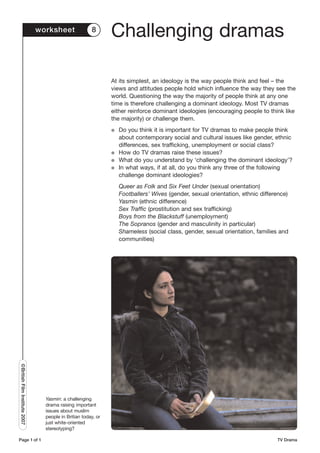
                                 Yasmin: a challenging
                                 drama raising important
                                 issues about muslim
                                 people in Britian today, or
                                 just white-oriented
                                 stereotyping?

Page 1 of 1                                                                                                                     TV Drama
worksheet   9
                                               Narrative
                                               construction
                                                      Television narratives are created by placing
                                                      images next to one another. The nature of
                                                      the narrative – what it suggests to audiences
                                                      – is affected by editing, camerawork and
                                                      mise en scène. Select any short sequence
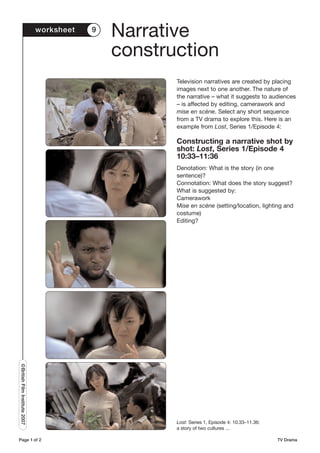
                                                      from a TV drama to explore this. Here is an
                                                      example from Lost, Series 1/Episode 4:

                                                      Constructing a narrative shot by
                                                      shot: Lost, Series 1/Episode 4
                                                      10:33–11:36
                                                      Denotation: What is the story (in one
                                                      sentence)?
                                                      Connotation: What does the story suggest?
                                                      What is suggested by:
                                                      Camerawork
                                                      Mise en scène (setting/location, lighting and
                                                      costume)
                                                      Editing?
©British Film Institute 2007


                                                      Lost: Series 1, Episode 4: 10.33–11.36:
                                                      a story of two cultures ...

Page 1 of 2                                                                                     TV Drama
worksheet   9   Narrative construction


                                               Conventions of a complete narrative
                                               Here is the start of a simple narrative: a couple wake up and go
                                               downstairs to breakfast. They do not realise that they are being
                                               watched by terrorists.
                                               G What happens next? Create a narrative in no more than five
                                                 sentences.
                                               G Which standard narrative conventions have you used?

                                               You might have come up with the following narrative conventions:
                                               G Beginning, middle and ending;
                                               G Characters – some good, some bad;
                                               G Probably a happy ending. Why do most stories end happily?

                                               Look at approximately the first five minutes of Series 3/Episode 10 of
                                               Spooks (which starts as outlined above). Which conventions are used?

                                               Prompts
                                               G This feels like the beginning of a narrative. Why?
                                               G What starts as an ordinary, everyday morning, is suddenly
                                                  threatened – a standard way of beginning a narrative. Why?
                                               G Audience involvement through the danger that is set up. We are
                                                  automatically being encouraged to take sides. Binary opposition?
                                               G Are any other binary oppositions established?


                                               Exploring narrative structures
                                               What are the different narrative structures associated with the
                                               following TV drama forms? Do they conform to Todorov’s and Lévi-
                                               Strauss’s outlines of narrative structures, which both have a
                                               fundamentally ideological significance?
                                               G   Single drama/film: Yasmin;
                                               G   Two-nighter: Sex Traffic;
                                               G   Soap (continuing drama): EastEnders;
                                               G   Serial: Bleak House;
                                               G   Anthology series (self-contained episodes, each based on different
                                                   characters): The Street;
                                               G   Long-form series drama: Lost;
                                               G   Long-form series drama with some narrative experimentation: 24.
©British Film Institute 2007


                                               Explore the beginnings and the conclusions of episodes from these
                                               dramas. What can you say about their narrative structure?
                                               G   ER
                                               G   West Wing
                                               G   Clocking Off
                                               G   State of Play


Page 2 of 2                                                                                                   TV Drama
worksheet   10
                                                The conventions of
                                                realism
                                                Dramas do not provide windows on reality, but offer audiences
                                                versions of reality using codes and conventions designed to convince
                                                them of this. Realism is constructed and is essentially an effect.
                                                To explore this, choose two contrasting hospital-based medical
                                                dramas (like ER, House and Bodies). How do they convey the sense
                                                of the reality of a hospital?
                                                                                                Think about the
                                                                                                following:
                                                                                                G   What kinds of
                                                                                                    characters
                                                                                                    appear and what
                                                                                                    are they wearing?
                                                                                                G   What is the
                                                                                                    narrative about?
                                                                                                    How is it
                                                                                                    constructed?
                                                                                                G   What are the
                                                                                                    most significant
                                                                                                    features of the
                                                                                                    mise en scène?
                                                                                                G   What kind of
                                                                                                    camerawork is
                                                                                                    used?
                                                                                                G   Do you notice
                                                                                                    anything
                                                                                                    particular about
                                                                                                    the editing?
                                                                                                G   What sort of
                                                                                                    dialogue is used
                                                                                                    (any dialogue
                                                                                                    that you
                                                                                                    particularly
                                                                                                    associate with
                                                                                                    hospitals)?
                                                                                                G   What other
                                                                                                    sound is used?
                                                                                                    Ambient (natural)
©British Film Institute 2007


                                                                                                    sound? Music?
                                                                                                    Effects of any
                                                                                                    kind?


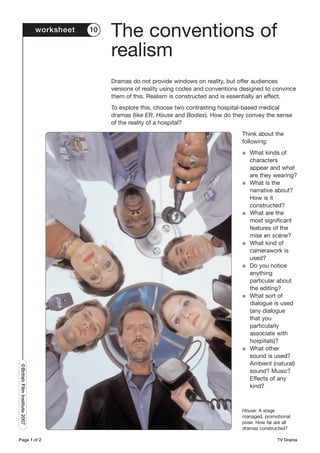
                                                                                                House: A stage
                                                                                                managed, promotional
                                                                                                pose. How far are all
                                                                                                dramas constructed?

Page 1 of 2                                                                                                    TV Drama
worksheet              10      The conventions of realism


                                 ER: Creating the effect of
                                 reality? For what
                                 reasons?
                                                                ER’s hard-wall, closed-ceiling emergency room sets [as opposed to
                                                                traditional open-ceiling and three-wall stage sets to allow for cameras
                                                                and lighting] … add another intrinsic element to the show’s realism …
                                                                It is much harder to move around on these stages because of the
                                                                ceilings that don’t move but that’s what makes you feel like you are
                                                                really in the ER. The sets provide more interesting possibilities for us
                                                                to choreograph scenes the way we do. We can shoot low and aim the
                                                                camera up and see the great ceilings and architecture or wind around
                                                                the multilayered hallways. You feel a sense of reality and immediacy ...
                                                                I think it’s a very subconscious thing, but I think it’s one of the keys to
                                                                the show.
                                                                Director, Mimi Leder, quoted in Pourroy, 1996, pp 33–4
©British Film Institute 2007


                                                              What does this extract tell you about the role of mise en scène and
                                                              camerawork in creating the effect of the real?


Page 2 of 2                                                                                                                          TV Drama
worksheet             11
                                                               Different kinds of
                                                               realism
                                                               There are different ways to create a sense of reality. The codes of
                                                               realism vary in different kinds of drama. Perhaps we should talk of
                                                               ‘realisms’ rather than realism. Realism perhaps reflects points of view
                                                               about ‘reality’ – sometimes the producers’ and sometimes
                                                               audiences’.
                                                               Choose three contrasting dramas which use different kinds of
                                                               camerawork and editing to attract different audiences, such as
                                                               Grey’s Anatomy (2005), Bodies (2003–6) and Casualty.
                                                               Each conveys a sense of reality but in a different way.
                                                               G   Which different codes of realism are used in each drama?
                                                               G   Do you think that Grey’s Anatomy shows hospitals from a younger
                                                                   person’s point of view, while Casualty adopts a slightly more
                                                                   mature perspective? Why is that?
                                                               G   Do you think that Bodies shows a particular point of view about
                                                                   the ‘reality’ of hospitals in Britain today? Whose point of view is
                                                                   that?


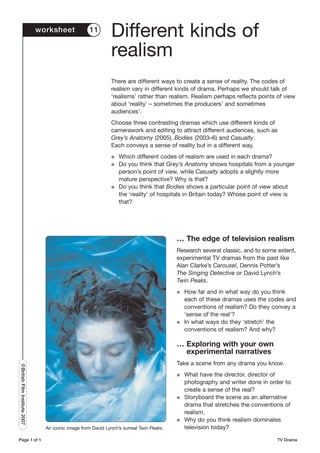
                                                                                          … The edge of television realism
                                                                                          Research several classic, and to some extent,
                                                                                          experimental TV dramas from the past like
                                                                                          Alan Clarke’s Carousel, Dennis Potter’s
                                                                                          The Singing Detective or David Lynch’s
                                                                                          Twin Peaks.
                                                                                          G   How far and in what way do you think
                                                                                              each of these dramas uses the codes and
                                                                                              conventions of realism? Do they convey a
                                                                                              ‘sense of the real’?
                                                                                          G   In what ways do they ‘stretch’ the
                                                                                              conventions of realism? And why?

                                                                                          … Exploring with your own
                                                                                            experimental narratives
                                                                                          Take a scene from any drama you know.
©British Film Institute 2007


                                                                                          G   What have the director, director of
                                                                                              photography and writer done in order to
                                                                                              create a sense of the real?
                                                                                          G   Storyboard the scene as an alternative
                                                                                              drama that stretches the conventions of
                                                                                              realism.
                                                                                          G   Why do you think realism dominates
                                 An iconic image from David Lynch’s surreal Twin Peaks.       television today?

Page 1 of 1                                                                                                                     TV Drama
worksheet           12
                                                         Contemporary
                                                         representations
                                                         of gender
                                                                                   It is often claimed that women are
                                                                                   represented as ‘sexual subjects’ rather than
                                                                                   ‘sexual objects’ and that men are no longer
                                                                                   represented in terms of power and force.
                                                                                   The way gender is represented in the media
                                                                                   seems to affect all audiences – it shapes
                                                                                   people’s sense of themselves. Choose
                                                                                   contrasting TV dramas and explore how
                                                                                   women and men are represented.
                                                                                   How are women and men represented in the
                                                                                   following:
                                                                                        Desperate Housewives or Footballers’
                                                                                        Wives
                                                                                        Wire in the Blood or Ultimate Force
                                                                                        Green Wing or Extras
                                                                                        Doctor Who
                                                                                        The OC or Totally Frank
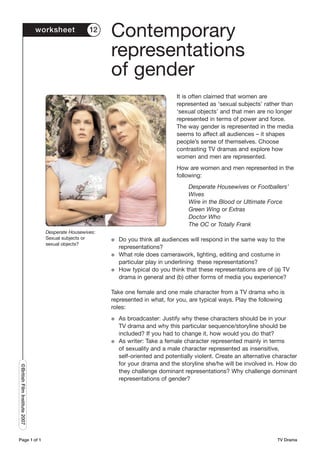
                                 Desperate Housewives:
                                 Sexual subjects or      G   Do you think all audiences will respond in the same way to the
                                 sexual objects?
                                                             representations?
                                                         G   What role does camerawork, lighting, editing and costume in
                                                             particular play in underlining these representations?
                                                         G   How typical do you think that these representations are of (a) TV
                                                             drama in general and (b) other forms of media you experience?

                                                         Take one female and one male character from a TV drama who is
                                                         represented in what, for you, are typical ways. Play the following
                                                         roles:
                                                         G   As broadcaster: Justify why these characters should be in your
                                                             TV drama and why this particular sequence/storyline should be
                                                             included? If you had to change it, how would you do that?
                                                         G   As writer: Take a female character represented mainly in terms
                                                             of sexuality and a male character represented as insensitive,
                                                             self-oriented and potentially violent. Create an alternative character
                                                             for your drama and the storyline she/he will be involved in. How do
©British Film Institute 2007


                                                             they challenge dominant representations? Why challenge dominant
                                                             representations of gender?


Page 1 of 1                                                                                                                TV Drama
worksheet            13
                                                           Positioning
                                                           audiences
                                                           Dramas tend to encourage the majority of their viewers to take up a
                                                           particular point of view to the characters and issues. This process is
                                                           called ‘positioning’.
                                                           Storyboard an alternative opening sequence to Spooks which just
                                                           focuses on Fiona and Adam. In ten shots, try to encourage the
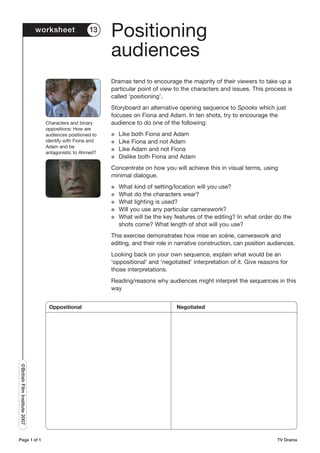
                                 Characters and binary     audience to do one of the following:
                                 oppositions: How are
                                 audiences positioned to   G   Like both Fiona and Adam
                                 identify with Fiona and   G   Like Fiona and not Adam
                                 Adam and be
                                                           G   Like Adam and not Fiona
                                 antagonistic to Ahmed?
                                                           G   Dislike both Fiona and Adam
                                                           Concentrate on how you will achieve this in visual terms, using
                                                           minimal dialogue.
                                                           G   What kind of setting/location will you use?
                                                           G   What do the characters wear?
                                                           G   What lighting is used?
                                                           G   Will you use any particular camerawork?
                                                           G   What will be the key features of the editing? In what order do the
                                                               shots come? What length of shot will you use?
                                                           This exercise demonstrates how mise en scène, camerawork and
                                                           editing, and their role in narrative construction, can position audiences.
                                                           Looking back on your own sequence, explain what would be an
                                                           ‘oppositional’ and ‘negotiated’ interpretation of it. Give reasons for
                                                           those interpretations.
                                                           Reading/reasons why audiences might interpret the sequences in this
                                                           way


                                  Oppositional                                       Negotiated
©British Film Institute 2007


Page 1 of 1                                                                                                                  TV Drama
worksheet   14
                                                TV drama – Its role
                                                for broadcasters
                                                It is important to ask what role TV drama plays for broadcasters. Is it
                                                still a flagship genre? Does it still anchor terrestrial schedules? With
                                                more and more platforms for viewing TV drama becoming available,
                                                are we moving from ‘broadcasting’ to ‘narrowcasting’? What role is
                                                TV drama playing in that possible shift? Do all these industry issues
                                                affect the nature and kinds of TV drama audiences see?
                                                What do the following reveal about the importance of TV drama for
                                                terrestrial broadcasters in Britain?
                                                G   BBC trailers like ‘The One for Drama’ (now ‘The One to Watch’)
                                                G   Promotion of autumn schedules
                                                G   Radio Times marketing
                                                G   Sponsorship on ITV – Sainsbury’s and Leerdammer
                                                Look at the websites for each of the major terrestrial broadcasters.
                                                G   How do the different broadcasters use their websites to market TV
                                                    drama?
                                                G   What differences are there between the major terrestrial
                                                    broadcasters?
                                                G   What does each website reveal about the significance of TV drama
                                                    for terrestrial broadcasters?
                                                Choose three contrasting channels.
                                                G   How far does TV drama contribute to the identity and brand image
                                                    of each of the major broadcasters and their channels?
                                                Read the following extracts from an Observer article, 25 November
                                                2005:


                                                    G On the BBC and TV drama
                                                    ‘… the sparkling array of new work on BBC1 coincides with the
                                                    corporation’s charter renewal. Having Poliakoff alongside Shakespeare
                                                    Retold and Bleak House on your flagship channel ticks that ‘public
                                                    service’ box rather better than Groundforce.’

                                                    G  On family drama: the Doctor Who effect
                                                    ‘[Doctor Who showed that] drama can trump both light entertainment
                                                    and reality pap in the ratings …’
©British Film Institute 2007


                                                    ITV are going to compete with Doctor Who. They have commissioned
                                                    a sci-fi drama Primaeval. Dan Chambers: ‘Reality TV probably peaked
                                                    last year and what will fill the gap is drama.’


                                                G   What do these comments suggest about the significance of TV
                                                    drama to broadcasters?


Page 1 of 2                                                                                                         TV Drama
worksheet            14    TV drama – Its role for broadcasters


                                                          Websites
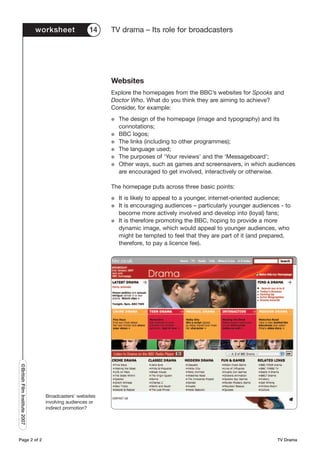
                                                          Explore the homepages from the BBC’s websites for Spooks and
                                                          Doctor Who. What do you think they are aiming to achieve?
                                                          Consider, for example:
                                                          G   The design of the homepage (image and typography) and its
                                                              connotations;
                                                          G   BBC logos;
                                                          G   The links (including to other programmes);
                                                          G   The language used;
                                                          G   The purposes of ‘Your reviews’ and the ‘Messageboard’;
                                                          G   Other ways, such as games and screensavers, in which audiences
                                                              are encouraged to get involved, interactively or otherwise.

                                                          The homepage puts across three basic points:
                                                          G   It is likely to appeal to a younger, internet-oriented audience;
                                                          G   It is encouraging audiences – particularly younger audiences - to
                                                              become more actively involved and develop into (loyal) fans;
                                                          G   It is therefore promoting the BBC, hoping to provide a more
                                                              dynamic image, which would appeal to younger audiences, who
                                                              might be tempted to feel that they are part of it (and prepared,
                                                              therefore, to pay a licence fee).
©British Film Institute 2007


                                 Broadcasters’ websites
                                 involving audiences or
                                 indirect promotion?


Page 2 of 2                                                                                                               TV Drama
worksheet           15
                                                            Programme supply
                                                            and digital rights
                                                            Downloading, on-demand viewing and podcasting
                                                            Read the following extracts from Emily Bell’s article for the Media
                                                            Guardian, 9 January 2006. It deals with just one aspect of the way
                                                            television viewing is changing. What are some of the other ways in
                                                            which viewers will be able to watch TV drama in future?


                                   … Microsoft and Sky [have] agree[d] last week         This is a model which has emerged after major
                                   to a historic union which will allow viewers to       interventions in the programme supply market
                                   download Sky programmes on to their PCs.              to correct the power of broadcasters over
                                   The scary union of Bill Gates and Rupert              teeny independents. Now these independents
                                   Murdoch … is just the latest reflection of how        have made millions out of stock market floats
                                   broadcasters are increasingly making their            and broadcasters are wondering where their
                                   programmes available over platforms other             next centime is coming from, the picture looks
                                   than television. Whilst in many parts of the          slightly different. Indeed, the fight between
                                   country many still struggle to get a clear signal     broadcasters and independents over what
                                   for Five, the industry is charging ahead with a       happens to rights is not a dead issue but the
                                   future which involves receiving your audio-           most pressing concern in the industry today.
                                   visual entertainment through a number of              Lucky Ofcom, the regulator, is producing its
                                   household devices. The strong rumours are             own thoughts on the issue of programme
                                   that Steve Jobs, head of Apple, is about to           supply and digital rights tomorrow.
                                   announce a hang-it-on-your-wall high
                                                                                         On the one hand you have Gates and Murdoch
                                   definition television with a computer built into
                                                                                         and the BBC, claiming that it is uneconomic to
                                   it – a kind of giant iPod Nano dangling above
                                                                                         commission programmes unless this includes
                                   the fireplace – which will accelerate the
                                                                                         the opportunity for the exploitation of
                                   process of watching what were once TV
                                                                                         electronic rights, and on the other hand you
                                   programmes as computer downloads.
                                                                                         have the independent producers worried that
                                   But behind the scenes this amazing vision of a        having finally garnered some power they are
                                   new world is a knotty problem for the                 potentially about to lose it to muscular mega
                                   regulators … at the moment you are allowed to         corporations. Then you have Channel 4, which
                                   sell programmes but retain the ‘other’ rights         owns no original production facilities, because
                                   [which include making money from other forms          that is how it is configured, and which faces a
                                   of distribution, including electronic]. If you sell   fairly miserable future without some retention
                                   to the BBC, which has a website it is proud of,       of residual and electronic rights.
                                   it has the electronic rights for seven days but
                                                                                         Who owns a programme and for how long is
                                   then they revert to you.
                                                                                         the pressing question to be answered.


                                                            G   What are the main sources of income for (a) the BBC (b) ITV and
©British Film Institute 2007


                                                                (c) independent producers of TV drama?
                                                            G   Set out the main ways in which downloading will affect (a)
                                                                broadcasters like the BBC and ITV and (b) independent producers
                                                                of TV drama like Kudos.
                                                            G   Why do you think downloading TV drama might pose more of a
                                                                threat than recording TV drama off-air?
                                                            G   What are the main commercial ways in which broadcasters are
                                                                hoping to benefit from downloading and podcasting?
                                                            G   Who owns a programme and for how long?

Page 1 of 1                                                                                                                        TV Drama
worksheet              16
                                                            TV crime drama:
                                                            Broadcasters’
                                                            approach to genre
                                                            The popularity of crime drama on TV
                                                            Crime drama is probably the most popular drama subgenre on
                                                            television outside soap opera. The following should give you a rapid
                                                            overview its popularity.
                                                            Look at a listings magazine and count roughly how many TV dramas
                                                            are shown in one week, and how many of these are crime dramas.
                                                            Exclude soaps and sitcoms.
                                                            G   During the week of 20–8 October 2005, 15 out of 27 TV dramas,
                                                                excluding soaps, were crime dramas – around 55%. If one
                                                                includes the five soaps, the percentage is just below 50%.
                                                            Look at the table of a September week’s Top 10 drama, based on
                                                            BARB (Broadcasters’ Audience Research Board) figures and reprinted
                                                            in Broadcast’s weekly look at ratings (Week ending: 25 September
                                                            2005, Broadcast, 14 October 2005).


                                                             Top 10 Drama
                                                                    Title              Day    Start   Viewers      Channel   Last
                                                                                                      (millions)             week
                                                                1   A Touch of Frost   Sun    20.25   10.28        ITV1      –
                                                                2   The Bill           Thu    20.00    8.19        ITV1      8
                                                                3   Casualty           Sat    20.20    7.57        BBC1      2
                                                                4   Waking the Dead    Mon    21.00    7.56        BBC1      –

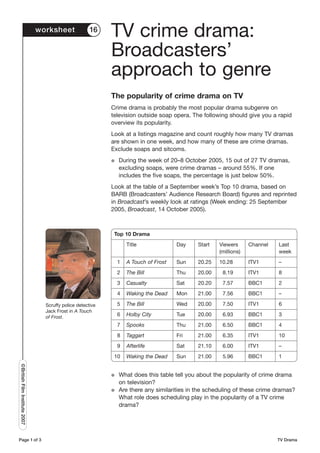
                                 Scruffy police detective       5   The Bill           Wed    20.00    7.50        ITV1      6
                                 Jack Frost in A Touch
                                 of Frost.                      6   Holby City         Tue    20.00    6.93        BBC1      3
                                                                7   Spooks             Thu    21.00    6.50        BBC1      4
                                                                8   Taggart            Fri    21.00    6.35        ITV1      10
                                                                9   Afterlife          Sat    21.10    6.00        ITV1      –
                                                             10     Waking the Dead    Sun    21.00    5.96        BBC1      1
©British Film Institute 2007


                                                            G   What does this table tell you about the popularity of crime drama
                                                                on television?
                                                            G   Are there any similarities in the scheduling of these crime dramas?
                                                                What role does scheduling play in the popularity of a TV crime
                                                                drama?


Page 1 of 3                                                                                                                  TV Drama
worksheet            16         TV crime drama: Broadcasters’ approach to genre


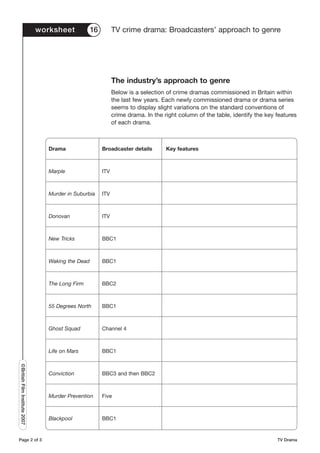
                                                               The industry’s approach to genre
                                                               Below is a selection of crime dramas commissioned in Britain within
                                                               the last few years. Each newly commissioned drama or drama series
                                                               seems to display slight variations on the standard conventions of
                                                               crime drama. In the right column of the table, identify the key features
                                                               of each drama.


                                  Drama                  Broadcaster details        Key features


                                  Marple                 ITV


                                  Murder in Suburbia     ITV


                                  Donovan                ITV


                                  New Tricks             BBC1


                                  Waking the Dead        BBC1


                                  The Long Firm          BBC2


                                  55 Degrees North       BBC1


                                  Ghost Squad            Channel 4


                                  Life on Mars           BBC1
©British Film Institute 2007


                                  Conviction             BBC3 and then BBC2


                                  Murder Prevention      Five


                                  Blackpool              BBC1


Page 2 of 3                                                                                                                    TV Drama
worksheet              16   TV crime drama: Broadcasters’ approach to genre


                                                           G   What is the ‘unique twist’ (Tom Toumazis) for these dramas, or the
                                                               ‘unique selling point’ for audiences?
                                                           G   Why do producers want this ‘unique twist’?
                                                           G   Why do audiences want some, but not too much, variation on the
                                                               familiar?

                                                           G   Only a relatively small proportion of US crime drama reaches
                                                               British television audiences. Why do you think the BBC, ITV,
                                                               Channel 4 and Channel 5 acquired the following?
                                                               – BBC1: The Medium
                                                               – BBC2: 24
                                                               – Channel 4: The Closer, The Sopranos
                                                               – Five: CSI (in its various forms), Columbo (series from the 1970s
                                                                 now shown during the daytime), The Shield
©British Film Institute 2007


                                 Why do you think
                                 Channel 5 acquired
                                 the US crime drama
                                 The Shield?

Page 3 of 3                                                                                                                TV Drama
worksheet            17
                                                            Representation
                                                            of the police
                                                            Endings and police procedures
                                                            The endings of crime dramas are very revealing. They generally
                                                            provide audiences with a satisfying conclusion where criminals are
                                                            captured and crimes are solved.
                                                            G   Do you know, for example, what percentage of crimes, including
                                                                murders, are solved in Britain today?
                                                            G   What view of the police and the legal system do most crime
                                                                dramas provide?

                                                            Look at the conclusions of three crime dramas you are familiar with.
                                                            Test out what you know about Todorov and Lévi-Strauss.
                                                            G   Do you see a restoration of equilibrium (Todorov) and a resolution
                                                                of conflict between good and bad (Lévi-Strauss)?
                                                            G   What does this suggest about the ideologies being conveyed to
                                                                the audience. Do they conform to dominant ideologies about the
                                                                police and criminality or challenge them?
©British Film Institute 2007


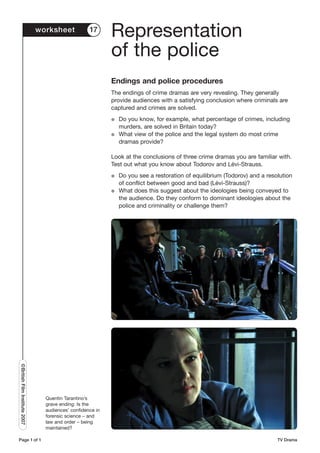
                                 Quentin Tarantino’s
                                 grave ending: Is the
                                 audiences’ confidence in
                                 forensic science – and
                                 law and order – being
                                 maintained?

Page 1 of 1                                                                                                                 TV Drama
worksheet   18
                                                Literary adaptations:
                                                Reaching new
                                                audiences
                                                Labelling the ‘classic literary adaptation’
                                                The way the ‘classic literary adaptation’ has been described by
                                                broadcasters has changed considerably. Currently, several terms are
                                                used and most of them are employed interchangeably by reviewers,
                                                commentators and academic writers.
                                                G   What are the connotations of the following labels used by
                                                    broadcasters for the ‘classic literary adaptation’?
                                                G   What do they suggest about the way broadcasters are trying to
                                                    appeal to audiences?
                                                    The classic serial (used particularly in the 1950s, 60s and early 70s)
                                                    – the BBC used a curtain-raising ident with classical music (a
                                                    Schumann symphony) for this in 1970s
                                                    Historical drama – used in 1980s
                                                    Costume drama – used in 1990s
                                                    Period drama – used more recently
                                                    Literary adaptation – used mainly by academic writers.

                                                Treatments, stars and audience identification
                                                Bleak House was notable for the way it used popular television actors
                                                not usually associated with classic drama. Think, for example, about:
                                                Johnny Vegas (Krook) the comedian, Gillian Anderson (Lady Dedlock)
                                                from The X-Files, Liza Tarbuck (Mrs Jellaby) from Linda Green,
                                                Warren Clarke (Boythorn) from Dalziel and Pascoe …
                                                G   What do these actors bring to the roles?
                                                G   Do you think they bring new audiences?
                                                Compare Bleak House with the more conventionally filmed TV series
                                                Pride and Prejudice. Start with the openings of each drama, where
                                                the major characters are introduced.
                                                G   List the features of Pride and Prejudice which you think make it
                                                    conventional, and would appeal to the ‘traditional’, classic drama
                                                    audience.
                                                G   List the ways in which Bleak House attempts to reach new
                                                    audiences.
©British Film Institute 2007


Page 1 of 2                                                                                                       TV Drama
worksheet   18   Literary adaptations: Reaching new audiences


                                                Preparing a treatment
                                                Choose a synopsis from a well-known classic novel. Prepare a
                                                treatment for Jane Tranter, Head of Drama at the BBC, with ideas on
                                                how to reach a new audience for your adaptation. In your treatment
                                                you should consider:
                                                G   Whether to update/set the novel in a contemporary context and if
                                                    so how;
                                                G   Visual style (camerawork/editing);
                                                G   Mise en scène (key locations/sets/lighting/costume);
                                                G   Stars/key actors, with reasons for your choice;
                                                G   Length of each episode, scheduling, channel and reasons for your
                                                    choice;
                                                G   Ideas for possible interactive features (website/‘red button’).
                                                You could find a synopsis of a novel like Wuthering Heights, Silas
                                                Marner, Oliver Twist, Great Expectations or Tess of the D’Urbervilles,
                                                all of which have been the subjects of films or TV dramatisations in
                                                the last ten years.
©British Film Institute 2007


Page 2 of 2                                                                                                     TV Drama
worksheet   19
                                                Representations
                                                in Bleak House
                                                How far is Bleak House relevant to society today? Explore how some
                                                of the issues it raises are represented. How far do you think
                                                audiences relate these issues to society today? For each topic, some
                                                suggested extracts are listed to help navigate your way around this
                                                15-part drama.

                                                Social class
                                                Look at the following extracts.
                                                G   What are the dominant views of society and social class conveyed
                                                    by each extract? How is the audience positioned to adopt that
                                                    dominant point of view? Consider dialogue and mise en scène.
                                                Ep 6: 04.40 – Sir Leicester Dedlock, Lady Dedlock and Mr Rouncewell
                                                Ep 1: 44.08 – Mrs Pardiggles, Esther, Ada and Richard visit
                                                              bricklaying family
                                                Ep 4: 17.50 – Mr Bucket seeks out Jo
                                                Ep 6: 14.51 – Mrs Woodcourt visits Bleak House
                                                Ep 6: 17:26 – Jo ill, Tulkinghorn protecting the interests of a great
                                                              family, Lady D and Guppy
                                                G   What view of society do the representations suggest?
                                                G   In what ways do they suggest that these images are competing for
                                                    audience attention?
                                                G   How far do you think they are similar to society today?
                                                G   Do you think audiences of the recent series made such
                                                    connections?
                                                G   What are the implications of that?

                                                Law
                                                Look at the first and last view of the court: Ep 1: 1.30 and
                                                Ep 15: 18.10–20.13 (the final judgment);
                                                Ep 9: 11.24 – Vholes
                                                G   What image of law and the legal system is suggested by the
                                                    drama?
                                                Tulkinghorn (notably the power he displays over Lady Dedlock)
                                                Ep 1: 1.30 – Court scene where we are first introduced to his
                                                               power and reptilian appearance
©British Film Institute 2007


                                                Ep 2: 18.38 – Where he is shown to respond manipulatively to what
                                                               he senses is some hidden secret which might damage
                                                               Sir Leicester
                                                Ep 2: 24:03 – Scene which ends with cross-cutting between
                                                               Tulkinghorn and Lady Dedlock suggesting menace
                                                               and power
                                                Ep 9: 24.46 – Now fully aware of Lady Dedlock’s secret, Tulkinghorn
                                                               displays complete power and control over her

Page 1 of 2                                                                                                    TV Drama
worksheet             19     Representations in Bleak House


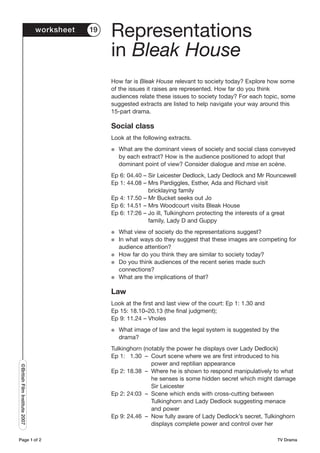
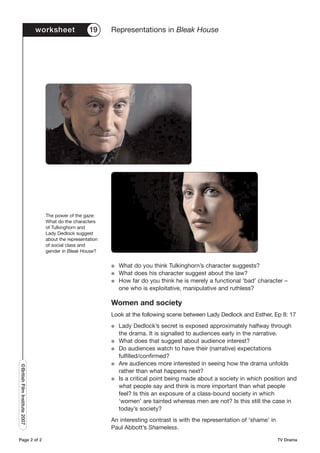
                                 The power of the gaze:
                                 What do the characters
                                 of Tulkinghorn and
                                 Lady Dedlock suggest
                                 about the representation
                                 of social class and
                                 gender in Bleak House?


                                                            G   What do you think Tulkinghorn’s character suggests?
                                                            G   What does his character suggest about the law?
                                                            G   How far do you think he is merely a functional ‘bad’ character –
                                                                one who is exploitative, manipulative and ruthless?

                                                            Women and society
                                                            Look at the following scene between Lady Dedlock and Esther, Ep 8: 17
                                                            G   Lady Dedlock’s secret is exposed approximately halfway through
                                                                the drama. It is signalled to audiences early in the narrative.
                                                            G   What does that suggest about audience interest?
                                                            G   Do audiences watch to have their (narrative) expectations
                                                                fulfilled/confirmed?
                                                            G   Are audiences more interested in seeing how the drama unfolds
©British Film Institute 2007


                                                                rather than what happens next?
                                                            G   Is a critical point being made about a society in which position and
                                                                what people say and think is more important than what people
                                                                feel? Is this an exposure of a class-bound society in which
                                                                ‘women’ are tainted whereas men are not? Is this still the case in
                                                                today’s society?
                                                            An interesting contrast is with the representation of ‘shame’ in
                                                            Paul Abbott’s Shameless.

Page 2 of 2                                                                                                                    TV Drama
worksheet   20
                                                Industry and genre

                                                Spooks provides a simple case study about the way the industry
                                                approaches genre. Use the following questions as a prompt.
                                                G   Why do you think an independent producer, like Stephen Garrett,
                                                    wanted to develop a TV drama in a different genre from crime and
                                                    hospital-based dramas?
                                                G   Why choose a ‘more modern approach to the world of
                                                    espionage’? What does this say about the espionage genre?
                                                G   Why do you think the BBC producer wanted more of an ‘intelligent
                                                    action drama’?
                                                G   How do you think Spooks would have differed if it had been
                                                    produced for Channel 4?
                                                G   How did Kudos attempt to make ‘television that would stop people
                                                    renting videos’?
                                                Look at the way the BBC has scheduled programmes in 2003/4 and
                                                2005 on Saturday nights.


                                                    November 2004
                                                     6.30 Strictly Come Dancing
                                                     7.35 National Lottery
                                                     8.15 Strictly Come Dancing
                                                     8.40 Casualty
                                                     9.30 Billy Connolly’s World Tour of New Zealand
                                                    10.10 News
                                                    10.30 Match of the Day
                                                    12.00 Film

                                                    March 2005
                                                     5.55 Strictly Dance Fever
                                                     7.00 Doctor Who
                                                     7.45 National Lottery
                                                     8.20 Casualty
                                                     9.10 Strictly Dance Fever
                                                     9.40 Out-take TV
                                                    10.10 News
                                                    10.30 Match of the Day
                                                    12.00 Film
©British Film Institute 2007


                                                G   How is the BBC trying to win back audiences from the video/DVD
                                                    rental market to television on Saturday nights?
                                                G   Why does the BBC need to do that?
                                                G   What is the role of TV drama in that competitive strategy?


Page 1 of 1                                                                                                 TV Drama
worksheet        21
                                                          Narrative resolution

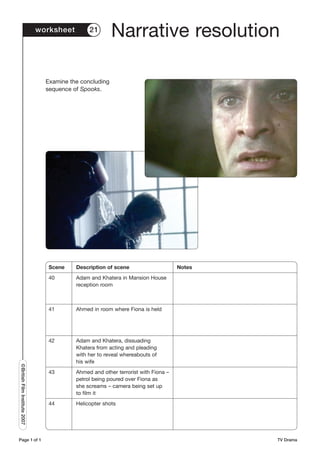
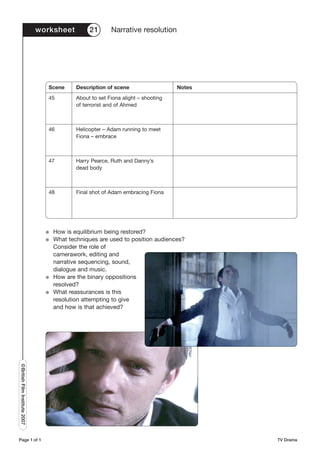
                                 Examine the concluding
                                 sequence of Spooks.


                                  Scene    Description of scene                     Notes
                                  40       Adam and Khatera in Mansion House
                                           reception room


                                  41       Ahmed in room where Fiona is held


                                  42       Adam and Khatera, dissuading
                                           Khatera from acting and pleading
                                           with her to reveal whereabouts of
                                           his wife
©British Film Institute 2007


                                  43       Ahmed and other terrorist with Fiona –
                                           petrol being poured over Fiona as
                                           she screams – camera being set up
                                           to film it
                                  44       Helicopter shots


Page 1 of 1                                                                                 TV Drama
worksheet          21       Narrative resolution


                                  Scene      Description of scene                   Notes
                                  45         About to set Fiona alight – shooting
                                             of terrorist and of Ahmed


                                  46         Helicopter – Adam running to meet
                                             Fiona – embrace


                                  47         Harry Pearce, Ruth and Danny’s
                                             dead body


                                  48         Final shot of Adam embracing Fiona


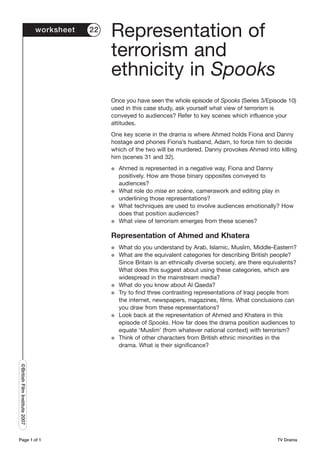
                                 G   How is equilibrium being restored?
                                 G   What techniques are used to position audiences?
                                     Consider the role of
                                     camerawork, editing and
                                     narrative sequencing, sound,
                                     dialogue and music.
                                 G   How are the binary oppositions
                                     resolved?
                                 G   What reassurances is this
                                     resolution attempting to give
                                     and how is that achieved?
©British Film Institute 2007


Page 1 of 1                                                                                 TV Drama
worksheet   22
                                                Representation of
                                                terrorism and
                                                ethnicity in Spooks
                                                Once you have seen the whole episode of Spooks (Series 3/Episode 10)
                                                used in this case study, ask yourself what view of terrorism is
                                                conveyed to audiences? Refer to key scenes which influence your
                                                attitudes.
                                                One key scene in the drama is where Ahmed holds Fiona and Danny
                                                hostage and phones Fiona’s husband, Adam, to force him to decide
                                                which of the two will be murdered. Danny provokes Ahmed into killing
                                                him (scenes 31 and 32).
                                                G   Ahmed is represented in a negative way, Fiona and Danny
                                                    positively. How are those binary opposites conveyed to
                                                    audiences?
                                                G   What role do mise en scène, camerawork and editing play in
                                                    underlining those representations?
                                                G   What techniques are used to involve audiences emotionally? How
                                                    does that position audiences?
                                                G   What view of terrorism emerges from these scenes?

                                                Representation of Ahmed and Khatera
                                                G   What do you understand by Arab, Islamic, Muslim, Middle-Eastern?
                                                G   What are the equivalent categories for describing British people?
                                                    Since Britain is an ethnically diverse society, are there equivalents?
                                                    What does this suggest about using these categories, which are
                                                    widespread in the mainstream media?
                                                G   What do you know about Al Qaeda?
                                                G   Try to find three contrasting representations of Iraqi people from
                                                    the internet, newspapers, magazines, films. What conclusions can
                                                    you draw from these representations?
                                                G   Look back at the representation of Ahmed and Khatera in this
                                                    episode of Spooks. How far does the drama position audiences to
                                                    equate ‘Muslim’ (from whatever national context) with terrorism?
                                                G   Think of other characters from British ethnic minorities in the
                                                    drama. What is their significance?
©British Film Institute 2007


Page 1 of 1                                                                                                       TV Drama
worksheet   23
                                                Doctor Who and
                                                fans: Doing your
                                                own survey
                                                Different audiences respond to TV dramas in different ways. Very
                                                often it is a question of emphasis. Using a focus group, when
                                                extracts are shown to a group of fans or enthusiasts, is a good way
                                                of exploring how different audiences respond to dramas. Below are
                                                some suggested episodes and/or extracts, with ideas about the kinds
                                                of questions to ask (based on the issues raised in Case Study 4). Aim
                                                to construct your own focus-group questions.

                                                Role of CGI effects
                                                Doctor Who and ‘The End of the World’ sequence (Series 1/Episode 2)
                                                G   What do you think of this as the concluding sequence of an
                                                    episode?
                                                G   What do you think of the special effects?
                                                G   Are they deliberately intended to be ‘realistic’ special effects?
                                                G   How do you think audiences respond to the special effects in the
                                                    drama?

                                                Tone
                                                Look at the opening of ‘Bad Wolf’ (Series 1/Episode 12), with its
                                                parodies of Big Brother, The Weakest Link and Trinny and Susanna.
                                                G   What is being parodied here?
                                                G   Are there any serious issues underlining this send-up – about
                                                    media ownership or audiences, for example?
                                                G   How seriously do audiences take these issues?
©British Film Institute 2007


Page 1 of 2                                                                                                    TV Drama
worksheet   23   Doctor Who and fans: Doing your own survey


                                                Characters and power
                                                Watch the end of Series 1/Episode 1, where Rose is deciding whether
                                                or not to join the Doctor.
                                                G   Why does Rose decide to join the Doctor?
                                                G   Do audiences see any particular significance in her decision to join
                                                    the Doctor?

                                                Look at key moments from ‘The Long Game’ (Series 1/Episode 7),
                                                where Cathica is being persuaded by the Doctor and Rose to rebel.
                                                G   What is the significance of the decisions Cathica makes?
                                                G   Do you think it is significant that Cathica is female?
                                                G   What is meant by the term ‘empowering’? How might ideas about
                                                    ‘empowerment’, putting people in the position to help themselves,
                                                    relate to these representations of characters?
                                                G   Do you think these are familiar ideas to audiences today? How
                                                    does that knowledge affect reactions to the representation of
                                                    these female characters?

                                                Look at the role of Doctor Who in ‘The Unquiet Dead’ (Series 1/
                                                Episode 3)
                                                G   How is he represented and why?

                                                Different audiences, different responses?
                                                G   Do you think children, young people, parents, students, fans
                                                    respond differently to Doctor Who?
                                                G   If possible, use the same extracts as above and carry out an
                                                    interview with at least two contrasting kinds of audience.
©British Film Institute 2007


Page 2 of 2                                                                                                     TV Drama
worksheet   24
                                                Representation
                                                of Rose
                                                As Rose appeared in every episode of Doctor Who (in 2005 and
                                                2006), studying her is a good way of exploring how women are
                                                currently represented in the media. The issues surrounding this
                                                representation remain open to debate. (For example, does sexuality
                                                still shape women's identity? Are they in control or exploited?).
                                                Choose what you consider to be key moments featuring Rose.
                                                Suggested extracts are listed below.
                                                Conclusion of Series 1/Episode 1
                                                Rose’s exchange with Gwyneth (‘The Unquiet Dead’, Series 1/
                                                Episode 3)
                                                Rose finding out about her father (‘Father’s Day’, Series 1/Episode 8)
                                                The way Rose and the Doctor act (choose any episode)
                                                G   What for you are typical representations of women today?
                                                    Give three contrasting examples.
                                                G   What do the examples suggest about women’s sexuality and
                                                    power?
                                                G   Do you agree that women today are often portrayed as ‘sexual
                                                    subjects’, in control of their sexuality, rather than the ‘sexual
                                                    objects’ of men’s desires and fantasies?
                                                G   What image of young women is being conveyed in these
                                                    sequences?
                                                G   Is Rose portrayed primarily in terms of sexuality? Suggest three
                                                    other representations of women you think are similar to Rose.
                                                G   Do you think different audiences (eg, female and male) react in the
                                                    same way to the representation of her character?
©British Film Institute 2007


Page 1 of 1                                                                                                     TV Drama
worksheet   25
                                                Title sequences:
                                                Shameless and
                                                Six Feet Under
                                                Title sequences are designed to attract (target?) audiences, set the
                                                tone and establish a brand image for TV dramas. They are generally
                                                produced by specialist companies (like Digital Kitchen who produced
                                                Six Feet Under’s title sequence). Studying title sequences is therefore
                                                a good way to explore dramas. Shameless and Six Feet Under are in
                                                varying degrees alternative and unconventional. You would expect
                                                that image to be established by the title sequences.
                                                G   What features of the title sequences for Shameless and Six Feet
                                                    Under create their alternative image (think about camerawork,
                                                    editing, images, music/sound)?
                                                G   Play each title sequence with sound only. How does the
                                                    soundtrack set up expectations of an alternative drama?
                                                G   Play each title sequence without sound. What are the connotations
                                                    of the images?
                                                G   Shameless: How does Frank’s voiceover anchor, and thus position,
                                                    audiences? (Take the example of the burning of the car at the
                                                    close of the sequence, for example.)
                                                G   Six Feet Under: Do you think the images of the title sequence
                                                    create a narrative? What is being suggested by that ‘narrative’?
                                                G   Alan Poul, one of the producers of Six Feet Under, says of the title
                                                    sequence that it sets the tone for the drama and establishes a
                                                    ‘brand image’. What is the importance of a brand image for TV
                                                    dramas?
©British Film Institute 2007


Page 1 of 1                                                                                                     TV Drama
worksheet              26
                                                           Representation
                                                           of gay sexuality
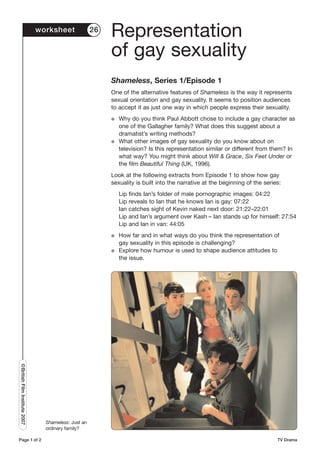
                                                           Shameless, Series 1/Episode 1
                                                           One of the alternative features of Shameless is the way it represents
                                                           sexual orientation and gay sexuality. It seems to position audiences
                                                           to accept it as just one way in which people express their sexuality.
                                                           G   Why do you think Paul Abbott chose to include a gay character as
                                                               one of the Gallagher family? What does this suggest about a
                                                               dramatist’s writing methods?
                                                           G   What other images of gay sexuality do you know about on
                                                               television? Is this representation similar or different from them? In
                                                               what way? You might think about Will & Grace, Six Feet Under or
                                                               the film Beautiful Thing (UK, 1996).
                                                           Look at the following extracts from Episode 1 to show how gay
                                                           sexuality is built into the narrative at the beginning of the series:
                                                               Lip finds Ian’s folder of male pornographic images: 04:22
                                                               Lip reveals to Ian that he knows Ian is gay: 07:22
                                                               Ian catches sight of Kevin naked next door: 21:22–22:01
                                                               Lip and Ian’s argument over Kash – Ian stands up for himself: 27:54
                                                               Lip and Ian in van: 44:05
                                                           G   How far and in what ways do you think the representation of
                                                               gay sexuality in this episode is challenging?
                                                           G   Explore how humour is used to shape audience attitudes to
                                                               the issue.
©British Film Institute 2007


                                 Shameless: Just an
                                 ordinary family?

Page 1 of 2                                                                                                                   TV Drama
worksheet             26      Representation of gay sexuality


                                                             Six Feet Under, Series 1
                                                             Look at some (or all) of the following sequences from different
                                                             episodes of Series 1:
                                                                 Episode 2: 3:40–5:10 (David’s fantasy about waking up with Keith
                                                                 and being quizzed by his dead father)
                                                                 Episode 10: 54:59–55:08 (where Angela comments that she has
                                                                 never known anyone so hung up about being gay)
                                                                 Episode 12 which features several revealing scenes raising issues
                                                                 about gay sexuality:
                                                                    1:40–3:10 (the homophobic murder which opens the episode)
                                                                    17:25–18:55 (fantasy sequence – conflict between David’s gay
                                                                   sexuality and his religious beliefs)
                                                                    37:22–40:07 (Rico’s homophobic reactions to David)
                                                                    46:20–49:37 (funeral with anti-homosexual demonstrations)
                                                                 Episode 13: 46:20–48:35 (David’s reading in church, a coded
                                                                 ‘coming out’)
                                                             G   How is gay sexuality represented in each extract?
                                                             G   How does this representation compare and contrast with other
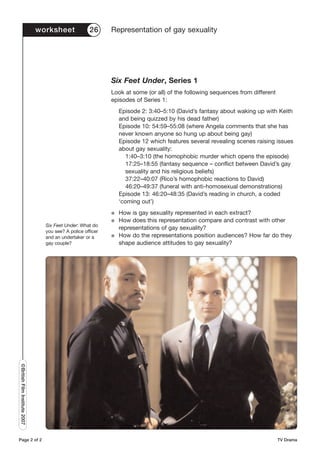
                                 Six Feet Under: What do
                                                                 representations of gay sexuality?
                                 you see? A police officer
                                 and an undertaker or a      G   How do the representations position audiences? How far do they
                                 gay couple?                     shape audience attitudes to gay sexuality?
©British Film Institute 2007


Page 2 of 2                                                                                                                    TV Drama
worksheet   27
                                                Challenging
                                                alternatives?
                                                Shameless builds a broad range of challenging issues into its
                                                narratives (family, community and social class are all represented in
                                                surprising and challenging ways). The narratives of each episode are
                                                structured to position audiences to accept alternative points of view
                                                about the issues. Six Feet Under uses fantasy sequences to explore
                                                the psychological reasons why characters are repressed. This has the
                                                effect of taking audiences with the characters to accept what might
                                                be considered alternative or challenging points of view. In different
                                                ways, therefore, both dramas position audiences to accept
                                                challenging points of view.

                                                Shameless
                                                Explore how family and community are represented in any episode.
                                                (Series 3/Episodes 1 and 4, or the 2004 Christmas Special episode
                                                are particularly good examples.)
                                                G   How does the narrative structure position audiences?
                                                G   Why do you think Paul Abbott and the other writers in the series
                                                    continually position audiences to suspend conventional moral
                                                    codes and accept the way of life of people on the Chatsworth
                                                    estate?
                                                G   How alternative and challenging do you think Shameless is? Why?
                                                G   Compare the representation of social class and community in
                                                    Shameless with dramas like Coronation Street, The Simpsons and
                                                    Life Begins.

                                                Six Feet Under and its fantasy sequences
                                                Choose three contrasting examples of the many fantasy sequences
                                                which are integral to the narrative structure of Six Feet Under. Here
                                                are some examples:
                                                    Nate: Series 1/Episode 1, 24:00–25:40
                                                    David’s fantasy sequences: Series 1/Episodes 10, 12 and 13
                                                    Ruth: Series 1/Episode 9: 40:10–40:47 and 42:56–46:24
                                                G   How experimental do you think the incorporation of these
                                                    sequences into the narrative of a TV drama is?
                                                G   To what extent do these fantasy sequences use surreal and
                                                    dream-like features? Why?
©British Film Institute 2007


                                                G   What do each of the sequences suggest about the characters?
                                                G   Are audiences being positioned to accept what each character is
                                                    trying to come to terms with?


Page 1 of 1                                                                                                     TV Drama

TV drama worksheets

  • 1.
    SERIES TEACHING FILM AND MEDIA STUDIES Teaching TV Drama Jeremy Points British Film Institute Series Editor: Vivienne Clark
  • 2.
    worksheet 1 Thinking about genre Genre means a ‘kind’ or ‘type’ and is a way of categorising films and TV programmes. Before you start studying TV drama, a broad television genre, you need to think about the role genre plays in broadcasters’ and television producers’ thinking as well as in audiences’ viewing. This will help put into context your detailed work on the TV drama genre. Your television viewing G What are some of your favourite TV programmes? G Why do you like them? G Are you aware that you are looking at a programme in a particular genre? Look at extracts from at least three contrasting television genres. You might try watching one without sound and one with sound only. G Can you identify the genre you are watching/ listening to? G What features enable you to identify the genre? Look at examples of programmes and TV dramas which combine elements of different genres – called hybrids. Examples include Big Brother, The Sopranos, Extras, Doctor Who, Sea of Souls. G Which elements of different genres can you identify in each programme? G Why do you think programmes like these are produced? G How would you label programmes like these? G How do broadcasters label them? ©British Film Institute 2007 What makes HBO’s The Sopranos a hybrid, and why? Page 1 of 2 TV Drama
  • 3.
    worksheet 1 Thinking about genre G Do you think that broadcasters and producers consider the different programmes they produce in terms of genre? G How far are the generic features of a programme part of audiences’ viewing experience? In what ways? G In what ways do you think a programme’s genre affects the kind of programme which is produced? Audiences’ ability to recognise the genre of a programme almost instantly means that they have assimilated the ingredients (‘conventions’ – see Worksheet 2) of a genre without realising it. As you study TV drama, you should think about how far the genre affects the nature of the drama. ©British Film Institute 2007 Page 2 of 2 TV Drama
  • 4.
    worksheet 2 What is TV drama? TV drama is a broad genre. At its simplest, it is fictionalised action in narrative form. It is important to gain some basic understanding of how and why TV drama splits into the different types broadcast today. G List as many examples of TV drama as you can. (Use a website, like the BBC’s, or a listings magazine to prompt you.) G Find examples of TV dramas which appear to be both a TV drama and something else, eg, a TV drama and a crime series like Prime Suspect. What is the reason for this kind of combination? G Name as many different kinds of TV drama as you can. What you have been doing is uncovering the various subgenres (genres within genres) of TV drama. G Genre means ‘kind’ or ‘type’. (Think of the way biologists refer to ‘genus’ to describe a type of plant or animal species.) G A television genre thus refers to programmes which can be categorised by the things they have in common – the conventions of a genre. G Many genres break down into subgenres. Crime drama is a TV drama which has become a genre in its own right. G TV drama has given rise to a number of subgenres. What started out as drama on television, single plays, quickly gave rise to different kinds of drama: costume dramas, children’s classic dramas, soap operas, crime dramas, hospital dramas, sci-fi dramas and historical adventures. This took place in the 1950s as the BBC was evolving and ITV first began broadcasting. Why do you think this happened? Why are there still so many different kinds of TV drama? (See the Is Prime Suspect a TV drama or a crime drama or both? What is the significance of these differnt ways of Timeline for further clues and examples ©British Film Institute 2007 categorising TV drama? of the first ‘subgenres’.) Page 1 of 1 TV Drama
  • 5.
    worksheet 3 TV drama conventions 1 The conventions of a genre are the ingredients which all examples of a genre share. They act a little like rules – not necessarily rigid rules but rules you need to follow in order to create something which audiences will recognise as part of a particular genre. Like other conventions – governing speech and behaviour, for example – audiences seem to assimilate the conventions of genres unconsciously. Establishing the conventions of TV drama Choose three or four contrasting TV dramas and look at short extracts from them. Here are some suggestions: a single drama like Yasmin, a crime or medical series like The Shield or Green Wing, a US drama series like 24 (2001), Lost or Desperate Housewives, a drama serial like the classic literary adaptation Bleak House (2005), a sensational drama like Footballers’ Wives or a teen drama like The OC. ©British Film Institute 2007 What is different about the drama series 24? Did it establish a new trend? Page 1 of 2 TV Drama
  • 6.
    worksheet 3 TV drama conventions 1 What do they have in common? You will find that TV dramas all have the following ingredients: G Characters – even particular kinds of characters: eg, at its most simple, ‘good’ and ‘bad’ characters. G Stories – they all tell stories, whether those stories involve adventure, crime or romance and they often, but not always, end happily. G The stories are told against familiar backdrops: – eg, homes, police stations and offices (for crime dramas), hospitals (for medical dramas) – most of which are created in studios. However, most dramas also use outside locations to create particular effects. G Camerawork – particular kinds of shots are used: eg, sequences involving establishing shots followed by mid-shots of characters, shot/reverse shots to show character interaction and, in particular, close-ups to show the characters’ emotions. G Stories use dialogue to tell the stories. Occasionally, monologues are built in (as voiceovers, a character telling a story). G Music is used to punctuate the action, create effects (suspense, tension) and underline emotional moments. G Particular subgenres tend to have items which make them immediately identifiable – police cars, blue lights, operating theatres and scalpels, triage/reception areas in hospitals. Icons of the genre, they symbolise the (sub)genre. ©British Film Institute 2007 Page 2 of 2 TV Drama
  • 7.
    worksheet 4 TV drama conventions 2 The conventions of TV drama revolve around: G Characters. G Narrative – both its overall structure and how it is constructed. G Sets and settings – locations against which the story unfolds and which frequently take on a symbolic significance. G Camerawork – particular kinds of camerawork are often associated with particular subgenres. G Dialogue, sound and music – sound and music create effects and often underline emotional content. G Icons – these tend to be associated with particular subgenres. Watching extracts from a selection of TV dramas, fill in the attached table. The key issue to identify is how these basic conventions are used in Six Feet Under: Character – a key the TV dramas you are studying. In several extracts, institutional and concept of TV drama audience issues will be raised. Aim to note these as well. ©British Film Institute 2007 Page 1 of 2 TV Drama
  • 8.
    worksheet 4 TV drama conventions 2 Name of drama Broadcaster/ scheduling details Writer/director/producer Conventions Characters Narrative Mise en scène (particularly locations, sets, lighting and costume) Sound: key dialogue, sound effects, music Icons Industry G Production, broadcast channel, scheduling, sponsorship, marketing and promotion, other available platforms etc. G Do you think any of the elements you have listed have shaped the drama? Audiences ©British Film Institute 2007 G Main target audience, male/female, different ways different audiences might respond to the drama, encouraging fandom etc. G Do you think the drama will shape audiences’ points of view about people, issues or events? Page 2 of 2 TV Drama
  • 9.
    worksheet 5 Working with characters Characters (and the narratives which flow from them) are at the centre of audiences’ enthusiasm for TV drama. They are also key to influencing audiences, how they think of people and groups of people, or particular issues. It is therefore important to ask how audiences relate to characters in a drama. Look at extracts from three or four contrasting dramas like Charmed, Pride and Prejudice, Footballers’ Wives or House. G What kinds of characters appear in the dramas? Are there similarities between characters in different dramas? G Do you respond emotionally to some characters? In what ways and why? G What do you understand by ‘identifying’ with a character? G Do you think all audiences respond in the same way to characters? G Are the producers, writers and/or directors of dramas trying to get you to respond in a particular way to characters? How? You have probably already realised that many TV drama narratives feature characters who are the opposite of one another, and that they are frequently set up in conflict. The most obvious conflict is between the good and bad characters. This simple idea appears to underlie many narratives and is generally described as ‘binary opposition’, after the French writer Claude Lévi-Strauss (who used it in his explorations of myths). Look at extracts from two or three dramas to explore how these character oppositions work. Again, choose contrasting dramas like Buffy the Vampire Slayer, Desperate Housewives, Blackpool or Spooks. Identify the good and bad characters. G How do you know which is which? G Are we as audiences being encouraged to sympathise with the good characters and be antagonistic to the bad? G How is this process underlined by editing and camerawork, mise en scène (like locations, settings, lighting and costume)? G Do the good characters succeed and the bad fail? Why is this? What effect does this have on audiences? ©British Film Institute 2007 Page 1 of 1 TV Drama
  • 10.
    worksheet 6 TV drama conventions 3 In order for television producers to keep audiences interested, they frequently make slight variations on the standard conventions of the genre. This is often noticeable in the way mise en scène, camerawork and sound/music is used. These elements are also used to underline issues raised by the drama. Mise en scène Choose extracts from three contrasting dramas such as Lost, Doctor Who, Funland, Rebus and Tipping the Velvet. The opening of an episode is frequently revealing. G What are the connotations of the mise en scène? G Does the mise en scène underline any particular issues which the drama might be raising? Choose dramas which you consider are slightly unconventional examples of a particular TV drama subgenre (like medical dramas). In what ways is the mise en scène different from the conventional kind of mise en scène used in that subgenre. Here is an example based on medical dramas. Conventional mise en scène? Casualty, Holby City and ER G Do you think these dramas have a conventional mise en scène? What makes it conventional? Unconventional mise en scène? Bodies and House G How far is the mise en scène in Bodies and House unconventional? Give reasons for any variations on the conventional. Camerawork Explore the way camerawork is used in three contrasting dramas. Some innovative examples from the 1990s are: NYPD Blue, This Life and Cops. Interesting contemporary examples include: Messiah 4, Ghost Squad, Bleak House and 24. G What kinds of camerawork are used and why? Sound and music Sound and music have taken an increasingly prominent role in TV ©British Film Institute 2007 drama, although they have always been significant. The most obvious role sound plays – in particular, but not exclusively, music – is in underlining emotional response and thus positioning audiences. In exploring this, play scenes without sound to highlight what you think sound will contribute and play sound without vision to explore what the sound suggests. Page 1 of 2 TV Drama
  • 11.
    worksheet 6 TV drama conventions 3 For example (in key dramas from the past): G What role does the non-diegetic sound play at the end of a typical ER episode? G What role does the title music play inthe 2005 US drama Rome? G What kind of soundtrack is used in the different CSI series? Take one example and explore how and why it is used. G At the moment when Darcy and Elizabeth first exchange glances of love in Episode 5 of Andrew Davies’s Pride and Prejudice, the volume of the non-diegetic music increases. This is a common technique to position audiences and is frequently used in romantic dramas. Look for your own examples. G In a classic drama from 1982, ‘Yosser’s Story’ from Alan Bleasdale’s Boys from the Blackstuff, a repeated harpsichord phrase is used throughout the drama to underline Yosser’s psychological isolation and imbalance. Look for another example of where music underlines a psychological effect. Music is sometimes used in an ironic way to counterpoint the action. Martin Scorsese exploits music ironically in many of his films. In Six Feet Under, Series 1/Episode 2, a character dies following a diving accident in his own swimming pool (accompanied by Dean Martin’s ‘Ain’t That a Kick in the Head’.) G Explore how sound and/or music is used ironically in drama. Good examples can be found in the opening of the recent adaptation of Much Ado about Nothing, Blackpool, Doctor Who or (from the past) Dennis Potter’s The Singing Detective and David Lynch’s Twin Peaks. ©British Film Institute 2007 Page 2 of 2 TV Drama
  • 12.
    worksheet 7 Genre – Open to change Genre variations Genres are always open to change. G Producers aim to vary the standard conventions to maintain audience interest without departing from them so much that they alienate audiences. G Audiences do not want slavish imitations but subtle variations on the expected. They are attracted to the slight variation but gain pleasure from the genre’s expectations being fulfilled. Explore variations in the crime genre. Look, for example, at the different kinds of investigators in crime dramas. Find out about the ones you are unfamiliar with. Extracts from several are available on www.screenonline.co.uk. For example: Dixon of Dock Green, Z Cars, The Sweeney, Cagney and Lacey, Starsky and Hutch, Hill Street Blues, NYPD Blue, Homicide, Cracker, Prime Suspect, Linda Lee, Murder in Suburbia, CSI, Silent Witness, Waking the Dead, New Tricks, Ghost Squad, Murphy’s Law. G Name other variations used in crime drama. Consider, for example, narrative and mise en scène. Hybrids Another way of varying and extending a genre is by creating hybrids. It may be that hybrids are not a new phenomenon, as is sometimes claimed, but something broadcasters and film producers have always employed. G In what ways do you think the following dramas are hybrids? List the genres which are blended to create the hybrid. The Singing Detective Blackpool Sea of Souls Murder Prevention Buffy the Vampire Slayer Charmed Doctor Who Footballers’ Wives ©British Film Institute 2007 Mayo G Why do you think broadcasting organisations commission and produce hybrid dramas? G Do audiences see these dramas as hybrids? Do you think audiences gain more pleasure from viewing hybrid genres? Page 1 of 1 TV Drama
  • 13.
    worksheet 8 Challenging dramas At its simplest, an ideology is the way people think and feel – the views and attitudes people hold which influence the way they see the world. Questioning the way the majority of people think at any one time is therefore challenging a dominant ideology. Most TV dramas either reinforce dominant ideologies (encouraging people to think like the majority) or challenge them. G Do you think it is important for TV dramas to make people think about contemporary social and cultural issues like gender, ethnic differences, sex trafficking, unemployment or social class? G How do TV dramas raise these issues? G What do you understand by ‘challenging the dominant ideology’? G In what ways, if at all, do you think any three of the following challenge dominant ideologies? Queer as Folk and Six Feet Under (sexual orientation) Footballers’ Wives (gender, sexual orientation, ethnic difference) Yasmin (ethnic difference) Sex Traffic (prostitution and sex trafficking) Boys from the Blackstuff (unemployment) The Sopranos (gender and masculinity in particular) Shameless (social class, gender, sexual orientation, families and communities) ©British Film Institute 2007 Yasmin: a challenging drama raising important issues about muslim people in Britian today, or just white-oriented stereotyping? Page 1 of 1 TV Drama
  • 14.
    worksheet 9 Narrative construction Television narratives are created by placing images next to one another. The nature of the narrative – what it suggests to audiences – is affected by editing, camerawork and mise en scène. Select any short sequence from a TV drama to explore this. Here is an example from Lost, Series 1/Episode 4: Constructing a narrative shot by shot: Lost, Series 1/Episode 4 10:33–11:36 Denotation: What is the story (in one sentence)? Connotation: What does the story suggest? What is suggested by: Camerawork Mise en scène (setting/location, lighting and costume) Editing? ©British Film Institute 2007 Lost: Series 1, Episode 4: 10.33–11.36: a story of two cultures ... Page 1 of 2 TV Drama
  • 15.
    worksheet 9 Narrative construction Conventions of a complete narrative Here is the start of a simple narrative: a couple wake up and go downstairs to breakfast. They do not realise that they are being watched by terrorists. G What happens next? Create a narrative in no more than five sentences. G Which standard narrative conventions have you used? You might have come up with the following narrative conventions: G Beginning, middle and ending; G Characters – some good, some bad; G Probably a happy ending. Why do most stories end happily? Look at approximately the first five minutes of Series 3/Episode 10 of Spooks (which starts as outlined above). Which conventions are used? Prompts G This feels like the beginning of a narrative. Why? G What starts as an ordinary, everyday morning, is suddenly threatened – a standard way of beginning a narrative. Why? G Audience involvement through the danger that is set up. We are automatically being encouraged to take sides. Binary opposition? G Are any other binary oppositions established? Exploring narrative structures What are the different narrative structures associated with the following TV drama forms? Do they conform to Todorov’s and Lévi- Strauss’s outlines of narrative structures, which both have a fundamentally ideological significance? G Single drama/film: Yasmin; G Two-nighter: Sex Traffic; G Soap (continuing drama): EastEnders; G Serial: Bleak House; G Anthology series (self-contained episodes, each based on different characters): The Street; G Long-form series drama: Lost; G Long-form series drama with some narrative experimentation: 24. ©British Film Institute 2007 Explore the beginnings and the conclusions of episodes from these dramas. What can you say about their narrative structure? G ER G West Wing G Clocking Off G State of Play Page 2 of 2 TV Drama
  • 16.
    worksheet 10 The conventions of realism Dramas do not provide windows on reality, but offer audiences versions of reality using codes and conventions designed to convince them of this. Realism is constructed and is essentially an effect. To explore this, choose two contrasting hospital-based medical dramas (like ER, House and Bodies). How do they convey the sense of the reality of a hospital? Think about the following: G What kinds of characters appear and what are they wearing? G What is the narrative about? How is it constructed? G What are the most significant features of the mise en scène? G What kind of camerawork is used? G Do you notice anything particular about the editing? G What sort of dialogue is used (any dialogue that you particularly associate with hospitals)? G What other sound is used? Ambient (natural) ©British Film Institute 2007 sound? Music? Effects of any kind? House: A stage managed, promotional pose. How far are all dramas constructed? Page 1 of 2 TV Drama
  • 17.
    worksheet 10 The conventions of realism ER: Creating the effect of reality? For what reasons? ER’s hard-wall, closed-ceiling emergency room sets [as opposed to traditional open-ceiling and three-wall stage sets to allow for cameras and lighting] … add another intrinsic element to the show’s realism … It is much harder to move around on these stages because of the ceilings that don’t move but that’s what makes you feel like you are really in the ER. The sets provide more interesting possibilities for us to choreograph scenes the way we do. We can shoot low and aim the camera up and see the great ceilings and architecture or wind around the multilayered hallways. You feel a sense of reality and immediacy ... I think it’s a very subconscious thing, but I think it’s one of the keys to the show. Director, Mimi Leder, quoted in Pourroy, 1996, pp 33–4 ©British Film Institute 2007 What does this extract tell you about the role of mise en scène and camerawork in creating the effect of the real? Page 2 of 2 TV Drama
  • 18.
    worksheet 11 Different kinds of realism There are different ways to create a sense of reality. The codes of realism vary in different kinds of drama. Perhaps we should talk of ‘realisms’ rather than realism. Realism perhaps reflects points of view about ‘reality’ – sometimes the producers’ and sometimes audiences’. Choose three contrasting dramas which use different kinds of camerawork and editing to attract different audiences, such as Grey’s Anatomy (2005), Bodies (2003–6) and Casualty. Each conveys a sense of reality but in a different way. G Which different codes of realism are used in each drama? G Do you think that Grey’s Anatomy shows hospitals from a younger person’s point of view, while Casualty adopts a slightly more mature perspective? Why is that? G Do you think that Bodies shows a particular point of view about the ‘reality’ of hospitals in Britain today? Whose point of view is that? … The edge of television realism Research several classic, and to some extent, experimental TV dramas from the past like Alan Clarke’s Carousel, Dennis Potter’s The Singing Detective or David Lynch’s Twin Peaks. G How far and in what way do you think each of these dramas uses the codes and conventions of realism? Do they convey a ‘sense of the real’? G In what ways do they ‘stretch’ the conventions of realism? And why? … Exploring with your own experimental narratives Take a scene from any drama you know. ©British Film Institute 2007 G What have the director, director of photography and writer done in order to create a sense of the real? G Storyboard the scene as an alternative drama that stretches the conventions of realism. G Why do you think realism dominates An iconic image from David Lynch’s surreal Twin Peaks. television today? Page 1 of 1 TV Drama
  • 19.
    worksheet 12 Contemporary representations of gender It is often claimed that women are represented as ‘sexual subjects’ rather than ‘sexual objects’ and that men are no longer represented in terms of power and force. The way gender is represented in the media seems to affect all audiences – it shapes people’s sense of themselves. Choose contrasting TV dramas and explore how women and men are represented. How are women and men represented in the following: Desperate Housewives or Footballers’ Wives Wire in the Blood or Ultimate Force Green Wing or Extras Doctor Who The OC or Totally Frank Desperate Housewives: Sexual subjects or G Do you think all audiences will respond in the same way to the sexual objects? representations? G What role does camerawork, lighting, editing and costume in particular play in underlining these representations? G How typical do you think that these representations are of (a) TV drama in general and (b) other forms of media you experience? Take one female and one male character from a TV drama who is represented in what, for you, are typical ways. Play the following roles: G As broadcaster: Justify why these characters should be in your TV drama and why this particular sequence/storyline should be included? If you had to change it, how would you do that? G As writer: Take a female character represented mainly in terms of sexuality and a male character represented as insensitive, self-oriented and potentially violent. Create an alternative character for your drama and the storyline she/he will be involved in. How do ©British Film Institute 2007 they challenge dominant representations? Why challenge dominant representations of gender? Page 1 of 1 TV Drama
  • 20.
    worksheet 13 Positioning audiences Dramas tend to encourage the majority of their viewers to take up a particular point of view to the characters and issues. This process is called ‘positioning’. Storyboard an alternative opening sequence to Spooks which just focuses on Fiona and Adam. In ten shots, try to encourage the Characters and binary audience to do one of the following: oppositions: How are audiences positioned to G Like both Fiona and Adam identify with Fiona and G Like Fiona and not Adam Adam and be G Like Adam and not Fiona antagonistic to Ahmed? G Dislike both Fiona and Adam Concentrate on how you will achieve this in visual terms, using minimal dialogue. G What kind of setting/location will you use? G What do the characters wear? G What lighting is used? G Will you use any particular camerawork? G What will be the key features of the editing? In what order do the shots come? What length of shot will you use? This exercise demonstrates how mise en scène, camerawork and editing, and their role in narrative construction, can position audiences. Looking back on your own sequence, explain what would be an ‘oppositional’ and ‘negotiated’ interpretation of it. Give reasons for those interpretations. Reading/reasons why audiences might interpret the sequences in this way Oppositional Negotiated ©British Film Institute 2007 Page 1 of 1 TV Drama
  • 21.
    worksheet 14 TV drama – Its role for broadcasters It is important to ask what role TV drama plays for broadcasters. Is it still a flagship genre? Does it still anchor terrestrial schedules? With more and more platforms for viewing TV drama becoming available, are we moving from ‘broadcasting’ to ‘narrowcasting’? What role is TV drama playing in that possible shift? Do all these industry issues affect the nature and kinds of TV drama audiences see? What do the following reveal about the importance of TV drama for terrestrial broadcasters in Britain? G BBC trailers like ‘The One for Drama’ (now ‘The One to Watch’) G Promotion of autumn schedules G Radio Times marketing G Sponsorship on ITV – Sainsbury’s and Leerdammer Look at the websites for each of the major terrestrial broadcasters. G How do the different broadcasters use their websites to market TV drama? G What differences are there between the major terrestrial broadcasters? G What does each website reveal about the significance of TV drama for terrestrial broadcasters? Choose three contrasting channels. G How far does TV drama contribute to the identity and brand image of each of the major broadcasters and their channels? Read the following extracts from an Observer article, 25 November 2005: G On the BBC and TV drama ‘… the sparkling array of new work on BBC1 coincides with the corporation’s charter renewal. Having Poliakoff alongside Shakespeare Retold and Bleak House on your flagship channel ticks that ‘public service’ box rather better than Groundforce.’ G On family drama: the Doctor Who effect ‘[Doctor Who showed that] drama can trump both light entertainment and reality pap in the ratings …’ ©British Film Institute 2007 ITV are going to compete with Doctor Who. They have commissioned a sci-fi drama Primaeval. Dan Chambers: ‘Reality TV probably peaked last year and what will fill the gap is drama.’ G What do these comments suggest about the significance of TV drama to broadcasters? Page 1 of 2 TV Drama
  • 22.
    worksheet 14 TV drama – Its role for broadcasters Websites Explore the homepages from the BBC’s websites for Spooks and Doctor Who. What do you think they are aiming to achieve? Consider, for example: G The design of the homepage (image and typography) and its connotations; G BBC logos; G The links (including to other programmes); G The language used; G The purposes of ‘Your reviews’ and the ‘Messageboard’; G Other ways, such as games and screensavers, in which audiences are encouraged to get involved, interactively or otherwise. The homepage puts across three basic points: G It is likely to appeal to a younger, internet-oriented audience; G It is encouraging audiences – particularly younger audiences - to become more actively involved and develop into (loyal) fans; G It is therefore promoting the BBC, hoping to provide a more dynamic image, which would appeal to younger audiences, who might be tempted to feel that they are part of it (and prepared, therefore, to pay a licence fee). ©British Film Institute 2007 Broadcasters’ websites involving audiences or indirect promotion? Page 2 of 2 TV Drama
  • 23.
    worksheet 15 Programme supply and digital rights Downloading, on-demand viewing and podcasting Read the following extracts from Emily Bell’s article for the Media Guardian, 9 January 2006. It deals with just one aspect of the way television viewing is changing. What are some of the other ways in which viewers will be able to watch TV drama in future? … Microsoft and Sky [have] agree[d] last week This is a model which has emerged after major to a historic union which will allow viewers to interventions in the programme supply market download Sky programmes on to their PCs. to correct the power of broadcasters over The scary union of Bill Gates and Rupert teeny independents. Now these independents Murdoch … is just the latest reflection of how have made millions out of stock market floats broadcasters are increasingly making their and broadcasters are wondering where their programmes available over platforms other next centime is coming from, the picture looks than television. Whilst in many parts of the slightly different. Indeed, the fight between country many still struggle to get a clear signal broadcasters and independents over what for Five, the industry is charging ahead with a happens to rights is not a dead issue but the future which involves receiving your audio- most pressing concern in the industry today. visual entertainment through a number of Lucky Ofcom, the regulator, is producing its household devices. The strong rumours are own thoughts on the issue of programme that Steve Jobs, head of Apple, is about to supply and digital rights tomorrow. announce a hang-it-on-your-wall high On the one hand you have Gates and Murdoch definition television with a computer built into and the BBC, claiming that it is uneconomic to it – a kind of giant iPod Nano dangling above commission programmes unless this includes the fireplace – which will accelerate the the opportunity for the exploitation of process of watching what were once TV electronic rights, and on the other hand you programmes as computer downloads. have the independent producers worried that But behind the scenes this amazing vision of a having finally garnered some power they are new world is a knotty problem for the potentially about to lose it to muscular mega regulators … at the moment you are allowed to corporations. Then you have Channel 4, which sell programmes but retain the ‘other’ rights owns no original production facilities, because [which include making money from other forms that is how it is configured, and which faces a of distribution, including electronic]. If you sell fairly miserable future without some retention to the BBC, which has a website it is proud of, of residual and electronic rights. it has the electronic rights for seven days but Who owns a programme and for how long is then they revert to you. the pressing question to be answered. G What are the main sources of income for (a) the BBC (b) ITV and ©British Film Institute 2007 (c) independent producers of TV drama? G Set out the main ways in which downloading will affect (a) broadcasters like the BBC and ITV and (b) independent producers of TV drama like Kudos. G Why do you think downloading TV drama might pose more of a threat than recording TV drama off-air? G What are the main commercial ways in which broadcasters are hoping to benefit from downloading and podcasting? G Who owns a programme and for how long? Page 1 of 1 TV Drama
  • 24.
    worksheet 16 TV crime drama: Broadcasters’ approach to genre The popularity of crime drama on TV Crime drama is probably the most popular drama subgenre on television outside soap opera. The following should give you a rapid overview its popularity. Look at a listings magazine and count roughly how many TV dramas are shown in one week, and how many of these are crime dramas. Exclude soaps and sitcoms. G During the week of 20–8 October 2005, 15 out of 27 TV dramas, excluding soaps, were crime dramas – around 55%. If one includes the five soaps, the percentage is just below 50%. Look at the table of a September week’s Top 10 drama, based on BARB (Broadcasters’ Audience Research Board) figures and reprinted in Broadcast’s weekly look at ratings (Week ending: 25 September 2005, Broadcast, 14 October 2005). Top 10 Drama Title Day Start Viewers Channel Last (millions) week 1 A Touch of Frost Sun 20.25 10.28 ITV1 – 2 The Bill Thu 20.00 8.19 ITV1 8 3 Casualty Sat 20.20 7.57 BBC1 2 4 Waking the Dead Mon 21.00 7.56 BBC1 – Scruffy police detective 5 The Bill Wed 20.00 7.50 ITV1 6 Jack Frost in A Touch of Frost. 6 Holby City Tue 20.00 6.93 BBC1 3 7 Spooks Thu 21.00 6.50 BBC1 4 8 Taggart Fri 21.00 6.35 ITV1 10 9 Afterlife Sat 21.10 6.00 ITV1 – 10 Waking the Dead Sun 21.00 5.96 BBC1 1 ©British Film Institute 2007 G What does this table tell you about the popularity of crime drama on television? G Are there any similarities in the scheduling of these crime dramas? What role does scheduling play in the popularity of a TV crime drama? Page 1 of 3 TV Drama
  • 25.
    worksheet 16 TV crime drama: Broadcasters’ approach to genre The industry’s approach to genre Below is a selection of crime dramas commissioned in Britain within the last few years. Each newly commissioned drama or drama series seems to display slight variations on the standard conventions of crime drama. In the right column of the table, identify the key features of each drama. Drama Broadcaster details Key features Marple ITV Murder in Suburbia ITV Donovan ITV New Tricks BBC1 Waking the Dead BBC1 The Long Firm BBC2 55 Degrees North BBC1 Ghost Squad Channel 4 Life on Mars BBC1 ©British Film Institute 2007 Conviction BBC3 and then BBC2 Murder Prevention Five Blackpool BBC1 Page 2 of 3 TV Drama
  • 26.
    worksheet 16 TV crime drama: Broadcasters’ approach to genre G What is the ‘unique twist’ (Tom Toumazis) for these dramas, or the ‘unique selling point’ for audiences? G Why do producers want this ‘unique twist’? G Why do audiences want some, but not too much, variation on the familiar? G Only a relatively small proportion of US crime drama reaches British television audiences. Why do you think the BBC, ITV, Channel 4 and Channel 5 acquired the following? – BBC1: The Medium – BBC2: 24 – Channel 4: The Closer, The Sopranos – Five: CSI (in its various forms), Columbo (series from the 1970s now shown during the daytime), The Shield ©British Film Institute 2007 Why do you think Channel 5 acquired the US crime drama The Shield? Page 3 of 3 TV Drama
  • 27.
    worksheet 17 Representation of the police Endings and police procedures The endings of crime dramas are very revealing. They generally provide audiences with a satisfying conclusion where criminals are captured and crimes are solved. G Do you know, for example, what percentage of crimes, including murders, are solved in Britain today? G What view of the police and the legal system do most crime dramas provide? Look at the conclusions of three crime dramas you are familiar with. Test out what you know about Todorov and Lévi-Strauss. G Do you see a restoration of equilibrium (Todorov) and a resolution of conflict between good and bad (Lévi-Strauss)? G What does this suggest about the ideologies being conveyed to the audience. Do they conform to dominant ideologies about the police and criminality or challenge them? ©British Film Institute 2007 Quentin Tarantino’s grave ending: Is the audiences’ confidence in forensic science – and law and order – being maintained? Page 1 of 1 TV Drama
  • 28.
    worksheet 18 Literary adaptations: Reaching new audiences Labelling the ‘classic literary adaptation’ The way the ‘classic literary adaptation’ has been described by broadcasters has changed considerably. Currently, several terms are used and most of them are employed interchangeably by reviewers, commentators and academic writers. G What are the connotations of the following labels used by broadcasters for the ‘classic literary adaptation’? G What do they suggest about the way broadcasters are trying to appeal to audiences? The classic serial (used particularly in the 1950s, 60s and early 70s) – the BBC used a curtain-raising ident with classical music (a Schumann symphony) for this in 1970s Historical drama – used in 1980s Costume drama – used in 1990s Period drama – used more recently Literary adaptation – used mainly by academic writers. Treatments, stars and audience identification Bleak House was notable for the way it used popular television actors not usually associated with classic drama. Think, for example, about: Johnny Vegas (Krook) the comedian, Gillian Anderson (Lady Dedlock) from The X-Files, Liza Tarbuck (Mrs Jellaby) from Linda Green, Warren Clarke (Boythorn) from Dalziel and Pascoe … G What do these actors bring to the roles? G Do you think they bring new audiences? Compare Bleak House with the more conventionally filmed TV series Pride and Prejudice. Start with the openings of each drama, where the major characters are introduced. G List the features of Pride and Prejudice which you think make it conventional, and would appeal to the ‘traditional’, classic drama audience. G List the ways in which Bleak House attempts to reach new audiences. ©British Film Institute 2007 Page 1 of 2 TV Drama
  • 29.
    worksheet 18 Literary adaptations: Reaching new audiences Preparing a treatment Choose a synopsis from a well-known classic novel. Prepare a treatment for Jane Tranter, Head of Drama at the BBC, with ideas on how to reach a new audience for your adaptation. In your treatment you should consider: G Whether to update/set the novel in a contemporary context and if so how; G Visual style (camerawork/editing); G Mise en scène (key locations/sets/lighting/costume); G Stars/key actors, with reasons for your choice; G Length of each episode, scheduling, channel and reasons for your choice; G Ideas for possible interactive features (website/‘red button’). You could find a synopsis of a novel like Wuthering Heights, Silas Marner, Oliver Twist, Great Expectations or Tess of the D’Urbervilles, all of which have been the subjects of films or TV dramatisations in the last ten years. ©British Film Institute 2007 Page 2 of 2 TV Drama
  • 30.
    worksheet 19 Representations in Bleak House How far is Bleak House relevant to society today? Explore how some of the issues it raises are represented. How far do you think audiences relate these issues to society today? For each topic, some suggested extracts are listed to help navigate your way around this 15-part drama. Social class Look at the following extracts. G What are the dominant views of society and social class conveyed by each extract? How is the audience positioned to adopt that dominant point of view? Consider dialogue and mise en scène. Ep 6: 04.40 – Sir Leicester Dedlock, Lady Dedlock and Mr Rouncewell Ep 1: 44.08 – Mrs Pardiggles, Esther, Ada and Richard visit bricklaying family Ep 4: 17.50 – Mr Bucket seeks out Jo Ep 6: 14.51 – Mrs Woodcourt visits Bleak House Ep 6: 17:26 – Jo ill, Tulkinghorn protecting the interests of a great family, Lady D and Guppy G What view of society do the representations suggest? G In what ways do they suggest that these images are competing for audience attention? G How far do you think they are similar to society today? G Do you think audiences of the recent series made such connections? G What are the implications of that? Law Look at the first and last view of the court: Ep 1: 1.30 and Ep 15: 18.10–20.13 (the final judgment); Ep 9: 11.24 – Vholes G What image of law and the legal system is suggested by the drama? Tulkinghorn (notably the power he displays over Lady Dedlock) Ep 1: 1.30 – Court scene where we are first introduced to his power and reptilian appearance ©British Film Institute 2007 Ep 2: 18.38 – Where he is shown to respond manipulatively to what he senses is some hidden secret which might damage Sir Leicester Ep 2: 24:03 – Scene which ends with cross-cutting between Tulkinghorn and Lady Dedlock suggesting menace and power Ep 9: 24.46 – Now fully aware of Lady Dedlock’s secret, Tulkinghorn displays complete power and control over her Page 1 of 2 TV Drama
  • 31.
    worksheet 19 Representations in Bleak House The power of the gaze: What do the characters of Tulkinghorn and Lady Dedlock suggest about the representation of social class and gender in Bleak House? G What do you think Tulkinghorn’s character suggests? G What does his character suggest about the law? G How far do you think he is merely a functional ‘bad’ character – one who is exploitative, manipulative and ruthless? Women and society Look at the following scene between Lady Dedlock and Esther, Ep 8: 17 G Lady Dedlock’s secret is exposed approximately halfway through the drama. It is signalled to audiences early in the narrative. G What does that suggest about audience interest? G Do audiences watch to have their (narrative) expectations fulfilled/confirmed? G Are audiences more interested in seeing how the drama unfolds ©British Film Institute 2007 rather than what happens next? G Is a critical point being made about a society in which position and what people say and think is more important than what people feel? Is this an exposure of a class-bound society in which ‘women’ are tainted whereas men are not? Is this still the case in today’s society? An interesting contrast is with the representation of ‘shame’ in Paul Abbott’s Shameless. Page 2 of 2 TV Drama
  • 32.
    worksheet 20 Industry and genre Spooks provides a simple case study about the way the industry approaches genre. Use the following questions as a prompt. G Why do you think an independent producer, like Stephen Garrett, wanted to develop a TV drama in a different genre from crime and hospital-based dramas? G Why choose a ‘more modern approach to the world of espionage’? What does this say about the espionage genre? G Why do you think the BBC producer wanted more of an ‘intelligent action drama’? G How do you think Spooks would have differed if it had been produced for Channel 4? G How did Kudos attempt to make ‘television that would stop people renting videos’? Look at the way the BBC has scheduled programmes in 2003/4 and 2005 on Saturday nights. November 2004 6.30 Strictly Come Dancing 7.35 National Lottery 8.15 Strictly Come Dancing 8.40 Casualty 9.30 Billy Connolly’s World Tour of New Zealand 10.10 News 10.30 Match of the Day 12.00 Film March 2005 5.55 Strictly Dance Fever 7.00 Doctor Who 7.45 National Lottery 8.20 Casualty 9.10 Strictly Dance Fever 9.40 Out-take TV 10.10 News 10.30 Match of the Day 12.00 Film ©British Film Institute 2007 G How is the BBC trying to win back audiences from the video/DVD rental market to television on Saturday nights? G Why does the BBC need to do that? G What is the role of TV drama in that competitive strategy? Page 1 of 1 TV Drama
  • 33.
    worksheet 21 Narrative resolution Examine the concluding sequence of Spooks. Scene Description of scene Notes 40 Adam and Khatera in Mansion House reception room 41 Ahmed in room where Fiona is held 42 Adam and Khatera, dissuading Khatera from acting and pleading with her to reveal whereabouts of his wife ©British Film Institute 2007 43 Ahmed and other terrorist with Fiona – petrol being poured over Fiona as she screams – camera being set up to film it 44 Helicopter shots Page 1 of 1 TV Drama
  • 34.
    worksheet 21 Narrative resolution Scene Description of scene Notes 45 About to set Fiona alight – shooting of terrorist and of Ahmed 46 Helicopter – Adam running to meet Fiona – embrace 47 Harry Pearce, Ruth and Danny’s dead body 48 Final shot of Adam embracing Fiona G How is equilibrium being restored? G What techniques are used to position audiences? Consider the role of camerawork, editing and narrative sequencing, sound, dialogue and music. G How are the binary oppositions resolved? G What reassurances is this resolution attempting to give and how is that achieved? ©British Film Institute 2007 Page 1 of 1 TV Drama
  • 35.
    worksheet 22 Representation of terrorism and ethnicity in Spooks Once you have seen the whole episode of Spooks (Series 3/Episode 10) used in this case study, ask yourself what view of terrorism is conveyed to audiences? Refer to key scenes which influence your attitudes. One key scene in the drama is where Ahmed holds Fiona and Danny hostage and phones Fiona’s husband, Adam, to force him to decide which of the two will be murdered. Danny provokes Ahmed into killing him (scenes 31 and 32). G Ahmed is represented in a negative way, Fiona and Danny positively. How are those binary opposites conveyed to audiences? G What role do mise en scène, camerawork and editing play in underlining those representations? G What techniques are used to involve audiences emotionally? How does that position audiences? G What view of terrorism emerges from these scenes? Representation of Ahmed and Khatera G What do you understand by Arab, Islamic, Muslim, Middle-Eastern? G What are the equivalent categories for describing British people? Since Britain is an ethnically diverse society, are there equivalents? What does this suggest about using these categories, which are widespread in the mainstream media? G What do you know about Al Qaeda? G Try to find three contrasting representations of Iraqi people from the internet, newspapers, magazines, films. What conclusions can you draw from these representations? G Look back at the representation of Ahmed and Khatera in this episode of Spooks. How far does the drama position audiences to equate ‘Muslim’ (from whatever national context) with terrorism? G Think of other characters from British ethnic minorities in the drama. What is their significance? ©British Film Institute 2007 Page 1 of 1 TV Drama
  • 36.
    worksheet 23 Doctor Who and fans: Doing your own survey Different audiences respond to TV dramas in different ways. Very often it is a question of emphasis. Using a focus group, when extracts are shown to a group of fans or enthusiasts, is a good way of exploring how different audiences respond to dramas. Below are some suggested episodes and/or extracts, with ideas about the kinds of questions to ask (based on the issues raised in Case Study 4). Aim to construct your own focus-group questions. Role of CGI effects Doctor Who and ‘The End of the World’ sequence (Series 1/Episode 2) G What do you think of this as the concluding sequence of an episode? G What do you think of the special effects? G Are they deliberately intended to be ‘realistic’ special effects? G How do you think audiences respond to the special effects in the drama? Tone Look at the opening of ‘Bad Wolf’ (Series 1/Episode 12), with its parodies of Big Brother, The Weakest Link and Trinny and Susanna. G What is being parodied here? G Are there any serious issues underlining this send-up – about media ownership or audiences, for example? G How seriously do audiences take these issues? ©British Film Institute 2007 Page 1 of 2 TV Drama
  • 37.
    worksheet 23 Doctor Who and fans: Doing your own survey Characters and power Watch the end of Series 1/Episode 1, where Rose is deciding whether or not to join the Doctor. G Why does Rose decide to join the Doctor? G Do audiences see any particular significance in her decision to join the Doctor? Look at key moments from ‘The Long Game’ (Series 1/Episode 7), where Cathica is being persuaded by the Doctor and Rose to rebel. G What is the significance of the decisions Cathica makes? G Do you think it is significant that Cathica is female? G What is meant by the term ‘empowering’? How might ideas about ‘empowerment’, putting people in the position to help themselves, relate to these representations of characters? G Do you think these are familiar ideas to audiences today? How does that knowledge affect reactions to the representation of these female characters? Look at the role of Doctor Who in ‘The Unquiet Dead’ (Series 1/ Episode 3) G How is he represented and why? Different audiences, different responses? G Do you think children, young people, parents, students, fans respond differently to Doctor Who? G If possible, use the same extracts as above and carry out an interview with at least two contrasting kinds of audience. ©British Film Institute 2007 Page 2 of 2 TV Drama
  • 38.
    worksheet 24 Representation of Rose As Rose appeared in every episode of Doctor Who (in 2005 and 2006), studying her is a good way of exploring how women are currently represented in the media. The issues surrounding this representation remain open to debate. (For example, does sexuality still shape women's identity? Are they in control or exploited?). Choose what you consider to be key moments featuring Rose. Suggested extracts are listed below. Conclusion of Series 1/Episode 1 Rose’s exchange with Gwyneth (‘The Unquiet Dead’, Series 1/ Episode 3) Rose finding out about her father (‘Father’s Day’, Series 1/Episode 8) The way Rose and the Doctor act (choose any episode) G What for you are typical representations of women today? Give three contrasting examples. G What do the examples suggest about women’s sexuality and power? G Do you agree that women today are often portrayed as ‘sexual subjects’, in control of their sexuality, rather than the ‘sexual objects’ of men’s desires and fantasies? G What image of young women is being conveyed in these sequences? G Is Rose portrayed primarily in terms of sexuality? Suggest three other representations of women you think are similar to Rose. G Do you think different audiences (eg, female and male) react in the same way to the representation of her character? ©British Film Institute 2007 Page 1 of 1 TV Drama
  • 39.
    worksheet 25 Title sequences: Shameless and Six Feet Under Title sequences are designed to attract (target?) audiences, set the tone and establish a brand image for TV dramas. They are generally produced by specialist companies (like Digital Kitchen who produced Six Feet Under’s title sequence). Studying title sequences is therefore a good way to explore dramas. Shameless and Six Feet Under are in varying degrees alternative and unconventional. You would expect that image to be established by the title sequences. G What features of the title sequences for Shameless and Six Feet Under create their alternative image (think about camerawork, editing, images, music/sound)? G Play each title sequence with sound only. How does the soundtrack set up expectations of an alternative drama? G Play each title sequence without sound. What are the connotations of the images? G Shameless: How does Frank’s voiceover anchor, and thus position, audiences? (Take the example of the burning of the car at the close of the sequence, for example.) G Six Feet Under: Do you think the images of the title sequence create a narrative? What is being suggested by that ‘narrative’? G Alan Poul, one of the producers of Six Feet Under, says of the title sequence that it sets the tone for the drama and establishes a ‘brand image’. What is the importance of a brand image for TV dramas? ©British Film Institute 2007 Page 1 of 1 TV Drama
  • 40.
    worksheet 26 Representation of gay sexuality Shameless, Series 1/Episode 1 One of the alternative features of Shameless is the way it represents sexual orientation and gay sexuality. It seems to position audiences to accept it as just one way in which people express their sexuality. G Why do you think Paul Abbott chose to include a gay character as one of the Gallagher family? What does this suggest about a dramatist’s writing methods? G What other images of gay sexuality do you know about on television? Is this representation similar or different from them? In what way? You might think about Will & Grace, Six Feet Under or the film Beautiful Thing (UK, 1996). Look at the following extracts from Episode 1 to show how gay sexuality is built into the narrative at the beginning of the series: Lip finds Ian’s folder of male pornographic images: 04:22 Lip reveals to Ian that he knows Ian is gay: 07:22 Ian catches sight of Kevin naked next door: 21:22–22:01 Lip and Ian’s argument over Kash – Ian stands up for himself: 27:54 Lip and Ian in van: 44:05 G How far and in what ways do you think the representation of gay sexuality in this episode is challenging? G Explore how humour is used to shape audience attitudes to the issue. ©British Film Institute 2007 Shameless: Just an ordinary family? Page 1 of 2 TV Drama
  • 41.
    worksheet 26 Representation of gay sexuality Six Feet Under, Series 1 Look at some (or all) of the following sequences from different episodes of Series 1: Episode 2: 3:40–5:10 (David’s fantasy about waking up with Keith and being quizzed by his dead father) Episode 10: 54:59–55:08 (where Angela comments that she has never known anyone so hung up about being gay) Episode 12 which features several revealing scenes raising issues about gay sexuality: 1:40–3:10 (the homophobic murder which opens the episode) 17:25–18:55 (fantasy sequence – conflict between David’s gay sexuality and his religious beliefs) 37:22–40:07 (Rico’s homophobic reactions to David) 46:20–49:37 (funeral with anti-homosexual demonstrations) Episode 13: 46:20–48:35 (David’s reading in church, a coded ‘coming out’) G How is gay sexuality represented in each extract? G How does this representation compare and contrast with other Six Feet Under: What do representations of gay sexuality? you see? A police officer and an undertaker or a G How do the representations position audiences? How far do they gay couple? shape audience attitudes to gay sexuality? ©British Film Institute 2007 Page 2 of 2 TV Drama
  • 42.
    worksheet 27 Challenging alternatives? Shameless builds a broad range of challenging issues into its narratives (family, community and social class are all represented in surprising and challenging ways). The narratives of each episode are structured to position audiences to accept alternative points of view about the issues. Six Feet Under uses fantasy sequences to explore the psychological reasons why characters are repressed. This has the effect of taking audiences with the characters to accept what might be considered alternative or challenging points of view. In different ways, therefore, both dramas position audiences to accept challenging points of view. Shameless Explore how family and community are represented in any episode. (Series 3/Episodes 1 and 4, or the 2004 Christmas Special episode are particularly good examples.) G How does the narrative structure position audiences? G Why do you think Paul Abbott and the other writers in the series continually position audiences to suspend conventional moral codes and accept the way of life of people on the Chatsworth estate? G How alternative and challenging do you think Shameless is? Why? G Compare the representation of social class and community in Shameless with dramas like Coronation Street, The Simpsons and Life Begins. Six Feet Under and its fantasy sequences Choose three contrasting examples of the many fantasy sequences which are integral to the narrative structure of Six Feet Under. Here are some examples: Nate: Series 1/Episode 1, 24:00–25:40 David’s fantasy sequences: Series 1/Episodes 10, 12 and 13 Ruth: Series 1/Episode 9: 40:10–40:47 and 42:56–46:24 G How experimental do you think the incorporation of these sequences into the narrative of a TV drama is? G To what extent do these fantasy sequences use surreal and dream-like features? Why? ©British Film Institute 2007 G What do each of the sequences suggest about the characters? G Are audiences being positioned to accept what each character is trying to come to terms with? Page 1 of 1 TV Drama