TUTORIAL
Qus. no. 1
A prolonged prothrombin time
indicates a deficiency in either of
factors __ ,__,___ or ____ .
What will happen and why:
To RBC size in patient with pernicious
anaemia.
Qus. no. 2
Why there is difference in number of
RBCS in male and female?
Qus. no. 3
How hypoxia stimulate erythropoiesis?
Qus. no. 4
Why should leishman’s stain be
acetone free ?
Qus. no. 5
Qus. no. 6
Why and how many times the blood is
diluted to count red blood cells ?
Give two pathological factors causing
polycythaemia.
Qus. no. 7
Qus. no. 8
Write down contents of Haemy`s
fluid?
Name different plasma proteins found
in blood and their role?
Qus. no. 9
Write short note on:
T lymphocyte
Qus. no. 10
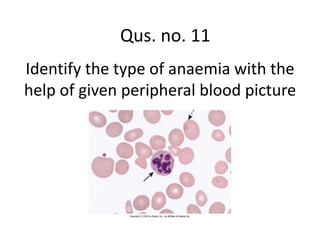
Identify the type of anaemia with the
help of given peripheral blood picture
Qus. no. 11
What does blood picture shows on the
basis of shape of RBCs?
Qus. no. 12
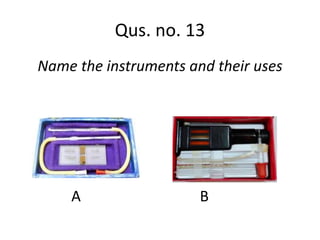
Name the instruments and their uses
A B
Qus. no. 13
Qus. no. 14
Name the two physiological conditions
in which ESR is high?
Qus. no. 15
What are the differences between
WBC and RBC pipette?
Macrophage present at following sites are
named as:
A. Macrophages lining the sinusoids of liver
__________
B. Bone marrow___________
C. Lungs ___________
Qus. no. 16
Role of thymus in the immune
system
Qus. no. 17
Anisocytosis and its causes.
Qus. no. 18
Advantages of biconcave shape of RBC
Qus. no. 19

Tutorial wednesday

Editor's Notes

  • #3 A prolonged prothrombin time indicates a deficiency in any of factors VII, X, V, prothrombin, or fibrinogen. It may mean that the patient has a vitamin K deficiency (vitamin K is a co-factor in the synthesis of functional factors II (prothrombin), VII, IX and X) or a liver disease (the liver is the site of synthesis of the plasma protein factors). The prothrombin time of patients receiving a vitamin K-competing coumarin drug such as warfarin (anticoagulation therapy used in deep venous thrombophlebitis) will also be prolonged, usually in the range of one and one half to two times the normal
  • #9 Hypoxia  , polycythemia vera
  • #10 Composition a. Sodium Chloride (Provides isotonicity) - 1 gm b. Sodium Sulphate (Prevents Roleaux formation) - 5 gms c. Mercuric Chloride (Acts as an antiseptic) - 0.5 gms d. Distilled water (Solvent) - 200cc
  • #11 Functions of plasma proteins 1-Osmotic function. 2-Buffer function. 3-Defensive function. 4-Blood clotting. 5-Blood viscosity. 6-Regulation of capillary permeability. 7-Transport and conservation of important elements. 8-Source of amino acids for the tissues
  • #12 lymphocyte, is a type of lymphocyte (a subtype of white blood cell) that plays a central role in cell-mediated immunity. T cells can be distinguished from other lymphocytes, such as B cells and natural killer cells, by the presence of a T-cell receptor on the cell surface. The “T cells” (so-called because they develop in a small organ called the thymus gland) are responsible for a variety of other immune responses.
  • #14 Poikilocytes are abnormally shaped red blood cells as seen on a blood film in humans Symptoms Of Poikilocytosis Deficiency in supply of oxygen to organs Irregular breathing Weight loss Severe growth retardation Nutrient deficiency Cardiovascular problems Poikilocytosis is usually caused due to deficiency of vitamin B12 and folic acid. In such cases, patients are simply advised to take nutrient rick supplements till their blood plasma content returns to normal. Anisocytosis occurs when the patient is suffering from anemia, thalassemia or any other disorder of the blood. For instance, iron deficiency will lead the cells to smaller and in a deformed state
  • #16 Name the two physiological conditions in which ESR is hIgh? Ans: a) Pregnancy b) Mensturation c)Increased temp.
  • #18 . Macrophages lining the sinusoids of liver (Kupffer cells), _ Spleen, _ Bone marrow (littoral cells), _ Lymph nodes, _ Lungs (pulmonary alveolar macrophages or PAM also called dust cells), _ Connective tissue (histiocytes), _ Pleura and peritoneum, _ Subcutaneous tissue, _ Bones (osteoclasts)
  • #19 The main function of the thymus is development of cell mediated immunity. _ The thymus confers immunological competence on the lymphocytes during their stay in the organ. In the thymus, T lymphocytes are educated so that they become capable of mounting cell-mediated immune response against appropriate antigen. T cells develop their specific T cell Markers, including TCR, CD3,CD4, or CD8 and CD2 (it thymus T cells multiply and differentiated into helper, cytotoxic , suppressor , cytotoxic T cells and memory cells
  • #20 . The various causes of anisocytosis are- Deficiency of vitamin A Deficiency of vitamin B12 Deficiency of iron Diamond-Blackfan anemia Myelodysplastic Syndrome
  • #21 9 Advantages of biconcave shape are: _ It renders the red cells quite flexible so that they can pass through the capillaries whose minimum diameter is 3.5 μm (Fig. 3.2-2). _ The biconcavity provides greater surface area as compared to volume which allows considerable alterations in the cell volume. Thus, the RBC can withstand considerable change in osmolality of plasma